Epizootic Haematopoietic Necrosis Virus (EHNV)
By Dr. Zubair Khalid, DVM, MS, PhD ·
Key Takeaways
- Epizootic Haematopoietic Necrosis Virus (EHNV) is a double-stranded DNA virus within the Ranavirus genus, family Iridoviridae, primarily affecting freshwater fish like redfin perch and rainbow trout. It is characterized by tropism for haematopoietic tissues, leading to necrosis of the kidney, spleen, and liver.
- Transmission is predominantly horizontal via waterborne exposure, direct contact with infected fish, or contaminated fomites, with shedding occurring in urine and faeces; vertical transmission has not been demonstrated. Outbreaks in wild redfin perch are often seasonal, occurring in warmer months (above 15°C), while farmed rainbow trout disease can be triggered by stressors like high stocking density or poor water quality.
- Diagnosis relies on a combination of virus isolation in fish cell lines (e.g., EPC, RTG-2) with characteristic cytopathic effects, molecular detection methods such as PCR and real-time PCR targeting viral genes, and serological assays like ELISA to detect antibodies in surviving fish.
- Pathogenesis involves viral entry through gills or the gastrointestinal tract, systemic spread via the bloodstream, and replication in endothelial cells and macrophages, resulting in widespread necrosis of haematopoietic tissues and often visible gross pathology such as pale gills, ascites, and enlarged spleen.
- Control and prevention strategies focus on strict biosecurity measures, quarantine protocols, and eradication efforts, as there is no specific antiviral treatment; disinfection of equipment and water, sourcing disease-free stocks, and avoiding stressors are critical in aquaculture.
- EHNV is a notifiable disease, and while vaccines are not commercially available, experimental inactivated vaccines have shown some protective efficacy in rainbow trout; ongoing research aims to clarify carrier fish roles, amphibian transmission potential, and climate change impacts.
Introduction
Epizootic haematopoietic necrosis virus (EHNV) is a double-stranded DNA virus belonging to the family Iridoviridae, genus Ranavirus [<a href="#ref-1">1</a>, <a href="#ref-2">2</a>]. It is the aetiological agent of epizootic haematopoietic necrosis (EHN), a notifiable disease of freshwater fish in Australia [<a href="#ref-3">3</a>, <a href="#ref-4">4</a>]. EHNV was first isolated in 1984 from redfin perch (Perca fluviatilis) in Victoria, Australia, and subsequently caused epidemic mortality events in wild redfin perch and mild disease in farmed rainbow trout (Oncorhynchus mykiss) across southeastern Australia [<a href="#ref-3">3</a>, <a href="#ref-5">5</a>]. The virus is characterised by its tropism for haematopoietic tissues, leading to necrosis of the kidney, spleen, and liver [<a href="#ref-6">6</a>]. EHNV is closely related to other ranaviruses such as Bohle iridovirus and frog virus 3, but it is antigenically and genetically distinct [<a href="#ref-7">7</a>, <a href="#ref-8">8</a>]. This article provides a detailed reference on the virology, epidemiology, pathogenesis, diagnostic methods, and control of EHNV, with a focus on veterinary and computational biology applications.
What is the taxonomic classification of EHNV?
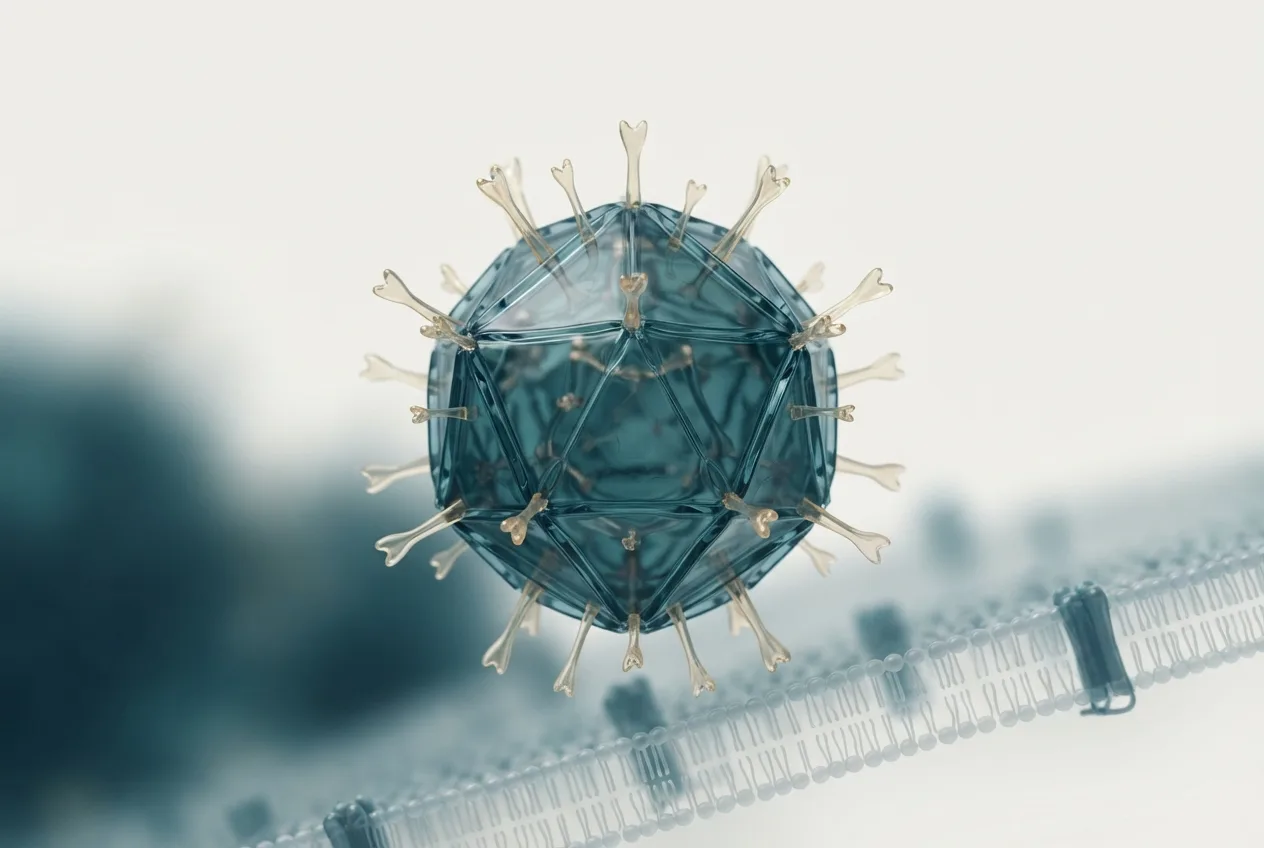
EHNV is classified within the family Iridoviridae, subfamily Alphairidovirinae, genus Ranavirus [<a href="#ref-2">2</a>, <a href="#ref-9">9</a>]. The genus Ranavirus includes viruses infecting fish, amphibians, and reptiles [<a href="#ref-7">7</a>]. EHNV is the type species for the genus in fish, and it shares morphological and genomic features with other ranaviruses such as frog virus 3 and Bohle iridovirus [<a href="#ref-8">8</a>]. The virion is icosahedral, approximately 150-200 nm in diameter, with a double-stranded DNA genome of about 130-140 kbp [<a href="#ref-9">9</a>, <a href="#ref-10">10</a>]. The virus is enveloped and contains a dense core surrounded by an internal lipid membrane [<a href="#ref-9">9</a>]. EHNV is serologically distinct from other fish iridoviruses, including those causing lymphocystis disease and red sea bream iridovirus [<a href="#ref-11">11</a>].
What are the physical and chemical properties of EHNV?
EHNV virions are stable under a range of environmental conditions. The virus is resistant to drying and can survive in water for extended periods [<a href="#ref-2">2</a>]. Temperature sensitivity is a critical factor: EHNV replicates optimally at 15-22 degrees Celsius in fish cell lines, with reduced replication at temperatures above 25 degrees Celsius [<a href="#ref-1">1</a>, <a href="#ref-12">12</a>]. The virus is inactivated by heat (60 degrees Celsius for 30 minutes), ultraviolet irradiation, and common disinfectants such as chlorine and iodine-based compounds [<a href="#ref-2">2</a>]. EHNV is sensitive to lipid solvents and detergents due to its envelope [<a href="#ref-9">9</a>]. The virus can be stored at -80 degrees Celsius for long-term preservation without significant loss of infectivity [<a href="#ref-13">13</a>].
What is the host range and geographic distribution of EHNV?
The primary susceptible hosts are redfin perch and rainbow trout [<a href="#ref-1">1</a>, <a href="#ref-14">14</a>]. Experimental infections have demonstrated susceptibility in many teleost species, including Macquarie perch (Macquaria australasica), silver perch (Bidyanus bidyanus), and Murray cod (Maccullochella peelii) [<a href="#ref-14">14</a>, <a href="#ref-15">15</a>]. However, natural outbreaks have been predominantly reported in redfin perch and rainbow trout [<a href="#ref-3">3</a>, <a href="#ref-5">5</a>]. EHNV is endemic to southeastern Australia, specifically in the Murray-Darling Basin, with detections in Victoria, New South Wales, the Australian Capital Territory, and South Australia [<a href="#ref-3">3</a>, <a href="#ref-16">16</a>]. The virus has not been reported in Europe or other continents, although challenge studies have shown that European stocks of redfin perch and rainbow trout are susceptible [<a href="#ref-17">17</a>, <a href="#ref-18">18</a>]. Risk assessments indicate a moderate likelihood of introduction and establishment in regions such as England and Wales if the virus were introduced via infected fish or contaminated equipment [<a href="#ref-19">19</a>].
How is EHNV transmitted and what are the epidemiological patterns?
Transmission occurs horizontally through waterborne exposure, direct contact with infected fish, or contact with contaminated fomites [<a href="#ref-2">2</a>, <a href="#ref-14">14</a>]. The virus is shed in urine, faeces, and possibly skin mucus [<a href="#ref-5">5</a>]. Cannibalism and scavenging of dead infected fish contribute to spread within populations [<a href="#ref-16">16</a>]. Vertical transmission has not been demonstrated [<a href="#ref-2">2</a>]. Epidemiological studies in farmed rainbow trout have shown that the virus can persist at low prevalence within populations, with clinical disease often triggered by stress factors such as high stocking density, poor water quality, or temperature fluctuations [<a href="#ref-5">5</a>, <a href="#ref-20">20</a>]. In wild redfin perch, outbreaks are typically seasonal, occurring in late spring and summer when water temperatures rise above 15 degrees Celsius [<a href="#ref-1">1</a>, <a href="#ref-3">3</a>]. Mortality rates can exceed 90% in juvenile redfin perch, while rainbow trout generally experience lower mortality (10-30%) [<a href="#ref-1">1</a>, <a href="#ref-18">18</a>]. The frequency of outbreaks in redfin perch has declined since 2012, possibly due to acquired herd immunity or reduced viral circulation [<a href="#ref-3">3</a>].
What is the pathogenesis and pathology of EHNV infection?
EHNV targets haematopoietic tissues, primarily the kidney and spleen, and also the liver [<a href="#ref-6">6</a>]. The virus enters the host through the gills or gastrointestinal tract and spreads via the bloodstream to internal organs [<a href="#ref-14">14</a>]. Replication occurs in endothelial cells and macrophages, leading to necrosis of haematopoietic tissue [<a href="#ref-6">6</a>]. Gross pathological findings include pale gills, ascites, splenomegaly, and multifocal necrosis in the liver, kidney, and spleen [<a href="#ref-4">4</a>, <a href="#ref-6">6</a>]. Histologically, there is extensive necrosis of haematopoietic cells in the renal interstitium and splenic red pulp, with intracytoplasmic inclusion bodies [<a href="#ref-6">6</a>]. In rainbow trout, lesions are often less severe, with focal necrosis and inflammation [<a href="#ref-6">6</a>]. EHNV induces apoptosis in infected cell cultures, as demonstrated in fish cell lines [<a href="#ref-21">21</a>]. The virus can also cause a persistent infection in surviving fish, which may act as carriers [<a href="#ref-5">5</a>].
What diagnostic methods are available for EHNV?
Diagnosis relies on virus isolation, molecular detection, and serological assays. Virus isolation is performed on fish cell lines such as epithelioma papulosum cyprini (EPC) or rainbow trout gonad (RTG-2) cells, with cytopathic effect (CPE) characterised by rounding, detachment, and syncytia formation [<a href="#ref-12">12</a>, <a href="#ref-22">22</a>]. The identity of the isolate is confirmed by immunofluorescence, immunoelectron microscopy, or PCR [<a href="#ref-23">23</a>, <a href="#ref-24">24</a>]. An antigen capture ELISA has been developed for detection of EHNV in tissue homogenates and cell culture supernatants, using polyclonal or monoclonal antibodies [<a href="#ref-13">13</a>, <a href="#ref-25">25</a>, <a href="#ref-26">26</a>]. The ELISA has high sensitivity and specificity for redfin perch and rainbow trout tissues [<a href="#ref-25">25</a>, <a href="#ref-26">26</a>]. Polymerase chain reaction (PCR) assays targeting the major capsid protein gene or other conserved regions provide rapid and sensitive detection [<a href="#ref-22">22</a>, <a href="#ref-24">24</a>]. Real-time PCR and sequencing are used for molecular epidemiology and strain differentiation [<a href="#ref-27">27</a>]. Serological tests, including virus neutralisation and ELISA, can detect antibodies in surviving fish, indicating past exposure [<a href="#ref-5">5</a>, <a href="#ref-20">20</a>].
Diagnostic Workflow for EHNV
flowchart TD
 A["Clinical signs: high mortality, pale gills, ascites"] --> B["Collect tissue samples: kidney, spleen, liver"]
 B --> C["Virus isolation on EPC or RTG-2 cells"]
 C --> D{"CPE observed?"}
 D -->|"Yes"| E["Confirm by PCR or antigen ELISA"]
 D -->|"No"| F["Passage blind or test by PCR"]
 E --> G["Report positive: notifiable disease"]
 F --> H["PCR positive?"]
 H -->|"Yes"| G
 H -->|"No"| I["Consider other pathogens"]
 B --> J["Direct PCR on tissue"]
 J --> K{"Positive?"}
 K -->|"Yes"| G
 K -->|"No"| L["Antigen ELISA on tissue"]
 L --> M{"Positive?"}
 M -->|"Yes"| G
 M -->|"No"| I
What are the differential diagnoses for EHNV?
Differential diagnoses include other viral haemorrhagic diseases of fish, such as infectious haematopoietic necrosis virus (IHNV), viral haemorrhagic septicaemia virus (VHSV), and spring viraemia of carp virus (SVCV) [<a href="#ref-4">4</a>, <a href="#ref-22">22</a>]. Bacterial infections (e.g., Aeromonas salmonicida, Flavobacterium psychrophilum) and parasitic infestations can also cause similar clinical signs [<a href="#ref-4">4</a>]. Histopathology and specific diagnostic tests (PCR, ELISA, virus isolation) are essential for differentiation. EHNV can be distinguished from other ranaviruses by antigenic analysis and genomic sequencing [<a href="#ref-7">7</a>, <a href="#ref-8">8</a>].
What control and prevention measures are recommended?
There is no specific treatment for EHNV infection. Control relies on biosecurity, quarantine, and eradication. In farmed fish, management practices include sourcing fish from EHNV-free stocks, disinfection of equipment and water, and avoiding stress [<a href="#ref-2">2</a>, <a href="#ref-20">20</a>]. In wild populations, movement restrictions and culling of infected stocks have been implemented to limit spread [<a href="#ref-3">3</a>, <a href="#ref-16">16</a>]. The disease is notifiable to the World Organisation for Animal Health (WOAH) and to national veterinary authorities [<a href="#ref-2">2</a>, <a href="#ref-4">4</a>]. Vaccines are not commercially available, but experimental inactivated vaccines have shown some protection in rainbow trout [<a href="#ref-22">22</a>]. Surveillance programs using PCR and ELISA are recommended for early detection [<a href="#ref-20">20</a>, <a href="#ref-26">26</a>].
What are the knowledge gaps and future research directions?
Uncertainties remain regarding the role of carrier fish in long-term persistence, the potential for transmission to amphibians, and the impact of climate change on geographic range expansion [<a href="#ref-28">28</a>]. Molecular epidemiology studies using whole-genome sequencing can clarify evolutionary relationships and transmission pathways [<a href="#ref-27">27</a>]. Improved diagnostic tools, such as portable PCR devices and multiplex assays, would enhance field surveillance. Risk assessment models incorporating environmental variables can inform biosecurity policies [<a href="#ref-19">19</a>].