When to Euthanize a Rabbit: Quality of Life Signs
By Dr. Zubair Khalid, DVM, MS, PhD ·
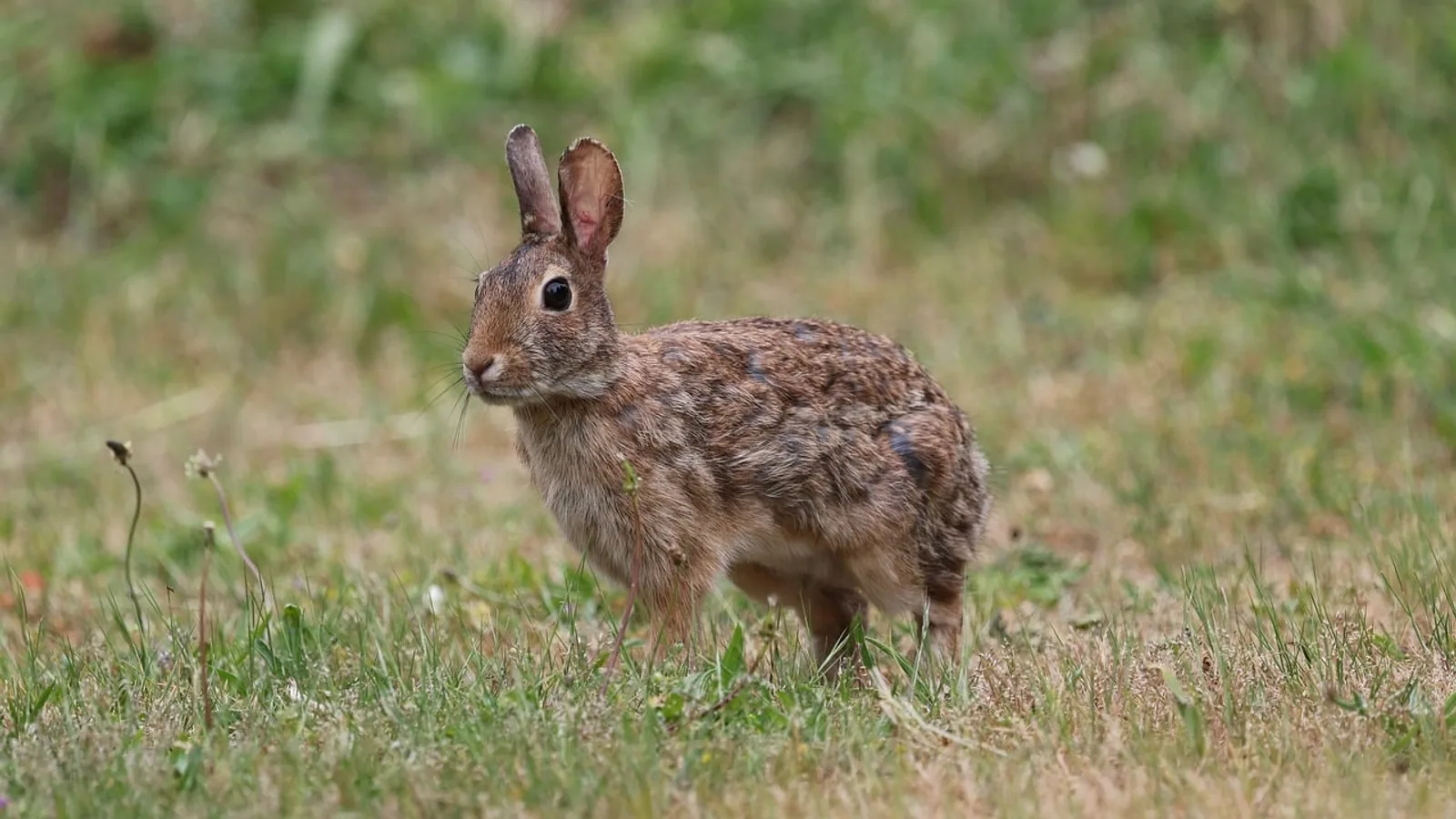
Most owners know it is time to euthanize a rabbit when three things are true at once. Pain or distress cannot be relieved with treatment, the rabbit has stopped doing the things that made it a rabbit (eating hay, moving, grooming, interacting), and bad days now clearly outnumber good ones. Euthanasia is a humane medical decision made together with a rabbit-savvy veterinarian. It is not a failure of care. It is the final act of care.
This guide walks you through a practical rabbit quality of life scale, the signs a rabbit is dying, how to comfort a dying rabbit in its final days, and how to cope with grieving the loss of a rabbit afterward.
This article is educational and is not a substitute for veterinary diagnosis or treatment.
At a Glance: A Daily Quality of Life Check
Use this table every morning and evening. Write the results down. Trends over days matter more than any single bad hour.
| What to check | Stable baseline | Red flag today |
|---|---|---|
| Hay and food interest | Eats hay and meals eagerly | Turns away from favorite foods |
| Droppings | Steady output of round, moist pellets | Few, tiny, misshapen, or no droppings |
| Posture and movement | Hops, stretches out, rears up | Hunched, reluctant to move, wobbly, or down |
| Grooming and rear end | Clean coat, clean and dry perineum | Matted fur, urine or feces stuck to the rear end |
| Interaction | Greets you, grooms a companion, is curious | Hides, does not react to you or a bonded partner |
| Breathing | Quiet and easy at rest | Fast, noisy, or open-mouth breathing |
| Pain signs | Relaxed face, sleeps stretched out | Teeth grinding, half-closed eyes, hunched and rigid posture |
| Trend | Mostly good days | Bad days outnumber good days |
Do this today:
- Weigh your rabbit on a digital kitchen scale in grams and record the number.
- Offer hay and one fragrant favorite herb, then note the interest level.
- Check the rear end for moisture, stuck feces, or fly eggs.
- Photograph your rabbit's posture and the perineal area for your veterinarian.
- Score each domain above and date the page.
- Call your rabbit-savvy veterinarian the same day if any red flag column applies.
Why Euthanasia Decisions Are Different for Rabbits
Rabbits are a prey species. Their survival instinct is to look normal for as long as possible, which means the visible signs of illness and pain arrive late and subtly. Veterinary reviews of rabbit care emphasize that recognizing illness in this species requires knowing specific, often quiet clinical signs, and that pain in rabbits is easy to miss without deliberate checking [1]. A rabbit that is still eating a little may already be in significant discomfort.
This changes the timing of end-of-life decisions. With a dog or cat, an owner often sees decline building over months. With a rabbit, a treatable-looking morning can become an irreversible evening. Two practical consequences follow. First, rabbits need a veterinarian who sees rabbits regularly, because generalist assessment frequently underestimates rabbit pain. Second, quality of life monitoring has to be proactive and daily, not reactive. Reviews of rabbit welfare practice converge on the same principle: continuous, individualized monitoring rather than one-time judgments [2].
What Quality of Life Means for a Rabbit
Quality of life for a rabbit is the ability to do rabbit things without suffering. That means eating hay for hours each day, producing steady droppings, hopping and stretching, grooming the coat, resting in relaxed positions, and engaging with you or a bonded companion. When disease removes several of these at once and treatment cannot restore them, the rabbit's welfare is failing even if it is still alive.
Formal welfare assessment in rabbits follows this logic. Structured welfare tools developed for the species use more than a hundred descriptors spanning physical, behavioral, and environmental categories, because no single measure captures welfare on its own [3]. Welfare frameworks for rabbits also stress recording evidence over time and comparing findings against the individual's own baseline, so that small deviations are caught early and interpreted in context [4]. Your rabbit's normal matters more than any generic standard. A laid-back senior lop that always naps at noon is different from a young active dwarf, and the scale below works because you score against your rabbit, not against an ideal.
A Rabbit Quality of Life Scale You Can Use With Your Veterinarian
The checklist below adapts the structure of formal rabbit welfare assessment, physical and behavioral measures scored against a baseline, into a form owners can complete at home [3][4]. It is a conversation aid, not a validated diagnostic instrument, and no score replaces a veterinary examination.
Score each domain 0 (stable), 1 (declining), or 2 (severe).
| Domain | 0, Stable | 1, Declining | 2, Severe |
|---|---|---|---|
| Appetite and hay | Eats hay and meals eagerly | Eats less hay, only takes tempting foods | Refuses all food, no interest in favorites |
| Droppings | Normal quantity, round and moist | Fewer, smaller, or irregular droppings | No droppings for many hours, or persistent soiling and diarrhea |
| Pain and comfort | Relaxed, stretches out, grooms freely | Hunched at times, grinding teeth, grooming less | Rigid hunch, reacts painfully to touch or movement, cannot rest |
| Mobility | Hops, jumps, explores | Slower, hesitates, stumbles on surfaces | Cannot stand, drags limbs, falls or rolls |
| Hygiene and skin | Clean coat, dry perineum, intact skin | Mild mats, damp rear end, reduced grooming | Urine scald, open sores, pressure points, flystrike |
| Interaction | Greets you, engages with companion | Withdrawn, hides, less response to you | Unresponsive, no reaction to you or a bonded partner |
| Breathing and warmth | Quiet easy breathing, warm ears | Faster breathing after little effort | Labored breathing, cold extremities, blue or gray gums |
| Good days vs bad days | Mostly good | Roughly even | Mostly bad |
How to use the scale:
- Score all eight domains once or twice daily during any illness or decline.
- Add the scores only to see the trend. A rising total over three to five days is the signal to call your veterinarian, not any single number.
- Bring the written log to appointments. Objectively recorded trends give your veterinarian far more to work with than memory.
- Re-score after any treatment change so you and your vet can judge whether the plan is working.
A widely used hospice principle applies well here: keep going while the good days outnumber the bad, and start planning the goodbye when they no longer do. Your veterinarian can help you define what a "good day" looks like for your specific rabbit, which is usually something concrete like eating hay unprompted, hopping to the litter box, and responding to your voice.
Signs a Rabbit Is Dying
Rabbits decline in two broad patterns, and they call for different responses.
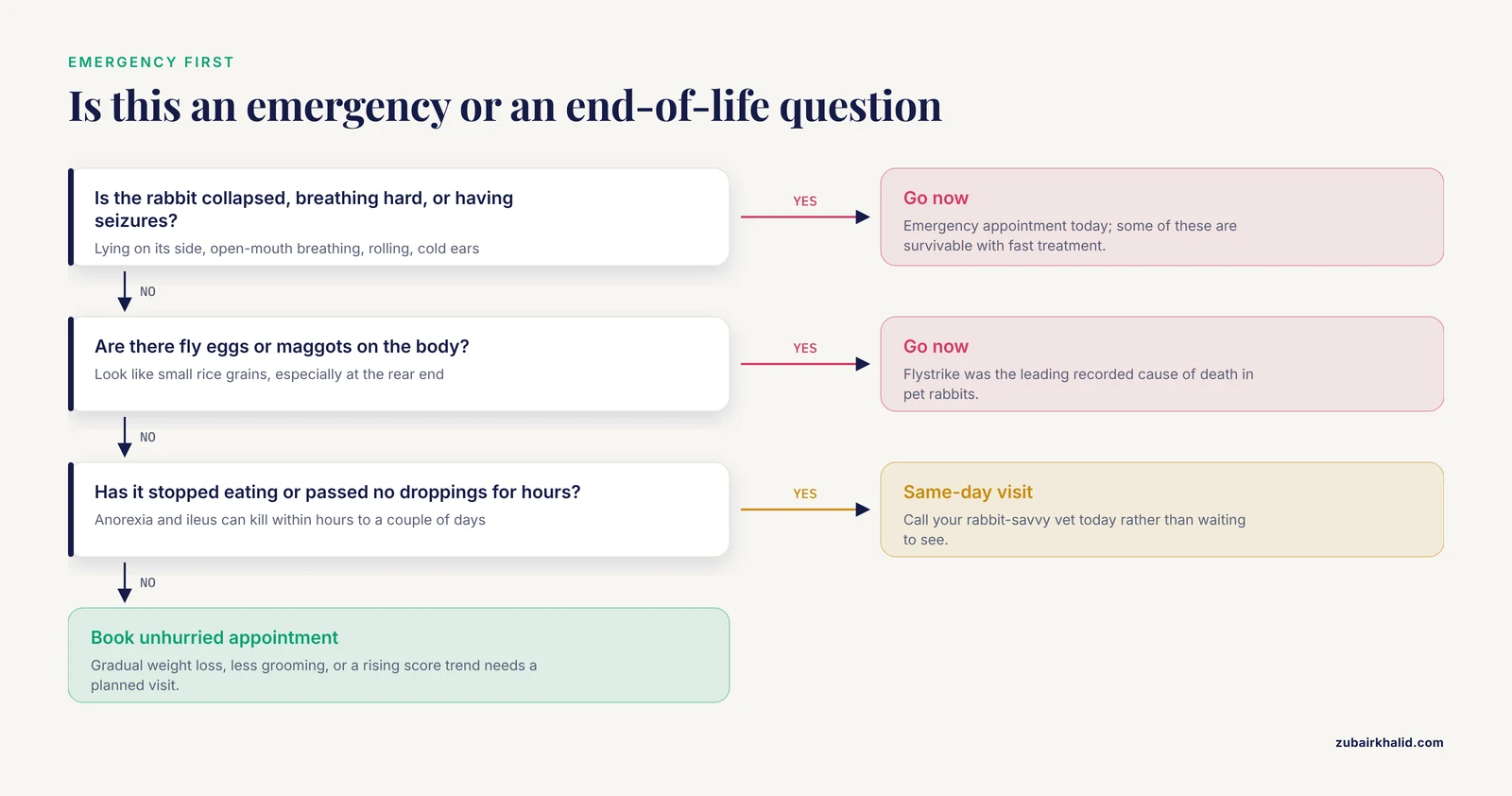
Acute collapse pattern. Large primary-care datasets from England record the most common causes of death in pet rabbits as myiasis (flystrike, 10.9 percent), anorexia (4.9 percent), recumbency or collapse (4.9 percent), and ileus, a shutdown of the gut (4.3 percent) [5]. Notice what that list has in common. Each of these can kill within hours to a couple of days, and each is also a reason for an emergency visit that might still save the rabbit. The signs a rabbit is dying in this pattern include:
- No food interest and no or very few droppings
- Lying on its side, unable or unwilling to rise
- Rapid, shallow, noisy, or open-mouth breathing
- Cold ears and cold limbs with a dropping body temperature
- Seizures, rolling, or a fixed stare
- Maggots or fly eggs anywhere on the body, especially the rear end
Any of these means an emergency appointment now, not a wait-and-see day. Some rabbits with these signs recover with aggressive treatment. Some do not. The distinction requires a veterinarian, bloodwork, imaging, and time, which is exactly why the decision point arrives at the clinic and not at home.
Gradual decline pattern. Chronic disease produces a slower fade. Watch for steady weight loss, a coat that looks rough because grooming has stopped, long hours in a hunched position, pressure sores on the hocks or hips, a permanently damp or soiled perineum, worsening head tilt or mobility loss, and a rabbit that stops coming to the cage door. In the same English dataset, the median age at death was 4.3 years with a wide range, reflecting how differently individual rabbits age and decline [5]. Some rabbits fade over weeks. Others hold steady for months with good supportive care. The quality of life scale is what turns this fuzzy decline into a trackable, discussable record.
Conditions That Commonly Lead to This Decision
Knowing the usual culprits helps you recognize when a problem is chronic and cumulative rather than a one-off illness.
Dental disease. Overgrown molars and overgrown nails are among the most prevalent disorders recorded in pet rabbits under veterinary care, with overgrown molars affecting roughly one in seven rabbits in a large UK cohort [6]. Molar spurs and root problems cause recurring pain and anorexia cycles. Some rabbits manage well with periodic dental work for years. When corrections stop holding, weight drops between procedures, and eating hay becomes impossible, the conversation shifts from treatment to comfort.
Flystrike and perineal soiling. Myiasis was the single most frequently recorded cause of death in the English primary-care dataset [5]. Flystrike develops when a rabbit cannot keep its rear end clean, usually because of mobility limits, obesity, pain, or dental disease that changes how it eats cecotropes. Lop-eared rabbits had higher odds of perineal fecal impaction than erect-eared rabbits, and brachycephalic rabbits also carried higher odds of perineal fecal impaction and tear duct abnormalities [6]. Repeated flystrike episodes, especially in a rabbit whose underlying cause cannot be corrected, are a common and legitimate endpoint in end-of-life discussions.
Obesity and mobility loss. Obesity affected nearly one in ten rabbits in the same UK cohort [6]. Excess weight makes grooming impossible, pressures the hocks, and compounds arthritis. When a rabbit can no longer reach its cecotropes or reposition itself comfortably, hygiene failures follow one after another.
Recurrent gut shutdown. A single ileus episode treated early often resolves. Repeated episodes that need hospitalization, that respond more weakly each time, or that leave the rabbit afraid of food mark a turning point. Track each episode on the scale and bring the record to your vet.
Age-related frailty. Senior rabbits accumulate small losses, thinner weight, slower grooming, less activity. Geriatric preventive care is a recognized part of rabbit veterinary practice, with examination schedules extending into the geriatric stage precisely so decline is caught while options still exist [1]. Frailty itself is not a reason for euthanasia. Unrelieved pain, repeated crises, and lost rabbit behaviors are.
When to Euthanize a Rabbit: Making the Decision With Your Veterinarian
The decision belongs to you, and the medical judgment belongs to your veterinarian. Here is how a good decision process actually runs.
Step 1: Get a hands-on examination. Surveys of rabbit owners consistently show a gap between intention and action. In one survey of 306 owners, only 47 percent scheduled regular check-ups and only 38 percent consulted a veterinarian when they noticed health changes [7]. If you are reading this article because something feels wrong, that appointment is the next step, not the scale alone.
Step 2: Bring objective records. Owner perception does not always track reality. A Croatian survey of 529 rabbit owners found that perceived care knowledge did not consistently align with actual husbandry practices [8]. Bring your weight log, dropping counts, photos, and completed scale scores. Concrete data beats impressions in the exam room.
Step 3: Define a trial of treatment with a recheck. For many conditions, the right move is a defined treatment trial with a scheduled recheck, after which you re-score quality of life together. Ask your vet directly: "What should improvement look like in one week, and what should we do if it does not happen?" Geriatric and chronic-care monitoring is standard rabbit practice, and recheck intervals should be set by the veterinarian based on the condition [1].
Step 4: Be honest about finances and capacity. Survey data show that owners' willingness to pay for veterinary treatment was linked to whether rabbits received routine healthcare and adequate living conditions [9]. If cost, time, or distance limits what treatment is possible, say so plainly. Veterinarians can prioritize palliative options, adjust plans, and help you avoid choices that prolong suffering without improving life. Hiding the constraint usually produces worse outcomes for the rabbit.
Step 5: Make the decision against explicit criteria. The strongest euthanasia decisions are made calmly, against criteria you and your vet wrote down in advance, such as "when she has not eaten hay on her own for three consecutive days despite treatment" or "when he can no longer reach his water and food without help." Deciding criteria in advance protects you from deciding in a 2 a.m. crisis and protects your rabbit from drifting past the point of comfort.
In the United States, euthanasia is performed by a licensed veterinarian, and the AVMA publishes the profession's guidance describing euthanasia as a death achieved with minimal pain and distress. Your veterinarian will document the decision and the reasoning in the medical record.
How to Comfort a Dying Rabbit
Whether you are in a hospice phase or waiting on diagnostics, comfort care has one goal: minimize stress and maximize the rabbit's own small pleasures.
Keep handling minimal and gentle. Handling alone measurably stresses rabbits. In a study of laboratory rabbits, repeated handling and blood sampling raised serum cortisol, and fecal cortisol metabolites stayed elevated for up to three days afterward [10]. Non-invasive fecal stress measurement is now used in pet rabbits precisely because rabbits carry a physiological stress load that their calm faces do not show [11]. For a fragile rabbit, cluster care into short sessions, support the hindquarters when lifting, and let most care happen where the rabbit already sits.
Build a recovery environment. Choose a quiet room at household temperature, away from drafts and direct sun. Use washable soft bedding that does not snag nails. Provide a low-entry litter box with hay directly in or beside it, since eating and dropping often stay linked. A heavy ceramic water bowl is usually easier for a weak rabbit than a bottle. If your rabbit is cold, use a microwaveable heat pad wrapped in a towel on one side of the enclosure only, so the rabbit can move away from it.
Protect the gut and the rear end. Offer fresh, sweet-smelling hay and fragrant herbs at nose level. If your rabbit will not eat, call your veterinarian the same day, and only syringe-feed a recovery diet if your veterinarian has prescribed one and shown you the technique. Check and gently clean the perineum daily, dry it fully, and inspect for fly eggs, which look like small rice grains. Flystrike was the leading recorded cause of death in pet rabbits in primary veterinary care [5], and daily rear-end checks are the single most effective owner defense during any period of reduced grooming.
Keep the familiar close. Environmental enrichment, including familiar objects, textures, and opportunities for species-typical behavior, is considered an essential component of animal care on par with nutrition and veterinary medicine, and its value should be judged by what the individual animal actually uses and prefers [12]. For a dying rabbit this translates simply: the favorite cardboard hide, the bonded companion within sight and smell, the blanket that smells like you. Do not rearrange the space or introduce new stimuli during decline.
Let bonded companions stay together. Only about a quarter of pet rabbits in one survey were provided companionship with another rabbit [7], so many owners face end-of-life care with a single rabbit. If yours is bonded to another, ask your veterinarian how to manage their time together during hospice and after death. Separating a bonded pair abruptly is itself a significant stressor, and most rabbits should be allowed to see and sniff their companion after death, which appears to help them process the loss.
What not to do. Do not force food or water without veterinary direction, do not bathe a weak rabbit, do not leave a soiled rear end unattended overnight, and do not substitute comfort care for an emergency visit when the acute signs listed above appear. Comfort care and urgent treatment are parallel tracks, not alternatives.
What Happens During Euthanasia
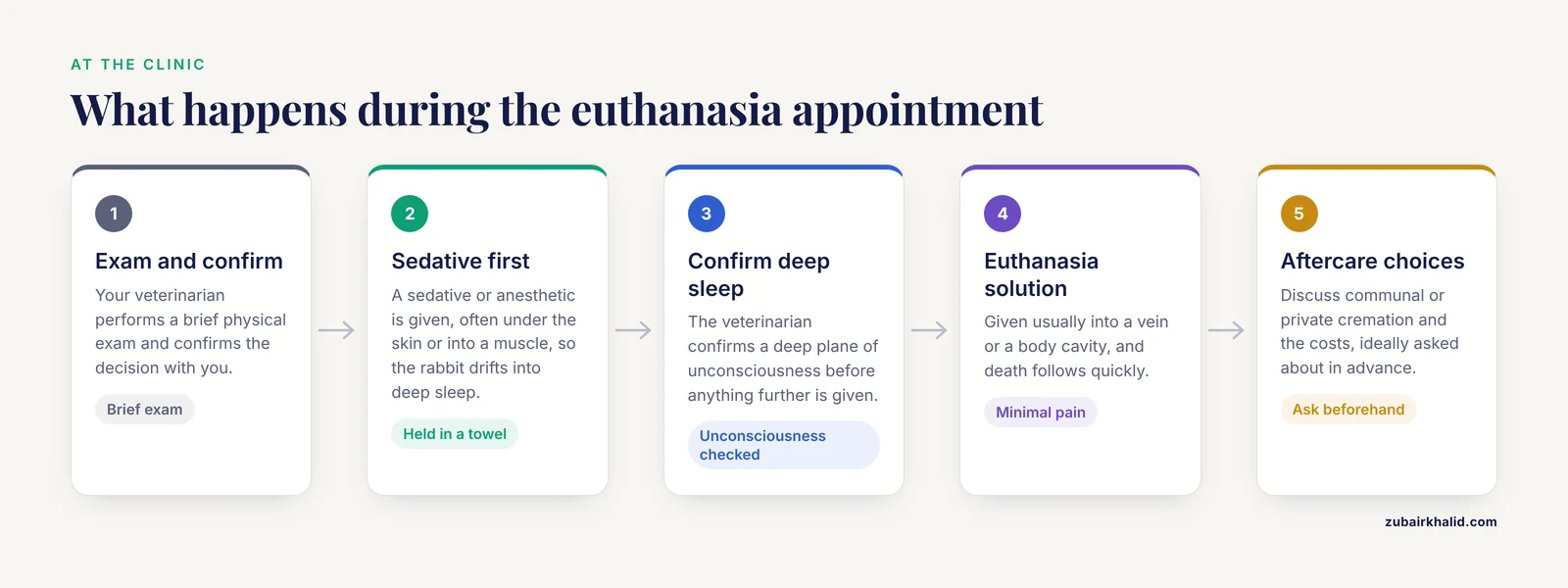
Knowing the sequence reduces fear for both of you. Your veterinarian will first perform a brief physical exam and confirm the decision. In most rabbit practice, a sedative or anesthetic agent is given first, often as an injection under the skin or into a muscle, so the rabbit drifts into deep sleep while still in your arms or on a familiar towel. Once your veterinarian confirms a deep plane of unconsciousness, the euthanasia solution is administered, usually into a vein or a body cavity, and death follows quickly. From the rabbit's perspective, the experience is falling asleep in a familiar-smelling towel.
Ask these questions in advance:
- Can the appointment be scheduled at a calm time of day, or can a mobile veterinarian come to the home?
- Can I be present and hold my rabbit throughout?
- Will you place an intravenous catheter only after my rabbit is sedated?
- What aftercare options exist, such as communal or private cremation, and what are the costs?
Most veterinarians welcome owners at the appointment, and being present is a personal choice with no wrong answer. If you have children, decide beforehand whether they will attend and prepare them for what they will see. Organizations such as the House Rabbit Society and the Rabbit Welfare Association and Fund publish end-of-life guidance for owners, and the Merck Veterinary Manual and VCA Animal Hospitals maintain owner-facing resources on exotic animal care and pet loss that can help you prepare.
Grieving the Loss of a Rabbit
Grieving the loss of a rabbit is real grief, and it deserves the same respect as any other loss. People who have never lived with a rabbit sometimes minimize the bond, which can leave owners grieving without the rituals that help. Give yourself the rituals anyway. Bury or scatter ashes where it means something, frame a photograph, write down the small daily habits you will miss. Support resources for rabbit loss exist through the House Rabbit Society and the Rabbit Welfare Association and Fund, and many general pet-loss hotlines accept calls about rabbits.
Watch the surviving rabbit closely. If your rabbit had a bonded companion, the survivor has lost a constant presence. Rabbits form strong social attachments, and the sudden absence of a partner is a major physiological and emotional event. For the next several days, monitor the survivor's hay intake, droppings, and interaction level, and call your veterinarian promptly if eating or dropping output drops, because stress-triggered gut slowdown is a genuine risk. Keep routines identical, keep the deceased rabbit's scent in the enclosure for a few days if the survivor seems to seek it, and expect behavior changes ranging from searching to temporary withdrawal.
There is no correct timeline for adopting again. Some people need months. Some people bring a new rabbit home within weeks because an existing rabbit is lonely, which is a legitimate welfare reason. When you do adopt, consider a rabbit whose energy matches the survivor, and plan a patient, properly supervised bonding process, ideally with guidance from a rescue or a rabbit-savvy veterinarian.
Common Mistakes to Avoid
- Waiting for dramatic signs. Rabbits hide illness until disease is advanced, so the visible crisis is usually late in the course [1]. Daily scoring exists to catch the quiet decline.
- Reading anorexia as pickiness. A rabbit that skips meals is a medical event, not a preference. Anorexia appears among the most common recorded causes of death in pet rabbits [5].
- Deciding alone. Quality of life scales inform the decision, they do not replace a physical exam, pain assessment, and diagnostics by a veterinarian who knows rabbits.
- Skipping rechecks during decline. Only about half of surveyed owners scheduled regular veterinary check-ups for their rabbits [7]. During chronic illness, rechecks are how you learn whether the plan is working.
- Keeping a rabbit alive for the family's sake. Prolonging life at the cost of unrelieved pain, repeated hospitalizations, and lost rabbit behaviors trades the rabbit's welfare for the family's comfort. The scale exists partly to make this visible.
- Ignoring the rear end. During any period of reduced grooming, a daily perineal check prevents flystrike, the most frequently recorded cause of death in pet rabbits [5].
Limitations and When to Contact a Veterinarian
Individual rabbits vary enormously in disease course, pain tolerance, and response to treatment, and only a hands-on examination by a rabbit-savvy veterinarian can turn the general guidance in this article into a decision about your specific rabbit. The scale above is a monitoring and communication tool, not a diagnostic test, and no score threshold replaces professional judgment.
Contact your veterinarian the same day if your rabbit shows any of the following:
- No eating or sharply reduced eating, or no droppings for several hours
- Lying on its side, unable to rise, or stumbling and falling
- Rapid, noisy, or open-mouth breathing
- Cold ears and limbs, or a rabbit that feels cold to the touch
- Seizures, rolling, head pressing, or sudden severe head tilt
- Fly eggs or maggots anywhere on the body, or a wet, soiled rear end with skin damage
- Crying out, grinding teeth continuously, or aggressive pain responses to touch
- Any rabbit whose quality of life score has worsened across three or more domains over a few days
Contact your veterinarian for a scheduled, unhurried appointment when you notice gradual changes such as steady weight loss, reduced grooming, decreasing interaction, or a rising trend on the quality of life scale. These appointments are where end-of-life planning, palliative options, and euthanasia decisions are discussed properly, with time for questions rather than in an emergency room at midnight.
Frequently Asked Questions
How do I know when it is time to euthanize my rabbit?
It is time when pain or distress cannot be relieved, your rabbit has lost the core behaviors that define its life, such as eating hay, moving, grooming, and engaging with you, and bad days outnumber good ones despite treatment. Score your rabbit's quality of life daily, share the record with a rabbit-savvy veterinarian, and make the decision against criteria you both agree on in advance.
What is a rabbit quality of life scale?
A rabbit quality of life scale is a checklist that scores domains such as appetite, droppings, pain, mobility, hygiene, interaction, breathing, and the balance of good versus bad days, usually from 0 (stable) to 2 (severe). The trend over several days matters more than any single score, and the scale works best as a shared record between you and your veterinarian.
What are the signs a rabbit is dying?
Acute signs include refusing food, producing no droppings, lying on the side unable to rise, labored or open-mouth breathing, cold extremities, seizures, and flystrike maggots on the body. Gradual signs include steady weight loss, a rough ungroomed coat, constant hunching, pressure sores, a soiled perineum, and withdrawal from interaction. Both patterns warrant same-day veterinary contact.
How can I comfort a dying rabbit at home?
Keep the rabbit in a quiet, familiar space with soft bedding, easy access to hay and water, and minimal handling, since handling alone measurably raises stress hormones in rabbits. Offer favorite foods at nose level, keep the rear end clean and dry, keep bonded companions together when possible, and preserve familiar objects and smells. Follow your veterinarian's instructions for any prescribed assisted feeding.
Is euthanasia painful for rabbits?
No. Veterinarians typically administer a sedative first so the rabbit falls into deep unconsciousness while held in a familiar towel, and the euthanasia medication is given only after the rabbit is fully asleep. The AVMA's guidance defines the goal of euthanasia as death with minimal pain and distress, which is exactly what sedation-first protocols achieve.
Should I stay with my rabbit during euthanasia?
Yes, if you can manage it emotionally, most veterinarians welcome owners throughout, and many rabbits are calmer with a familiar person present. There is no obligation, and some owners prefer to say goodbye before the procedure. Ask your clinic in advance about their process so you can decide without pressure on the day.
Will my other rabbit grieve the loss of a bonded companion?
Rabbits form strong social bonds, and survivors commonly show searching behavior, withdrawal, or reduced eating after a companion dies. Monitor the survivor's hay intake and droppings closely for the following days and call your veterinarian if either declines, because stress can trigger gut slowdown. Allow the survivor to see and sniff the deceased companion, keep routines stable, and consider a patient bonding process with a new rabbit when the time feels right.
When is a rabbit's condition an emergency rather than an end-of-life issue?
Treat any acute sign, including anorexia, absent droppings, collapse, labored breathing, seizures, cold body temperature, or flystrike, as an emergency first, because several of the most common causes of death in pet rabbits are also conditions that can be survived with rapid treatment. Only a veterinary examination can distinguish a survivable crisis from a terminal one, so go to the clinic and have the end-of-life conversation there if the news is bad.
Sources
- Rabbit care and husbandry.
- Enhancing Rabbit Welfare in Intensive Production Systems: A Review.
- A Welfare Assessment Tool to Harmonize Care and Management for Research Rabbits.
- A rabbit is not a mouse: a framework for the initial welfare assessment and long-term monitoring of genetically altered laboratory rabbits.
- Morbidity and mortality of domestic rabbits (Oryctolagus cuniculus) under primary veterinary care in England.
- Conformation-associated health in pet rabbits in the UK: A VetCompass cohort study.
- An investigation into how ownership factors influence the lifestyle and health management of rabbits.
- Perceived Rabbit Care Knowledge Does Not Consistently Align with Owner-Reported Husbandry Practices: A Survey of Pet Rabbit Owners in Croatia.
- Perceptions of the rabbit as a low investment 'starter pet' lead to negative impacts on its welfare: Results of two Danish surveys.
- Infrared Thermal Imaging and Blood and Faecal Cortisol Measurements for Stress Assessment in Rabbits During Blood Sampling.
- Methodological differences in fecal corticosterone metabolite extraction in pet rabbits: implications for welfare assessment.
- Environmental enrichment for laboratory rodents and rabbits: requirements of rodents, rabbits, and research.