When to Euthanize a Hedgehog: Quality of Life Signs
By Dr. Zubair Khalid, DVM, MS, PhD ·

Euthanasia becomes the kindest choice for a hedgehog when it has more bad days than good ones, when it can no longer eat, drink, move, breathe, or stay warm without constant struggle, and when a veterinarian has confirmed that the problems causing that suffering cannot be treated or managed acceptably. Because hedgehogs are small, stoic animals that hide illness until disease is often advanced, the decision usually arrives faster than owners expect. The goal of this guide is to give you a clear framework for judging quality of life, recognizing the signs a hedgehog is dying, providing comfort in the final days, and making the decision itself with confidence rather than guilt.
This article is educational and is not a substitute for veterinary diagnosis or treatment.
At a Glance: Your Daily Quality of Life Checklist
Use this checklist every day once your hedgehog is elderly or ill. Any single item in the urgent column justifies a same-day call to your exotics veterinarian.
| Domain | Acceptable quality of life | Urgent concern, call your veterinarian |
|---|---|---|
| Appetite | Eats most meals with normal interest | Refuses food for more than about 24 hours, or cannot chew or swallow |
| Hydration | Drinks normally, moist gums | Not drinking, sunken eyes, dry sticky gums, skin tents |
| Mobility | Walks, climbs cage furniture, uncurls normally | Wobbling, dragging limbs, circling, unable to uncurl or stand |
| Breathing | Quiet and effortless at rest | Open-mouth breathing, wheezing, belly effort with each breath |
| Hygiene | Grooms, keeps quills and underside clean | Sits in urine or feces, quills matted, pressure sores developing |
| Comfort | Rests curled in a relaxed ball, responds to you | Trembling, hunched posture, vocalizing, flinching when touched |
| Engagement | Explores at night, shows interest in food and handling | Unresponsive, does not attempt to forage or anoint, hides constantly |
| Weight | Stable on your gram scale | Steady decline over days despite eating |
Why the Euthanasia Decision Is Different for Hedgehogs
Three realities shape end-of-life decisions for hedgehogs in ways that do not apply to cats or dogs.
First, their lifespan is short. Most pet African pygmy hedgehogs live only a handful of years, and many develop serious disease while still young by the standards of other pets. An owner who expected a decade of companionship often faces end-of-life decisions in year three or four.
Second, hedgehogs mask illness. As prey animals, they suppress outward signs of weakness until a condition is advanced. By the time a hedgehog stops curling, stops eating, or sits fluffed and motionless, it has often been unwell for longer than you realized. The Merck Veterinary Manual notes that hedgehogs commonly present to veterinarians with advanced disease for exactly this reason.
Third, their small size leaves little physiologic reserve. A hedgehog that stops eating can deteriorate within a day or two, so waiting to "see how tomorrow goes" carries more risk than it would in a larger animal. This is why a structured daily assessment, rather than a wait-and-see instinct, is the backbone of a good end-of-life decision.
What Usually Brings Hedgehogs to the End of Life
Knowing the typical final-stage conditions helps you understand what your veterinarian is treating and which outcomes are realistic.
Wobbly hedgehog syndrome. This progressive neurologic disease causes hind limb weakness, wobbling, and eventual paralysis. It has no cure, and affected hedgehogs gradually lose the ability to walk, self-feed, and groom. Many owners and veterinarians consider euthanasia when a hedgehog with wobbly hedgehog syndrome can no longer reach food and water, maintain hygiene, or move without distress.
Cancer. Hedgehogs develop tumors at a high rate, including cancers of the mouth, skin, mammary tissue, and internal organs. Some masses are manageable for a time with surgery, but many are discovered late because of the animal's habit of hiding illness.
Dental and oral disease. Broken teeth, gum infections, and oral tumors make eating painful. Weight loss and drooling in an older hedgehog often trace back to the mouth.
Respiratory infections and pneumonia. Hedgehogs are sensitive to drafts and temperature swings, and respiratory disease can progress quickly in such a small patient.
Organ failure and general decline. Kidney disease, liver disease, and heart disease occur in geriatric hedgehogs and typically produce gradual weight loss, reduced appetite, and weakness.
Severe parasitic or skin disease. Mite infestations and fungal infections cause intense discomfort, quill loss, and self-trauma. These are usually treatable, but in a debilitated geriatric animal they can be the final burden that tips the balance.
Ask your veterinarian two questions once a diagnosis is made. What can treatment realistically achieve, and what will the remaining time look like for my hedgehog? The answers anchor every decision that follows.
Signs a Hedgehog Is Dying
The signs a hedgehog is dying overlap heavily with the signs of serious but treatable illness, which is why veterinary assessment comes first whenever these appear suddenly. Recognizing the pattern, though, helps you judge whether comfort care or euthanasia is the right next step.
Behavioral signs. A dying hedgehog stops performing its normal nightly routine. It no longer runs on its wheel, forages, or anoints. It stays balled up for abnormal stretches or lies flat on its side rather than curled. It stops responding to your voice or the smell of a favorite food.
Physical signs. Expect progressive weight loss you can feel along the spine and hips, a hunched or flattened posture, dull eyes, dehydration with dry sticky gums, matted quills from failed grooming, and soiled fur around the vent from incontinence or immobility. Cold ears and feet signal that the body is losing its ability to regulate temperature, a late and serious sign.
Eating and drinking signs. Complete anorexia, dropping food, pawing at the mouth, or inability to swallow. In small animals, a day without food is a genuine emergency, not a phase to ride out.
Breathing signs. Labored, open-mouth, or noisy breathing, blue-tinged gums, and rhythmic belly effort with each breath indicate respiratory failure.
Neurologic signs. Circling, head tilting, seizures, tremors, or full paralysis. In the context of wobbly hedgehog syndrome, these signs mark the transition from manageable decline to end-stage disease.
Any of these signs warrants an immediate call to an exotics veterinarian. A cluster of several signs in a hedgehog already known to have advanced disease is the point at which most owners and vets begin the formal quality of life conversation.
A Hedgehog Quality of Life Scale You Can Use
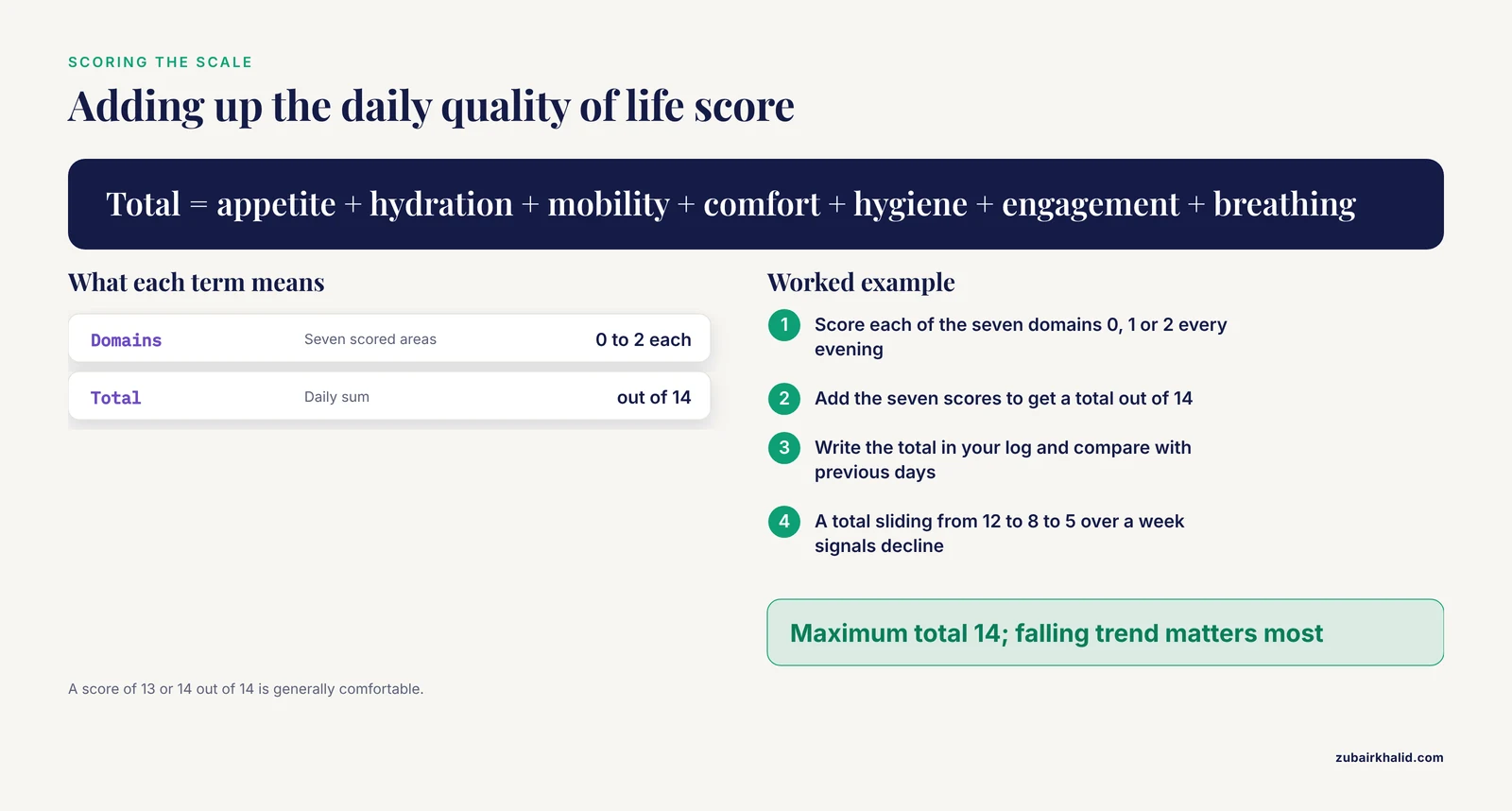
A hedgehog quality of life scale turns a foggy, emotional question into a concrete, daily score. Score each domain from 0 (terrible) to 2 (normal) every evening, add the total, and track the trend. Share the log with your veterinarian.
| Domain | 2 points | 1 point | 0 points |
|---|---|---|---|
| Appetite | Eats normal amounts eagerly | Eats some, needs encouragement | Will not eat |
| Hydration | Drinks normally | Drinks little | Not drinking |
| Mobility | Moves and uncurls normally | Wobbles, moves less | Cannot walk or uncurl |
| Comfort | Relaxed, no distress signs | Occasional restlessness or hunching | Constant distress, trembling, vocalizing |
| Hygiene | Clean and grooming | Partially soiled or matted | Sits in waste, sores forming |
| Engagement | Responds to you, explores nightly | Reduced interest | Unresponsive, no interest in anything |
| Breathing | Quiet and easy | Occasional snuffling | Labored or open-mouth breathing |
Two rules make this scale work in practice. First, follow the trend, not a single night. A hedgehog scoring 13 or 14 out of 14 is generally comfortable. A hedgehog whose total slides from 12 to 8 to 5 over a week is telling you something important. Second, weight the domains unequally in your mind. A hedgehog that cannot breathe comfortably, cannot eat at all, or is in visible distress has a quality of life problem regardless of how the other categories score. Discuss your running totals with your exotics veterinarian so the medical picture and your home observations are interpreted together.
Many veterinarians also use the informal "bad days versus good days" rule borrowed from small animal end-of-life care. When bad days outnumber good days for more than a few consecutive days despite treatment, the case for euthanasia becomes strong.
How to Track Quality of Life Day by Day
Follow this routine once your hedgehog is over middle age or has been diagnosed with a serious condition.
- Weigh daily. Use a digital kitchen scale that reads in grams. Weigh at the same time each evening, ideally just before feeding. Record the number. Weight trend is the single most objective quality of life signal you have.
- Log food and water. Note approximate amounts consumed, not just whether the bowl looks touched.
- Check droppings and urine. Note color, consistency, and whether stool is produced at all. Straining to urinate or producing no urine is an emergency.
- Observe one full active period. Hedgehogs are nocturnal. Watch for at least part of their normal night activity before scoring the scale above.
- Photograph weekly. Photos of posture, face, and belly make gradual decline visible when daily memory fails.
- Score the scale and write one sentence. A short daily note such as "ate half, wobbled to the wheel, rested in my hand calmly" gives your veterinarian far more useful history than a stressed recollection at the appointment.
This record also protects you emotionally. When the euthanasia conversation comes, and the evidence in your log shows steady decline, you will know the decision rested on documented facts rather than one difficult night.
How to Comfort a Dying Hedgehog
If your veterinarian has confirmed that the condition is terminal or that your hedgehog is in its final days, comfort care becomes the primary goal. Here is how to comfort a dying hedgehog at home.
Warmth. Keep the environment in the warm range that healthy hedgehogs require, roughly the mid 70s to mid 80s Fahrenheit, and avoid drafts and sudden temperature drops. A sick hedgehog cannot thermoregulate well, and a cold hedgehog may become too weak to eat. If you add gentle supplemental heat, such as a low ceramic heat source at one end of the enclosure, always leave the animal room to move away from it. Never guess at temperature needs for a critical animal, ask your veterinarian exactly what range to maintain.
Easy access to everything. Move to a single-level enclosure with food, water, and a hide placed within a short walk of wherever your hedgehog rests. Low-sided dishes, a shallow water dish rather than a bottle if drinking from the bottle has become difficult, and a soft, washable hide make each basic task less expensive in energy.
Quiet and dimness. Reduce handling, wheel access if the animal can no longer use it safely, and household noise. A dying hedgehog should spend its energy on resting, not on fleeing perceived threats.
Food and fluid support. Offer strongly scented, soft, palatable foods such as warmed wet food or a favorite treat if your veterinarian approves. Hand feeding and syringe feeding a hedgehog must be taught by a veterinarian, because food or liquid placed into the mouth of a weak animal can be inhaled into the lungs. If your veterinarian recommends assisted feeding, ask for a demonstration before you leave the clinic and confirm exactly what product, amount, and schedule to use.
Gentle hygiene. Spot clean soiled bedding promptly. A weak hedgehog that lies in urine develops skin burns and sores quickly. If the underside becomes soiled, clean it with a warm, damp cloth and dry thoroughly rather than bathing the whole animal.
Medication and palliative care. Your veterinarian may prescribe pain control, appetite support, anti-nausea medication, or fluids under the skin. These can genuinely extend comfortable time. Never give human pain medications, as several common drugs are toxic to small mammals, and dosing errors are fatal at hedgehog size.
Your presence. Speak softly, keep your hands slow, and let the hedgehog rest against your warmth if it settles there. Hedgehogs do not understand death, but they do register calm, warmth, and familiar scent, and those things lower their stress in the final days.
What the Euthanasia Appointment Looks Like
Understanding the process removes much of the dread. Euthanasia of a hedgehog is performed by a veterinarian and follows the same ethical framework the American Veterinary Medical Association applies to companion animal euthanasia, meaning the method must be rapid, painless, and performed with appropriate sedation.
Before the appointment, ask your clinic these questions.
- Will an exotics veterinarian perform the procedure, and does that veterinarian have hedgehog experience?
- May I be present, and may I hold or touch my hedgehog during the procedure?
- Will my hedgehog receive a sedative first so it drifts off calmly?
- What aftercare options do you offer, such as individual cremation with ashes returned or communal cremation, and can I take my hedgehog home for burial where local rules allow?
The appointment itself usually follows a short sequence. The veterinarian confirms the decision and answers final questions, may perform a brief examination, gives a sedative so your hedgehog relaxes completely in your hands or a warm hide, and then administers the euthanasia medication. Death follows quickly and painlessly. Some owners notice small reflex movements afterward, which are normal and do not mean the animal felt anything.
In-home euthanasia for hedgehogs depends entirely on which mobile or exotics veterinarians serve your area. Ask early, because arranging it takes time and the option is worth pursuing for an animal that finds travel stressful.
Euthanasia must always be performed by a licensed veterinarian. DIY methods, including freezing, suffocation, or any home technique, are inhumane and, for many methods, illegal under animal cruelty statutes in the United States.
Common Mistakes Owners Make
Waiting for a dramatic sign. Hedgehogs rarely cry out or visibly writhe. Waiting for an obvious pain display means waiting too long. Fluffed posture, hunching, refusal of food, and withdrawal are how hedgehogs express severe discomfort.
Treating anorexia as minor. One skipped meal can be meaningless, but more than roughly a day without food in a hedgehog is an emergency requiring veterinary attention the same day.
Syringe feeding without training. Forcing food or water into the mouth of a weak or poorly swallowing hedgehog risks aspiration pneumonia. Get hands-on instruction first.
Letting one good evening erase a bad week. A single night of eager eating after days of decline is real but should not reset the decision. Judge by the trend on your log, and by the pattern over weeks.
Comparing hedgehogs to dogs and cats. A hedgehog in end-stage wobbly hedgehog syndrome or late-stage cancer does not have months of comfortable decline ahead the way a larger pet sometimes does. Their small reserve compresses timelines.
Deciding in isolation. Owners sometimes euthanize without a current diagnosis, or conversely keep going far past the point of comfort because no one framed the choice clearly. A quality of life conversation with an exotics veterinarian, even by phone, prevents both errors.
Welfare and Safety Points
Your obligations at the end of life are simple and strict. Prevent pain, prevent fear, prevent prolonged hunger and thirst, and keep the animal clean and warm. When you cannot meet those obligations with available treatment and care, euthanasia performed by a veterinarian is the welfare choice, not a failure. The American Veterinary Medical Association frames euthanasia as a means of relieving unretrievable suffering, which is precisely the situation owners of terminally ill hedgehogs face.
Never attempt to end a hedgehog's life at home. Never release a sick or dying hedgehog outdoors, where it will die slowly from exposure or predation and where released pets can also introduce disease to wild hedgehog populations in regions that have them. If cost is the barrier to euthanasia, say so plainly to your clinic. Many practices work with owners on end-of-life fees, and some communities have humane societies or exotics rescue networks that can help.
Grieving the Loss of a Hedgehog
Grieving the loss of a hedgehog is real grief, and it deserves the same respect as grief for any pet. Two features make it distinctive. The bond, though deep, is usually shorter, and the decision to euthanize often falls on an owner who has cared for the animal through a fast-moving illness with little time to prepare.
Give yourself permission to grieve fully. Practical steps that help many owners include the following.
- Hold a small ritual. A photo display, a written letter, a burial or a planted memory spot, or keeping the returned ashes in a small urn all give the loss a shape.
- Tell someone who understands. Exotics owner communities, where many members have faced the same compressed lifespan, are often more understanding than friends who never knew the animal.
- Involve children honestly. Simple, truthful language about death and a chance to say goodbye helps children process the loss and models healthy grieving.
- Do not rush a replacement. Bringing home a new hedgehog immediately can blunt grief temporarily but often complicates it. Wait until you can think of a new animal as a new relationship rather than a repair.
- Watch for complicated grief. If grief remains disabling after several months, or if it joins existing depression, talking with a counselor experienced in pet loss is a reasonable step, and pet loss support hotlines exist for exactly this purpose.
The short lifespan of a hedgehog is part of the bargain owners accept, and the intensity of the loss reflects the quality of care you provided, not the size of the animal.
Limitations and When to Contact a Veterinarian
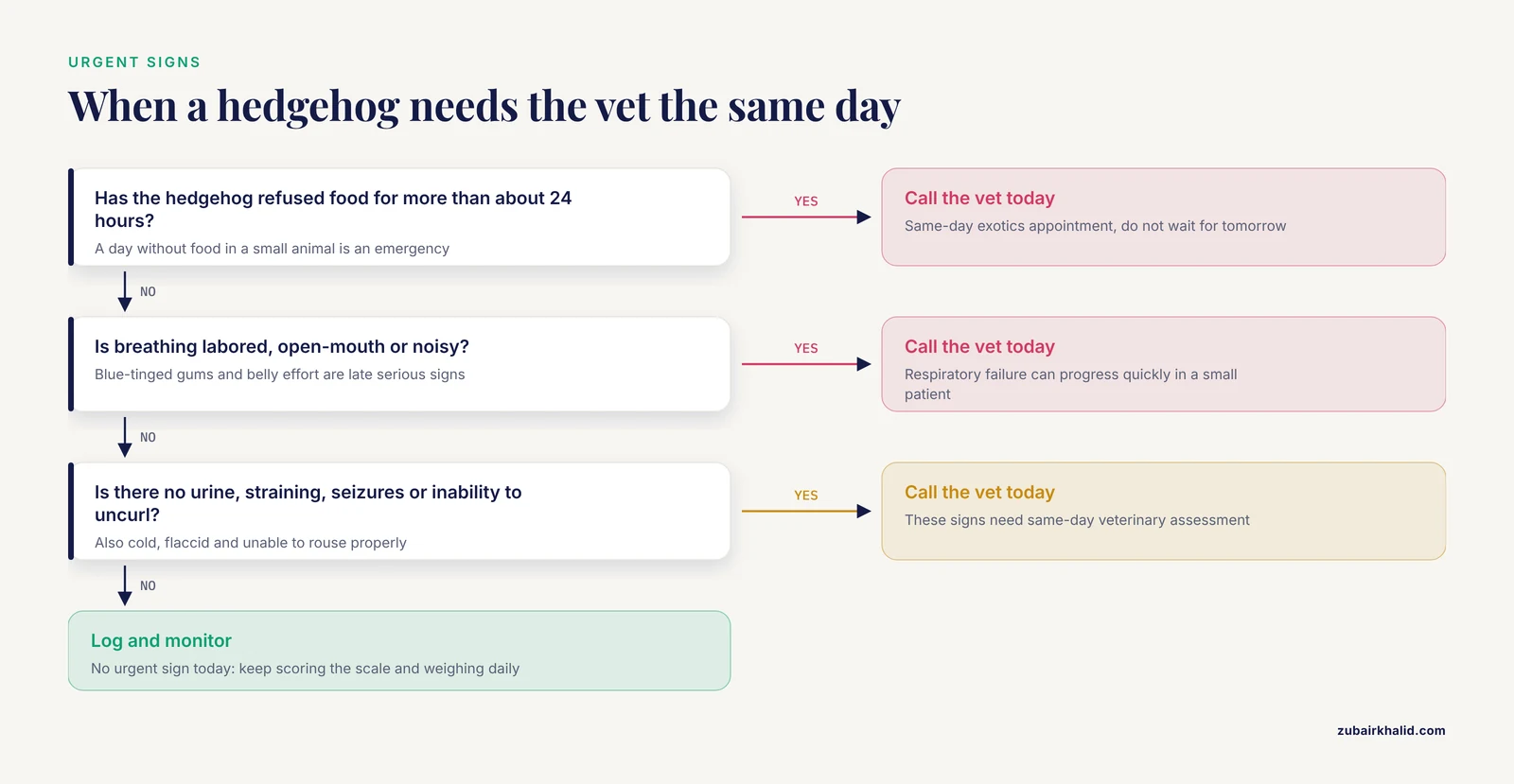
Every hedgehog's situation is individual, and only a veterinarian who has examined your animal can diagnose its condition, estimate its prognosis, or perform euthanasia. Use this article to organize your observations and questions, then bring them to an exotics or small mammal veterinarian.
Contact a veterinarian the same day for any of the following.
- No food for more than about 24 hours, or a sudden drop in appetite in an already thin animal
- Labored, open-mouth, or noisy breathing, or blue-tinged gums
- No urine, straining to urinate, or blood in urine or stool
- Seizures, circling, head tilt, sudden inability to stand, or inability to uncurl
- A cold, flaccid hedgehog that cannot rouse properly
- Active bleeding, a rapidly growing mass, a broken limb, or an injury from a fall or cage mate
- Prolonged trembling, hunched posture, or vocalizing that suggests pain
Contact a veterinarian promptly, within a few days, for steady weight loss, reduced activity, drooling or pawing at the mouth, quill loss with irritated skin, lumps anywhere on the body, or a quality of life scale total that keeps sliding. If you do not have an exotics veterinarian, search the directory of the Association of Exotic Mammal Veterinarians or call general practices in your area to ask whether they treat hedgehogs before an emergency develops.
Frequently Asked Questions
When should you euthanize a hedgehog?
Euthanize a hedgehog when it has more bad days than good, when it cannot eat, drink, move, breathe, or stay clean without ongoing distress, and when a veterinarian has confirmed the underlying condition cannot be treated or managed acceptably. A quality of life scale tracked over days, discussed with your vet, is the most reliable guide.
What are the signs a hedgehog is dying?
The main signs are complete refusal of food, labored or open-mouth breathing, inability to walk or uncurl, cold extremities, a hunched or flattened posture, a soiled or matted coat from failed grooming, and withdrawal from all normal night activity. Several of these appearing together in a known ill hedgehog indicate end-stage decline.
Is wobbly hedgehog syndrome a reason to euthanize?
Wobbly hedgehog syndrome is progressive and untreatable, and it eventually removes the ability to walk, eat independently, and groom. Many owners choose euthanasia when the hedgehog can no longer reach food and water or maintain basic comfort, guided by their veterinarian's assessment of the stage.
How do I comfort a dying hedgehog?
Keep it warm in the mid 70s to mid 80s Fahrenheit range without drafts, provide a single-level enclosure with food, water, and a hide close at hand, minimize noise and handling, spot clean soiling promptly, and follow your veterinarian's instructions for palatable food and any assisted feeding or medication.
Can a hedgehog die of old age at home?
Yes, some hedgehogs decline gradually and die quietly, but most serious conditions cause discomfort before death, and small animals can deteriorate very fast once eating stops. A veterinary assessment is the only way to know whether a natural death at home will be peaceful or involve avoidable suffering.
How does a hedgehog quality of life scale work?
You score seven domains, typically appetite, hydration, mobility, comfort, hygiene, engagement, and breathing, from 0 to 2 each day, then track the total over time. A falling total across a week, or zeros in breathing, appetite, or comfort, signals that it is time for a euthanasia conversation with your veterinarian.
Can a veterinarian euthanize a hedgehog at my home?
Some mobile and exotics veterinarians offer in-home euthanasia for small mammals, but availability varies widely by location. Call exotics clinics in your area well before the decision point to find out who provides the service and what they charge.
Is it normal to grieve deeply after losing a hedgehog?
Yes. Grief does not scale with an animal's size, and losing a small pet you cared for intensively, often through a short and fast illness, is genuinely painful. Rituals, supportive communities, and, if needed, pet loss counseling all help, and waiting before bringing a new hedgehog home is usually wise.