When to Euthanize a Guinea Pig: Quality of Life Signs
By Dr. Zubair Khalid, DVM, MS, PhD ·
Euthanasia is the right choice when your guinea pig's suffering is persistent, untreatable, or worse than any remaining good days, and when your veterinarian confirms that the conditions causing that suffering cannot be relieved. There is no single moment that looks the same for every animal. The decision becomes clear when you combine a structured quality of life assessment, a clear veterinary diagnosis, and honest observation of your guinea pig's daily experience. A guinea pig who has stopped eating, cannot move comfortably, no longer interacts with a bonded companion, and shows no response to treatment over days to weeks is telling you, in the only language available, that its welfare has collapsed.
This guide gives you a practical quality of life scale, the physical and behavioral signs that a guinea pig is approaching the end of life, concrete comfort measures for the final days, guidance on the euthanasia appointment itself, and support for the grief that follows. It is written for owners in the United States working with a small mammal or exotics veterinarian.
This article is educational and is not a substitute for veterinary diagnosis or treatment.
At a Glance: A Daily Quality of Life Checklist
Score your guinea pig on each item daily when you are worried. Use a simple 0 (poor), 1 (fair), 2 (good) system. A consistently low total, or any single zero that persists for more than a day or two, warrants a veterinary conversation about comfort care or euthanasia.
| Domain | What to check | Score 0 (poor) | Score 2 (good) |
|---|---|---|---|
| Appetite and hydration | Hay, pellets, vegetables, water intake | Refusing all food, no fecal droppings | Eats eagerly, normal droppings |
| Body condition | Weight trend and body condition score | Ongoing loss, ribs prominent, feels light | Stable weight, well-fleshed |
| Mobility and posture | Movement, hunching, grooming | Hunched, immobile, soiled rear, unkempt coat | Moves normally, grooms fully |
| Comfort and pain | Breathing, vocalizing, reaction to touch | Labored breathing, grinding teeth, flinches | Relaxed, stretches out, normal breathing |
| Behavior and social life | Interaction with cagemate and you | Withdrawn, hides, unresponsive | Popcorns, wheeks, engages with companion |
Two rules make this tool useful rather than academic. First, track the trend, not a single day. Good days matter more than bad days only when they outnumber them and the good days are genuinely good. Second, treat the scale as a conversation starter with your veterinarian, not a verdict. Structured welfare assessment tools of this kind, which deliberately combine behavioral information with physical condition rather than relying on appearance alone, have been shown to support end of life decision making in veterinary settings [1].
Why Guinea Pigs Hide Illness Until It Is Advanced
Guinea pigs are prey animals. Their survival strategy in the wild depends on looking healthy for as long as possible, so a sick cavy often appears only slightly off while the underlying problem is already serious. This single biological fact shapes everything else in this article. By the time a guinea pig looks obviously ill to an owner, the window for simple intervention has often narrowed.
The published welfare literature on this species concentrates on exactly this problem. A systematic review of welfare indicators in small mammals, including guinea pigs, emphasizes that no single measure captures welfare reliably, and that multiple animal based indicators such as body condition, behavior, coat condition, and activity must be combined to identify a welfare compromise [2]. In practical terms, this means you should never wait for one dramatic symptom. Watch for the pattern.
Research on pet guinea pigs in the United Kingdom found that dental disease was the most common problem seen in guinea pigs presented to veterinary practices, which places diet and tooth wear at the center of long term health [3]. The same review highlighted that chronic stress contributes to common pathologies in this species, including respiratory disease. Both conditions, dental pain and respiratory infection, are among the most frequent reasons a guinea pig's quality of life deteriorates in old age or during illness.
There is also a husbandry dimension. Surveys of guinea pig owners in the UK and New Zealand documented that a substantial share of pet guinea pigs live in enclosures smaller than recommended minimums, receive inconsistent veterinary care, and, in one New Zealand sample, fewer than half of owners reported ever taking their guinea pig to a veterinarian [4][5][6]. Underuse of veterinary care is one reason end of life decisions arrive at a crisis point. A guinea pig under regular veterinary observation tends to reach the euthanasia decision with a diagnosis in hand, rather than in an emergency room at two in the morning.
The Guinea Pig Quality of Life Scale, Explained
Welfare scientists organize assessment around domains of experience rather than individual symptoms. Applied to a pet guinea pig at the end of life, the five domains below cover what matters most. Each one draws on indicators validated in the small mammal welfare literature [2].
Appetite and Hydration
Guinea pigs are hindgut fermenters whose digestive tract depends on constant movement. The Merck Veterinary Manual's exotic animal resources emphasize that anorexia in guinea pigs is always serious and requires prompt attention, because the gastrointestinal tract slows or stops when food intake stops. Hand count droppings. A healthy adult produces a steady stream of oval droppings throughout the day. Fewer, smaller, misshapen, or absent droppings are an early warning that outranks almost any other sign.
Weigh your guinea pig on a kitchen scale at the same time of day, weekly when healthy and daily when ill. Body weight is one of the physical indicators used in formal welfare studies of guinea pigs [7]. A gram scale that reads in single gram increments costs little and provides the most objective data you will ever have about your pet's condition.
Body Condition
Obesity and emaciation both signal welfare problems. In a recent survey of exotic companion mammals, 23 percent of pet guinea pigs were overweight, and owner awareness was poor, with far fewer owners recognizing the problem than the measurements revealed [8]. The same study noted that underweight body condition occurs in guinea pigs as well, particularly in males [8]. At the end of life, the concern is usually the opposite, gradual muscle loss over the hips and spine. Run your fingertips along the spine and hip bones weekly. Bones that feel sharp and prominent with no flesh over them indicate real decline.
Mobility, Posture, and Hygiene
A comfortable guinea pig moves freely, stretches out when resting, and grooms its entire body. A painful guinea pig sits hunched in a corner with a puffed coat, moves reluctantly, and stops grooming the rear end. Soiling around the genitals and anus, or a matted, dirty coat, indicates that grooming has stopped and that discomfort or weakness is advanced. Joint disease, foot sores, dental pain, and internal disease all show up here first.
Comfort and Pain
Guinea pigs in pain grind their teeth (distinct from the gentle purring of contentment), refuse to be touched in specific areas, breathe rapidly, or sit with eyes half closed. Labored breathing, with visible effort and flared nostrils, is an emergency, because respiratory disease in this species progresses quickly and stress makes it worse. Vocalizing when handled or picked up, a change from the usual squeaks, often means pain.
Behavior and Social Life
Guinea pigs are intensely social. The UK welfare survey of nearly 4,600 owners found that guinea pigs housed with a conspecific displayed positive behaviors more frequently than those housed alone, and that larger enclosures were associated with more positive behavior as well [4]. This matters at the end of life for two reasons. First, a bonded companion is one of the strongest comfort measures you can provide to a dying guinea pig. Second, a guinea pig that stops interacting with its companion, stops responding to the sound of the refrigerator or the rustle of a vegetable bag, and withdraws to a corner is showing a behavioral welfare signal that should weigh heavily in your assessment [2].
Scoring and Thresholds
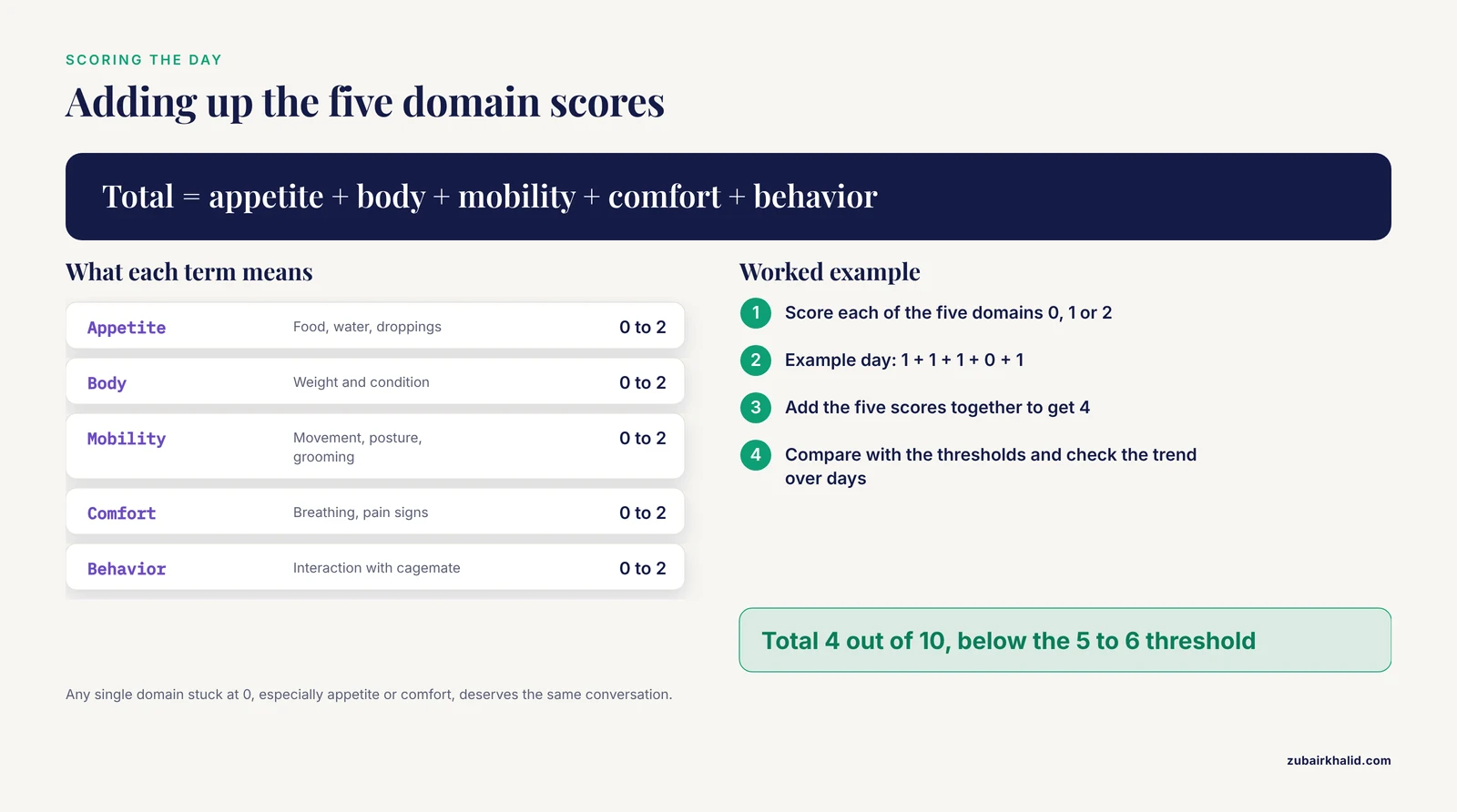
Score each domain 0 to 2 daily and keep a simple log. A practical framework many owners and veterinarians use together is:
- A total of 9 to 10 out of 10 supports continued care and treatment.
- A total of 7 to 8 supports active treatment, with reassessment every few days.
- A total at or below 5 to 6, sustained across several days despite appropriate veterinary treatment, is the point where most owners and veterinarians begin an explicit euthanasia conversation.
- Any single domain stuck at 0, especially appetite or comfort, deserves the same conversation regardless of the total.
These thresholds are decision aids, not diagnostic criteria. Your veterinarian, who can palpate, image, and examine what you can only observe, will interpret the same numbers differently depending on the diagnosis, the prognosis, and what treatment options remain.
Signs a Guinea Pig Is Dying
No owner should have to guess whether these signs constitute an emergency. The following list describes the physical and behavioral changes commonly seen in the final days of life in this species. Several of them are also treatable emergencies, which is precisely why they demand same day veterinary contact rather than watchful waiting at home.
Appetite and Gut Signs
- Complete refusal of all food, including favorite hand fed vegetables
- No droppings for several hours, or tiny, dry, misshapen droppings
- Diarrhea or wet, soiled bedding around the rear
- Rapid, visible weight loss over days
- Drooling or a permanently wet chin, which the welfare literature links to dental disease, the most common clinical problem in pet guinea pigs [3]
Breathing and Circulation
- Labored, open mouthed, or noisy breathing, which in this species is associated with respiratory disease that stress can aggravate
- A body that feels cool to the touch at the ears and paws
- Lying on one side with no attempt to right itself
- Pale or bluish tinge to the lips and inner eyelids
Posture and Appearance
- Hunched stance with a puffed coat, often in a corner
- Eyes sunken, half closed, or dull
- Unkempt coat, especially a greasy or matted rear end, indicating grooming has ceased
- Twitching, seizure activity, or head tilting
Behavioral Withdrawal
- No response to the voice, the opening of the cage, or the sound of food preparation
- Refusal to interact with a bonded cagemate
- Unresponsiveness to gentle handling that the animal previously tolerated
If several of these signs appear together and your guinea pig has already been diagnosed with an untreatable or terminal condition, they represent the final decline. If they appear without a diagnosis, they are an emergency, not an expected death. The Merck Veterinary Manual's exotic animal guidance is unambiguous on this point: anorexia, respiratory distress, and collapse in guinea pigs require immediate professional evaluation, because treatable conditions such as dental disease, gut stasis, and pneumonia look identical to terminal decline from the outside.
When to Euthanize a Guinea Pig: The Decision Framework
The decision to euthanize rests on three questions answered together, not in isolation.
Question one: Is the suffering treatable? Ask your veterinarian for a specific diagnosis or differential list, and a realistic prognosis for each. Dental disease, for example, can often be managed for months with regular filing and dietary support, while advanced organ failure cannot. A guinea pig whose condition has a reasonable treatment path has not yet reached the decision point.
Question two: Is the treatment itself a burden? Some treatments require repeated clinic visits, force feeding, injections, or hospitalization. Guinea pigs find restraint and handling stressful, and stress in this species is implicated in disease exacerbation, including respiratory disease [3]. A treatment that prolongs life but converts every remaining day into a stressful ordeal may reduce welfare even while extending it. This trade off belongs at the center of the conversation with your veterinarian.
Question three: Does the good still outweigh the bad? This is where the quality of life scale earns its keep. A record kept over one to two weeks shows whether the trend is toward recovery, plateau, or decline. Veterinary welfare assessment tools that track quality of life over time, combining physical and behavioral data, were designed in part to support exactly this decision, and studies of their use highlight their value in identifying when euthanasia should be performed [1].
Owners should also know what humane euthanasia actually involves. In research settings, work on euthanasia methods for guinea pigs focuses on rendering the animal immediately and irreversibly unconscious with minimal distress [9]. In companion animal practice in the United States, euthanasia is performed by a licensed veterinarian, most commonly with an injectable anesthetic agent given after a sedative so the animal drifts off calmly. The AVMA provides the professional framework veterinarians in the US follow for humane euthanasia, and your veterinarian can walk you through the specific protocol they will use. You are entitled to ask, and a good exotics practice will explain the sequence: sedation, a final calm period where you can say goodbye, then the final injection, after which breathing and the heartbeat stop within a minute or two.
Signs that the decision point has arrived, in the judgment of most small animal veterinarians:
- No response to appropriate treatment for the diagnosed condition over a reasonable trial period
- Persistent anorexia or the need for continuous force feeding with no prospect of resuming voluntary eating
- Unrelieved pain that does not respond to analgesia
- Loss of the ability to move to food, water, or a companion
- Soiling and skin breakdown from immobility
- Labored breathing at rest
- A quality of life score at or below the low threshold for more than a few consecutive days
Two signs that the decision point has not arrived: a treatable condition under active treatment, and an animal that still eats, interacts, and shows moments of genuine engagement even if it is weak. Old and frail is not the same as suffering. A geriatric guinea pig can live a dignified, comfortable final phase with warmth, accessible food, and companion contact, and euthanasia can wait for a genuine deterioration.
How to Comfort a Dying Guinea Pig
Comfort care, sometimes called hospice care, aims to maximize the quality of the days that remain, whether those days precede a natural death or a planned euthanasia. Every measure below reduces stress, and reducing stress in this species has direct health value, because stress is implicated in common guinea pig pathologies.
Warmth and Environment
- Keep the ambient temperature stable and draft free. Sick guinea pigs lose thermoregulation quickly.
- Move the cage to a quiet room away from televisions, dogs, and household traffic.
- Line the enclosure with soft, clean bedding, changed frequently, so a weak animal never lies in dampness.
- Lower the food and water to floor level, or scatter food within reach of an animal that can no longer walk far.
- Provide a hide, but leave it open enough that you can check on the animal without reaching in and startling it.
Companionship
Do not separate a dying guinea pig from its bonded companion unless a veterinarian advises it for medical reasons. Guinea pigs housed with a conspecific display more positive behaviors, and the presence of a companion demonstrably reduces stress in this species [3][4]. The companion also provides warmth, reassurance, and, after the death, its own experience of loss that needs managing.
Food and Fluids
- Offer favorite foods by hand several times a day. Hand feeding serves a comfort function even when only a few bites are taken.
- Offer hay constantly. A constant supply of hay promotes tooth wear and gastrointestinal health, and the veterinary literature identifies hay as central to welfare in this species.
- Fresh vegetables with high moisture content can support hydration in an animal drinking less.
- Never begin syringe feeding, critical care formulas, or supplemental fluids without veterinary direction. The volumes, products, and techniques matter, and incorrect force feeding can cause aspiration.
Pain Relief and Medical Comfort
Ask your veterinarian specifically about analgesia for end of stage patients. Pain medication appropriate to guinea pigs, dispensed and dosed by a veterinarian, can transform the final week. Ask also whether anti nausea support, assisted feeding, or subcutaneous fluids fit your animal's situation. A palliative care plan is a legitimate request to bring to any exotics appointment.
Gentle Handling
Speak in a low, familiar voice before touching. Support the whole body. Keep handling sessions short and stop when the animal shows stress signs. Practitioners who work with guinea pigs in handling intensive settings emphasize learning the species specific stress signals, such as freezing, rapid breathing, and teeth chattering, and removing the animal from stressful situations promptly [10]. Those same signals are your guide at the bedside.
The Euthanasia Appointment: What to Expect and How to Prepare
Contact an exotics or small mammal practice in advance. Not every companion animal clinic sees guinea pigs regularly, and arranging the appointment ahead of time, ideally with a diagnosis already established, spares you a crisis decision in an unfamiliar clinic.
Questions to ask when you book:
- Will a veterinarian with guinea pig experience perform the procedure?
- Can I be present, and can my children be present if I choose?
- Will my guinea pig be sedated first so it is calm and pain free?
- Can I hold my pet during the procedure?
- What happens afterward? Options usually include communal or private cremation, or taking your pet home for burial where local regulations permit.
Practical preparation:
- Bring the bonded companion or a piece of soiled bedding from home. Familiar smells reduce stress during transport and waiting.
- Bring your quality of life log. It documents the trend and helps the veterinarian confirm your assessment.
- Decide beforehand whether you want to be present for the final injection. Many owners find presence comforting and many find it difficult. There is no correct answer, only your answer.
- Ask for a moment of privacy afterward. Clinics expect this request.
Afterward, expect the body to go completely limp. Eyes may remain open. Small muscle twitches can occur in the first moments and are normal. Your guinea pig felt none of it if sedation was used, because the final agent acts under deep anesthesia.
Caring for the Surviving Guinea Pig
A bonded guinea pig that loses its companion experiences a real disruption. Owners commonly report searching behavior, reduced appetite, and increased vocalizing in the surviving animal. The UK welfare data supports the premise behind this concern, showing that conspecific housing is associated with more frequent positive behaviors in guinea pigs [4], and the veterinary literature confirms that a companion reduces stress in this species [3].
Practical steps for the survivor:
- Let the survivor see and sniff the body, or the bedding, before removal if circumstances allow. This appears to reduce searching behavior.
- Watch food intake closely for the first week. A survivor that stops eating needs veterinary attention just as urgently as the one you lost.
- Maintain routine. Feeding times, floor time, and cage cleaning on the usual schedule provide stability.
- Do not rush to rehouse. When you do consider a new companion, introductions are best done through an exotics knowledgeable rescue, since compatibility varies and forced pairings can cause injury and stress.
Grieving the Loss of a Guinea Pig
Grieving the loss of a guinea pig is real grief, and owners frequently report that others minimize it because of the animal's size. The bond with a small pet is built through years of daily care, and losing it hurts. Several things help:
- Acknowledge the loss out loud, to family, friends, or a pet loss support line. Many veterinary schools and organizations in the United States operate free pet loss hotlines.
- Involve children honestly. Simple, truthful language about death, an opportunity to say goodbye, and a small ritual such as a burial or a photo memorial help children process the loss and prevent confusion.
- Give yourself permission to grieve for a few days before making any decisions about rehoming or new pets.
- Some owners find that keeping the quality of life log, which documents the care and attention their pet received, provides a measure of comfort afterward.
Common Mistakes at the End of Life
- Waiting out a weekend with an anorexic guinea pig. A guinea pig that has not eaten since morning needs same day veterinary contact, because gut function deteriorates rapidly without food intake.
- Assuming weight loss is normal aging. Objective body condition assessment matters, as population surveys of pet guinea pigs show that both overweight and underweight conditions are common and frequently unrecognized by owners [8].
- Withholding veterinary care because the animal is old. Dental disease, the most common clinical problem in pet guinea pigs, is often manageable and painful when unmanaged [3].
- Trying home remedies instead of a diagnosis. Respiratory signs, diarrhea, and anorexia in this species each have multiple causes requiring different treatments.
- Separating the dying animal from its companion. Companion presence reduces stress and supports welfare in this species [3].
- Postponing the euthanasia decision until collapse. A planned euthanasia on a calm day, with the companion present and the animal sedated, is a gentler ending than an emergency euthanasia in crisis.
- Co housing a guinea pig with a rabbit. The veterinary literature notes that rabbits can injure guinea pigs and carry diseases to which guinea pigs are susceptible, which is why co housing is no longer recommended [3].
Limitations and When to Contact a Veterinarian
Every guinea pig is an individual, and the thresholds, timelines, and comfort measures in this article require interpretation by a veterinarian who has examined your animal. A quality of life scale is a structured way to observe and communicate, not a substitute for clinical judgment.
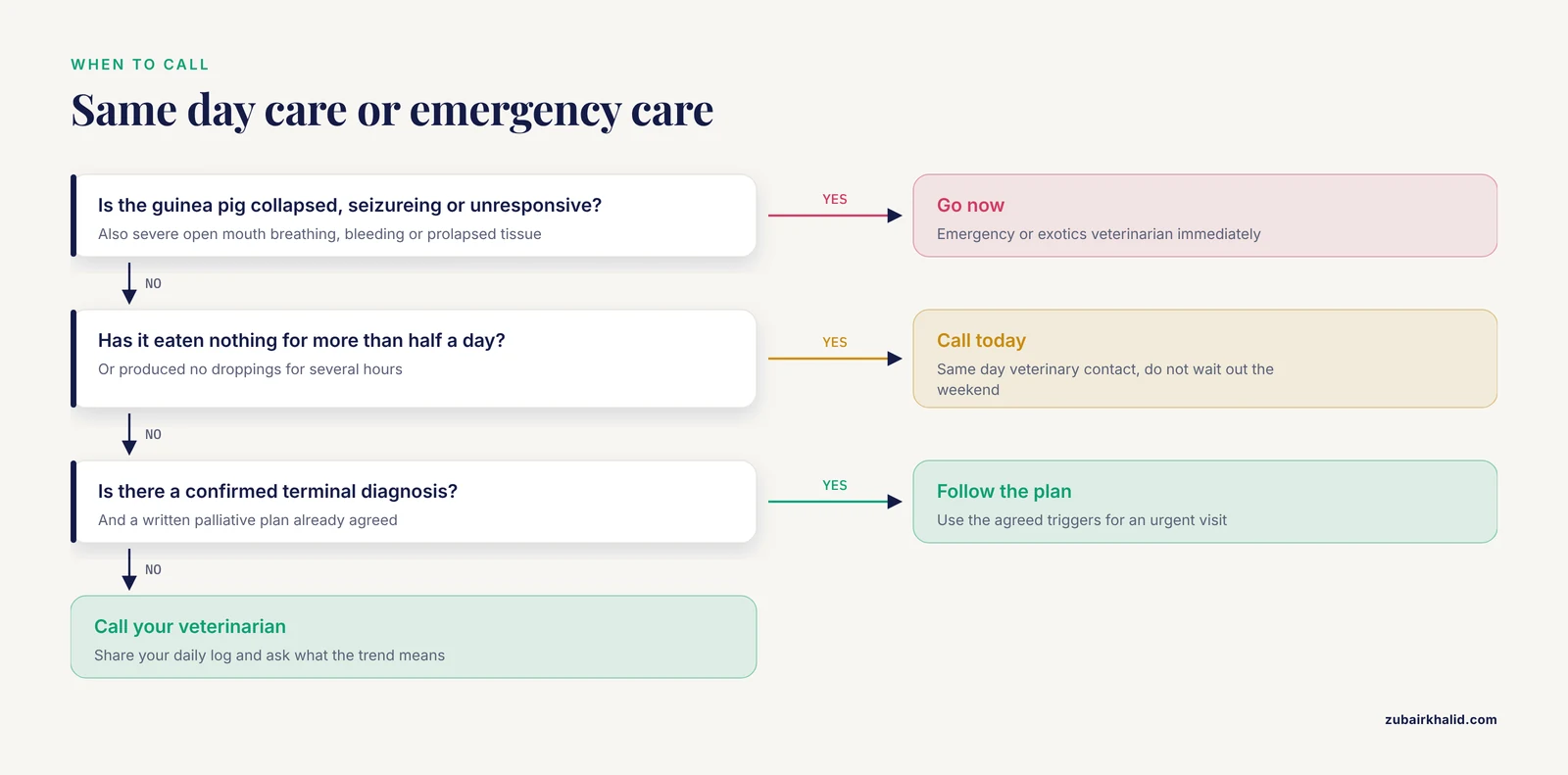
Contact your veterinarian the same day if your guinea pig:
- Has not eaten for more than half a day, or has produced no droppings for several hours
- Is losing weight visibly or by scale measurement
- Is drooling, has a wet chin, or is dropping food from its mouth
- Shows labored, rapid, or noisy breathing
- Sits hunched and unmoving, or refuses to come out of its hide
- Has diarrhea, a soiled rear end, or has stopped grooming
- Is vocalizing in pain when handled or when moving
Go to an emergency or exotics veterinarian immediately if your guinea pig:
- Is collapsed, seizureing, or unresponsive
- Has severe labored breathing with an open mouth
- Is bleeding, has a prolapsed tissue at the rectum or vagina, or has suffered trauma
- Has a body temperature that feels dangerously cold to the touch and is deteriorating rapidly
If you have already had a terminal diagnosis confirmed and you are managing palliative care, establish a written plan with your veterinarian covering the analgesic regimen, the parameters that would trigger an urgent visit, and the specific observations that would confirm the euthanasia decision. Recheck the plan whenever the trend on your daily log changes.
Frequently Asked Questions
How do I know when it is time to euthanize my guinea pig?
The time has come when your guinea pig's suffering is persistent and untreatable, meaning the bad days outnumber the good and appropriate veterinary treatment has failed to relieve pain, anorexia, or loss of mobility. Use a daily quality of life log covering appetite, body condition, mobility, comfort, and social behavior, share it with your exotics veterinarian, and make the decision together when the low scores persist across several days despite treatment.
What is a guinea pig quality of life scale?
A guinea pig quality of life scale is a simple scoring tool, typically rating five domains (appetite and hydration, body condition, mobility and hygiene, comfort and pain, and behavior and social engagement) from 0 to 2 each day. Tracking the total over one to two weeks reveals the trend and converts vague worry into concrete data you and your veterinarian can act on. Structured welfare tools of this type are used in veterinary settings specifically to support euthanasia timing decisions.
What are the signs a guinea pig is dying?
The most common signs are complete refusal of food, absent or tiny droppings, rapid weight loss, a hunched posture with a puffed coat, labored breathing, cool ears and paws, a dull half closed gaze, a soiled and unkempt rear end, and withdrawal from a bonded companion and from familiar sounds. These same signs can indicate treatable emergencies, so they always warrant same day veterinary contact unless a terminal diagnosis is already confirmed.
Can a guinea pig die suddenly without warning?
Sudden death can occur in guinea pigs, most often when an owner missed the subtle early signs, because this prey species hides illness until disease is advanced. Gastric stasis, heart disease, respiratory infection, and heat stroke can all progress from seemingly normal to critical within hours. Daily observation, weekly weighing, and prompt veterinary attention to small changes are the best protection against a sudden loss.
How can I comfort a dying guinea pig?
Keep the animal warm, quiet, and with its bonded companion, provide soft clean bedding and constant access to hay and favorite foods offered by hand, and ask your veterinarian for pain medication and a palliative care plan. Handle gently and briefly, speak in a familiar low voice, and lower food and water so a weak animal can reach them. Do not begin syringe feeding or fluids without veterinary direction.
Should I be present during my guinea pig's euthanasia?
You may be present, and most exotics practices will accommodate you holding your sedated pet during the procedure. Many owners find presence comforting and find later reassurance in knowing their pet died calmly in their hands, while others prefer not to watch. Both choices are valid. Decide before the appointment and tell the clinic so they can arrange the room and the timing.
Does the surviving guinea pig grieve a lost companion?
Surviving guinea pigs commonly show searching behavior, increased vocalizing, and reduced appetite after losing a bonded companion, which reflects the importance of conspecific company to this species, where companionship is associated with more frequent positive behavior and reduced stress. Let the survivor investigate the body or bedding before removal, monitor food intake closely for the first week, maintain the usual routine, and contact your veterinarian if the survivor stops eating.
How do I cope with grieving the loss of a guinea pig?
Acknowledge the loss openly, use pet loss support resources such as the free hotlines run by veterinary schools, involve children with honest, simple language and a small memorial ritual, and wait before making decisions about new pets. The depth of grief does not depend on the size of the animal, and years of daily care create a bond that deserves to be mourned fully.
Sources
- Assessment of the Welfare of Experimental Cattle and Pigs Using the Animal Welfare Assessment Grid
- Review of Rat (Rattus norvegicus), Mouse (Mus musculus), Guinea pig (Cavia porcellus), and Rabbit (Oryctolagus cuniculus) Indicators for Welfare Assessment
- Impact of husbandry on the welfare of pet guinea pigs in the UK
- Current welfare state of pet guinea pigs in the UK
- Cross-sectional survey of housing for pet guinea pigs (Cavia porcellus) in New Zealand.
- Cross-sectional survey of husbandry for pet guinea pigs (Cavia porcellus) in New Zealand.
- Physical and Physiological Indicators of Welfare in Guinea Pigs (Cavia porcellus) Serving as Ambassador Animals
- Prevalence and awareness of obesity and related husbandry practices in Estonian rabbits, guinea pigs, and rats
- Humane Euthanasia of Guinea Pigs (Cavia porcellus) with a Penetrating Spring-Loaded Captive Bolt.
- Promoting the General Welfare of Therapy Rabbits and Guinea Pigs in Animal-Assisted Interventions with Youth