When to Euthanize a Gerbil: Quality of Life Signs
By Dr. Zubair Khalid, DVM, MS, PhD ·

Euthanasia becomes the kindest option when a gerbil can no longer eat or drink on its own, breathes with obvious effort, cannot regulate its body temperature or move to food and water, or loses interest in every activity that once mattered to it and does not improve with veterinary treatment. There is rarely a single moment that settles the decision. Instead, you watch for a pattern: more bad days than good days, weight slipping away despite hand feeding, and a gerbil that stops behaving like a gerbil.
Because gerbils are small, quiet animals, many owners worry they will miss the right moment or wait too long. This guide walks you through a practical quality of life framework, the physical and behavioral signs that suggest a gerbil is nearing the end of life, how to comfort a dying gerbil, what to expect from a veterinary euthanasia appointment, and how to cope with the loss afterward.
This article is educational and is not a substitute for veterinary diagnosis or treatment. Any end of life decision for your gerbil should be made together with a veterinarian who can examine your pet and rule out treatable conditions.
At a Glance: A Daily Quality of Life Checklist for Gerbils
Use this checklist every morning and evening during your gerbil's final period of life. Two or more red flags that persist for 24 to 48 hours, or any single red flag in the urgent column, means it is time to call your veterinarian.
| Domain | Green flag (quality of life is present) | Red flag (call your veterinarian this week) | Urgent (same-day veterinary contact) |
|---|---|---|---|
| Eating | Eats seed mix, pellets, and favorites with enthusiasm | Eats only soft or hand-fed food, leaves favorites untouched | No food intake for 24 hours or more |
| Drinking | Drinks normally | Drinks far less or far more than usual | No visible drinking plus lethargy |
| Breathing | Quiet, effortless breathing | Slight click or faster breathing at rest | Open-mouth breathing, labored effort, blue or gray tones |
| Mobility | Digs, climbs, runs on the wheel | Slow to rise, drags limbs, stops using burrow or wheel | Cannot stand, falls over, drags the hind end |
| Body condition | Stable weight, normal coat | Visible weight loss, dull or unkempt coat, diarrhea or wet tail area | Rapid decline over hours, bleeding, seizures, collapse |
| Behavior | Grooms, burrows, hoards, greets you | Sleeps away from cagemates, stops hoarding, fluffed and hunched posture | Cold to the touch, unresponsive, gasping |
| Comfort | Settles calmly, sleeps curled and relaxed | Restless pacing, grinding teeth with drooling, unable to get comfortable | Crying out, obvious severe distress |
A gerbil quality of life assessment works best when you track it in writing. A simple notebook with one row per day gives you an honest record instead of a memory shaped by hope or by guilt.
Why End of Life Decisions Look Different in Gerbils
Gerbils are short-lived companions. Improved husbandry and better veterinary knowledge of exotic pets have gradually extended how long small pets such as gerbils live, which means more owners now face age-related illness and end of life care rather than sudden loss alone [1]. That longer partnership makes the euthanasia conversation harder, not easier, because the bond is stronger than most people expect when they bring home a palm-sized animal.
Three features of gerbil biology shape every end of life decision.
First, gerbils are small patients with small reserves. A gerbil that stops eating for a single day has already lost a meaningful share of its body energy, and dehydration develops quickly. What would be a minor 24-hour appetite dip in a large dog can be a genuine crisis in a gerbil. Veterinary hematologists note that physical examination, history, and husbandry information can be greatly supplemented by blood work in gerbils, but collecting enough blood for a full hemogram is challenging in such small patients [2]. Your veterinarian may therefore rely heavily on hands-on examination, weight trends, and imaging rather than extensive laboratory panels.
Second, gerbils communicate through behavior before they communicate through obvious illness. Research on small mammal owners shows that most owners judge health and welfare at home primarily through behavioral indicators rather than through clinical measurements, and that these observations map naturally onto the Five Domains welfare framework covering nutrition, physical environment, health, behavior, and mental state [3]. This is good news for owners facing end of life decisions. You do not need laboratory equipment to track your gerbil's quality of life. You need to know what normal looks like for your individual animal and to notice when it changes.
Third, diagnostic and treatment options expand every year. Veterinary reviews of geriatric small mammals describe how polymerase chain reaction testing and other molecular diagnostics now let practitioners identify specific causes of disease from very small biologic samples, and how radiography and ultrasonography add valuable diagnostic information in these species [1]. A gerbil that would have been written off a generation ago may have a treatable condition. This is why a quality of life decline should always trigger a veterinary visit before it triggers an end of life conversation, unless the gerbil is in immediate severe distress.
Understanding Gerbil Quality of Life: The Five Domains Framework
Modern animal welfare science evaluates an animal's life across five domains: nutrition, physical environment, health, behavior, and mental state. Small mammal welfare researchers have mapped exactly these domains onto how pet owners assess their animals at home [3]. The framework translates directly into a gerbil quality of life scale you can use at home.
Nutrition and hydration
Quality of life requires a gerbil that wants to eat. Watch for these specifics:
- Does your gerbil approach food when you open the cage, or does it ignore meals it once ran for?
- Is it still hoarding food in its burrow or stash, a natural behavior that reflects both appetite and energy?
- Can it hold and manipulate seed hulls, or has it switched to only soft foods because holding food hurts?
- Are cheeks still filling, or does food fall from the mouth?
Hand feeding a gerbil can extend comfort, but hand feeding is support, not recovery. If your gerbil eats only what you place in its mouth, cannot swallow reliably, or shows no interest even in favorite foods, the underlying problem is usually advancing.
Physical environment
A dying gerbil still benefits from an environment that matches its species needs. Gerbil welfare research shows that when housing fails to meet behavioral needs, gerbils develop abnormal repetitive behaviors such as stereotypic digging and bar chewing, and that correcting the environment measurably reduces stress, with fecal cortisol used to confirm those stress differences [4]. In palliative care the same principle applies in reverse. A gerbil at the end of life needs a deep, comfortable substrate it can rest in or on, easy access to food and water without climbing, and a warm, quiet location. Simplify the environment: lower the wheel access if it struggles to climb, place food and water close to its resting spot, and keep the room warm and draft free.
Health and physical comfort
Track weight if you can. A kitchen scale that reads in single grams lets you follow a decline objectively. Note the coat. A gerbil that stops grooming develops a greasy, roughened, or unkempt coat, and this change is one of the most reliable visible signals that a small mammal is unwell. Watch the droppings and the area around the tail and vents. Diarrhea or a wet, soiled rear end is a red flag that warrants same-day veterinary contact.
Behavior
Behavior is where gerbils speak most clearly. A healthy gerbil digs, hoards, grooms, investigates, and interacts with cagemates. Positive reinforcement research in gerbils shows that these animals learn quickly, engage voluntarily with trained interactions, and show measurably increased voluntary approach behavior when their welfare is managed well [5]. The practical translation for end of life care is this: voluntary engagement is one of the best quality of life indicators you have. A gerbil that still chooses to come to your hand, still takes a treat, still nudges its cagemate, still moves toward novelty rather than away from it, is telling you something meaningful. A gerbil that stops all voluntary engagement, even when supported with food and warmth, is telling you something equally meaningful.
Mental state
The fifth domain is the one owners struggle with most. Is your gerbil experiencing more comfort than distress across a typical day? Signs of distress include persistent hunching, fluffed fur with a hunched posture, teeth grinding paired with drooling, restlessness that prevents sleep, and hiding combined with refusal of all interaction. Signs of comfort include relaxed curling to sleep, normal grooming, interest in nesting material, and calm response to your presence.
Signs a Gerbil Is Dying
No single sign confirms that a gerbil is dying, and several of the signs below can also appear in treatable illness. Their meaning comes from the pattern, the speed of change, and what your veterinarian finds on examination. Watch for clusters, not isolated symptoms.
Late-stage physical signs
- Refusal of food and water. A gerbil that will not eat even hand-fed soft food, and will not drink, is approaching a critical point within a day or two.
- Labored breathing. Open-mouth breathing, visible heaving of the chest and abdomen, a clicking sound with each breath, or blue-gray coloring around the nose and paws signals severe respiratory compromise.
- Loss of body temperature. A gerbil that feels cool to your touch, sits fluffed and motionless, and cannot warm itself is in serious trouble. Small mammals lose heat rapidly when circulation and metabolism fail.
- Loss of mobility. Dragging the hind end, falling to one side, circling, seizures, or inability to stand can indicate stroke-like events, serious infection, or organ failure.
- Rapid weight loss. A spine and hip bones that become prominent within days reflect muscle wasting, not just fat loss.
- Cold, pale, or blue extremities and a weak, slow response when gently touched.
- Unresponsiveness. A gerbil that no longer reacts to handling, sound, or gentle touch is in the final stage of decline.
Behavioral signs that accompany dying
- Abandoning the nest or burrow, or lying stretched out away from cagemates.
- Stopping hoarding behavior entirely.
- No grooming, leading to a stained, matted, or scruffy coat.
- No reaction to foods or handling that always produced interest before.
- Fluffed fur with a hunched posture held for hours at a time.
- Vocalizing when touched or moved, which can indicate pain.
Signs that need same-day veterinary care rather than end of life planning
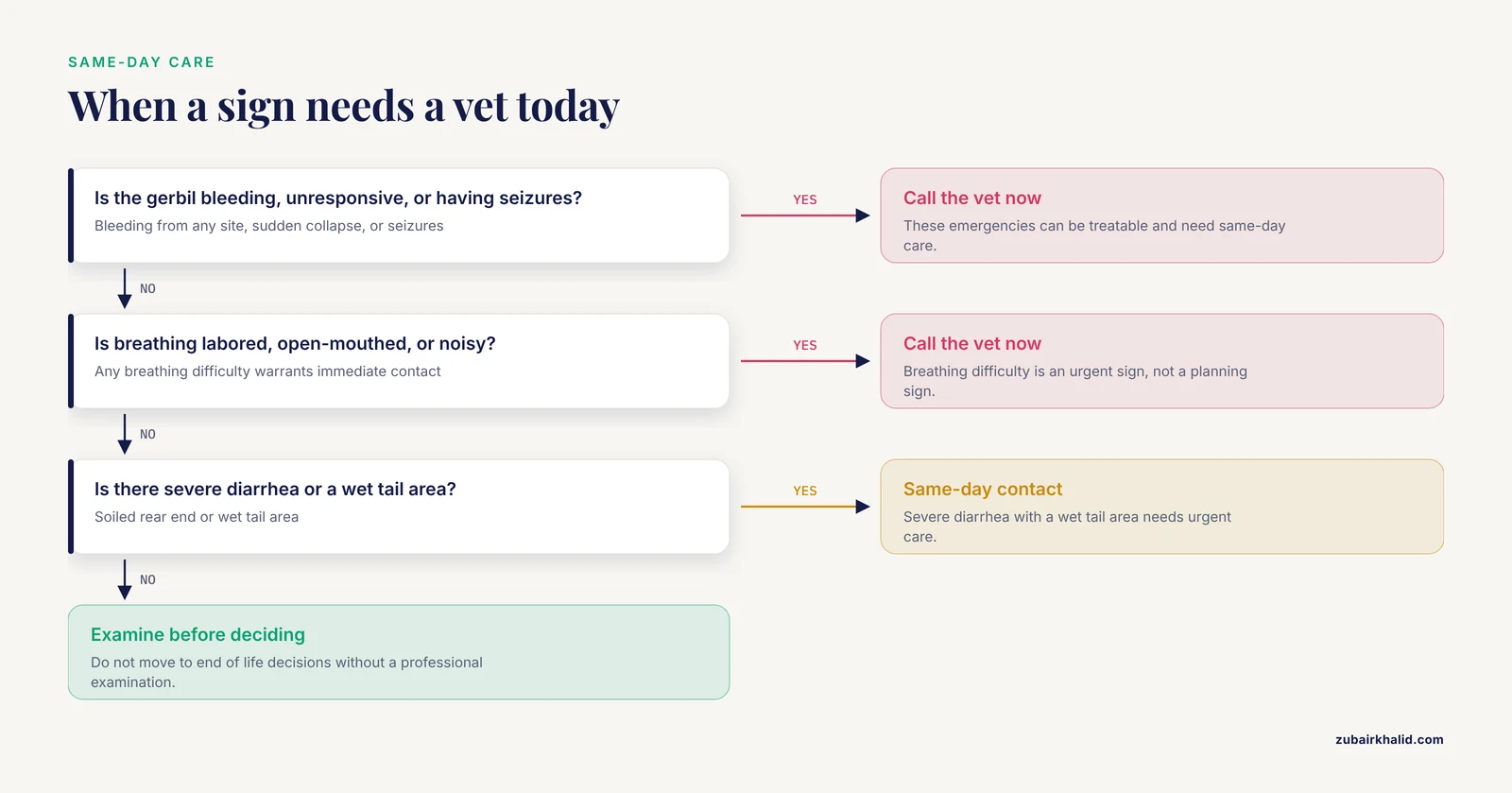
Bleeding from any site, sudden collapse, seizures, a suspected broken limb or spine after a fall, severe diarrhea with a wet tail area, and any breathing difficulty all warrant immediate veterinary contact. Some of these emergencies are treatable. Do not move from observation to end of life decisions without a professional examination unless the animal is beyond any realistic help and suffering severely.
A Practical Gerbil Quality of Life Scale
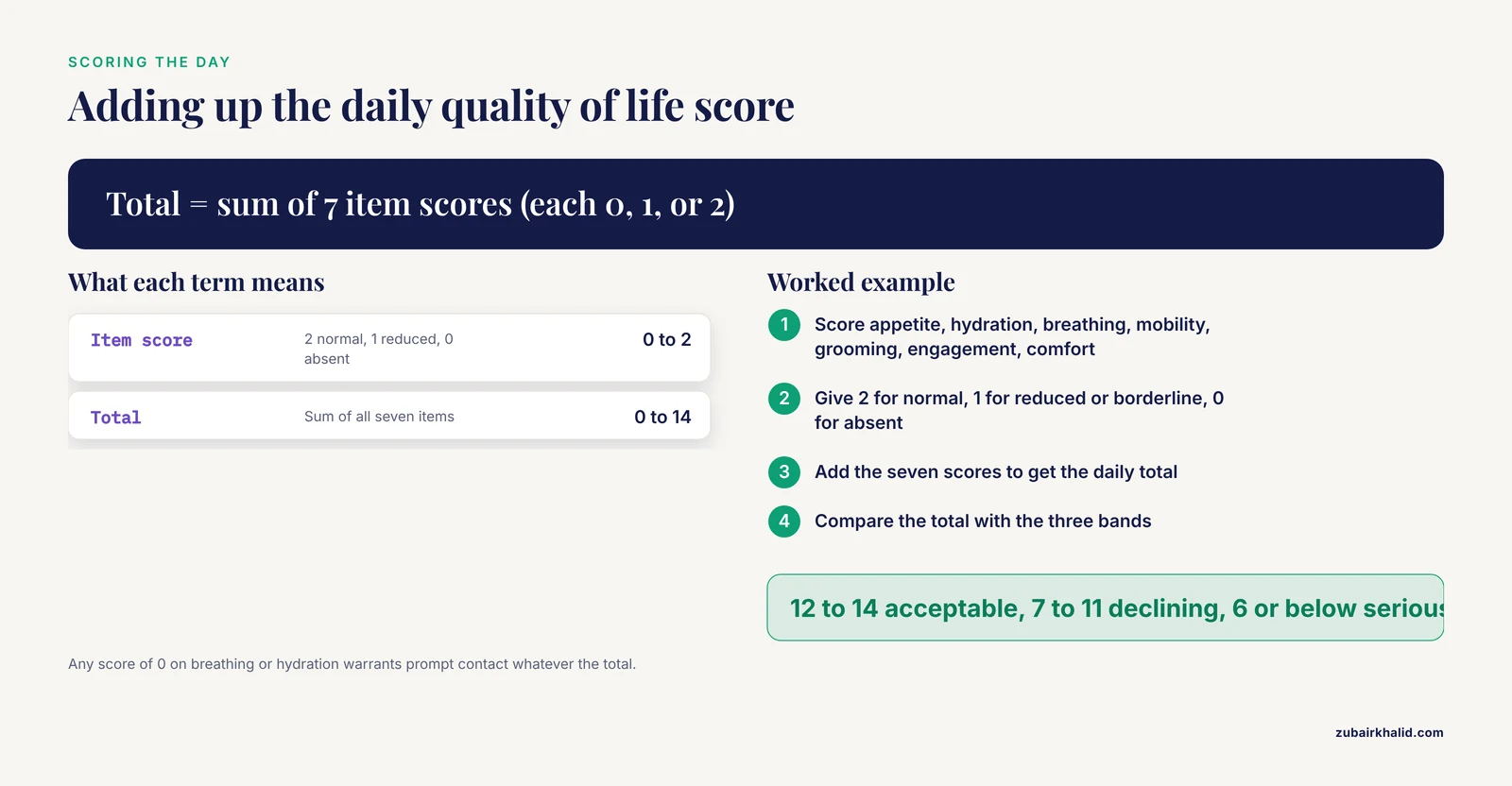
Score your gerbil daily on each of the seven items below using the Five Domains framework as the structure. Give 2 points for normal, 1 point for reduced or borderline, and 0 points for absent or severely impaired.
| # | Item | Score 2 | Score 1 | Score 0 |
|---|---|---|---|---|
| 1 | Appetite | Eats all foods offered, including hard seeds | Eats soft foods only, or eats less than half of normal | Refuses all food, including favorites and hand feeding |
| 2 | Hydration | Drinks normally, moist gums | Drinks little, slightly tacky gums | No drinking, dry gums, sunken eyes |
| 3 | Breathing and comfort | Quiet breathing, settles and sleeps normally | Occasional effort, restless sleep | Labored or open-mouth breathing, cannot settle |
| 4 | Mobility and posture | Digs, climbs, moves freely | Slow, stiff, avoids climbing | Cannot stand or walk, drags limbs, seizures |
| 5 | Grooming and coat | Clean, sleek coat | Slightly dull coat, missed spots | Matted, greasy, soiled coat, no grooming |
| 6 | Engagement | Greets you, hoards, interacts with cagemates | Responds slowly, brief interest only | No response to food, handling, or cagemates |
| 7 | Comfort versus distress | Appears comfortable most of the day | Mixed good and bad hours | Distress or pain behaviors most of the day |
How to interpret the totals:
- 12 to 14 points. Quality of life is currently acceptable. Continue supportive care and keep monitoring.
- 7 to 11 points. Your gerbil is declining. Schedule a veterinary examination to look for treatable causes, discuss palliative options, and start planning.
- 6 points or below, or any score of 0 on breathing or hydration. Quality of life is seriously compromised. Contact your veterinarian promptly to discuss whether euthanasia is the appropriate next step.
This scale is an owner tool built on the same behavioral indicators small mammal owners rely on when assessing welfare at home [3]. It does not replace a veterinary examination. Treatable diseases, including dental problems, infections, and parasitic disease, can produce low scores that reverse with treatment. The scale tells you when to seek help and when to open the conversation. Your veterinarian tells you what is medically possible.
When to Euthanize a Gerbil: Concrete Triggers for the Conversation
Bring up euthanasia with your veterinarian when one or more of the following is true. These criteria are deliberately concrete so that you are not deciding in the middle of the night on instinct alone.
- Your gerbil scores 6 or below on the scale for two consecutive days, or scores 0 on breathing, hydration, or mobility.
- Bad days outnumber good days for a week or more, even with supportive care.
- Your veterinarian has diagnosed a condition that is not treatable, or treatment has been attempted and the gerbil has not improved.
- Pain cannot be controlled. The gerbil shows pain behaviors despite appropriate treatment, or the medications needed cause more problems than they solve.
- The gerbil can no longer perform basic gerbil behaviors. It cannot dig, nest, hoard, or move to food and water without help, and there is no reasonable prospect of recovery.
- The gerbil is suffering now. Severe respiratory distress, uncontrolled bleeding, or continuous distress behaviors mean the conversation should happen immediately, not at the next scheduled appointment.
Two honest notes about timing. First, gerbils decline quickly, so a plan you would take a week to consider for a dog may need to be made in a day for a gerbil. Build the relationship with a small mammal or exotic pet veterinarian before a crisis, so you have a professional who knows your animal and can act fast. Second, owners sometimes wait because the gerbil still eats a little, still opens its eyes, or still responds to their voice. Those signs are meaningful, but they are not the same as quality of life. A gerbil can be alive in every measurable sense while its comfort has already gone. The question is not whether life is present. The question is whether life is worth living from the gerbil's perspective, measured through appetite, comfort, mobility, and engagement.
What Happens at the Veterinary Appointment
When you bring a declining gerbil to a small mammal veterinarian, expect a focused, efficient visit.
History and examination. The veterinarian will ask about appetite, droppings, weight trend, housing, and cagemates, then perform a hands-on examination checking weight, body condition, coat, teeth, abdomen, breathing, and temperature.
Diagnostic options. Blood work in gerbils is possible but constrained by patient size, and veterinary hematologists describe specialized methods for collecting and interpreting small blood samples in gerbils [2]. Radiography and ultrasonography are valuable diagnostic modalities in these small patients, and molecular tests such as polymerase chain reaction can identify specific causes of disease from tiny samples [1]. Ask your veterinarian which tests are realistically useful for your gerbil's condition and which would change the treatment plan. A test that will not change the outcome may only add stress at the end of life.
Treatment versus palliation. If a treatable condition is found, your veterinarian will discuss first-line treatment, expected duration, and follow-up timing specific to the diagnosis. If the condition is not treatable, or if your gerbil is too frail for treatment, the discussion shifts to palliative care and euthanasia.
The euthanasia procedure itself. Humane euthanasia is a veterinary procedure performed using methods designed to be painless. In the United States, this is work for a licensed veterinarian. Ask your veterinarian in advance how the procedure is performed, whether you can be present, and how your gerbil will be handled before and during it. Most small mammal practitioners are gentle about these questions and will walk you through every step. There is no requirement to be present, and there is no reason to be ashamed if you cannot be. There is also deep value for many owners in holding their pet as it passes. Choose what protects you both.
Aftercare. Ask about options for the body. Individual cremation with returned ashes, communal cremation, and home burial where local rules permit are common choices. Your veterinary clinic can explain what it offers.
How to Comfort a Dying Gerbil
If your gerbil is in its final days under hospice-style care, whether while you pursue treatment or while you prepare for euthanasia, comfort is a real and active form of care. Gerbil welfare research demonstrates that small changes in housing and handling measurably change gerbil stress, confirmed physiologically through fecal cortisol measurements [4]. The same sensitivity applies at the end of life.
Warmth
A dying gerbil often cannot thermoregulate. Move the cage to the warmest draft-free room in the home. Offer a safe external heat source, such as a heat pad placed under half of the enclosure so the gerbil can move toward or away from warmth, or a microwavable small-animal heat pad wrapped in fabric. Check temperature with your hand frequently. Overheating is as dangerous as chilling.
Easy access to food and water
Place food and water at floor level near the resting spot. Offer favorite soft foods by hand. Offer water from a low dish as well as the bottle, because a weak gerbil may not manage the bottle mechanism. If your veterinarian has approved supplemental feeding, follow the plan exactly, including what, how much, and how often.
Familiar bedding and burrow material
Gerbils have a deep behavioral need to burrow, and providing appropriate burrowing substrate is one of the refinements shown to protect gerbil welfare [4]. In palliative care, deep, soft bedding lets a weak gerbil rest in a natural posture, cushion pressure points, and feel secure. Provide extra nesting material and let the gerbil arrange it.
Reduce stress, not interaction
Keep the room quiet and predictable. Limit handling to gentle, low-to-the-surface contact, always over a soft surface in case of falls. Positive reinforcement and calm, familiar human interaction are well tolerated by gerbils and can support their welfare [5], so quiet talking, gentle scent familiarity, and brief soft touches often comfort more than they stress. Watch your gerbil's response. If it flinches, squeaks, or tries to escape, give it space and shorten the next session.
Protect the cagemate relationship
If your gerbil lives with a companion, keep them together when the sick gerbil tolerates it. Separation at the end of life can distress both animals. If the dying gerbil is being bullied, or if there is a risk of disease transmission that your veterinarian has flagged, follow your veterinarian's housing advice. After a death, give the surviving gerbil time and watch it closely for appetite and behavior changes, since companion animals also react to loss.
Track comfort, not just survival
Keep the daily quality of life score going during hospice care. The goal of comfort care is not to prolong the score of 6. It is to keep the score as high as possible for as long as the gerbil remains comfortable, and to let euthanasia take over when comfort can no longer be maintained.
Common Mistakes Owners Make at the End of Life
- Waiting for dramatic signs. Gerbils show decline through subtle behavioral change long before collapse. Small mammal owners who assess welfare through daily behavioral observation catch problems earlier than those waiting for obvious illness [3]. Weigh your gerbil, watch its eating, and act on small changes.
- Assuming old age explains everything. Geriatric small mammals face specific, sometimes treatable, veterinary concerns, and modern diagnostics can identify specific causes in these patients [1]. Always ask what is treatable before accepting decline as inevitable.
- Postponing the first veterinary visit until the gerbil is critical. Because gerbils decompensate fast, a condition caught early may respond to treatment, while the same condition 48 hours later may leave only the euthanasia option.
- Stopping food and water because the gerbil refuses the usual diet. Offer alternatives, soft foods, and hand feeding, and call your veterinarian. Never force large volumes of liquid into a weak gerbil's mouth, which risks aspiration.
- Trying to end a pet's life at home. Inhumane methods cause suffering. Euthanasia is a veterinary procedure, and laws on who may perform it vary by state. Always use a veterinarian.
- Leaving a dying gerbil with an aggressive cagemate. Sick animals are sometimes harassed. If the healthy cagemate is bullying the sick one, separate them while keeping them close enough to see and smell each other, and ask your veterinarian for guidance.
- Rehoming or adding a new gerbil immediately after a death. New introductions among gerbils require careful, gradual methods, and a grieving owner is rarely in the best state to manage one. Give yourself and any surviving gerbil time.
Limitations and When to Contact a Veterinarian
Every gerbil is an individual, and only a veterinarian who examines your animal can diagnose its condition, estimate whether treatment is realistic, and judge whether euthanasia is appropriate. This article provides a framework for observation and decision making, not a diagnosis.
Contact your veterinarian promptly, within 24 hours, when:
- Your gerbil has not eaten for 24 hours, or eats dramatically less than normal.
- Weight is visibly dropping over several days.
- Droppings become soft, small, or absent.
- The coat becomes rough or the gerbil stops grooming.
- The quality of life score falls into the 7 to 11 range and stays there.
Contact your veterinarian urgently, the same day, when:
- Breathing is labored, open-mouthed, noisy, or rapid at rest.
- The gerbil cannot stand, drags its hind end, seizes, or circles.
- There is bleeding from any site.
- The gerbil feels cold, is fluffed and motionless, and does not respond normally.
- Severe diarrhea or a wet, soiled rear end appears.
- The gerbil collapses or becomes unresponsive.
- Pain behaviors appear, including crying out when touched or inability to settle at all.
If your regular veterinarian does not treat exotic pets, ask for a referral to a small mammal or exotics practice. Many general practices also offer telemedicine triage, which can help you judge urgency before traveling.
Grieving the Loss of a Gerbil
Losing a gerbil hurts more than most people anticipate. These animals live in your home, greet you, learn your routines, and hold a real place in your daily rhythm, and when they die, the silence in the room is genuine. Grieving the loss of a gerbil is normal, and it does not need to be justified to anyone.
Give the grief the same respect you would give the loss of a larger pet. Some approaches that help:
- Mark the death deliberately. A small burial, cremation with the ashes returned, a photograph, or a written note about who this particular gerbil was, quirks included, gives the loss a shape.
- Talk about it. Tell someone the story of your gerbil. Children in the household especially benefit from honest, simple language about death rather than euphemisms, and from being allowed to participate in a small goodbye ritual.
- Expect the echo. Many owners report grief arriving in waves, sometimes days or weeks after the death, triggered by feeding times or the sound of the wheel. This is normal.
- Care for the surviving gerbil. If your gerbil had a companion, the survivor may eat less, search the cage, or act restless. Give it extra attention and watch its food intake, and ask your veterinarian when and whether to consider a new companion.
- Consider support resources. Grief over any pet is legitimate, and many veterinary practices and veterinary colleges offer pet loss support resources for owners of all species.
When you are ready, and only when you are ready, you can think about whether another gerbil belongs in your life. The relationship you built is not replaced by a new animal. It simply gets its own place in your history, and the care you learned, including the care you gave at the end, makes you better prepared for the next small life you take on.
Frequently Asked Questions
When should I euthanize a gerbil?
Consider euthanasia when your gerbil cannot eat or drink on its own, has labored breathing, cannot stand or stay warm, scores 6 or below on a daily quality of life checklist for two days in a row, or has an untreatable condition with uncontrolled pain. Make the final decision with a veterinarian who has examined your pet.
What are the signs a gerbil is dying?
The clearest signs are refusal of all food and water, open-mouthed or labored breathing, a cold body with fluffed fur and hunched posture, inability to stand or move normally, rapid weight loss, no grooming, and no response to food, handling, or cagemates. Clusters of these signs over a day or two indicate serious decline.
How can I comfort a dying gerbil?
Keep the gerbil warm with a safe heat source at one side of the enclosure, place food and water at floor level, offer soft favorite foods by hand, provide deep soft bedding and nesting material, keep the room quiet, and handle gently and briefly. Follow your veterinarian's instructions for any supplemental feeding or medication.
Is euthanasia painful for gerbils?
No. Veterinarian-performed euthanasia uses methods accepted by organizations such as the AVMA to ensure the process is painless. Ask your veterinarian beforehand exactly how the procedure will be done, whether you can be present, and how your gerbil will be handled, so there are no surprises.
How do I use a gerbil quality of life scale?
Score seven items daily, appetite, hydration, breathing and comfort, mobility, grooming and coat, engagement, and overall comfort versus distress, giving 2 points for normal, 1 for reduced, and 0 for absent. Totals of 12 to 14 suggest acceptable quality of life, 7 to 11 suggests declining welfare that warrants a veterinary visit, and 6 or below, or any zero on breathing or hydration, warrants a prompt euthanasia conversation.
How do I know if my gerbil is in pain?
Pain in gerbils usually appears as behavior change rather than crying out. Watch for hunched fluffed posture, teeth grinding with drooling, refusal to eat or groom, restlessness that prevents sleep, squeaking when touched or moved, hiding away from cagemates, and sudden aggression when handled. Any of these signs warrants a veterinary examination.
Will my other gerbil grieve when its cagemate dies?
Gerbils are social animals, and a surviving cagemate often shows changes such as searching the cage, eating less, or restlessness after a companion dies. Keep the routine stable, offer extra attention, monitor food intake closely, and ask your veterinarian whether and when to introduce a new companion.
How do I cope with grieving the loss of a gerbil?
Acknowledge that the loss is real, mark it with a ritual such as burial, cremation, or a written remembrance, talk about your gerbil with family or friends, and expect grief to arrive in waves over days and weeks. Many veterinary practices and veterinary colleges offer pet loss support resources, and taking on a new gerbil is a choice to make only when you are ready.
Sources
- Selected Veterinary Concerns of Geriatric Rats, Mice, Hamsters, and Gerbils.
- Hematologic Assessment in Pet Rats, Mice, Hamsters, and Gerbils: Blood Sample Collection and Blood Cell Identification.
- Small mammal owners' experiences of housing challenges and animal welfare: A COM-B and word frequency analysis.
- Refinement of gerbil housing and husbandry in the laboratory.
- Enhancing Gerbil Welfare Through Positive Reinforcement Training in Research Environments.