How to Travel with a Rabbit or Guinea Pig by Car
By Dr. Zubair Khalid, DVM, MS, PhD ·

Traveling with a rabbit in car conditions works best when the animal rides in a hard-sided, well-ventilated carrier that is belted or wedged securely in the back of the vehicle, the cabin stays cool, and you build in stops for hay, water, and dropping checks. Guinea pigs follow the same rules with a few species-specific adjustments covered below. Both are prey species. They hide fear, they hide pain, and heat overwhelms them far faster than it overwhelms humans, so a quiet-looking animal is not always a comfortable one.
This guide covers preparation, equipment, step-by-step execution, common mistakes, troubleshooting, and the warning signs that call for a veterinarian.
This article is educational and is not a substitute for veterinary diagnosis or treatment.
At a Glance: Car Travel Setup for Rabbits and Guinea Pigs
| Item | What to do |
|---|---|
| Carrier | Hard-sided, ventilated, escape-proof, lined with absorbent bedding and hay |
| Placement | Back seat or rear footwell, belted or wedged, out of direct sun and airbag zones |
| Temperature | Pre-cool the cabin, run air conditioning, never leave the animal in a parked car |
| Food | Normal diet with unlimited grass hay, no fasting, no new foods on travel day |
| Water | Offer at every stop, use wet greens as backup hydration |
| Stress control | Partial carrier cover, quiet cabin, gentle braking, a familiar hideout inside |
| Monitoring | Visual checks at stops, track droppings and appetite through the day after arrival |
| Emergency plan | Phone numbers for your home vet and an exotic-savvy clinic near your destination |
Why Car Travel Is Hard on Prey Species
Rabbits and guinea pigs evolved as prey animals, and their response to a moving vehicle resembles their response to a predator. Some freeze and sit motionless for the entire trip. Others panic, dig at the carrier floor, and injure their nails or teeth. Neither behavior means the animal is relaxed. Both species also live most of their lives inside a small, familiar territory, so a car full of vibration, engine noise, and unpredictable motion is an alien environment by default.
The medical risk comes from what stress does to the digestive tract. Small-mammal references such as the Merck Veterinary Manual describe gastrointestinal stasis, a slowing or shutdown of gut movement, as one of the most common emergencies in pet rabbits, and stress is a recognized trigger. A rabbit that stops eating and stops producing droppings can deteriorate quickly. Guinea pigs respond to stress in a similar way, going off feed and slowing the gut, which is why veterinarians treat a guinea pig that will not eat as urgent rather than something to wait out.
Heat is the second major hazard. Neither species tolerates warm conditions well, and the temperature inside a parked car climbs far faster than the temperature outside. The AVMA's pet owner resources are direct on this point for all animals, and the risk is greater for small mammals because they have very few ways to cool their own bodies.
Finally, both species mask illness until disease is advanced. A pet that seemed fine at departure can be in real trouble by arrival, which is why monitoring during and after the drive matters as much as the drive itself.
Before You Go: Vet Prep and a Rabbit Care Checklist
Veterinary check and paperwork
Book a checkup with a veterinarian who treats exotic companion mammals if the trip is long, if this is your pet's first car ride, or if your pet is young, senior, pregnant, or managing a chronic condition. Not every clinic sees rabbits and guinea pigs, so confirm before you rely on one.
Two questions belong in that appointment. First, ask whether your pet is fit for the trip and whether any existing condition changes the plan. Second, ask whether you should carry a syringe-feeding recovery diet and learn how to use it, because a small-mammal veterinarian may want a reluctant eater to have calories available on the road rather than waiting for a clinic visit.
Documentation requirements vary by destination and by species, and some jurisdictions restrict small-mammal entry. Ask your veterinarian what your route requires and confirm the rules for your destination before you leave, not at a checkpoint.
Before travel, identify a clinic near your destination that treats rabbits and guinea pigs and save its phone number. In an emergency you will not have time to search.
Pre-travel rabbit care checklist
Work through this list the day before departure:
- Hard-sided carrier sized so your rabbit can stand, turn around, and lie down
- Absorbent bedding such as paper-based litter or towels, plus spare liners
- Unlimited grass hay in a sealed bag, enough for the trip plus two extra days
- The pellets and greens your rabbit already eats, again with a two-day surplus
- A tip-resistant water crock, or the bottle style your rabbit already uses at home
- A cardboard box or hideout that fits inside the carrier
- Towels, paper towels, and trash bags for spot cleaning
- A small exercise pen to set up at your destination
- Copies of medical records and any current prescriptions
- Phone numbers for your regular vet and a destination emergency clinic
- A recent photo of your rabbit for identification if it escapes
- Frozen water bottles wrapped in towels for warm weather, extra bedding for cold weather
Start carrier acclimation several days ahead as well. Leave the open carrier in your rabbit's space with bedding, hay, and the occasional treat inside. The Rabbit Welfare Association and Fund emphasizes that rabbits are territorial and feel safest in familiar surroundings, and a carrier that already smells like home is far less frightening than a strange plastic box on travel morning.
A short guinea pig care guide for travel day
Guinea pigs share most travel rules with rabbits, with three additions. First, they cannot manufacture their own vitamin C and must receive it from food every day, a point the Merck Veterinary Manual stresses in its guinea pig husbandry guidance. Pack the vegetables your pig already eats, such as bell pepper or leafy greens, and never introduce a new food on travel day. Second, guinea pigs are highly social, and a bonded pair generally travels more calmly together in one adequately sized carrier. House them separately if they do not already live together peacefully, and always keep rabbits and guinea pigs in separate carriers. Third, guinea pigs drink a lot relative to their size, so hydration checks at stops deserve extra attention.
Choosing and Setting Up the Carrier
Carrier selection criteria
The House Rabbit Society recommends hard-sided carriers for rabbit transport, and the same logic applies to guinea pigs. Look for rigid plastic walls, secure latches a clever animal cannot work open, ventilation on at least two sides, and a door wide enough to lift your pet in and out without squeezing. A top-loading door makes loading far easier with a nervous animal.
Size is a balance. The carrier must be large enough for your pet to stand at full height, turn around, and lie down stretched out, but small enough that a sudden stop does not launch it from one end to the other. Soft fabric bags collapse, offer little protection in a sudden stop, and a rabbit's teeth defeat zippers quickly. Exercise balls, harnesses, and open laps are not restraint and are not acceptable in a moving vehicle. Shake the closed carrier before you buy or load it, because a latch that rattles open in your kitchen will open on the highway.
Bedding and interior
Line the floor with an absorbent layer, such as towels topped with paper-based bedding, and add a loose pile of grass hay across part of the floor. Tuck in a hideout, a small cardboard box works well, so your pet can choose darkness when it wants it. Include something that smells like home, such as bedding from the main enclosure. Remove anything that can slide or tip, because loose bowls and toys become projectiles under braking. Rabbits and guinea pigs may chew cardboard and bedding, so plan to replace soaked or shredded material at stops.
Securing the carrier in the car
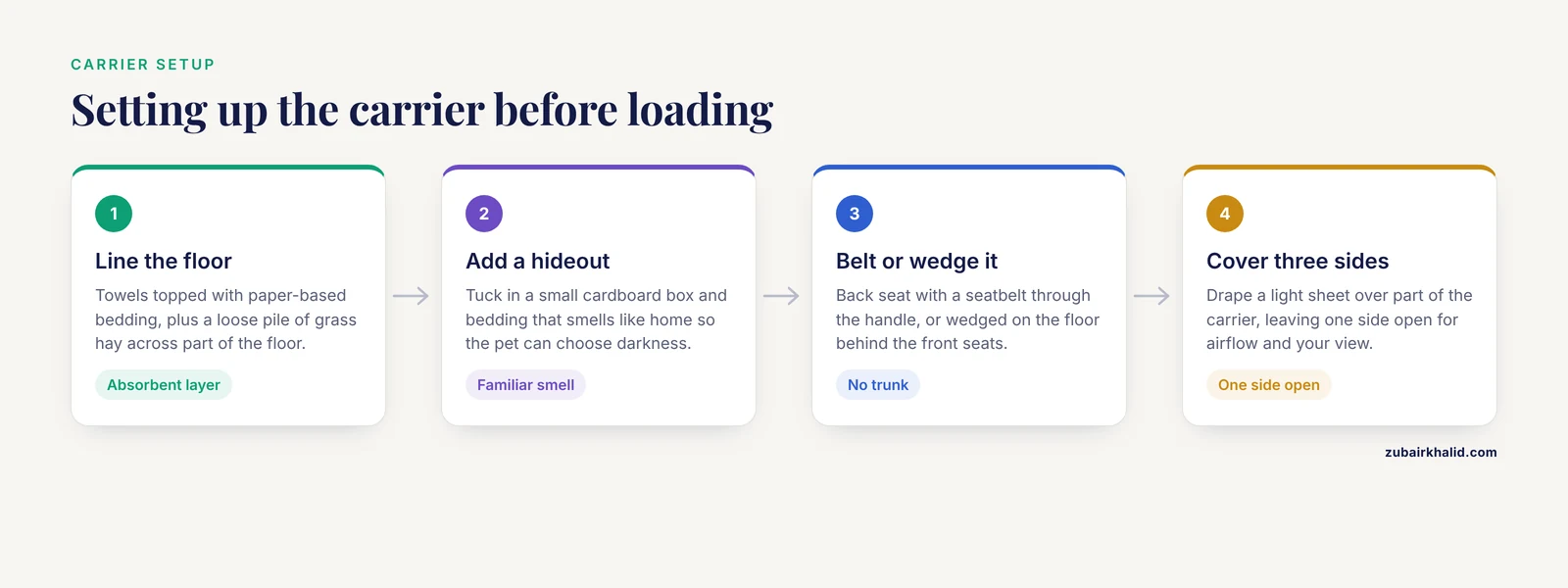
AVMA owner guidance on vehicle travel applies to every species, restraint protects both the animal and the people in a crash. Put the carrier on the back seat with a seatbelt threaded through its handle, or wedge it on the floor behind the front seats. Keep it out of direct sunlight and away from vents blowing hot or cold air straight into it. Never place the carrier in the trunk, in the bed of a pickup, or on the front seat, where airbag deployment can injure a small animal even inside a carrier.
Traveling with a Rabbit in Car Step by Step
- Acclimate first. Several days before the trip, leave the open carrier in your pet's area with bedding and hay inside, and feed a few meals near or in it.
- Take practice drives. Short trips around the block let you learn how your pet responds while the stakes are low. An animal that stays tense through an entire short drive needs a slower acclimation plan before a long journey.
- Pack the night before. Work through the checklist above so travel morning is a calm pickup rather than a scramble.
- Feed normally. Rabbits and guinea pigs must not be fasted before travel. Their digestive tracts need constant movement, and an empty stomach works against the gut rather than protecting it.
- Pre-cool the vehicle. Run the air conditioning before the animal is loaded so the carrier never sits in a warm cabin.
- Load calmly in an enclosed space. Carry the pet to the carrier in a room with the door closed. When lifting a rabbit, support the hindquarters, VCA Animal Hospitals' rabbit handling guidance notes that a sudden kick from those powerful back legs can injure the spine. Scoop a guinea pig with two hands under the chest and rump.
- Secure and cover. Belt or wedge the carrier, then drape a light sheet over part of it, leaving one side open for airflow and your view of the animal.
- Drive gently. Moderate speeds, slow stops, low music. Ask passengers to keep voices down and hands out of the carrier, and skip air fresheners or strong scents, because both species have sensitive respiratory tracts.
- Stop and check. At each break, look without necessarily opening the carrier. Is the posture relaxed or hunched? Are there droppings? Offer water and a handful of fresh hay, and spot clean if the bedding is soaked.
- Settle and monitor on arrival. Set up a pen with familiar bedding, the hideout, hay, and water. Watch appetite and dropping production closely for the next day, because stress-related gut slowdown often appears after the trip ends rather than during it.
Traveling with a Rabbit in Car: Tips That Make the Drive Easier
Food and water on the road
Bring the exact hay, pellets, and vegetables your pet eats at home. Sudden diet changes upset the gut of both species, and a travel day is the worst possible time to discover an animal refuses an unfamiliar vegetable. Scatter hay through the carrier rather than relying on a rack, and offer water in a heavy crock at every stop. Many animals will not drink from a bottle in a moving car, and some will not drink away from home at all. Wet greens cover part of that gap, which is one more reason to pack them.
Temperature control
Plan travel for the cooler parts of the day in warm months and pre-cool the cabin before loading. At stops, touch the carrier interior. A hot carrier means the animal needs a cooler spot immediately. A frozen water bottle wrapped in a towel gives your pet a place to lean away from heat without sitting on ice. In cold weather, add bedding and keep the carrier out of drafts, but never block all ventilation.
Keeping stress low
Cover most of the carrier so passing traffic cannot startle your pet, keep the radio low, and drive as if there were a full cup of water on the dashboard. On long trips, a passenger seated near the carrier can reassure the animal and spot problems early. Keep dogs and cats out of the same vehicle when you can, the sight and smell of a predator an arm's length away can keep a prey animal flooded with stress hormones for hours.
Rest stops and monitoring
Treat every stop as a health check as well as a bathroom break. Count droppings, watch breathing, and look at posture. A relaxed rabbit or guinea pig sits loosely, often with hay in front of it. A worried one crouches with ears flat, eyes wide, and fast breathing. Note what you see at each stop so you can describe trends to a veterinarian if needed. Constant thumping from a rabbit, or repeated squealing from a guinea pig, signals fear rather than conversation.
Common Mistakes When Traveling with a Rabbit in Car
- Letting the animal ride loose or on a lap. A loose rabbit under the brake pedal or a guinea pig dropped during a panic leap ends in injury or a lost pet. In a crash, an unrestrained animal becomes a projectile.
- Stopping for a few minutes with the pet in a parked car. Cabin temperatures climb quickly even in shade with windows cracked, and small mammals have almost no capacity to cool themselves.
- Fasting before the trip. Owners who fast dogs before procedures copy the habit. Rabbits and guinea pigs need food moving through the gut continuously, and fasting pushes them toward stasis.
- Introducing new foods on travel day. A novel vegetable can cause diarrhea or feed refusal, exactly what you do not want to troubleshoot on the road.
- Using the wrong carrier. Too large and the animal is thrown around, too small and it cannot rest, soft-sided and it can chew out, wire-floored and its feet take the abuse.
- Storing the carrier in the trunk or truck bed. There is no temperature control, no monitoring, and no protection in a rear impact.
- Skipping the destination vet search. The hardest emergency to manage is one where no nearby clinic treats exotics.
- Reading stillness as contentment. Freezing is a fear response in prey animals. Judge comfort by eating, drinking, and droppings rather than by quietness.
- Ignoring a slowdown in droppings. Fewer or smaller droppings after travel are the earliest visible sign of gut trouble and the clearest signal to call a veterinarian.
- Waiting out a feed refusal. A rabbit or guinea pig that will not eat is a same-day veterinary problem, not something to monitor until the trip ends.
Troubleshooting Problems on the Road
Your pet will not eat in the car
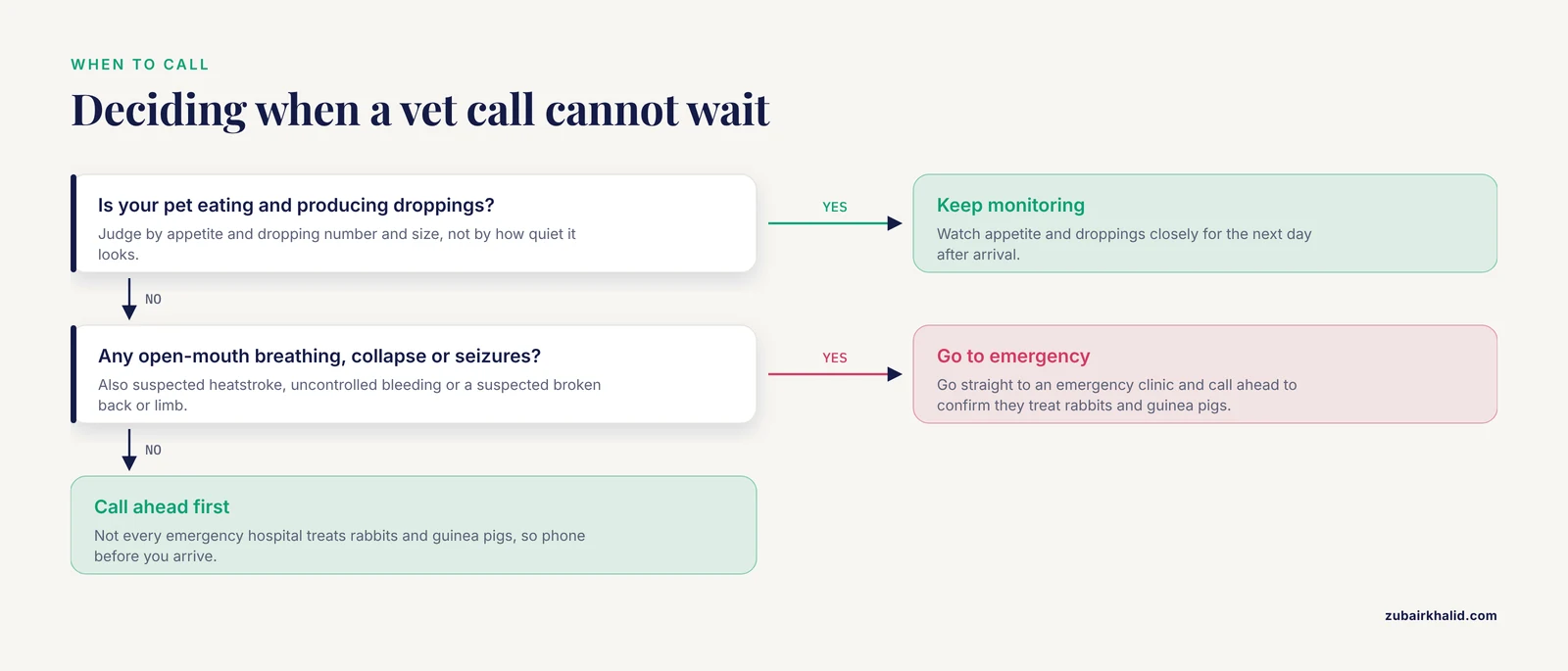
Refusing food during the drive is common and often resolves once the animal settles. Keep hay in front of it and offer familiar greens at stops. Track the timing. If your pet still refuses food after settling at your destination, contact a veterinarian the same day.
Your pet will not drink
Offer water in a crock at every stop and add wet greens. Note the last confirmed intake. If refusal continues past the first hours at your destination, call the clinic you identified before the trip.
Droppings slow or stop
Dropping output is your best window into gut function. A drop in number or size after travel deserves same-day veterinary advice, especially alongside a reduced appetite. Do not wait to see whether it resolves on its own.
Escape attempts
If a pet gets loose in the vehicle, pull over safely, close the windows and doors, and stay low and quiet. Lure with hay or a favorite vegetable rather than grabbing. Never open a carrier in an unenclosed space, load and unload indoors or inside a closed garage whenever possible.
Heat and cold emergencies
Open-mouth breathing, drooling, weakness, hot ears, or collapse in warm conditions point to heatstroke. Move the animal to a cool space, dampen the ears and paws gently with room-temperature water, offer cool water to drink if it will take it, and go straight to an emergency veterinarian. Do not use ice water, gradual cooling while you travel to the clinic is safer. In cold conditions, huddling, cool ears, and lethargy call for gradual warming and a veterinary call.
Welfare and Safety Points Owners Overlook
Ask first whether the trip is necessary. Rabbits bond strongly to their own territory, and the Rabbit Welfare Association and Fund notes that many rabbits cope better with a knowledgeable sitter in their own home than with a journey to an unfamiliar place. For vet visits and household moves, travel is unavoidable, and preparation is what limits the risk.
Bonded rabbits and guinea pigs comfort each other and often travel better as a pair, provided the carrier is large enough and the pair already lives together peacefully. Any chasing, rough mounting, or nipping means separate carriers for the trip.
Keep the carrier away from other pets in the vehicle, and never leave the animal alone in the car, with the engine running or off. Air conditioning can fail, and a running unattended vehicle carries its own risks.
Think about the destination, not just the drive. Pet-proof the room where your pet will stay, block access to electrical cords, remove toxic houseplants, and set up the pen with the same hideout, bedding, and hay from the carrier so the new space smells familiar.
Limitations and When to Contact a Veterinarian
Every rabbit and guinea pig is an individual, and only a veterinarian who has examined your pet can judge whether a specific trip is safe for that animal. The guidance here reflects general small-mammal practice rather than a verdict on your particular pet.
Contact a veterinarian promptly, the same day, if your pet shows any of the following during or after travel:
- No eating, or a clear drop in appetite
- Fewer, smaller, or absent droppings
- Hunched posture, teeth grinding, or reluctance to move
- Labored breathing, open-mouth breathing, or noise with each breath
- Discharge from the nose or eyes
- Diarrhea, or a dirty, wet rear end
- A bloated or drum-tight abdomen
- Trembling that does not settle, collapse, or seizures
- Any injury from a fall, a kick, an escape attempt, or another pet
Go to an emergency clinic immediately for open-mouth breathing, collapse, seizures, suspected heatstroke, uncontrolled bleeding, or a suspected broken back or limb. Call ahead, because not every emergency hospital treats rabbits and guinea pigs, and the clinic you identified before departure is the one to contact.
Frequently Asked Questions
Can my rabbit or guinea pig ride loose in the car if it seems calm?
No. A loose small animal can reach the pedals, escape through a partially open window, or be thrown during a sudden stop. Stillness in prey animals is often freezing rather than relaxation, so the risk remains regardless of temperament.
Should I cover the carrier during the drive?
Yes, partially. Covering three sides blocks visual startles and helps prey animals feel hidden, while one open side preserves airflow and lets you check on your pet. Use a light fabric and never cover all ventilation.
How long can a rabbit travel in one day?
There is no fixed safe number. Judge by your individual animal, build in stops to offer water and hay, and consider splitting very long journeys across two days. If your pet stays tense and stops producing droppings, stop for the day.
Can a rabbit and a guinea pig share one carrier?
No. Keep them in separate carriers. They have different dietary needs, a rabbit's powerful hind legs can seriously injure a guinea pig, and each animal does better with its own hideout and hay.
What if my pet will not eat or drink during the trip?
Keep offering familiar hay and greens, offer water at stops, and track the timing. Refusal that continues after the animal settles at your destination is a same-day veterinary call, because gut slowdown in both species escalates quickly.
Do I need paperwork to cross state lines with a rabbit or guinea pig?
Requirements vary by destination and species, and some jurisdictions restrict small-mammal entry. Ask your veterinarian before the trip and confirm the rules for your destination directly rather than assuming none apply.
What temperature is safe for car travel?
No single number covers every animal, but both species tolerate heat poorly and cool conditions far better. Pre-cool the cabin, keep the carrier out of direct sun, and never leave the animal in a parked car, even briefly, even in shade.
Should I sedate my rabbit for a long car trip?
Do not give any sedative without a veterinarian's direction. Sedation affects prey species differently than dogs and cats, and a sedated small mammal is harder to monitor. Discuss severe travel anxiety with a small-mammal veterinarian, who may recommend acclimation strategies instead.