Taming a Guinea Pig: A 14-Day Trust-Building Plan
By Dr. Zubair Khalid, DVM, MS, PhD ·
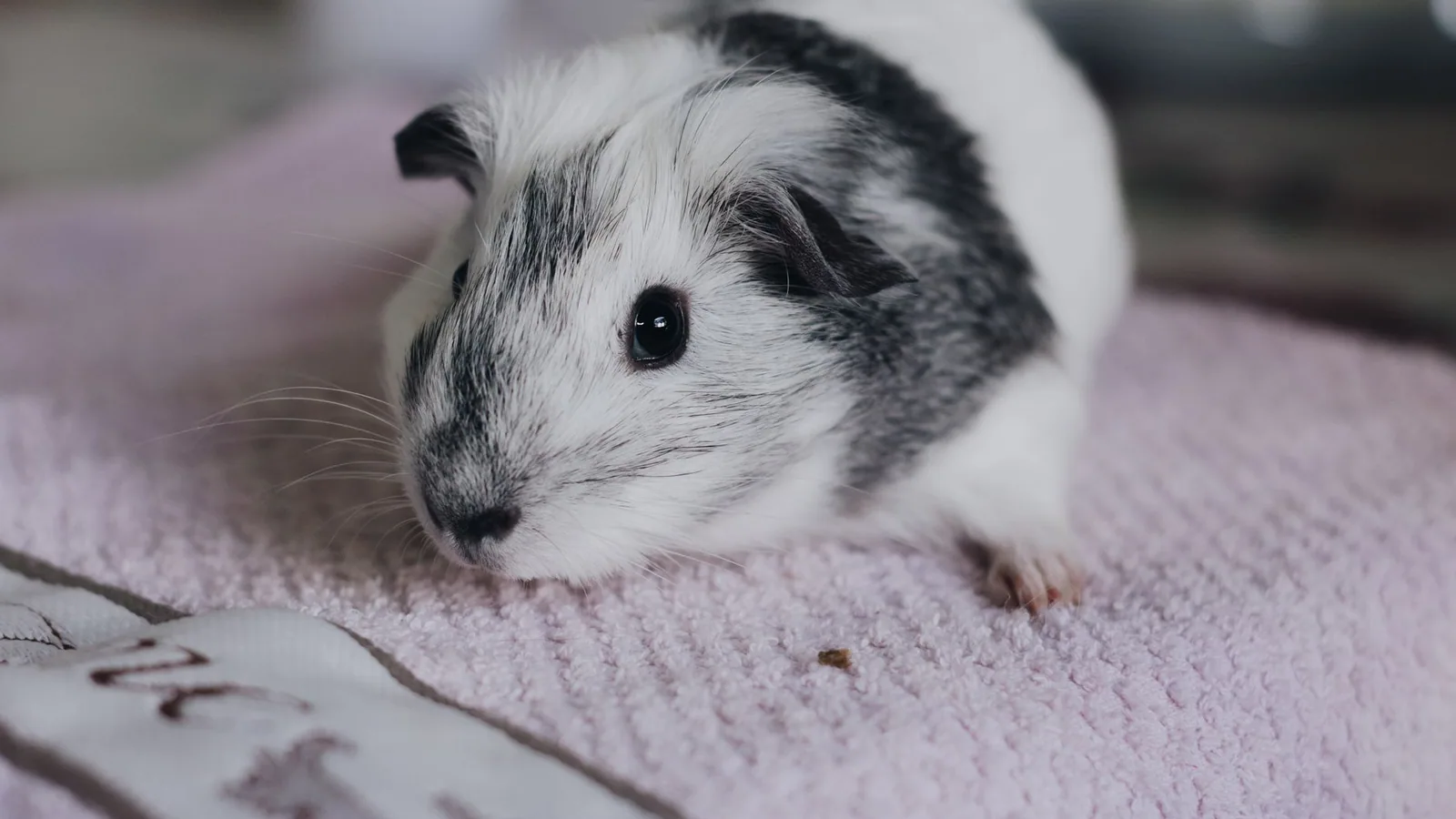
Taming a guinea pig takes about two weeks of short, calm, repeated sessions where you let the animal set the pace. You start by simply sitting near the cage, then progress to offering food from your hand, then to brief lifts, and finally to relaxed lap time. Guinea pigs are prey animals, so their instinct is to freeze or flee when a large shape reaches over them. Your job is to prove, day after day, that you predict nothing bad. Most healthy guinea pigs will accept handling within 14 days if you follow the plan below and never rush a step.
This guide gives you the full schedule, a fill-in template you can copy, a worked example, and the troubleshooting steps that matter most in the first month. It fits alongside any standard guinea pig care guide you already use and includes a short care checklist so taming work never crowds out diet, housing, or health basics.
This article is educational and is not a substitute for veterinary diagnosis or treatment.
At a Glance: The 14-Day Trust-Building Plan
| Phase | Days | Goal | Daily Time | Success Marker |
|---|---|---|---|---|
| Settle and observe | 1-3 | Let the guinea pig learn your voice and routine | 5-10 min | Eats and moves normally while you sit nearby |
| Hand feeding | 4-7 | Associate your hands with food | 10 min, 2 sessions | Takes a treat from your open palm |
| Contact and touch | 8-11 | Accept touch in the cage | 10 min, 2 sessions | Stays calm when touched on the shoulder |
| Lift and lap time | 12-14 | Short lifts and lap sessions | 10-15 min | Sits on your lap for several minutes without panic |
If any marker is not reached, repeat that phase for two to three more days before moving on. The plan is a template, not a stopwatch.
Why Guinea Pigs Need a Trust-Building Plan
Guinea pigs (Cavia porcellus) are ground-dwelling herbivores that evolved as prey for birds of prey and mammals. The Merck Veterinary Manual describes them as docile, social animals that rarely bite, but that are easily startled and rely on hiding and fleeing rather than fighting. That single fact shapes every taming technique in this article.
Three consequences follow from their prey biology:
- Approach from above triggers panic. A hand descending from overhead mimics a hawk. Approaching low and from the side reads as harmless.
- Freezing is fear, not calm. A guinea pig that goes rigid is frightened. A relaxed guinea pig moves, eats, and explores.
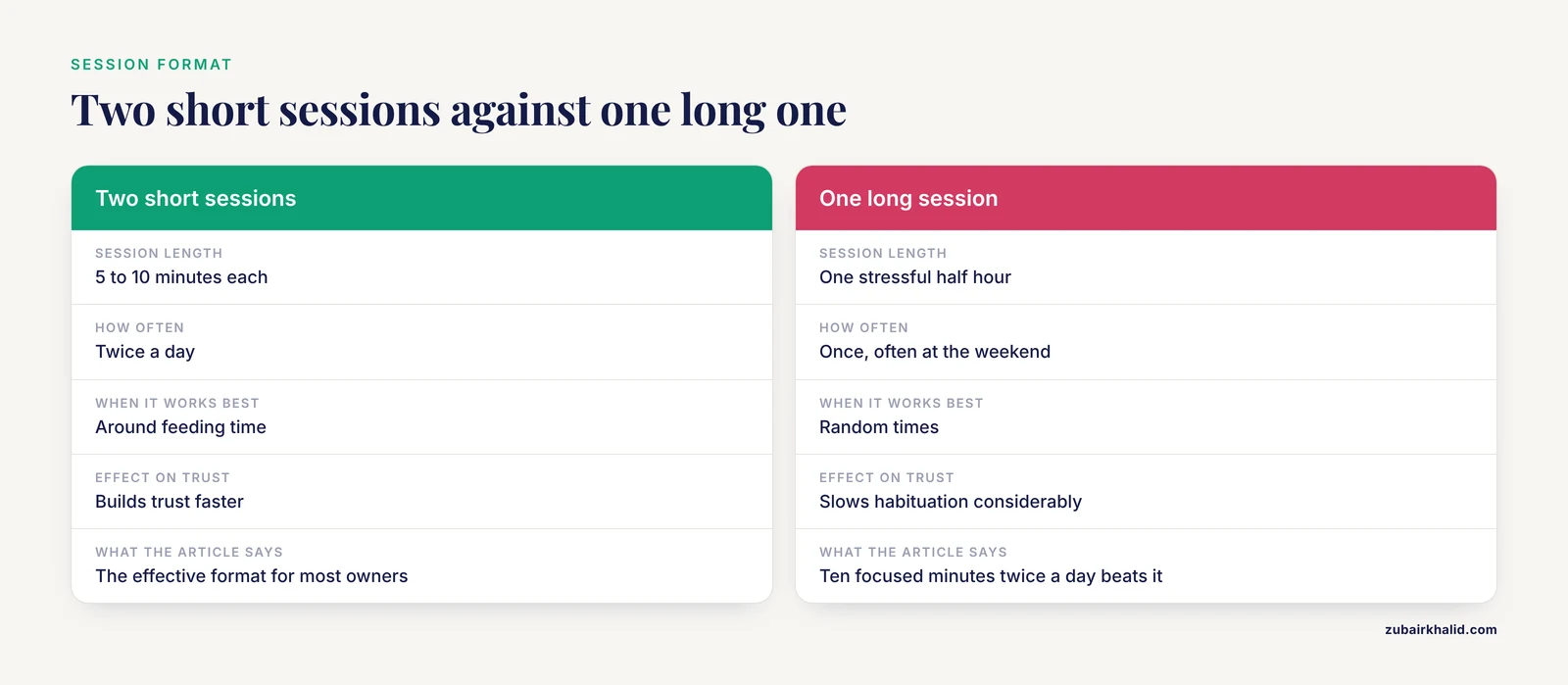
- Consistency beats intensity. Two calm 10-minute sessions a day build trust faster than one long, stressful session on the weekend.
Guinea pigs also communicate with sounds. The loud "wheek" signals excitement, often at the sound of a food container. Purring, rumbling, and chirping carry different meanings depending on body posture. Learning these sounds is part of taming your guinea pig, because you will use calm, consistent talk in a low voice as a predictable signal that you are near and that nothing bad follows.
Before Day 1: Setup, Supplies, and a Care Checklist
Taming fails when the underlying care is wrong. A hungry, cold, or painful guinea pig cannot learn that humans are safe. Before you begin, run through this checklist, which condenses the core husbandry points from the Merck Veterinary Manual and VCA Animal Hospitals guidance on guinea pig care.
Guinea pig care checklist
- Cage large enough for normal movement, with solid flooring and absorbent bedding
- Unlimited grass hay available at all times
- Fresh vegetables daily, including a source of vitamin C, because guinea pigs cannot synthesize this vitamin and depend on dietary intake
- Fresh water in a bottle or heavy bowl, changed daily
- A hide box or covered retreat in the cage
- Food bowl and hay rack placed away from the toilet area
- Chew-safe enrichment, since teeth grow continuously
- A scheduled wellness visit with a veterinarian experienced in exotic companion mammals
- Cage located in a quiet, draft-free room at a comfortable household temperature, away from direct sun and loud appliances
Two setup points directly affect taming. First, keep the cage in a room where the household spends time. A guinea pig in a silent spare room never habituates to normal human noise and traffic. Second, never house guinea pigs with rabbits. Rabbits can carry bacteria that cause serious disease in guinea pigs, and the two species have different dietary and social needs, so reputable rabbit care checklists and exotic animal references treat cross-species housing as a welfare risk, not a convenience.
Supplies for taming sessions
- Small pieces of a favorite vegetable, such as a sliver of bell pepper or a leaf of romaine, reserved for training only
- A towel to cushion your lap and to safely wrap a nervous animal if needed
- A low, stable chair or a cushion on the floor, so a jump or fall is never far
- A small treat bowl you use at the same time each day, as an audio cue
- A notebook or phone note for the daily log described below
The 14-Day Plan, Step by Step
This is the taming guinea pig format this article is built around. Each day has one goal, one or two short sessions, and one measurable marker. Move forward only when the marker is met.
Days 1 to 3: Settle, Observe, and Become Background
Goal. Your guinea pig learns your voice, your smell, and your schedule without any pressure to interact.
How to do it.
- Sit beside the cage at the same times each day, ideally around feeding.
- Speak in a low, even voice for 5 to 10 minutes. Read aloud if it feels awkward to talk.
- Do not reach into the cage. Do not tap the bars. Do not try to touch.
- Refill hay and water normally, moving slowly.
Success marker. By day 3, the guinea pig resumes eating, drinking, and moving around while you sit nearby, rather than freezing in the hide box the whole time.
Why this works. Habituation to your presence is the foundation of everything else. The Merck Veterinary Manual notes that guinea pigs adapt well to routine handling, and routine is exactly what these three days build.
Days 4 to 7: Hand Feeding
Goal. Your open hand becomes a reliable source of good things.
How to do it.
- Place a vegetable sliver on your open palm and rest your hand flat on the cage floor near, but not inside, the hide box.
- Keep your hand still. Do not reach toward the animal.
- Wait. A curious guinea pig may take several minutes the first time.
- When the treat is taken, withdraw calmly. End on success.
- Over the following days, move your hand slightly farther from the hide box and let the guinea pig come to you.
- Begin saying a short phrase, such as "hello piggies," every time before you offer food, so the phrase becomes a predictor of treats.
Success marker. The guinea pig takes food from your open palm and begins approaching when it hears your cue phrase.
Practical note. Use small pieces. A treat the size of a fingernail keeps sessions focused and avoids overfeeding vegetables relative to the hay-based diet recommended for guinea pigs.
Days 8 to 11: Contact and Touch
Goal. The guinea pig tolerates brief touch while all four feet stay on the floor.
How to do it.
- Start each session with hand feeding, then rest your hand near the animal without touching.
- On the next session, touch the shoulder briefly, then remove your hand and offer a treat.
- Progress to short strokes along the back and shoulders, always in the direction the hair lies.
- Never approach from above. Bring your hand in low and from the side or front.
- Watch for the freeze response. If the animal goes rigid, stop touching and simply rest your hand nearby until it relaxes.
Success marker. The guinea pig continues eating or exploring while you touch it, and does not run to the hide box when your hand enters the cage.
Days 12 to 14: Lifts and Lap Time
Goal. Brief, secure lifts followed by calm lap sessions.
How to do it.
- Scoop with two hands, one under the chest and one under the rump, lifting close to your body. The Merck Veterinary Manual emphasizes supporting the hindquarters because the spine is not designed for twisting or dropping.
- Keep the first lift to a few seconds, then return the animal to the cage and offer a treat.
- Extend to 1 to 2 minutes of holding, then to lap time with a towel on your knees.
- Keep lap sessions under 10 minutes in this phase. Young guinea pigs in particular tire and chill quickly when held too long.
- Always sit on the floor or in a low chair. A guinea pig that leaps from lap height can be seriously injured.
Success marker. The guinea pig sits on your lap, eats, or explores calmly for several minutes and returns to the cage without frantic scrambling.
A Worked Taming Guinea Pig Example
Readers often ask for a concrete taming guinea pig example rather than a schedule. Here is how one plausible week looks in the daily-log template.
Owner. First-time owner with a 10-week-old male guinea pig named Milo, home for three days before Day 1.
| Day | Session | What Happened | Marker Met? |
|---|---|---|---|
| 1 | Morning, 6 min | Milo froze in hide box the entire session | No, expected |
| 2 | Morning, 8 min | Came out to eat hay while owner read aloud | Partial |
| 3 | Evening, 8 min | Wheeked at the sound of the veg container | Yes |
| 4 | Evening, 10 min | Ignored the palm treat for 7 minutes, then took it | Yes |
| 5 | Morning, 10 min | Took treat within 30 seconds of the cue phrase | Yes |
| 6 | Evening, 10 min | Ran to the front of the cage when owner sat down | Yes |
| 7 | Morning, 10 min | Ate from palm twice in one session | Yes, advance |
If Milo had still been hiding through Day 3, the owner would simply repeat Days 1 to 3 through Day 6 and move on from there. Slower is normal for adult guinea pigs from pet stores or rescues, animals with no prior positive handling, and newly adopted pairs still sorting out their hierarchy.
Reading Guinea Pig Body Language During Taming
Taming your guinea pig safely depends on reading signals correctly. The following table reflects descriptions of normal guinea pig behavior in veterinary references.
| Signal | Meaning | Your Response |
|---|---|---|
| Popcorn (sudden vertical jumps) | Excitement, often in young guinea pigs | Continue, this is positive |
| Wheeking | Anticipation, usually food related | Can be used as a training bridge |
| Rumbling with a swaying rear | Dominance display, often between cage mates | Do not interfere unless fighting starts |
| Teeth chattering | Irritation or warning | Stop the session, give space |
| Freezing with flattened body | Fear | Remove your hand, end session calmly |
| Biting or hard nipping | Fear or pain | Check your technique, consult a veterinarian if new behavior |
| Hiding for a full day without eating | Possible illness, not shyness | Contact a veterinarian the same day |
That last row matters. A guinea pig that stops eating is having a medical problem, not a personality problem. Anorexia in guinea pigs is an emergency because gastrointestinal stasis can develop rapidly, and the Merck Veterinary Manual lists anorexia as a key sign of illness in this species.
Common Mistakes That Set Taming Back
- Grabbing from above. This is the single most common error. It confirms the hawk fantasy and can undo a week of progress.
- Long sessions. Ten focused minutes twice a day beats one stressful half hour. End every session before the animal panics.
- Forcing interaction through children. Young children should sit with a parent and offer treats with a hand guided by an adult, not carry the animal.
- Skipping the settle phase. Owners who rush to picking up on Day 2 often produce a terrified animal that now hides whenever a human approaches.
- Inconsistent timing. Guinea pigs learn schedules. Random session times slow habituation considerably.
- Treating freezing as success. A rigid guinea pig is not calm. Progress is measured by normal eating, moving, and exploring in your presence.
- Ignoring the cage mate. A bonded pair should be tamed together when possible. Separating a bonded pair for long solo sessions can itself cause stress, and reputable guinea pig care guidance stresses keeping compatible pairs together.
Troubleshooting Common Problems
My guinea pig runs and hides every time I approach
Go back one phase. If the animal hides during hand feeding, return to sitting and talking only for two to three days, then restart hand feeding with the treat placed farther from the hide box. Reduce your approach speed. Slow is a signal in itself.
My guinea pig takes the treat but nips my fingers
Nipping during hand feeding usually means the animal cannot distinguish food from fingers. Offer treats on a flat palm with the vegetable laid across your fingers, not pinched between them. Wash hands before sessions so food smells do not linger from other tasks.
My guinea pig squeals when I pick it up
A sharp squeal on lifting means the support is wrong or the animal was startled. Review your two-handed scoop and make sure the hindquarters are fully supported. If squealing continues with correct technique, or if the animal cries when touched in one spot, pain is possible and a veterinary exam is needed.
Progress stopped at week two
Plateaus are normal. Hold the current phase for several days, keep sessions short and predictable, and check the environment for new stressors such as a moved cage, a new pet, construction noise, or a change in household routine. If a plateau lasts more than two weeks, ask an exotic-animal veterinarian to rule out pain, dental disease, or other medical causes before assuming the problem is behavioral.
Handling, Children, and Household Safety
Correct lifting technique is a welfare issue, not just a taming issue. Support the whole body, keep the animal close to your chest, and sit down for all lap time. Never allow a young child to carry a guinea pig standing up. The Merck Veterinary Manual specifically cautions that guinea pigs are easily injured if dropped, and that young animals should be handled minimally at first.
Wash your hands before and after handling. Guinea pigs can carry organisms without showing illness, and routine hand hygiene is standard small-mammal practice in veterinary guidance.
If you also keep rabbits, run a separate rabbit care checklist for that species rather than merging routines. Rabbits and guinea pigs differ in diet, social structure, and disease risk to each other, so cross-species housing and shared exercise pens without supervision are not recommended in veterinary references.
Limitations and When to Contact a Veterinarian
Every guinea pig is an individual, and the 14-day plan is a general framework rather than a medical protocol. Any health question about your specific animal needs an in-person examination by a veterinarian experienced with exotic companion mammals. That single limitation governs everything above.
Contact a veterinarian promptly, the same day if possible, for any of the following:
- Not eating, or eating noticeably less hay than usual for more than a few hours
- No fecal output, or small, dry, misshapen droppings
- Diarrhea, lethargy, hunching, or a hunched, puffed-up posture
- Drooling, a wet chin, or difficulty chewing, which can indicate dental disease
- Discharge from the eyes or nose, labored breathing, or sneezing
- A squeal or flinch when touched in a specific location
- Overgrown nails, overgrown incisors, or sores on the feet
- Any bite or deep scratch, which can infection risk, in a wound that breaks skin
- Sudden behavior change in an animal that was previously tame, because pain is a leading cause of new aggression or hiding in small mammals
Schedule a wellness exam early in ownership if you have not already. Establishing a baseline with an exotics veterinarian before behavioral problems begin makes later phone calls and visits far more productive, and it is a recommendation consistent with general preventive-care guidance from veterinary organizations such as the AVMA.
Frequently Asked Questions
How long does it take to tame a guinea pig?
Most guinea pigs accept handling within 14 days of consistent, calm sessions, but shy or previously mishandled animals may need several weeks or months. Progress is measured by relaxed eating and exploring in your presence, not by the calendar.
Can I tame an older guinea pig, or does it only work with babies?
Older guinea pigs can be tamed. The plan works at any age, though adults from pet stores or rescues often move through the phases more slowly. Patience and consistency matter more than age.
How often should I do taming sessions?
Twice a day for 5 to 10 minutes is the effective format for most owners. Sessions around feeding time work best because the animal is already alert and motivated.
Why does my guinea pig squeak loudly when I open the fridge?
Loud squeaking, called wheeking, is an anticipatory food call. It is a normal, positive signal, and many owners use the sound of food preparation as a natural training cue during taming sessions.
Is it okay if my guinea pig never sits on my lap?
Yes. Some guinea pigs plateau at calm hand feeding and tolerant touch. That is a legitimate outcome. Never force lap time, because forcing it can undo the trust already built.
Can guinea pigs and rabbits be tamed and housed together?
No. Rabbits can carry bacteria that cause serious disease in guinea pigs, and the species have different dietary and housing needs. Tame each species separately and keep them in their own enclosures.
What treats work best for taming?
Small pieces of fresh vegetable that the guinea pig already eats, such as bell pepper or leafy greens, work well. Keep pieces fingernail-sized and consistent with the hay-based diet recommended for guinea pigs, and introduce any new food gradually.
When should I worry that hiding is a health problem instead of shyness?
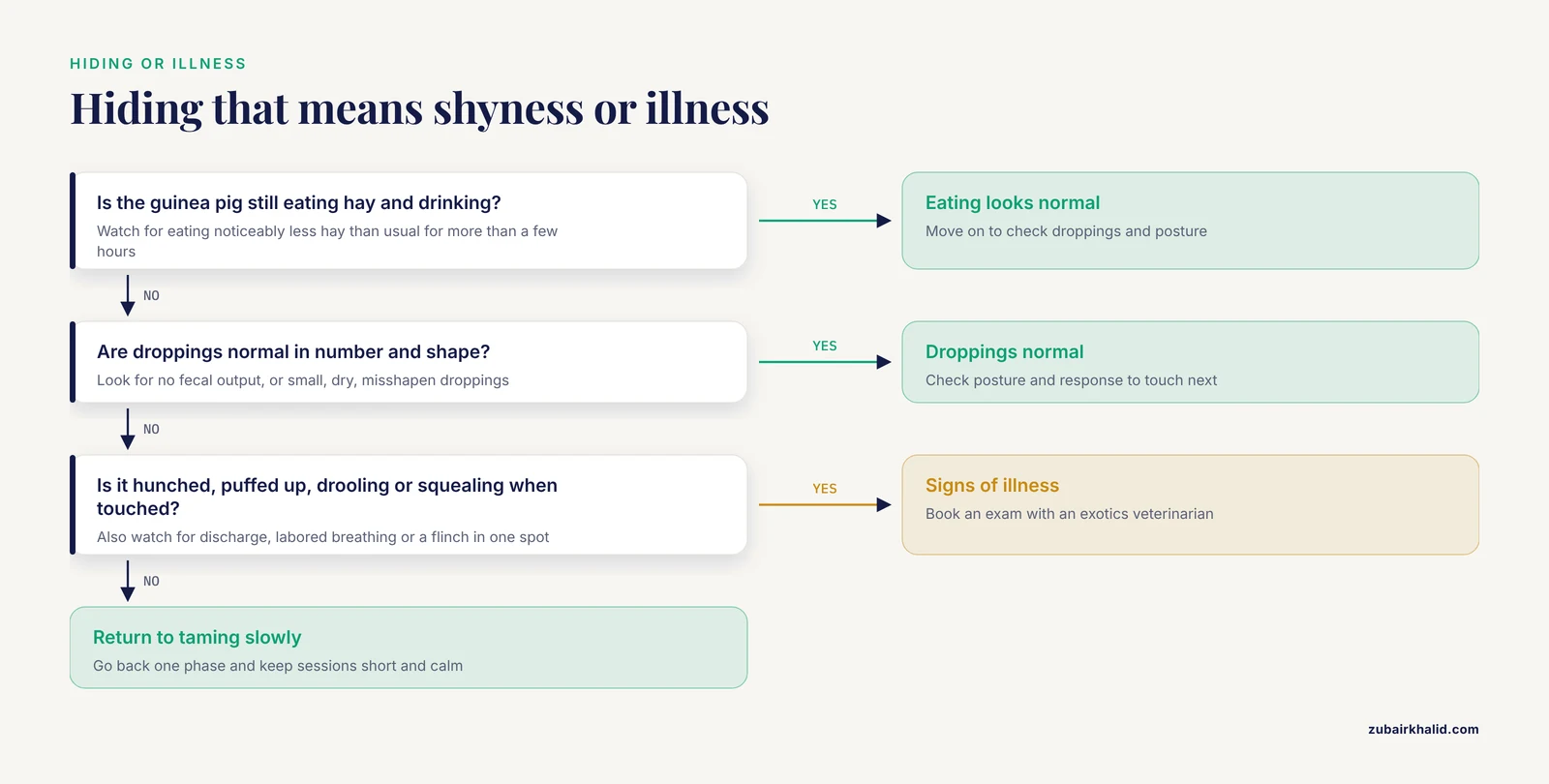
Worry when hiding is paired with reduced eating, fewer or smaller droppings, lethargy, or a hunched posture. A guinea pig that hides but eats, drinks, produces normal droppings, and responds to food cues is showing normal prey-animal behavior. A guinea pig that stops eating needs a veterinarian the same day.