Small Pet Grooming Kit: 10 Must-Have Tools
By Dr. Zubair Khalid, DVM, MS, PhD ·

A good small pet grooming kit is a set of tools sized and shaped for tiny, fragile bodies, while a dog or cat kit is built for larger, tougher skin and coats. The rule of thumb for choosing: match every tool to your specific species and coat length, and favor the smallest, quietest, gentlest option that still does the job. Rabbits, guinea pigs, and other small mammals have thin skin, fast nails, and dense coats that human or large-animal tools can easily damage.
Why a Dedicated Grooming Kit Matters
Grooming is a core part of basic hygiene care for companion animals, and research published in veterinary literature notes that missing routine grooming care carries real risks to an animal's health and welfare [1]. Grooming is also a natural behavior with biological functions, including parasite defense, removing debris, and thermoregulation, and studies in rodents show that self-grooming follows organized, predictable sequences governed by the nervous system [2]. That biology has a practical consequence for owners: when a small mammal cannot keep up with its own grooming, whether because of age, obesity, dental disease, arthritis, or a coat type it cannot maintain alone, the tools to fill that gap need to be ready before a problem starts.
Small mammals are not scaled-down cats and dogs. Rabbit skin in particular is famously thin and tears easily, a point the House Rabbit Society stresses in its handling guidance. Guinea pig nails grow quickly and curl. Long-haired breeds of both species mat within days if brushing lapses during a shed. A kit assembled for these animals specifically, with correctly sized tools, removes most of the risk from routine grooming at home.
Research on pet owner behavior also supports preparing properly. In a study of owners using a subsidized grooming service program, 92 percent reported at least one barrier to maintaining their pet's grooming at home, and 91 percent said that supplies such as brushes and combs, along with hands-on support, would help them meet their pet's grooming needs [1]. The same study found that owners who received a nail-trimming demonstration reported significant increases in confidence afterward [1]. A well-built kit plus a single demonstrated technique from your veterinarian or a rabbit and guinea pig rescue removes the two most common reasons at-home grooming fails.
The Complete Small Pet Grooming Kit at a Glance
The table below lists the ten tools that form the core of a functional small pet grooming kit. Each is explained in detail in the sections that follow.
| # | Tool | What It Does | Best For | Watch-Outs |
|---|---|---|---|---|
| 1 | Soft bristle brush | Removes loose surface hair and distributes natural oils | Short-haired rabbits, guinea pigs with smooth coats, sensitive areas | Stiff bristles can scratch thin skin |
| 2 | Slicker brush | Pulls out loose undercoat during heavy sheds | Molting rabbits, dense-coated guinea pigs | Use light pressure, never drag on thin skin |
| 3 | Wide-tooth comb | Works through tangles and long coat layers | Angora and other long-haired rabbits, Peruvian and Silkie guinea pigs | Pulling mats tight hurts, work from the tips |
| 4 | Fine-tooth (flea) comb | Finds fleas, debris, and small tangles close to the skin | All species, face and feet detail work | Metal teeth near skin need slow, angled strokes |
| 5 | Grooming gloves | Removes loose hair by touch, doubles as bonding | Pets that resist tools, nervous or newly adopted animals | Less effective on dense mats, a supplement not a substitute |
| 6 | Scissor-style nail clippers | Trims small nails cleanly and with visibility | Rabbits, guinea pigs, rats, chinchillas | Overcutting the quick causes pain and bleeding |
| 7 | Nail file or emery board | Smooths sharp nail edges after trimming | All species, especially animals who resist clippers | Filing alone is too slow for overgrown nails |
| 8 | Blunt-tip safety scissors | Careful spot trimming near mats or soiled fur | Long-haired pets, perineal hygiene in older animals | Never use near skin on a rabbit without veterinary demonstration |
| 9 | Styptic powder | Helps stop bleeding from an accidentally nicked nail | Every kit, as an emergency backup | Use only as your veterinarian directs |
| 10 | Non-slip towel or grooming mat | Secures footing and wraps nervous pets safely | All species, nail trims and exams at home | Avoid loose fabric that slips underfoot |
The 10 Tools Explained
1. Soft Bristle Brush
The soft bristle brush is the daily workhorse of the complete small pet grooming kit. It lifts loose surface hair, sweeps away dander and dust, and gives you a low-stress way to make coat checks part of your routine. For short-haired rabbits and smooth-coated guinea pigs such as American and Abyssinian breeds, this brush alone handles most routine maintenance between molts.
Choose a brush with a small head, soft natural or fine synthetic bristles, and no sharp seam along the bristle base that could scratch skin. Small animal bristle brushes are sold at most pet retailers, and a soft baby hairbrush is a common substitute recommended by experienced rabbit caregivers. Brush in the direction of hair growth with flat, sweeping strokes rather than pressing down.
2. Slicker Brush
During a molt, a short-haired rabbit can shed an astonishing volume of coat over a few weeks, and a slicker brush removes that loose undercoat far faster than bristles alone. Fine bent wires on a padded head lift dead hair from the undercoat so your pet swallows less of it. This matters most for rabbits, because rabbits cannot vomit, so swallowed hair must pass through the digestive tract, which is why House Rabbit Society and Rabbit Welfare Association and Fund guidance both emphasize brushing heavily during shedding seasons.
Use a small slicker, not a full-size dog slicker. Keep the pressure light, work in short strokes in the direction of the coat, and lift the tool away rather than dragging it against the skin. For guinea pigs with dense double coats, a slicker is useful during seasonal shedding as well.
3. Wide-Tooth Comb
The wide-tooth comb does the structural work in a long coat. It separates the coat into layers, finds tangles before they become mats, and lets you check down to the skin on long-haired rabbits such as Angoras and long-haired guinea pigs such as Peruvians, Silkies, and Texels. Rabbits and guinea pigs of these coat types need grooming at least daily, and Rabbit Welfare Association and Fund guidance for long-coated rabbits stresses exactly that frequency.
Comb from the hair tips downward, loosening each section before moving closer to the skin. If the comb stops, do not pull. Hold the coat at the base so tension does not reach the skin, and work the tangle open with your fingers. A metal comb with rounded tooth tips lasts longer and cleans more easily than plastic.
4. Fine-Tooth (Flea) Comb
A fine-tooth comb serves two purposes. It is a detection tool, letting you part the coat and inspect close to the skin for fleas, flea dirt, skin flakes, or wounds that a brush would glide over. It is also a precision tool for the face, feet, and around the genitals where larger brushes are clumsy.
Metal flea combs with rounded tooth ends are safest. Run short strokes and wipe the teeth on a damp paper towel between passes so you can see what you are picking up. If you find fleas or heavy flea dirt on a rabbit or guinea pig, contact your veterinarian before applying any product, because many flea treatments labeled for cats and dogs are unsafe for small mammals.
5. Grooming Gloves
Grooming gloves turn brushing into petting. Loose hair adheres to soft rubber tips on the palm, and many animals that flee a brush will accept a gloved hand. For newly adopted pets, animals with a history of rough handling, and rabbits who associate restraint with danger, the glove is the tool that starts the relationship.
Treat the glove as a supplement rather than a replacement. It removes loose surface hair well but does almost nothing for mats or dense undercoat. Use it for calm daily sessions, then follow with a brush or comb as your pet tolerates. A consistent finding in the literature on grooming is that grooming behavior is integrated into normal daily routines rather than being purely reactive [2], and building a predictable, gentle grooming routine taps into that same pattern-seeking biology.
6. Scissor-Style Nail Clippers
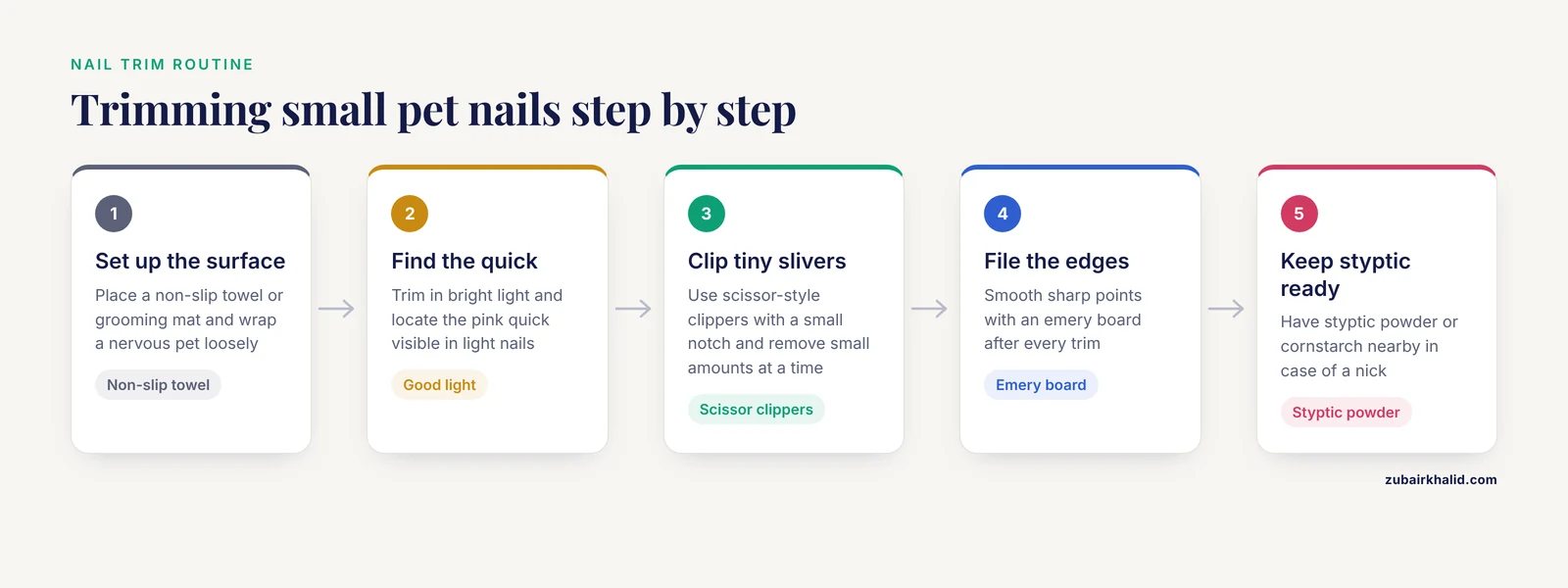
Nail trimming is the task owners fear most and the one where a demonstration pays off fastest. Owners in the subsidized grooming program study showed statistically significant gains in nail-trimming confidence after a single hands-on demonstration [1]. Ask your veterinarian or an experienced rescue volunteer to show you where the quick sits on your species, then practice while they watch.
Scissor-style clippers with a small cutting notch give you the best visibility on small nails. Guillotine-style clippers hide the nail, and human clippers crush rather than cut small curved nails. Trim in good light, remove tiny slivers at a time, and stop well before the pink quick that is visible in light nails. On dark nails, trim conservatively and file instead. Ask your veterinarian how often your individual animal needs trims, as growth rate varies with diet, activity, and age.
7. Nail File or Emery Board
A flat emery board or small file smooths the sharp points clippers leave behind, which protects both your arms and your pet's skin from scratch damage. Filing after every trim also slows the return of sharp edges between sessions. For animals that tolerate handling but panic at the click of clippers, some owners maintain nails entirely by filing short sessions several times per week. This takes patience, and it works only on nails that are already near the correct length. Heavily overgrown nails, especially nails that have curled or grown into the pad, need professional trimming first.
8. Blunt-Tip Safety Scissors
Rounded blunt-tip scissors let you trim soiled fur or carefully free a loose tuft without a sharp point near skin. They are most useful for long-haired guinea pigs whose coats collect urine and feces around the rear, and for older rabbits who cannot keep their hindquarters clean. Soiled perineal fur attracts flies and raises the risk of flystrike, so many experienced caregivers keep blunt scissors specifically for keeping that area clear.
The watch-out is serious. Rabbit skin is thin enough to tear under scissors even when the cut is careful, and House Rabbit Society guidance repeatedly warns owners about this. If a mat sits close to the skin, do not cut it out at home. Ask your veterinarian or a groomer experienced with rabbits to remove it, and use the comb and slicker to prevent the next mat from forming.
9. Styptic Powder
Even careful trimmers occasionally nick a nail. Styptic powder is a hemostatic product pressed onto a bleeding nail tip to speed clotting. Keep a small jar in the kit as insurance, but treat it as a veterinary-guided tool. Ask your veterinarian to show you how to apply it during your first supervised trim, and know that bleeding that does not stop quickly with pressure and powder is a reason to call the clinic. If you choose not to keep styptic powder, keep cornstarch as a commonly suggested household fallback and still confirm its use with your veterinarian.
10. Non-Slip Towel or Grooming Mat
The humble towel is the tool that makes every other tool safer. A textured, non-slip surface keeps a rabbit or guinea pig from splaying its legs on a slick table, and a loose wrap, sometimes called a burrito wrap, calms a nervous animal during nail trims without squeezing the chest or abdomen. Small mammals have powerful hind legs and fragile spines, and restraint that prevents sudden kicking is a genuine injury-prevention step.
Choose a towel with some grip or place a rubber grooming mat on your work surface. Wash the towel between sessions. Keep a second towel reserved for cleaning up after perineal trims or messy shedding.
Small Pet Grooming Kit Options: Pros and Cons
Owners usually choose among three kit styles. Each has trade-offs.
Preassembled small pet kits. Retail kits bundle a brush, comb, clippers, and file in one box. The advantage is cost and convenience, and a decent kit covers the basics for a short-haired guinea pig on day one. The disadvantages are quality and sizing. Bundled clippers are often flimsy, brushes are sometimes stiffer than thin rabbit skin tolerates, and long-haired breeds outgrow the included comb quickly. A preassembled kit works as a starting point, not as the best small pet grooming kit for a dedicated owner.
Building your own kit. Buying each tool separately costs more up front and takes more research, but it lets you match each item to your animal. An Angora rabbit owner can invest in a proper wide-tooth comb and a quality slicker, while a short-haired guinea pig owner spends that money on better clippers instead. The disadvantage is that new owners sometimes overbuy, filling a drawer with tools their pet will never need. Build around your species and coat, not around a list.
Veterinary and rescue starter kits. Some rabbit and guinea pig rescues sell or gift starter kits assembled by experienced caregivers, sometimes paired with a grooming or nail-trim demonstration. Given the evidence that demonstrations raise owner confidence in nail trimming [1], this route is hard to beat if one is available in your area. The limitation is availability, which varies by region.
The deciding criteria that should drive the choice are simple. First, species and coat length determine which tools earn their place. Second, tool quality matters most for clippers and scissors, where dull or loose tools cause injuries. Third, your own confidence matters, and a kit you understand how to use outperforms a fuller kit you avoid opening.
Worked Scenarios
Scenario 1: A short-haired adult rabbit in a first-floor apartment. This owner needs the smallest functional kit. A soft bristle brush for daily passes, a small slicker for the twice-yearly heavy molts, scissor clippers with a file, a flea comb for quick skin checks, and a non-slip towel. The slicker earns its place only during shedding season, but rabbits shed hard enough that skipping it means sweeping hair daily and worrying about ingested fur. This owner should book one nail-trim demonstration at the next wellness visit before attempting the first trim.
Scenario 2: A long-haired guinea pig, such as a Peruvian, in a family home. This coat demands the complete small pet grooming kit. A wide-tooth comb for daily work through the long coat, a slicker for the undercoat, a flea comb for the face, and blunt-tip scissors for keeping the rear clean between full trims. Children in the household should be taught to hold the pet seated on the towel rather than carrying it, because falls from a child's height can injure small mammals. The family should confirm with an exotic-pet veterinarian how often the coat needs a professional tidy.
Scenario 3: A senior rabbit with arthritis and a history of messy hindquarters. Senior rabbits often groom themselves less, and the literature on mammalian grooming makes clear that self-grooming depends on physical capacity as well as motivation [2]. This owner's kit shifts toward hygiene tools. Blunt-tip scissors for the perineal area, unscented wipes for spot cleaning between vet-approved baths, the towel for safe positioning, and a grooming glove for gentle sessions the rabbit can tolerate on sore joints. This owner should also ask the veterinarian about checking the rabbit's hocks, teeth, and nails at each visit, since reduced self-grooming and overgrown nails often travel together.
Grooming Sections for Your Rabbit Care Checklist and Guinea Pig Care Guide
If you maintain a rabbit care checklist or a guinea pig care guide, the grooming entries below slot directly into either document.
Rabbit grooming checklist items.
- Brush short-haired rabbits at least weekly, and long-haired rabbits daily, increasing frequency during molts
- Use a slicker or wide-tooth comb to remove loose undercoat during heavy sheds, because rabbits cannot vomit and swallowed hair must pass through the gut
- Check the hindquarters and underside at every session for soiled fur and flystrike risk
- Inspect nails at each session and trim on the schedule your veterinarian recommends
- Check hocks for thinning fur and sores, especially in heavier rabbits
- Never bathe a rabbit in water, a point Rabbit Welfare Association and Fund and House Rabbit Society guidance both stress, because bathing can trigger shock, use wipes or spot cleaning instead
Guinea pig grooming checklist items.
- Brush short-haired guinea pigs weekly and long-haired breeds daily
- Check the grease gland at the base of the spine in males and ask your veterinarian how to manage buildup
- Keep the rear fur trimmed short in long-haired animals to prevent soiling
- Trim nails on a regular schedule, as guinea pig nails grow quickly and curl with age
- Comb out tangles before they tighten, working from the tips toward the skin
- Watch weight and appetite at grooming sessions, since a guinea pig that stops eating needs veterinary care the same day
Both lists share a principle worth stating once. Grooming sessions double as health exams. Running hands and combs over the whole body weekly is how most owners catch lumps, wounds, parasites, and weight loss early, and the study of grooming program clients confirms that supplies such as brushes and combs are among the supports owners themselves identify as most useful for maintaining care at home [1].
Common Mix-Ups
Using dog or cat tools at full strength. A full-size slicker dragged across rabbit skin can scratch or tear it. Downsize every tool and lighten every stroke.
Cutting mats with scissors. The most common self-inflicted grooming injury in rabbits comes from scissors slipping into thin skin over a mat. De-mat with combs and fingers, or have the veterinarian remove tight mats.
Cutting nails to the quick repeatedly. Repeated quick cuts make nails harder to maintain and make the pet harder to restrain. Trim tiny amounts and file.
Bathing small mammals. Full water baths stress rabbits and guinea pigs and are unnecessary for routine care. Spot clean, brush, and trim soiled fur instead, and ask your veterinarian when a cleaning situation genuinely requires clinical help.
Grooming through a problem. A pet that suddenly resists handling, has patchy hair loss, flaky skin, or sores is showing you a symptom, not an attitude problem. Stop, look closely, and call the clinic.
Assuming short coats need nothing. Even short-haired animals shed, grow nails, and benefit from the health check built into each grooming session.
Limitations and When to Contact a Veterinarian
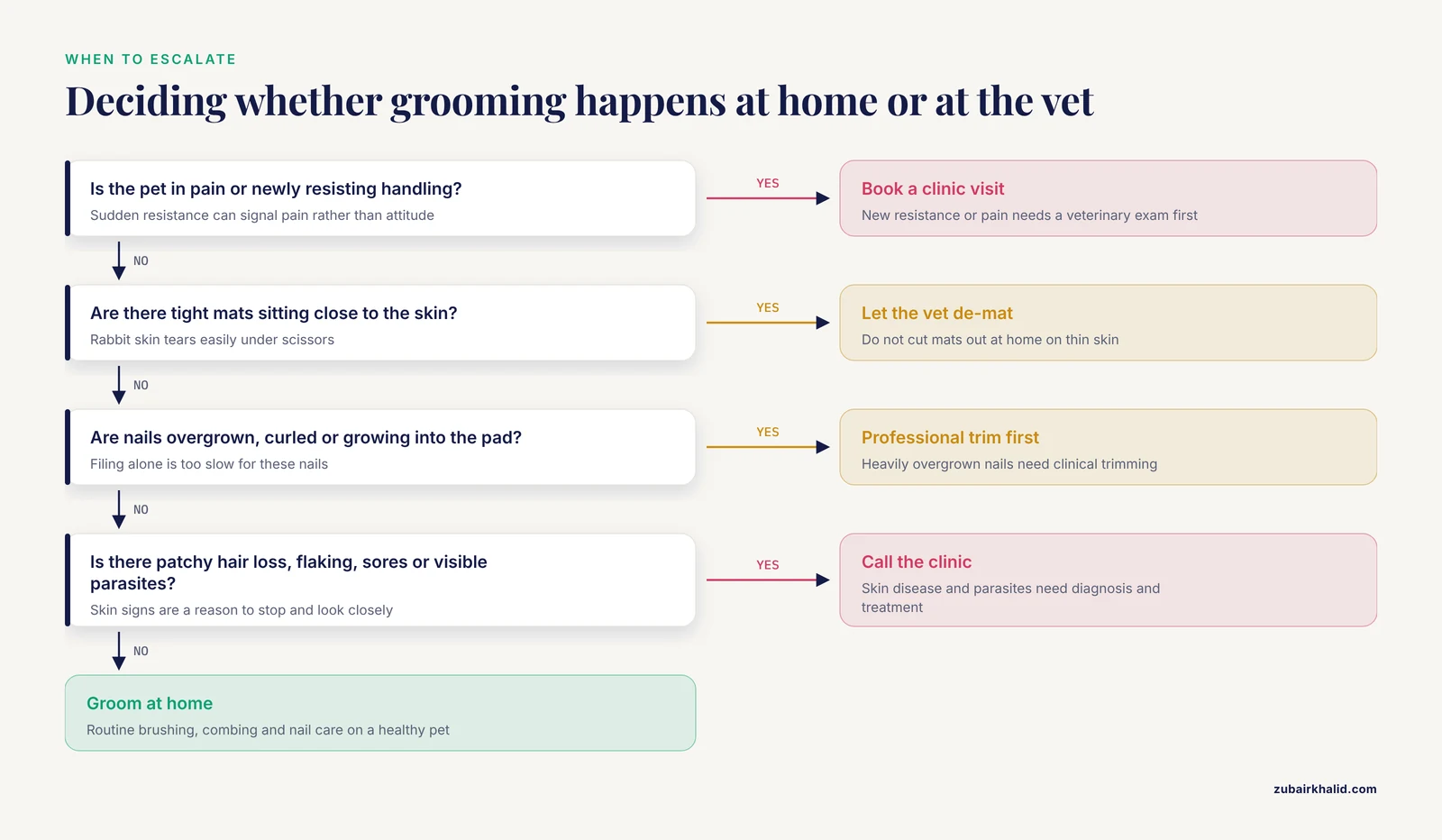
This article is educational and is not a substitute for veterinary diagnosis or treatment. The guidance here describes routine preventive grooming for healthy animals. Individual cases differ by species, breed, age, coat, diet, and housing, and your veterinarian should set the specifics for your pet, including nail trim frequency and whether any product in your kit is appropriate.
Contact your veterinarian promptly if any of the following occur:
- Bleeding from a nail or cut that does not stop within a few minutes of pressure
- A wound, tear, or swelling anywhere on the skin, since thin skin injuries can worsen quickly
- Sudden resistance to handling that is new for your pet, which can signal pain
- Patchy hair loss, redness, flaking, scabs, or visible parasites
- Fur or debris around or in the genitals, diarrhea pasting the rear, or wet, matted hindquarters
- Any suspicion of flystrike, meaning maggots or eggs in soiled fur, which is an emergency
- Overgrown or curled nails, especially nails touching or growing into the pad
- A pet that stops eating, produces fewer droppings, or seems lethargic during or after a grooming session
These escalation criteria apply across rabbits, guinea pigs, and similar small mammals, and an exotic-pet veterinarian is the right first call for all of them.
Frequently Asked Questions
How often should I groom my rabbit or guinea pig?
Short-haired animals usually need brushing once or twice weekly, with more frequent sessions during shedding seasons. Long-haired rabbits and long-haired guinea pig breeds need daily combing. Ask your veterinarian for a schedule fitted to your pet's coat, age, and health.
What is the best small pet grooming kit for a beginner?
The best beginner kit contains five items: a soft bristle brush, a small slicker or wide-tooth comb matched to your pet's coat, scissor-style nail clippers, an emery board, and a non-slip towel. Add the remaining tools as your pet's coat and your skills demand them. A grooming demonstration from your veterinarian or a rescue is worth more than any additional tool.
Can I use human clippers or human brushes on my small pet?
Human nail clippers crush small curved nails instead of cutting them cleanly, and human hairbrushes are too stiff and too large for thin small-mammal skin. Buy tools sized for small animals, or in a pinch use a very soft baby hairbrush and file rather than clippers.
How do I trim nails without hurting my pet?
Have a veterinarian or experienced rescue volunteer show you where the quick is on your species, trim in bright light, and remove tiny slivers at a time. Wrap your pet loosely in a towel on a non-slip surface, keep sessions short, and keep styptic powder or cornstarch nearby in case of a nick.
Do short-haired or hairless pets need grooming tools at all?
Yes, though the kit shrinks. Short-haired pets still shed, grow nails, and need skin checks, so a bristle brush, clippers, file, flea comb, and towel cover them. Hairless breeds need skin checks and nail care but no coat tools at all.
When should grooming happen at the vet instead of at home?
Any task involving tight mats near skin, an animal in pain, overgrown or curled nails, suspected skin disease or parasites, or a pet that will not tolerate handling safely should move to the clinic. Vets can also sedate or trim under clinical conditions when a pet cannot be handled awake.
Further Reading
- Practitioners' experiences of deteriorating personal hygiene standards in people living with depression in Australia: A qualitative study.
- The effect of personal grooming on self-perceived body image.
- Feminine Intimate Hygiene: A Review of Healthy and Unhealthy Habits in Women.
- Prevalence and Motivation: Pubic Hair Grooming Among Men in the United States.