Signs of Stress in Pet Mice and How to Help
By Dr. Zubair Khalid, DVM, MS, PhD ·
Pet mice show stress through behavior long before they show it on any lab report. The clearest signs of stress in pet mice are constant hiding, a rough or patchy coat, reduced nesting and burrowing, unexplained aggression toward cage mates or your hand, and repetitive escape attempts such as bar biting or lid jumping. Most cases trace back to a short list of causes: social conflict, a cage that blocks natural digging and climbing, disturbing odors from other animals, damp or dirty bedding, or untreated pain. You can correct many of these at home within days. A veterinarian should evaluate any mouse whose signs persist, worsen, or come with weight loss, wounds, or eye changes.
Mice are prey animals, and their instinct is to hide weakness until they cannot hide it anymore. That instinct makes stress easy to miss and makes early action valuable. Chronic stress is not a mood problem. It changes how a mouse's body responds to the next challenge, including infections [1].
Owner triage summary
- Call a veterinarian the same day for bite wounds, refusal to eat or drink, sudden lethargy, rapid weight loss, or a swollen, cloudy, or watery eye.
- Fix at home and monitor closely for hiding after a cage change, bar biting in a barren cage, mild squabbling between newly introduced cage mates, and nervousness after a household disruption.
- Never do give human pain relievers or another pet's leftover medication, bathe a mouse to fix a coat problem, or force handling on a frightened animal.
This article is educational and is not a substitute for veterinary diagnosis or treatment.
Signs of Stress in Pet Mice at a Glance
Use this table as your first triage filter. It maps the most common signs to their likely meaning, the immediate step, and whether professional care is needed.
| Sign | What it often means | Do this now | Vet needed? |
|---|---|---|---|
| Hiding, freezing, will not come out | Fear, recent disturbance, or pain | Reduce noise and handling, add cover, review recent changes | If it lasts more than a day |
| Bar biting, lid jumping, pacing | Cage too barren or small | Add deep bedding, hides, tunnels, nesting material | No, if it settles within days |
| Fighting with cage mates, visible wounds | Social incompatibility | Separate immediately, keep the wounded mouse warm and quiet | Yes, wounds need treatment |
| Rough, patchy, or greasy coat, scratching | Dermatitis, parasites, or pain | Book an exam, do not bathe | Yes |
| Reduced nesting or burrowing | Stress, illness, or too little bedding | Add nesting material and deepen the bedding | If no improvement in a few days |
| Less interest in food, weight loss | Illness or chronic stress | Weigh the mouse, offer the usual diet, check the water bottle | Same day |
| Watery, swollen, or cloudy eye | Ocular disease, often painful | Minimize handling, arrange an exam | Yes |
| Sudden lethargy or weakness | Possible systemic illness | Keep warm and quiet, offer food, call the vet | Same day |
How Stress Works in a Mouse's Body
Mice are built as prey. Their stress system is designed for quick, repeated threats, and in captivity those threats are usually social, sensory, or environmental rather than physical. Researchers measure the system directly. The mouse stress hormone is corticosterone, the counterpart of cortisol in people, and studies read it from blood plasma or from fecal samples [2], [3].
Acute stress is the freeze-or-flee response. In controlled testing, mice show a strong fear reaction to the odor of predator feces, demonstrated with a synthetic fox feces compound, while the same testing found no fear response to human urine odor [4]. That tells you two useful things. Predator smells genuinely alarm a mouse. Your own scent, on the other hand, is not the fear trigger many owners assume it to be, although rough handling can frighten any animal.
Chronic stress is different and more damaging. When mice live with a persistent stressor, such as continuously wet bedding, their bodies stay in a heightened state, and a later immune challenge produces exaggerated, prolonged responses [1]. Chronic stress experiments also show behavioral shutdown. Mice lose interest in sweet solutions they normally prefer, move less, and interact less with other mice [5]. A chronically stressed mouse often does not look frantic. It looks flat.
Two more points shape everything below. First, sex matters. Male mice are more prone to aggression-driven social stress, while females are more sensitive to isolation [3]. Second, individuality matters. A multicenter study that housed mice under matched conditions across four facilities found that the individuality of each mouse added its own influence on stress outcomes [3]. Your mouse is an individual, and the plan that worked for your neighbor's mouse may not work for yours.
Signs of Stress in Pet Mice
Behavioral Signs
Hiding and freezing. Research anxiety tests measure how much time a mouse spends in exposed, open areas versus protected edges [2]. A pet mouse that stops exploring, stays pressed into one corner, or will not come out even for food is showing the home-cage version of that avoidance.
Loss of natural behaviors. Nesting and burrowing are core mouse activities, and researchers use them as welfare readouts [3]. Healthy mice dig and burrow enthusiastically when given the chance [6]. A mouse that stops building nests or tunneling is telling you something is wrong.
Aggression and biting. Cage mate fighting that leaves wounds is a documented stress outcome, especially in males [3]. A previously gentle mouse that suddenly bites when touched may be protecting a painful spot, because pain is a recognized driver of welfare problems in mice [7].
Reduced voluntary interaction. Mice that willingly approach a familiar handler are showing comfort. Willingness to interact with a human handler is exactly what researchers track when they measure whether an intervention improves welfare [2]. A mouse that used to climb your hand and now bolts is regressing.
Physical Signs
Coat and skin. Large-scale disease records from mouse colonies list dermatitis, along with nonspecific signs such as poor hair coat, lethargy, and muscle wasting, among the most commonly reported problems [8]. A rough, greasy, or patchy coat is one of the most reliable visible clues that something is off.
Weight. Body weight is one of the core daily health indicators for small mammals, alongside coat condition, hydration, and activity [9]. Weight loss in an adult, or failure to gain in a young mouse, deserves the same urgency as any other physical sign.
Eyes. Ocular disease is common in mice and easy to overlook, because even professional facilities rarely perform routine eye checks and often lack the magnification tools needed to spot early lesions [10]. Watery discharge, swelling, cloudiness, or a closed eye is never a cosmetic issue.
Wounds and hydration. Bite wounds from cage mates are visible stress damage. Dehydration shows up as dull eyes, tacky gums, and reduced activity, which is why hydration belongs on the same checklist as weight and coat [9].
Stressed Mouse Symptoms That Mimic Illness
Stressed mouse symptoms overlap heavily with early disease. Lethargy, a poor coat, and reduced appetite are nonspecific signs that appear in stressed mice and sick mice alike, and they rank among the most frequent complaints recorded in mouse colonies [8]. Treat any of these as a reason for a veterinary exam, not as a self-diagnosis of stress. The exam exists to rule out disease first.
What Causes Stress in Pet Mice
Social Conflict and Isolation
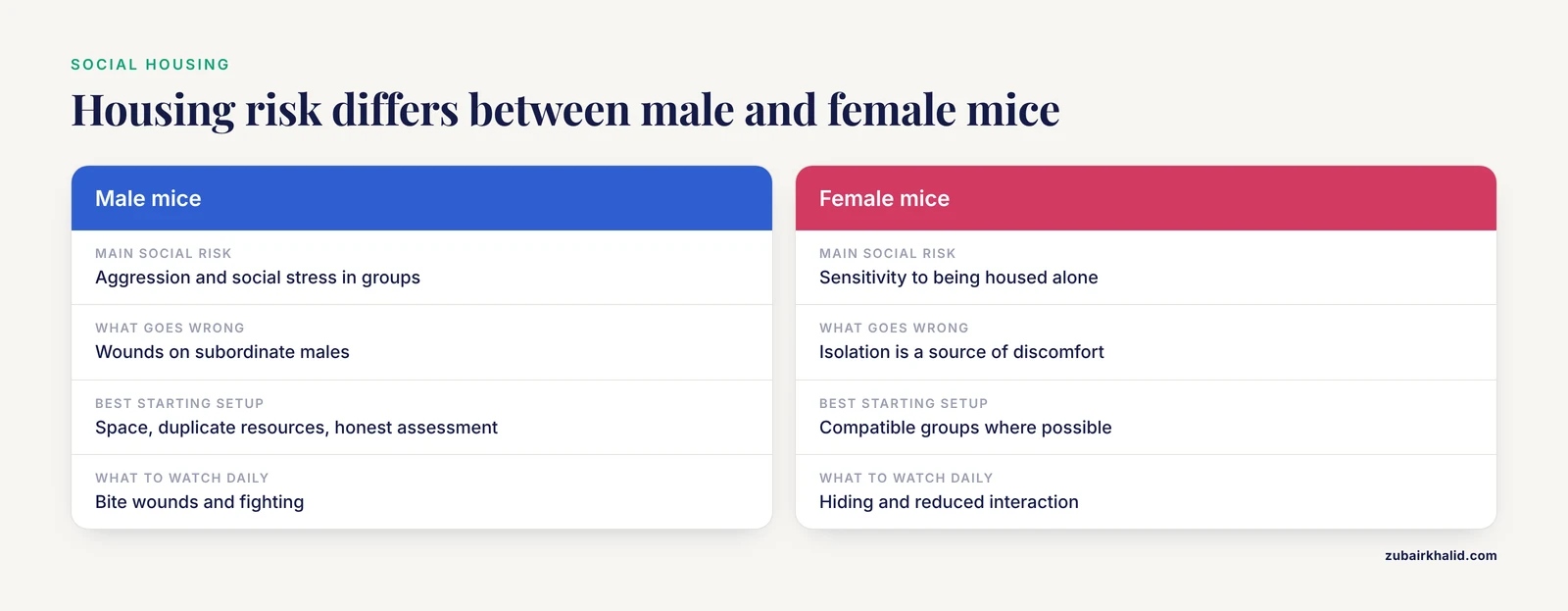
Social housing is the most misunderstood part of mouse care. Male mice housed together can develop aggression and social stress with real physiological consequences, and wounded subordinates are a common presentation [3]. Female mice have the opposite problem. Single housing is described in the housing literature as a potential source of discomfort for females [3]. Adding a new cage mate without a plan is itself a stressor, because introductions can go wrong quickly. There is no universal rule that fits every mouse, and the individual animal's response matters as much as the arrangement [3].
A Cage That Blocks Natural Behavior
Standard small housing restricts the expression of natural behaviors in rodents [6]. Mice are fossorial animals, which means digging and burrowing are species-typical activities, not optional hobbies [6]. A cage with a thin bedding layer and no structure gives a mouse nothing to do with its body or brain. Small, conventional cages are precisely what researchers use as the contrast condition when they want to compare against enriched housing [11]. If your setup looks like that contrast condition, your mouse is living in the control group of a stress study.
Wet Bedding, Ammonia, and Cleaning Routines
Wet bedding is not a minor housekeeping issue. Researchers deliberately keep mice on wet bedding for weeks to create a chronic stress model, because sustained dampness reliably activates the stress system [1]. Ammonia from urine is another documented cage parameter that facilities monitor as part of animal condition [12]. Cleaning creates its own problem, because a full cage teardown erases the scent landscape a mouse depends on, and cage change stress is a recognized concern that facilities actively work to reduce [12], [13]. Good cleaning is a balance between hygiene and continuity.
Odors You Cannot Smell
Smell is a mouse's primary information channel. Scents tell a mouse about the identity, sex, and physiological status of nearby animals and warn of predators [13]. In facility surveys, hands and gloves transferred odors between male and female mice, most units housed males and females in the same room, and many staff underestimated how strongly human and animal odors affect mice [13]. Rats are the species most commonly housed near mice, and only a minority of surveyed units were aware that rat scents could affect their mice [13]. At home, the equivalents are a predator species housed or handled nearby, hands that just held another animal, or heavily scented products around the cage. Predator odors are documented fear triggers, even though human urine odor itself did not provoke fear in controlled testing [4].
Pain and Hidden Disease
Pain is a stressor, and minimizing it is a core welfare obligation in mouse care [7]. Common pain sources include dermatitis and ocular disease, both of which rank among the most frequently reported spontaneous problems in large colony records [8]. Eye lesions deserve special mention because they are frequently missed without deliberate, magnified examination [10]. A mouse in untreated pain will often present as a "stressed" mouse, and no amount of enrichment will fix it.
Age, Sex, and Background
Three factors set your mouse's baseline risk. Sex shapes stress style, with males more aggression-prone in groups and females more sensitive to solitude [3]. Background strain or line influences how and when age-related signs appear, a point emphasized in welfare guidance for ageing mice [14]. Age itself matters. Old mice predictably develop a set of age-related lesions, some benign and some painful, and chronic disease in old age carries real welfare costs [15].
How to Calm a Stressed Mouse
Step 1: Find and Remove the Trigger
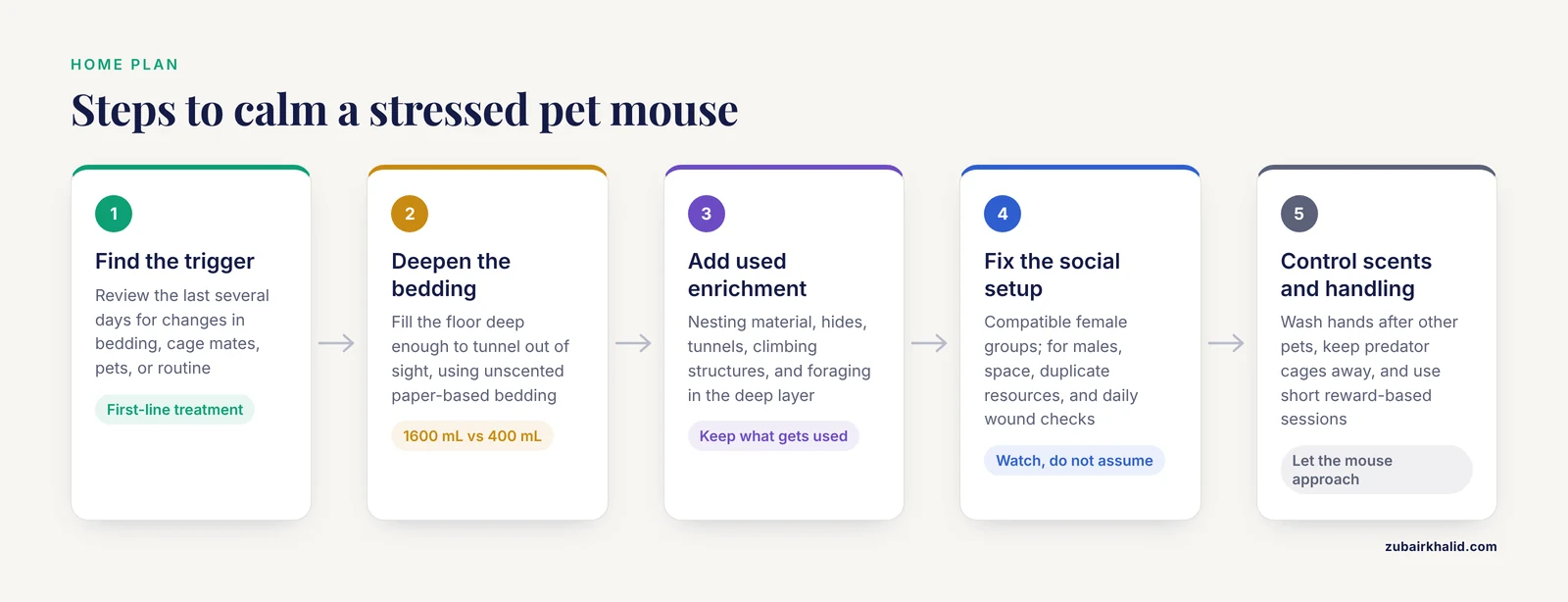
Review the last several days. Did you change bedding brands, move the cage, add or lose a cage mate, bring home a new pet, rearrange the room, or shift the cleaning schedule? Did another family member handle the mouse differently? Most stress cases have an identifiable trigger, and removing it is the first-line treatment. If the trigger was unavoidable, such as a household move, your job is to restore predictability around the cage rather than undo the change.
Step 2: Deepen the Bedding
This is the single highest-value upgrade for most pet mice. When researchers gave mice roughly four times the standard bedding volume, 1600 mL versus 400 mL, the mice dug and burrowed far more, and the deep layer buffered the cage from room temperature and humidity swings while improving cage hygiene [6]. Physiological measures such as body weight and food intake stayed stable, meaning the upgrade helped behavior without disrupting health [6]. At home, fill the cage floor deep enough that your mouse can tunnel out of sight. Use unscented paper-based bedding.
Step 3: Add Enrichment That Gets Used
Environmental enrichment is one of the areas veterinarians most want improved for mice [16]. Practical options include nesting material, hides, tunnels, climbing structures, and foraging opportunities built around the deep bedding layer. The payoff is measurable. In mate choice tests, female mice preferred males raised in well-resourced enriched housing, spending about 1.5 times longer near them and sniffing them nearly twice as long as brothers raised in small conventional cages [11]. Enriched housing produced males that were visibly lower stress to another mouse. Watch which items your mouse actually uses and keep those. Unused clutter is not enrichment.
Step 4: Get the Social Setup Right
Keep female mice in compatible groups where possible, because isolation is a documented source of discomfort for females [3]. For males, assess honestly. A male group needs space, duplicate resources, and daily checks for wounds, because aggression and social stress are documented risks [3]. Some adult males genuinely cannot live together, and a single male needs compensating enrichment and daily calm interaction. When introducing mice, plan gradual, supervised steps with a willingness to separate permanently, because fighting injuries are the downside risk. Watch your mice rather than following a rule.
Step 5: Control the Scent Environment
Wash your hands after handling other pets and before handling your mice, and use separate handling cloths or sleeves for different animals [13]. Keep predator species, including rats, cats, and ferrets, from housing or lingering directly beside the mouse cage, because predator odors are documented fear triggers for mice [13], [4]. Skip scented bedding, air fresheners, and perfumed sprays near the cage. A mouse's nose is its safety system, and strong artificial odors add noise to a channel it depends on [13].
Step 6: Rebuild Trust With Calm Handling
Use gentle restraint, supporting the body rather than snatching from above, and keep early sessions brief [9]. Then add choice. In a pilot study, a four-day positive reinforcement program built around a clicker increased mice's voluntary interaction with their handler and promoted weight gain during the training period, although standard anxiety tests and stress hormone levels did not change significantly [2]. The authors treated the findings as preliminary, but the direction is useful for owners. Short, predictable, reward-based sessions let the mouse choose to approach, and voluntary approach is exactly what improved [2].
Step 7: Rework the Cleaning Routine
Judge cleaning by smell and bedding condition, not only by the calendar. Research facilities now extend cleaning intervals when bedding and monitoring allow, using ammonia levels and overall animal condition as the deciding criteria [12]. In one comparison, paper pulp cellulose bedding held up well over longer intervals, while corncob bedding produced larger urine latrines and sometimes needed earlier changes [12]. At home, spot clean soiled areas daily, do a fuller change when dampness or odor appears, remove wet spots the same day you find them because sustained wet bedding is a documented chronic stressor [1], and keep a portion of unsoiled familiar bedding at each change so the cage's scent continuity survives.
Home Care Mistakes That Make Stress Worse
Self-prescribing painkillers. Never give human pain relievers, and never reuse another pet's meloxicam. Meloxicam is one of the most studied analgesics in mice, but a systematic review of 94 studies found a wide range of dosages, with efficacy varying considerably by procedure, strain, and sex, and no single universally effective regimen [7]. The dose that helps one mouse can be wrong for another, which is why dosing belongs to your veterinarian.
Bathing a mouse. Bathing to fix a greasy or patchy coat backfires. Water and damp bedding recreate the wet conditions that drive chronic stress [1], and coat problems usually have a specific cause such as dermatitis that needs diagnosis and targeted treatment [8].
Punishing fear. Squirt bottles, loud corrections, and forced handling teach a prey animal that you are a threat. Fear behaviors are information, not defiance.
Forcing cohabitation. Do not house two incompatible males together in the hope they will settle down. Aggression between males produces real wounds and measurable physiological stress [3].
Adding scent clutter. New scented products, a relocated cage next to a predator pet, or unwashed hands after handling other animals all register in a mouse's primary sensory channel [13].
Veterinary Care for a Stressed Mouse
What the Exam Covers
A veterinarian treating a stressed mouse works through a structured history and exam. Expect questions about diet, housing size, bedding type and depth, cage mates, cleaning schedule, recent household changes, and any new pets or odors. The physical exam centers on the core health indicators of weight, coat condition, hydration, and activity [9], along with the skin for dermatitis and wounds [8], the eyes for lesions that routine checks often miss [10], and any bite injuries from cage mates. The purpose is to separate environmental stress from disease, because the two present almost identically in this species [8].
Pain Management
If the exam finds pain, analgesia is part of the treatment, not an optional extra, because minimizing pain is a recognized welfare obligation in mice [7]. Meloxicam is the most studied option, with a large evidence base showing benefit in many settings, but also showing that responses vary by strain, sex, and procedure and that no universal dosing regimen exists [7]. Your veterinarian will select the drug, dose, and duration for your individual mouse. Do not continue, stop, or adjust a prescribed pain medication on your own.
Prognosis and Follow-Up
Stress caused by environment, handling, or routine usually resolves once the cause is removed and the cage is upgraded, and many mice settle noticeably within days of a real fix. Stress caused by pain or disease carries the prognosis of that underlying condition, which is why the exam matters. Chronic, unaddressed stress is the worst scenario, because it primes the body to respond poorly to future illness [1]. There is no fixed recheck timeline that fits every case. Your veterinarian will set follow-up based on the cause, and any mouse on analgesia needs a planned recheck to confirm the medication is helping.
Stress in Middle-Aged and Older Mice
Ageing changes the stress picture. Welfare guidance for ageing mouse colonies recommends stepping up monitoring from around 15 months of age as the default, adjusted earlier or later based on the mouse's background strain and known risk [14]. The reason is practical. Old mice predictably develop a subset of age-related lesions, and while not every visible lump or patchy area signals a crisis, chronic disease in old age carries real pain and welfare costs that deserve veterinary attention [15].
For owners, this translates into three habits. Weigh your mouse regularly so downward trends surface early. Watch for new hesitancy, reduced grooming, or changes in nesting, which can mark the start of age-related decline, [15]. Discuss cage adaptations for an ageing mouse, such as easier access to food and water, with an exotics veterinarian, because the right modifications depend on what the exam finds.
Emergency Red Flags
Seek veterinary care the same day for any of the following:
- Bite wounds or any open injury, especially between cage mates
- Refusal to eat or drink, or no droppings in the cage
- Sudden lethargy, weakness, or collapse
- Rapid weight loss or a visibly empty flank from muscle wasting [8]
- A swollen, cloudy, bleeding, or held-shut eye,
- Hair loss with broken, bleeding, or inflamed skin
- A previously calm mouse that turns sharply aggressive, which can signal pain
Limitations and When to Contact a Veterinarian
Individual cases vary, and only a veterinarian who examines your mouse can distinguish stress from disease. Much of the research behind this article comes from laboratory settings, where housing, handling, and genetics differ from the home, and even highly standardized studies show that individual animals respond differently under identical conditions [3]. Use these findings as direction, not diagnosis.
When to see a vet for a stressed mouse comes down to a simple rule. Environmental fixes are appropriate first steps for hiding, bar biting, and mild squabbling in an otherwise bright, eating, well-groomed mouse. Contact a veterinarian, ideally one with exotics or small-mammal experience, when any of the following occur:
- Any wound appears, or fighting escalates [3]
- Appetite or water intake drops, or weight falls on the scale
- Lethargy lasts beyond a day or the mouse stops coming out at all [8]
- Coat changes, persistent scratching, or broken skin appear
- An eye looks cloudy, swollen, watery, or stays closed
- Stress behaviors persist after you have corrected housing, social setup, scent factors, and cleaning
- Your mouse is middle-aged or older and shows any new sign [14]
This article is educational and is not a substitute for veterinary diagnosis or treatment.
Frequently Asked Questions
What are the most common signs of stress in pet mice?
Constant hiding, a rough or patchy coat, reduced nesting and burrowing, unexplained aggression, bar biting or lid jumping, and less interest in food. Physical signs such as lethargy and weight loss overlap with illness, so a veterinary exam is the safest way to sort them out.
Can stress make my mouse sick?
Yes. Chronic stress keeps a mouse's stress system activated and changes how its body responds to a later illness, which is why researchers use sustained stressors to study disease responses. A stressed mouse that then faces an infection tends to fare worse than a calm one.
Should male mice live alone or with a cage mate?
It depends on the individual male. Groups of males can work but carry a documented risk of aggression and wounds, while some males must live alone. A single male needs extra enrichment and daily calm interaction to offset the loss of company.
How much bedding does a pet mouse need?
More than most owners give. Mice dig and burrow naturally, and studies giving mice a deep bedding layer showed far more of these natural behaviors plus a more stable cage climate. Fill the cage floor deep enough for your mouse to tunnel and disappear from view.
How do I calm a mouse that panics when I pick it up?
Stop grabbing and start inviting. Use gentle restraint only when necessary, keep sessions short, and let the mouse approach you for a reward. Short, predictable, positive reinforcement sessions increased voluntary interaction with handlers in a pilot study.
Can stress look like illness in mice?
Yes. Lethargy, a poor coat, and reduced appetite are nonspecific signs that appear in both stressed and sick mice, and they are among the most common complaints recorded in mouse colonies. Treat any of these as a reason for a veterinary exam, not a diagnosis of stress.
When is a stressed mouse an emergency?
Same-day veterinary contact is warranted for bite wounds, refusal to eat or drink, sudden lethargy, rapid weight loss, or a swollen or cloudy eye. These signs suggest pain or disease rather than simple environmental stress.
Can my other pets stress my mice without ever touching them?
Yes. Mice detect predator odors and react with measurable fear, and animal scents travel on hands, gloves, clothing, and air. Wash your hands after handling other pets before you handle your mice, and keep predator cages well away from theirs.
Sources
- Chronic stress primes TLR3-mediated systemic inflammation to produce persistent post-viral fatigue syndrome-like symptoms in mice.
- Effects of Clicker Training on Behavioral and Stress Markers of Welfare in the F1 Generation of CD1 Mice: A Pilot Study.
- Laboratory conditions matter: social housing in male and female laboratory mice in a multicenter study approach.
- Lack of fear response in mice (Mus musculus) exposed to human urine odor.
- Analysis of gut microbiota and intestinal mucosal neurotransmitter changes and their correlation in adolescent depression mice.
- Impact of Bedding Volume on Cage Microclimate and Behavior in 129SV and Desmin-Knockout (Des-/-) Mice.
- Administration of meloxicam to improve the welfare of mice in research: a systematic review (2000 - 2020).
- Incidence rates of spontaneous disease in laboratory mice used at a large biomedical research institution.
- Building a humane scientific future: Second Asia Laboratory Animal Day.
- Prevalence and management practices of ophthalmic lesions in laboratory mice.
- Finding Mr. Right: Housing Quality Affects Male Mouse Attractiveness to Females, With Implications for Conservation Captive Breeding.
- Analysis of Individually Ventilated Cage (IVC) Microenvironments During 21-d Cage Change Frequency for Mice Using Two Different Bedding Types.
- Olfaction variation in mouse husbandry and its implications for refinement and standardization: UK survey of animal scents.
- Progressing the care, husbandry and management of ageing mice used in scientific studies.
- Practical pathology of aging mice.
- A Survey of Laboratory Animal Veterinarians Regarding Mouse Welfare in Biomedical Research.