Safe Vegetables for Guinea Pigs and Rabbits
By Dr. Zubair Khalid, DVM, MS, PhD ·
Safe vegetables for guinea pigs and rabbits come down to one working rule: most dark leafy greens and crunchy, water-rich vegetables are appropriate daily foods, while starchy, sugary, pungent, and mold-prone items are not. Hay remains the foundation of the diet for both species. Vegetables add moisture, fiber, micronutrients, and chewing variety, and they are also the easiest part of the daily routine to get wrong. This guide gives you the safe vegetable list for rabbits and guinea pigs, a daily format you can copy into your own care routine, the reasons behind each recommendation, and clear signs that a feeding problem needs a veterinarian.
This article is educational and is not a substitute for veterinary diagnosis or treatment.
At a Glance: A Daily Feeding Checklist You Can Use Today
Use this checklist as a template for each animal in your household. Adjust quantities with your veterinarian for underweight, overweight, pregnant, or growing animals.
| Daily step | Rabbits | Guinea pigs |
|---|---|---|
| , - | , - | , - |
| Grass hay, unlimited | Available all day, refilled whenever empty | Available all day, refilled whenever empty |
| Fresh leafy greens | Roughly one packed cup of mixed greens per two pounds of body weight, split into two feedings, per VCA Animal Hospitals and House Rabbit Society feeding guidance | About one packed cup of mixed greens per adult guinea pig per day, split into two feedings, per VCA Animal Hospitals guidance |
| Vitamin C source | Not required, rabbits make their own | Daily, from bell pepper or another high-vitamin-C vegetable, because guinea pigs cannot synthesize vitamin C, as described in the Merck Veterinary Manual |
| Pellets | Small measured portion, timothy-based for adults | Small measured portion, timothy-based for adults, vitamin C fortified |
| Water | Fresh, changed daily | Fresh, changed daily, bottle or heavy bowl |
| Monitoring | Count droppings, watch appetite | Count droppings, watch appetite and posture |
| New foods | One new vegetable at a time, small amount, watch for soft stool | One new vegetable at a time, small amount, watch for soft stool |
The two species share most of their safe vegetable list, but they are not interchangeable animals. Comparative anatomical research shows just how specialized each species is. A micro-CT study of the guinea pig cervical spine documented unique vertebral features that contrast sharply with the segmented structures seen in rabbits, a reminder that these are different species with different bodies and different needs, not two versions of the same pet [1].
Why Vegetables Matter So Much for Herbivore Digestion
Rabbits and guinea pigs are hindgut fermenters. Their digestive tract depends on a constant flow of coarse fiber, and the cecum, a large fermentation organ, houses the bacteria that break down plant cell walls. When fiber flow slows or stops, the entire system can stall, a condition owners and veterinarians call gastrointestinal stasis.
Rabbits are particularly fragile in this regard. Veterinary research on isoflurane anesthesia in rabbits documents how easily their gastrointestinal transit time, feed intake, and defecation can be disturbed, and why rabbits carry a high risk of peri-anesthetic gastrointestinal complications compared with dogs and cats [2]. The practical lesson for feeding is straightforward. Anything that disrupts fiber intake, including a diet heavy in starch or sugar, an abrupt food change, or a day of refused food, can set off a cascade. Daily observation of food intake and fecal output is one of the most sensitive tools an owner has, and the same parameters, feed intake and defecation, are exactly what researchers track when they measure gut function in this species [2].
Diet composition also shapes the cecal microbiome itself. A controlled feeding trial in growing rabbits showed that adding a novel forage, dried prickly pear cactus cladode, increased crude fiber digestibility by roughly 23 percent and neutral detergent fiber digestibility by roughly 18 percent, improved serum antioxidant capacity, and shifted cecal bacteria in a favorable direction, reducing Escherichia coli and increasing Lactobacillus species, with no negative effect on growth [3]. That trial supports a broader principle. The vegetable and forage portion of the diet is not just filler. It actively changes how well the gut works and which bacteria live in it.
The same principle cuts the other way. Diet changes alter gut lining and organ health, as shown in rabbit feeding trials where even modest changes in protein source produced measurable changes in intestinal and hepatic histology [4]. Feed quality matters as much as feed type. Rabbits are unusually susceptible to ochratoxin A, a mycotoxin produced by Aspergillus and Penicillium molds that contaminates feed, and pathological changes can occur at relatively low exposure levels while residues persist in tissues after exposure ends [5]. That is the scientific basis for one of the strictest rules in small mammal feeding: never offer wilted, moldy, or spoiled vegetables, and discard damp produce before mold can establish.
The Safe Vegetable List for Rabbits and Guinea Pigs
The list below reflects feeding guidance published by the Merck Veterinary Manual, VCA Animal Hospitals, House Rabbit Society, and the Rabbit Welfare Association and Fund. Rotate at least two or three different greens daily rather than relying on a single vegetable.
Staple leafy greens, feed daily in rotation
- Romaine lettuce, green leaf lettuce, red leaf lettuce
- Cilantro
- Parsley, in moderation for guinea pigs because of its calcium content
- Basil
- Mint
- Dill
- Arugula, in moderation
- Radicchio
- Endive, escarole, frisee
- Butterhead lettuce
- carrot tops
- Watercress
- Wheatgrass
- Romaine hearts, washed and drained
Crunchy non-leafy vegetables, feed daily or most days
- Bell peppers, any color. Sweet peppers are a Capsicum species but contain negligible capsaicin, the pungent compound that makes hot chilies burn, so they are safe while hot peppers are not [6]
- Cucumber
- Celery, sliced into short pieces to reduce string trapping
- Zucchini
- Carrot, as a small treat portion because of sugar content
- Broccoli, small amounts and infrequent for gas-prone animals
- Fennel
- Brussels sprouts and cabbage, small amounts only, since some individuals develop gas or soft stool
Occasional vegetables, a few times weekly at most
- Kale and other Brassica greens, limited because of calcium and goitrogen content
- Spinach and chard, limited because of high oxalate and calcium levels
- Collard and mustard greens
- Pumpkin and squash, small pieces
- Green beans
Vegetables and related foods to leave out
- Onion, garlic, leeks, chives, and all allium family plants
- Hot chili peppers, because capsaicin is the active pungent compound in these fruits and concentrated Capsicum extracts are known irritants [6]
- Potatoes, rhubarb, and avocado
- Iceberg lettuce, which offers little nutrition and mostly water
- Beans, peas in large amounts, corn, and other starchy seeds and legumes
- Any vegetable that is wilted, slimy, fermented, or moldy. Moldy feed is a documented health hazard in rabbits, and prevention of mold contamination is described as crucial because even low-level mycotoxin exposure causes pathology in this species [5]
Guinea pig specific additions
Guinea pigs share nearly this entire list, with two differences that belong in every guinea pig care guide. First, they cannot manufacture their own vitamin C and must receive it in food every day, a requirement described in the Merck Veterinary Manual. Bell peppers are the most reliable everyday source on the safe vegetable list because they are accepted readily, are low in oxalates compared with parsley and spinach, and are high in vitamin C. Second, portion sizes run smaller. An adult guinea pig eats roughly one packed cup of mixed greens daily, while a four-pound rabbit may take two cups.
How to Introduce New Vegetables, Step by Step
A new vegetable is a microbiome event, not just a menu item. The cecal bacteria need time to adjust, and the cactus cladode trial in rabbits showed that even a beneficial novel forage was evaluated over weeks of controlled feeding, not a single day [3]. Follow this sequence.
- Start with one vegetable and one small piece. A leaf, a one-inch slice, or a single leaf of greens is enough for a first offering.
- Feed it alone with familiar greens. Do not stack two new foods in the same week, or you will not know which one caused a reaction.
- Watch the droppings for 24 to 48 hours. Normal round, dry droppings mean the vegetable is tolerated. Soft, mushy, stuck-together droppings or uneaten cecotropes mean you should pause that vegetable.
- Watch the appetite. A rabbit or guinea pig that leaves hay or greens untouched after a new food needs closer observation.
- Increase gradually over one to two weeks. If the small portion is tolerated, double it slowly over subsequent days until it fits the daily portion plan.
- Log what you introduced and when. A simple notebook entry, the vegetable, the date, and any changes in stool, becomes the format your veterinarian will thank you for if a problem appears later.
Daily Portions and Scheduling
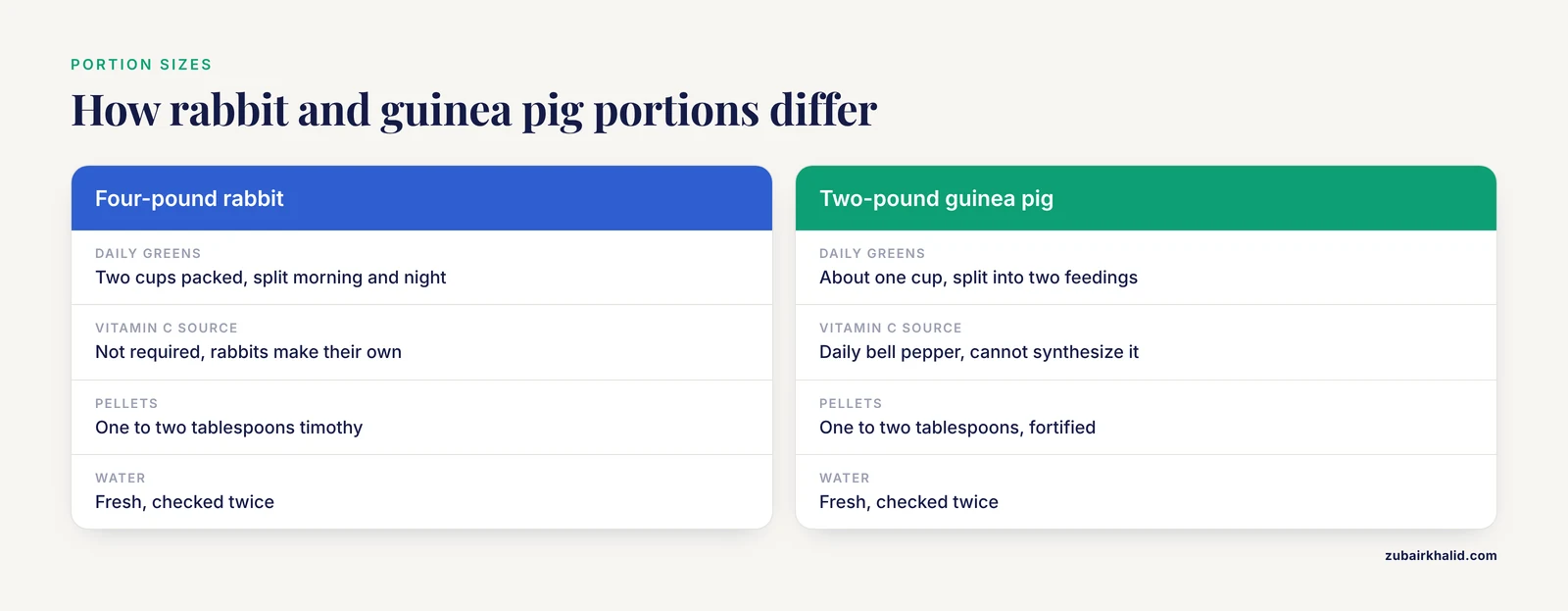
Here is a working example of a full day of feeding for an average four-pound adult rabbit and an average two-pound adult guinea pig. Treat these as examples from published feeding guidance, not prescriptions, and confirm amounts with your veterinarian.
Rabbit, four pounds. Unlimited timothy hay, refilled morning and evening. Two feedings of greens, one cup total packed volume per two pounds of body weight, so two cups split morning and night, rotating at least three greens. One to two tablespoons of plain timothy pellets. One thin carrot coin or small bell pepper slice as a hand-fed treat. Fresh water checked twice.
Guinea pig, two pounds. Unlimited timothy hay. About one cup of mixed greens split into two feedings, always including a vitamin C source such as bell pepper. One to two tablespoons of vitamin C fortified timothy pellets. Fresh water checked twice.
Both species benefit from fixed feeding times. Predictable meals make it easy to notice the earliest sign of trouble, a half-eaten breakfast. Build your own rabbit care checklist or guinea pig care guide around three checkpoints, morning appetite, evening appetite, and dropping count, and keep the checklist on the cage or hutch where everyone in the household can use it.
Washing, Storage, and Food Safety
Wash every vegetable under running water before it reaches the bowl, including pre-washed salad greens. Pesticide residues, soil bacteria, and cross-contamination from store packaging are all removed by a thorough rinse and a dry. Some vegetables and fruits also contain proteins that act as allergens in sensitive people, which is one reason produce allergen testing exists, so owners with food allergies should handle and wash produce with the same care they use for their own food [7].
Storage discipline matters more for these species than for a human household. Damp greens in a sealed bag mold quickly, and mycotoxins such as ochratoxin A are a real and documented hazard in rabbit feed, with kidney and liver injury possible at low exposures and residues persisting after the contaminated feed is withdrawn [5]. Practical rules:
- Buy quantities you can finish within three to four days.
- Store greens loose or in a ventilated container lined with dry paper towel.
- Discard anything slimy, brown at the stem, or smelling even faintly of fermentation.
- Never feed from a bag with visible mold anywhere in it, because mycelium and spores spread beyond the visible spot.
- Wash bowls and remove uneaten fresh food within a few hours, especially in warm rooms.
Research into plant-derived compounds in rabbit diets continues to expand, including work on flavonoids such as luteolin studied in growing rabbits under heat stress, but these are compounds delivered in controlled research settings, not a reason to supplement a healthy pet with extracts [8]. Fresh vegetables and good hay already provide the plant chemistry these animals evolved to process.
Common Mistakes
- Feeding a monotonous single green. Kale every day concentrates calcium and goitrogens. Rotate three or more greens.
- Treating carrots as a staple. Carrots are roots high in sugar. They are a treat portion, not a daily base, despite the cartoon image.
- Confusing sweet peppers with hot peppers. Bell peppers are safe daily vegetables. Chili peppers deliver capsaicin and should never be offered [6].
- Letting children feed free choice. Unmeasured crackers, bread, and fruit cause more diet-related illness than any vegetable. Vegetables are the safe category, and everything else needs permission.
- Changing the diet abruptly. A sudden switch in greens or pellets can shift cecal fermentation within a day. Transition over at least one week.
- Ignoring dropping changes because the animal "seems fine." Rabbits and guinea pigs hide discomfort. Fecal output is the earliest objective sign, which is why researchers measure defecation alongside feed intake when evaluating gut function [2].
- Feeding produce past its prime. A vegetable safe when fresh can carry mold toxins when spoiled, and rabbits are among the more susceptible species [5].
- Substituting vegetables for hay. Greens do not provide the coarse, long-strand fiber that wears teeth and drives gut motility. Hay stays unlimited no matter how many vegetables are eaten.
Troubleshooting Feeding Problems
Soft or mushy droppings after a new vegetable. Remove that vegetable, keep hay unlimited, and return to the previous tolerated list. Most mild cases resolve within a day. If soft stool persists beyond 24 hours, or the animal stops eating, contact your veterinarian.
Refusing vegetables the pet previously loved. Check the produce first, rabbits and guinea pigs frequently reject wilted or strong-smelling greens. If the food is fresh and refusal continues past one meal, look for droppings and behavior changes, because reduced appetite in these species is a symptom, not a preference.
Gas and a hunched posture. Reduce or eliminate cruciferous vegetables such as cabbage and Brussels sprouts, and watch closely. Bloating in a small herbivore is time-sensitive.
Uneaten cecotropes, the soft clustered droppings sometimes mistaken for diarrhea. This often reflects too many rich foods or excess body weight that prevents the animal from eating cecotropes directly. Review the treat and pellet portions with your veterinarian before cutting greens, which are rarely the cause.
Slower gut after a hospital stay or sedation. Anesthesia measurably alters gastrointestinal transit time, feed intake, and defecation in rabbits, and these effects are actively studied because peri-anesthetic gastrointestinal complications are a known risk in the species [2]. If your pet returns home from a procedure with reduced appetite, follow your veterinarian's discharge instructions exactly and monitor droppings closely during recovery.
Welfare and Enrichment Points
Vegetables are more than nutrition. Hand-feeding a bell pepper slice builds trust with a new rabbit or guinea pig faster than any other technique. Hiding greens inside a cardboard tube or stuffing a hay-based toy with washed herbs turns mealtime into foraging behavior, which occupies an animal that in the wild would spend hours each day searching for food. The Rabbit Welfare Association and Fund and House Rabbit Society both emphasize that variety and foraging opportunity are welfare needs, not luxuries. Aim for texture variety too, crunchy stems, soft leaves, and water-rich vegetables each engage the teeth differently, which supports natural wearing of continuously growing incisors and molars.
Fresh vegetables also increase water intake. Rabbits and guinea pigs on dry pellet-heavy diets drink less than animals on a greens-rich plan, and higher moisture intake supports urine flow. Watch for the combination of unlimited hay, generous greens, and clean water as the single most protective feeding pattern you can offer.
Limitations and When to Contact a Veterinarian
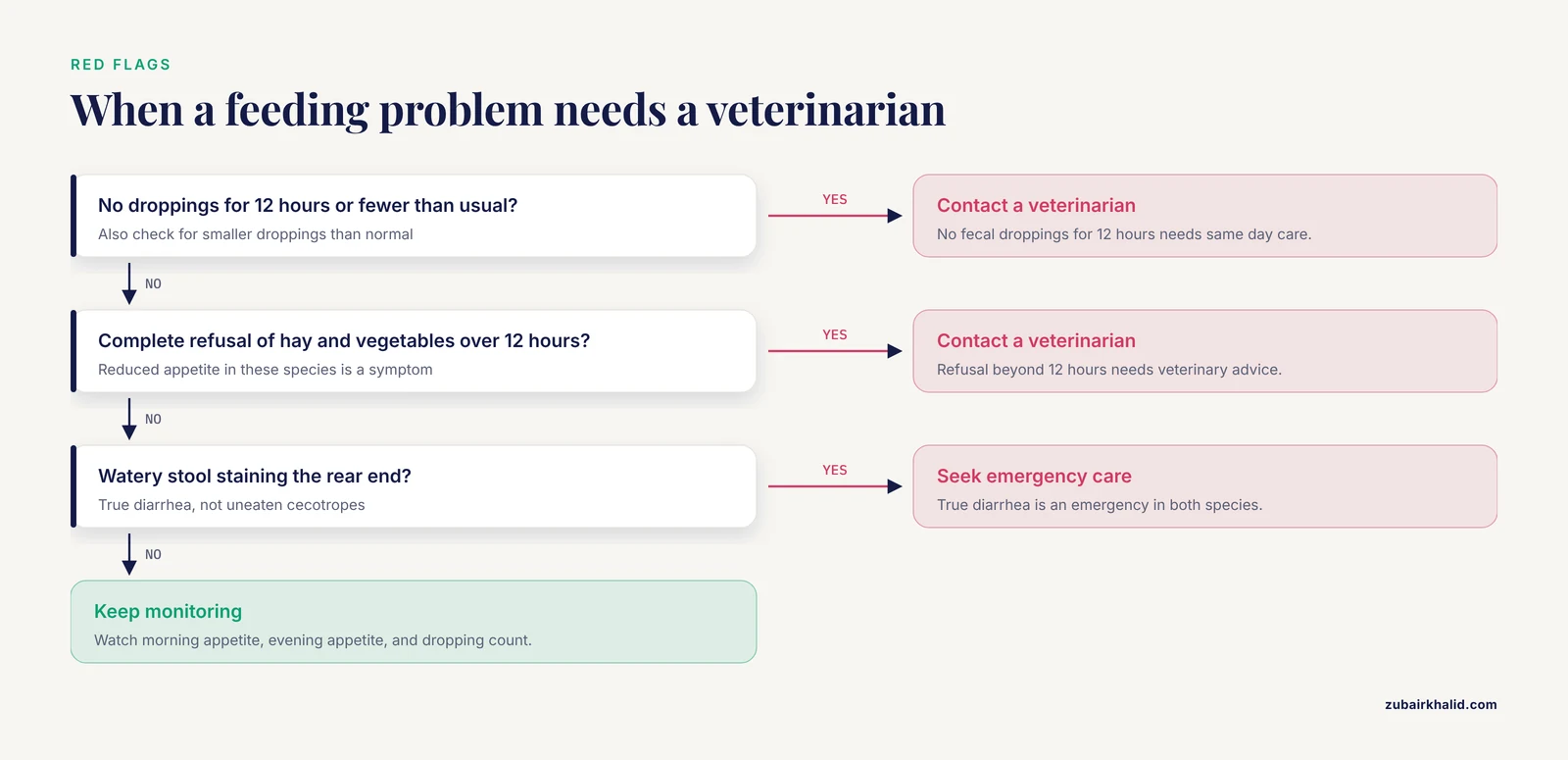
Individual animals vary in tolerance, age, weight, and health status, so the amounts and lists here are starting points that should be tailored with a veterinarian who has examined your pet. Contact a veterinarian the same day, or seek emergency care, if you see any of the following:
- No fecal droppings for 12 hours, or fewer and smaller droppings than usual
- Complete refusal of hay and vegetables for more than 12 hours
- True diarrhea, watery stool staining the rear end, which is an emergency in both species
- A hunched posture, pressing the belly to the floor, teeth grinding from pain, or a visibly distended abdomen
- Drooling, a wet chin, or dropped food, which suggests dental disease that changes what the animal can safely chew
- In guinea pigs, swollen or painful joints, rough coat, or bleeding gums, which can signal inadequate vitamin C intake and need veterinary confirmation
- Any known or suspected ingestion of onions, hot peppers, moldy food, or other items from the avoid list
- Weight loss you can feel along the spine or hips, or a sudden change in water intake
Frequently Asked Questions
Can rabbits and guinea pigs eat the same vegetables?
Mostly yes. Both species thrive on the same rotated leafy greens, bell peppers, cucumber, and celery. The differences are portion size, smaller for guinea pigs, and vitamin C, which guinea pigs must get from food every day while rabbits synthesize their own.
What is an example of a safe daily vegetable serving?
For a four-pound rabbit, one packed cup of mixed romaine, cilantro, and bell pepper split across two meals is a typical example. For an adult guinea pig, one packed cup of mixed greens including bell pepper for vitamin C is the standard example.
Can they eat bell peppers every day?
Yes. Sweet bell peppers are safe for both species daily, and they are the preferred everyday vitamin C source for guinea pigs. Hot chili peppers are a different fruit entirely and should never be fed because of their capsaicin content.
Can rabbits eat cactus pads or nopales?
Spineless prickly pear cladodes are fed to rabbits in controlled nutrition research, where moderate inclusion improved fiber digestibility and shifted cecal bacteria favorably without harming growth. If you want to try cactus pads, use commercially sold, de-spined, washed nopales in small amounts and introduce them like any other new vegetable.
Which vegetables should never be fed?
Onions, garlic, leeks, and chives, hot peppers, potatoes, rhubarb, avocado, and iceberg lettuce should all stay off the menu, along with anything wilted, slimy, or moldy.
How often can I introduce a new vegetable?
One new vegetable per week is a safe pace for most animals. Feed a small piece, watch droppings and appetite for 24 to 48 hours, and only then increase the amount.
Do guinea pigs really need vegetables for vitamin C?
Yes. Guinea pigs cannot synthesize vitamin C and need a daily dietary source, so a vitamin C rich vegetable such as bell pepper should appear in the bowl every day. Pellets fortified with vitamin C help but should not be the only source.
Is a wilted bag of greens safe if only part looks spoiled?
No. Discard the whole bag. Mold on feed produces mycotoxins such as ochratoxin A, and rabbits are a particularly susceptible species where even relatively low exposure can cause organ injury. When in doubt, throw it out.
Sources
- CT Anatomy of the Guinea Pig Cervical Vertebra.
- Evaluation of the Effects of Isoflurane Anaesthesia on Gastrointestinal Transit Time, Feed Intake and Defecation in Rabbits.
- Nutritional, metabolic, and intestinal responses to dried Opuntia ficus-indica cladode powder in growing rabbits.
- House Cricket (Acheta domesticus) Meal as an Alternative Protein Source for Fattening Rabbits: Effects on Growth Performance, Nutrient Digestibility, Intestinal Morphology, and Histopathology.
- Ochratoxin A Toxicity in Rabbits-A Review.
- Final report on the safety assessment of capsicum annuum extract, capsicum annuum fruit extract, capsicum annuum resin, capsicum annuum fruit powder, capsicum frutescens fruit, capsicum frutescens fruit extract, capsicum frutescens resin, and capsaicin.
- [[Study of allergens from vegetables, fruits and berries].](https://pubmed.ncbi.nlm.nih.gov/15188561/)
- Dose-response effects of dietary luteolin-loaded chitosan nanoparticles on growth and physiological responses of post-weaning rabbits reared under summer heat stress.