Safe Toys and Equipment for Pet Rats: What to Avoid
By Dr. Zubair Khalid, DVM, MS, PhD ·

The safest toys for pet rats are untreated wood, plain paper and cardboard, cotton or fleece fabric without loose threads, and hard plastics with no small, detachable parts. The most dangerous items are soft plastic toys that shatter, anything with string, yarn, or rubber bands, wheels with wire rungs, balls and spheres a rat can be trapped in, and toys made from aromatic softwoods such as cedar or pine. Research in laboratory rats shows why this matters. A barren, under-stimulating cage produces boredom and measurable harm to mental and physical health, and a stimulating living environment is essential for normal behavior and welfare regardless of age or sex [1]. Enrichment lowers stress hormones, reduces fear-related responses, and increases exploratory behavior in rodents [2].
This guide explains how to choose safe toys for pet rats, which materials and designs to avoid, and how to set up cage accessories that enrich without injuring. The core rule is simple. Rats chew everything, squeeze through anything, and bury their faces into every gap, so every item in the cage must assume all three behaviors will happen.
Safe Toys for Pet Rats at a Glance
| Category | Safe choices | Avoid |
|---|---|---|
| Gnawing | Untreated hardwood blocks, plain cardboard, apple or willow wood sold for small pets | Cedar, pine, pressure-treated wood, painted or varnished wood, plastic chews that splinter |
| Climbing | Ropes of natural fiber, solid-surface platforms, ladders with wide rungs | Wire ramps with gaps, rope with frayed strands, plastic ledges that crack |
| Hiding | Cardboard boxes, ceramic or wooden hides with two exits, fabric hammocks without loose threads | Enclosed plastic balls, hides with a single exit, anything that can trap a limb |
| Foraging | Cardboard tubes stuffed with bedding and food, dig boxes filled with paper, treat balls of hard, food-safe plastic | Toys with glue, staples, or metal eyes, thin soft plastic that breaks into pieces |
| Play outside the cage | Supervised playpens, ball pits, tunnels | Exercise balls that enclose the rat, free roam near other pets or wires |
A quick daily check catches most problems before they become injuries. Run your hands over each toy and feel for sharp edges, splinters, loose fibers, or cracks. Look for chew marks on plastic. Remove anything that has changed shape since yesterday.
Why Rats Need Toys, Not Just a Cage
Rats are among the most cognitively and socially complex animals kept as companion animals, and a cage with only food, water, and bedding is not enough for them. A 2022 systematic review concluded that boredom in rats and mice is measurable and avoidable, and that confinement and under-stimulation have potentially detrimental effects on mental and physical health [1]. Enrichment is not decorative. It changes physiology. Rodents raised in enriched environments show lower corticosterone concentrations, improved heart rate measures, less anxiety-like behavior, and more exploration than animals in standard housing [2].
The benefits extend to emotional state. Rats given regular access to a ball pit and a playpen produced more 50 kHz ultrasonic vocalizations, a graded and quantifiable indicator of a positive affective state, and playpen access completely offset the negative emotional state induced by an anxiogenic drug in one laboratory study [3]. Periodic access to a large play cage stopped repetitive behavior in rats kept in small cages, with the animals showing signs of excitement during play sessions [4].
Owner survey data back this up in the home. A study of 677 pet rat owners found that reported enrichment types could be summarized and analyzed alongside behavior, supporting the idea that the variety and number of enrichment items in a pet rat's environment is a meaningful welfare variable, not just a cosmetic one [5].
The practical takeaway is that toys for pet rats are preventive medicine. Enrichment has even been shown to reduce pain-like behaviors and support locomotor recovery after spinal cord injury in rats, working alongside analgesic treatment rather than replacing it [6].
What Makes a Toy Safe for a Rat
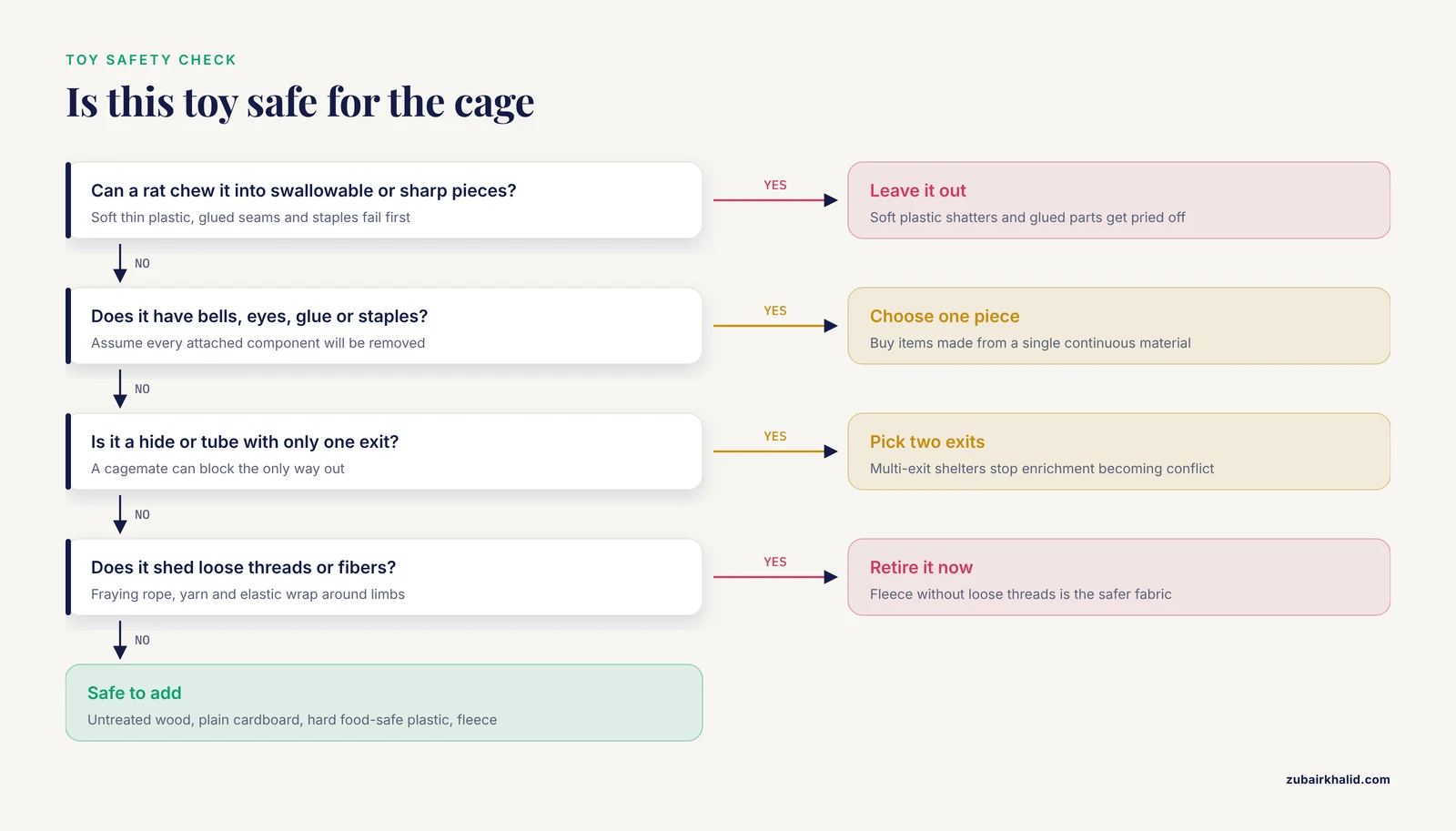
Rats test objects with their teeth before anything else. Any toy that will enter the cage must pass a few criteria.
Material integrity. A safe toy survives being gnawed without breaking into swallowable pieces, splintering into sharp points, or unraveling into loops that can catch a toe or tooth. Soft, thin plastics are the worst offenders because rats can destroy them in minutes. Hard, food-grade plastics designed for small animals hold up better, and wood sold for small pet chewing is processed to remove hazards.
Size relative to the rat. Adult rats have flexible skeletons and can pass through gaps you would not expect. Anything with an opening big enough for a head can become an opening big enough for a rat, which is how entrapment injuries happen. Choose hides, tunnels, and hammocks sized for adult rats, and reject anything a rat could partially enter and wedge into.
No small parts. Bells, googly eyes, glued seams, staples, and metal hangers are the classic failure points of cheap small pet toys. A rat that pries a bell off a toy can swallow it. Assume every glued or attached component will eventually be removed by your rats, and buy items constructed from a single continuous material.
Escape routes. A mapping review of more than 1,000 studies on rat housing refinements found that rats prefer complex environments, including shelters and multiple objects that offer different areas and resources for diverse behaviors [7]. Complexity is good, but each hideout should have more than one exit so a dominant cagemate cannot trap a subordinate inside. This matters especially in groups with established hierarchies.
Washability. Fabric items and plastic platforms need regular cleaning. Choose accessories you can scrub or replace cheaply rather than items that absorb urine and become a hygiene problem.
Best Rat Toys by Category
The best rat toys map onto the behaviors rats evolved to perform. Gnawing, climbing, digging, foraging, and nesting each need an outlet, and research supports variety. Rats kept under a regime of regularly changed enrichment responded more optimistically in ambiguous situations than rats given the same enrichment continuously, suggesting that novelty itself improves emotional state [8].
Gnawing and chewing. Untreated hardwood blocks, plain cardboard boxes and tubes, and wood chews marketed for small pets give rats a legal target for teeth that grow continuously. Rotate chewing materials so they stay interesting.
Foraging and digging. Scatter feeding, cardboard tubes stuffed with bedding and a few kibble pieces, and a dig box filled with shredded paper turn eating into work. Ball pits deserve special mention. In laboratory settings, ball pits reliably induced positive ultrasonic vocalizations in male rats and are described as a simple and effective method for improving affective state [3]. A shallow bin filled with safe ball pit balls and scattered treats reproduces this at home for very little cost.
Climbing. Ropes, solid platforms at multiple heights, and branches of safe wood build the three-dimensional layout rats want. Cage height matters as much as floor area, because climbing is a major part of a rat's daily activity budget.
Nesting material. Nesting is a core behavior, and it has clinical relevance. In a study of 405 laboratory rats, about 5 percent developed overgrooming-related self-injury, and providing shredded paper nesting material throughout life reduced the severity of that self-injury after onset [9]. For pet owners, the lesson is direct. Offer generous quantities of paper-based nesting material and torn plain tissue, not cotton wool, which can wrap around limbs or be ingested.
Playpens and out-of-cage time. Supervised out-of-cage play in a rat-proofed area or playpen is one of the highest-value additions you can make. A short report on laboratory rats housed in small cages found that three visits per week to a large play cage eliminated the rats' repetitive behaviors within two weeks and was proposed as an enrichment option when a larger home cage is not possible [4]. At home, a playpen with tunnels, boxes, and a dig bin gives controlled freedom. Always supervise, and block access to electrical cords, gaps behind appliances, and other pets.
Toxic Materials for Pet Rats
Because rats gnaw on everything, material toxicity is a genuine risk rather than a theoretical one. The following categories account for most of the toxic materials for pet rats that owners accidentally bring into the cage.
Aromatic softwoods. Cedar and untreated pine contain volatile oils that are repeatedly flagged in small mammal husbandry guidance because of concerns about respiratory and liver effects in small animals. Exotic animal resources such as the Merck Veterinary Manual advise careful selection of bedding and wood products for small mammals. Use paper-based bedding instead, and reserve wood toys for hardwoods sold specifically for small pets.
Treated, painted, or varnished wood. Pressure-treated lumber, wood from hardware stores, painted furniture parts, and varnished sticks can carry preservatives, lead-based old paint, or solvent residues. A rat will strip the coating off within a day. Only use wood labeled untreated and food-safe or sold for small animal chewing.
Adhesives, metals, and finishes. Hot glue, super glue, staples, galvanized wire with zinc coating, and painted metal all become hazards once a rat chews them. For DIY cage accessories, use mechanical connections such as zip ties checked regularly, or stainless hardware, and keep glued projects out of the cage entirely.
Plastics of unknown origin. Thin packaging plastic, vinyl, and soft toy plastics can contain additives and always pose a physical risk from ingestion of fragments. Hard, food-safe plastic designed for animal use is the standard to aim for.
Fragranced products. Scented bedding, essential oil diffusers near the cage, and perfumed sprays are poorly tolerated by small mammals with sensitive respiratory tracts. Keep the cage environment unscented.
If you are unsure about a specific product, the safest approach is to ask an exotic animal veterinarian before introducing it, and to supervise the first sessions with any new item.
Dangerous Toys for Pet Rats
Most injuries seen with rat cage equipment fall into a short list of predictable failure modes. These are the dangerous toys for pet rats that deserve special caution.
Enclosed exercise balls and spheres. Solid plastic exercise balls, marketed for hamsters and often marketed for rats, prevent a rat from controlling its own movement, provide no ventilation, and can trap toes and tail. Rats explore with whiskers and scent, and a sealed ball removes all of that. A supervised playpen achieves the same exercise safely.
Wire-surfaced wheels. Wheels with rungs or bars can catch limbs and are associated with foot injuries in small rodents. Choose a wheel with a solid running surface, large enough that the rat runs with a straight spine rather than an arched back, and mounted so tails cannot catch in the axle.
String, yarn, elastic, and rubber. Loose fibers wrap around limbs and teeth. Fraying rope toys, yarn hammocks, and elastic cords are among the most common entanglement hazards. If a fabric item develops loose threads, retire it immediately.
Small, hollow plastic toys. Cat toys with bells, thin plastic balls, and broken plastic hides shatter into sharp fragments. Rats destroy these quickly and can ingest pieces.
Toys with single-exit hides. A tube or hide with one opening becomes a trap if another rat blocks it or if a rat panics. Dominance dynamics in male rats are well documented, and environmental enrichment reduces dominant agonistic behavior in individually housed males [10]. Multi-exit shelters prevent enrichment from becoming a site of conflict.
Anything scented, glittered, or coated. Glitter, foil, chemical scents, and soft rubber coatings all end up in a rat's mouth.
DIY items with glue or staples. Cardboard constructions held together with adhesive, stapled packaging, and egg cartons with glued seams should be avoided. Plain cardboard held by folds alone is fine.
One note on cardboard. Plain brown cardboard tubes and boxes are among the best rat toys available and cost nothing. Avoid printed inserts with heavy ink coverage, glossy paper, and anything that has contained food with seasoning or adhesive residue.
Rat Cage Accessories Safety
The cage itself is the largest piece of equipment you will buy, and rat cage accessories safety starts with space. Minimum space allowances for laboratory rats are legislated based on weight, with the understanding that increased housing density encourages crowding stress, and research on housing density and space allocation shows that density and surface area measurably affect behavior and welfare, with dominant animals responding more optimistically in better spatial conditions [11]. For pet owners, the practical translation is generous floor area, multiple levels, and enough resources that cagemates are not competing for food, water, or resting spots.
Social housing is part of the equipment plan. Rats are a social species, and the consequences of isolation are well studied. Singly housed male rats showed reduced activity, more self-directed behaviors, and escape-related behaviors compared with group-housed males, and pathophysiological measures supported the conclusion that isolation harms welfare [12]. Female rats housed singly showed up to a threefold increase in escape-oriented behaviors, indicating a strong drive to re-establish social contact [13]. A same-sex group of two or more rats, ideally adopted together, is the single most important enrichment decision you will make. Enrichment alone does not substitute for a companion. In laboratory males, enrichment suppressed dominant behavior in individually housed rats, but social housing combined with enrichment was more effective than enrichment alone [10].
Layout choices. Provide multiple hides, at least one per rat plus a spare, so a subordinate always has an alternative. Rats prefer complex environments with shelters and multiple objects [7], so think in terms of a furnished landscape rather than a few scattered items.
Wheel selection. If you include a wheel, choose a solid-surface model sized for adult rats. Check it weekly for chewing damage and wobble.
Hammocks and fabrics. Fleece is preferred over woven fabrics because it does not fray into threads. Inspect hammocks weekly for chewed straps and replace worn clips.
Nesting and substrate. Paper-based bedding and shredded paper nesting material support natural nesting behavior and have been associated with reduced severity of overgrooming-related self-injury in rats [9]. Avoid cotton nesting fluff, which is a known entanglement and ingestion risk in small rodents.
Prenatal and early-life context. If you breed rats, enrichment matters before birth. Offspring of rats given environmental enrichment during gestation and after weaning showed reduced corticosterone levels and less freezing behavior in open-field testing than controls [14], so the enrichment environment of a pregnant dam shapes the animals that end up in pet homes.
Rotation, Cleaning, and Inspection
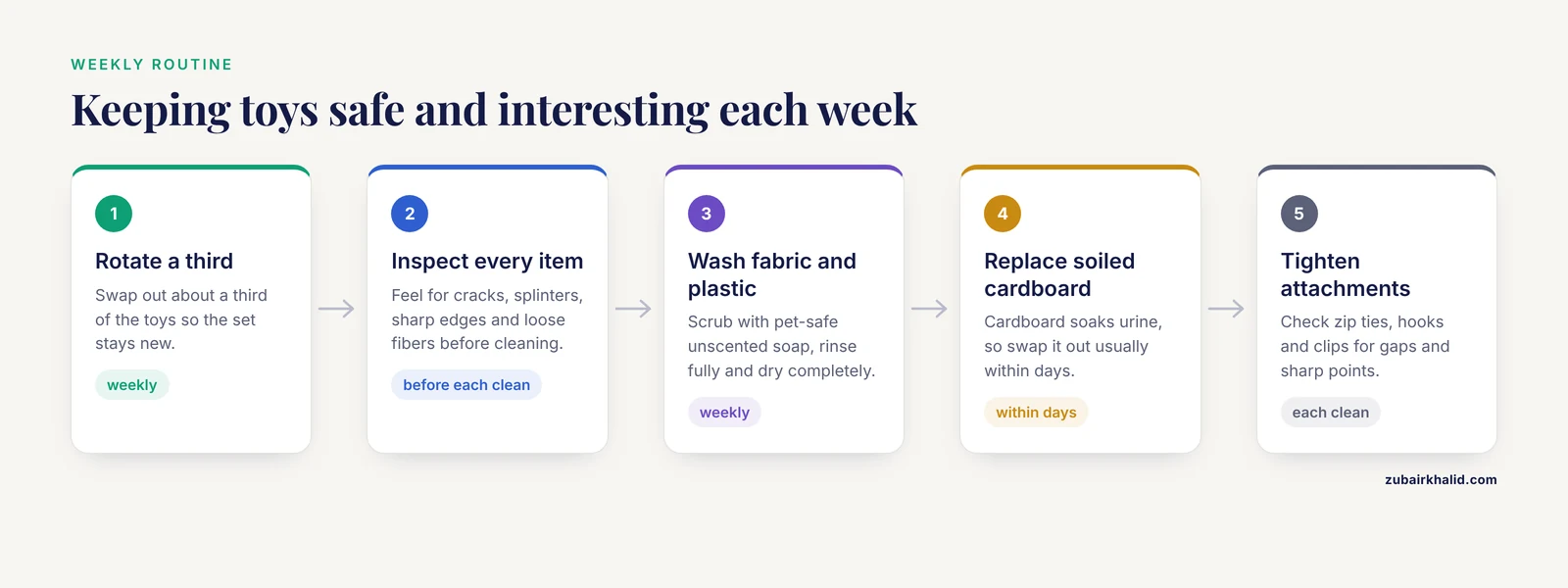
Enrichment only works if it stays safe and stays interesting. Build a simple weekly routine.
- Rotate, do not accumulate. Because regularly changed enrichment produced more optimistic responses in rats than consistent enrichment [8], swap a third of the toys each week rather than leaving the same items permanently in place.
- Inspect before each clean. Feel every item for cracks, splinters, sharp edges, and loose fibers. Plastic that has been chewed thin should be discarded.
- Wash fabric and plastic weekly. Hammocks, platforms, and hard toys can be scrubbed with pet-safe unscented soap, rinsed thoroughly, and dried fully before returning to the cage.
- Replace cardboard on schedule. Cardboard soaks urine and should be replaced when soiled, usually within days.
- Check attachments. Zip ties, hooks, and clips loosen over time and can create gaps or sharp points. Tighten or replace them during each clean.
Common Mistakes Rat Owners Make
- Buying a hamster-sized wheel or ball. Rats outgrow small rodent equipment quickly, and undersized equipment forces arched posture or enclosed confinement.
- Assuming a large cage replaces enrichment. Space without complexity still produces boredom, and under-stimulation has detrimental effects on welfare [1].
- Leaving one toy in place for months. Novelty is part of the benefit, and regular enrichment change improved emotional state in rats compared with a fixed set of items [8].
- Housing rats alone and compensating with toys. Isolation itself produces welfare deficits in males and females [12], [13], and enrichment combined with companionship outperforms enrichment alone [10].
- Ignoring small amounts of chewing damage until the toy fails. The failure moment is when injury happens.
- Choosing scented or dyed products because they look appealing to humans. Attraction to a product's appearance has no relationship to its suitability for a rat.
Troubleshooting Behavior Problems Enrichment Can Address
Some behavior problems improve when the toy plan is fixed.
Overgrooming and barbering. If a rat develops bald patches or skin wounds from self-grooming, increase nesting material first. Shredded paper nesting enrichment reduced the severity of overgrooming-related self-injury in rats in a large observational study [9]. Persistent self-injury needs a veterinary visit to rule out parasites, dermatitis, and pain.
Aggression between cagemates. Adding hides with multiple exits and spreading resources reduces competition. Enrichment suppresses dominant agonistic behavior, particularly in individually housed males [10], and social housing with enrichment reduces dominant behavior more than enrichment alone [10]. Sudden aggression between previously compatible rats warrants a veterinary check for pain.
Repetitive behaviors. Bar-biting and circuit running in a small cage respond well to more space and more stimulation. Periodic access to a large play cage eliminated repetitive behavior in laboratory rats within two weeks [4].
Lethargy and disinterest. A rat that ignores all toys may be ill rather than bored. Reduced exploratory behavior is a nonspecific sign, and a rat that stops engaging with an environment it previously used should be examined by a veterinarian.
Limitations and When to Contact a Veterinarian
This article is educational and is not a substitute for veterinary diagnosis or treatment.
Most of the evidence on rat enrichment comes from laboratory colonies, and a mapping review of 1,017 refinement studies concluded that a one-size-fits-all approach to refinements may not be appropriate because different refinements affect different rats in different ways [7]. Individual rats vary in temperament, age, and health status, and what suits one animal may stress another. Your exotic animal veterinarian can help you tailor enrichment to your specific group, particularly if any rat is elderly, injured, recovering from surgery, or living alone after a cagemate died.
Contact a veterinarian promptly if you see any of the following: bleeding or a visible wound after play, a limb or tail caught in equipment, a rat that has ingested plastic, glue, or an unknown material, sudden aggression between cagemates, persistent overgrooming with hair loss or broken skin, labored breathing, discharge from the eyes or nose, lethargy with loss of interest in enrichment and food, or a suspected fracture or sprain after a fall from a platform or wheel. Rats deteriorate quickly once illness is visible, so same-day assessment is a reasonable default for any acute sign.
Frequently Asked Questions
What are the safest toys for pet rats?
Untreated hardwood chews, plain cardboard tubes and boxes, paper nesting material, fleece hammocks without loose threads, hard food-safe plastic toys from one solid piece, and supervised dig boxes and ball pits are the safest options. Every item should survive chewing without splintering, shattering, or shedding fibers, and hides should have more than one exit.
What toys are dangerous for pet rats?
The most dangerous toys are enclosed exercise balls, wheels with wire rungs, toys with string, yarn, elastic, or rubber, thin plastic toys that break into sharp pieces, items with bells, googly eyes, glue, or staples, and aromatic softwoods such as cedar and pine. Any single-exit hide can also become a trap in a group of rats.
Are exercise wheels safe for pet rats?
A solid-surface wheel sized so an adult rat runs with a straight spine is generally considered acceptable, and many rats enjoy wheels. Avoid rung-style wheels, undersized wheels that force an arched back, and wheels with exposed axles that can catch a tail. Check the wheel weekly for chewing damage.
Can rats play with toilet paper rolls and cardboard?
Yes, plain cardboard is one of the best rat toys. Tubes stuffed with bedding and treats encourage foraging, and boxes become hides and chew targets. Replace cardboard when it is soiled or heavily chewed, and avoid glossy, heavily printed, or glued packaging.
What wood is safe for rats to chew?
Hardwood sold specifically for small animal chewing, such as apple or willow wood marketed for pets, is the reliable choice. Avoid cedar, untreated pine, pressure-treated lumber, painted or varnished wood, and any wood from unknown sources. If you cannot confirm a wood is untreated and safe, do not put it in the cage.
How many toys does a rat cage need?
There is no fixed number, but rats prefer complex environments with shelters and multiple objects that allow diverse behaviors, so aim for several hiding places, at least one foraging activity, a climbing structure, nesting material, and a chew item available at any time. More resources also reduce competition between cagemates.
How often should I change my rat's toys?
Rotate a portion of the toys weekly. Research found that rats experiencing regular enrichment changes showed more optimistic responses in ambiguous situations than rats with consistent enrichment, so novelty is part of the welfare benefit. Keep a small collection and cycle items in and out rather than leaving everything in place permanently.
Do rats need toys if they get daily free-roam time?
Yes. Out-of-cage play is valuable, and laboratory work shows playpens and ball pits induce positive emotional states in rats, but the home cage is where rats spend most of their time and it still needs foraging, climbing, hiding, and nesting opportunities. Free-roam time and in-cage enrichment serve different needs and work best together.
Sources
- Bored at home?-A systematic review on the effect of environmental enrichment on the welfare of laboratory rats and mice
- Environmental enrichment for laboratory rats and mice: endocrine, physiological, and behavioral benefits of meeting rodents' biological needs
- The use of ball pits and playpens in laboratory Lister Hooded male rats induces ultrasonic vocalisations indicating a more positive affective state and can reduce the welfare impacts of aversive procedures
- Periodic stays in a ‘playcage’ as an environmental enrichment measure for laboratory rats housed in individually ventilated cages: Short report
- Thinking outside the lab: can studies of pet rats inform pet and laboratory rat welfare?
- Additive Effects of Environmental Enrichment and Ketamine on Neuropathic Pain Relief by Reducing Glutamatergic Activation in Spinal Cord Injury in Rats
- A mapping review of refinements to laboratory rat housing and husbandry
- The influence of regularly changing enrichment on the cognitive judgement bias of laboratory rats
- Nesting material enrichment reduces severity of overgrooming-related self-injury in individually housed rats
- Effects of the housing system and environmental enrichment on social dominance in laboratory male rats
- Assessment of housing density, space allocation and social hierarchy of laboratory rats on behavioural measures of welfare
- Housing and Welfare in Laboratory Rats: Welfare Implications of Isolation and Social Contact Among Caged Males
- Housing and Welfare in Laboratory Rats: The Welfare Implications of Social Isolation and Social Contact Among Females
- Effect of prenatal and postnatal environmental enrichment on laboratory rats' welfare