Safe Toys and Equipment for Pet Mice: What to Avoid
By Dr. Zubair Khalid, DVM, MS, PhD ·

The safest toys for pet mice are items that let them perform natural behaviors, especially nesting, burrowing, chewing, climbing, and hiding. Untreated paper-based nesting material, plain cardboard tubes and boxes, solid hideouts, and chew items made for rodents are reliable choices. The most dangerous items are strongly scented products, soft plastics that can be swallowed, toys with sharp edges or loose fibers, and unstable structures that can fall and trap a mouse.
Research on laboratory mice gives pet owners an unusually strong evidence base here. Mice kept in enriched environments show more natural play and activity, and enrichment can even support recovery from illness and surgery [1][2]. At the same time, the same research shows that the wrong accessory can cause real harm. Scented products have measurably worsened aggression-related injuries in mice [3], and poorly planned cage structuring can trigger fighting between males [2]. This guide explains how to choose the best mouse toys, how to spot dangerous toys for pet mice, and how to evaluate every accessory in the cage for safety.
This article is educational and is not a substitute for veterinary diagnosis or treatment.
Safe Toys and Equipment at a Glance
| Category | Safe choices | Avoid | Red flags to watch for |
|---|---|---|---|
| Nesting material | Shredded paper, paper pulp products, untreated paper | Scented bedding, cotton wool-style fluffy material, fabric that frays into threads | Wet or soiled nests, bald patches from overgrooming |
| Hides and shelters | Solid plastic or ceramic hides, cardboard boxes with two exits | Hides with sharp interior edges, tunnels that can roll and pin a mouse | A mouse that never leaves one hide, wounds on the lowest-ranking mouse |
| Chewing | Rodent chew toys, plain cardboard, untreated wood sold for rodents | Painted, dyed, or scented wood, items with glue or staples | Broken teeth, drooling, refusal to eat |
| Climbing and wheels | Solid-surface wheels, sturdy branches and platforms that cannot tip | Wire rungs that catch feet, wobbly towers stacked on uneven bedding | Limping, swollen feet, reluctance to climb |
| Scent and cleaning | Plain hot water and pet-safe rinse, drying fully before reuse | Essential oil sprays, lavender products, scented cleaners near the cage | Sudden hiding, freezing, aggression after a new product is introduced |
Why Enrichment Matters So Much for Mice
Mice are active, curious animals with strong motivations to dig, nest, gnaw, and explore. When the environment does not allow these behaviors, welfare suffers in visible ways. In studies of individually housed rodents, a small percentage developed pathological overgrooming that led to self-injury, and providing nesting material throughout life reduced the severity of that self-injurious behavior [4]. For pet owners, this is the clearest argument for filling the cage with functional enrichment rather than decorative items.
Enrichment also affects health outcomes. Reviews of laboratory mouse housing conclude that a complex and familiar environment, along with positive social contact, supports recovery from surgery, injury, and spontaneous disease [1]. A pet mouse recovering from an illness or a dental procedure has a better chance in a cage where it can rest in a warm nest and behave normally.
Laboratory animal veterinarians surveyed about mouse welfare identified continued improvement of environmental enrichment as one of the priority areas for the field [5]. That professional consensus translates directly to pet care. Enrichment is not an optional decoration, and it is also not a free-for-all. Every accessory either adds to welfare or subtracts from it.
One more point shapes everything else in this article. Enrichment changes social dynamics. In one study, male mice given progressively more structured cages showed more play and higher general activity without any increase in aggression or stress hormones [2]. But other work found that adding enrichment does not automatically fix aggression problems, and some interventions backfire [3]. Choosing safe toys for pet mice means choosing items that enrich without destabilizing the group.
The Best Mouse Toys and How to Choose Them
Nesting material comes first
If you buy only one category of item, make it nesting material. Nest building is a high-priority behavior for mice, and mice given the opportunity build more complex nests, which is used as a welfare indicator in research settings [6]. Shredded paper and paper pulp products are practical choices because mice can tear and rearrange them into a nest shape.
What to look for:
- Paper-based material that tears cleanly and holds a nest shape
- Enough volume for the mouse to build a closed or domed nest, not just a flat scattering
- Unscented product with no added dyes
What to avoid:
- Fluffy cotton-wool-style nesting material. Fine threads can wrap around toes and limbs, and if swallowed they can cause digestive blockages. Ask an exotics veterinarian to show you safe options if you are unsure about a product.
- Fabric scraps that shed long threads, for the same entanglement and ingestion reasons.
- Anything perfumed. This is covered in detail below.
Check the nest at every cage check. A wet, flattened, or abandoned nest can be an early sign that a mouse is unwell, and it also tells you when the material needs replacing.
Bedding as functional equipment
Bedding is the single largest accessory in the cage, and its safety profile matters more than most owners realize. Comparative studies of bedding types have examined paper pulp cellulose and corncob bedding in mouse cages, measuring ammonia levels, humidity, and overall animal condition, and found welfare-relevant differences between them, including earlier cage change needs with corncob [7]. For pet owners, the practical takeaway is that bedding choice affects cage odor, moisture, and how often you must disturb the mice with a full change.
Choose bedding that:
- Is unscented and paper- or cellulose-based unless your veterinarian recommends otherwise
- Is deep enough for digging and burrowing, since mice are highly motivated to dig
- Stays dry, because damp bedding drives ammonia and skin problems
Discuss any bedding you are unsure about with your veterinarian, especially aromatic wood products, since bedding composition and volatile compounds are an active area of welfare research and recommendations continue to evolve.
Hides, tunnels, and burrow-like structures
Mice are prey animals and spend much of their day moving between covered spaces. A good hideout has a solid structure, an entrance sized for the mouse, and ideally more than one exit so a cornered mouse can always leave. In research housing, cage structures that resemble burrows were associated with reduced aggressive behavior among group-housed males [8]. For pet mice, partial divisions and burrow-style shelters can serve the same function, giving each animal a retreat without cutting it off from the group.
Safe hideout criteria:
- Solid surfaces with no sharp interior seams or exposed staples
- Stable base that cannot tip when the mouse climbs on top
- Multiple entrances when possible
- Easy to clean or cheap enough to discard and replace
DANGER ZONE items in this category include narrow tunnels that can rotate and pin a mouse against the cage wall, hides with narrow necks that a growing mouse can get stuck in, and glass containers that can overheat or offer poor traction.
Chew items
Gnawing wears down continuously growing teeth, so chew material belongs in every mouse cage. Plain cardboard, untreated wood products sold for rodents, and commercial rodent chews are the standard options. Inspect every chew item regularly and replace it when it becomes small enough to swallow, soggy, or soiled with urine.
Avoid painted, dyed, varnished, or scented wood, and any assembled item held together with glue, staples, or plastic parts. If a chew item has components you cannot identify, treat it as a dangerous toy for pet mice and leave it at the store.
Wheels and exercise equipment
Mice are nocturnal runners, and a wheel is one of the best mouse toys available, but only when it is the right design. Choose a solid-surface wheel rather than one with rungs or mesh, because gaps can catch a foot or a tail. The wheel should be large enough that the mouse runs with a straight back rather than an arched spine, and it must spin freely without wobble. If you are unsure about sizing for your mouse, ask an exotics veterinarian or an experienced small-mammal rescue for a hands-on demonstration.
Check the wheel weekly for hair or nesting material wrapped around the axle, which is a common cause of entanglement injuries.
Climbing structures and platforms
Mice climb readily and use vertical space. Safe options include solid platforms, branches from rodent-safe wood sources, and ropes designed for small animals, all anchored so they cannot shift or fall. Place structures above deep bedding so a fall lands softly. Do not stack towers on loose bedding where they can topple, and remove any structure a mouse has gnawed into an unstable shape.
Social enrichment as equipment
Cage companions are the most powerful enrichment a mouse can have, and housing decisions deserve the same safety thinking as toy decisions. Research on male laboratory mice has explored separated pair housing, in which a perforated divider allows olfactory, visual, and acoustic contact while preventing fighting, and found that pair-housed males built more complex nests and positioned themselves near their cage mate [6]. A comparable approach exists for pet mice that cannot live together peacefully, such as males with a history of serious fighting. A well-built divider, with bars fine enough to prevent injury, can preserve social contact safely.
On the other hand, recent multicenter work shows that there is no universal housing prescription. Outcomes of single versus group housing differed more between facilities and between individual animals than between housing types, leading the authors to recommend refinement tailored to the specific situation rather than a one-size-fits-all rule [9]. In practice this means watching your own animals. Some groups of mice thrive together. Some individuals do better with a neighbor behind a divider. If you are deciding whether to house a mouse alone, in a pair, or in a group, discuss your specific animals with a veterinarian who has small-mammal experience.
Dangerous Toys for Pet Mice and Toxic Materials
Scented products are the clearest documented hazard
Mouse welfare research has repeatedly shown that odors are not neutral to mice. Olfaction is central to how mice communicate and perceive threat, and scents of animal origin can trigger physiological and behavioral responses that affect welfare [10]. Predator odors are especially powerful. Mice exposed to a synthetic analog of fox feces showed strong fear responses, confirming how acutely mice react to certain smells [11].
The practical lesson for owners came from a study testing interventions for aggression-related injuries. Lavender essential oil, sometimes suggested as a calming aid, significantly increased wounding in group-housed male mice rather than reducing it [3]. Do not use essential oil sprays, scented bedding, scented chew sticks, aroma diffusers near the cage, or essential-oil-based cleaning products on or around mouse equipment. When you clean accessories, use plain hot water and a thorough rinse, and let everything dry completely before it goes back in the cage.
Scent hygiene extends to your hands and other pets. Husbandry surveys in mouse facilities found wide variation in glove changing and hand washing between handling different species, and many respondents acknowledged that scents from other animals, most commonly rats, could affect mice [10]. At home, wash your hands before handling your mice if you have recently handled a cat, a ferret, a snake, or other animals, and keep small predator pets in separate rooms away from the mouse cage. A mouse that smells a predator all day lives in a state of background fear, no matter how good its toys are.
Ingestion and entanglement hazards
Mice test objects with their teeth, so any accessory will eventually be chewed. Toxic materials for pet mice are less often a single banned substance and more often a category of risk:
- Soft, thin plastics that can be chewed into swallowable pieces
- Items with glued joints, metal staples, or embedded wire
- Rubber and foam products, which shred easily
- Dyed or painted surfaces of unknown composition
- Fabric with loose threads that can wrap around limbs or be swallowed
Inspect every toy weekly and discard anything that is fraying, cracking, or small enough to fit entirely in a mouse's mouth. When you cannot verify what an item is made of, choose a different item. If your mouse has swallowed part of a toy, or if you see drooling, pawing at the mouth, reduced appetite, or no fecal output, contact a veterinarian promptly, since dental and gastrointestinal problems in mice escalate quickly.
Overcrowding and structural mistakes
More stuff is not automatically better. Cage structuring changes how mice use space, and in groups of males it can change aggression. Although enrichment increased play and activity without raising aggression in one docile strain [2], other work testing a variety of enrichments found that none of them reduced post-shipping aggression-related injuries, and injury from aggression remains a leading welfare problem and a common cause of unplanned loss in mice [3]. Aggression in mice also clusters around predictable moments, particularly when unfamiliar mice are first combined and after cage cleaning, when scent marks are wiped out [3].
For owners, this translates into three rules:
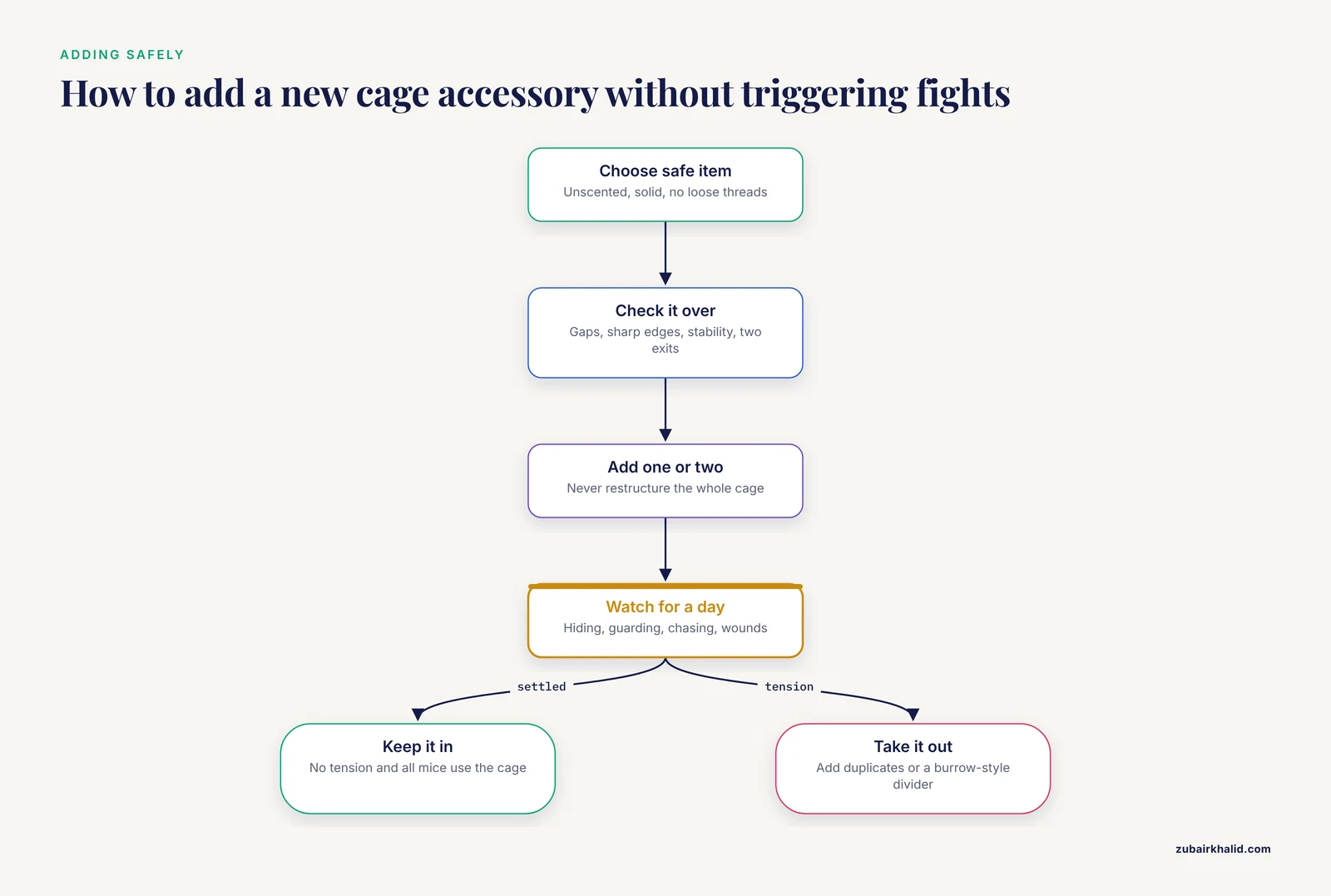
- Introduce new accessories gradually, one or two at a time, and watch the group for a day or two afterward.
- Preserve some familiar scent during partial cleaning by leaving a little used nesting material behind rather than sterilizing everything at once.
- Watch the lowest-ranking mouse closely. Chronic hiding, weight loss, or wounds around the rump and tail mean the layout or the group composition needs changing.
Individual variation is real. Multicenter housing research found that individuality of the mice influenced outcomes alongside the housing system itself [9], so a layout that works for one group of mice may not suit another.
Mouse Cage Accessories Safety: Evaluating What You Already Own
Walk through your cage with this checklist. Each item should pass every question.
- Material. Can I identify what this is made of? Is it unscented? Does it shed threads, splinter, or flake?
- Mechanical safety. Are there gaps that could catch a foot, tail, or tooth? Sharp edges? Moving parts that could pinch?
- Stability. If my mouse climbs on top, could this tip, roll, or fall?
- Escape and entrapment. Could a mouse enter and get stuck? Are there at least two ways out of tunnels and hides?
- Social effect. After this went in, did any mouse start hiding more, guarding resources, or showing wounds?
- Cleanability. Can I scrub and rinse this thoroughly without degrading it?
If an item fails any question, remove it and replace it with something from the safe list above. Partial cage dividers deserve special mention for multi-mouse households. A divider that creates separate territories while allowing contact through a perforated barrier significantly reduced aggressive behavior in group-housed male mice in controlled testing [8], and it remains one of the few accessories with direct evidence for reducing a specific welfare problem. Make sure any divider you use has openings too small for a head or foot to pass through and no sharp cut edges.
Common Mistakes Owners Make
- Buying scented everything. Scented bedding, scented chew sticks, and lavender sprays are marketed for rodents but run against the evidence on odor sensitivity and, in the case of lavender, against direct experimental results [3].
- Treating toys as decoration. The best mouse toys are functional. A deep layer of tearable nesting material does more for welfare than a colorful plastic ornament the mouse cannot chew or rearrange [4].
- Adding everything at once. Sudden restructuring of a cage, especially right after cleaning, destabilizes scent maps and social hierarchies [3]. Change the layout in stages.
- Leaving damaged items in the cage. A chewed plastic wheel or a frayed rope is a different hazard than the item was on day one. Inspect weekly.
- Using predator-adjacent items or locations. Keeping the cage in a room a cat or ferret frequents, or handling mice right after touching those animals, exposes mice to olfactory stress cues [10].
- Assuming enrichment fixes fighting. Enrichment supports welfare, but specific aggression problems need specific solutions, such as layout changes, a divider, larger space, or in some cases separate housing [8][3].
Troubleshooting Problems After Adding Toys or Equipment
My mice started fighting after I added a new accessory. Remove the item and see whether tension settles. Resource guarding over a single hide or wheel is common. Provide duplicates of high-value items, or add a burrow-style divider so mice can hold separate territories while sharing the cage [8]. Reintroduce mice that were never housed together only with a plan discussed with a veterinarian or experienced rescue, because injuries from unfamiliar mice being combined are a recognized and serious problem [3].
One mouse is overgrooming or has bald patches. Overgrooming that progresses to self-injury is documented in underenriched singly housed rodents, and nesting material enrichment reduced the severity of these lesions in a large observational study [4]. Add generous nesting material and a hide, and have a veterinarian examine the mouse, since skin disease has other causes as well.
My mouse limps or holds a foot up after introducing a wheel. Remove the wheel immediately and check for gaps, rough edges, or hair wrapped around the axle. Foot and limb injuries from wire surfaces and entanglement are preventable with solid-surface equipment. Have the mouse examined if lameness persists beyond a day of rest.
A mouse is suddenly hiding constantly and not building a nest. A mouse that stops nesting, stops eating, or sits hunched needs veterinary attention promptly. Nest quality is a recognized indicator of well-being, and its decline is an early warning sign [6]. Also review recent changes. New scents, new products, or a nearby predator pet can all explain abrupt behavior change [10].
My older mouse stopped using the wheel and climbing structures. Aging mice need adapted environments, and welfare guidance for older mice emphasizes enhanced monitoring and adjusted husbandry as animals decline [12]. Lower the platforms, add ramps, keep food and water easy to reach, and ask your veterinarian to check for pain, since chronic disease is common in older mice and is manageable when caught [13]. Do not simply remove all enrichment. Older mice still benefit from nesting material and familiar, stable surroundings [1].
Welfare and Daily Safety Checks
Build a short routine around the cage:
- Daily: confirm every mouse eats, drinks, moves normally, and has a visible nest. Scan for wounds, bald patches, drooling, or labored breathing.
- Weekly: inspect every toy and accessory for damage, check the wheel axle, and replace chewed or frayed items.
- At cleaning: preserve some familiar nesting material, avoid all scented products, and dry everything fully before reassembly.
- Ongoing: watch group dynamics. Wounds, chasing, and one mouse living inside a single hide are signs the layout or grouping needs work.
Because mice are prey animals that hide illness, subtle changes in nesting, grooming, and activity are often the first signals of disease. Improving an owner's ability to notice a sick mouse early is one of the clearest findings from large-scale welfare reviews [14]. Your toys and accessories are also your monitoring tools. A mouse that stops using its favorite enrichment is telling you something.
Limitations and When to Contact a Veterinarian
Much of the strongest evidence on mouse enrichment comes from laboratory settings with standardized strains and conditions. Those findings transfer well to pet mice in many respects, but optimal housing is not generalizable to every situation, and individual animals respond differently to the same setup [9]. Each case needs a veterinarian, especially an exotics or small-mammal veterinarian, to weigh your specific animals, cage, and history.
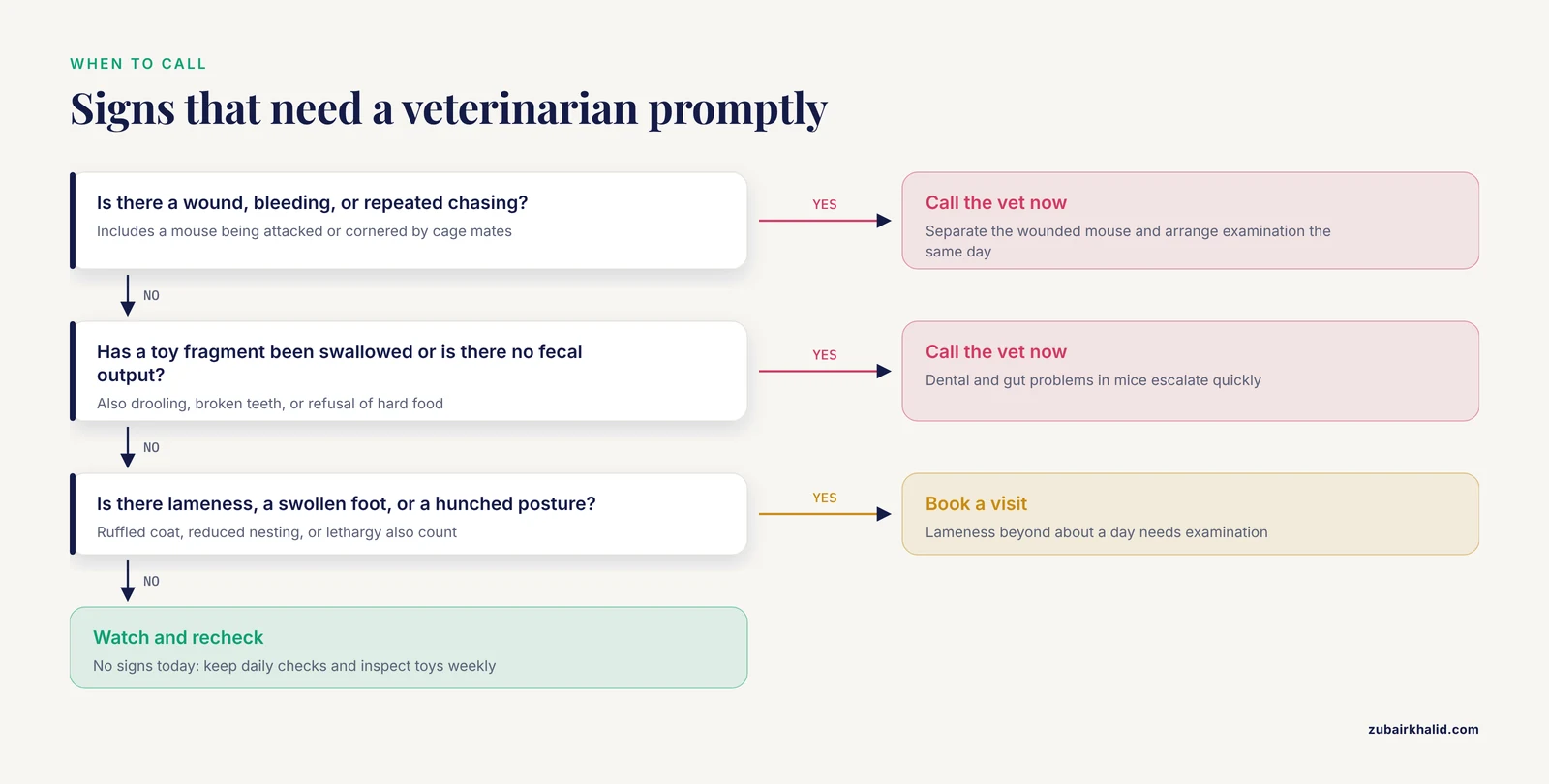
Contact a veterinarian promptly if you see any of the following:
- A wound, bleeding, or a mouse being repeatedly chased or attacked
- Bald patches, scabs, or spreading hair loss, which may be overgrooming or skin disease
- Drooling, broken teeth, or refusal to eat hard food
- A missing or swallowed toy fragment, or constipation with no fecal output
- Lameness lasting more than about a day, or a swollen foot
- Hunched posture, ruffled coat, reduced nesting, or lethargy, since nonspecific signs like these are among the most commonly reported problems in mice and warrant early examination [14]
- Any eye redness, cloudiness, squinting, or discharge, because ocular disease is common in mice and benefits from early, targeted examination [15]
- Sudden behavior change after a new product, scent, or accessory entered the home [10][3]
Do not delay care based on how the mouse behaved yesterday. Mice decline quickly once illness becomes visible.
Frequently Asked Questions
What are the safest toys for pet mice?
The safest toys for pet mice are functional items that support nesting, burrowing, chewing, climbing, and hiding, such as shredded paper nesting material, plain cardboard, solid hides, and solid-surface wheels. Choose unscented products, inspect them weekly for damage, and remove anything a mouse has chewed into a swallowable or unstable shape.
What toys are dangerous for pet mice?
Dangerous toys for pet mice include anything scented, items with loose threads or soft chewable plastic, objects with sharp edges, staples, or glued joints, tunnels that can trap a mouse, and towers that can tip over. Scented products deserve special caution, since essential oil products applied to cages increased injuries in mice in controlled testing [3].
Which materials are toxic or risky for pet mice?
Risky materials for pet mice include dyed or painted wood, glued assemblies, foam and rubber, cotton-wool-style nesting material, and any plastic soft enough to be chewed apart. Because mice gnaw everything, assume any material will end up in the mouth. If you cannot identify what an item is made of, discuss it with a veterinarian or choose a plain paper, cellulose, or untreated wood alternative.
How often should I rotate or replace mouse toys?
Replace damaged toys immediately and refresh nesting material whenever it is soiled, checking nests daily. Introduce new items one or two at a time rather than all at once, because sudden restructuring after cage cleaning is a recognized trigger for aggression in groups of male mice [3]. Preserving a little familiar nesting material during cleaning helps mice keep their scent map.
Do pet mice need a wheel?
Most pet mice benefit from a wheel because running is a strong natural behavior, but only with a solid-surface wheel that lets the mouse run with a flat back and spins freely without wobble. Avoid rung or mesh surfaces that can catch feet and tails. Check the axle weekly for hair or nesting material that can cause entanglement.
Can I give my mice cardboard tubes and boxes?
Yes. Plain, unscented cardboard tubes and boxes are among the best mouse toys because they are chewable, rearrangeable, and cheap to replace. Remove them when they become soggy, heavily soiled, or chewed thin, and avoid printed or coated cardboard if you cannot confirm the ink or coating, a question you can also raise with your veterinarian.
Why did my mice start fighting after I added new cage accessories?
New accessories can create competition over high-value resources such as hides and wheels, and layout changes around cleaning can disrupt the scent and social structure mice rely on. Aggression-related injury is a major welfare problem in mice, and enrichment alone does not reliably prevent it [3]. Spread out duplicates of valued items, consider a burrow-style partial divider, which reduced aggressive behavior in group-housed males in controlled testing [8], and separate wounded animals for veterinary care.
What bedding is safest for pet mice?
Unscented, paper-based cellulose bedding is a strong default, and comparative studies of paper pulp and corncob bedding found welfare-relevant differences in cage microenvironment and the timing of cage changes [7]. Keep bedding deep enough for digging, keep it dry, avoid strongly aromatic or perfumed products, and review your specific bedding choice with an exotics veterinarian, since bedding research continues to evolve.
Sources
- Effects of experimental housing conditions on recovery of laboratory mice.
- Effects of environmental enrichment on males of a docile inbred strain of mice.
- The effect of early life experience, environment, and genetic factors on spontaneous home-cage aggression-related wounding in male C57BL/6 mice.
- Nesting material enrichment reduces severity of overgrooming-related self-injury in individually housed rats.
- A Survey of Laboratory Animal Veterinarians Regarding Mouse Welfare in Biomedical Research.
- Social enrichment by separated pair housing of male C57BL/6JRj mice.
- Analysis of Individually Ventilated Cage (IVC) Microenvironments During 21-d Cage Change Frequency for Mice Using Two Different Bedding Types.
- Partial cage division significantly reduces aggressive behavior in male laboratory mice.
- Laboratory conditions matter: social housing in male and female laboratory mice in a multicenter study approach.
- Olfaction variation in mouse husbandry and its implications for refinement and standardization: UK survey of animal scents.
- Lack of fear response in mice (Mus musculus) exposed to human urine odor.
- Progressing the care, husbandry and management of ageing mice used in scientific studies.
- Practical pathology of aging mice.
- Incidence rates of spontaneous disease in laboratory mice used at a large biomedical research institution.
- Prevalence and management practices of ophthalmic lesions in laboratory mice.