Safe Toys and Equipment for Hedgehogs: What to Avoid
By Dr. Zubair Khalid, DVM, MS, PhD ·

The safest toys for hedgehogs are solid-surface wheels, wide smooth tunnels, simple hard plastic balls, and unscented fabric or paper items with no loose threads. The most dangerous items are wire or mesh wheels, exercise balls, anything with small parts that break off, scented or resinous materials such as cedar, fabric with loops or frayed strings, and cage furniture that lets a hedgehog climb and fall. Hedgehogs injure themselves on equipment far more often than owners expect, and most of those injuries come from a short list of predictable hazards.
This guide walks through what makes a toy safe or dangerous for an African pygmy hedgehog, how to vet every item before it enters the cage, and which common pet-store products belong on the do-not-buy list.
At a Glance: Safe and Unsafe Items
| Item | Safe version | Avoid | Why it matters |
|---|---|---|---|
| Running wheel | Solid surface, no gaps, large enough for a flat-backed stride | Wire or mesh wheels, wheels with spokes or crossbars | Gaps catch toes and limbs, causing fractures and degloving injuries |
| Cage floor | Solid flooring with paper or aspen bedding, or fleece liner checked for loose threads | Wire floors, grated bottoms | Wire floors cause foot injuries and pressure sores |
| Cage structure | Single-level enclosure | Multi-level cages, ramps, high platforms | Hedgehogs have poor vision and climb poorly, so falls cause broken limbs |
| Tunnels | Wide, smooth PVC pipe or commercial tunnels wider than the hedgehog's shoulders | Narrow tubes, tubes with sharp cut edges | Entrapment and abrasions |
| Paper tubes | Cut lengthwise before offering | Intact toilet paper tubes | A hedgehog can push its head in and become stuck |
| Balls | Large, smooth, hard plastic balls a hedgehog can push | Small balls, balls with bells inside, foam balls | Bells and foam pieces break off and are swallowed |
| Bedding | Paper-based bedding, kiln-dried aspen, fleece liners | Cedar shavings, pine shavings with strong odor | Aromatic phenols in cedar irritate airways and are toxic materials for hedgehogs |
| Hideouts | Wooden or plastic hides with large openings and no small parts | Hides with staples, sharp edges, glued decorations | Chewing and entrapment hazards |
| Cleaning products | Mild unscented soap, thorough rinsing | Pine-scented or phenol disinfectants, essential oil sprays | Residues irritate airways and can be ingested during self-anointing |
Why Toy Safety Works Differently for Hedgehogs
Hedgehog anatomy and behavior create hazards that do not apply to other small mammals, so safe choices for rabbits, rats, or guinea pigs are not automatically safe choices here.
Three traits drive most toy-related injuries:
- They run long distances at night. Hedgehogs in captivity walk and run for much of the night on a wheel, so the wheel is the piece of equipment they interact with most, and it is also the most common source of foot and limb injuries when its surface has gaps.
- They chew and taste new objects. Hedgehogs investigate by mouthing, and they perform a behavior called self-anointing, in which they lick a new or strong-smelling object, build up frothy saliva, and spread it over their spines. Anything on the object ends up in the mouth. A toy coated in cleaner residue, essential oil, or varnish is therefore not just a contact hazard, it is a swallowing hazard.
- They see poorly and move in bursts. Hedgehogs rely on smell and hearing more than sight, and they startle easily. A startled hedgehog bolts without looking, which is why open-height enclosures, ramps, and climbing structures produce so many fall injuries.
Combine these traits and a pattern emerges. The best hedgehog toys are low to the ground, solid, unscented, too large to swallow, and free of gaps. Almost every dangerous toy for hedgehogs fails one of those tests.
Choosing Safe Toys for Hedgehogs
The running wheel
A solid-surface wheel is the single most valuable enrichment item for a pet hedgehog because these animals naturally travel long distances overnight. Selecting the right wheel matters more than selecting any other toy.
Use these selection criteria:
- Solid running surface with no holes, mesh, or spokes. Wire and mesh wheels catch tiny toes between the gaps. Fractures, torn nails, and severe degloving injuries of the toes are documented consequences.
- No center bar or crossbar. Running hedgehogs cannot step over a center support, and a bar across the running path causes stumbles and collisions.
- Large enough for a flat back. Watch your hedgehog run. The spine should stay roughly level, not humped upward. If the animal arches, the wheel is too small.
- Stable base or secure mounting. A wheel that tips mid-sprint throws the animal against the cage wall.
- Easy to clean. Hedgehogs often urinate and defecate on wheels. Smooth plastic or metal surfaces that wipe clean are best, and the wheel should be washable daily.
Inspect the wheel weekly for cracks, wobble, and rough edges. Replace it at the first sign of surface damage.
Tunnels and hides
Hedgehogs are shy and need places to retreat. Hides are not optional enrichment, they are core equipment for reducing chronic stress.
- Choose tunnels wider than the hedgehog's full spined width so the animal can turn around inside.
- Smooth PVC pipe from the hardware store, with edges sanded or capped, works well and disinfects easily.
- Avoid tunnels with interior ridges, glued decorations, or staples that a mouth can reach.
- Offer at least one hide per side of the enclosure so the hedgehog never has to cross open space to reach cover.
Balls and push toys
Solid, smooth plastic balls large enough that they cannot be mouthed and swallowed are the classic hedgehog toy. Hedgehogs push them around and investigate them by scent. The rules are simple. No small balls. No balls with bells, noisemakers, or internal parts. No foam, rubber, or soft vinyl that teeth can shear pieces from. Any toy that smells strongly of plastic or chemicals should be aired out until odor-free, or returned.
Digging boxes and foraging items
Digging is a natural behavior, and a shallow box filled with child-safe shredded paper or clean, pesticide-free dried leaves gives your hedgehog a productive outlet. Foraging enrichment also encourages normal activity patterns.
Keep digging materials clean and replace them often, because buried food spoils and buried waste goes unnoticed. Never use potting soil, garden soil, or leaves collected from areas treated with pesticides or fertilizers.
Textiles, used carefully
Fleece liners and fleece hide pouches are popular cage accessories, and they can be safe with inspection habits. Fleece is a good textile choice because it does not unravel into long threads the way woven cotton does. Even so, shredded or frayed fleece develops loops that can wrap around a toe and cut off circulation, a problem small-animal veterinarians see regularly in species kept on fabric.
Check every fabric item daily for loose threads, stretched holes, and pulled seams. Retire any item that starts to shred. Avoid woven cotton bedding, towels with pulled loops, and any fabric item with attached buttons, eyes, or stuffing that a determined chewer can open.
Hedgehog Cage Accessories Safety
The cage itself and its fixed furnishings cause a large share of hedgehog injuries, often before an owner realizes the risk.
Enclosure structure
Hedgehogs are ground dwellers with poor distance vision and little aptitude for climbing. A multi-level cage is one of the most common dangerous cage setups sold for small animals. Falls from even modest heights produce broken limbs and internal injuries in hedgehogs.
- Use a single-level enclosure with a solid floor.
- Wire or grated flooring is inappropriate. It causes foot injuries and does not allow natural bedding digging.
- Smooth walls are fine, because hedgehogs do not escape by climbing, but confirm the enclosure has a secure top if it has any cage bars, since hedgehogs are persistent and surprisingly capable climbers when motivated.
- Keep the enclosure away from drafts and direct sun, and maintain the warm, stable room temperature that African pygmy hedgehogs need. Chilling can trigger a hibernation attempt that these pet hedgehogs cannot safely complete, so any heat equipment must be secured where it cannot be chewed, knocked over, or reached.
Food and water equipment
- Use heavy ceramic dishes that a rooting hedgehog cannot flip.
- Shallow, wide water dishes work well for many hedgehogs. If you use a dish, keep the water shallow enough that a small hedgehog cannot struggle in it, and change it daily.
- Keep food and water away from the hide area so the hide stays clean.
Bedding
Bedding is equipment, and the wrong bedding is a genuine toxic-material problem rather than a comfort issue.
- Avoid cedar shavings entirely. Cedar releases aromatic phenols that irritate the respiratory tract of small mammals and are considered hazardous when used as bedding.
- Be cautious with pine. Pine with a strong aromatic odor carries the same concern. If you use softwood shavings at all, they should be kiln-dried and low-odor, and the safest default is paper-based bedding or kiln-dried aspen.
- Paper-based bedding and aspen allow digging, which is enrichment in itself.
- Spot clean daily and change bedding on a schedule that keeps ammonia and moisture from building up.
Toxic Materials for Hedgehogs
Because hedgehogs lick and anoint on novel items, chemical safety rules are stricter for them than for many other pets. Treat anything scented, resinous, painted, or chemically treated as unsafe until proven otherwise.
Materials and residues to keep out of the enclosure:
- Cedar and strongly aromatic wood. Phenols in cedar are the classic small-mammal bedding hazard and irritate airways even without direct ingestion.
- Essential oils and strongly scented products. Diffusers, scented sprays, and heavily scented bedding near the cage expose a small animal with a sensitive respiratory tract to concentrated volatile compounds. Do not use them in the room the cage sits in.
- Phenol and pine-scented disinfectants. Residues on cage surfaces, toys, or hands transfer directly into the hedgehog's mouth during anointing and grooming. Clean with mild unscented soap and water, rinse until no residue remains, and dry before returning items to the cage.
- Painted, varnished, or treated wood. Household paints, sealants, and pressure-treated lumber are not safe if chewed. If you build wooden hides or platforms, use plain, unfinished, pet-safe wood and replace it when it becomes chewed or soaks up urine.
- Galvanized metal and corroded metals. Chewable wire or metal parts that shed zinc or other metals from coatings or corrosion should never be inside the cage.
- Pesticide- and herbicide-treated plant material. For dig boxes, use only material sold for animal use or gathered from areas you know are untreated.
- Fragranced litter and deodorizer products. If a product is marketed as making the cage smell better, it probably belongs nowhere near the cage.
The general rule: if it has a strong smell, a coating, or a chemical purpose, it does not go in the cage. Plain, inert, washable materials are the standard.
Dangerous Toys for Hedgehogs: The Do-Not-Buy List
These are the items most often bought by well-meaning owners and most often associated with preventable injuries.
- Wire and mesh running wheels. The single most dangerous common product marketed for hedgehogs. Toe and limb entrapment injuries on gapped wheel surfaces are a recognized hazard. Solid surface only.
- Hamster and rodent exercise balls. The sealed plastic ball that rolls around the floor is wrong for hedgehogs. They stress most hedgehogs, offer no traction, can trap limbs through slotted vents, and overheat a small animal in a warm room. Hedgehogs get their running from a proper wheel, not a rolling ball.
- Multi-level cages, ramps, and climbing towers. Falls from platforms are a leading cause of fractures in this species, which navigates heights poorly.
- Small balls, balls with bells, and foam toys. Any toy that can produce a swallowable piece is a gastrointestinal foreign body risk. A swallowed bell or foam chunk may require surgery.
- String, yarn, elastic, and rubber bands used as enrichment. Swallowed thread and string can create a linear foreign body, one of the more serious gastrointestinal emergencies in small animals. Do not put them in the cage at all.
- Latex and soft rubber toys. Teeth shear off pieces that get swallowed. Dog and cat chew toys are not hedgehog toys.
- Toys with glued eyes, buttons, or decorations. Pet-store plush items and decorated hides often have parts attached with glue or staples that a hedgehog can work loose.
- Scented anything. Scented chews, scented bedding, and scented cage deodorizers all conflict with the toxic-materials rules above.
- Intact toilet paper tubes. Many hedgehogs love them, but a hedgehog can wedge its head inside and panic. Cut the tube open along its length so it can never trap a head, and the toy becomes safe.
- Deep water containers and open-top baths left unsupervised. Hedgehogs can swim, but they exhaust and chill quickly. Supervise any water time closely, use shallow warm water, and dry the animal fully afterward.
How to Vet Any Toy Before It Enters the Cage
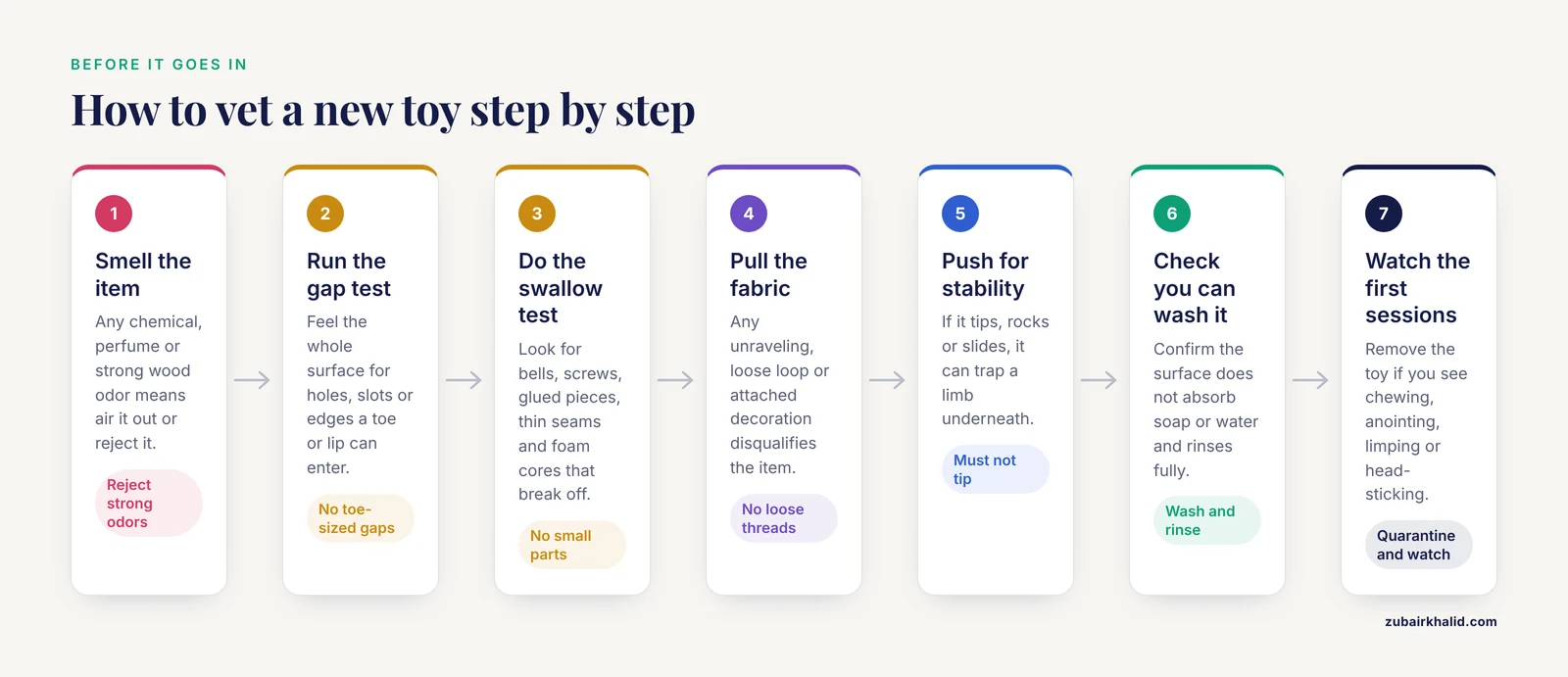
Run every new item through this checklist before offering it.
- Smell test. Sniff the item at close range. Any chemical, perfume, or strong wood odor means it needs to air out or be rejected.
- Gap test. Run your fingers over the whole surface. Feel for holes, slots, or edges wide enough for a toe or a lip to enter. Hedgehog toes are small, so gaps that seem harmless to you are not harmless to them.
- Swallow test. Look for parts that could break off and pass a small mouth. Bells, screws, glued pieces, thin plastic seams, and foam cores all fail this test.
- Thread test. Pull gently on fabric. Any unraveling, loose loop, or attached decoration disqualifies the item.
- Stability test. Push the item the way a rooting hedgehog would. If it tips, rocks, or slides across the cage, it can trap a limb underneath.
- Cleanability test. Confirm you can wash and fully rinse it without the surface absorbing soap or water.
- Quarantine-and-watch period. Introduce the toy, then observe the first sessions. Note chewing, anointing, limping, or head-sticking behavior, and remove the item if any of these appear.
Common Mistakes Owners Make
- Buying a wire wheel because it is cheaper or quieter. The savings are not worth a toe amputation. Solid surface is non-negotiable.
- Adding a second level "for space." Hedgehogs do not use levels the way rats do, and the fall risk outweighs the floor space gained.
- Using cedar for its odor control. The smell that makes cedar appealing to humans is the phenol load that irritates small mammals.
- Leaving strings and ropes in the cage because the hedgehog "ignores them." Chewing behavior can start suddenly, and a swallowed string can sit unnoticed until an emergency develops.
- Cleaning with the same products used in the kitchen or bathroom. Scented residues on toys and cage surfaces transfer straight into the mouth during anointing.
- Trusting the "small animal" label on packaging. Products labeled for hamsters, gerbils, or chinchillas are frequently inappropriate for hedgehogs, particularly wheels, exercise balls, and wire accessories.
- Skipping daily equipment checks. A wheel that develops a crack or a fleece liner that shreds can go from safe to dangerous between weekly cleanings.
Troubleshooting Common Problems
My hedgehog ignores the wheel. Check fit first. A wheel that is too small, too noisy, or unstable discourages use. Confirm the surface is solid and the wheel spins freely. Some hedgehogs take days or weeks to adopt a wheel. Consistent overnight access in a quiet room is the main fix.
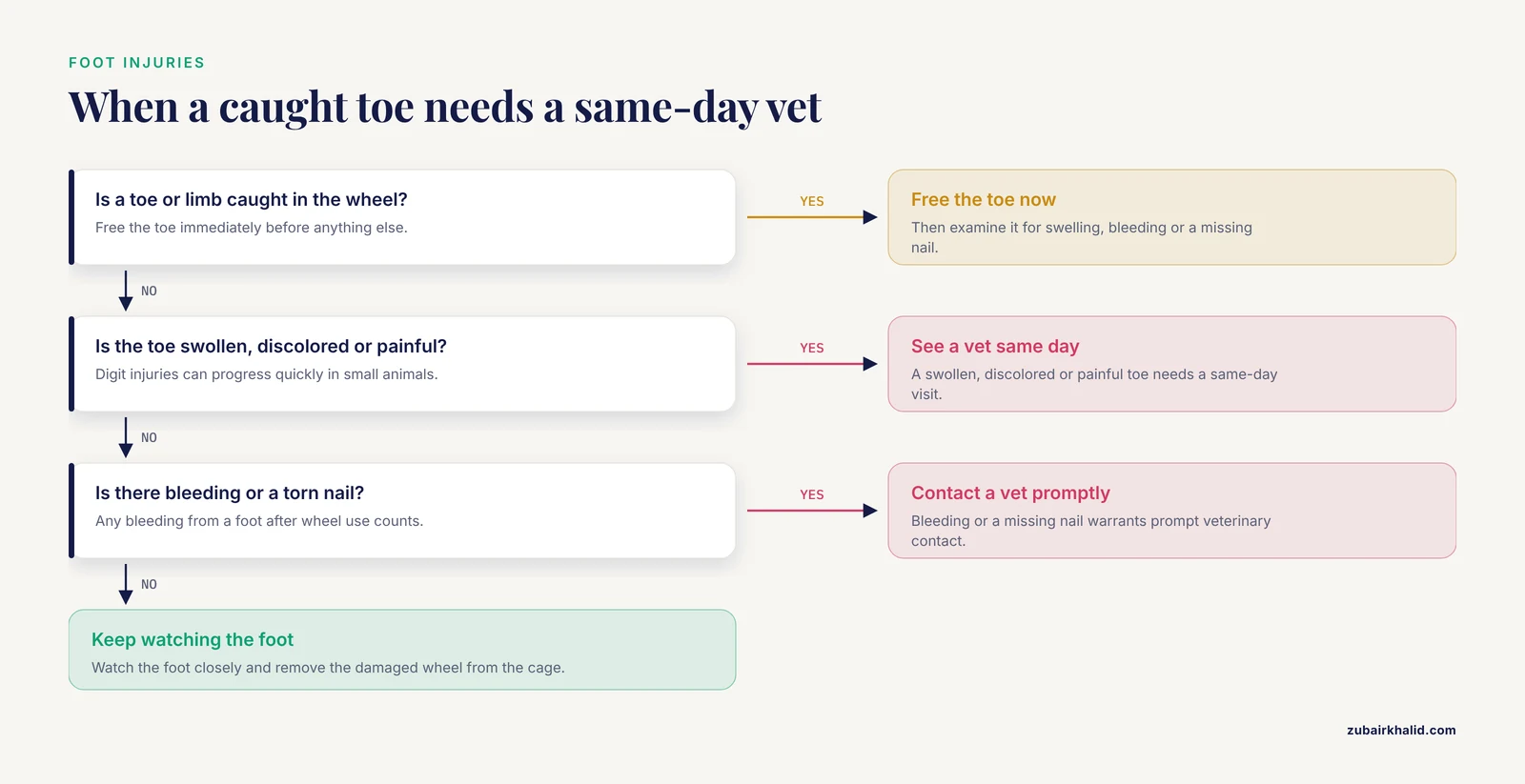
My hedgehog got a toe caught. Free the toe immediately, then examine it for swelling, bleeding, or a missing nail. Any toe that looks swollen, discolored, or painful needs a same-day veterinary visit, because digit injuries can progress quickly in small animals.
My hedgehog anoints excessively on a new toy. Remove the item and rinse it thoroughly. Persistent anointing on one object suggests the item carries a smell or residue the hedgehog finds alarming. Wash it, air it out for several days, or discard it.
My hedgehog chews everything. Increase solid, chewable, safe options such as hard plastic balls and untreated wood blocks from the pet store, and remove anything soft or coated. Persistent inappropriate chewing, or chewing that produces drooling or refusal to eat, warrants a dental check by a veterinarian experienced with exotic animals.
My hedgehog seems stiff after cage changes. Sudden wobbly movement, hunched posture, or unresponsiveness in a cool room can signal a temperature problem, which is an emergency in pet hedgehogs. Warm the environment appropriately and contact a veterinarian.
Welfare and Enrichment Principles
Safe equipment is the baseline, and good enrichment builds on it. A well-set hedgehog enclosure includes a solid running wheel, at least one or two hides, a dig box rotated with fresh material, a few push toys, and bedding deep enough to burrow in. Rotate items rather than adding everything at once, and keep a short diary of what your individual animal uses. Hedgehogs show strong individual preferences, and the best hedgehog toys are the ones your particular animal engages with nightly and cannot injure itself on.
If you keep hedgehogs, confirm that they are legal where you live, because several US states and municipalities restrict or prohibit keeping them. Where they are legal, routine wellness examinations with a veterinarian who treats exotic companion mammals are part of responsible care, consistent with the preventive-care approach promoted by organizations such as the AAHA and the AVMA for all companion animals.
Limitations and When to Contact a Veterinarian
Individual hedgehogs vary in size, behavior, and health status, and only a veterinarian who has examined your animal can give advice tailored to your specific case.
Contact a veterinarian promptly, the same day whenever possible, for any of the following:
- A limp, a swollen or discolored toe, a torn or missing nail, or any bleeding from a foot, especially after wheel use
- Refusal to eat or a marked drop in activity lasting more than about a day
- Cool body temperature, wobbly gait, or unusual lethargy, which can indicate a dangerous drop in body temperature
- Labored breathing, sneezing, nasal discharge, or a change in breathing sound, which can indicate respiratory disease worsened by irritating bedding or airborne chemicals
- Drooling, pawing at the mouth, or a sudden inability to close the mouth, which can indicate an oral foreign body
- Vomiting, diarrhea, or a bloated abdomen, which can indicate a swallowed foreign object such as string, foam, or plastic
- Any injury from a fall, even if the hedgehog seems fine afterward, since internal injuries may not be obvious
An exotic-animal or small-mammal veterinarian is the right starting point for hedgehog health problems. This article is educational and is not a substitute for veterinary diagnosis or treatment.
Frequently Asked Questions
What are the best hedgehog toys?
Solid-surface running wheels, wide smooth tunnels, large hard plastic balls, dig boxes filled with paper or clean dried leaves, and simple fleece hides are the best hedgehog toys. Choose items that are unscented, gap-free, too large to swallow, and easy to wash.
Are exercise balls safe for hedgehogs?
No. Hamster-style exercise balls stress hedgehogs, offer no traction, can trap limbs through vents, and add heat in a warm room. A solid-surface wheel inside the cage provides the running exercise hedgehogs need.
Can hedgehogs play with toilet paper tubes?
Yes, but only after you cut each tube open lengthwise. An intact tube can trap a hedgehog's head, and a panicked, spined animal wedged in a tube is dangerous to handle. The cut tube keeps the scent novelty without the entrapment risk.
Why is cedar bedding dangerous for hedgehogs?
Cedar releases aromatic phenols that irritate the respiratory tract of small mammals and are considered hazardous as bedding. Use paper-based bedding, kiln-dried aspen, or checked fleece instead.
What kind of wheel is safe for a hedgehog?
A wheel with a completely solid running surface, no center bar, no mesh or spokes, and enough diameter that the hedgehog runs with a flat back. Wire and mesh wheels catch toes and cause serious injuries.
Do hedgehogs need toys at all?
Yes. Hedgehogs are active, nocturnal foragers, and a cage with only food, water, and a hide leads to inactivity and stress. A solid wheel, dig box, tunnels, and rotating simple toys support normal behavior.
Are fleece liners and hides safe for hedgehogs?
They are safe when inspected daily. Fleece does not unravel like woven fabric, but shredded or frayed fleece forms loops that can wrap around toes and restrict circulation. Retire any fleece that begins to shred, and avoid cotton fabric, buttons, and stuffing.
How should I clean hedgehog toys and cage accessories?
Wash items with mild unscented soap and warm water, rinse until no residue remains, and dry fully before returning them. Avoid pine-scented or phenol disinfectants and essential oil cleaners, because residues end up in the hedgehog's mouth through licking and anointing.