Safe Toys and Equipment for Gerbils: What to Avoid
By Dr. Zubair Khalid, DVM, MS, PhD ·

The safest toys for gerbils are untreated wooden chew items, plain cardboard tunnels and boxes, deep substrate for digging, ceramic or wooden hides, and a solid-surface exercise wheel sized so the gerbil runs with a flat back. The most dangerous items are plastic objects the gerbil can gnaw into sharp fragments, toys with loose fibers or small detachable parts, wire wheels with open rungs, narrow enclosed tubes that can trap a limb, scented or softwood bedding materials, and any item treated with paint, varnish, glue, or fragrance. Gerbils are powerful, persistent gnawers, and nearly every toy-related injury in this species comes from a material they were able to chew apart.
This guide explains what makes an item safe or dangerous for a gerbil, how to build an enrichment setup that meets this species' specific behavioral needs, and which common owner mistakes cause the most problems. Because gerbils hide illness well, any toy that could cause injury or ingestion of foreign material deserves more caution than most owners initially give it.
At a Glance: A Gerbil Toy Safety Checklist
| Item | Safe version | Keep out of the enclosure |
|---|---|---|
| , - | , - | , - |
| Chew items | Untreated wood, plain cardboard | Painted, varnished, glued, dyed, or scented objects |
| Tunnels | Cardboard tubes, ceramic pipes, wooden hides | Narrow plastic tubes, flimsy plastic that shatters into fragments |
| Exercise wheel | Solid running surface, large enough for a flat back | Wire or spaced-rung wheels, tiny hamster-sized wheels |
| Bedding and substrate | Paper-based or aspen substrate deep enough to dig | Cedar shavings, strongly scented softwood bedding |
| Soft items | Plain, unscented paper-based nesting material | Cotton wool, fiberfill, fabric with loose threads |
| Attachments | Securely fixed, gnaw-resistant hardware | Loose hooks, clips, chains, or small detachable parts |
| Placement | Stable items that cannot collapse or tip | Stacked heavy objects over tunnels, items wedged above burrow entrances |
If you take one action today, remove every plastic item in the enclosure and check whether each remaining toy has small parts, loose fibers, or a scented or coated surface. Replace those items with plain cardboard, untreated wood, or ceramic alternatives.
Why Toy Choice Matters More for Gerbils Than Most Owners Expect
Gerbils are not casual chewers. Their wild relatives excavate elaborate burrow systems, and the drive to dig, tunnel, and gnaw is hardwired rather than learned. Research on gerbil housing found that when gerbils are denied an outlet for these behaviors, they develop recognizable behavioral abnormalities. Stereotypic digging, a repetitive digging motion performed with no purpose, developed in gerbils housed without any form of burrow. Stereotypic bar chewing was linked to husbandry factors, particularly juveniles separated from their family group too early [1]. These are not minor quirks. They are welfare red flags that appear when the environment fails to meet the animal's needs.
The same research produced an encouraging finding. An integrated artificial burrow system prevented the development of stereotypic digging, and simple changes to housing and husbandry significantly reduced bar chewing [1]. In practical terms for pet owners, this means the toys and accessories you choose are not decoration. They are the primary mechanism preventing repetitive, stress-linked behavior in your gerbil.
Enrichment also shapes the brain. In gerbil studies, housing animals in an enriched environment increased newborn neurons in the hippocampus and improved spatial learning and memory performance compared with standard housing [2]. Separate gerbil research on recovery from brain injury found that enriched housing improved functional recovery, with enriched animals performing similarly to healthy controls on behavioral tasks over time [3]. While pet gerbils are not laboratory animals, the underlying principle transfers directly. A gerbil with tunnels to run through, substrate to dig in, and objects to chew is not just entertained. That gerbil is physically building a better-functioning nervous system.
What Gerbils Actually Need From Their Equipment
Before selecting specific items, understand the three drives every safe toy should serve.
The drive to dig
Digging is the defining behavior of this species. When it has no outlet, gerbils develop stereotypic digging, and providing a burrow-like structure prevents that outcome [1]. The practical translation is straightforward. Your gerbil needs a deep layer of substrate suitable for tunneling, or at minimum a burrow substitute such as a deep dig box within the enclosure. A shallow layer of bedding over a plastic floor is the single most common housing failure in pet gerbils, and it is the one most directly tied to a documented welfare problem.
The drive to gnaw
Gerbil teeth grow continuously, and gnawing keeps them worn down while occupying the animal for hours. Every gerbil enclosure needs chewable items made from safe, untreated materials. Cardboard tubes from paper towel rolls, plain cardboard boxes, and untreated wooden blocks all give the gerbil a legitimate target. Without acceptable chew items, the gerbil will choose its own targets, which is how owners end up with gnawed cage bars, destroyed plastic accessories, and injured teeth.
The drive to run and explore
Gerbils are active, ranging animals. Enriched environments that offer movement, novelty, and problem-solving measurably improve gerbil brain function and learning behavior [2]. This drive is served by an appropriately sized exercise wheel, regular rearrangement of tunnels and hides, and supervised out-of-enclosure exploration in a secure, gerbil-proofed space.
The Best Gerbil Toys, Category by Category
Digging and burrowing equipment
The single most valuable piece of equipment for a gerbil is substrate deep enough to tunnel in. Research shows that a burrow system prevents stereotypic digging from developing [1], and a deep substrate layer is the closest practical equivalent in a home enclosure. Choose a substrate that holds a tunnel shape, such as paper-based bedding or aspen shavings, filled to a depth that lets the gerbil burrow fully out of sight. Many owners use a glass or deep plastic tank specifically to allow this depth. Check with your veterinarian about substrate depth recommendations for your specific enclosure, since depth depends on the tank size and ventilation you have.
A dedicated dig box works as a supplement if the main enclosure cannot hold deep substrate. Fill a sturdy open-topped container with safe substrate and refresh it regularly.
Chew toys
The best gerbil chew items share three properties. They are untreated, they contain no glue or coating, and they are dense enough to wear teeth without splintering into needle-like fragments. Suitable options include plain cardboard tubes and boxes, untreated wooden blocks sold for small mammals, and loofah or natural woven grass products without binding agents. Inspect wooden items sold as small mammal chews and reject any that are dyed, flavored, varnished, or held together with visible glue.
Tunnels and hides
Gerbils use tunnels the way they use burrows, as secure passage and resting space. Safe tunnel options include cardboard tubes, ceramic pipe sections with smooth edges, and wooden hide houses with multiple exits. Provide more than one exit from every hide so a subordinate gerbil in a pair or clan cannot be cornered. Avoid any tunnel narrow enough that a gerbil could wedge itself inside, and avoid enclosed plastic tubes entirely, for reasons covered below.
Exercise wheels
A wheel lets a gerbil express running behavior safely inside the enclosure. Two features determine whether a wheel is safe. First, the running surface should be solid, not wire or spaced rungs, because open gaps catch limbs and tails. Second, the wheel must be large enough that the gerbil runs with a straight back rather than an arched one. A wheel that forces the animal to bend sharply while running is a source of spinal strain over time. When in doubt between two sizes, choose the larger one.
Foraging and problem-solving items
Scattering a portion of the daily food ration through the substrate, hiding seeds inside rolled cardboard, and rotating which hide contains a food reward all turn feeding into natural foraging work. Enrichment research in gerbils demonstrates that a stimulating environment produces measurable neurological and learning benefits [2], and foraging is one of the easiest enrichments to implement. There is no need to buy commercial puzzle feeders designed for other species, which often contain plastic parts. A cardboard tube stuffed with hay and seed achieves the same goal with zero risk.
Toxic Materials for Gerbils and Materials to Reject for Other Reasons
Because gerbils gnaw continuously, material safety is inseparable from toy safety. Work through every item in the enclosure against this list.
Aromatic softwoods
Cedar shavings and some softwood beddings release aromatic compounds that are widely flagged in small mammal husbandry guidance because of concerns about respiratory and liver irritation. Veterinary resources for exotic pets, including the Merck Veterinary Manual's exotic animal materials, consistently direct small mammal owners toward paper-based or aspen bedding and away from aromatic cedar products. Ask your veterinarian to confirm the substrate they recommend, since product formulations vary.
Treated, painted, or glued items
Any toy with paint, varnish, stain, dye, or adhesive is unsuitable, because the gerbil will ingest surface material as it gnaws. This includes many decorative wooden items sold for home décor rather than for pets, and craft-store wood. Pine cones collected outdoors are a common owner mistake. They carry unknown residue from pesticides, road runoff, and wild animal contamination, and they cannot be made reliably safe at home.
Plastic
Plastic deserves special attention because it is the material behind many gerbil injuries. A gerbil can chew through plastic in a remarkably short time. The risks are twofold. Sharp fragments cut mouths, cheeks, and paws. Ingested pieces cause gastrointestinal obstruction, a serious emergency in an animal this size. Plastic accessories marketed for hamsters are frequently too small and too fragile for gerbils. Treat any plastic in the enclosure, including plastic wheels, plastic tunnels, and plastic hide houses, as a consumable that the gerbil will eventually destroy. Most experienced gerbil veterinarians recommend removing plastic entirely and building the enclosure from glass, metal, ceramic, untreated wood, and cardboard.
Loose fibers and nesting materials
Fluffy commercial nesting products made of cotton or synthetic fiber are a recurring cause of harm in small mammals. Fibers can wrap around a limb or foot and cause constriction injury, or they can be swallowed. Plain, unscented paper-based nesting material or torn unscented toilet paper is the safe alternative.
Scented products
Essential oils, scented bedding, perfumed litters, and heavily fragranced cleaning products on cage accessories are poor matches for an animal with a small body and a sensitive respiratory tract. Clean accessories with plain hot water and, when needed, a pet-safe disinfectant fully rinsed and dried before the item returns to the enclosure.
Metals and hardware
Galvanized wire can raise zinc concerns if gnawed persistently, so avoid accessories built from hardware-store wire. Check that every clip, hook, and hanging attachment is secure and gnaw-resistant, because a falling toy or a swallowed clip is a preventable emergency.
Dangerous Toys for Gerbils: The Most Common Owner Mistakes
These mistakes appear repeatedly in gerbil-keeping communities and veterinary practices, and each one is easy to correct.
- Buying hamster-sized equipment. Gerbils are larger, faster, and stronger than hamsters. Undersized wheels strain their spines, and undersized hides and tunnels trap them. Size everything for the adult gerbil, not the juvenile.
- Providing shallow bedding. A thin layer of bedding over a floor is the setup most associated with stereotypic digging, a welfare problem documented in gerbils housed without burrow opportunities [1]. Depth is not a luxury. It is the core behavioral requirement.
- Leaving plastic accessories in place after chewing starts. Once a gerbil has opened a plastic hide or tunnel, jagged edges form within days. Remove the item the first time you see damage.
- Assuming a pet-store label means safe. Small mammal product aisles contain plastic toys, dyed chews, and fiber nesting material that experienced owners and veterinarians routinely reject. Read materials, not marketing.
- Skipping the wheel entirely or choosing an open-rung wheel. Gerbils need a running outlet, and wire wheels trade that outlet for limb and tail injuries. A solid-surface wheel of adequate size solves both problems.
- Using exercise balls. Plastic exercise balls restrict ventilation, stress the animal, and put a digging, jumping species on an uncontrolled hard surface. Free exploration in a gerbil-proofed room or a secure playpen is a better alternative.
- Wedging heavy objects over tunnels. Gerbils dig under and burrow through everything. A heavy ceramic hide or stone placed above a tunnel the gerbil has undermined can collapse. Keep the structure above any diggable area either firmly secured or light enough that a collapse cannot trap or crush.
- Ignoring bar chewing. Bar chewing is not harmless. It is a documented stereotypy linked to husbandry factors, including premature separation of young gerbils from their family group [1]. A gerbil chewing bars needs an environmental fix, not a reprimand.
Gerbil Cage Accessories Safety: Evaluating What You Already Own
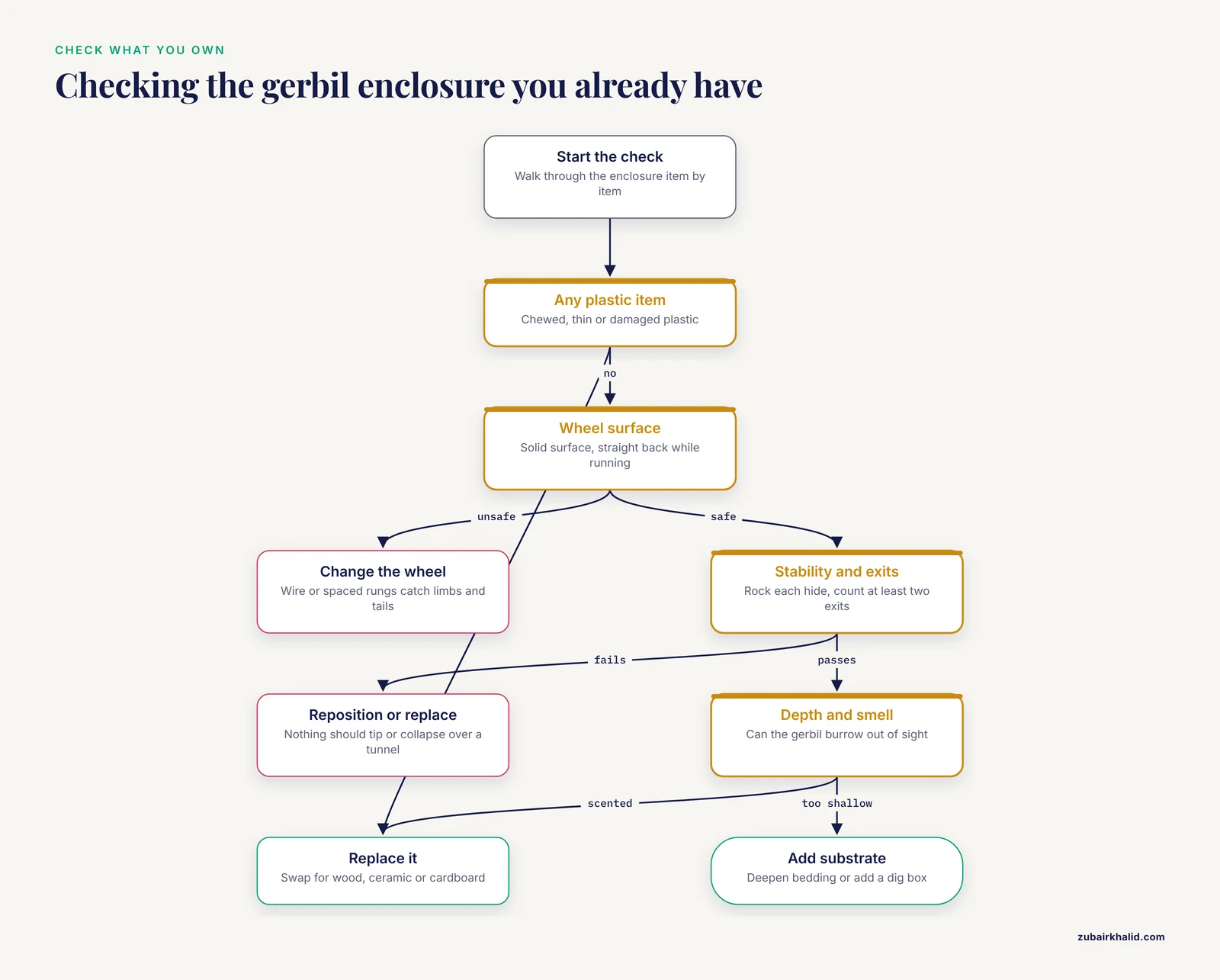
Walk through your enclosure with this evaluation sequence.
- Pull out every plastic item. Set them aside and decide whether each is genuinely thick, durable, and undamaged. In most cases, replacement is the safer call.
- Check wheel surface and size. Solid surface, adequate diameter, straight back while running.
- Test stability. Rock each hide and tunnel. Anything that can tip, collapse, or fall when a gerbil digs beneath it needs to be repositioned or replaced.
- Count the exits. Every enclosed hide needs at least two openings if you keep more than one gerbil.
- Sniff test. Scented bedding, scented chews, and any accessory with a chemical or perfume odor should leave the enclosure.
- Inspect for sharp points. Run a finger over every surface. Cut cardboard edges, wire ends, and cracked ceramic all cause lacerations.
- Confirm substrate depth. If your gerbil cannot fully burrow out of sight, add substrate or add a dig box.
- Schedule rotation. Enrichment works best with novelty. Plan to rearrange tunnels and swap chew items regularly rather than leaving an identical layout for months.
Setting Up a Safe Enrichment Layout, Step by Step
- Start with the enclosure itself. A glass tank or deep enclosure with a secure mesh lid supports deep substrate far better than a wire cage, and it eliminates the bar-chewing surface entirely. If you currently use a wire cage, discuss upgrading with a small mammal veterinarian, particularly if your gerbil already chews bars.
- Add substrate to burrowing depth. Fill a substantial portion of the enclosure floor with paper-based or aspen bedding deep enough for tunnels.
- Place a burrow substitute. Even with deep substrate, a half-buried ceramic pipe, a cardboard-box burrow, or a commercial burrow box gives the gerbil a fixed secure site, mirroring the artificial burrow systems shown to prevent stereotypic digging in gerbils [1].
- Install the wheel. Solid surface, generous diameter, positioned where it cannot tip and cannot be undermined by digging.
- Build a tunnel network. Connect hides with cardboard or ceramic tunnels, providing multiple routes and exits.
- Add chew stations. Distribute untreated wood and cardboard throughout, and replace them as they are destroyed. Destruction is the intended outcome.
- Create a foraging layer. Scatter seed mix through the substrate so the gerbil digs for food, combining the foraging and digging drives in one activity.
- Plan supervised exploration. Beyond the enclosure, offer a secure playpen or gerbil-proofed room session for exploration. Enriched, varied environments produce measurable neurological benefit in gerbils [2], and novel safe space is one of the strongest forms of variety available to a pet owner.
Troubleshooting Common Behavior Problems
Stereotypic digging
If your gerbil digs obsessively at a corner or at the cage floor with no goal, treat it as an environmental signal. This pattern develops in gerbils deprived of burrowing opportunities and is prevented by providing a burrow structure [1]. Increase substrate depth first. If the enclosure cannot accommodate depth, add a large dig box and a burrow hide immediately.
Bar chewing
Persistent bar chewing responds to husbandry change, not deterrence. Remove the bars as a chewing surface by moving to a bar-free enclosure, and review whether the gerbil has adequate chew items, burrow access, and social stability. In laboratory settings, adaptations to housing routines significantly reduced bar chewing incidence [1], and the same principle applies at home. Change the environment the behavior happens in.
Destructive boredom
A gerbil that shreds everything within hours usually needs more rather than fewer chew items, plus foraging work and layout changes. Rotate items weekly. Rearrange tunnels during routine cleaning so the layout is always a small puzzle.
Reluctance to interact
Gerbils can be trained to interact voluntarily with people. A structured clicker training protocol, in which gerbils learn to approach and interact with a human hand for a food reward, was successfully completed by a cohort of 43 gerbils over a 10-day program, and trained animals showed increased voluntary interaction with humans [4]. Short, reward-based handling sessions are a form of cognitive enrichment and reduce handling stress. If your gerbil freezes or flees at every approach, reward-based training is a better investment than more physical toys.
The Owner Side of the Equation
A large survey of small mammal owners in the United Kingdom, covering 723 owners across eight species including gerbils, found that the availability of suitable enclosures was the primary barrier to good housing, while owner capability and motivation were generally strong [5]. This finding matters for gerbil owners reading this article. Most owners want to provide good welfare and know how to assess it, largely by watching their animals' behavior. The gap is usually practical access to appropriate housing and equipment rather than willingness. If the barrier for you is cost or availability of a deep substrate enclosure, prioritize it. A proper enclosure with simple, safe, inexpensive enrichment such as cardboard and substrate outperforms a small cage filled with commercial plastic toys on every welfare measure that research has examined in this species.
The same survey work found that owners most often judge health and welfare through behavioral indicators [5]. For gerbil owners, that judgment is exactly where toy safety lives. A gerbil that digs purposefully, runs freely, gnaws appropriate items, and explores eagerly is telling you the setup works. A gerbil that bars, digs in corners, or sits motionless is telling you something in the equipment list needs to change.
Limitations and When to Contact a Veterinarian
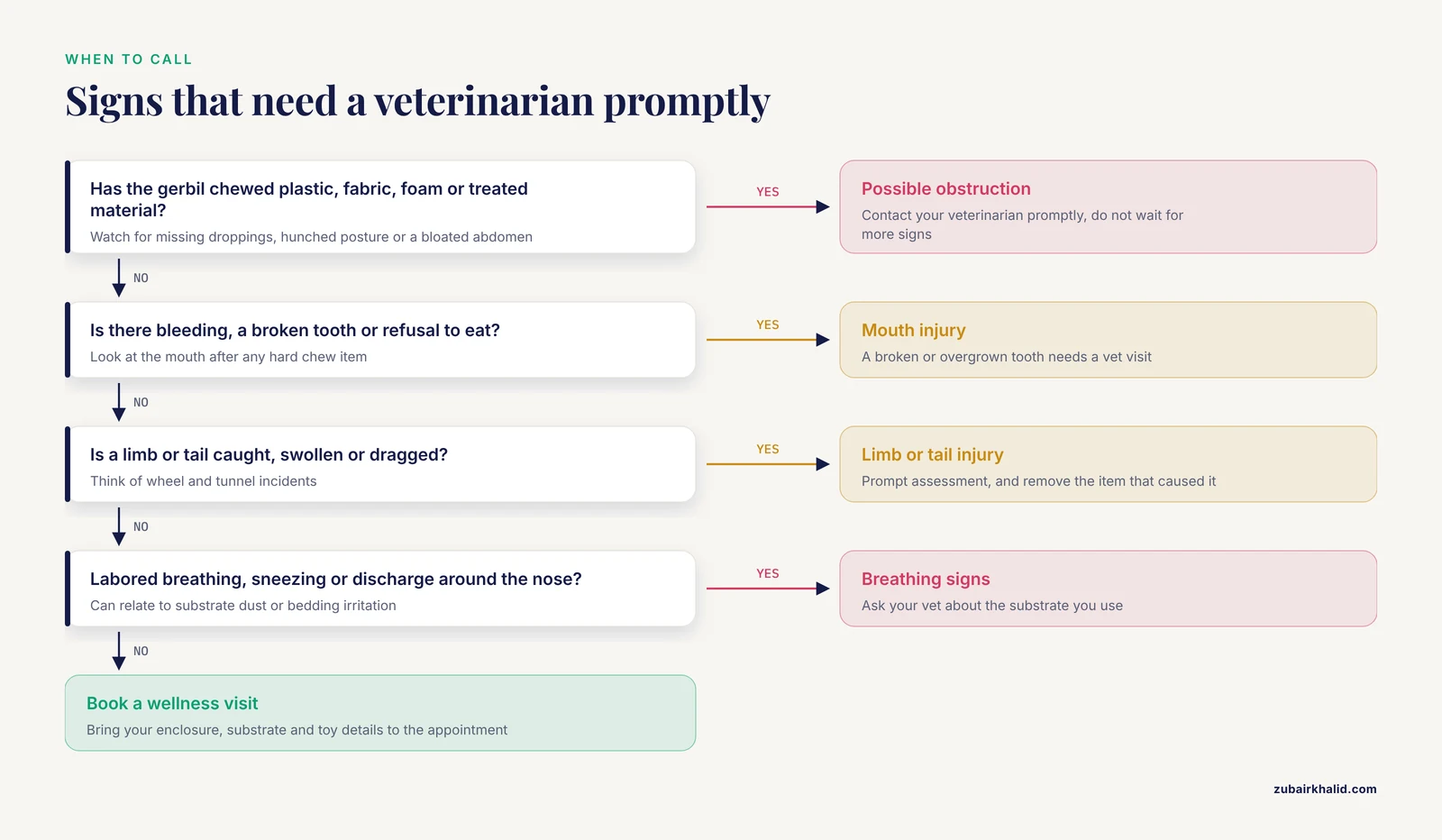
Every gerbil is an individual, and any persistent concern about behavior, appetite, or activity warrants a conversation with a veterinarian experienced in exotic small mammals. When you attend a wellness visit, bring details of your enclosure, substrate, and toys, because husbandry history meaningfully supplements the clinical assessment veterinarians perform on small mammals [6].
Contact your veterinarian promptly if you observe any of the following.
- Bleeding from the mouth, a broken or overgrown tooth, or a reluctance to eat after chewing a hard object
- Missing droppings, a hunched posture, bloated abdomen, or any sign of pain, which can indicate gastrointestinal obstruction from ingested material
- A limb or tail caught, swollen, or dragged, including after a wheel or tunnel incident
- Labored breathing, sneezing, or discharge around the nose, which can relate to substrate dust or bedding irritation
- Sudden onset or rapid escalation of repetitive digging, bar chewing, or circling
- Any wound, abscess, or limping
- A gerbil that has chewed and possibly swallowed plastic, fabric, foam, or any treated material
This article is educational and is not a substitute for veterinary diagnosis or treatment.
Frequently Asked Questions
What are the safest toys for gerbils?
Untreated wooden chews, plain cardboard tubes and boxes, deep diggable substrate, ceramic pipes and hides, and a solid-surface exercise wheel are the safest options. All of them tolerate heavy gnawing without producing sharp fragments, loose fibers, or toxic coatings.
What toys are dangerous for gerbils?
Dangerous toys for gerbils include plastic items that can be chewed into sharp or swallowable pieces, wire wheels with open rungs, toys with small detachable parts, fluffy fiber nesting products, scented or painted items, and narrow tubes a gerbil could wedge inside. Any toy the gerbil can destroy into fragments should be treated as a hazard.
Are plastic toys safe for gerbils?
Most plastic toys are not safe for gerbils because gerbils chew through plastic quickly, creating sharp edges and swallowable fragments that can cause mouth injuries or intestinal blockage. A heavily constructed, undamaged plastic wheel may be acceptable, but inspect it constantly and remove it at the first sign of chewing.
Do gerbils need an exercise wheel?
Yes, a wheel provides a valuable running outlet, but only a solid-surface wheel large enough for the gerbil to run with a straight back. Wire and spaced-rung wheels catch limbs and tails and should be avoided. Discuss wheel sizing with a small mammal veterinarian if you are unsure.
Is cardboard safe for gerbils to chew?
Plain, unwaxed, undyed cardboard is one of the safest and best chew materials for gerbils. Remove glossy printed cardboard, tape, staples, and any box that held scented products, and replace cardboard items as they are chewed down.
How often should I rotate or replace gerbil toys?
Inspect toys during every enclosure clean and replace cardboard and wooden chews as they wear, typically within days to weeks. Rearrange tunnels and hides at each major clean so the environment stays novel, since environmental variety supports gerbil learning and brain health.
Why does my gerbil chew the cage bars?
Bar chewing is a stereotypic behavior linked to housing and husbandry factors, including inadequate outlets for gnawing and, in young gerbils, premature separation from the family group. The fix is environmental, including a bar-free enclosure, adequate chew items, and burrowing opportunities, rather than punishment or deterrents.
Can gerbils learn tricks or play with their owner?
Yes. Gerbils successfully learned a structured 10-day clicker training protocol to approach and interact with a human hand for food rewards, and trained gerbils showed increased voluntary human interaction. Short reward-based sessions are safe enrichment and reduce handling stress.
Sources
- Refinement of gerbil housing and husbandry in the laboratory.
- Environmental enrichment enhances neurogenesis and improves functional outcome after cranial irradiation.
- Environmental enrichment enhances recovery of function but exacerbates ischemic cell death.
- Enhancing Gerbil Welfare Through Positive Reinforcement Training in Research Environments.
- Small mammal owners' experiences of housing challenges and animal welfare: A COM-B and word frequency analysis.
- Hematologic Assessment in Pet Rats, Mice, Hamsters, and Gerbils: Blood Sample Collection and Blood Cell Identification.