How Much Exercise Does a Pet Rat Need?
By Dr. Zubair Khalid, DVM, MS, PhD ·

A pet rat needs some form of physical activity every single day, both inside and outside the cage. There is no single validated number of minutes that applies to every rat, but the practical standard of care is clear. Rats should have a large, multi-level cage that allows climbing and movement, daily opportunities for supervised playtime outside the cage in a safe, secured area, and in-cage enrichment such as a solid-surface exercise wheel, climbing structures, and foraging activities. Rats are active, intelligent animals, and a cage alone, no matter how large, cannot meet all of their exercise needs.
Research on pet rat welfare supports this conclusion. In a survey of 677 United Kingdom rat owners, researchers could not confirm that many pet rats had sufficient opportunities to explore outside their enclosure, and the authors flagged this gap as a genuine welfare concern [1]. A separate study of companion exotic mammals found that 28 percent of pet rats were overweight, that male rats were more likely to be overweight than females, and that insufficient physical activity was one of the detrimental husbandry practices identified in the population [2]. Exercise is not optional for this species. It is a core part of daily care, alongside diet, social companionship, and appropriate housing.
This article is educational and is not a substitute for veterinary diagnosis or treatment.
Rat Exercise Needs at a Glance
Use this checklist as your daily and weekly baseline. Every item on it can be put into action today.
| Priority | Action | Frequency |
|---|---|---|
| Daily, non-negotiable | Supervised playtime outside the cage in a rat-proofed space | Every day |
| Daily, in-cage | Running wheel (solid surface, appropriately sized) available overnight | Always available |
| Daily, in-cage | Foraging and climbing enrichment rotated through the cage | Every day, rotate items weekly |
| Weekly | Inspect body condition by feeling along the spine and hips | Once a week |
| Weekly | Deep-clean and rearrange cage zones to encourage re-exploration | Once a week |
| Ongoing | Watch activity level, posture, and breathing during play | Every session |
| At least yearly | Discuss weight, body condition score, and husbandry with a veterinarian | Every wellness exam |
The weekly body condition check matters more than most owners realize. In the Estonian study of exotic companion mammals, only 11 percent of rat owners believed their pets were overweight, while 28 percent of rats measured in that survey actually were. That gap between perception and reality is one of the strongest arguments for structured, regular exercise and objective weight monitoring rather than guessing.
Why Exercise Matters So Much for Rats
Exercise protects against obesity, and obesity is common in pet rats
Obesity is a documented welfare problem in companion rats. In the Estonian survey, 28 percent of pet rats were overweight, defined as a body condition score above 3 out of 5. Male rats carried a higher risk than females, and the study also identified a correlation between age and body condition. The same survey found that 58 percent of owners of rabbits, guinea pigs, and rats had never received husbandry advice from a veterinarian, which means most owners are designing exercise routines without professional input [2]. Physical activity, combined with appropriate feeding, is the primary tool owners control directly to keep body condition in the healthy range.
Exercise shapes behavior and emotional state
Research in laboratory rats consistently shows that physical activity changes behavior in measurable ways. In a four-week housing study, rats given access to a running wheel showed consistently higher physical activity than rats in standard housing, and enriched conditions reduced anxiety-like behavior on an elevated plus maze test. Notably, the effects of wheels and the effects of novel objects differed, which tells us that different types of enrichment and exercise produce different behavioral benefits [3]. For a pet owner, the practical translation is this. A wheel provides sustained locomotor activity, while climbing structures, digging boxes, and novel objects provide exploratory and problem-solving activity. Pet rats benefit from both, not one at the expense of the other.
Housing structure itself influences movement. A 2025 study comparing Sprague-Dawley rats housed in two-level, enriched colony cages with rats in conventional single-level pair-housed cages found that the most notable behavioral differences involved locomotor activity [4]. Vertical space and complexity change how much rats move. This is why experienced rat keepers and the expert-developed pet rat housing guidelines emphasize cage complexity, including multiple levels and suitable refuges, rather than floor space alone [5].
Exercise has documented physiological benefits in rats
Preclinical research in rats has shown that regular physical exercise reduces depression-like behavior, increases expression of brain-derived neurotrophic factor in the hippocampus, and reduces neuroinflammation [6]. Cardiovascular research in rats has also shown that sustained, moderate-intensity exercise is better suited to improving cardiac energy metabolism than high-intensity exercise, which was associated with greater myocardial fibrosis in that model [7]. These findings come from laboratory models, not pet rats, so they should be read as supporting the general principle that moderate, consistent activity is preferable to sporadic, exhausting bouts. They do not define an exercise prescription for your pet.
How Much Exercise Does a Rat Need?
Because no controlled study has established a minute-by-minute exercise prescription for pet rats, the honest answer is built on daily structure rather than a stopwatch. Here is the routine that aligns with what the welfare research and expert guidelines support.
The daily framework
Out-of-cage playtime, every day. Every rat should leave the cage for supervised activity in a safe, enclosed space each day. The duration should be guided by your rats. A typical session runs as long as the animals remain active, curious, and engaged, and it should end when they start settling down to sleep, showing stress, or trying to hide. Many owners find that splitting playtime into one or two sessions works well around the rats' natural activity pattern, since rats are most active in the evening and overnight.
In-cage movement, around the clock. The cage must support exercise between play sessions. Expert consultation guidelines for pet rat housing, developed with veterinarians, veterinary nurses, animal welfare scientists, and experienced owners, cover suitable cage sizing and internal complexity as core housing features [5]. In practice, that means multiple connected levels, solid climbing surfaces, and enough room for a running stride. The two-level colony cage study showed that vertical complexity changes locomotor behavior in rats [4], so a tall, layered cage is genuinely an exercise tool, not just housing.
Overnight activity opportunities. Rats are most active when the household is quiet. A solid exercise wheel left available overnight captures a large share of their natural activity budget. In the enrichment study, wheel-containing groups showed consistently higher physical activity throughout the housing period than groups without wheels [3].
Why "daily" matters more than a fixed duration
Rats have short lifespans and fast metabolisms, and their condition changes quickly in both directions. A fixed prescription, such as a set number of minutes, invites owners to treat exercise as a checkbox. The better model is daily opportunity plus observation. If your rats spend the whole session running, climbing, and exploring, they are telling you the session length suits them. If they sit huddled, groom compulsively, or retreat to a corner within minutes, the environment or the session structure needs adjustment before the duration does.
Exercise Ideas for Pet Rats
The best routine combines aerobic activity, climbing, exploration, and problem-solving. Here are proven options, with selection criteria for each.
Free-range playtime in a rat-proofed room
This is the highest-value exercise a pet rat can get. Choose a small room or a contained area, remove or secure electrical cords, block gaps behind appliances, remove toxic plants, and keep other pets, especially cats, dogs, and ferrets, entirely separated. The United Kingdom welfare survey identified exposure of pet rats to predator species within the home as one of its most serious welfare findings [1]. Predator presence, even through glass or a screen, is a stressor, not a safe form of entertainment.
A solid-surface exercise wheel
Wheels are the single most reliable way to increase voluntary activity, and the research supports it. Rats with wheel access show consistently higher physical activity than rats without [3]. Selection criteria:
- Solid running surface or fine mesh, never widely spaced bars or open rungs, which can trap limbs and tails
- Large enough diameter that the rat runs with a straight back rather than an arched spine
- Stable base or secure mounting that does not wobble
- Easy to clean, because wheels collect urine and droppings quickly
Introduce the wheel gradually. Exercise research protocols habituate rats to equipment in staged phases precisely because unfamiliar equipment causes stress and unreliable behavior at first [8]. Place the wheel in the cage with no pressure to use it, and let curiosity do the work.
Climbing and vertical complexity
Add rope bridges, wooden ladders, ledges, hanging hammocks at staggered heights, and branches. Climbing builds coordination and muscle and uses the vertical dimension that makes multi-level cages so effective for locomotor activity [4]. Check every structure for frayed rope, sharp edges, and wobbly mounting during your weekly cage inspection.
Foraging and digging
Scatter-feeding, treat balls, cardboard boxes filled with shredded paper and hidden food, and rotating novel objects all convert eating time into movement and mental work. The enrichment study found that rats with objects to interact with spent significantly more time in object interaction, and that object-based and wheel-based enrichment produced different patterns of exploratory behavior [3]. Rotate items weekly so the environment stays novel.
Training and interactive play
Rats learn quickly and respond well to food rewards. Teaching a recall, teaching them to climb onto your hand and shoulder, and setting up simple obstacle courses from boxes and tubes all produce structured exercise with a bonding payoff. Short training sessions also give you a daily window to observe gait, breathing, and posture, which is how most health problems are caught early at home.
Setting Up Rat Playtime Outside the Cage
Playtime outside the cage is where most exercise injuries and escapes happen, so structure matters.
Step 1. Choose and prepare the space. A small bedroom, a bathroom with the drain covered, or a playpen on a washable floor all work. Remove cords, cover floor-level gaps, block access behind furniture, and remove anything you cannot afford to have gnawed, because rats chew.
Step 2. Remove predators and stressors from the room. No cats, dogs, or ferrets in sight or smelling range during playtime. The predator-exposure findings from the United Kingdom survey make this a welfare line, not a preference [1].
Step 3. Let the rats come out on their own terms. Open the cage door and wait. Rats taken out abruptly, especially in a brand-new environment, show stress behaviors that look like frantic movement but are not healthy exercise. Research protocols habituate rats to new exercise contexts in gradual phases for exactly this reason [8]. New rats benefit from starting in a smaller, familiar space and expanding the territory over days.
Step 4. Supervise actively. Sit on the floor with the rats, offer occasional treats, and redirect chewing toward appropriate items. Active supervision is how you catch the first signs of trouble, whether that is a rat wedged somewhere unsafe or one rat bullying another.
Step 5. End on a good note. Guide the rats back to the cage with a food trail or a familiar treat at the cage door rather than grabbing them. A predictable, calm ending keeps playtime a positive event they look forward to tomorrow.
Step 6. Count everyone back in. Do a head count before closing the cage. Rats find hiding spots fast, and a rat left loose overnight is at risk from chewing, dehydration, and household hazards.
Signs a Rat Needs More Exercise
Watch for these indicators during daily handling and playtime.
- Weight gain or soft body condition. Feel along the spine and hips weekly. If you cannot feel the backbone easily under the skin, body condition is creeping up. Given that 28 percent of pet rats in one survey were overweight while only 11 percent of owners believed their rats were overweight, an objective hands-on check beats visual judgment [2].
- Reduced interest in leaving the cage. A rat that used to bolt out of the cage door and now hesitates may be carrying extra weight, feeling unwell, or simply deconditioned. Reduced activity is a recognized welfare indicator in rats, and continuous monitoring of home-cage behavior is used in research as a non-invasive marker of compromised welfare [9].
- Repetitive cage behaviors. Bar gnawing, repetitive pacing along the same route, and cage-side begging for attention can indicate that in-cage enrichment and out-of-cage time are not meeting the animal's needs. Housing complexity directly affects locomotor and exploratory behavior in rats [4].
- Low muscle tone and reluctance to climb. Rats that stop using upper cage levels first often show the change at the top of the cage, because climbing is the first activity they drop.
- Breathlessness or early fatigue during normal play. Panting, open-mouth breathing, or a rat that stops mid-session and labors to recover needs a veterinary appointment, not a rest day. Respiratory disease is common in pet rats, and exercise intolerance is one of its presenting signs.
- Destructive or attention-seeking behavior that improves after playtime. If chewing the bars and digging at the cage floor stop on days with good play sessions and return on skipped days, the pattern itself is telling you the exercise budget is too low.
Common Mistakes
Treating the cage as enough. Even a large, well-furnished cage cannot replace out-of-cage exploration. The United Kingdom welfare survey found that many owners could not confirm their rats had sufficient opportunities to explore [1]. The cage is the baseline. Playtime is the program.
Using a small-diameter or barred wheel. A wheel that forces the spine into an arch, or one with open rungs that trap limbs, causes injury rather than exercise. Choose a large, solid-surface wheel.
Introducing exercise abruptly to an out-of-shape rat. A rat that has been sedentary for months needs gradual increases, the same staged habituation logic used in formal exercise research protocols [8]. Start with short sessions in a small area and build over weeks.
Allowing predator pets nearby. Even a dog lying calmly across the room can suppress natural behavior in a prey species. Separate completely.
Substituting food for activity, or activity for diet. Overweight rats need both more movement and an owner-guided feeding plan reviewed with a veterinarian. Exercise alone rarely reverses obesity, and the surveyed population showed that owner underestimation of weight is the norm, not the exception [2].
Skipping the veterinary conversation. Most owners in the Estonian survey had never received husbandry advice from a veterinarian [2]. A wellness exam is the right place to review your rat's body condition score and get an exercise and feeding plan tailored to the individual animal.
Limitations and When to Contact a Veterinarian
No controlled study has defined an exact daily exercise duration for pet rats, and the research cited here comes partly from laboratory models with different contexts from a home environment. The daily framework in this article reflects welfare research, expert housing guidelines, and established small-mammal practice, and individual cases always need a veterinarian's judgment.
Contact a veterinarian experienced with exotic companion mammals if any of the following occur:
- Open-mouth breathing, wheezing, rattling sounds, or labored breathing during or after activity
- Sudden reluctance to move, dragging limbs, or signs of pain when climbing
- A fall from a height during playtime, even if the rat seems fine afterward, because internal injuries may not be obvious
- Rapid weight gain or loss, or a body condition you cannot assess confidently
- A lump, wound, torn nail, or tail injury sustained during play
- Lethargy, hunched posture, ruffled coat, or refusal of food, which are nonspecific signs of illness in rodents and warrant prompt evaluation
- Any behavioral change, such as aggression or hiding, that begins alongside changes in activity
Because rats decline quickly when ill, treat these signs as same-day or next-day concerns rather than watch-and-wait items. Ask your veterinarian to weigh your rat at every visit and to show you how to score body condition at home, since owner perception of weight status is demonstrably unreliable [2].
Frequently Asked Questions
How much exercise does a rat need each day?
Every pet rat needs daily exercise, made up of supervised out-of-cage playtime plus in-cage activity such as a wheel, climbing structures, and foraging. No validated minute count exists for pet rats, so let your rats guide session length. Active, curious behavior means the session is working. Early fatigue, hiding, or stress means adjust the setup before cutting the time.
Do pet rats need an exercise wheel?
Yes, a wheel is one of the most effective tools for increasing voluntary activity. Research shows rats with wheel access maintain consistently higher physical activity than rats without one [3]. Choose a large wheel with a solid running surface, mount it securely, and let the rats adopt it at their own pace.
How long should rat playtime outside the cage last?
Base the length on your rats rather than a fixed rule. A good session runs as long as the rats stay active and engaged, and it ends when they settle down to sleep or show stress. If you are starting with a new or out-of-shape rat, begin with short sessions in a small space and extend gradually over days and weeks.
What are the signs a rat needs more exercise?
Weight gain you can confirm by feel, reduced interest in leaving the cage, repetitive behaviors like bar gnawing, reluctance to climb to upper cage levels, and breathlessness during normal play. Reduced home-cage activity is a recognized welfare indicator in rats [9], and weekly hands-on body condition checks catch weight gain that owners otherwise miss [2].
Can I let my rat free roam in my room?
Yes, if the room is thoroughly rat-proofed and completely free of predator pets. Remove or secure electrical cords, block gaps behind appliances and furniture, remove toxic plants, and supervise the entire session. Always do a head count before closing the cage.
Are exercise balls safe for pet rats?
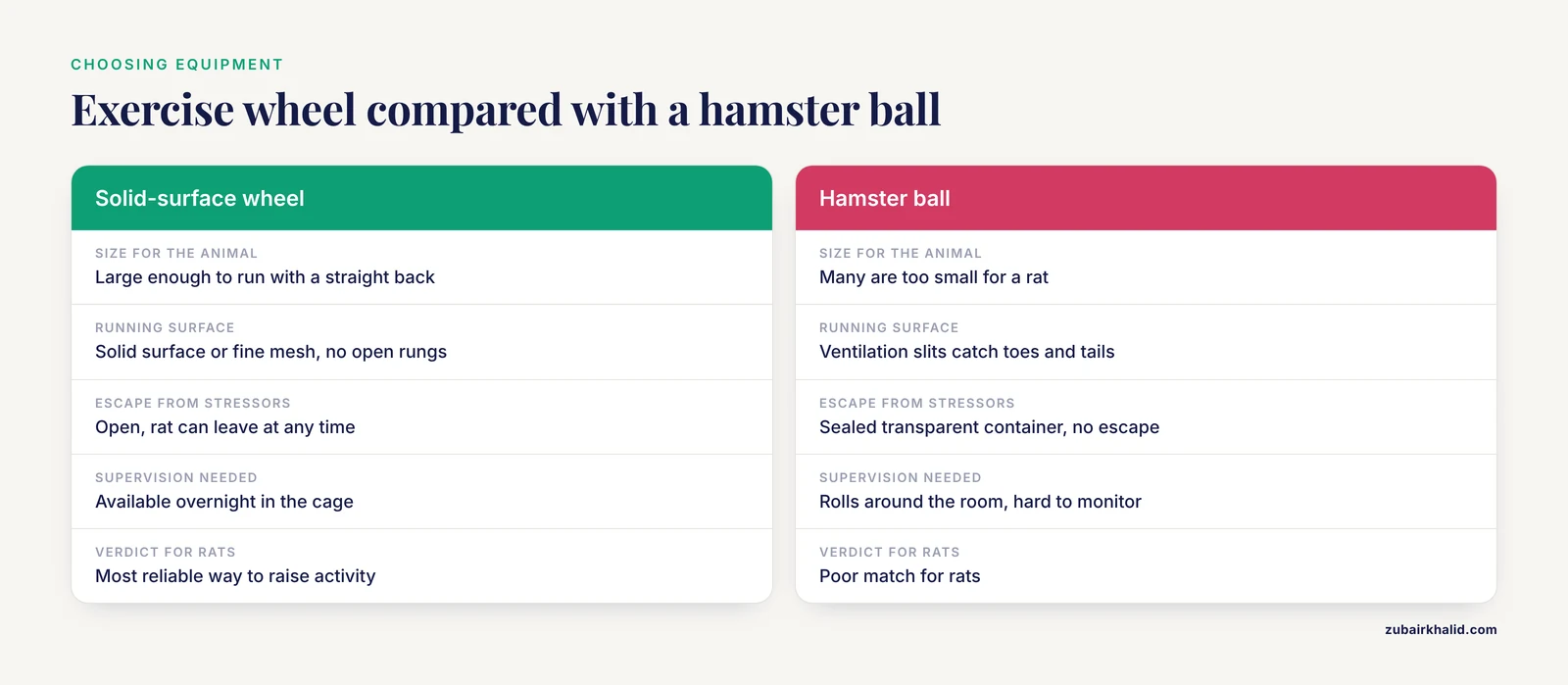
Balls designed for hamsters are generally a poor match for rats. Many are too small, have ventilation slits that catch toes and tails, and trap a prey animal in a transparent container with no escape from household stressors including other pets. Supervised free-range playtime and a properly sized solid-surface wheel provide the same activity with far less risk.
How do I help an overweight rat lose weight?
Increase daily activity gradually and review the diet with a veterinarian, because weight loss plans for rodents need to protect against rapid weight loss and nutrient gaps. Start with short daily play sessions and extend them over several weeks. Since 28 percent of pet rats in one survey were overweight and most owners underestimated it, ask your veterinarian to confirm the body condition score and set a target weight at the first appointment [2].
Can older or sick rats still get exercise?
Yes, but the program changes. Older rats and rats with chronic conditions, especially respiratory disease, usually do better with shorter, gentler, more frequent sessions, ground-level play instead of high climbing, and close attention to breathing and fatigue. Any rat with a diagnosed health condition needs an exercise plan cleared by its veterinarian before you increase activity.
Sources
- Pet rat welfare in the United Kingdom: The good, the bad and the ugly.
- Prevalence and awareness of obesity and related husbandry practices in Estonian rabbits, guinea pigs, and rats.
- Distinct Enriched Environment Components Differentially Shape the Temporal Dynamics of Anxiety-Like Behavior in Rats.
- Assessment of Behavioral, Clinical, and Histological Outcomes in Sprague-Dawley Rats Housed in Enriched Colony Cages Versus Conventional Pair Housing over 28 Days.
- Developing guidelines for pet rat housing through expert consultation.
- Effects of Ninjin'yoeito and physical exercise on serum corticosterone and hippocampal BDNF/proBDNF and neuroinflammation in post-stroke depression in rats.
- Effects of different intensity endurance training on atrial fibrillation in rats.
- A Jacketed Telemetry Method for Monitoring Cardiorespiratory Adaptation During Exercise in Rats.
- Hesperidin from Citrus reticulata peel improves welfare in PTU-induced hypothyroid rats through home-cage behavior, endocrine, neurobehavioral, and anti-inflammatory mechanisms.