Rat Care Guide: Daily, Weekly, and Monthly Routine
By Dr. Zubair Khalid, DVM, MS, PhD ·

A good rat care routine takes about 20 to 30 minutes a day, plus a longer cleaning and enrichment session once a week and a deeper monthly review of the cage, supplies, and each rat's health. The daily work is simple: check every rat, refresh food and water, spot clean, and spend time interacting. The weekly work is a full cage clean and enrichment rotation. The monthly work is a deep clean, a supply check, and a careful hands-on exam of each animal. Rats are nocturnal, so schedule cleaning and handling during their active evening hours whenever possible, because research shows that husbandry performed during a rat's normal sleeping period raises measurable stress markers and disrupts sleep [1].
This guide walks through the full routine, explains the science behind each step, and tells you when a problem needs a veterinarian rather than a schedule adjustment.
Rat Care Routine at a Glance
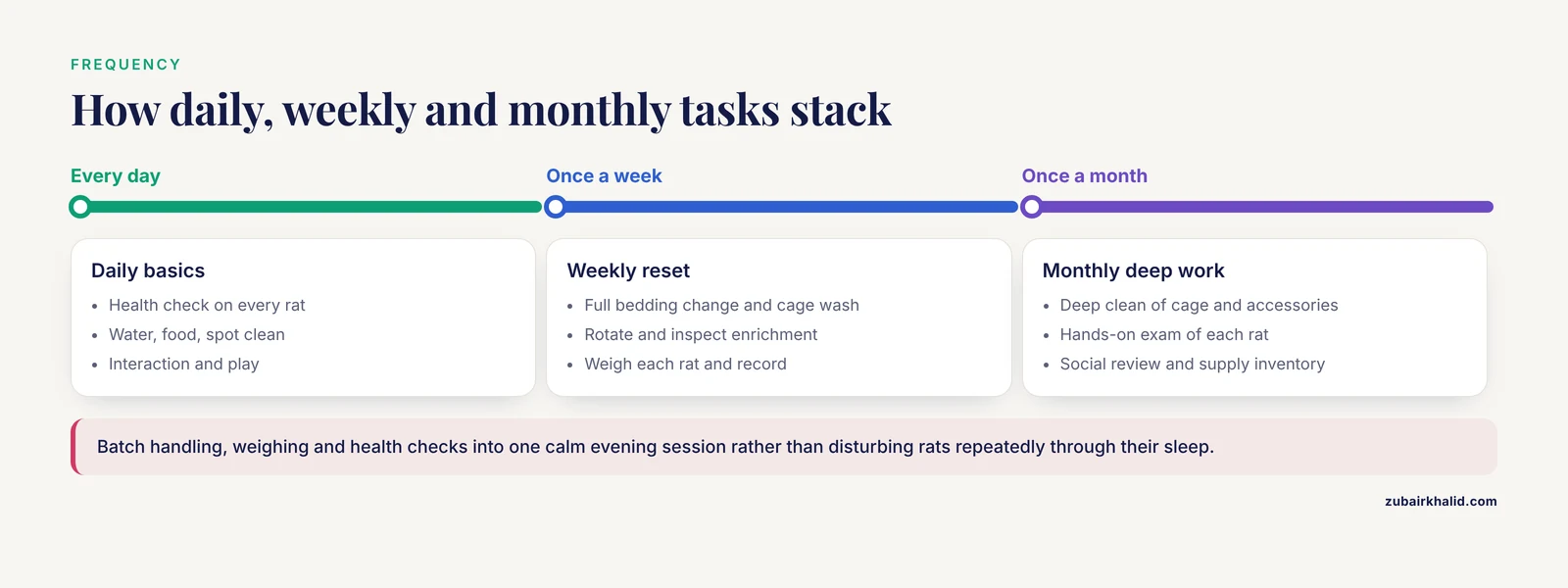
| Frequency | Task | Time |
|---|---|---|
| Every day | Visual health check on every rat | 2 to 3 minutes |
| Every day | Refresh drinking water | 2 minutes |
| Every day | Provide measured food, remove perishable leftovers | 3 minutes |
| Every day | Spot clean soiled bedding and litter areas | 5 minutes |
| Every day | Interaction, play, or training outside the cage | 15 to 30 minutes |
| Weekly | Full bedding change and cage wash | 30 to 45 minutes |
| Weekly | Rotate and inspect enrichment items | 10 minutes |
| Weekly | Weigh each rat and record it | 5 minutes |
| Monthly | Deep clean of the cage, hides, and accessories | 45 to 60 minutes |
| Monthly | Full hands-on exam and supply inventory | 20 minutes |
| Monthly | Review cage layout and social dynamics | 10 minutes |
Why a Consistent Routine Matters for Rats
Rats are among the most studied animals in welfare science, and that research translates directly to pet care. Three findings shape every recommendation in this guide.
First, timing matters. In a controlled study, rats that experienced routine husbandry procedures such as weighing and cleaning during their sleep phase showed more stress indicators, including chromodacryorrhea (the red porphyrin discharge around the eyes and nose), less sleep, and less enrichment-directed behavior than rats handled during their active phase [1]. Rats are most active at night. Build your rat care routine around their evening wake-up, not your midday convenience.
Second, companionship is not optional. Singly housed male rats in a classic housing study showed reduced activity, more self-directed behaviors, and behaviors associated with escape attempts and seeking social contact compared with group-housed rats [2]. Single housing also produced physiological changes consistent with chronic stress. The social structure of rat groups matters too. Analysis of a rat colony showed that established groups are socially stable, but introducing new individuals causes a period of social rearrangement before stability returns [3]. Plan introductions for times when you can monitor the group closely.
Third, space and complexity change how rats feel. Housing studies found that dominant rats in more spacious conditions made more optimistic judgments in cognitive bias tests, a recognized indicator of positive emotional state, while crowded conditions and small space allocations pushed animals toward pessimistic responses [4]. A mapping review of more than 1,000 refinement studies concluded that rats prefer complex environments with shelters and multiple objects that allow diverse behaviors [5]. A systematic review on enrichment found that barren, under-stimulating housing produces measurable signs of boredom in rodents, and that a stimulating environment is essential for normal behavior and welfare regardless of age or sex [6].
Getting Started: Rat Care for Beginners
Before your first day on any routine, get the foundation right. The setup decisions you make before bringing rats home determine how easy every later task will be.
Keep rats in compatible groups
Plan to keep at least two or three rats together. The evidence against single housing is strong. Isolated males showed escape-related behaviors, increased self-directed activity such as tail manipulation, and organ changes consistent with chronic stress [2]. Same-sex groups from the same litter integrate most smoothly, because colony research shows rats prefer interacting with familiar littermates and that new introductions temporarily destabilize the group [3].
Choose a large, complex cage
Buy the largest cage you can accommodate and afford. Judgment bias research links greater space allocation with more optimistic responses in rats [4], and the refinement review confirms rats prefer environments offering multiple areas and resources [5]. Select a cage with:
- Solid, deep base for bedding (avoid wire floors, which are hard on feet)
- Multiple levels connected by ramps or platforms
- Bar spacing small enough to prevent escapes
- Doors large enough for your hand to reach every corner
- Good ventilation, because solid plastic-walled enclosures trap ammonia
Furnish with function, not decoration
Provide at least one enclosed hide per rat, plus extra hides so no rat is trapped by a dominant cagemate. Add hammocks, ropes, tunnels, chew items, and a solid-surface exercise wheel sized for rats. Rotate items weekly to keep the environment novel, an approach supported by enrichment research showing varied, complex environments reduce boredom-related behaviors [6] and that novel experiences such as ball pits and playpens increase ultrasonic vocalizations associated with positive affect in rats [7].
Locate the cage carefully
Place the cage in a room with a stable temperature, away from direct sun, drafts, and loud appliances. If you keep natural predators such as cats, ferrets, or snakes in the home, position the cage so rats cannot see or smell them. A large survey of pet rat owners found that predator exposure was among the variables associated with differences in reported rat behavior [8]. Rats are prey animals, and chronic exposure to predator cues is a recognized welfare concern.
The Daily Routine: Your Rat Daily Care Checklist
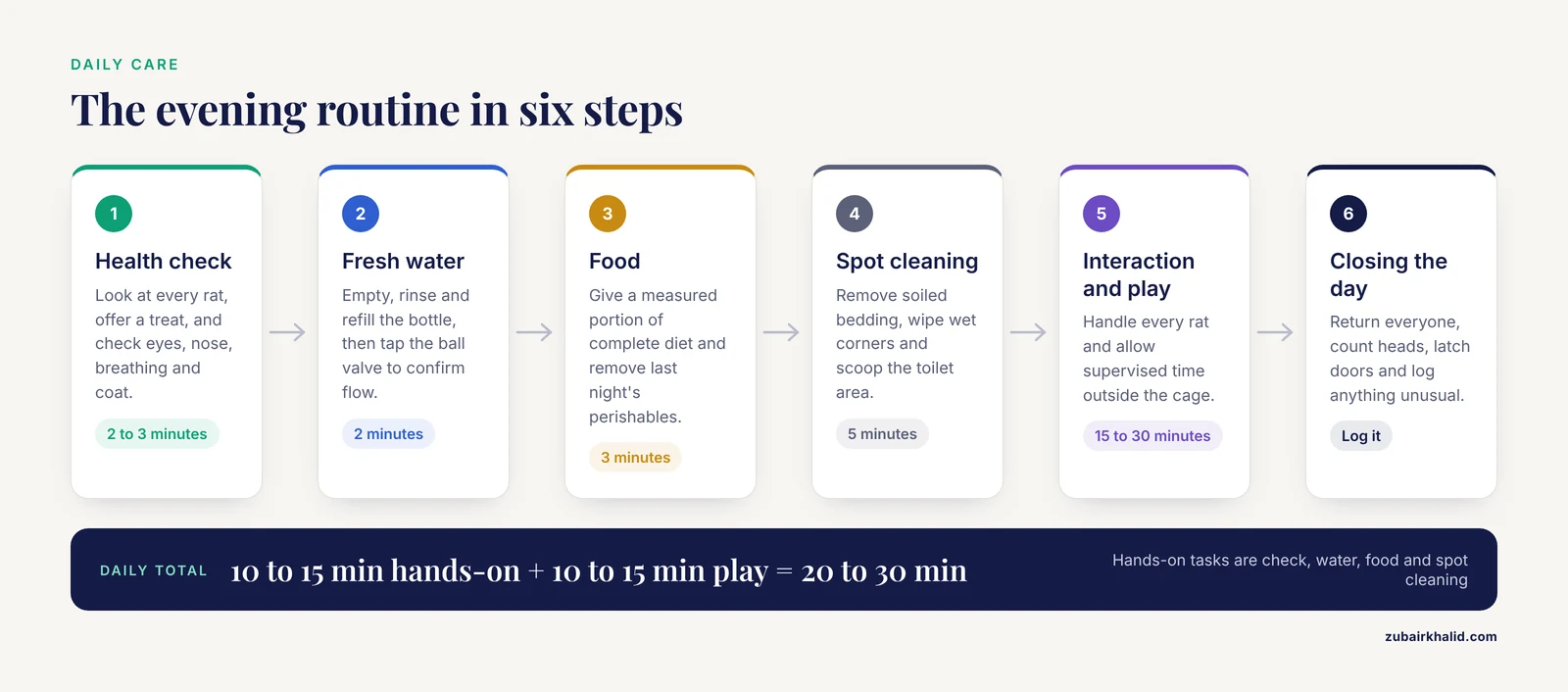
Daily care is the backbone of how to take care of a rat. Do the whole sequence in the same order each evening so your rats learn to anticipate it.
1. The two-minute health check
Before anything else, look at every rat from a short distance, then offer a treat and look closely.
- Is each rat active, alert, and moving normally?
- Are the eyes bright, with no red porphyrin staining around the eyes or nose? Excessive porphyrin staining is a documented stress indicator in rats
- Is breathing quiet, with no clicking, wheezing, or labored effort?
- Is the coat smooth and the body condition normal?
- Is anyone hunched, puffed up, sitting apart from the group, or grinding teeth abnormally?
Facial changes matter. The Rat Grimace Scale is a validated tool that identifies pain through specific facial expressions, and real-time interval scoring of it has been shown to reliably discriminate between painful and non-painful conditions in rats [9]. You do not need the formal scoring system, but you should know the features it tracks: orbital tightening around the eyes, nose and cheek bulge, ear position, and whisker change. A rat showing several of these features together needs veterinary attention the same day.
2. Fresh water
Empty, rinse, and refill the water bottle daily. Check the ball valve by tapping it to confirm water flows, because a stuck bottle can leave a rat without water despite a full reservoir. Watch at least one rat drink if you can.
3. Food
Provide a measured portion of a complete rat diet each evening. Remove fresh produce or other perishable items left from the previous day, since spoilage in a warm cage causes both digestive risk and odor. If you give fresh foods, offer them in the evening when rats are naturally feeding.
4. Spot cleaning
Remove visibly soiled bedding, wipe any wet corners, and scoop the toilet area. Daily spot cleaning keeps ammonia low, extends bedding life, and makes the weekly full clean faster and less disruptive.
5. Interaction and play
Open the cage, put your hand in calmly, and let rats come to you. Handle every rat daily, even the shy ones, for at least a few minutes each. If a rat enjoys it, try playful handling: gentle hand movements that mimic rough-and-tumble play. Research on playful handling protocols shows these interactions increase 50 kHz ultrasonic vocalizations, an established measure of positive affect in rats, compared with a motionless hand [10]. Interestingly, the response varies by individual. In one registered study, females vocalized more in conditions with minimal or no pinning, while males responded similarly across variations [10]. This tells you something practical: let each rat set the pace. Some rats love being scooped and turned gently. Others prefer climbing onto your hand or shoulder.
Free play in a secure, rat-proofed area or a dedicated playpen adds another layer of positive experience. Rats given access to a playpen showed increased positive-affect vocalizations, and playpen access completely mitigated a drug-induced negative affective state compared with animals that stayed in the home cage [7]. Even 20 minutes of supervised out-of-cage time is a meaningful welfare investment.
6. Closing the day
Return everyone to the cage, count heads, latch every door, and log anything unusual. A simple notebook or phone note recording weight, appetite, and behavior builds a baseline that makes early illness detection far easier.
Weekly Rat Care Tasks
Once a week, replace the entire bedding, wash the cage, and refresh the environment.
Full bedding change
Move the rats to a secure carrier or playpen. Remove all bedding. Rats scent-mark, so leaving a small handful of clean, unsoiled familiar bedding in the fresh layer helps preserve group scent and can reduce post-cleaning squabbling.
Wash the cage and accessories
Scrub the cage base, bars, shelves, ramps, and all hides with hot water and a small-animal-safe disinfectant or diluted unscented dish soap, then rinse thoroughly and dry completely before reassembling. Damp environments promote mold and skin problems.
Rotation and inspection of enrichment
Swap worn items for cleaned reserves. Check hammocks for frayed threads that can trap toes, inspect wheels for cracked bearings, and discard chewed plastic with sharp edges. Introduce one or two new items each week. The enrichment literature shows rats engage more with varied, complex setups [5], and novelty itself appears rewarding, as novel activities like ball pits measurably shift rats toward a more positive affective state [7].
Weekly weigh-in
Weigh each rat on a kitchen scale and record the number. Weight is one of the most sensitive early indicators of illness in rats. Weekly weights catch gradual loss that daily visual checks miss. Weighing is also a husbandry procedure with documented effects if done poorly. In the timing study, weighing was among the procedures that, when performed during the sleep phase, produced measurable stress responses [1]. Weigh during evening hours, keep sessions brief, and reward with a treat.
Behavioral watch
Spend ten minutes observing the group without interfering. Note who sleeps with whom, whether any rat is being excluded from resources, and whether play and grooming are balanced. If you notice new chasing, fighting, or a previously sociable rat isolating itself, note the date. Persistent exclusion from resources is a welfare problem in hierarchies, and dominance status measurably shapes welfare outcomes, with subordinate animals showing less optimistic judgment bias in housing studies [4].
The Monthly Routine
Deep clean
Once a month, do everything in the weekly routine plus these steps:
- Disassemble the cage fully and wash every part, including trays and corners where urine salts accumulate
- Soak and scrub wooden and plastic accessories
- Replace any item that cannot be fully cleaned or sanitized
- Wash fabric items such as hammocks in hot water
Hands-on exam
Once a month, examine each rat individually from nose to tail:
- Teeth: Check that incisors are aligned, not overgrown or broken. Rats with overgrown or misaligned teeth need veterinary trimming
- Skin and coat: Part the fur and look for scabs, wounds, mites (tiny moving specks), or thinning patches, especially at the shoulders and rump
- Eyes and nose: Confirm no porphyrin crusting. Remember that heavy porphyrin staining is a recognized stress sign
- Ears and face: Palpate gently along the jaw for swellings
- Body condition: Run your hands along the spine and ribs. You should feel bones under a thin covering, not sharp ridges
- Nails and feet: Look for overgrown nails, reddened heels, or swollen joints (a sign associated with bumblefoot)
- Tail: The tail should be clean and intact. Excessive tail-directed behavior, particularly in isolated rats, has been interpreted as a surrogate social response and a sign of compromised welfare [2]
- Rear end: Confirm normal droppings and a clean, dry perineum
Social review
Groups change. Reassess monthly whether the group composition is still working, whether resource competition is rising, and whether anyone needs more space. If you plan to add a rat, remember that introductions create a predictable period of social rearrangement with a temporary rise in aggression before stability returns [3]. Schedule introductions for a period when you can supervise daily and be ready to separate fighters safely.
Supply inventory
Check food stock for freshness and expiration, replace old chew items, verify your first-aid basics, and confirm your exotics veterinarian's contact information is current.
Health Monitoring: Reading the Signals Your Rat Sends
A routine is only as good as what it detects. Several validated tools used in research can guide your observation at home.
Facial pain signs. The Rat Grimace Scale tracks five facial features and has been validated for pain assessment, with real-time interval observation shown to be feasible and effective for identifying pain and enabling early intervention [9]. Learn the facial action units: squinting eyes, bulging cheeks and nose, flattened ears, and changed whisker carriage. Several of these appearing together, especially with hunched posture or reduced activity, is an urgent sign.
Behavior as an early warning. Changes in learned behaviors can precede visible illness. In a longitudinal study of rats trained to solve a lockbox task, performance time followed a three-phase pattern, and declines in task performance coincided with rising stress hormone measures and confirmed illness. When the housing room changed, solving times more than doubled [11]. At home, this means a rat that suddenly stops working for a favorite treat, stops climbing to a usual perch, or takes far longer to reach a known food reward may be telling you something is wrong before any other sign appears.
The limits of visual assessment. Do not rely on appearance alone. Research comparing standard visual welfare score sheets against fecal corticosterone metabolites, a validated physiological stress measure, found that some subjective visual scores did not reflect the animals' actual stress response [12]. Practical takeaway: pair your eyes with objective records. Keep weekly weights, note activity, and log behavior changes with dates. Objective trends catch what casual observation misses.
Timing sensitivity. Because sleep disruption itself is a welfare problem, batch your handling, weighing, and health checks into one calm evening session rather than disturbing the rats repeatedly through their sleep period [1].
Common Mistakes in Rat Care Routines
- Cleaning during the sleep phase. Midday cage cleaning is convenient for you and stressful for them. Shift the routine to evening
- Keeping a single rat. The behavioral and physiological evidence against solitary housing is consistent [2]
- Cleaning too aggressively. Stripping all scent and rearranging everything at once destabilizes group scent maps. Leave a little familiar bedding and keep the layout recognizable
- Static enrichment. The same toys week after week produce the boredom-related behavioral signs documented in under-stimulated rodents [6]. Rotate weekly
- Treating facial grime as normal. Porphyrin staining is not dirt. Chronic staining is a stress marker documented in husbandry research
- Skipping the weigh-in. Subjective appearance can fail to reflect real physiological state [12]. A scale is cheap and catches problems early
- Ignoring resource guarding. If one rat monopolizes food or hides, add duplicates. Space and resource distribution measurably affect welfare, with subordinate animals most affected [4]
- Assuming quiet means fine. Reduced activity is one of the documented changes in stressed or isolated rats [2]. A rat that has slowed down deserves a closer look, not relief
Limitations and When to Contact a Veterinarian
This article is educational and is not a substitute for veterinary diagnosis or treatment. Individual rats vary widely in age, temperament, and health status, and any specific concern about your own animals needs a veterinarian experienced with rodents rather than a general guide.
Contact a veterinarian promptly, the same day, for any of the following:
- Open-mouth breathing, audible clicking or wheezing, or visible effort when breathing
- Several facial pain signs appearing together, such as squinting with cheek bulge and flattened ears [9]
- Porphyria staining around the eyes or nose that is heavy, persistent, or accompanied by lethargy
- Any bleeding, wound, or abscess
- Sudden weight loss between weekly weigh-ins, or a rat that stops eating for more than a few hours
- Diarrhea, sustained abnormal droppings, or a wet, soiled rear end
- A lump anywhere on the body, especially in the mammary region
- Overgrown or broken teeth, or drooling and dropping food
- A sudden decline in learned behaviors or activity without an obvious environmental cause [11]
- Injuries from a fight during an introduction, and any aggression that is escalating rather than settling
Find a veterinarian who treats exotic or small mammals before an emergency occurs, and bring your weight and behavior log to the appointment. Those records shorten diagnosis.
Frequently Asked Questions
How much time does a daily rat care routine actually take?
Plan on 20 to 30 minutes a day. The hands-on tasks, including the health check, water and food refresh, spot cleaning, and cage tidying, take roughly 10 to 15 minutes. Interaction and supervised play time should add at least 10 to 15 more minutes, and most owners find that time becomes the best part of the day.
Can I keep just one rat?
No. Rats are highly social, and research consistently shows that singly housed rats display reduced activity, more self-directed and escape-related behaviors, and physiological stress changes compared with group-housed rats. Keep at least a compatible pair, ideally a same-sex group.
What time of day should I clean the cage and handle my rats?
Evening. Rats are nocturnal, and studies show that husbandry procedures performed during their sleep phase increase stress markers such as porphyrin staining, reduce sleep, and reduce enrichment-directed behavior. Schedule your routine in their active period.
How often should I fully clean the cage?
Do a full bedding change and cage wash weekly, with daily spot cleaning in between. Once a month, add a deep clean, disassembling the cage and scrubbing or soaking every component and accessory.
How do I know if my rat is in pain?
Look at the face and posture. Squinting eyes, bulging nose and cheeks, flattened ears, and altered whiskers are the features tracked by the validated Rat Grimace Scale. Combine these with hunched posture, reduced activity, or appetite loss, and treat it as a same-day veterinary problem.
What kind of enrichment do rats need?
Provide variety and complexity: multiple hides, levels, tunnels, ropes, chew items, foraging opportunities, and weekly rotation of items. Studies show rats prefer complex environments with multiple objects and resources, and novel activities such as ball pits and playpens measurably increase positive-affect signals.
How do I introduce a new rat to my existing group?
Expect disruption. Colony research shows that introducing new individuals causes social rearrangement and reduced stability before the group restabilizes. Introduce on neutral territory, proceed gradually over days, supervise closely, and provide duplicate hides and food stations so no rat can monopolize resources.
What supplies do I need before bringing rats home?
A large multilevel cage with solid flooring and small bar spacing, dust-free bedding, a water bottle and heavy food bowl, a complete rat diet, at least one hide per rat plus spares, a rat-appropriate exercise wheel, chew items, a kitchen scale for weekly weighing, and cleaning supplies. Line up an exotics veterinarian before arrival day.
Sources
- Let sleeping rats lie: Does the timing of husbandry procedures affect laboratory rat behaviour, physiology and welfare?
- Housing and Welfare in Laboratory Rats: Welfare Implications of Isolation and Social Contact Among Caged Males
- The “Second Life” of laboratory rats (Rattus norvegicus): Assessment of social behavior of a colony of rats based on social network analysis
- Assessment of housing density, space allocation and social hierarchy of laboratory rats on behavioural measures of welfare
- A mapping review of refinements to laboratory rat housing and husbandry
- Bored at home?-A systematic review on the effect of environmental enrichment on the welfare of laboratory rats and mice
- The use of ball pits and playpens in laboratory Lister Hooded male rats induces ultrasonic vocalisations indicating a more positive affective state and can reduce the welfare impacts of aversive procedures
- Thinking outside the lab: can studies of pet rats inform pet and laboratory rat welfare?
- Real-time application of the Rat Grimace Scale as a welfare refinement in laboratory rats
- Stage 2 Registered Report: Refinement of tickling protocols to improve positive animal welfare in laboratory rats
- Can trained behavior serve as tool for welfare assessment? A pilot study in a cancer model with Wistar rats.
- Additional Assessment of Fecal Corticosterone Metabolites Improves Visual Rating in the Evaluation of Stress Responses of Laboratory Rats