Rabbits Enrichment Ideas That Match Natural Behavior
By Dr. Zubair Khalid, DVM, MS, PhD ·
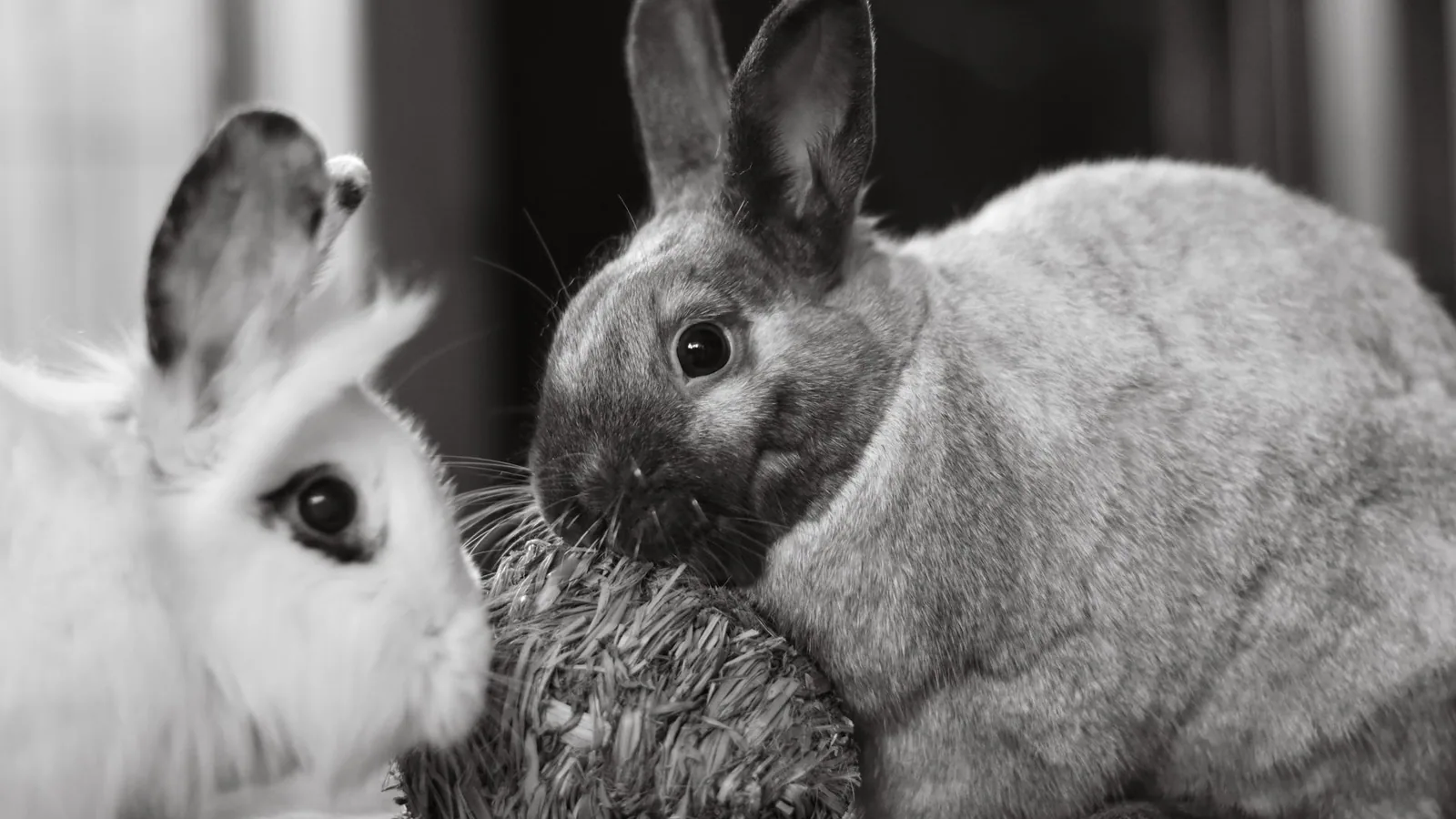
The best rabbit enrichment ideas give your rabbit daily opportunities to do what rabbits are built to do: dig, chew, graze, hide, hop, stand up on their hind legs, and explore. Research on laboratory and farmed rabbits shows that simple additions such as a dig bin, a destructible chew object, a hanging toy, an elevated platform, or edible chew sticks significantly increase active, exploratory behavior compared with a barren enclosure [1][2]. For a pet rabbit, that same principle translates into a rotating set of safe chewing and digging outlets, constant grass hay, hiding places, space to move, and, when compatible, a bonded companion.
This article explains why enrichment matters, how to recognize boredom, which enrichment types match rabbit behavior, how to build DIY options safely, and when a problem needs a veterinarian rather than another toy.
This article is educational and is not a substitute for veterinary diagnosis or treatment.
Rabbit Enrichment at a Glance
If you can only change a few things today, start with this checklist.
| Priority | Action | Behavior it satisfies |
|---|---|---|
| 1 | Provide unlimited grass hay, ideally presented so the rabbit works for it | Grazing, foraging |
| 2 | Offer one safe destructible chew item daily | Chewing, gnawing |
| 3 | Set up a dig box with paper or safe bedding | Digging |
| 4 | Add a hiding place large enough for a full body stretch | Hiding, resting stretched out |
| 5 | Add an elevated platform or low ramp for rearing and hopping up | Rearing, perching, jumping |
| 6 | Scatter a small portion of fresh greens or herbs in the enclosure | Foraging |
| 7 | Guarantee predictable, generous daily exercise time in a larger area | Running, binkying, exploring |
| 8 | Rotate toys every few days so nothing becomes wallpaper | Novelty, exploration |
Each row maps to a species-typical behavior documented in the rabbit enrichment literature [3][4][5].
Why Enrichment Is Not Optional for Rabbits
Environmental enrichment is the deliberate modification of an animal's environment so the animal can express its natural behavioral repertoire, which prevents behavioral frustration and negative emotional states [3]. Veterinary researchers regard enrichment as an essential component of animal care, equal in standing to nutrition and veterinary care, not as a decorative extra [4].
Rabbits in the wild spend much of their active time grazing, selecting foods, digging, and remaining alert to predators. When a pet rabbit cannot perform these behaviors, the result is frustration, and stress in rabbits is well documented to affect physiology and behavior, including immune function and activity patterns [6]. Studies of housed rabbits consistently show that barren environments reduce active behavior. In one controlled study, rabbits in large runs spent more than twice as long in active, exploratory behavior as rabbits in standard cages, and three different enrichment devices, a hanging toy, a destructible device, and a dig bin, each restored active behavior to near run-level levels [1].
Enrichment also reaches beyond behavior. A 2025 study of welfare-oriented housing found that rabbits kept in pens with environmental enrichment material had altered cecal microbiota and higher cecal short-chain fatty acid content, markers of improved intestinal health [7]. Another line of research shows that increased enclosure size improves tibiofibula bone diameter and reduces fluctuating asymmetry, a stress-related developmental marker, suggesting structural space itself is part of enrichment [8].
The pet rabbit picture remains far from ideal. A survey of 1,254 rabbit owners in England found that 59 percent of rabbits were kept in a traditional hutch or cage, exercise access was often unpredictable or ill-timed, and only 41.9 percent of owners kept rabbits with a companion [9]. Those findings are a useful mirror for any owner wondering whether their rabbit's environment is meeting the species' needs.
Signs of a Bored Rabbit
Enrichment researchers define the problem in terms of behavioral frustration: an animal unable to perform motivated behaviors develops negative affective states and abnormal behaviors [3]. Watch for the following patterns, and treat them as information about the environment rather than as personality quirks:
- Long periods of motionless lying in the same spot with no cycling between resting, feeding, and moving. Healthy rabbits distribute their day across feeding, walking, and resting [10].
- Repetitive or stereotypic behaviors, which enrichment programs are specifically designed to discourage [1].
- Destructive chewing of cage bars, baseboards, carpets, or furniture. Bar and surface gnawing is a common outlet when safe chewing materials are absent [3][11].
- Overreaction to small changes, or withdrawal and freezing, since rabbits are prey animals that cope with stress through fear responses and reduced exploration [6].
- Aggression toward the owner or a companion rabbit, which can emerge when housing conditions create chronic stress [3].
- Excessive weight gain or constant请求 for food, when eating is the only stimulation available.
One caution from the welfare literature: rabbits are prey species and often freeze when people are watching, so brief observation from a distance or a cheap camera recording gives a far more accurate picture of your rabbit's activity level than watching directly [1].
Matching Enrichment to Natural Rabbit Behavior
The most effective enrichment matches a specific behavior. The categories below follow the structure used in published rabbit enrichment studies.
Grazing and Foraging Enrichment
Rabbits are grazing hindgut fermenters, and the search for food occupies a large share of their natural activity budget. Free-choice grass hay is the foundation, but presentation matters. Stuffing loose hay into a cardboard tube, a paper bag, or a willow ball forces the rabbit to work the hay out, converting passive feeding into active foraging. Novel food items are recognized in the laboratory animal literature as a legitimate form of enrichment because they encourage species-appropriate behaviors and satisfy physical and psychological needs [12]. Small portions of fresh leafy greens or safe herbs scattered through bedding turn mealtime into a search task.
Edible enrichment outperforms most inanimate objects. In a study of young New Zealand White rabbits given one hour of enrichment daily for 15 days, rabbits spent significantly more time interacting with an edible chew stick than with any other food item or non-food object, and total activity was significantly greater in food-enriched rabbits than in rabbits given non-food toys [2].
Sprouted wheatgrass is another documented option. It is described as a natural enrichment requiring minimal preparation, appropriate for rabbits and other herbivores, and rabbits can consume it safely as part of foraging enrichment [13].
Chewing and Destructible Enrichment
A rabbit's teeth grow continuously, and gnawing is a core behavioral need, not a bad habit. Wooden gnawing structures that can be chewed, hidden in, and sat on are a standard enrichment package in welfare-focused housing research [8][11]. Safe destructible items include plain untreated cardboard, hay-stuffed paper tubes, and commercial chew sticks made for rabbits. The principle confirmed by research is that the item should be something the rabbit can genuinely destroy. A study comparing enrichment devices found a destructible device produced the highest measured active behavior time of the three devices tested [1].
Selection criteria for chew items:
- Untreated wood or paper-based materials with no glues, inks, staples, or varnish
- Large enough that the rabbit cannot swallow pieces whole
- Replaceable, because the value of a chew object comes from its destruction
Digging Enrichment
Digging is one of the most strongly motivated rabbit behaviors, and a dig bin is one of the few enrichment devices experimentally shown to raise active behavior in rabbits to levels seen in much larger enclosures [1]. A simple dig box filled with shredded paper, plain paper bedding, or a child-safe sandbox-style tray of soil or play sand gives the rabbit a legal outlet for this drive. Placing hay and a few scattered pellets or greens in the dig box combines digging with foraging.
Hiding and Vertical Space
Rabbits are prey animals, so hiding is not a luxury. A hiding box or tunnel lets the rabbit control its own exposure, which reduces the chronic vigilance that welfare researchers identify as a core stressor in captive rabbits [6]. In group-housed farmed rabbits, hiding tubes and elevated platforms are the standard structural enrichment tools, and platforms in particular change behavior measurably: rabbits provided with an elevated plastic platform performed the rearing position, standing up on their hind legs, more frequently and rested with a stretched body for longer than rabbits without one [5]. Wooden structures that serve as both a hide and a chew object combine several needs in one item [8].
A hideout also matters outdoors. In a pasture study of weaned rabbits, groups with a roof-shaped wooden hideout on the grass area had a secure refuge while grazing, which is exactly the function a hide serves for a pet rabbit exploring a room or a run [14].
Mirrors, Balls, and Novel Objects
Simpler objects can still work. In a study of weaned rabbits, cages enriched with plastic-colored balls and with mirrors improved marketing body weight, feed conversion, carcass quality, and natural behavioral activity compared with control cages [10]. This supports a practical rule: even a small, low-cost object beats an empty cage, provided it is safe and rotated.
Space, Exercise, and Social Enrichment
Space is itself enrichment. Rabbits given larger living areas spend significantly more time in active, exploratory behavior, and increased cage size improved bone diameter and reduced fluctuating asymmetry in fattening rabbits [1][8]. For a pet rabbit, this means the enclosure should be the resting place, not the whole world, and daily time in a rabbit-proofed room or a secure run should be predictable rather than occasional, because unpredictable exercise access is one of the documented weaknesses of typical pet rabbit housing [9].
Social enrichment deserves equal weight. Rabbits are social, and only a minority of surveyed pet rabbits lived with a conspecific [9]. A bonded companion is the single richest form of enrichment available to a rabbit, but bonding must be done gradually and monitored, because incompatible pairs fight, guard resources, and avoid one another, problems documented in the pet population at meaningful rates [9]. If you plan to bond rabbits, discuss introductions with a rabbit-savvy veterinarian or an experienced rescue organization first.
How to Keep a Rabbit Entertained All Day
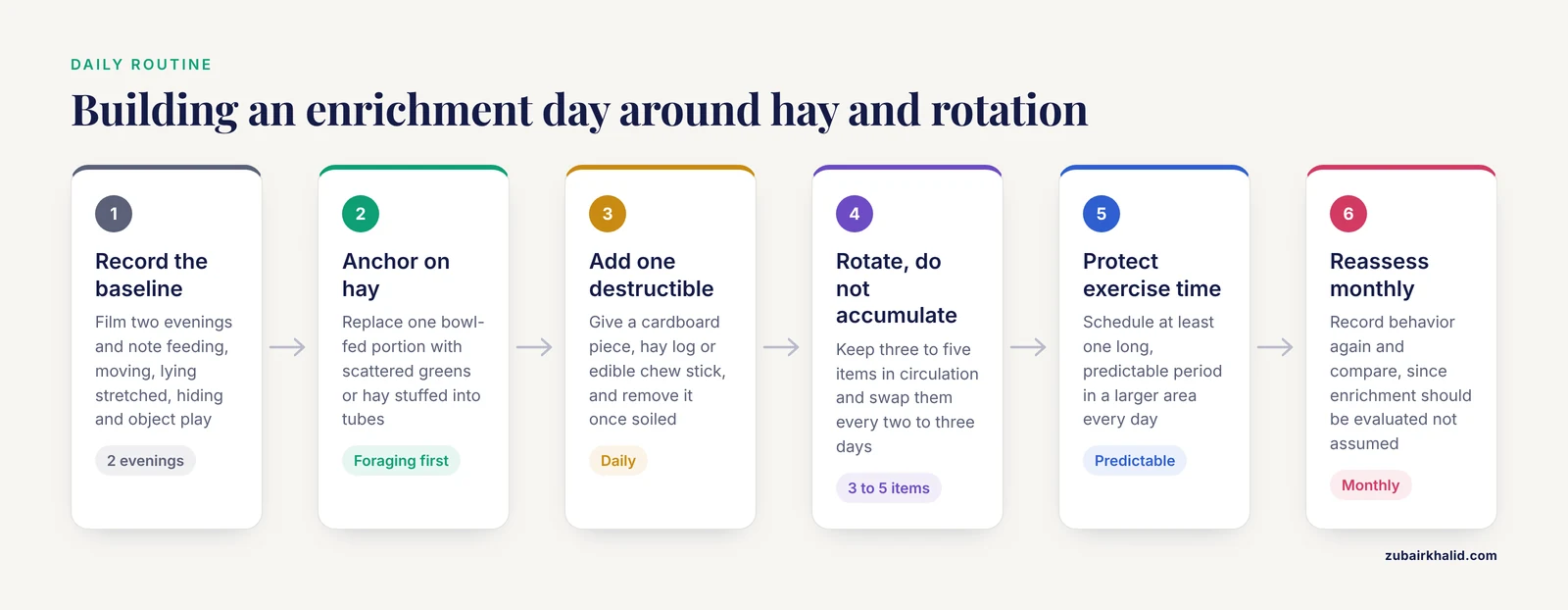
An effective program is built on rotation and predictability rather than on buying toys constantly.
- Audit the baseline. Record what your rabbit does for two evenings on video. Note time spent feeding, moving, lying stretched, hiding, and interacting with objects. This is your comparison point.
- Anchor the day around hay and foraging. Replace one bowl-fed meal portion with scattered greens or hay stuffed into tubes. Food-based enrichment produces the strongest and most sustained interaction in controlled comparisons [2].
- Provide one destructible item daily. Cardboard castle pieces, hay logs, or an edible chew stick. Remove items once they are heavily soiled with urine or feces.
- Rotate, do not accumulate. Keep three to five items in circulation and swap them every two to three days. Novelty drives exploration, and a toy left in place for weeks stops functioning as enrichment [3].
- Protect exercise time. Schedule at least one long, predictable period in a larger area daily. Predictability matters, because ill-timed or unpredictable access is a recognized welfare weakness in pet rabbit care [9].
- Add vertical structure. A low platform or sturdy box lets the rabbit rear and hop up, behaviors measurably increased by platforms in research settings [5].
- Reassess monthly. Re-record behavior and compare. The welfare literature stresses that enrichment should be evaluated for actual benefit to the animal, not assumed [4].
DIY Rabbit Enrichment Projects
Do-it-yourself rabbit enrichment is inexpensive and effective, and the published literature repeatedly uses ordinary materials as study enrichment: cardboard dig bins, paper-based destructible devices, cardboard tubes, and hay-based items [1][2][11]. A few projects to try:
Hay-stuffed tube. Take a plain toilet paper or paper towel tube, stuff it loosely with grass hay, and tuck a few herbs in the center. The rabbit unrolls and chews the tube.
Dig box. A low plastic storage tray filled with shredded paper, plain paper bedding, or sterile play soil. Bury a few pieces of dried forage or herbs for a find-and-dig game.
Cardboard castle. Stack plain cardboard boxes with cut doorways. This provides chewing, hiding, climbing, and territory structure in one object, similar to the multi-function wooden structures used in housing research [8].
Hay pile maze. Scatter loose hay in a shallow box with paper balls hidden inside.
Willow or apple branch bundle. Safe untreated wood branches, thoroughly dried, bundled with plain twine. Gnawing sticks are a documented component of welfare-friendly pen enrichment [11].
Forage tray. A tray of hay with a handful of greens distributed through it, replacing a bowl.
Construction rules for every project: no staples, tape, glue, plastic windows, dyed paper, or scented materials, and anything chewable should be inspected daily and removed when soiled or degraded.
Choosing the Best Toys for Rabbits
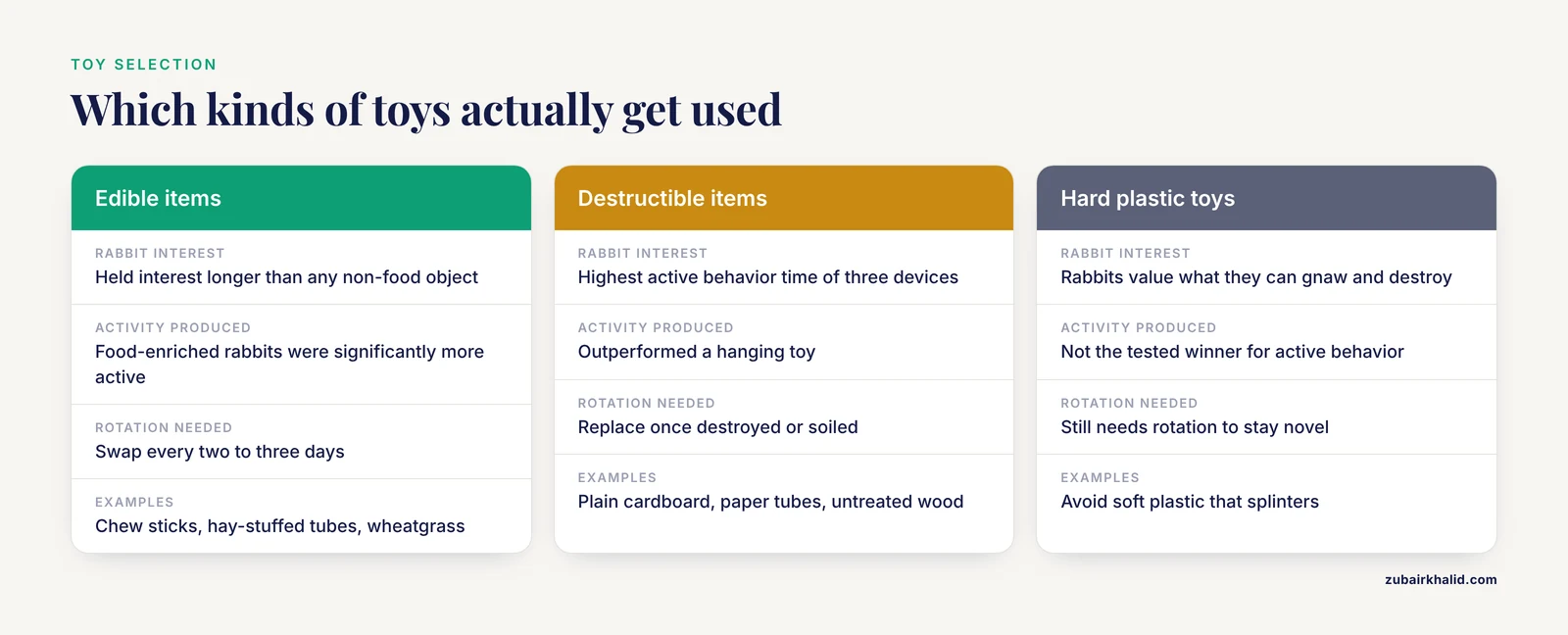
The best toys for rabbits are the ones that get used. Controlled comparisons offer three practical lessons:
- Edible beats inert. Food-based items held rabbit interest longer and produced more total activity than any non-food object tested [2].
- Destructible beats durable. A destructible device outperformed a hanging toy for promoting active, exploratory behavior [1].
- Novelty matters. Even simple items such as plastic balls and mirrors changed behavior measurably when they were new to the rabbits [10], which is why rotation matters more than the price of the toy.
When shopping, prioritize untreated wood, kiln-dried pine, willow, seagrass, plain cardboard, and hay-based products. Avoid soft plastic items that splinter, painted or varnished objects, rubber items that can be torn and swallowed, and anything with small detachable parts. Introduce one new item at a time so you can see whether the rabbit actually uses it. An item ignored for a week is a candidate for rotation out rather than permanent clutter.
Common Mistakes
- Treating the hutch as the whole habitat. A hutch-only life with occasional, unpredictable yard access is the most common housing pattern in the pet population and one of the clearest welfare problems documented in surveys [9].
- Feeding only from a bowl. Bowl feeding removes the foraging behaviors that occupy a wild rabbit's day [12].
- Buying hard plastic toys instead of chewable materials. Rabbits value what they can gnaw and destroy.
- Skipping the hideout. Rabbits cannot relax without a refuge, and vigilance is a documented stressor [6][14].
- Assuming quiet means content. Prey animals freeze when observed, so low observed activity may be an artifact of your presence [1].
- Forcing bonding. Incompatible pairs fight and guard resources, and pair housing is only enrichment when the pair is compatible [9].
- Leaving the same toys for months. Static environments lose their enrichment value as novelty fades [3].
Welfare and Safety Points
Any enrichment carries risk if poorly chosen. Follow these rules:
- Inspect chew items daily and remove them once they are urine-soaked, falling apart, or small enough to be swallowed in chunks.
- Introduce dietary enrichment gradually. Novel foods are enrichment, but sudden diet changes can upset the hindgut, so add new greens one at a time in small amounts and watch the fecal output [12].
- Place platforms low enough that falls are harmless, and make sure they are stable and non-slip.
- Supervise cardboard play if your rabbit eats large amounts of paper rather than just shredding it.
- In group housing, monitor for skin injuries, because research on group-housed rabbits shows structural enrichment changes social dynamics and injuries can occur even in well-designed systems [5][15].
- Remember that enrichment affects health, not just mood. Improved cecal microbiota and short-chain fatty acid profiles in enriched housing show that environment reaches the gut [7].
Organizations such as the House Rabbit Society and the Rabbit Welfare Association and Fund publish owner-facing guidance consistent with this research, and the Merck Veterinary Manual's exotic and laboratory animal resources cover general rabbit husbandry. Use them to cross-check any specific product or setup you plan to introduce.
Limitations and When to Contact a Veterinarian
Most published enrichment research has been done on laboratory and farmed rabbits, so exact behavioral numbers may not transfer perfectly to individual pet rabbits, and individual cases need a veterinarian's judgment. Enrichment also cannot fix medical problems. Contact a rabbit-savvy veterinarian promptly if you see:
- A drop of more than a few hours in fecal output, or no fecal output, which can signal gastrointestinal stasis
- Not eating hay or refusing favorite foods for more than several hours
- Destructive behavior that appears suddenly rather than gradually, since abrupt behavior change is a red flag rather than a boredom sign
- Dental problems such as dropping food, drooling, or wet chinning with saliva, which excessive chewing alone will not solve
- Unexplained aggression, especially sudden aggression in an previously placid rabbit, which can indicate pain [6]
- Overgrown incisors or uneven wear, which enrichment chewing does not correct
- Skin injuries or persistent fighting in a pair-housed rabbit [15]
- Chronic lethargy, hunching, or pressing the abdomen to the floor
Behavioral enrichment is complementary to veterinary care, and the welfare literature treats the two as equally necessary components of good husbandry [4].
Frequently Asked Questions
What are the best rabbit enrichment ideas for a beginner?
Start with unlimited grass hay presented for foraging, one daily destructible chew item, a dig box, a hiding box, and predictable daily exercise in a larger area. These five cover grazing, chewing, digging, hiding, and locomotion, the behaviors rabbits most need to express [3][1].
How do I know if my rabbit is bored?
Look for long motionless periods with no movement between feeding and activity, repetitive behaviors, bar or furniture gnawing, destructive chewing, and new aggression. These are expressions of behavioral frustration when natural behaviors are blocked [3].
What are the best toys for rabbits?
Edible and destructible toys work best. Rabbits interacted longer with edible chew sticks than with any non-food object in controlled testing, and a destructible device produced the highest active behavior of the devices tested [1][2]. Untreated wood, willow, plain cardboard, and hay-based toys are good choices.
How much exercise space does a pet rabbit need?
More is better, and space measurably increases active exploratory behavior and even improves bone quality [1][8]. Practical guidance from rabbit welfare organizations such as the RWAF is to make the enclosure a resting base with daily access to a larger exercise area, rather than relying on a hutch alone [9].
Can I make DIY rabbit enrichment at home?
Yes. Cardboard tubes stuffed with hay, shredded paper dig boxes, cardboard castles, and bundles of safe untreated branches are all inexpensive options built from materials researchers themselves use in enrichment studies [1][11]. Avoid tape, glue, staples, dyes, and scented materials.
Is it safe to give my rabbit a mirror?
A mirror was used successfully as cage enrichment in a published study and improved both behavior and production measures in farmed rabbits [10]. Use a sturdy, shatterproof, framed mirror fixed securely so it cannot fall, and remove it if your rabbit reacts with persistent fear or aggression.
Do rabbits get bored living alone?
Rabbits are social animals, and companionship is a major enrichment source. Survey data show only a minority of pet rabbits live with a conspecific, and those that do gain the ability to perform natural social behavior [9]. Bonding must be gradual, because incompatible pairs fight and guard resources [9].
How often should I rotate my rabbit's toys?
Every two to three days is a reasonable routine. Novelty drives exploration, and enrichment works by encouraging the expression of natural behaviors, so items that sit in place for weeks stop doing their job [3]. Keep a small rotation box and swap items on a fixed schedule.
Sources
- Behavioral Effects of Cage Size and Environmental Enrichment in New Zealand White Rabbits.
- Evaluation of objects and food for environmental enrichment of NZW rabbits.
- Environmental Enrichment in Rabbit Husbandry: Comparative Impacts on Performance and Welfare.
- Environmental enrichment for laboratory rodents and rabbits: requirements of rodents, rabbits, and research.
- The Use of Environmental Enrichments Affects Performance and Behavior of Growing Rabbits Housed in Collective Pens.
- Effects of husbandry and management systems on physiology and behaviour of farmed and laboratory rabbits.
- Effects of the Welfare Housing Systems Based on Environmental Enrichment on Growth Performance, Meat Quality, and Intestinal Health in Rabbits.
- Cage size and enrichment effects on the bone quality and fluctuating asymmetry of fattening rabbits.
- The current state of welfare, housing and husbandry of the English pet rabbit population.
- Using Different Cage Enrichments to Improve Rabbits' Performance, Behavior, and Welfare.
- Measuring fluctuating asymmetry in fattening rabbits: a valid indicator of performance and housing quality?
- Novel food items as environmental enrichment for rodents and rabbits.
- Organic wheatgrass as environmental enrichment.
- Effect of outdoor grazing-area access time and enrichment on space and pasture use, behaviour, health and growth traits of weaned rabbits.
- Effects of group size and cage enrichment on social behaviour and skin injuries of breeding rabbits housed part-time in group.