Questions to Ask a Rabbit Vet: Template and ExampleList and Examples
By Dr. Zubair Khalid, DVM, MS, PhD ·
The most useful questions to ask a rabbit vet fall into five groups: the vet's rabbit experience, your rabbit's diet, dental and gut health, preventive care such as spay or neuter and vaccination, and what to do in an emergency. Ask them at the first visit, write the answers down, and you leave the appointment with a personal care plan instead of a vague sense of reassurance.
This article gives you a copy-ready question template, worked examples of what good answers sound like, and a rabbit care checklist you can use the same day. Every question is phrased so a real veterinarian can answer it in a sentence or two, which keeps the appointment moving.
This article is educational and is not a substitute for veterinary diagnosis or treatment.
At a Glance: The Five Core Question Groups
| Question group | What you are trying to learn | When to ask |
|---|---|---|
| Vet experience | Does this clinic regularly treat rabbits? | Before or at the first visit |
| Diet and weight | Exactly what should this rabbit eat each day? | First visit and every annual checkup |
| Dental and gut health | Is my rabbit's teeth and gut function normal, and what warning signs matter most? | First visit and any visit for appetite or stool changes |
| Preventive care | Does my rabbit need spay or neuter, vaccination, or parasite screening? | First visit, then as scheduled |
| Emergency plan | Who do I call after hours, and which signs mean go now? | First visit, before you ever need it |
Rabbits are prey animals that hide illness until problems are advanced, so the value of these questions is not only in the answers but in establishing a baseline your vet can compare against later. The Merck Veterinary Manual notes that many disorders of rabbits relate directly to diet, dentition, and gastrointestinal function, which is why those topics anchor the template.
Why Asking Structured Questions Matters for Rabbits
Rabbits are classified as exotic companion animals, and general-practice clinics vary widely in how much rabbit caseload they handle. The House Rabbit Society maintains a public listing of rabbit-savvy veterinarians precisely because finding one takes deliberate effort. A clinic that sees rabbits weekly will examine a rabbit differently from one that sees a rabbit twice a year.
Structured questions also protect you from two common failure modes. The first is leaving the appointment without concrete instructions, such as a specific hay-to-pellet-to-vegetable plan for your rabbit's age. The second is not knowing the emergency threshold, which matters because conditions like gastrointestinal stasis can progress quickly. VCA Animal Hospitals emphasizes that a rabbit that stops eating or producing droppings needs prompt veterinary attention rather than watchful waiting at home.
Questions to Ask Before You Book: Finding a Rabbit-Savvy Vet
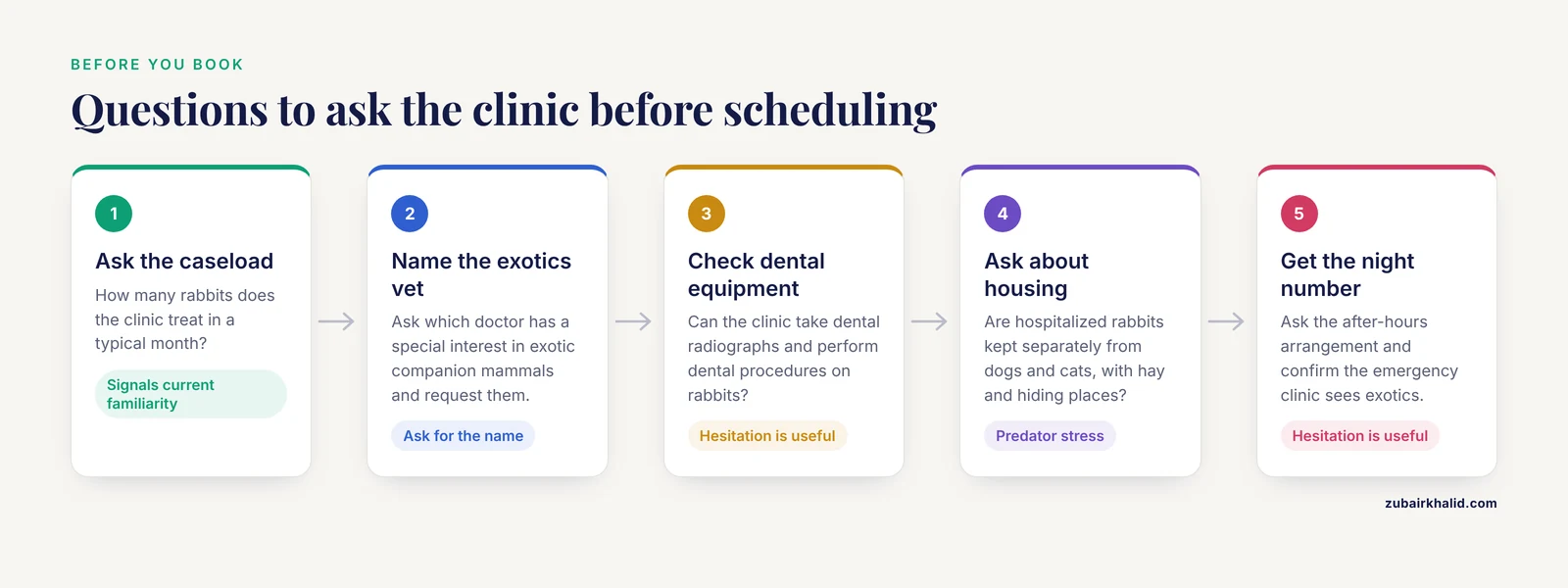
Call or email the clinic before scheduling a wellness exam. Ask these questions to the receptionist or practice manager.
- How many rabbits does this clinic treat in a typical month? A meaningful caseload signals current familiarity with rabbit anesthesia, dentistry, and handling.
- Do any of your veterinarians have a special interest in exotic companion mammals? Some clinics designate one doctor for small mammals. Ask for that doctor's name and request appointments with them.
- Do you have the equipment to take dental radiographs and perform dental procedures on rabbits? Dental disease is one of the most common reasons rabbits need veterinary care, and not every clinic can image or trim rabbit teeth.
- Do you hospitalize rabbits separately from dogs and cats? Rabbits are easily stressed by the sight, sound, and smell of predators. Ask where hospitalized rabbits are kept and whether staff provide hay and hiding places.
- What is your after-hours arrangement for rabbits? Get the name and number of the emergency clinic, and confirm that the emergency clinic sees exotics. Some emergency hospitals do not.
- What is your policy on a meet-and-greet visit? Some owners pay for a short get-acquainted visit before committing.
If a clinic hesitates on question 3 or question 5, that is useful information. You can still use the clinic for routine care, but you will want a referral plan for dental work and emergencies.
First-Visit Template: Questions to Ask a Rabbit Vet
Use this format for the first wellness exam. Bring a written copy, a list of everything your rabbit eats, a photo or sample of the litter box contents if stool output has changed, and any prior medical records.
History and Examination Questions
- Based on the exam, what is my rabbit's body condition score, and is the weight appropriate for the breed and frame?
- My rabbit is a (breed, age, sex, spay or neuter status). Are there conditions common to this profile that I should watch for?
- Can you show me how to check the incisors at home, and how will you monitor the molars, which I cannot see?
- Are the nail length, ear canals, skin, and vent area normal today?
Diet Questions
Bring your actual feeding plan to the appointment, including brands, amounts, and treats. Then ask:
- Given what I currently feed, what specifically should change, in what order, and over what time frame?
- Unlimited grass hay is the foundation, correct? Which hay types do you recommend for my rabbit's age, and how do I transition between them?
- How much pellet is appropriate per day for my rabbit's size, and does the brand or formulation matter?
- Which vegetables are appropriate, in what quantity, and which foods on my list should I stop?
- How should I introduce new foods without upsetting the gut?
- What should healthy droppings look like in size, number, and consistency, and what changes warrant a call?
Rabbit welfare guidance consistently identifies unlimited hay, appropriate fresh foods, and restricted pellets as the dietary core, and the Rabbit Welfare Association and Fund provides detailed feeding guidance that many owners find useful for day-to-day decisions. Your vet will tailor that framework to your individual rabbit, which is exactly what these questions are for.
Dental and Gastrointestinal Questions
- Does my rabbit show any signs of early dental disease on today's exam?
- Are there skull shape factors in my rabbit's breed that raise dental risk, and does that change monitoring frequency?
- What is your preferred early response if my rabbit eats less for half a day? At what point do I come in rather than wait?
- Do you recommend any home monitoring, such as daily weight checks, and with what frequency?
Preventive Care Questions
- Do you recommend spaying or neutering for this rabbit, at what point, and why in this individual case?
- Is vaccination against rabbit hemorrhagic disease virus indicated for my rabbit given our local risk? House Rabbit Society resources track the disease's spread in the United States and describe the vaccine options available here.
- Should my indoor rabbit be on parasite prevention, and is screening for parasites like Encephalitozoon cuniculi appropriate in my situation?
- How often do you want to see this rabbit, and what should each routine visit include?
Housing, Behavior, and Enrichment Questions
- My rabbit lives (indoors free roam, in a pen, in a cage). What changes would you make to that setup?
- How much daily exercise and out-of-enclosure time do you consider appropriate for this rabbit?
- My rabbit shows this behavior (describe: digging, circling, chewing baseboards, growling, thumping). Is this normal, and how should I respond?
- If I am considering a second rabbit, what do you advise about bonding and quarantine?
The Rabbit Welfare Association and Fund promotes housing that allows rabbits to stand fully upright, stretch out, and move freely, along with constant companionship and enrichment, and their guidance is a reasonable starting point for the housing conversation.
Emergency Preparedness Questions
- What is your after-hours protocol, and what is the number I call?
- Which signs in a rabbit mean bring them in immediately, even at 2 a.m.?
- What should I keep at home as a rabbit first-aid and supportive-care kit?
- If my rabbit stops eating entirely, how long is too long, and what should I do in the meantime?
Many clinics provide a printed emergency sheet. Ask for one. If the clinic does not have one, ask them to write the top three go-now signs on your exam summary.
Worked Examples: What Good Answers Sound Like
A question template is only useful if you know whether the answers you receive are solid. These examples show the difference.
Question: "What should I feed my adult rabbit?"
A strong answer names specifics: unlimited grass hay such as timothy, a measured daily pellet amount appropriate to your rabbit's weight, a measured variety of leafy greens, and limited treats, with a transition plan if your current diet is pellet-heavy. A weak answer is "a good rabbit food from the pet store." The Merck Veterinary Manual emphasizes that improper diet is a major contributor to gastrointestinal and dental disease in rabbits, so a vet who cannot discuss hay and forage in concrete terms may not manage rabbits routinely.
Question: "My rabbit has not eaten since this morning. What should I do?"
A strong answer sets a time threshold, asks about the last normal droppings, asks whether the rabbit is bright and drinking or dull and hunched, and gives you a decision rule such as "if no improvement by evening, come in." It may also ask you to check whether the rabbit is producing small or no fecal pellets, because reduced gut motility is the concern. A weak answer is "wait and see." VCA Animal Hospitals identifies anorexia in rabbits as a situation that requires veterinary evaluation rather than prolonged home observation.
Question: "Does my rabbit need to be spayed?"
A strong answer discusses the individual rabbit, the marked reduction in uterine disease risk in spayed females, behavioral benefits, and the clinic's experience with rabbit anesthesia and surgery, including pain control and recovery monitoring. A weak answer is a flat yes or no with no discussion of the clinic's rabbit surgical experience. Ask directly how many rabbit spays the surgeon performs per year.
Question: "Is vaccination needed?"
In the United States, this answer depends on local risk. Rabbit hemorrhagic disease virus type 2 has spread across much of North America, and House Rabbit Society resources encourage owners in affected areas to discuss vaccination with their vet. A strong answer references the disease status in your region, the vaccine products available, and the booster schedule. A weak answer dismisses the question without discussing regional risk.
Copy-Ready Question Format You Can Print
Use this condensed template at any rabbit vet appointment. Bring a pen, or record the conversation on your phone with the vet's permission.
Before booking
- How many rabbits do you treat monthly?
- Which vet sees exotics, and can I book with them?
- Can you perform rabbit dental procedures and dental radiographs?
- What is your after-hours emergency plan for rabbits?
At the exam
- Is my rabbit's weight and body condition appropriate?
- What diet changes do you recommend, specifically and in what order?
- Are the teeth healthy today, including the back molars?
- Does my rabbit need spay or neuter, and when?
- Does my rabbit need any vaccination given our local disease risk?
- Are any screening tests recommended at this visit?
- How much exercise and out-of-enclosure time do you recommend?
- What are the top three signs that mean an immediate visit?
- When should I schedule the next checkup?
If your rabbit is sick
- What do you think is going on, and what else could it be?
- What is the treatment plan, how long will it take, and what improvement should I see by when?
- What side effects or complications should I watch for at home?
- When do you want to recheck, and what should I do if my rabbit worsens before then?
Question 15 and question 17 matter more than owners expect. Rabbit medications are frequently continued for a defined course, and gut-targeted supportive care often continues beyond the point where appetite returns, so clarify the full duration before you leave.
Rabbit Care Checklist to Bring to the Appointment
Complete this checklist the night before the visit. The answers turn vague questions into specific ones.
- Rabbit's age, breed, sex, and spay or neuter status
- Source and date of acquisition, plus any prior medical records
- Current diet: hay type and availability, pellet brand and daily amount, vegetables offered daily, fruits and treats and their frequency
- Housing: enclosure dimensions, flooring, location in the home, out-of-enclosure hours per day
- Companions: housed alone or bonded with another rabbit
- Litter setup: litter type, box location, any changes in use
- Last 48 hours of appetite, water intake, dropping output, and activity
- Any behavior changes: aggression, hiding, lethargy, teeth grinding, changes in posture
- Any prior illnesses, treatments, or medications
- Photos or short videos of the behavior or symptom you are worried about
A video is often worth more than a description. Rabbits that act normal at the clinic frequently behave abnormally at home, and the video gives your vet information the exam cannot.
Common Mistakes Owners Make at Vet Visits
- Waiting for the appointment to mention a symptom. Rabbits that stop eating need assessment quickly. Call the clinic the day you notice the change and describe it. VCA Animal Hospitals guidance treats reduced appetite in rabbits as a prompt for veterinary contact, not home observation alone.
- Assuming any small animal vet is a rabbit vet. Ask the caseload question. Rabbits differ from cats and dogs in drug choices, anesthetic management, and handling, and the Merck Veterinary Manual treats rabbit medicine as its own subject area for a reason.
- Feeding questions left until the rabbit is sick. Ask the diet questions at the healthy first visit. Diet-driven problems are far easier to prevent than reverse.
- Skipping the emergency conversation. Owners who leave the first visit knowing the after-hours number and the go-now signs respond faster when stasis or injury happens at night.
- Describing symptoms in vague terms. "She seems off" gives the vet little to work with. "She has eaten about a quarter of her usual ration since yesterday morning and her droppings are smaller than normal" is actionable.
- Rehome-level housing questions never asked. If your rabbit's pen is too small for full extension and upright posture, raise it at the visit. The Rabbit Welfare Association and Fund's housing standards make a useful reference point for that discussion.
A Note for Households With Guinea Pigs
Many households keep guinea pigs alongside rabbits or consider adding one, and the same clinic may see both. Do not assume that rabbit advice transfers. A guinea pig care guide and rabbit care guidance overlap on hay-based diets and unlimited forage, but they diverge on a critical point: guinea pigs require a dietary source of vitamin C because they cannot synthesize it, a difference your exotic vet can explain in detail. Guinea pigs also have their own social, housing, and handling needs that differ from rabbits.
If you keep both species, ask your vet these additional questions:
- Should guinea pigs and rabbits be housed together or kept as separate companions? Many welfare sources recommend separate housing because a rabbit can injure a guinea pig even unintentionally, and the two species have different dietary requirements.
- What vitamin C plan does my guinea pig need, and how much vitamin C does my rabbit need, if any?
- Do the same go-now emergency signs apply to both species?
Asking species-specific questions in the same appointment is efficient and prevents cross-species errors in feeding and housing.
Limitations and When to Contact a Veterinarian
This article provides a question framework. It does not diagnose your rabbit, and individual cases always need a veterinarian who has examined the animal. Treatment decisions, medication choices, anesthesia plans, and diagnostic testing are individualized.
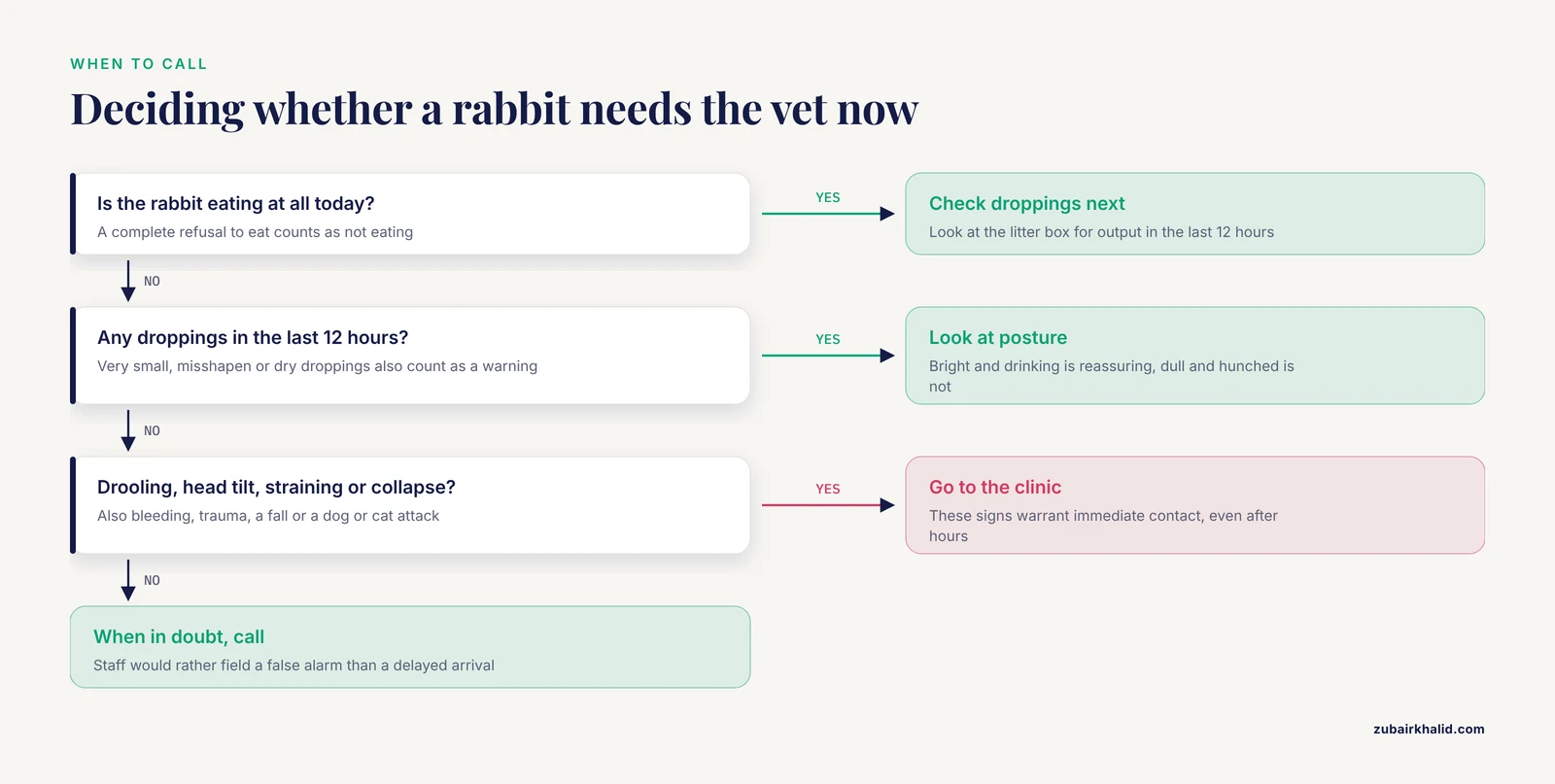
Contact your veterinarian promptly, or the emergency clinic after hours, for any of the following:
- No appetite or significantly reduced appetite lasting more than a few hours, or any complete refusal to eat
- No fecal droppings for 12 hours or more, or very small, misshapen, or dry droppings
- Drooling, wet chin or forepaws, or dropping food while trying to eat
- Lethargy, hunched posture, pressing the abdomen toward the ground, or reluctance to move
- Diarrhea or unformed feces, which differ from normal soft cecotropes
- Sneezing, nasal discharge, head tilt, wobbliness, or rolling
- Straining to urinate, absence of urine, blood-tinged urine in an unusual context, or a wet or soiled vent area
- Bleeding, trauma, a suspected fall, or a dog or cat attack, even if the rabbit seems fine afterward
- A lump, swelling, or sudden weight change
- Any collapse, seizure, or labored breathing
A rabbit that is not eating at all is a same-day or emergency visit, not a tomorrow visit. If your regular clinic cannot see a sick rabbit promptly, ask for a referral to an exotics specialist. When in doubt, call. The clinic staff would rather field a false alarm than hear about a delayed arrival.
Frequently Asked Questions
What questions should I ask a rabbit vet at the first visit?
Ask about the vet's rabbit caseload, whether they can do dental procedures, what diet changes they recommend for your specific rabbit, whether spay or neuter and vaccination are indicated, and what the after-hours emergency plan is. The template in this article covers all five groups with exact wording.
How do I find a vet who is experienced with rabbits?
Call clinics and ask how many rabbits they treat per month and whether a specific doctor handles exotics. The House Rabbit Society maintains a listing of rabbit-savvy vets, and local rabbit rescue groups are another reliable source of recommendations.
What should I bring to a rabbit vet appointment?
Bring your rabbit in a secure carrier with hay and a familiar hide, the completed checklist from this article, any prior records, and photos or videos of any abnormal behavior or droppings. A sample of unusual droppings can also help the vet.
Does my indoor rabbit need to see a vet at all?
Yes. Indoor rabbits still need wellness exams, dental monitoring, and preventive care discussions, and indoor status does not eliminate risks such as rabbit hemorrhagic disease in many regions. Annual visits establish a baseline that makes illness easier to detect early.
Should I ask about vaccinating my rabbit against rabbit hemorrhagic disease?
Yes, ask directly. The disease has spread across parts of the United States and vaccination is available here, so your vet can assess your local risk and recommend an appropriate schedule.
How often should a rabbit have a checkup?
Ask your vet, since recommendations vary with age and health status. Many vets see healthy adult rabbits annually and senior rabbits or rabbits with dental disease more often. Your first visit is the right time to agree on a schedule.
Can I use the same vet for my rabbit and my guinea pig?
Often yes, if the clinic sees both species. Be aware that their needs differ, particularly the guinea pig's requirement for dietary vitamin C, so ask species-specific questions rather than assuming rabbit advice transfers across.
What emergency signs in a rabbit mean I should call the vet immediately?
Not eating, no droppings for half a day or more, drooling, lethargy with a hunched posture, diarrhea, straining to urinate, bleeding, trauma, or collapse all warrant immediate contact. Confirm your own clinic's list at the first visit so you are not deciding under stress.