Bringing Home a New Rat: First Week Guide
By Dr. Zubair Khalid, DVM, MS, PhD ·

Most pet rats begin to settle within the first few days and are visibly comfortable in a well-prepared cage by the end of the first week. The goal of the new rat first week is simple: keep the environment calm and consistent, let the rat hide and explore on its own terms, watch its eating, drinking, weight, and droppings every day, and book a checkup with a veterinarian experienced in exotic pets. Rats that get this quiet, structured start tend to eat sooner, hide less, and adapt to handling faster than rats dropped into a busy household with no adjustment period.
This guide walks you through everything that happens between the moment you decide on bringing home a rat and the end of day seven, including a complete new rat checklist, a day-by-day plan, the behavior changes that are normal during settling in, and the warning signs that mean you should call a veterinarian.
This article is educational and is not a substitute for veterinary diagnosis or treatment.
At a Glance: The New Rat First Week
| Day | Focus | What to do |
|---|---|---|
| Before pickup | Preparation | Cage assembled, solid floor with bedding, hide box, water bottle, food, enrichment in place. Find an exotic pet veterinarian. |
| Day 1 | Arrival and quiet | Transfer the rat gently, offer food and water, then leave it alone except for quiet observation. Record weight if possible. |
| Day 2 | Observation | Confirm eating, drinking, and droppings. Keep handling to brief, low sessions. |
| Days 3 to 5 | Gentle trust building | Short positive sessions, treats through the cage door, let the rat come to you. Book the first vet visit. |
| Days 6 to 7 | Routine and review | Weigh again, check coat and activity, confirm the vet appointment, and begin planning introductions if you have other rats. |
Why the First Week Matters
Rats are prey animals. Their instinct when placed in an unfamiliar space is to freeze, hide, and map the environment by scent and sound before they move confidently. A first week that respects that instinct produces a calmer, more handleable rat. A first week filled with handling attempts, cage rearranging, and household noise teaches the rat that humans are a threat, and that lesson takes weeks to undo.
Welfare research on pet rats also gives owners a reason to take the start seriously. A survey of 677 pet rat owners in the United Kingdom found that while many rats were provided with a social companion and enrichment, owners could not always be sure their rats had a sufficiently nutritious diet or enough opportunity to explore, and the survey documented a generally high prevalence of disease in pet rats [1]. Several of those gaps trace back to decisions made in the first days of ownership, so the habits you build now set the trajectory for the rest of your rat's life.
Setting Up Before Bringing Home a Rat
Everything the rat needs should already be in the cage before it arrives. Settling in goes faster when the rat can immediately find food, water, and a hiding place without needing to learn anything new.
Cage and Flooring
Choose a cage with a solid floor covered in appropriate bedding rather than a wire-bottom floor. Housing recommendations from the National Research Council and the Association for Assessment and Accreditation of Laboratory Animal Care both call for rats to be kept in solid-bottom cages with bedding, and a study comparing the two flooring types found no clinical advantage to wire floors that would justify choosing them over solid surfaces [2]. Solid flooring with bedding is also far kinder to rat feet and allows natural foraging and digging behavior.
Cage sizing, safe spacing of bars, and injury prevention are covered in detail by expert-consulted pet rat housing guidelines developed with veterinarians, veterinary nurses, animal welfare scientists, and experienced rat owners and published in the Veterinary Record [3]. Those guidelines are a sound reference when you evaluate a cage, and your veterinarian can help you apply them to the specific cage you own.
Refuge, Substrate, and Enrichment
The same expert guidelines place strong emphasis on three features inside the cage [3]:
- Refuges. At least one enclosed hide box or covered hammock where the rat can retreat completely. A new rat will spend much of the first days in its refuge, and that is healthy, normal behavior.
- Substrate. Bedding deep enough to allow digging and foraging. Nesting substrate matters, and owner surveys suggest rats do not always receive adequate nesting material [1].
- Enrichment. Climbing structures, chew items, and opportunities to explore. Enrichment was one of the things many owners in the United Kingdom survey did well, and it should start from day one, not after the rat has settled [1].
Set all of this up before the rat comes home. Rearranging the cage during the first week removes scent cues the rat is using to feel secure and resets the settling-in clock.
Location and Scent Environment
Place the cage in a room with normal household activity but no direct disturbances. Rats have sensitive hearing, so keep the cage away from speakers, televisions at high volume, and anywhere a dog or cat can paw at or reach the bars.
Predator exposure inside the home is one of the serious welfare failures documented in the pet rat owner survey, with some rats reported as being exposed to predator species in the household [1]. Cats and dogs should never have physical access to the rat's cage, and the cage should be in a room the predators cannot enter unattended.
Scent also matters more than many owners realize. Rodents rely heavily on olfactory communication, and research on rodents shows that scents of animal origin, including predator odors, can trigger physiological and behavioral responses [4]. In practical terms, avoid cleaning the cage with strongly scented products, do not place the cage near a litter box or pet food storage that attracts other animals, and wash your hands before handling if you have just touched a cat, dog, or ferret.
Your New Rat Checklist
Use this new rat checklist before pickup day. Every item should be ready before the rat enters your home.
- Cage that meets current pet rat housing guidance for size, bar spacing, and injury prevention [3]
- Solid-bottom floor with several centimeters of appropriate bedding
- One enclosed refuge per rat, plus a hammock or covered platform
- Water bottle, filled and tested for drips, plus a spare
- The same food the rat was eating before arrival, enough for a gradual transition
- Heavy ceramic food bowl that cannot be tipped
- Chew-safe enrichment and climbing structures
- A digital kitchen scale for weekly weight checks
- Carrier for transport and for vet visits
- Contact details for a veterinarian who treats rats and exotic pets
- Nesting material such as unscented paper-based bedding
- A quiet, predator-free room identified for the cage
The First Week, Day by Day
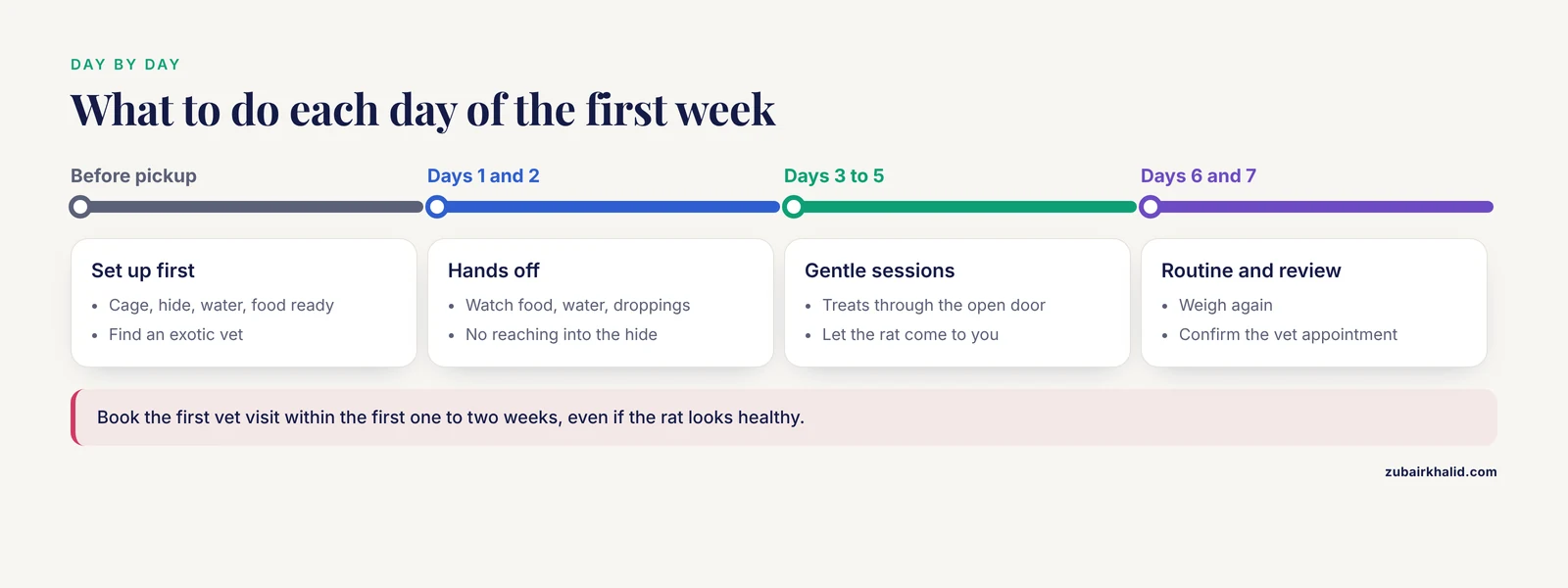
Days 1 and 2: Arrival and Hands-Off Observation
Transfer the rat from the carrier to the prepared cage gently and without chasing it around the carrier. The fastest method is to open the carrier inside or against the cage door and let the rat walk out on its own.
For the first two days, your job is observation, not interaction. Watch from a respectful distance for these basics:
- The rat reaches food and water within the first hours.
- Droppings appear and look normal and formed.
- The rat uses its hide box, moves around the cage, and sniffs its surroundings.
- Breathing looks quiet and effortless, with no clicking, wheezing, or rattling sounds.
It is normal for a new rat to eat very little on day one and to stay hidden. Do not reach into the hide box to check on the rat. Veterinarians and animal care professionals rely on weight, coat condition, hydration, and activity as core health indicators in rodents [5], and you can gather all four by watching from outside the cage without disturbing the rat.
If the rat was traveling with a companion or came from a known group, keep whatever cage mates it arrived with together. Rats are social animals, and companionship was identified as one of the things pet rat owners do well in the large United Kingdom survey [1]. A rat settling in alongside a familiar companion typically shows less hiding and resumes eating sooner.
Days 3 to 5: Gentle Trust Building
From about day three, begin short, predictable, positive sessions. The pattern that works:
- Sit next to the cage and speak quietly for a few minutes so the rat learns your voice.
- Offer a small food treat through the open door without requiring the rat to take it from your hand.
- Let the rat approach you. Never pull it out of the hide box.
- If the rat climbs onto your hand or arm voluntarily, let it, then return it gently to the cage after a short session.
Keep handling attempts brief at this stage, and use gentle restraint only when necessary, such as moving the rat into a carrier. Gentle handling and calm restraint are emphasized in professional animal care training because rough handling creates lasting fear in rodents [5]. Several short sessions per day beat one long session, and ending each session while the rat is still comfortable builds trust faster than pushing until it flees.
During this window, schedule the first vet visit for a rat within your first two weeks of ownership. Details on what that visit should cover are below.
Days 6 and 7: Routine and Review
By the end of the first week, a healthy, well-prepared rat should be:
- Eating and drinking normally and consistently
- Producing normal droppings
- Moving confidently around the full cage
- Emerging from the hide box when you approach, at least sometimes
- Showing clean coat condition, bright eyes, and steady breathing
Weigh the rat on days 1 and 7 if you can, using a kitchen scale and a small container. Weight trend matters more than any single number, and a stable or slowly increasing weight in the first week is a reassuring sign. Weighing at the start gives your veterinarian a baseline at the first appointment.
Use day 7 to review the checklist items and confirm that the routine you have built, including feeding times, light cycle, and cleaning schedule, is one you can maintain long term.
How Long for a Rat to Settle In
Owners asking how long for a rat to settle in should expect a range rather than a single number. In practice, most rats show confident exploration and voluntary approach within three to seven days in a calm home, while shy rats, rats from stressful backgrounds, and rats kept alone rather than with a companion can take several weeks to appear fully relaxed.
Progress is not linear. A rat may explore boldly on day two and hide more on day four after a noisy evening. That pattern is normal. Judge settling in by trend, not by a single day. You should see gradual improvement across the week in these markers:
- Time spent visible rather than hidden
- Willingness to take food in your presence
- Relaxed body posture, grooming, and stretching while you watch
- Voluntary climbing onto your hand or arm
If a rat is still hiding constantly, refusing food, or panicking at your approach after two full weeks, that is a signal to slow down and to discuss the behavior with an exotic pet veterinarian, because pain or illness can present as fear and inactivity.
Feeding During the First Week
Feed the diet the rat was already eating, and change foods gradually over the following week or two rather than abruptly. Sudden diet changes in small animals commonly cause digestive upset, and a settling rat is already dealing with enough stress.
The owner survey in the United Kingdom found that researchers could not be certain whether pet rats were receiving a sufficiently nutritious diet, which makes nutrition one of the recognized gaps in pet rat care [1]. Use the first week as a chance to get this right:
- Ask the breeder, rescue, or pet store exactly what the rat was eating and keep that as the base.
- Provide fresh water at all times and check the bottle daily for function and cleanliness.
- Do not make treats, seeds, or sugary foods the main diet. Discuss an appropriate staple diet and treat list with your veterinarian at the first visit, since the right balance depends on the rat's age and condition.
- Feed at consistent times. Predictable feeding is one of the fastest ways to teach a nervous rat that your presence means good things.
Never restrict food or water in a pet rat as a way to encourage hand-feeding or weight control without explicit veterinary direction. Limiting food or water is recognized in professional animal care as a intervention that can harm health and welfare and is subject to veterinary oversight for good reason [6].
Health Monitoring and the First Vet Visit for a Rat
Daily Health Checks
Check these five things every day during the first week. They take two minutes and catch problems early.
- Appetite and thirst. Is food being eaten and is the water level dropping?
- Droppings. Formed and present, not absent, tiny, or watery.
- Breathing. Quiet effort, no clicking, sneezing, or rattling.
- Coat and posture. Smooth coat, no hunched stance, no porphyrin crusting around the eyes or nose at levels beyond a small amount after sleep.
- Activity. Normal exploration and interaction with cage mates.
Regular health monitoring with early disease detection is standard practice in professional rodent care precisely because small animals hide illness until disease is advanced [5]. Subclinical infections can also remain unnoticed while still affecting the animal, which is a core finding of long-term rodent health monitoring programs [7]. A rat that looks slightly off in the morning can be seriously ill by evening, so treat small changes as meaningful.
Booking and Preparing for the First Vet Visit
Schedule the first vet visit for a rat within the first one to two weeks, even if the rat appears healthy. A baseline exam establishes weight, checks the respiratory system, teeth, skin, and coat, and gives you a professional contact before an emergency.
Before the visit:
- Confirm the practice treats rats specifically. Not all small animal hospitals see exotic pets, so ask when booking.
- Bring the rat in a secure carrier with bedding and a hide box inside.
- Bring a fresh sample of the food you are using so the veterinarian can review the diet.
- Note the day 1 weight, what the rat has been eating, drinking, and any behaviors you have questions about.
At the visit, ask about diet, parasite control, dental health, neutering options if you keep mixed sexes, and the introduction process for any rats you plan to add later. If your veterinarian recommends diagnostic testing, discuss what each test is for and what the results would change about your rat's care.
Quarantine and Introductions to Existing Rats
If you already have rats, do not house the newcomer with them during the first week. Keep the new rat in a separate cage in a separate room, handle the new rat last during your care routine, and wash your hands between groups. Rodent health monitoring programs exist in professional facilities because infections can spread quietly through colonies before signs appear [7]. Quarantine of new arrivals is the single most effective way to protect your existing rats, and your veterinarian can advise on how long to continue it and on a safe introduction plan.
Rats are territorial, so even after quarantine, introductions should happen on neutral ground, gradually, and with supervision. Ask your veterinarian or an experienced rescue for a step-by-step introduction protocol suited to your animals.
Common First-Week Mistakes
- Handling too much too soon. Pulling a frightened rat from its hide box teaches it that your hands are predators. Let it come to you.
- Rearranging the cage. Every change removes scent landmarks. Set up once and leave the layout alone.
- Housing a single rat. Keeping one rat alone deprives it of companionship, and owner survey data show companionship is a core element of good pet rat welfare [1].
- Changing food on day one. Keep the familiar diet and transition slowly.
- Skipping the vet visit because the rat looks fine. High disease prevalence in pet rats is a documented welfare concern [1], and early baseline exams catch problems while they are still treatable.
- Placing the cage where predators can reach it. Direct predator exposure was documented as one of the worst welfare problems found in pet rat homes [1].
- Cleaning with scented products or overcleaning. Rodents communicate and orient through scent, and strong odors can be stressful [4]. Spot clean during the first week and preserve familiar scent.
- Using a wire-bottom cage. Solid-bottom housing with bedding is the recommended standard for rats [2].
- Introducing the new rat to existing rats immediately. Quarantine protects everyone, and rushed introductions cause injuries.
Welfare and Safety Points
- Rats are most active at dawn and dusk and overnight. Expect bursts of activity when the household is quiet, and do not interpret daytime sleeping as illness.
- Provide nesting material from day one. Nesting substrate was one of the areas where pet rats were found to be underprovided in the owner survey [1].
- Supervise any out-of-cage time. Free-roam sessions should happen in a sealed, rat-proofed room with no other pets present and no gaps to escape through.
- Keep the room temperature stable and avoid drafts and direct sunlight on the cage.
- Record weight, appetite, and behavior in a simple daily log. Professional animal care programs rely on routine documentation of these indicators to detect problems early [5].
Limitations and When to Contact a Veterinarian
The advice here reflects published pet rat welfare research and expert housing guidelines [2][5] and general principles of professional rodent care [1][4]. Every rat is an individual, and a veterinarian who can physically examine your animal is the right source for decisions about diet specifics, cage-mate introductions, medications, and anything beyond basic husbandry.
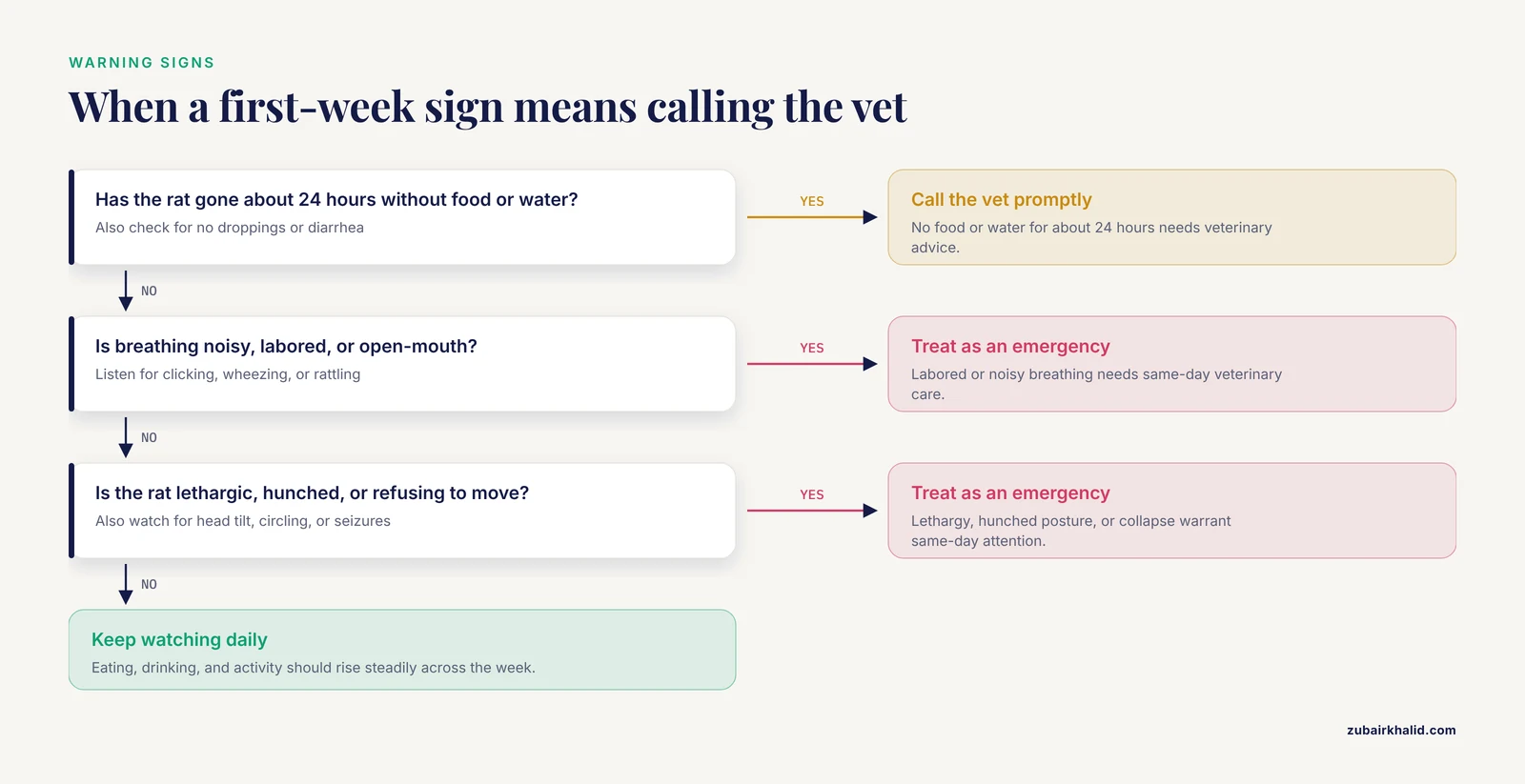
Contact a veterinarian promptly, and treat the same day as an emergency when these signs appear:
- No food intake for more than about 24 hours, or no water intake
- No droppings, or diarrhea
- Labored, noisy, or open-mouth breathing, clicking sounds, or blue-tinged extremities
- Lethargy, hunched posture, or refusal to move
- Bleeding, wounds, a limp, or suspected fall
- Head tilt, circling, tremors, or seizures
- Visible swelling, a mass, or sudden weight loss
- Sudden aggression or collapse
- In females, any vaginal bleeding or discharge
- Bite wounds from cage mates or household pets
If you cannot reach an exotic pet veterinarian, ask the practice you called for a referral to the nearest emergency service that treats small mammals. Small animals deteriorate quickly, and waiting out a weekend is riskier than a middle-of-the-night drive.
Frequently Asked Questions
How long does it take for a new rat to settle in?
Most rats settle within three to seven days in a quiet, well-prepared home, though shy rats or rats from stressful backgrounds may need several weeks. Judge settling in by the trend across days, not by any single day.
What should be on a new rat checklist?
A correctly sized cage with a solid floor and bedding, a hide box, water bottle, the food the rat was already eating, enrichment and nesting material, a scale for weight checks, a carrier, and contact details for an exotic pet veterinarian.
Should I get one rat or two?
Rats are social and should be kept with at least one compatible companion whenever possible. Companionship is widely recognized as a core part of good pet rat welfare in owner welfare research.
When should I schedule the first vet visit for a rat?
Book it within the first one to two weeks, even if the rat looks healthy. The baseline exam establishes weight and health records and gives you a professional contact before any emergency.
Can I hold my new rat during the first week?
Keep handling minimal for the first two days, then begin short, positive sessions from day three. Let the rat approach you rather than pulling it from its hide box, and end each session while the rat is still calm.
What behavior is normal during the first week?
Hiding, eating less than usual on day one, freezing at sudden noises, and slower exploration are all normal. Eating, drinking, and activity should steadily increase over the week.
What warning signs mean I need a veterinarian right away?
Refusal to eat or drink, no droppings or diarrhea, noisy or labored breathing, lethargy, bleeding, head tilt, sudden swelling, or collapse all warrant same-day veterinary attention.
Can my new rat join my existing rats right away?
No. Quarantine the new rat in a separate cage in a separate room during the first week and follow your veterinarian's guidance on quarantine length and gradual, supervised introductions on neutral ground.
Sources
- Pet rat welfare in the United Kingdom: The good, the bad and the ugly.
- Clinical pathology laboratory values of rats housed in wire-bottom cages compared with those of rats housed in solid-bottom cages.
- Developing guidelines for pet rat housing through expert consultation.
- Olfaction variation in mouse husbandry and its implications for refinement and standardization: UK survey of animal scents.
- Building a humane scientific future: Second Asia Laboratory Animal Day.
- Regulatory issues regarding the use of food and water restriction in laboratory animals.
- Twenty years of health monitoring in a conventional neuroscience animal facility: challenges, strategies, and 3Rs-oriented approaches to animal welfare, personnel health, and research integrity.