Bringing Home a New Rabbit: First Week Guide
By Dr. Zubair Khalid, DVM, MS, PhD ·

Most rabbits need three to seven days to show their normal personality in a new home, and some cautious adults take two to three weeks before they fully relax. During that first week your job is not training or bonding. Your job is to keep the environment quiet and predictable, offer food and water, watch droppings and appetite, and let the rabbit decide when to explore. Rabbits are prey animals, so their stress response runs strong and slow. Research on stress physiology shows that fecal cortisol metabolites in rabbits can stay elevated for up to three days after a stressful event, which means a single frightening car ride on day one can color behavior for much of the week [1].
This guide walks you through the new rabbit checklist, the day-by-day settling period, feeding, housing, body language, and planning the first vet visit for a rabbit. Individual rabbits vary, and any specific concern about your animal should be confirmed with a veterinarian who treats rabbits.
This article is educational and is not a substitute for veterinary diagnosis or treatment.
At a Glance: Your First Week Plan
| Day | Goal | Key actions |
|---|---|---|
| , - | , - | , - |
| Before pickup | Prepare the space | Set up enclosure, hide box, litter box, hay, water. Rabbit-proof one room. Book a rabbit-savvy vet. |
| Day 1 | Arrival and calm | Quiet room, minimal handling, leave hay and water, keep other pets away. |
| Days 2 to 3 | Observe | Track eating, drinking, dropping output, and hiding. Sit on the floor nearby without forcing contact. |
| Days 4 to 5 | Gentle routine | Same feeding times daily. Offer hay by hand. Let the rabbit approach you. |
| Days 6 to 7 | Short exploration | Allow supervised time in the rabbit-proofed room. Schedule the first vet visit if not already booked. |
| Any day | Red flags | No droppings, refusing food, lethargy, diarrhea, or injury means call the vet the same day. |
Before You Pick Up the Rabbit: The New Rabbit Checklist
Getting the environment right before bringing home a rabbit prevents most first-week problems. Rabbits raised in different housing systems show measurably different behavior and stress responses, and the conditions an animal lives in directly shape its welfare and growth [2]. That finding comes from production research, but the principle applies to your living room. What you set up this week sets the baseline for how your rabbit behaves for months.
Work through this new rabbit checklist before pickup day:
Enclosure. Choose the largest enclosure you can accommodate. Pet rabbit welfare surveys in the Netherlands found that many rabbits were kept in relatively small enclosures under 5,000 square centimeters of floor area, and that rabbits in small housing systems showed altered behavior compared with rabbits in larger systems [3]. Bigger is consistently better. Multiple welfare assessment protocols for rabbits identify low space allowance and low enclosure height as recurring welfare problems [4].
Floor surface. Avoid wire floors with holes. A study comparing perforated plastic floors with circular holes against slatted plastic floors in rabbits found significantly more soiling of cages and animals, higher coccidial oocyst counts, and significantly higher losses on the hole-design floors [5]. A solid or slatted solid floor with absorbent bedding is the safer choice for a pet.
Hide box or shelter. Rabbits need a covered retreat where they can see out but feel enclosed. Enrichment material and shelters are among the resources most often missing in rabbit housing assessments, and their absence is recorded as a welfare deficit in formal protocols [4]. A cardboard box with two exit holes works well.
Litter box and paper-based bedding. Place a litter box in a corner. rabbits naturally pick one toileting spot. Avoid clumping cat litter and cedar or pine shavings, and ask your veterinarian about safe options.
Hay. Grass hay should be available at all times. Keep it in a rack or a clean corner so it stays dry and uncontaminated.
Water. Provide a heavy ceramic bowl. Bowls allow a more natural drinking posture than most bottles, though either is acceptable if the rabbit uses it. Confirm during the first days that the rabbit is actually drinking.
Food. Buy a small amount of the food the rabbit was already eating so you can transition gradually. A 2026 nutritional analysis of commercial small-mammal and rabbit diets found inconsistencies between label claims and laboratory results for every diet tested, and none met the stated requirements for all species listed on the label [6]. This underlines two practical points. Feed a diet formulated specifically for rabbits, not a mixed-rodent product, and discuss the exact brand and ration with your veterinarian at the first visit.
Rabbit-proofed room. Block access to electrical cords, baseboards, houseplants, and small gaps behind furniture. Rabbits chew, and chewing is normal behavior, not misbehavior.
Carrier. A hard-sided carrier with good ventilation, lined with a towel. You need this for the ride home and for the first vet visit.
Vet contact. Identify a rabbit-experienced veterinarian before you need one. Not all small-animal clinics treat rabbits, so call ahead and confirm.
Day 1: Bringing Home a Rabbit Without Overwhelming It
The drive home is already a significant stressor. Everything on day one should reduce stimulation, not add to it.
Put the carrier in the prepared enclosure, open the door, and leave the room. Do not pull the rabbit out. Most rabbits will exit the carrier on their own once the room is quiet, often after dark when the house is still. Rabbits are crepuscular, meaning they are most active at dawn and dusk, so do not be surprised if your new rabbit sleeps through the middle of the day and comes alive in the evening.
Keep these rules for day one:
- No handling beyond what is necessary for safety.
- No visitors, no children playing in the room, no loud music or television.
- Other household pets kept out of the room entirely. Even the scent and sounds of a predator species raise stress in rabbits.
- Fresh grass hay, water, and a small portion of the previous diet available immediately.
- Droppings checked at least twice. Normal rabbit droppings are round, dry, and produced in large numbers continuously.
A useful finding from laboratory rabbit research applies directly here. In a study of stress during routine procedures, not only did handled rabbits show elevated serum cortisol and fecal cortisol metabolites, but rabbits housed in the same room that were never touched also showed transient physiological stress responses, apparently from environmental cues alone [1]. Translation for the home setting. Your new rabbit registers everything happening nearby, including shouting, barking, vacuuming, and doors slamming. Keep the whole room calm, not just your hands.
How Long for a Rabbit to Settle In
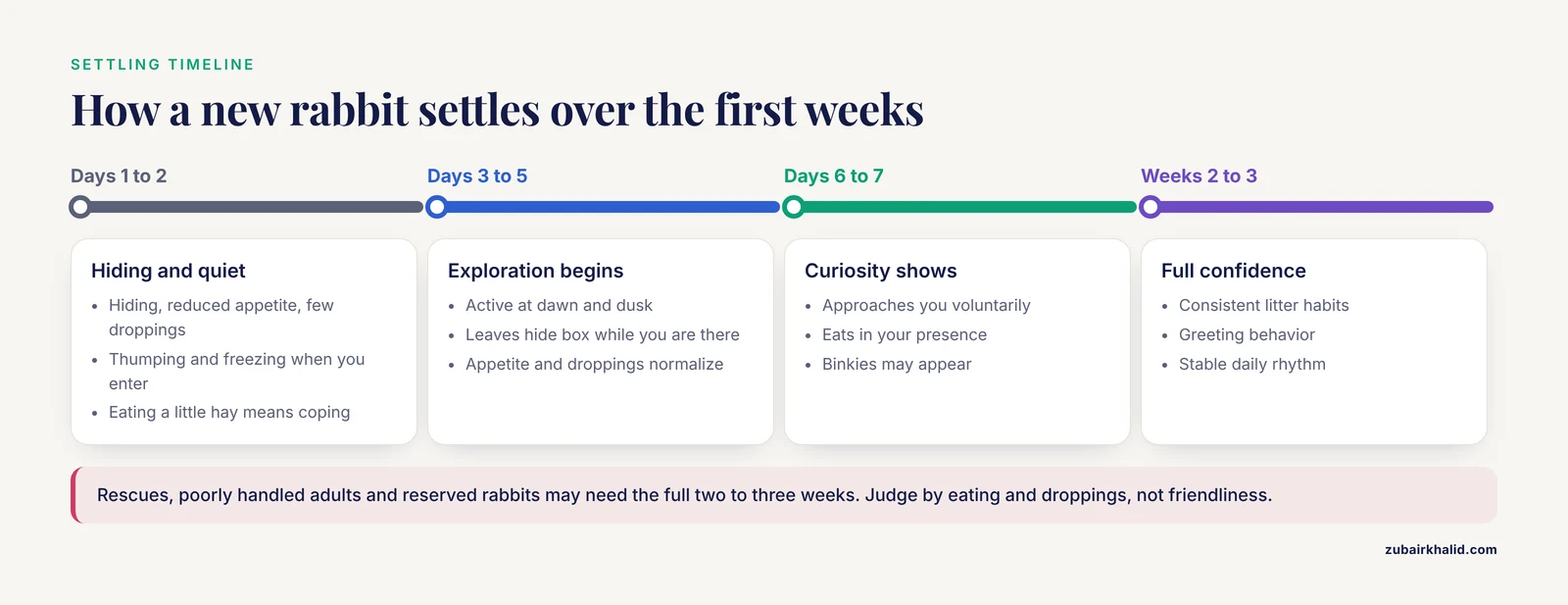
So how long for a rabbit to settle in. Expect a predictable arc.
Days 1 to 2. Hiding, reduced appetite, few droppings, thumping, freezing when you enter the room. This is normal. A rabbit that eats a little hay and produces droppings is coping.
Days 3 to 5. Exploration begins, usually at dawn and dusk. The rabbit starts leaving the hide box while you are in the room. Appetite and dropping output normalize.
Days 6 to 7. Most rabbits show curiosity, approach you voluntarily, eat in your presence, and begin marking routines. Binkies, the joyful mid-air twists rabbits do, may appear.
Weeks 2 to 3. Full confidence. Consistent litter habits, greeting behavior, and a stable daily rhythm.
The cautious end of this range is real. Adult rabbits from rescue situations, rabbits with limited prior handling, and naturally reserved individuals may need two to three weeks. Behavior research supports patience. In a household survey of 912 Dutch pet rabbits with direct behavioral observations on 66 of them, rabbits showed fear responses in contact, handling, and open-field tests, and housing conditions shaped how those behaviors expressed [3]. The personality you see on day two is not the personality you will see in week six.
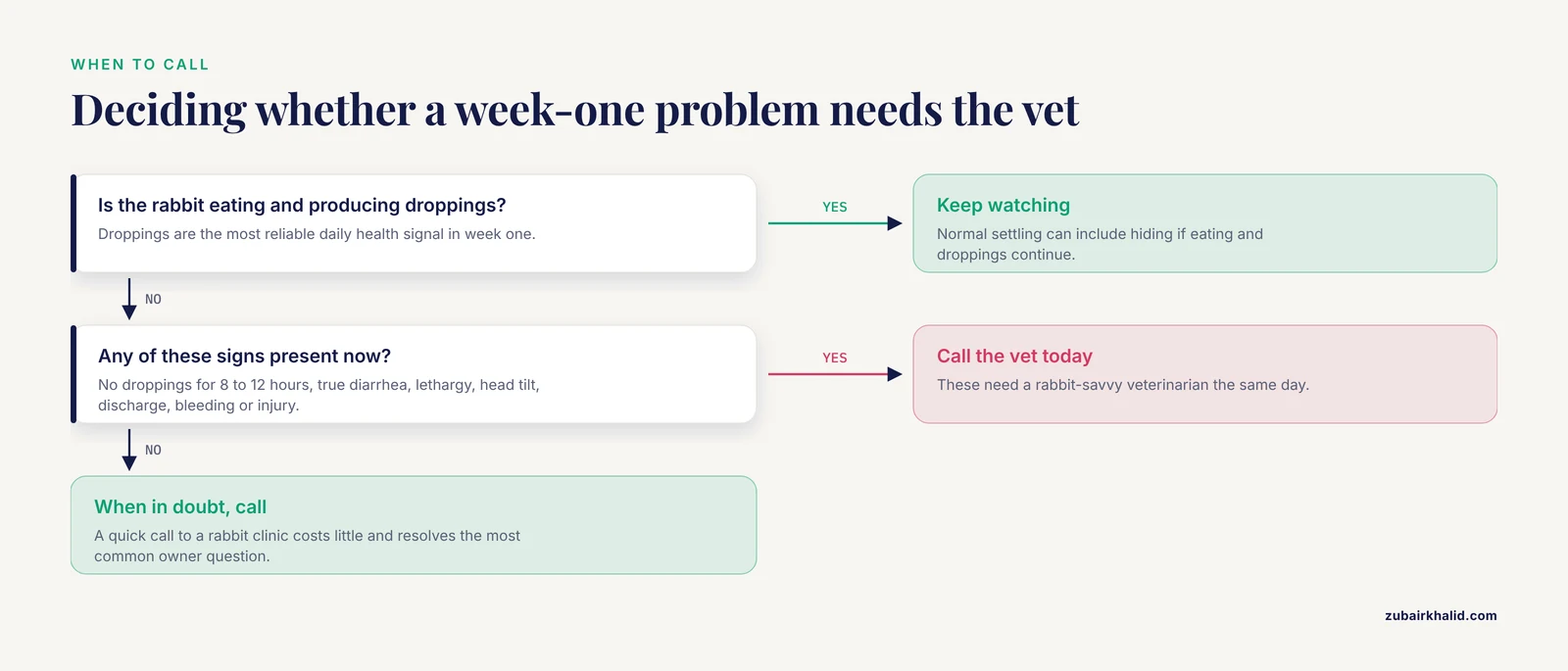
The key metric during the settling window is not friendliness. It is food intake and dropping output. A rabbit that eats and produces normal droppings from day two onward is physically fine, even if it hides. A rabbit that stops eating entirely is not fine, at any stage of settling, and needs veterinary attention the same day.
Feeding During the First Week
Rabbits have a digestive system designed for continuous grazing, so the first-week feeding plan has one central rule. Keep hay in front of the rabbit at all times, and change as little else as possible.
Keep the previous diet. Ask the seller, breeder, or rescue what the rabbit was eating and take some home, or buy the same product before pickup. Abrupt diet changes in a stressed animal invite digestive upset.
Hay first, always. Grass hay, offered freely, is the backbone of the diet. It provides the long-strand fiber that keeps gut motility normal and wears down continuously growing teeth.
Transition new foods slowly. If your veterinarian or a trusted rabbit resource recommends changes, introduce one item at a time over days, not all at once in week one.
Greens in modest amounts. If the rabbit was already eating leafy greens, continue the same ones. If it was not, wait until it has settled before introducing them gradually.
Do not overfeed pellets. Pellets are a concentrated supplement to a hay-based diet, not the diet itself. The nutritional analysis cited above found that commercial diets frequently fail to match their labels, so pellet quantity and brand choice are exactly the topics to raise with your rabbit-savvy vet [6].
Watch the output. Count droppings daily in week one. A drop in quantity, smaller or misshapen droppings, or soft stools are early warnings. True diarrhea in a rabbit is an emergency.
Fresh water, checked twice daily, rounds out the plan. Refuse to worry about exact gram counts of everything in week one. Prioritize hay intake, hydration, and normal droppings.
Housing Setup for Welfare, Not Just Confinement
The first week is when housing habits get set, so build for the rabbit's real needs. Welfare scientists who study rabbits use structured frameworks covering physical, behavioral, environmental, and procedural categories, and housing design appears in every one of them as a primary welfare lever [7].
Practical application for a pet home:
Space to move. The rabbit should be able to take several consecutive hops, stand fully upright on the hind legs, and stretch out flat. Formal welfare assessments of rabbit housing repeatedly flag low space allowance, low cage height, and absence of platforms as the main structural deficits found in practice [4]. An elevated platform or a low shelf adds usable territory in the same footprint.
Room to exercise. An enclosure alone is not enough. Plan supervised free time in a rabbit-proofed room daily, starting with short sessions in week one and building up. In on-farm welfare comparisons, rabbits kept in larger collective park systems showed health and welfare profiles comparable to or better than those in standard cages, with the larger systems giving more opportunity for normal movement [8]. You do not need a 30,000-square-centimeter park, but the direction of the evidence is clear. More space supports better outcomes.
Solid, dry footing. Slippery floors and wire floors both cause problems. Provide secure traction, keep bedding dry, and clean soiled areas promptly. Wet or soiled flooring is associated with skin and parasitic problems in assessments of rabbit housing [5].
Enrichment. Chew items, cardboard tunnels, a dig box, and rearrangeable objects. Enrichment is consistently listed among the resources most often missing for rabbits [4], and behavioral welfare indicators for the species include the expression of normal behaviors such as foraging and exploration [9].
Companionship, eventually. Rabbits are social, and solitary housing in the Dutch survey was associated with reduced lifespan compared with group housing [3]. Do not rush this in week one. Bonding rabbits is a structured process best started after your new rabbit has settled and had its first vet visit. Discuss timing and introduction methods with your veterinarian or a rabbit rescue experienced in bonding.
Reading Your Rabbit: Normal Settling Behavior Versus Stress
Learning to read your rabbit is the single most valuable skill of the first week. Structured welfare tools for rabbits describe assessment across physical, behavioral, environmental, and procedural domains, and a proposed species-specific framework emphasizes recording clinical and behavioral markers together rather than in isolation [7], [10]. You can apply a simplified version at home.
Signs of normal settling:
- Hiding that decreases over days.
- Eating hay in the hide box, then in the open.
- Droppings present and normal within 24 to 48 hours.
- Exploring at dawn and dusk.
- Approaching you voluntarily by the end of the week.
Signs of stress that call for slowing down:
- Constant freezing or thumping that does not improve by day four or five.
- Refusing to leave the hide box even to eat or use the litter box.
- Aggressive lunging or biting when approached, which usually means fear rather than temperament.
- Bar-biting or repetitive circling, which are stereotypic behaviors. In the household survey cited above, rabbits in small enclosures showed increased stereotypic behavior and altered time budgets compared with the natural activity pattern of the species [3]. If you see this, expand space and enrichment rather than punishing the behavior.
Signs of illness, not adjustment. These are covered in the escalation section below and never warrant a wait-and-see approach.
Stress in rabbits can also be measured objectively. Fecal corticosterone metabolite measurement is a validated non-invasive method for assessing the stress response in domestic rabbits, and researchers have worked to standardize the technique because methodological differences affect results [11]. You will not be running lab tests at home, but this research matters for one practical reason. It confirms that behavioral signs you can see, such as hiding and reduced activity, track real physiological stress, so take them seriously.
Handling Your New Rabbit
Correct handling in week one builds trust for life. Incorrect handling teaches the rabbit that human contact means being trapped.
- Sit on the floor at the rabbit's level and let it come to you. Rabbits in the contact test referenced earlier approached humans more when singly housed or kept in small systems [3], which tells you that contact on the rabbit's own terms is the variable that matters.
- Never pick up a rabbit to force interaction. Reserve picking up for necessity, health checks, and moving the animal for safety.
- When you must lift, support the hindquarters and chest fully, keep the body close to yours, and keep lifts short and low to the ground. A struggling rabbit that is dropped can fracture limbs or the spine.
- Stroke the top of the head and the ears' base. Most rabbits dislike being touched under the chin, on the belly, or on the feet.
- Keep sessions short. Five calm minutes twice a day beats one long session.
Children should sit on the floor and let the rabbit approach. No rabbit should be carried by a young child in the first week.
The First Vet Visit for a Rabbit
Schedule the first vet visit for a rabbit within the first one to two weeks, sooner if the rabbit came from an unknown background or shows any abnormal sign. Some owners book the visit before pickup day, which is ideal because it removes one decision from a busy week.
Before the visit:
- Confirm the clinic treats rabbits. Ask specifically how many rabbits the practice sees.
- Bring a fresh fecal sample in a clean container if the clinic requests one.
- Bring a list of what the rabbit is eating, including the pellet brand, hay type, and any vegetables.
- Bring the carrier lined with a towel, and consider a light blanket over it to reduce visual stimulation on the drive.
- Write down your questions. Week-one owners forget them otherwise.
At the visit, a rabbit-savvy veterinarian will typically perform a full physical examination, check body weight and teeth, assess coat and skin, listen to the heart and lungs, and discuss diet, housing, parasites, and preventive care relevant to your region. Vaccination availability for rabbits varies by country and region, so ask your veterinarian what is recommended and required where you live rather than assuming.
The visit also establishes a baseline. Weight recorded at the first visit becomes the reference point for every future check, which matters because rabbits hide illness until disease is advanced. A framework proposed for long-term welfare monitoring in rabbits emphasizes exactly this, recording early baseline evidence so that later deviations from normal can be detected and interpreted [10].
If your rabbit is one of a pair or a bonded group, mention this at the visit. Research on laboratory rabbits has shown that even animals not directly handled can show physiological stress responses from cues in the environment [1], and your vet can advise on keeping the bonded group calm around vet trips.
Common First-Week Mistakes
Avoiding these errors prevents most early problems:
- Too much handling too soon. Carrying the rabbit constantly to "get it used to people" produces a frightened animal that learns to avoid you.
- Rewashing the enclosure daily. Overcleaning removes scent cues the rabbit uses to orient. Spot-clean soiled areas and do a full clean on a regular schedule instead.
- Changing the diet immediately. New home plus new food doubles the stress load. Keep the previous diet for the first days.
- Too-small enclosure "just for now." The Dutch pet rabbit survey found small housing was common and was linked with altered behavior [3]. Start with adequate space on day one rather than planning to upgrade later.
- Ignoring droppings. Owners watch the face and the personality. Veterinarians watch the output. Droppings are your most reliable daily health signal.
- Introducing other pets early. Curious dogs and cats, however gentle, are predators. Their presence slows settling and can cause genuine harm.
- Bathing the rabbit. Rabbits do not need baths, and wetting a rabbit can cause severe stress and dangerous drops in body temperature. Spot-clean soiled fur with a damp cloth.
- Skipping the vet visit because the rabbit "seems fine." Rabbits mask disease. A healthy-looking new rabbit still needs a baseline exam.
Troubleshooting Week-One Problems
The rabbit hides constantly. Give it more time, reduce noise, and sit quietly on the floor without reaching. Most hiding resolves within the first week as the rabbit maps its territory.
The rabbit will not use the litter box. Move droppings and urine-soaked bedding into the box so scent cues point the way. Confine to a smaller area with the box until the habit forms, then expand space gradually.
The rabbit thumps when you enter. Thumping is an alarm signal. Stop approaching, drop your energy, and let the rabbit come to you. Pair your entrances with something positive, such as placing hay in the rack.
The rabbit nips or lunges. This is fear, not aggression. Back off, reduce handling to zero, and rebuild at the rabbit's pace. If it persists past the settling period, ask your veterinarian for a referral to a behavior resource.
The rabbit is not eating hay or droppings are reduced. This is the one week-one problem that is never behavioral. A rabbit that stops eating can develop serious gastrointestinal consequences quickly. Contact a rabbit-savvy veterinarian the same day. The Merck Veterinary Manual's exotic animal resources and rabbit-focused organizations such as the House Rabbit Society and the Rabbit Welfare Association and Fund all emphasize that reduced appetite and reduced dropping output in rabbits require prompt veterinary attention.
Sneezing, discharge, head tilting, or limping. Any of these means a vet visit now, not at the end of the week.
Limitations and When to Contact a Veterinarian
Individual rabbits vary widely in personality, background, and health status, and the timelines in this guide describe typical patterns rather than guarantees for your animal. Diagnosis and treatment decisions belong with a veterinarian who has examined your rabbit.
Contact a veterinarian immediately, the same day, for any of the following:
- No droppings for 8 to 12 hours, or a marked drop in dropping number or size.
- Refusing all food, or eating dramatically less than usual.
- True diarrhea, meaning unformed or liquid stool. This is an emergency in rabbits.
- Lethargy, hunching in a corner, teeth grinding indicating pain, or a hunched posture with pressing the belly to the floor.
- Discharge from the eyes or nose, sneezing, or noisy breathing.
- Head tilt, loss of balance, or rolling.
- Any bleeding, wound, suspected fall, or suspected injury from another pet.
- Straining to urinate, absence of urine, or blood in the urine.
- A sudden behavior change in a rabbit that had been settling well.
Schedule a routine appointment, within a few days, for a persistent reduction in activity beyond the first week, ongoing stereotypic behaviors, chronic soft stools, overgrown nails or teeth noticed at home, or skin and coat problems such as flaking, bald patches, or itching. Formal welfare assessment frameworks for rabbits treat skin condition, body condition, and behavior as core monitored indicators, which reflects how often these systems reveal early disease [7], [9].
When in doubt, call. A quick phone call to a rabbit-experienced clinic costs little and resolves the most common owner question of week one, which is whether a behavior is normal.
Frequently Asked Questions
How long does it take for a rabbit to settle in?
Most rabbits settle substantially within three to seven days, showing normal eating, dropping output, and exploration by the end of the first week. Cautious adults, rescues, and poorly socialized rabbits can take two to three weeks to reach full confidence.
Should I pick up and hold my new rabbit during the first week?
No. Keep handling to what is necessary for safety and health checks. Sit on the floor and let the rabbit approach you. Forced handling during the settling period teaches the rabbit to fear human contact.
What should I feed my new rabbit in the first week?
Feed unlimited grass hay, fresh water, and the same pellet food the rabbit was already eating. Transition any diet changes gradually after the rabbit has settled, and confirm the exact ration with your veterinarian at the first visit.
When should I schedule the first vet visit for a rabbit?
Book it for within the first one to two weeks of bringing your rabbit home, or before pickup day if possible. Go sooner if the rabbit shows any abnormal sign such as reduced appetite, no droppings, discharge, or injury.
Can I let my new rabbit roam the whole house right away?
No. Confine the rabbit to one prepared, rabbit-proofed room for the first week, then allow supervised access to additional areas gradually once it is eating well, using the litter box, and relaxed.
Should I get a second rabbit immediately so mine is not lonely?
Not during the first week. Rabbits are social and companionship is valuable long term, but bonding takes a structured introduction process best started after your rabbit has settled and had its first vet visit. Ask your veterinarian or an experienced rabbit rescue about bonding.
My new rabbit hides all day and only comes out at night. Is that normal?
Yes. Rabbits are crepuscular, meaning they are most active at dawn and dusk, and hiding is normal settling behavior for the first several days. If the rabbit eats, drinks, and produces droppings, give it time.
Does my new rabbit need vaccinations?
Vaccination recommendations for rabbits vary by region and disease risk, so this is a question for your veterinarian at the first visit. Ask which vaccines are available and recommended in your area rather than following a general list.
Sources
- Infrared Thermal Imaging and Blood and Faecal Cortisol Measurements for Stress Assessment in Rabbits During Blood Sampling
- Behaviour and welfare assessment of autochthonous slow-growing rabbits: The role of housing systems
- Welfare assessment in pet rabbits
- Animal Welfare Assessment Protocol for Does, Bucks, and Kit Rabbits Reared for Production
- Welfare assessment in rabbits raised for meat and laboratory purposes in enclosures with two floor types: Perforated plastic with holes versus slats.
- Nutritional assessment of commercial diets for small rodents and rabbits: Impacts of inadequate nutrition.
- A Welfare Assessment Tool to Harmonize Care and Management for Research Rabbits
- A pilot study about on-farm assessment of health and welfare in rabbits kept in different housing systems
- Review of Rat (Rattus norvegicus), Mouse (Mus musculus), Guinea pig (Cavia porcellus), and Rabbit (Oryctolagus cuniculus) Indicators for Welfare Assessment
- A rabbit is not a mouse: a framework for the initial welfare assessment and long-term monitoring of genetically altered laboratory rabbits
- Methodological differences in fecal corticosterone metabolite extraction in pet rabbits: implications for welfare assessment