Bringing Home a New Hamster: First Week Guide
By Dr. Zubair Khalid, DVM, MS, PhD ·

Most hamsters need several days to about a week to settle into a new home. During that first week, your job is to provide a correctly set up enclosure, a predictable routine, and as little disruption as possible. Handle only when the hamster shows curiosity, keep the room quiet, and watch eating, burrowing, and activity levels rather than trying to entertain a naturally nocturnal animal that has just left everything familiar.
The first week is also the window in which the most common welfare mistakes happen. Surveys of hamster owners repeatedly identify the same problems: enclosures that are too small, housing hamsters together when they should live alone, shallow bedding that prevents natural burrowing, and hamster balls that cause stress rather than enrichment [1][2][3]. This guide walks you through a new hamster checklist, a day-by-day plan for the first seven days, what settling in actually looks like, and how to plan a first vet visit for a hamster.
Bringing Home a Hamster: The Week at a Glance
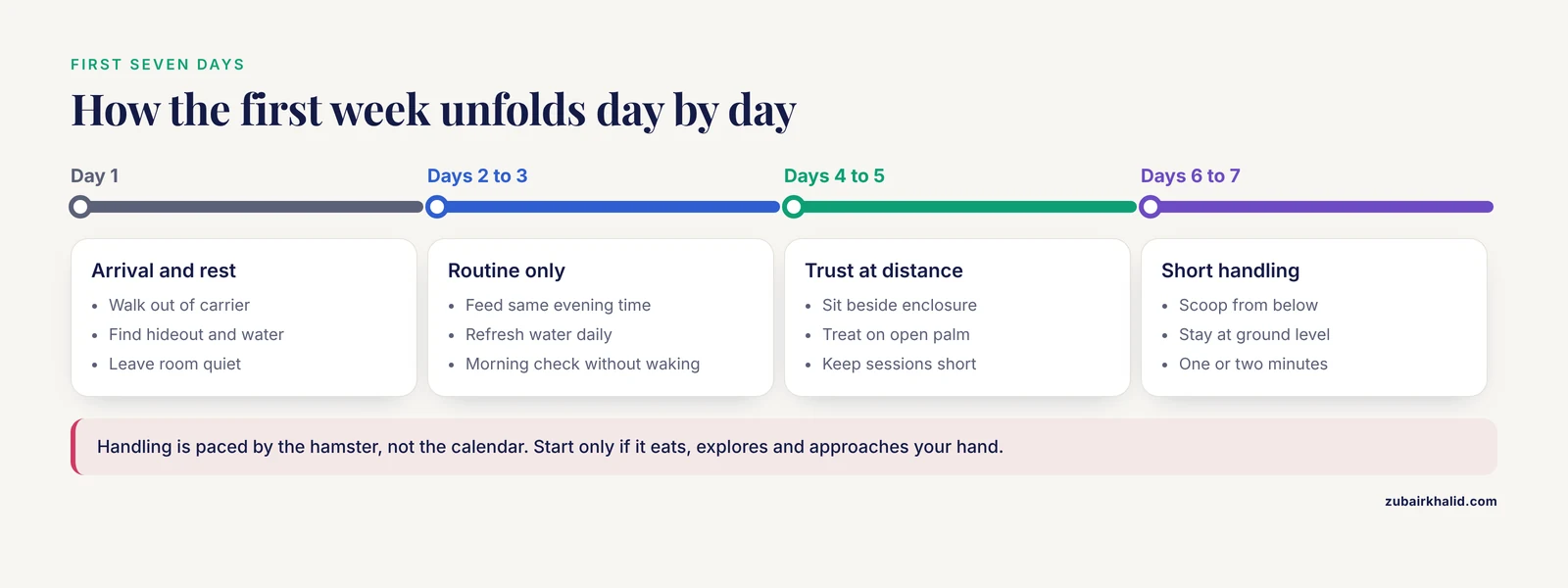
| Day | Primary goal | What you do |
|---|---|---|
| , - | , - | , - |
| Before pickup | Prepare the habitat | Set up the enclosure, fill with deep substrate, add wheel, hideout, chew toys, food, and water at least a day early |
| Day 1 | Safe arrival and rest | Transport in a secure carrier, place the hamster in the pre-built habitat, then leave the room quiet and hands off |
| Days 2 to 3 | Establish routine | Feed at a consistent evening time, refresh water, do light spot checks, no handling |
| Days 4 to 5 | Build trust at a distance | Sit near the enclosure, speak softly, offer a treat on your open palm inside the cage, let the hamster approach you |
| Days 6 to 7 | Short, gentle handling | Begin brief handling sessions at ground level if the hamster is eating and exploring normally, watch for stress signals |
| Any day | Health monitoring | Track appetite, droppings, activity after dark, and appearance. Contact an exotic veterinarian if anything worries you |
Before Pickup: Your New Hamster Checklist
Research on hamster husbandry consistently shows that owners want to do the right thing, but the availability of suitable enclosures is the single biggest barrier to good welfare [2]. Hamster care guidelines are also variable and the published literature on pet hamster health is limited, so a little planning goes a long way [1]. Work through this list before your hamster comes home, not after.
Enclosure and location
Choose the largest enclosure you can reasonably accommodate. In a survey of dwarf hamster owners, a meaningful proportion of hamsters were kept in enclosures under 75 cm in length, and inadequate enclosure size was identified as a key welfare concern for pet hamsters in captivity [1]. A crowded pet store habitat is a transport container, not a permanent home.
Place the enclosure:
- In a room with a stable, comfortable temperature, away from direct sun and drafts
- Where the hamster can sleep undisturbed during the day
- Away from predator species. In one large owner survey of Syrian hamsters, more than 45 percent of respondents reported housing their hamster in close proximity to cats, dogs, or other predator animals, a welfare concern the authors flagged explicitly [3]
Bedding and burrowing substrate
Hamsters are burrowers. Deep bedding lets them build tunnels, which is one of their strongest natural behaviors. The Syrian hamster owner survey found that shallower substrate depth was significantly associated with more owner-observed bar biting, a recognized stress-related behavior [3]. Fill the enclosure with a thick layer of appropriate small-mammal bedding rather than a thin scatter.
Equipment
- A solid-surface exercise wheel sized so the hamster runs with a straight back. More than 95 percent of surveyed Syrian hamster owners provided a wheel, a hideaway, or chew toys, and these are the core enrichment items your hamster needs [3]
- At least one hideout or covered shelter where the hamster can sleep and stash food
- Chew toys, since hamster teeth grow continuously
- A heavy food bowl and a water bottle or bowl. Check both daily
- Nesting material appropriate for small mammals, not loose cotton fibers that can tangle around limbs
Food and water
Provide a commercial hamster staple diet and fresh water daily. The Syrian hamster survey noted that some hamsters were fed a diet that was not entirely appropriate, which the authors listed among their welfare concerns [3]. Ask what food the hamster was eating before you bring it home. Any diet change should be gradual so you do not upset the gut during an already stressful week. If you plan to offer fresh foods, discuss amounts and safe options with an exotic veterinarian at the first visit.
If you are bringing home more than one hamster, provide one food and one water source per animal at minimum. In the dwarf hamster survey, most hamsters were provided with fewer food and water sources than there were animals in the group, and that resource shortage was flagged as a welfare concern for co-housed animals [1].
One hamster per cage, in most cases
Syrian hamsters must live alone. Dwarf hamsters are sometimes co-housed, but a study of dwarf hamster housing found that co-housing failure from aggression was common, and that hamsters older than 6 months were significantly more likely to fail co-housing, with an odds ratio of 4.75 in that study [1]. The authors identified co-housing failure arising from aggression as a key welfare concern. For a new pet in your first week together, the safest plan is one hamster per enclosure unless you have discussed a specific co-housing plan with an experienced exotic veterinarian, and even then you need spare housing, extra food and water stations, and a daily observation plan ready.
Skip the hamster ball
Nearly one in five Syrian hamster owners surveyed, 18.4 percent, used hamster balls, and ball use was significantly associated with greater owner-observed bar biting, along with shallower substrate and more frequent handling [3]. Exercise balls remove the control a hamster needs. It cannot choose when to stop, cannot reach water, and cannot avoid bumps and drops. A large wheel inside a deep-bedded enclosure is a better investment.
Day 1: Bringing Your Hamster Home
Transport the hamster in a secure, ventilated carrier with a small amount of its familiar bedding. Drive smoothly and keep the carrier out of direct sun. Car rides are stressful for prey animals, so go straight home.
When you arrive:
- Place the carrier inside or beside the prepared enclosure and let the hamster walk out on its own, or gently tip it out without grabbing.
- Do not redecorate. The hideout, food, water, and bedding should already be in place so the hamster can immediately find shelter, food, and water.
- Leave the room quiet. Dim the lights if the arrival is late in the day.
- Resist the urge to peek constantly or wake the hamster up to show family members. Hamsters are nocturnal. A hamster sleeping through its first day home is behaving normally.
Your goal on day 1 is simple. The hamster should find its hideout, find water, and start to learn the layout in peace.
Days 2 to 3: Routine Over Interaction
For the next few days, keep interaction minimal and routine consistent.
- Feed at the same time each evening, when the hamster naturally wakes.
- Refresh water daily and confirm the bottle or bowl works.
- Do a quick visual check each morning without waking the hamster. Note whether food was eaten, whether droppings look normal, and whether bedding has been rearranged or tunnels started.
- Speak softly when you enter the room so the hamster learns your voice and associates it with food rather than danger.
A hamster that eats, drinks, burrows, and uses its wheel during this window is settling in well, even if it never appears while you are awake.
Days 4 to 5: Building Trust Without Grabbing
Once the hamster is eating reliably and moving normally at night, begin low-pressure association work:
- Sit beside the enclosure for a few minutes at a time during the hamster's active hours.
- Place a small piece of its regular food or a treat on your open palm inside the cage and stay still. Let the hamster come to you. Do not close your hand around it.
- Keep sessions short. End before the hamster loses interest so that each encounter ends on a good note.
Handling during the first week should be paced by the hamster, not the calendar. The Syrian hamster survey found that more frequent handling was significantly associated with owner-observed bar biting, which suggests that pushing interaction too hard, too fast, can backfire [3]. Slow, hamster-led handling is the safer route.
Days 6 to 7: First Short Handling Sessions
If your hamster is eating well, exploring, burrowing, and approaching your hand voluntarily, begin brief handling:
- Scoop from below with both hands, or encourage the hamster to step into a cup you bring close. Never lift a hamster by the scruff, and never wake it abruptly to pick it up.
- Keep the first sessions at ground level, over your lap or a low surface, in case of a sudden jump.
- Keep them short, a minute or two at first, and return the hamster calmly to its enclosure.
- Wash your hands before handling, especially if you have handled food or other pets, and wash them after as well.
A surprising number of first-week problems come from well-meant excitement. Waking a sleeping hamster, lifting it high off the ground, letting young children handle it unsupervised, and introducing it to the family dog up close are all common and avoidable mistakes.
How Long for a Hamster to Settle In
Plan on several days to a week of minimal interference, and treat the first full week as an adjustment window rather than a deadline. There is no single timetable, and individual hamsters vary widely. Signs that your hamster is settling in include:
- Eating and drinking on a regular rhythm
- Building nests and digging tunnels in the substrate
- Using the wheel during active hours
- Hoarding food, which is normal hamster behavior
- Becoming curious about your hand and your voice
Signs that the hamster is still stressed include persistent hiding even at night, refusing food, bar chewing, and frantic escape behavior when you approach. Give those signs more time and reduce interaction further. If food refusal lasts more than a day or two, or you see droppings that are unusually small, absent, wet, or discolored, contact an exotic veterinarian rather than waiting the week out.
One study of Syrian hamster owners found that most, 65.9 percent, had never taken their hamster to a veterinarian, and the authors called for better distribution of hamster care information to owners [3]. The dwarf hamster survey similarly found that the majority of hamsters had not received veterinary care [1]. A hamster is a short-lived pet, which makes every week of good care matter. Building a relationship with an exotic veterinarian in the first week costs you one appointment and buys you a professional who already knows your setup if an emergency arrives later.
The First Vet Visit for a Hamster
Book a first vet visit for a hamster with a veterinarian who treats exotic pets and small mammals, ideally within the first week or two. Hamsters present to veterinary clinics for both preventive care and treatment of illness, and a clinic experienced with small mammals will have the equipment and handling protocols those visits require [4].
What happens at the visit
Expect the veterinarian to spend significant time on history and husbandry, which the veterinary literature treats as core diagnostic information rather than small talk. Assessment of hamster patients combines the physical examination and history with husbandry information, and can be supplemented by hematologic parameters, meaning bloodwork, when indicated [4].
Typical components of a first visit include:
- A hands-on physical exam, checking body condition, teeth, skin, coat, eyes, and the ventral scent marks or lumps an owner may not have noticed
- Weight measurement, recorded as a baseline for future comparison
- Review of your enclosure, substrate, diet, and handling routine
- Discussion of parasite concerns and any species-specific risks the veterinarian wants to screen for based on your hamster's background
Blood sampling in hamsters
If bloodwork is recommended, hamster blood collection is a procedure for an experienced exotic veterinarian. The published veterinary literature describes multiple techniques for blood collection in hamsters and confirms that with proper technique, venipuncture can be performed safely and repeatably. In one recent study of a novel technique, the mentolabial approach, blood collection was successful in all ten Chinese hamsters sampled under chemical restraint, with no clinical complications and stable hematologic values over repeat sampling [5]. The practical takeaway for owners is that if your veterinarian recommends labwork, the procedure itself is routine in capable hands. Small patients simply require small-gauge, careful technique and, commonly, light sedation or anesthesia.
Ask the clinic these questions at the first visit:
- What diet and treat plan do you recommend for this species and age?
- What substrate and enclosure setup do you consider ideal?
- What are the emergency signs specific to hamsters, and do you offer after-hours care or referral?
- When would you next want to see my hamster?
Daily Monitoring After the First Week
Hamster owners in welfare research rely mostly on behavioral indicators to judge health at home, and that instinct is correct. Behavior is the most commonly used and most useful signal owners have [2]. Build a short daily habit:
- Morning, without waking the hamster: glance at food stores, water level, and droppings
- Evening, during active hours: watch for normal wheel use, foraging, and burrowing
- Weekly: weigh your hamster if you can, using a small kitchen scale and a cup. Sudden weight loss is one of the most reliable early signs of illness in small mammals
Because hamsters are nocturnal and stoic, illness often shows first as a change in routine. A hamster that stops hoarding, stops using the wheel, or sleeps in a new open spot deserves a closer look.
Common First-Week Mistakes
- Housing two hamsters together to keep them company. Aggression and co-housing failure are well documented, especially in dwarf hamsters over 6 months of age [1]. Syrians must always live alone.
- Choosing a small cage because it is marketed for hamsters. Inadequate enclosure size is one of the most consistently identified welfare problems in pet hamsters [1][2].
- Shallow bedding. Deep substrate supports natural burrowing, and shallow substrate is associated with stress behaviors such as bar biting [3].
- Using a hamster ball. Ball use is associated with more bar biting and removes the hamster's control over its own movement [3].
- Housing the cage near predators. Keeping a hamster within sight and smell of cats, dogs, or other predators is a documented welfare concern [3].
- Handling too much, too soon. Pushing interaction during the adjustment window increases stress and slows trust.
- Skipping the vet because the hamster looks fine. Most pet hamsters never see a veterinarian [1][3], which means problems are often caught late.
Limitations and When to Contact a Veterinarian
This article is educational and is not a substitute for veterinary diagnosis or treatment. The published research on pet hamster husbandry and health is limited, care guidelines vary, and individual hamsters differ in temperament, age, species, and background, so your veterinarian's specific advice always takes precedence over general guidance [1].
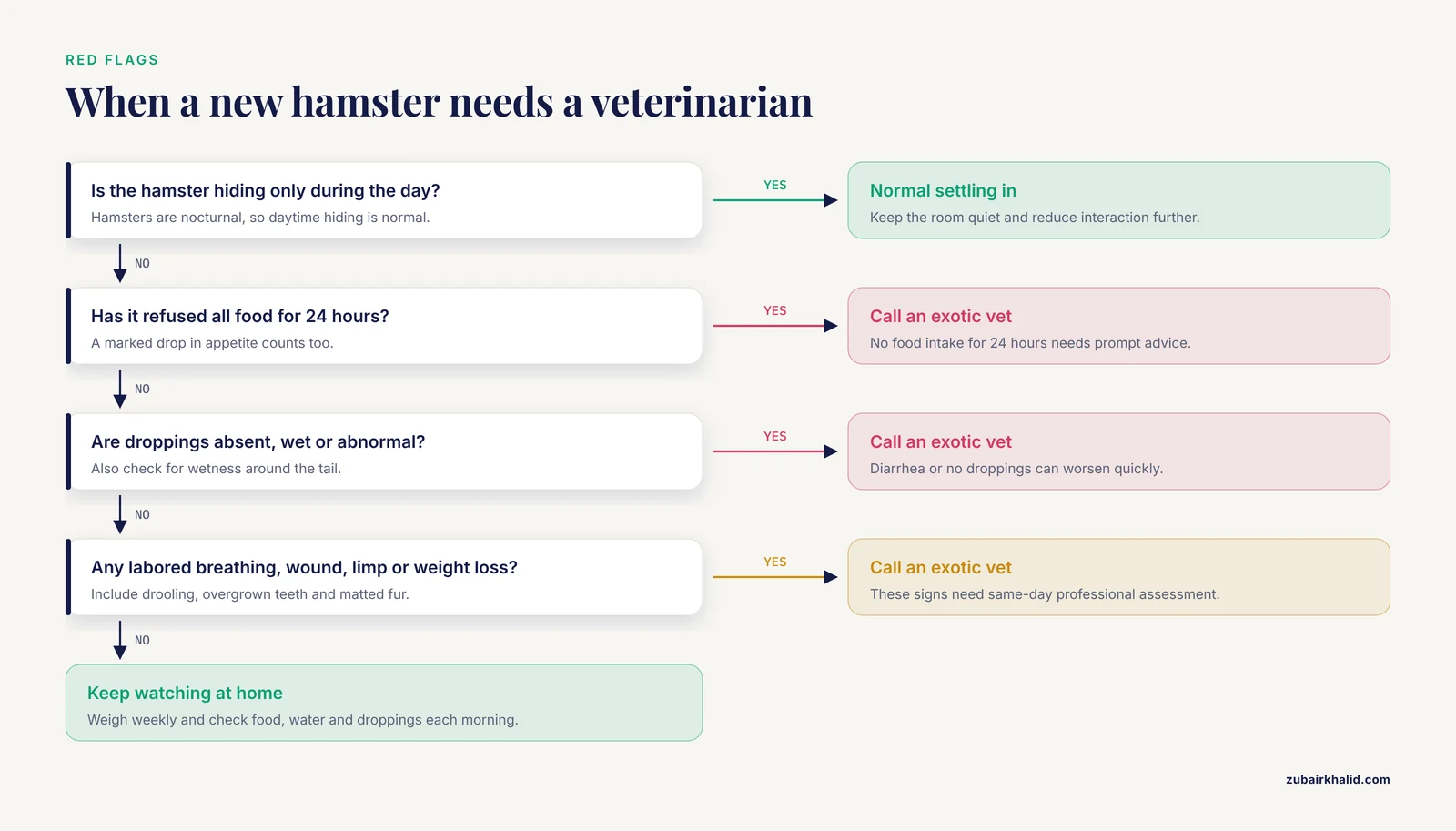
Contact an exotic veterinarian promptly if your new hamster shows any of the following:
- No food intake for 24 hours, or a marked drop in appetite
- No droppings, diarrhea, wetness around the tail, or visibly abnormal droppings
- Lethargy during normal active hours, or a hamster that does not wake for food
- Wet or matted fur around the face or tail, discharge from eyes or nose, or labored breathing
- A wound, a fall, a limp, or swelling anywhere on the body
- Overgrown or misaligned teeth, drooling, or dropping food
- Sudden weight loss on your weekly scale checks
- Any aggression or injury between co-housed hamsters, which requires immediate separation
Find a clinic that treats small mammals before you need one. Call ahead and confirm the practice sees hamsters, since not every small animal clinic has exotic pet experience or the ability to perform laboratory sampling safely on a hamster-sized patient [4][5].
Frequently Asked Questions
How long does it take for a new hamster to settle in?
Most hamsters need several days to about a week, and some take longer. Judge settling in by behavior rather than the calendar. Eating, drinking, burrowing, and night activity mean your hamster is adjusting.
Should I handle my hamster during the first week?
Not in the first few days. Give the hamster time to establish food, water, and a nest first. Begin palm-feeding around days 4 to 5 and short handling only if the hamster approaches you willingly.
Do I need a first vet visit for a hamster?
Yes. An early visit with an exotic pet veterinarian establishes a baseline weight and exam, reviews your setup, and gives you a contact for emergencies. Most pet hamsters never see a veterinarian, which means illness is often caught late.
What should be on my new hamster checklist?
A large enclosure, deep burrowing substrate, a properly sized solid wheel, a hideout, chew toys, appropriate bedding material, a hamster staple diet, fresh water, and a secure transport carrier.
Can I keep two hamsters together?
Syrian hamsters must live alone. Dwarf hamster co-housing frequently fails due to aggression, and the risk rises significantly once dwarf hamsters pass 6 months of age. If you are set on keeping more than one, discuss a full plan with an exotic veterinarian and prepare separate housing.
Why is my new hamster hiding all day?
Hamsters are nocturnal and daytime hiding is normal, especially during adjustment. A hamster that also hides at night, refuses food, or seems lethargic when awake needs veterinary attention.
Is a hamster ball safe?
No. Hamster ball use is associated with increased stress behavior, and a ball takes away the hamster's ability to stop, rest, or reach water. Use a wheel inside the enclosure instead.
When should I worry about my new hamster's health?
Contact a veterinarian if your hamster stops eating for 24 hours, produces no or abnormal droppings, breathes with difficulty, bleeds, limps, loses weight, or becomes suddenly inactive during its normal waking hours.
Further Reading
Sources
- Preliminary investigation into the housing of dwarf hamsters.
- Small mammal owners' experiences of housing challenges and animal welfare: A COM-B and word frequency analysis.
- Burrowing for answers: Investigating Syrian hamster welfare through owner surveys.
- Hematologic Assessment in Pet Rats, Mice, Hamsters, and Gerbils: Blood Sample Collection and Blood Cell Identification.
- The mentolabial approach is a novel, safe, and effective method of blood collection in rats (Rattus norvegicus) and Chinese hamsters (Cricetulus griseus).