Bringing Home a New Gerbil: First Week Guide
By Dr. Zubair Khalid, DVM, MS, PhD ·

Most gerbils settle into a new home within a few days to about two weeks, and the first seven days largely determine how quickly that happens. Your job during a new gerbil's first week is to minimize stress, set up an enclosure that meets the species' deep-seated need to dig and burrow, and let the animal control the pace of interaction. Research on Mongolian gerbils (Meriones unguiculatus) shows that housing which fails to meet behavioral needs produces measurable stress and abnormal behaviors, while simple refinements to housing prevent them [1]. That evidence, gathered in laboratory settings, translates directly to the home cage: the environment you prepare before your gerbil walks through the door matters more than anything you do during the first few days of handling.
This guide walks you through a new gerbil checklist, a day-by-day settling plan, what to expect as your gerbil adjusts, and how to arrange a sensible first vet visit for a gerbil.
At a Glance: Your First Week Plan
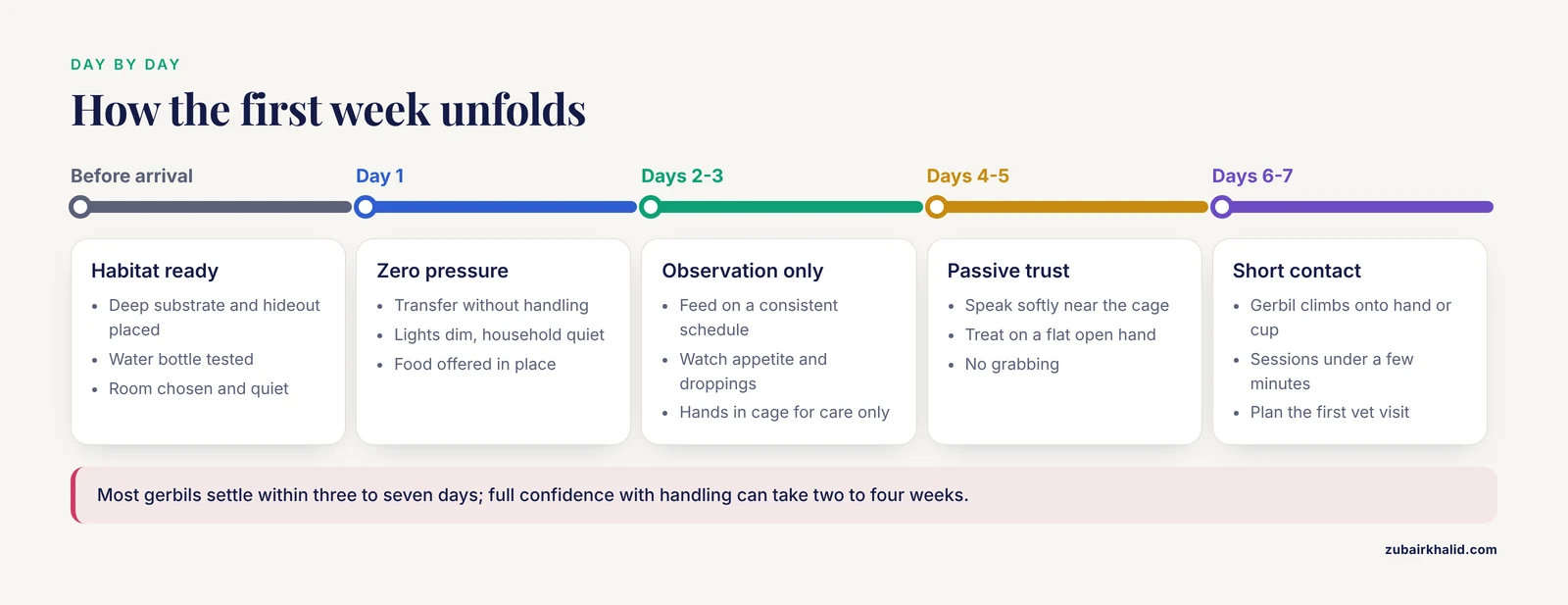
| Day | Main Goal | Key Actions |
|---|---|---|
| , - | , - | , - |
| Before arrival | Habitat ready | Enclosure set up, deep substrate, hideout, water bottle tested, food stocked, room chosen and warmed |
| Day 1 | Zero pressure | Transfer gerbil, leave alone, no handling, lights dim, household quiet |
| Days 2-3 | Observation | Feed on schedule, watch behavior and droppings, hands in cage only for care tasks |
| Days 4-5 | Passive trust building | Speak softly near the cage, offer a treat from a flat open hand, no grabbing |
| Days 6-7 | Short voluntary contact | Allow gerbil to climb onto your hand or into a cup, keep sessions under a few minutes, watch body language |
| End of week 1 | Veterinary planning | Schedule a first vet visit with an exotics-savvy clinic, confirm droppings, appetite, and activity are normal |
New Gerbil Checklist: Supplies to Have Ready Before Arrival
Preparing everything in advance is the single most effective thing you can do. A survey of more than 700 UK small mammal owners found that the availability of suitable enclosures was the primary barrier to good housing, while most owners were willing and able to provide high welfare once the right setup existed [2]. Buy the right equipment before the animal arrives rather than improvising afterward.
Your checklist should include:
- A properly sized enclosure. Gerbils dig extensively, so a glass tank with a secure mesh lid or a deep, escape-proof enclosure is generally preferred over a wire cage with shallow bedding. Choose the largest footprint your space and budget allow.
- Deep bedding and substrate. A deep layer of paper-based or aspen bedding lets your gerbil tunnel, which is a core behavioral need. Laboratory research demonstrated that the absence of a burrow caused stereotypic digging in gerbils, and that providing an integrated burrow system prevented that abnormal behavior from developing [1].
- A hideout or burrow structure. A ceramic or wooden hide, a multi-chamber house, or simply deep substrate that the gerbil can excavate gives it a secure retreat [1].
- A water bottle or heavy ceramic bowl. Test the sipper tube before the gerbil arrives so you know it dispenses water reliably.
- Species-appropriate food. A commercial gerbil or rodent pellet mix as the base diet, stored in a sealed container.
- An exercise wheel. Solid-surface wheels reduce the risk of limb or tail injuries compared with barred wheels. Discuss wheel size and type with your veterinarian or a knowledgeable small mammal retailer.
- Chew items. Gerbils gnaw continuously. Untreated wood chews and cardboard provide an outlet. Bar chewing in gerbils has been linked to early separation from the family group and to barren housing, so offering proper chewing material addresses a real behavioral need [1].
- Nesting material. Unscented paper-based nesting material lets the gerbil build a nest inside its hideout.
- A travel carrier. For the trip home and for veterinary visits.
- A food dish and spare bedding. Rotate bedding so you always have clean material on hand.
Why the First Week Matters
Small mammals like gerbils are almost entirely dependent on owner-provided housing and husbandry, and studies of pet small mammal owners show that welfare problems most often trace back to the environment rather than to the animal itself [2]. A gerbil arriving in your home has just experienced capture, transport, novel smells, and a novel space. Its stress response is already activated. Your first week either lowers that stress or adds to it.
Gerbils are prey animals. Their instinct in a new environment is to freeze, hide, and map their surroundings before exploring openly. Fighting that instinct by forcing interaction during the first days produces an animal that associates your hands with fear. Respecting it produces a gerbil that approaches you voluntarily within days to weeks.
Before You Bring Your Gerbil Home
Set Up the Habitat Completely
Set up the enclosure at least a day before bringing home a gerbil. Fill the tank with a deep layer of substrate, place the hideout, wheel, water bottle, and food dish, and offer a small amount of nesting material. The goal is a functional burrow-like environment. In laboratory studies, gerbils housed without a burrow developed compulsive digging at the cage corners, while those given an artificial burrow system did not [1]. A home enclosure does not need to replicate a laboratory burrow system exactly, but the principle holds: deep substrate plus a secure retreat is not a luxury, it is preventive behavioral medicine.
Choose the Room Carefully
Place the enclosure in a room with stable temperature, away from direct sunlight, radiators, drafts, televisions, and loud household traffic. Gerbils hear high frequencies well, so keep the enclosure away from speakers and stereos. A room where the family spends calm, predictable time works better than an isolated room, because it lets the gerbil habituate to ordinary human sounds and smells without being handled.
Decide on Companionship Before Arrival
Gerbils are social animals and are generally kept in same-sex pairs or small groups. If you plan to keep a pair, this is the time to plan for it, since introducing unfamiliar adult gerbils later is difficult and can result in serious fighting. Young gerbils raised together from the same litter adjust most easily. Discuss pairing and introduction methods with your veterinarian or breeder before purchase. Research also shows that separating juvenile gerbils from their family group too early, before younger siblings are born, contributes to the development of bar chewing later in life [1], so ask the seller how the litter was raised.
Day 1: Arrival Day
- Keep the trip short and calm. Transport the gerbil in a secure carrier with bedding from its previous home if the seller or shelter provides it. Familiar scent reduces the shock of a new environment.
- Transfer without handling. Open the carrier inside the enclosure, or pour the gerbil gently into the cage, and let it disappear into the substrate or hideout. Do not reach in.
- Confirm water access. Check that the gerbil can find the sipper tube. Very young gerbils may need a shallow water dish until they learn the bottle, which is worth confirming with your seller.
- Leave the room mostly alone. Dim the lights, keep noise low, and resist the urge to watch constantly. Brief, calm glances are fine. Long, face-pressed-to-the-glass staring is not.
- Offer food in place. Scatter a small amount of the diet it was eating previously, even if you plan to transition foods gradually. Sudden diet changes add digestive stress to an already stressful day.
Expect your gerbil to spend most of day 1 hiding, digging furiously at corners, or rearranging bedding. This is normal exploration and territory mapping, not a problem to fix.
Days 2 and 3: Observation Without Pressure
For the next two days, your role is caretaker, not companion. Follow this routine:
- Feed on a consistent schedule at roughly the same time each day. Predictability is itself a form of enrichment.
- Check the essentials daily. Confirm the gerbil is eating, drinking, producing normal droppings, and moving normally. Behavioral indicators like appetite, activity, and posture are exactly what experienced small mammal owners rely on most to assess welfare at home [2].
- Keep hands in the cage only for care tasks. Refilling food and water is fine. Reaching toward the gerbil is not.
- Talk softly near the cage. Sitting near the enclosure and speaking in a low, even voice for a few minutes at a time lets the gerbil learn your voice and scent while it remains in control of the encounter.
Some gerbils will ignore all of this and start tunneling with gusto by day 2. Others will remain almost entirely underground. Both are within the range of normal.
Days 4 to 7: Building Trust at the Gerbil's Pace
The Open Hand Method
From day 4 onward, begin passive trust building. Wash your hands so they carry no food-like or pet-animal smells, then rest a flat open hand in the enclosure near (not on) the gerbil's path. Do not move it toward the animal. Place a small treat, such as a single sunflower seed, on your palm and wait. The gerbil decides whether to approach.
Expect short sessions, a few minutes each, once or twice daily. End every session by choice, meaning you withdraw your hand while the gerbil is calm, not after it has fled.
Why Voluntary Approach Matters
This approach has experimental support in the species. A study of 43 gerbils adapted a clicker training protocol for the species, teaching the animals to voluntarily approach and interact with a human hand in exchange for food rewards over a standardized ten-day program. The training was fast, efficient, and well tolerated, and trained animals, particularly females, showed increased voluntary interaction with humans and greater exploratory behavior in open field testing [3]. You do not need a clicker to benefit from the underlying principle: rewarding voluntary approach with food builds a cooperative, low-stress relationship faster than any amount of forced handling.
First Lifts
Once your gerbil reliably climbs onto your open hand, you can begin lifting it briefly, a few centimeters at first, always over the enclosure or a soft surface so a jump cannot cause injury. cupping both hands around the animal without gripping is the safest hold. Gerbils have delicate tails, and a gerbil should never be picked up by the tail, since the skin can slip off (a condition called degloving) and the injury requires veterinary care.
How Long for a Gerbil to Settle In
Most owners see meaningful settling within three to seven days, with full confidence, predictable routines, and relaxed handling developing over two to four weeks. The honest answer to how long for a gerbil to settle in is that it depends on the individual animal's age, background, and temperament, and on how much control it retains during the process.
Signs your gerbil is settling:
- Emerging from the burrow or hideout at regular times
- Eating and drinking normally at your schedule
- Digging, rearranging, and tunneling with purpose rather than panic
- Approaching the cage front when you appear
- Taking treats from your hand or fingers resting on the substrate
Signs that settling has stalled or is going backward include persistent frantic corner digging day after day without building burrows, gnawing at bars or cage furniture obsessively, refusal to eat, and constant fleeing whenever you approach. Frantic digging at cage corners in particular is a documented response to the absence of a true burrowing opportunity [1], so re-evaluate substrate depth and hideout quality before assuming the behavior is temporary.
Feeding and Water During the First Week
Feed the same food the gerbil ate before arrival for the first several days, then transition to your chosen diet gradually over a week or more by mixing increasing proportions of the new food. Keep the diet simple during week one. Novel vegetables and treats can wait until the gerbil is settled, and any additions should be introduced one at a time in small amounts.
Fresh water must be available at all times. Check the sipper tube daily, since new gerbils sometimes fail to locate a bottle quickly, and bedding can lodge in the tube's tip.
If you are unsure which commercial diet to choose or whether your gerbil is eating enough, bring that question to the first veterinary visit rather than guessing.
Monitoring Health at Home During Week One
The first week establishes your baseline. Learn what your gerbil's normal looks like in these categories:
- Appetite and drinking. Steady interest in food at mealtimes.
- Droppings. Small, firm, dark pellets. Soft or pasty droppings, or no droppings at all, warrant attention.
- Activity pattern. Gerbils are crepuscular, active in bursts at dawn and dusk, with periodic napping.
- Coat and posture. A smooth, groomed coat, bright eyes, and no hunched sitting.
- Respiration. Quiet breathing. Clicking, wheezing, or open-mouth breathing is an emergency.
Experienced small mammal owners overwhelmingly rely on these behavioral indicators rather than physical measurements to judge welfare at home [2], and that habit is worth building from day one, because it makes genuine changes obvious to you and easy to describe to your veterinarian.
The First Vet Visit for a Gerbil
When to Schedule It
Schedule a first vet visit for a gerbil within the first one to two weeks of ownership, once the animal has had a few days to settle. Look for a clinic that explicitly treats exotic pets and small mammals, and call ahead to confirm. Many general practices have limited rodent experience, and a clinic that sees gerbils regularly will be better equipped for both routine checks and emergencies.
What Happens at the Visit
A wellness examination for a gerbil typically includes weighing, a physical examination of the coat, teeth, eyes, ears, and abdomen, a review of the diet and enclosure, and discussion of parasite prevention and dental health. Be prepared to describe your setup in detail, including substrate depth, enclosure type, and cage mates, because husbandry review is central to rodent wellness care.
Blood work is not always part of a routine first visit, and for good practical reasons. Veterinary hematology references note that blood sample collection in pet gerbils, like other small rodents, is constrained by the animal's small blood volume and the difficulty of accessing adequate veins, which makes sampling a skill reserved for experienced handlers and usually reserved for situations where it is genuinely needed [4]. Advanced diagnostics for small rodents continue to expand, however. Modern exotic animal practice increasingly uses polymerase chain reaction testing and other molecular methods that work with very small biologic samples, along with radiology and ultrasonography, giving veterinarians diagnostic options that did not exist for these species a generation ago [5].
Questions to Ask at the First Visit
- Is my gerbil's weight and body condition appropriate for its age?
- Do its teeth look normal, and what should dental problems look like at home?
- Is my enclosure setup adequate, especially substrate depth and enrichment?
- What diet do you recommend for this specific animal?
- What are the emergency signs that should bring me in immediately?
- If I keep a pair, what should I watch for regarding introductions and aggression?
Common First Week Mistakes
- Handling too soon. Forcing interaction in the first 48 hours is the most common error and the most costly in lost trust.
- Shallow bedding. A centimeter or two of shavings cannot support tunneling. Gerbils deprived of burrowing opportunities develop stereotypic digging, a persistent abnormal behavior that is preventable with proper substrate [1].
- Using a barred cage with exposed bars to chew. Beyond the injury risk, bar chewing is a recognized abnormal behavior in this species linked to poor early husbandry and barren environments [1]. A tank or deep enclosure with chew-safe items removes the trigger.
- Changing everything at once. New food, new handling, new cage location, and new cage mates all in one week stack stressors. Change one variable at a time.
- Washing the enclosure with strongly scented cleaners. Residual odors disrupt scent mapping. Use plain hot water or pet-safe unscented cleaners during week one.
- Assuming a hiding gerbil is sick. Hiding is normal. A gerbil that hides, plus refuses food, plus produces abnormal droppings, is telling you something different. Judge sickness by clusters of signs, not by a single behavior.
Troubleshooting First Week Problems
Frantic digging at corners. Check substrate depth first. If bedding is shallow, add more. Provide a burrow-like hideout with a tunnel entrance. Digging at corners rather than burrowing in bedding is a classic sign that the digging need is not being met [1].
Chewing the bars or lid. Offer more chew-safe wood and cardboard, verify the diet is complete, and consider whether the enclosure is too small or too barren. Remember that early life separation from the family group also contributes to bar chewing in this species, so a newly homed juvenile may be predisposed, and enrichment is your best tool [1].
Refusing to come out. Give it more time. Extend the quiet observation phase by a few days and let the gerbil set the pace. If food is being eaten overnight and caches are disappearing, the gerbil is fine.
Not drinking. Verify the bottle works. If the gerbil has not located the water within the first day, place a small, heavy, shallow dish temporarily and contact your veterinarian for guidance if the problem persists.
Nipping or biting. Usually a sign of fear or of hands that smell like food. Wash hands before sessions, slow down, and return to open-hand treat offering. Never punish, since punishment cements the fear.
Welfare and Safety Points for the First Week
- Keep the gerbil away from other household pets entirely. A curious cat or dog staring through the glass is a predator stimulus, regardless of how friendly your pets are.
- Do not bathe gerbils. Water bathing is stressful and dangerous for small rodents, and coat maintenance is handled by self-grooming.
- Keep the room temperature stable and comfortable for you, which generally suits gerbils as well.
- Handle only over soft surfaces or inside the enclosure until trust is established, because a fall from even modest height can injure a small rodent.
- Wash your hands before and after every contact.
Limitations and When to Contact a Veterinarian
Individual gerbils vary widely in temperament, background, and health, and no article can substitute for examination of your specific animal. Use this guide as a framework, and treat your veterinarian as your partner in the first month.
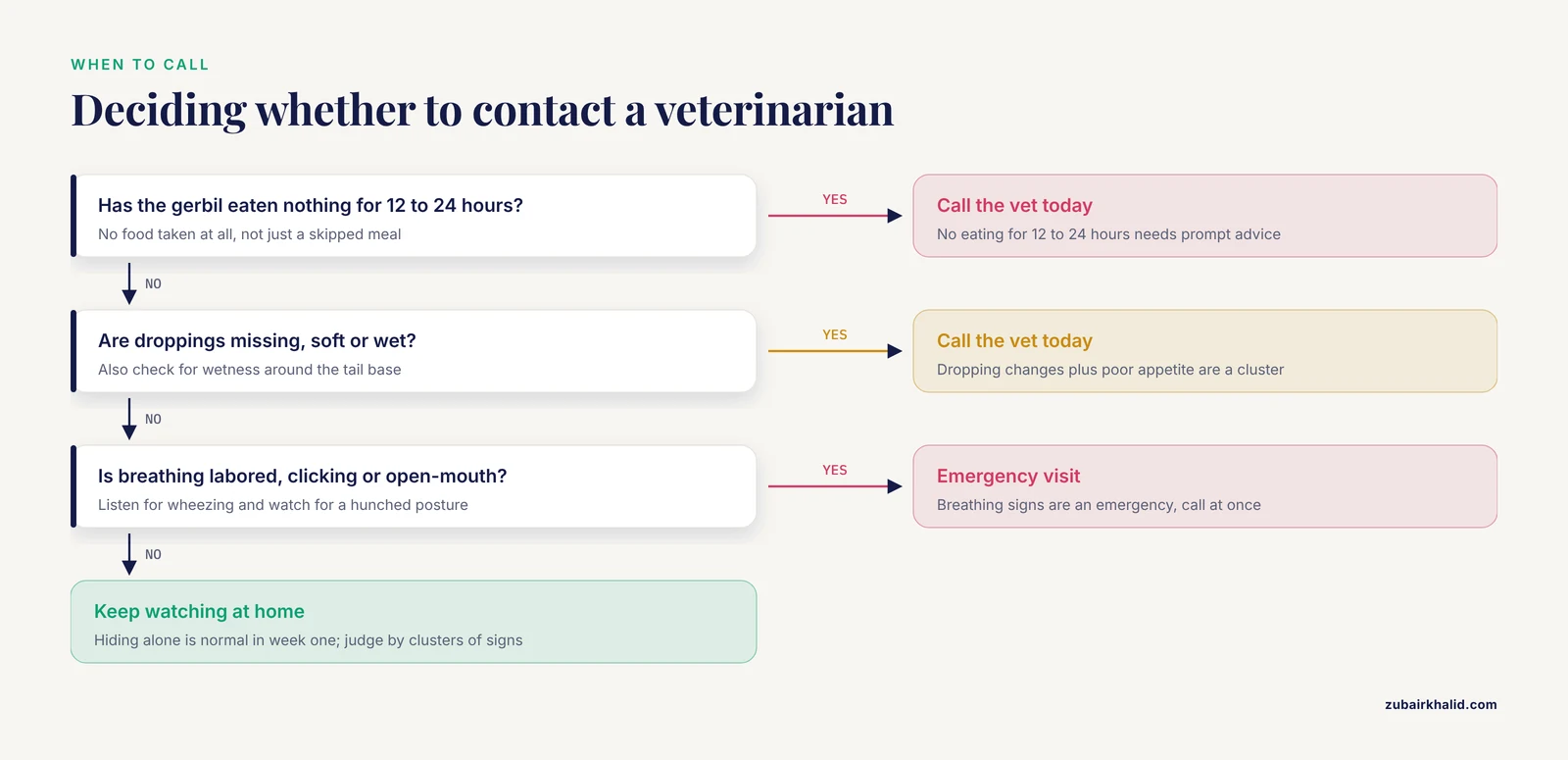
Contact a veterinarian promptly, the same day if possible, if you observe any of the following:
- No eating for more than 12 to 24 hours
- No droppings, or persistent soft or wet droppings
- Labored, clicking, or open-mouth breathing
- Discharge from the eyes or nose
- A hunched, fluffed-up posture with lethargy
- Bleeding, a limp, or a swollen or injured tail
- Sudden aggression or collapse
- Diarrhea or wetness around the tail base
Because gerbils are small prey animals, they instinctively mask illness, and by the time a rodent looks obviously sick it is often seriously compromised. When in doubt, call an exotics-savvy clinic and describe what you are seeing. Improved husbandry and better veterinary knowledge have extended the lifespans of pet gerbils and other small rodents in recent decades [5], and that lifespan advantage depends heavily on early intervention when problems appear.
This article is educational and is not a substitute for veterinary diagnosis or treatment.
Frequently Asked Questions
How long does it take a gerbil to settle into a new home?
Most gerbils begin exploring, eating normally, and accepting treats within three to seven days, though full confidence with handling can take two to four weeks. Age, background, and your consistency all influence the timeline, so let the individual animal set the pace.
Should I handle my gerbil during the first week?
Avoid lifting your gerbil in the first two to three days. From around day 4, begin offering treats on a flat open hand and let the gerbil choose to approach. Lifting should wait until the gerbil climbs onto your hand willingly.
Can a gerbil live alone?
Gerbils are social animals and are generally happiest in same-sex pairs or small groups raised together. Introducing unfamiliar adults later is difficult and can lead to serious fighting, so plan companionship before you buy and discuss introductions with your veterinarian.
What should I feed my new gerbil during the first week?
Feed the same food the gerbil was eating before arrival for the first several days, then transition gradually to your chosen commercial gerbil diet over a week or more. Keep treats and fresh foods out of week one so digestive stress does not stack onto relocation stress.
When should my gerbil have its first vet visit?
Schedule a wellness exam with an exotics-savvy clinic within the first one to two weeks, after a few days of settling. The visit establishes a baseline weight and health record and lets the veterinarian review your husbandry before problems develop.
Why is my new gerbil digging frantically at the corners of the cage?
Corner digging is a recognized abnormal behavior in gerbils housed without a true burrowing opportunity. Deepen the substrate, add a burrow-style hideout, and give the gerbil enough bedding to build tunnels. If the behavior persists despite proper housing, ask your veterinarian for advice.
Is it normal for my gerbil to hide all day?
Yes, especially in the first week. Gerbils are prey animals and spend much of the day underground or in their hideout, with activity bursts at dawn and dusk. hiding becomes a concern only when combined with not eating, abnormal droppings, or lethargy.
Can I clicker train or tame my gerbil?
Yes. A research protocol successfully adapted clicker training for gerbils, teaching them to voluntarily approach a human hand for food rewards over ten days, and trained gerbils showed more voluntary human interaction and greater exploration. The same principle works at home: reward voluntary approach, never force contact.
Further Reading
Sources
- Refinement of gerbil housing and husbandry in the laboratory.
- Small mammal owners' experiences of housing challenges and animal welfare: A COM-B and word frequency analysis.
- Enhancing Gerbil Welfare Through Positive Reinforcement Training in Research Environments.
- Hematologic assessment in pet rats, mice, hamsters, and gerbils: blood sample collection and blood cell identification.
- Selected Veterinary Concerns of Geriatric Rats, Mice, Hamsters, and Gerbils