How to Trim Rabbit Nails: A Stress-Free Guide
By Dr. Zubair Khalid, DVM, MS, PhD ·
Trim your rabbit's nails every four to six weeks using small animal nail clippers, one tiny clip at a time, while someone your rabbit trusts holds them securely. The goal is to remove only the sharp tip and stay well clear of the quick, the pink blood vessel and nerve that runs inside each nail. Most trims take less than ten minutes once your rabbit accepts the routine. Rabbits with dark nails, arthritis, obesity, or a history of painful handling often do better with help from a second person or a veterinary technician, and there is no shame in outsourcing the job.
This guide walks you through the full process, from gathering supplies to positioning, clipping, and troubleshooting a rabbit that wants nothing to do with the whole idea. You will also learn the mistakes that cause the most injuries, what to do if you cut the quick, and how nail care fits into a broader rabbit care checklist.
At a Glance: Rabbit Nail Trim Essentials
| Item | Practical guidance |
|---|---|
| Frequency | Check nails monthly. Most rabbits need a trim every 4 to 6 weeks |
| Tools | Scissor-style or guillotine clippers made for small animals, styptic powder or cornstarch, a towel, a headlamp or bright lamp, treats |
| Positioning | Upright cradle against your chest, or a loose towel wrap on a non-slip surface |
| Where to cut | Only the clear, curved hook past the quick, in small slivers |
| Safety stop | If you cannot see or confidently predict where the quick is, clip less or ask a professional |
| Red flags | Bleeding that does not stop within 5 to 10 minutes, limping, a split or torn nail, swelling at the toe, nails curled into the pads |
Why Rabbit Nails Need Regular Trimming
A rabbit's nails grow continuously for life. In the wild, digging, running over rough ground, and burrowing wear the nails down naturally. A house rabbit padding across carpet, tile, and grass hay simply does not generate that wear, so the nails keep growing.
Overgrown nails create a chain of predictable problems:
- Altered posture and gait. Long nails force the toes back and shift weight onto the heels. Many owners first notice that their rabbit sounds different on hard floors, a click and scrape instead of quiet padding.
- Snagging and tearing. A long nail catches in carpet, blanket weave, or wire exercise pen flooring. The rabbit panics, yanks, and the nail tears, sometimes at the base. Torn nails bleed heavily and are genuinely painful.
- Curled nails. neglected nails can curl into long spirals and eventually press into the foot pads or the fur of the leg, causing sores and infection risk.
- Scratches during handling. Every rabbit owner eventually learns that thick forelimb nails leave deep welts, and a rabbit that scratches during handling becomes a rabbit everyone avoids handling, which worsens the nail problem.
Regular trims are one of the cheapest, highest-yield preventive tasks in rabbit care, alongside dental monitoring and weight checks.
Rabbit Nail Anatomy: Knowing Where to Cut
Each nail contains a quick, a core of blood vessel and nerve. Cutting into the quick hurts and bleeds, and the rabbit will remember it.
- Forepaws have five toes each, including the dewclaw, the smaller toe set higher on the inside of the leg. The dewclaw nail is easy to overlook and is often the first to overgrow.
- Hind paws have four toes each. Hind nails are usually the thickest and grow fastest because they drive the rabbit's hopping.
On white or light-colored nails, the quick shows as a pink column running partway down the nail. On dark or black nails, you cannot see it, so you work by geometry instead. The nail grows as a curved hook past the point where the underside of the nail stops being flat and becomes hollow and thinner. That hollow hook is dead keratin and can be trimmed safely.
The Merck Veterinary Manual includes rabbits in its exotic and laboratory animal resources, and companion rabbit husbandry guides from sources such as VCA Animal Hospitals, the House Rabbit Society, and the Rabbit Welfare Association and Fund all emphasize the same practical rule: remove small amounts, stop well before you guess the quick might be, and trim again sooner rather than gambling on one aggressive cut. Small slivers cost you a few extra minutes. One deep cut costs you your rabbit's trust and a bloody towel.
Supplies You Need Before You Start
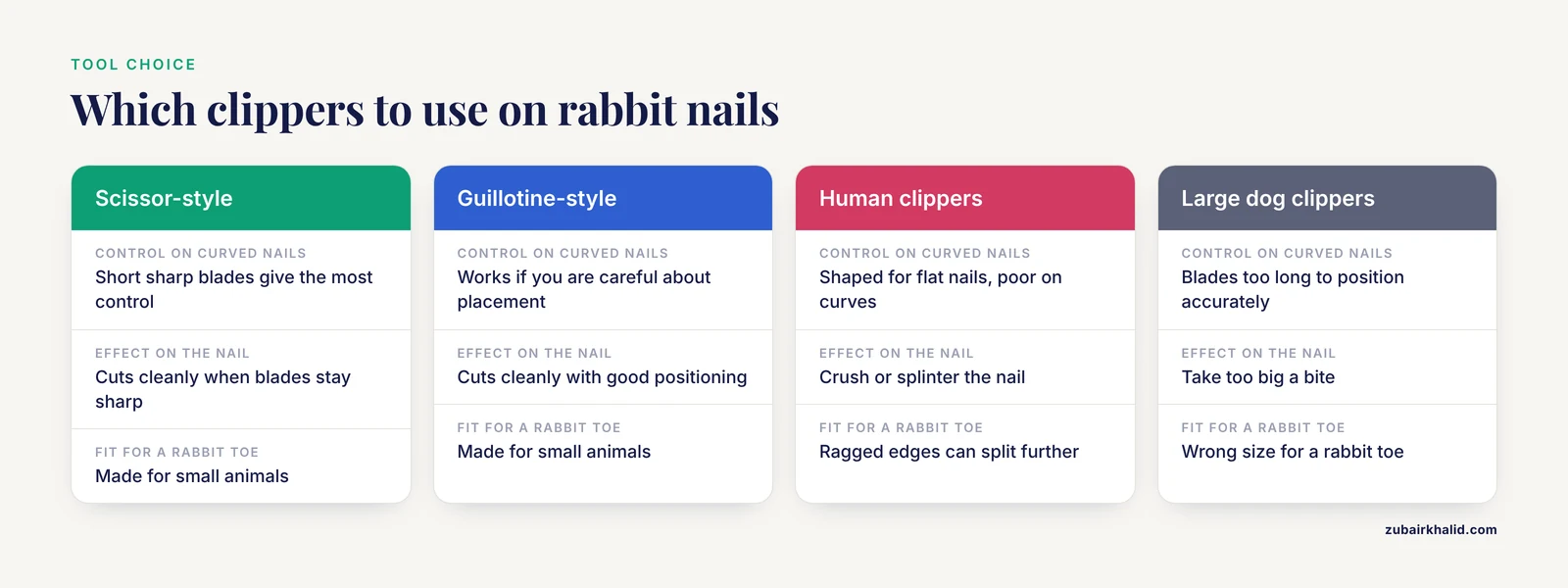
Gather everything before you bring the rabbit into the room. Every interrupted search for a missing item raises stress for both of you.
- Small animal nail clippers. Scissor-style clippers with short, sharp blades give you the most control on curved rabbit nails. Guillotine-style clippers also work if you are careful about placement. Human nail clippers crush flat nails, and the large scissor clippers made for dogs have blades too long to position accurately on a rabbit toe.
- Styptic powder, or plain cornstarch as a home alternative, in a small dish within arm's reach.
- A towel. A bath towel gives grip on a slippery table and doubles as a wrap for a wiggly rabbit.
- Good lighting. A headlamp or a bright lamp positioned so light shines through pale nails makes the quick far easier to see.
- Treats your rabbit genuinely loves, offered between toes and after each session.
- A helper (optional but valuable). A second person who holds gently and feeds treats turns a wrestling match into a routine task.
Keep the clippers sharp. Dull blades crush and split the nail instead of cutting cleanly, which hurts even when you miss the quick.
How to Trim Rabbit Nails Step by Step
The sequence below is the core of nail trimming without the struggle. Work slowly, and if your rabbit is new to the routine, spread the first few sessions over several days. Trimming one or two feet per session is a legitimate strategy for nervous rabbits.
Step 1: Set the stage
Choose a quiet room with the door closed, no other pets present, and a non-slip surface at a comfortable working height. A bathroom counter, a low table with a yoga mat, or your lap with a towel all work. Sit down rather than looming over the rabbit. Rabbits are prey animals, and a large shadow moving overhead reads as a predator.
Step 2: Establish calm contact
Let your rabbit settle on the towel for a minute. Stroke the ears and back. Offer a treat. Feed a few treats while touching each paw briefly so paw handling predicts good things rather than capture.
Step 3: Position the rabbit
Two positions work for most rabbits:
- Upright cradle. Sit or kneel with the rabbit's back against your chest, one forearm under the chest and the other supporting the hindquarters. Your helper sits facing you and lifts one paw at a time. This is the least stressful position for most rabbits because their feet stay near the ground and their vision stays open.
- Towel wrap on a table. Lay the rabbit on the towel with the body loosely wrapped, one foot or one side exposed at a time. This contains flailing without pressure on the chest or belly.
Avoid holding a rabbit belly-up on its back. Some rabbits become motionless in that position, a response sometimes called trancing, but the stillness is a fear response rather than relaxation, and welfare-focused organizations such as the Rabbit Welfare Association and Fund advise keeping trims upright for that reason.
Step 4: Identify the quick before every cut
Press gently on the toe pad to extend the nail. On light nails, find the pink column and plan your cut two to three millimeters in front of it. On dark nails, look at the underside of the nail, find where the flat plate ends and the hollow hook begins, and cut only that hook.
Step 5: Clip in small slivers
Hold the clipper at a shallow angle so the cut is roughly perpendicular to the length of the nail, not flat across it. Trim one small sliver at a time, pausing to look at the fresh cut surface. If you see a pale, chalky, dry interior, you are still in dead keratin and can take another sliver. If you see any hint of pink or the nail feels soft and vascular, stop on that nail.
Work one paw at a time and return the paw to the rabbit between nails if the rabbit seems tense. A treat after each paw resets the mood.
Step 6: Do not forget the dewclaws
On each forepaw, find the higher-set fifth toe and trim its nail along with the other four. Dewclaw nails overgrow quietly and curl into the leg fur, where they can embed in skin.
Step 7: Finish on a good note
End the session even if you finished only two feet. Give a treat, some quiet petting, and return the rabbit to a familiar space. Sessions that end calmly build the tolerance you will rely on next month.
Step 8: Record the date
Note the trim date on a calendar or in your phone. Most rabbits settle into a visible rhythm, and a written interval prevents the silent slide into overgrowth.
How to Trim Rabbit Nails: Tips That Make It Easier
These tips come from the consistent advice given across rabbit welfare and small mammal veterinary resources, adapted to what actually happens in living rooms.
- Start younger rather than older, or start today regardless. A rabbit introduced to paw handling young accepts trims quickly. An adult rabbit can learn the routine at any age, but expect the first several sessions to be shorter and slower.
- Handle paws on non-trim days. During petting sessions, lift each paw for two seconds and put it down. Pair it with a treat. This desensitization is the single biggest factor in nail trimming without the struggle.
- Trim after exercise, not after sleep. A rabbit that has just run around and is settling down is often more tolerant than one startled out of a nap.
- Take less off, more often. A conservative trim every four weeks is safer and less stressful than a dramatic cut every three months, especially on dark nails.
- Use a headlamp. A headlamp shines light through the nail from behind the clipper, which makes the quick visible even on lightly pigmented nails.
- Keep sessions under ten minutes. Rabbits escalate in stress over time. Two short, calm sessions beat one long battle.
- Watch body language. Thumping, kicking, growling, or struggling means stop. Forcing a trim through a struggle teaches the rabbit that capture means danger, which raises the cost of every future trim and increases injury risk to both of you.
- Book help early for difficult rabbits. Many veterinary clinics and rabbit-savvy groomers trim nails for a modest fee, often without an appointment. Making professional trims part of the routine is better care than monthly battles at home, and it gives a professional eyes on your rabbit's feet several times a year.
Common Mistakes When Trimming Rabbit Nails
Learning how to trim rabbit nails safely is largely about avoiding a short list of predictable errors.
- Cutting past the quick to shorten the nail faster. This is the most common and most damaging mistake. The quick grows longer when nails stay overgrown, so after months of neglect the safe cut point sits further out than owners expect. Remedy that by trimming small slivers weekly until the quick recedes, rather than one painful cut.
- Using the wrong tool. Human nail clippers splinter rabbit nails. Large dog clippers take too big a bite. Wrong-tool cuts leave ragged edges that split further up the nail.
- Trimming on a slippery surface. A rabbit that cannot grip cannot feel secure, and slipping during a struggle is how legs get injured. Always work on a towel or non-slip mat.
- Holding too loosely during the cut. Hesitant half-restraints produce the worst outcome, a squirm mid-cut. Either restrain confidently with the rabbit's body supported, or do not start the cut yet.
- Missing the dewclaws. Owners systematically trim the four visible toes and leave the dewclaw to curl for months.
- Chasing a struggling rabbit around the room. Every failed chase teaches the rabbit that nail trim time is a chase. Set up calmly, and if the rabbit refuses, end and retry later rather than cornering and grabbing.
- Waiting until nails are visibly long. By the time nails click loudly and curl, the quick has lengthened and the trim is harder. Regular short trims keep the quick short and each session easy.
- Punishing or scolding the rabbit. Rabbits do not connect scolding with the nail trim. They connect it with you.
What to Do If You Cut the Quick
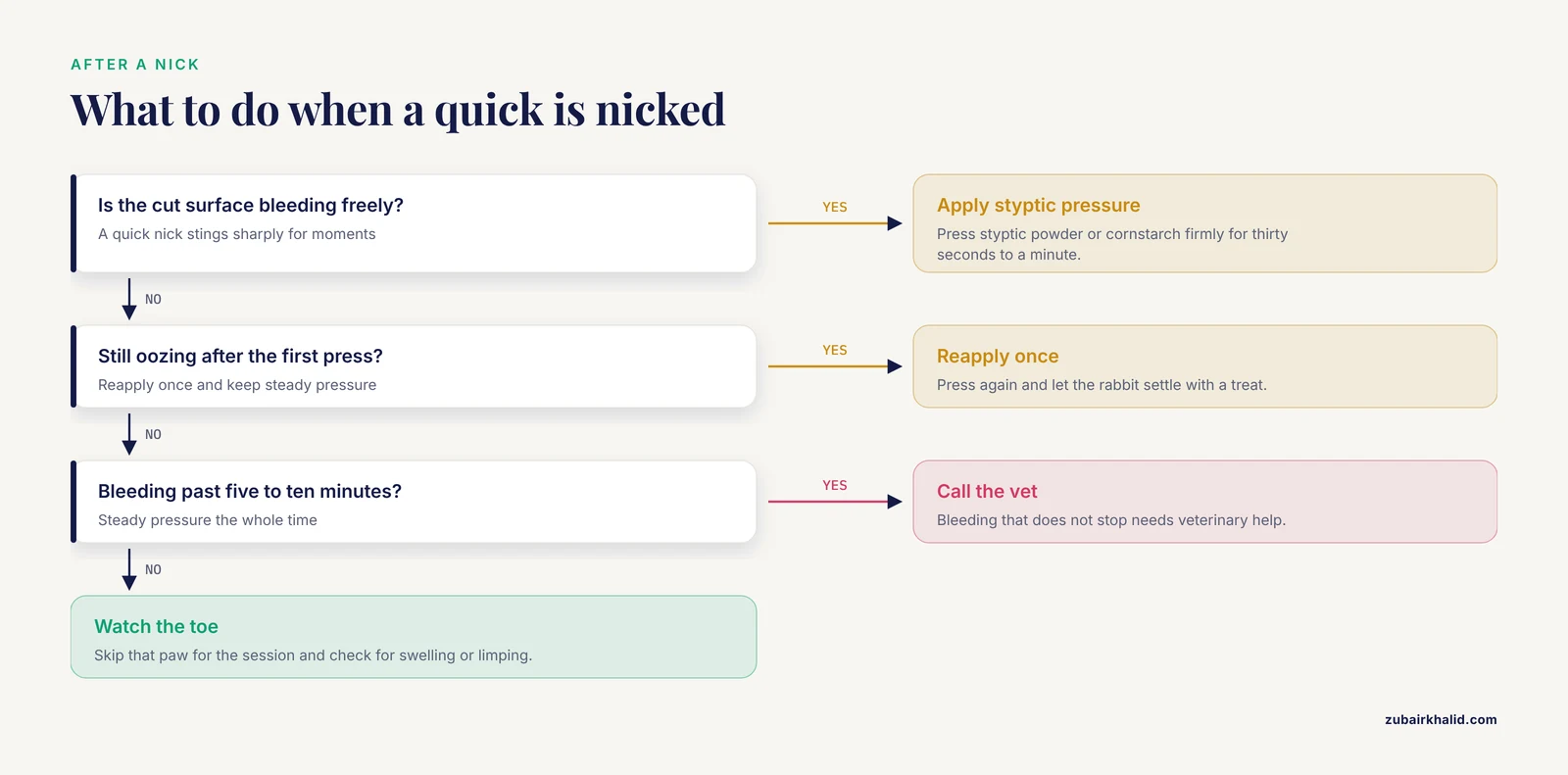
Even experienced owners occasionally nick a quick, so prepare for it in advance rather than mid-bleed.
- Stay calm. Your reaction sets the tone.
- Press a pinch of styptic powder or cornstarch firmly onto the cut surface and hold for thirty seconds to a minute.
- Reapply once if oozing continues.
- Offer a treat and let the rabbit settle. A quick nick stings sharply for moments and typically stops bleeding within minutes with pressure.
- Skip further trimming on that paw for the session.
Contact your veterinarian if bleeding does not stop within five to ten minutes of steady pressure, if the toe swells in the following days, or if the rabbit limps. A rabbit that holds a foot up or refuses to put weight on a leg after any trim needs a same-day veterinary check, since a broken or deeply torn nail can require treatment and pain management.
How Nail Trims Fit Into a Rabbit Care Checklist
Nail trims work best as one line on a broader routine rather than an isolated event. A practical rabbit care checklist looks like this:
- Daily: fresh hay and water, clean litter box area, visual health check, exercise time, grooming during heavy sheds.
- Weekly: a hands-on check of ears, eyes, nose, teeth alignment if your rabbit tolerates it, coat for mats, and a quick look at each paw, including dewclaws and the heels.
- Monthly: a deliberate nail inspection and trim, plus a weight check.
- Yearly: a wellness examination with a rabbit-savvy veterinarian, including dental evaluation. Dental disease and nail overgrowth are both common in pet rabbits, and an annual exam catches what hands-on checks miss.
Small weekly paw checks matter because they catch problems while they are trivial. A nail that is just starting to curl takes one sliver to fix. A nail that has embedded in a pad needs a veterinarian.
A Note for Guinea Pig Owners
If you keep guinea pigs alongside your rabbit, the same general approach applies, and a good guinea pig care guide treats nail trimming as routine maintenance too. Guinea pig nails also grow continuously, they have more nails per animal to trim, and dark nails present the same quick-location challenge. Guinea pigs are often calmer about being held in a lap than rabbits, which makes trims easier, but they are delicate and must never be squeezed. Use the same small animal clippers, the same sliver-by-sliver technique, and the same rule that a resistant animal or a cut quick beyond simple home care means professional help. One practical caution: keep species separate during trims and housing decisions, since rabbits and guinea pigs have different dietary and social needs even though their nail care overlaps.
Limitations and When to Contact a Veterinarian
This article is educational and is not a substitute for veterinary diagnosis or treatment. Individual rabbits vary in temperament, health status, and nail anatomy, and any specific concern about your rabbit's feet, gait, or handling tolerance is a question to raise with a veterinarian who treats rabbits.
Contact a veterinarian or rabbit-savvy groomer in these situations:
- A nail is torn, split, broken, or bleeding and you cannot stop the bleeding with pressure within about ten minutes.
- Your rabbit limps, holds a paw up, or refuses to hop normally after a trim.
- A nail has curled and appears to be pressing into or embedded in skin or a foot pad. Embedded nails frequently need professional trimming and may need treatment for a secondary sore.
- The toes, nail beds, or hocks are swollen, red, or discharging.
- Your rabbit has a known health condition such as heart disease, respiratory disease, or severe arthritis, where restraint stress itself carries risk. Ask your veterinary team whether trims should happen in clinic.
- Your rabbit panics to the point of injuring itself during home trims. A clinic or experienced technician can trim under calm, efficient handling, and recurring severe panic can be discussed with your veterinarian.
- You notice overgrown or thickened nails that seem disproportionate to the trim interval. Conditions affecting nail and foot health exist in rabbits, and they are diagnosed by examination rather than home trimming adjustments.
Nothing in this guide replaces an examination. When in doubt about a foot, a nail, or a behavior change during handling, photograph the area and call your veterinary clinic.
Frequently Asked Questions
How often should I trim my rabbit's nails?
Check your rabbit's nails monthly and plan on trimming every four to six weeks for most rabbits. Activity level, flooring, genetics, and season all shift the interval, so let the nails themselves tell you. A nail that audibly clicks on hard floors or starts to curve past the toe pad is due for a trim.
What happens if I accidentally cut the quick?
Apply styptic powder or cornstarch with firm pressure for thirty seconds to a minute, reapply once if needed, and offer a treat. Bleeding normally stops within minutes. If bleeding continues past five to ten minutes of pressure, or if the toe swells or your rabbit limps afterward, contact your veterinarian.
Can I use human nail clippers on my rabbit?
No. Human clippers are shaped for flat nails and tend to crush or splinter a rabbit's curved nail, leaving a ragged edge that can split further. Use scissor-style or guillotine clippers made for small animals, which give you the short-blade control a rabbit's nail requires.
How do I find the quick on black or dark nails?
You cannot see a quick through a dark nail, so work from the underside instead. Find where the flat plate of the nail ends and the thinner, hollow, hooked tip begins, and trim only that hook in small slivers. Stop as soon as the cut surface stops looking dry and chalky. If you cannot confidently judge the line, take less off or have a professional demonstrate on one paw.
Why does my rabbit struggle so much during nail trims?
Rabbits are prey animals, and being restrained with paws lifted is inherently threatening to them until they learn otherwise. Previous painful trims, rough handling, slippery surfaces, and being flipped onto the back all deepen the fear. The fix is gradual desensitization on non-trim days, upright restraint with a helper, short sessions, and treats, plus a willingness to stop and try again another day.
Can a vet or groomer trim my rabbit's nails instead?
Yes, and for many owners it is a sensible option. Many veterinary clinics and rabbit-experienced groomers perform nail trims quickly and inexpensively, sometimes without an appointment. If your rabbit has health conditions that make restraint risky, has severely overgrown or embedded nails, or panics badly at home, professional trims are the better choice.
What happens if rabbit nails are never trimmed?
Overgrown nails curl, catch in carpet and cage flooring, and tear, which is painful and bleeds heavily. Long nails also shift the rabbit's weight and posture, alter gait, and can contribute to foot and heel problems, while dewclaws left untrimmed can curl into the leg fur and skin. Regular trimming every four to six weeks prevents essentially all of this.
Do guinea pigs need nail trims too?
Yes. Guinea pig nails grow continuously and need the same kind of routine trimming as rabbit nails, typically with the same small animal clippers and the same sliver-by-sliver technique. Guinea pigs have more nails to trim per animal and are generally calmer in a lap, but they are fragile and should never be restrained tightly. Consult a guinea pig care guide or your veterinarian for species-specific handling details.
Further Reading
- Recognizing red flags in genetic cardiomyopathy: the importance of genetic testing.
- Pain 'red flags'. Recognizing the signs.
- School Nurses on the Front Lines of Healthcare: Red Flags and Red Herrings: Improving the Recognition of Bruises and Burns Associated With Physical Abuse in School-Age Children.
- The Intersection of Child Trafficking and Health Care: Our Unique Role as Pediatric Clinicians.
- Recognizing and Managing Children with a Pediatric Cancer Predisposition Syndrome: A Guide for the Pediatrician.
- Health literacy: implications for ambulatory care.