How to Prepare Your Rabbit for a Vet Visit
By Dr. Zubair Khalid, DVM, MS, PhD ·

To prepare your rabbit for a vet visit, book with a clinic that treats rabbits regularly, gather a written history of diet, housing, droppings, and medications, condition your rabbit to a solid-bottom carrier over several days, keep food and water available right up to travel, and plan a calm, short journey with the carrier secured and partially covered. Rabbits are prey animals that hide illness and react strongly to stress, so the preparation you do before the appointment directly affects both the quality of the examination and your rabbit's wellbeing.
Rabbits are presented to veterinarians in increasing numbers, and their special needs as patients are well recognized in the exotic animal literature [1]. That literature also makes a second point clear: much of a successful visit is determined before the rabbit ever reaches the clinic, through the instructions given when the appointment is made and the way the rabbit is housed, fed, and transported [1]. This article walks you through that preparation step by step, with practical tips, the mistakes owners most often make, and clear guidance on when to call the veterinarian instead of waiting for a scheduled appointment.
This article is educational and is not a substitute for veterinary diagnosis or treatment.
At a Glance: Your Rabbit Vet Visit Checklist
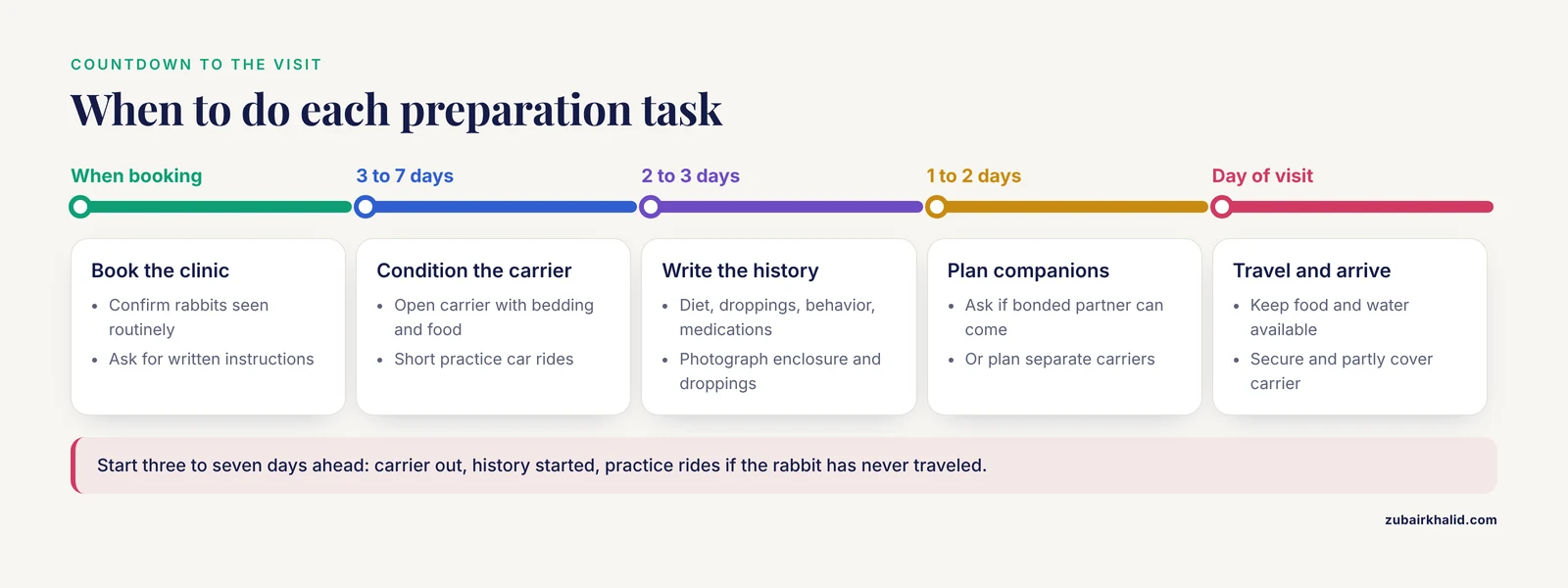
Use this rabbit care checklist today. Each item maps to a detailed section below.
| Step | Action | Timing |
|---|---|---|
| 1 | Confirm the clinic sees rabbits and ask for pre-visit instructions | When booking |
| 2 | Write down diet, housing, weight changes, droppings, and behavior | 2 to 3 days before |
| 3 | Photograph the enclosure, food, and any abnormal droppings | 2 to 3 days before |
| 4 | Place the carrier in the rabbit's area, open, with bedding and food inside | 3 to 7 days before |
| 5 | Take short practice car rides if the rabbit has never traveled | 3 to 7 days before |
| 6 | Secure a companion rabbit's travel plan, or plan separate carriers | 1 to 2 days before |
| 7 | Check that food, water, and bonded companions travel with the rabbit | Day of visit |
| 8 | Bring the history sheet, photos, medications, and a sample of the usual hay | Day of visit |
| 9 | Keep the car cool, secure the carrier, drive smoothly, and head home promptly | Day of visit |
Why Preparation Matters for Rabbits
Rabbits differ from dogs and cats in three ways that shape every part of this preparation.
First, they are prey species. A rabbit faced with a dog bark, a slippery carrier floor, or rough handling experiences that as a life-threatening event. Stressed rabbits struggle during restraint, which makes examination harder and increases the risk of injury [1]. Veterinary staff trained in rabbit-specific restraint techniques can perform examinations, blood collection, and medication administration safely, but calm, well-prepared patients make those techniques easier and safer to apply [1].
Second, rabbits hide disease. By the time a rabbit looks obviously sick to an owner, the illness is often advanced. Recognizing subtle signs of illness is a core skill taught to veterinary teams caring for rabbits, and it depends heavily on the history the owner provides at the appointment [1]. Your written observations of appetite, droppings, posture, and behavior often supply the diagnostic clues the physical exam cannot.
Third, rabbits have a digestive system that depends on continuous movement. Anything that interrupts normal eating, including a stressful trip or a wrong assumption about fasting, can set back gut function. This is why feeding and transport instructions for rabbits look very different from those for a dog or cat, and why pre-surgical and anesthetic planning for rabbits gets special attention in veterinary references [1].
Preparation is not fuss. It is the difference between a rabbit that arrives stable, examinable, and safe, and a rabbit that arrives compromised.
Step-by-Step: How to Prepare Your Rabbit for a Vet Visit
Step 1: Book With a Rabbit-Experienced Clinic and Ask for Instructions
Not every small animal clinic treats rabbits, so the first call matters. Ask directly:
- Does a veterinarian at this practice treat rabbits routinely?
- Is the appointment scheduled at a quiet time of day?
- Are dogs and cats kept in a separate waiting area, or can I wait in the car until called?
- Are there specific instructions for feeding, water, or medications before this particular visit?
Veterinary literature recommends that practices give owners specific instructions when the appointment is made, precisely because rabbit patients have needs that a standard dog-and-cat script does not cover [1]. Ask for those instructions in writing or by email so nothing is lost between the phone call and the visit.
If your rabbit is ill rather than visiting for a routine check, describe the symptoms when you book. The clinic may want a shorter wait time, a specific veterinarian, or immediate triage.
Step 2: Build Your History Sheet
Write things down rather than trusting memory. A rabbit's presentation for preventive care runs from the first visit through geriatric visits, and at each stage the veterinarian relies on the owner's account of daily life [1]. Your sheet should cover:
- Diet. The exact hay, pellets, vegetables, and treats, and roughly how much of each per day.
- Appetite and drinking. Any change over the past week.
- Droppings. Size, number, shape, and any cecotrope changes. Photograph anything abnormal.
- Urine. Color, sludge, or changes in volume.
- Housing. Enclosure dimensions, flooring, substrate, exercise time, and whether the rabbit lives indoors or outdoors.
- Companions. Other rabbits in the home and their health, since bonding and contagious illness both matter.
- Behavior. Activity level, posture changes, teeth grinding, hunching, reluctance to move.
- Medical history. Previous illnesses, surgeries, and all medications or supplements with doses.
- Reproductive status. Whether the rabbit is spayed or neutered, and if not, at what age the topic was last discussed with a veterinarian.
Spaying and neutering have established preventive indications in rabbits, and your veterinarian will want to know the status at the first visit [1]. If your rabbit is intact, note it on your sheet so the conversation happens.
Step 3: Choose and Condition the Carrier
The right carrier makes travel safer and the clinic visit calmer. Selection criteria:
- Solid floor. Wire floors injure feet and give nothing to grip. Line the bottom with a towel or mat that provides traction.
- Hard-sided construction. A rigid carrier protects against compression and gives the rabbit a stable surface.
- Secure, top or side access. Latches must not pop open if the carrier tips.
- Adequate size. The rabbit should be able to turn around and crouch naturally without sliding across the space.
- Ventilation with coverage options. Airflow matters, and a light cloth draped partly over the carrier during transport reduces visual stress.
Conditioning starts days before the visit. Put the carrier in your rabbit's living area with the door open, bedding inside, and occasional food placed in it. Many rabbits will enter voluntarily within a few days, and a rabbit that walks in on its own is far less stressed than one that is chased and grabbed. If your rabbit is bonded to another rabbit, ask the clinic whether the companion can come along, because a bonded partner is a powerful source of calm. Keep bonded pairs together unless the clinic advises otherwise for biosecurity or treatment reasons.
Step 4: Plan the Journey
Travel planning covers three variables: temperature, motion, and time.
- Temperature. Rabbits handle cold better than heat, and overheating during a car trip is a genuine welfare risk. Use air conditioning in warm weather, never leave the carrier in a parked car, and keep the carrier out of direct sun.
- Motion. Place the carrier on the vehicle floor behind a seat or secure it with a seatbelt so it cannot slide. Drive smoothly, take corners gently, and avoid loud music.
- Time. Ask for an appointment slot that minimizes waiting. Rabbits presented in increasing frequency for veterinary care have taught practices that short, quiet visits reduce patient stress [1], and most rabbit-savvy clinics will work with you on timing.
If your rabbit has never ridden in a car, take one or two short practice trips before the real appointment so the motion and noise are not brand new on the day.
Step 5: Keep Food and Water Available Before Travel
This is where rabbit preparation diverges sharply from dog and cat habits. Rabbits should continue eating normally before a routine veterinary visit. An empty stomach is not the goal for a standard examination, and interrupting eating before travel works against a gut that is designed to keep moving.
Fasting questions arise most often around anesthesia and surgery, and anesthetic planning in rabbits is its own specialized topic that veterinary teams prepare case by case [1]. Never apply a dog-and-cat fasting rule to your rabbit on your own initiative. Follow exactly the pre-procedure instructions your veterinarian gives for that specific rabbit and that specific procedure, and if the instructions are unclear, call and ask before the day of surgery.
For a routine visit, offer the normal diet right up to departure. Bring some of the usual hay and a favorite vegetable so your rabbit can eat during the wait and on the ride home.
Step 6: The Day of the Visit
On the morning of the appointment:
- Check your rabbit's droppings and appetite and note anything unusual on your history sheet.
- Confirm the carrier is lined, latched, and has familiar bedding with your rabbit's scent.
- Load the rabbit by letting it hop into the carrier, or by lifting it calmly with full support of the chest and hindquarters. Never lift a rabbit by the ears or scruff alone, and never let it dangle or kick freely, because a powerful kick can injure the spine.
- Place the carrier in the car, secure it, partially cover it, and start the drive.
- Arrive, check in, and ask to wait in the car or in a quiet corner if the waiting room is full of predator species.
- Tell the staff about any recent symptoms before the rabbit is placed on the table, so the team can plan restraint and handling [1].
Step 7: At the Clinic
A rabbit-savvy team will examine your rabbit with species-appropriate handling, on a non-slip surface, in a calm space [1]. You can help by:
- Mentioning immediately if your rabbit has eaten or passed droppings normally that morning.
- Asking staff to call you over for anything you want to see or learn, such as nail trims, weighing technique, or safe oral medication administration, which veterinary references cover as a skill owners can be taught [1].
- Reporting pain signs you have observed at home, such as hunching, reluctance to move, teeth grinding, or reduced appetite, because the clinical signs associated with pain in rabbits are specific and the veterinary team will match your observations against them [1].
Ask the veterinarian to demonstrate anything you are unsure about before you leave. A follow-up plan with a recheck date should be part of the discharge conversation, and if it is not, ask for one.
Step 8: After the Visit
The trip home matters as much as the trip out. Drive calmly, keep the carrier covered, and put your rabbit straight back into its familiar enclosure on arrival. Offer hay and water immediately. Monitor appetite, droppings, and behavior for the rest of the day, and call the clinic if eating or droppings do not resume normally within hours of returning home. If medications were prescribed, confirm the administration technique with the staff before leaving, since giving oral medication to rabbits is a taught skill with established techniques [1].
Supplies Worth Having Ready
Keep these items in one place so every visit is easy to assemble:
- A hard-sided, solid-floor carrier lined with a towel or mat
- A spare towel and a light cover cloth
- Your written history sheet, updated after each visit
- Photos on your phone of the enclosure, the food setup, and any abnormal droppings or posture
- A sealed bag of the rabbit's usual hay and a container of its usual vegetables
- Current medications in their original packaging
- A small water bottle or syringe for water if the trip is long, offered at stops rather than free in the carrier where it can spill
Common Mistakes When Preparing a Rabbit for a Vet Visit
These are the errors owners make most often, each of which has a simple fix.
1. Booking with a general clinic without confirming rabbit experience. Rabbits have species-specific handling, restraint, anesthesia, and preventive care needs [1]. Confirm experience before the appointment, not during it.
2. Fasting the rabbit because that is what happens with dogs and cats. Routine rabbit visits do not require withholding food, and unnecessary fasting works against normal gut function. Anesthetic fasting decisions belong to the veterinary team for that specific procedure [1].
3. Introducing the carrier on visit day. A carrier that appears once a year predicts a chase, a scramble, and a terrified rabbit. Leave the carrier out days in advance [1] references recommend that staff give owners pre-appointment instructions, and conditioning at home is the owner's half of that plan.
4. Chasing and grabbing for capture. Being pursued and lifted awkwardly is a prey animal's nightmare scenario. Herd the rabbit into the carrier gently, or use food to lure it in, and lift with full body support.
5. Letting the carrier slide in the car. An unsecured carrier tips and slides with every turn. Floor placement behind a seat or a seatbelt anchor solves it.
6. Skipping the history sheet. Vague answers like "eating less, maybe" cost diagnostic time. Written observations of appetite, droppings, and behavior are among the most valuable data the veterinarian receives.
7. Waiting in a chaotic waiting room. Barking dogs next to a rabbit carrier is avoidable stress. Ask to wait outside or in the car until the exam room is ready.
8. Ignoring subtle symptoms until they become obvious. Rabbits mask illness. Recognizing early clinical signs is emphasized in veterinary training on rabbit care precisely because owner vigilance is the front line [1]. A change in dropping size or a rabbit sitting hunched in a corner is a reason to call, not a reason to wait.
9. Separating bonded pairs without asking. A bonded companion is a calming presence. Ask whether the partner should come along before assuming separation is necessary.
10. Leaving without a follow-up plan. Preventive care in rabbits is structured from the first visit through geriatric care [1]. Ask when the next check should be and what signs should trigger an earlier return.
Troubleshooting a Rabbit That Refuses the Carrier
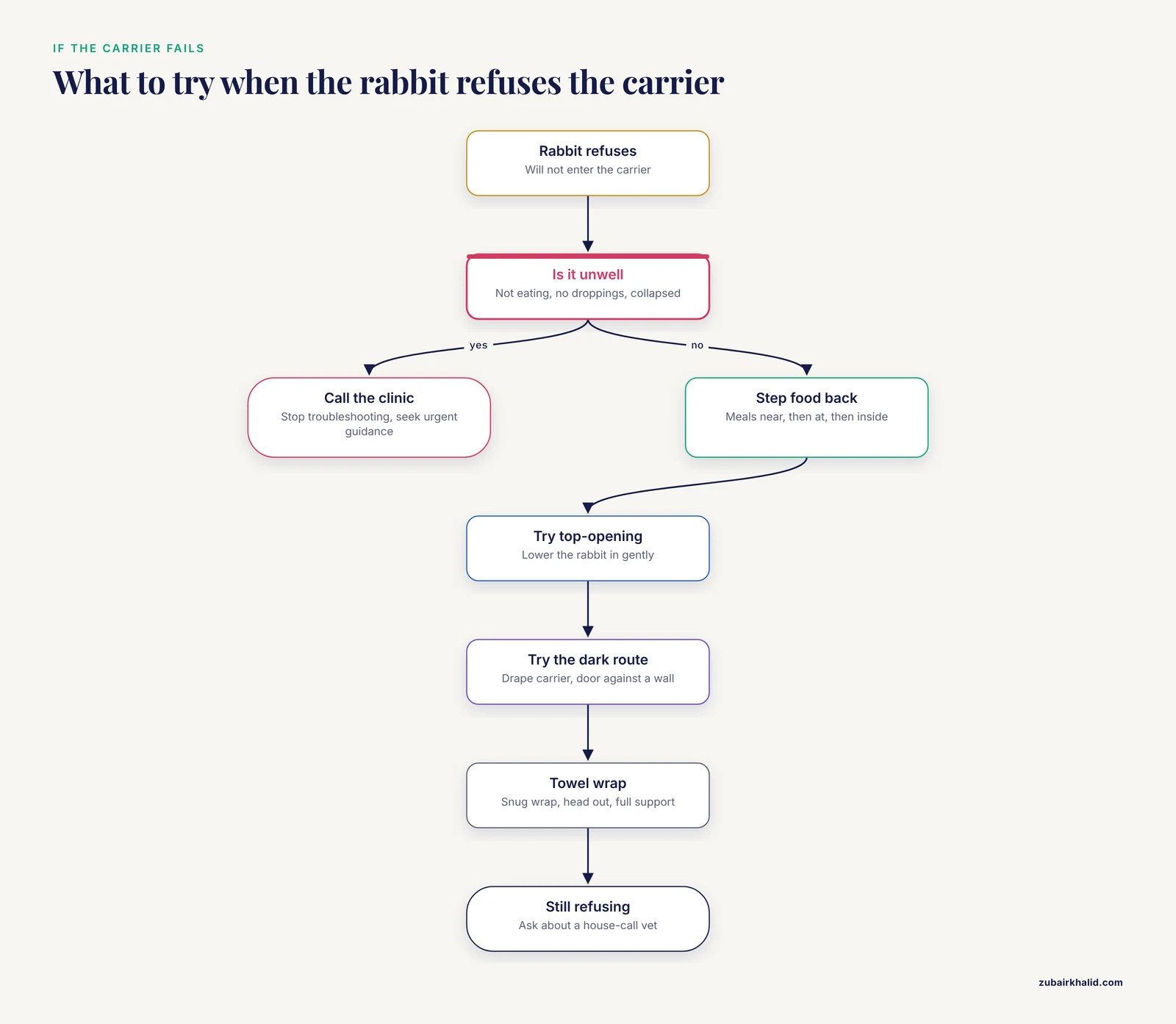
If your rabbit will not enter the carrier despite conditioning:
- Move the food strategy back a step. Place meals near the carrier, then at the threshold, then inside, over several days. Do not compress this into one afternoon.
- Use a top-opening carrier as a backup. Lowering a rabbit into a top-loading carrier is often less stressful than pushing it through a front door it has learned to fear.
- Try the dark route. Rabbits enter enclosed, dim spaces willingly. Drape the carrier, put the open door against a wall, and let the rabbit walk toward the darkness on its own.
- Wrap, do not wrestle. If capture is unavoidable, wrap the rabbit snugly in a towel with the head out, support the whole body, and lower it into the carrier. Ask your veterinary team to demonstrate a safe towel wrap at your next visit, since proper restraint technique is a taught skill [1].
- Book a house-call or mobile vet if travel itself is the emergency. For a rabbit in obvious distress, a Veterinarian who can see the animal at home removes the transport risk entirely. This is a question to raise with local clinics in advance.
If the rabbit is not eating, not producing droppings, or is collapsed, stop troubleshooting the carrier and call the clinic for urgent guidance immediately.
Welfare and Safety Points
- Never leave a rabbit in a parked car, in any season.
- Never transport a rabbit loose in a vehicle or on a seat.
- Never lift by the ears, scruff alone, or legs. Support the chest and hindquarters together.
- Keep the car cool. Heat is a faster killer of rabbits than cold.
- Preserve the bond. Transport bonded pairs together when the clinic allows it.
- Handle medications exactly as prescribed, and confirm administration technique before leaving the clinic [1].
- Give your rabbit quiet recovery time at home after the visit, with normal food available, before resuming extra handling or exercise.
Does This Apply to Guinea Pigs? A Brief Guinea Pig Care Guide Note
Much of this preparation transfers directly to guinea pigs, and owners who keep both species often ask about a guinea pig care guide parallel. The same core steps apply: book with an experienced exotics clinic, condition a solid-bottom carrier days ahead, keep food available before a routine visit, secure the carrier in the car, and bring a written history. The differences matter too. Guinea pigs have their own dietary requirements, their own pain and illness signs, and their own handling considerations, so do not assume your rabbit's feeding plan or your veterinarian's rabbit instructions apply unchanged to a cavy. Ask the clinic for species-specific instructions when you book, and confirm that the veterinarian you are seeing treats guinea pigs as regularly as rabbits.
Preventive Care and Routine Wellness Visits
Preparation is easier when visits are routine. Veterinary references outline preventive examination schedules for rabbits running from the first visit through geriatric visits, with spaying and neutering discussed as indicated [1]. A rabbit that sees the veterinarian regularly, travels in a familiar carrier, and has a history sheet already updated arrives calm and examinable, and problems get caught while they are still small. Ask your veterinarian at the first visit how often your particular rabbit should be seen as it ages, and put those dates on your calendar.
Limitations and When to Contact a Veterinarian
Every rabbit is an individual, and the preparation steps in this article support but never replace a veterinary assessment. Individual cases, including rabbits with chronic disease, senior rabbits, pregnant does, and rabbits recovering from surgery, need a veterinarian's direct guidance on fasting, transport, medications, and follow-up intervals.
Contact a veterinarian promptly, the same day, rather than waiting for a scheduled visit, if your rabbit shows any of the following:
- Not eating, or eating dramatically less than usual
- No fecal droppings, or dramatically smaller, misshapen, or fewer droppings
- Hunched posture, teeth grinding, reluctance to move, or pressing the belly to the ground
- Labored breathing, open-mouth breathing, or blue-tinged gums
- Head tilt, rolling, circling, or loss of balance
- Diarrhea, or a soaked, dirty rear end
- Sudden collapse, extreme lethargy, or unresponsiveness
- Bleeding, a suspected broken bone, or trauma from a fall, kick, or predator encounter
- Straining to urinate, or no urine output
- A sudden drop in water intake
Any of these signs in a rabbit is a same-day concern, and several are emergencies. Because rabbits hide illness until disease is advanced, err on the side of calling. A phone call that turns out to be nothing costs little. A waited day can cost everything.
Frequently Asked Questions
How far in advance should I prepare my rabbit for a vet visit?
Start three to seven days ahead. Place the open carrier in your rabbit's area immediately, begin your written history the same day, and take practice car rides if your rabbit has never traveled. Booking the appointment itself should happen even earlier, since rabbit-experienced clinics often book out.
Should my rabbit fast before a vet visit?
No, not for a routine examination. Offer normal food right up to departure. Fasting before anesthesia or surgery is decided case by case by your veterinary team, so follow their exact instructions for that procedure and ask questions in advance if anything is unclear.
What should I bring to a rabbit vet appointment?
Bring a written history covering diet, housing, droppings, behavior, and medications, photos of the enclosure and anything abnormal, your rabbit's usual hay and vegetables, current medications in their packaging, and a lined, solid-floor carrier with familiar bedding.
How do I get my rabbit into the carrier if it hides?
Leave the carrier out for days with food and bedding inside so your rabbit enters voluntarily, then herd gently or lure with food rather than chasing. A top-loading carrier or a towel wrap used correctly, as your veterinary team can demonstrate, are backup options.
How often should rabbits see a veterinarian?
Rabbit preventive care follows a schedule from the first visit through geriatric life stages, set out in veterinary references [1]. Ask your veterinarian at the first appointment how often your rabbit should be examined as it ages, and call sooner whenever appetite, droppings, or behavior change.
Can I use a dog or cat carrier for my rabbit?
Only if it meets rabbit needs. The carrier must have a solid floor for traction and foot safety, hard sides for protection, secure latches, and enough room for the rabbit to crouch and turn. Add a towel for grip and partially cover it during travel.
Do guinea pigs need the same preparation for a vet visit?
Mostly yes. Carrier conditioning, written history, food available before travel, and a secured carrier all transfer from rabbits to guinea pigs. Confirm with the clinic that the veterinarian treats guinea pigs, and ask for species-specific feeding and fasting instructions, since guinea pig requirements differ from rabbit requirements.
How can I tell if my rabbit is too stressed to travel?
Watch for rapid breathing, freezing and cowering, frantic circling in the carrier, trembling, or complete refusal to move. If those signs appear before departure, give the rabbit time to settle, retry calmly, and call the clinic if distress persists. If the rabbit shows illness signs rather than stress signs, such as not eating or no droppings, treat it as urgent and call the clinic immediately.