How to Prepare a Rabbit or Guinea Pig for a Pet Sitter
By Dr. Zubair Khalid, DVM, MS, PhD ·

Preparing a rabbit or guinea pig for a pet sitter comes down to three things done before you walk out the door. First, write a one-page care plan that covers exact feeding amounts, feeding times, cleaning duties, handling rules, and your veterinarian's contact details. Second, stage and label every supply the sitter will touch, from hay and pellets to the carrier and spare water bottle. Third, arrange written authorization for veterinary treatment and do at least one trial visit so the sitter meets your pet while you are still home.
Rabbits and guinea pigs are not starter pets for a casual drop-in sitter. Both species are prey animals that hide illness until they are seriously unwell, both depend on a constantly moving digestive tract that stalls quickly when meals are missed, and guinea pigs must take in vitamin C every day through their diet because their bodies cannot manufacture it, a fact highlighted in the Merck Veterinary Manual's exotic animal resources. A dog sitter can miss a walk and recover the next day. A rabbit sitter who misses two feedings can trigger a gastrointestinal emergency. The steps below show you how to close that gap methodically, and the checklists and common-mistakes section show you where owners most often fall short.
This article is educational and is not a substitute for veterinary diagnosis or treatment.
Prepare for a Pet Sitter at a Glance
Use this table as your working checklist. Every row is expandable in the step-by-step section below.
| Task | Why it matters | Ideal timing |
|---|---|---|
| , - | , - | , - |
| Screen and book a sitter with small mammal experience | Rabbits and guinea pigs need species-specific feeding and handling, not generic pet care | 4 or more weeks before travel |
| Schedule a pre-travel veterinary exam | Confirms your pet is healthy enough to be left, refills medications, updates your contact file | 2 to 3 weeks before travel |
| Write the care plan and rabbit care checklist | The single document the sitter will actually follow | 2 weeks before travel |
| Stage and label all food and supplies | Prevents wrong portions, wrong vegetables, and missed meals | 1 week before travel |
| Run a paid trial visit with you at home | Reveals handling problems while you can still correct them | 3 to 7 days before travel |
| Sign a veterinary authorization form and confirm emergency clinic access | Saves hours when minutes matter | Before departure |
| Walk the sitter through everything in person | Turns the written plan into practiced muscle memory | Departure day |
Why Rabbits and Guinea Pigs Need More Sitter Preparation Than Dogs or Cats
Understanding the "why" behind each step makes you a better planner and helps you judge whether a sitter is genuinely qualified.
They hide illness by instinct. Rabbits and guinea pigs are prey species. A sick rabbit in the wild attracts predators, so both species mask pain, weakness, and gut discomfort until disease is advanced. The House Rabbit Society's veterinary resources stress that an owner or sitter who waits for obvious signs of sickness has usually waited too long. Your sitter must learn to look for subtle changes instead, such as a smaller pile of droppings, half-eaten food, or a pet sitting hunched in a corner.
Their gut never shuts down. Both species are hindgut fermenters designed to process high-fiber grass almost continuously. When a rabbit or guinea pig stops eating, even for a short period, gut motility slows and dangerous changes begin. This is why uninterrupted hay access and on-time feedings are non-negotiable items on any rabbit care checklist, not conveniences.
Guinea pigs need daily vitamin C. Like humans, guinea pigs cannot synthesize their own vitamin C and develop deficiency disease without regular dietary intake. The Merck Veterinary Manual notes that deficiency can appear within weeks on an inadequate diet. A sitter who replaces your fresh vegetable routine with pellets alone for a week can genuinely harm your guinea pig, which is why a short guinea pig care guide sheet belongs in your leave-behind folder.
They are sensitive to heat and stress. Neither species tolerates hot rooms, direct sunlight, or loud environments well. Rabbits dissipate heat poorly and can develop heat stroke in warm conditions. Barking dogs, blaring televisions, and constant handling attempts all add stress, and stress alone can suppress appetite in both species.
They are fragile physically. A rabbit's skeleton is light and powerful hind legs can injure the spine if the animal kicks while improperly held. Guinea pigs are similarly prone to injury from drops and squeezes. Sitters need explicit handling instructions, including the rule that children do not lift these pets unsupervised.
How to Prepare for a Pet Sitter for Small Pets, Step by Step
This is the core how-to section. Work through the steps in order, starting as far ahead of your trip as you can manage. People are surprisingly bad at last-minute pre-travel preparation, a pattern documented in travel medicine research, where one airport survey found that fewer than one in ten travelers heading to malaria-prone regions had taken the recommended preventive medication despite known risks [1]. Pets depend on us closing that same planning gap for them.
Step 1: Screen and Book the Right Sitter
Start here because the best sitters for small mammals are booked early. When you interview candidates, ask these questions and listen for specific answers rather than reassurance.
- Have you cared for rabbits or guinea pigs before, and what was your daily routine with them?
- What would you do if my rabbit had not eaten by your evening visit?
- How much hay do you believe a rabbit needs each day?
- Are you comfortable syringe feeding if my veterinarian directs it?
- Are you available at consistent morning and evening times, seven days a week?
Good answers include unlimited hay, immediate concern about a pet that is not eating, and willingness to follow a written protocol. Red flags include anyone who describes rabbits as low-maintenance cage pets, anyone planning one visit per day for a pair of guinea pigs with medical needs, and anyone who cannot name the emergency plan you will give them.
Options range from professional pet-sitting services to a knowledgeable friend or a trusted neighbor. Whichever you choose, confirm the person is willing to visit twice daily for rabbits and at minimum twice daily for guinea pigs, because fresh water, fresh vegetables, and a health glance twice a day is the baseline for these species.
Step 2: Schedule a Pre-Travel Veterinary Examination
Book a wellness visit two to three weeks before you leave. Use the appointment to accomplish four things.
- Confirm fitness for travel away from you. Ask your veterinarian to perform a full exam and tell you whether anything about your pet's current health changes the sitting plan.
- Record a baseline weight. Weight is the single most useful number a sitter can report to a veterinarian. Give the sitter a kitchen scale or a gram scale and show them how to weigh your pet in a box, subtracting the box weight. Ask your vet how often to weigh while you are gone and what weight loss should trigger a call.
- Refill and simplify medications. If your pet takes any medication, refill it, pre-measure doses into labeled containers where possible, and write out the schedule with times, amounts, and what to do about a missed dose.
- Ask about preventable risk. Discuss with your veterinarian whether vaccination against rabbit hemorrhagic disease virus type 2 is appropriate for your rabbit given disease activity in your region, and ask whether any parasite prevention is relevant. Also ask the clinic directly whether they will accept authorization by phone from a pet sitter or whether you must sign a form in advance.
Step 3: Write the Care Plan and Rabbit Care Checklist
The care plan is one page, printed, laminated or sleeved, and posted where the sitter will see it, with a second copy in your leave-behind folder. Structure it as a daily checklist so nothing depends on memory.
Feeding section
- Morning and evening feeding times, written as clock times
- Exact pellet amounts per pet, measured with the actual cup or scoop, described in writing (for example, "the blue scoop, level full, split between both bowls")
- The vegetable list your pets currently eat, with amounts, and a separate "do not feed" list of items you have never introduced, since abrupt new foods can trigger digestive upset
- Hay type and confirmation that hay must never run out
- For guinea pigs, the daily vitamin C sources and the warning that pellets alone do not cover this need
- Fresh water change schedule and how to check the bottle for flow
Cleaning section
- Litter box or tray cleaning frequency and products to use
- Spot cleaning routine and full cleaning schedule for longer trips
- Where dirty bedding and waste go
Handling and behavior section
- How to pick up each pet, which rooms are safe for floor time, and the rule that lifting is two-handed and close to the body
- Each pet's name, personality, hiding spots, and normal droppings and appetite
- Whether your pets live bonded in one enclosure or must never be mixed
Health section
- The red flag list from the troubleshooting section below
- Your veterinarian's name, address, phone number, and after-hours plan
- The nearest emergency exotics-friendly clinic, because not all emergency hospitals see rabbits and guinea pigs, a distinction the VCA Animal Hospitals small mammal guides emphasize
- Your pet's baseline weight and the call trigger you agreed with your veterinarian
If your pets are guinea pigs, attach a one-page guinea pig care guide addendum covering the vitamin C requirement, the hay-first diet, and the fact that a guinea pig that is not eating or that is drooling or pawing at the mouth needs a same-day veterinary call.
Step 4: Stage the Feeding Station
Do not leave the sitter a cupboard of possibilities. Leave a station that makes the right choice the easy choice.
- Fill a dedicated bin with more hay than the trip requires and place it beside the enclosure.
- Pre-portion pellets into labeled daily containers or baggies, one per feeding.
- Pre-wash, dry, and bag the hardy vegetables for the first few days. For longer trips, leave a written approved list plus a note on which vegetables the sitter should buy fresh and how to introduce nothing new.
- Place the pellet scoop, the vegetable knife and cutting board, and the feeding schedule physically next to the food.
- Store one week of backup pellets and one spare bag of hay in a separate location in case of spills or pests.
Step 5: Prepare Water, Housing, and Litter
- Wash and refill the water bottle or bowl, and leave a fully assembled spare bottle so a cracked or clogged bottle becomes a two-minute swap rather than an emergency. Check the sipper tube by touching it to confirm water flows.
- Show the sitter where spare bedding, litter, and the litter scoop live, and demonstrate one full cleaning routine.
- Note on the care plan where your pets hide, so a sitter who cannot see an animal checks the known spots rather than assuming an escape.
- If the enclosure has doors, latches, or a known escape trick, demonstrate it and write it down in plain language.
Step 6: Plan Exercise, Enrichment, and the Room
Rabbits and guinea pigs need daily time outside their enclosure for movement and mental health, and both species chew, which means the environment must be safe before the sitter opens any door.
- Define the exact floor-time space, its boundaries, and its duration for each visit.
- Rabbit-proof or guinea-proof the room yourself before you leave: cover or lift electrical cords, block gaps behind furniture, remove toxic houseplants, and secure anything you do not want chewed.
- Provide hideouts, chew items appropriate for the species, and at least one enrichment item the sitter can rotate, such as a paper bag stuffed with hay.
- Write the rule that floor time happens with doors closed, other pets out of the room, and the sitter staying in the room.
Step 7: Build the Emergency Plan
This step determines outcomes when something goes wrong.
- Packed carrier. Assemble the carrier with a towel inside and place it where the sitter can grab it in seconds. Show the sitter how to get your pet into it.
- Written veterinary authorization. Leave a signed letter naming the sitter, your pets, and your authorization for examination and treatment up to a stated dollar limit, plus your payment method on file at the clinic if your veterinarian allows it. Call your clinic and the emergency clinic in advance to confirm they accept this arrangement.
- Two-clinic list. Post your regular veterinarian and at least one emergency or exotics-experienced backup, with addresses, phone numbers, and hours.
- Emergency fund or card. Leave a card or agreed payment method for the sitter to use for veterinary care and confirm this in writing.
- Your reachability plan. List the phone numbers and times you can be reached in your destination, and name a local decision-maker who can act if you cannot be reached.
- Basic first-aid items. Ask your veterinarian what to stock. Typical recommendations include gauze, a towel for restraint, and syringes for assisted feeding if your veterinarian teaches the technique. Do not stock or instruct medications without your veterinarian's guidance.
Step 8: Do a Paid Trial Visit
Have the sitter perform one or two complete visits while you are at home, going through the whole routine themselves rather than watching you do it. Correct technique in real time. Watch specifically for gentleness in handling, correct pellet portions, hay top-ups, the water bottle check, and whether they can read the droppings and food bowls the way your care plan asks. Pay for the trial visit. A paid trial sets the expectation that this is a professional engagement with professional standards.
Step 9: Run the Departure-Day Handoff
On the day you leave, allow 30 to 45 minutes. Walk the whole circuit with the sitter one final time, hand over keys and alarm codes, confirm the veterinary authorization is signed and on the counter, review the red flag list verbally, share your itinerary contact details, and remind the sitter that you would rather get three "probably nothing" calls than one late call about a rabbit that has not eaten. Then leave a printed copy of the daily checklist on the refrigerator or cage side, because the plan the sitter can see is the plan that gets followed.
Supplies to Have Ready Before You Leave
Selection criteria matter more than brand names. Choose these items and stage them before the trial visit.
- Hay. Grass hay appropriate to your pet's age and veterinary advice, stored in a dry, sealed bin, in enough quantity to outlast the trip plus a buffer. Avoid dusty, moldy, or damp-smelling hay.
- Pellets. The same plain pellet your pet already eats, not a new formula, and no muesli-style mixes with seeds and colored bits, which encourage picky eating.
- Vegetables. Your pet's established list, pre-washed where practical, with the approved list written out. Freshness matters, so for long trips leave purchasing instructions instead of stockpiling greens that will spoil.
- Water equipment. A primary bottle or heavy bowl plus one complete spare, since both species should have a backup hydration source the sitter can swap in seconds.
- Litter and bedding. The exact products your pets are used to, in sufficient quantity, because switching litters mid-trip can disrupt litter habits and add stress.
- Carrier. A secure, ventilated carrier sized for your pet, lined with a towel, tested before you leave.
- Gram scale. An inexpensive digital kitchen scale plus a box, so the sitter can track weight.
- Syringes. Only if your veterinarian has demonstrated assisted feeding and provided the product to use.
- Cleaning supplies. Unscented cleaner safe for small animals, paper towels, spare litter, and a small hand broom.
- Printed documents. Care plan, red flag list, veterinary authorization, clinic list, and your contact card.
Common Mistakes Owners Make When Preparing for a Pet Sitter
Knowing how to prepare for a pet sitter for small pets includes knowing where preparation typically fails. These are the mistakes that show up again and again.
- Leaving instructions verbal instead of written. A spoken tour evaporates within a day. The care plan on paper or on the fridge is what the sitter follows on day four.
- Assuming any pet lover knows small mammals. Dog and cat experience does not transfer. Many otherwise excellent sitters have never heard that guinea pigs need dietary vitamin C or that hay must be unlimited for rabbits.
- Scheduling one visit per day. A single daily visit leaves a rabbit that stopped eating in the morning unobserved for nearly 24 hours, and both species need twice-daily fresh vegetables, water checks, and health observation as a minimum.
- Not arranging veterinary authorization in advance. A sitter with a sick animal, no signed authorization, and an owner on a plane loses hours or days at exactly the wrong moment. Some clinics will not treat without owner consent, so this is a call to make before departure, not during the emergency.
- Failing to identify an exotics-capable emergency clinic. Many emergency hospitals do not staff veterinarians experienced with rabbits and guinea pigs. Finding one at 9 p.m. during a crisis is the wrong time to start searching.
- Leaving unmeasured food. "Give a scoop of pellets" produces ten different amounts from ten people. Pre-measure portions or supply the literal scoop with the amount written down.
- Introducing new foods right before the trip. Sudden diet changes can upset digestive tracts. Lock the diet in place for at least a week before departure and instruct the sitter against additions.
- Skipping the trial visit. Problems you would have caught in ten minutes, such as an escape-prone latch, a pet who bites when cornered, or a sitter who cannot lift correctly, surface instead during your trip when you cannot fix them.
- Not weighing the pet or recording a baseline. Without a baseline, subtle weight loss from gut slowdown goes unnoticed until it is severe.
- Forgetting the household, not just the pet. Heat and air conditioning settings, which room stays cool, who to tell that a stranger is entering the home, and what to do about other pets in the house all belong in the written plan.
- Underestimating heat. Owners plan for cold and forget that a warm snap can turn a sunny room into a hazard for these species while everyone is away.
Troubleshooting: What the Sitter Should Do When Something Looks Wrong
Give your sitter this section verbatim. It is written as instructions to them.
Your rabbit or guinea pig is not eating or is eating less. Check the food bowl and hay rack, look for droppings, and call the contact number on the care plan. Do not wait until the next visit. A small herbivore that stops eating needs veterinary attention quickly, and most exotic veterinarians treat even a half day of complete refusal to eat as urgent, so confirm your own veterinarian's threshold before you leave and write that threshold on the plan.
Droppings are smaller, fewer, misshapen, or absent. This pairs with reduced appetite and means the same call. Count and note what you see before calling.
Droppings are soft, mushy, or stuck to the rear. Note what vegetables were fed at the last two meals, photograph the droppings if you can, and call the care plan contact. Do not change the diet on your own.
Your pet is not drinking or the bottle level has not moved. Check the tube for clogs by touching it, offer water in a shallow heavy bowl as an alternative, and call if intake stays low.
Your pet is quiet, hunched, puffy-eyed, or hiding more than usual. Rabbits and guinea pigs hide illness, so unusual stillness is itself a finding. Offer food, do not force handling, and call.
Drooling, a wet chin, or pawing at the mouth. This suggests dental pain, which is common in both species, and needs a same-day veterinary call.
Labored breathing, open-mouth breathing, or a head tilt. Call the emergency line immediately and transport in the prepared carrier.
An escape. Close all doors first, then search hiding places quietly, place food and water near known hideouts, and do not chase. Call the owners and the care plan contact.
Bonded pair suddenly fighting. Separate only if there is active injury risk, and call for guidance, since re-bonding advice should come from experienced rabbit or guinea pig resources, not improvisation.
Heat in the room. Move the enclosure to the coolest part of the home, offer water, and call for guidance if the pet is panting, lethargic, or sprawled and unresponsive to gentle touch.
Welfare and Safety Points Every Sitter Must Know
Hand these ground rules to the sitter along with the care plan.
- Handle low, close, and briefly. Two hands, one supporting the rear, held close to the body over a soft surface or near the floor. Never pick up by the ears, scruff loosely without support, or carry a struggling rabbit at height. If a pet thrashes, the sitter should crouch and let the animal go rather than grip harder.
- Respect the prey-animal nervous system. Move slowly, speak quietly, sit on the floor during floor time, and let the pet approach. Forcing interaction raises stress hormones and suppresses appetite, which in these species is a medical risk, not a mood issue.
- Protect the ears. Keep dogs, cats, and loud media away from the small pet room. Even a barking dog in the next room, with no direct contact possible, can frighten a rabbit or guinea pig badly.
- No unsupervised child contact. Children may visit the enclosure with an adult present, but lifting is adult-only.
- Never change the diet, the enclosure, or the routine. Stability is medicine for these species while the owner is away.
- Wash hands between pets and before feeding. Small mammals can carry bacteria such as Salmonella, and routine hygiene protects both the sitter and the animals.
- Keep the room temperature stable and cool, out of direct sun and away from heat sources, and check on the pets during any hot weather.
- Log every visit. A simple written log of feeding times, droppings, water, and behavior, left beside the cage, keeps continuity and gives the veterinarian a record if something goes wrong.
Limitations and When to Contact a Veterinarian
Every animal is an individual, and the decisions in this article, including feeding amounts, exercise routines, weight thresholds, and medication instructions, need to be confirmed with a veterinarian who has examined your specific pet. Use this article as the organizing framework, not as a prescription.
Contact your veterinarian before departure if any of the following apply, and direct the sitter to contact the listed clinics during your trip when any of these occur.
- Your rabbit or guinea pig has not eaten, or has eaten dramatically less, for more than a few hours
- Fecal output has dropped noticeably, stopped, or turned mushy or liquid
- Your pet shows lethargy, hunching, tooth grinding, a hunched or bloated abdomen, drooling, a wet chin, or pawing at the mouth
- Breathing is rapid, labored, or open-mouthed, or there is discharge from the nose or eyes
- There is any injury, bleeding, limping, or suspected fall
- Your guinea pig shows signs consistent with vitamin C deficiency, such as reluctance to move, a rough coat, or joint tenderness, which the Merck Veterinary Manual lists among deficiency concerns
- Your pet has been exposed to heat, or the room temperature has been high and the pet is panting or limp
- A bonded pair has suddenly become aggressive and cannot be safely managed
- The sitter reports any change in weight below the threshold you set with your veterinarian
Confirm the specific phone numbers, after-hours arrangements, and authorization requirements of your own veterinary clinic and local emergency hospital in writing before you travel.
Frequently Asked Questions
How far in advance should I prepare for a pet sitter for small pets?
Start at least four weeks ahead by screening and booking the sitter, then work backward through the steps: veterinary exam two to three weeks out, written care plan and staged supplies one to two weeks out, and a trial visit in the final week. Earlier is always better for sitters with rabbit or guinea pig experience, who are in high demand.
What should I include in my written care instructions?
Include feeding times and exact measured amounts, the hay requirement, the approved and prohibited vegetable lists, daily vitamin C sources for guinea pigs, water and cleaning routines, handling rules, each pet's personality and hiding spots, the red flag health list, your veterinarian's details, an emergency clinic backup, your contact information, and your signed veterinary authorization. Keep it to one page, printed, and posted where the sitter works.
Should I board my rabbit or guinea pig instead of using a sitter?
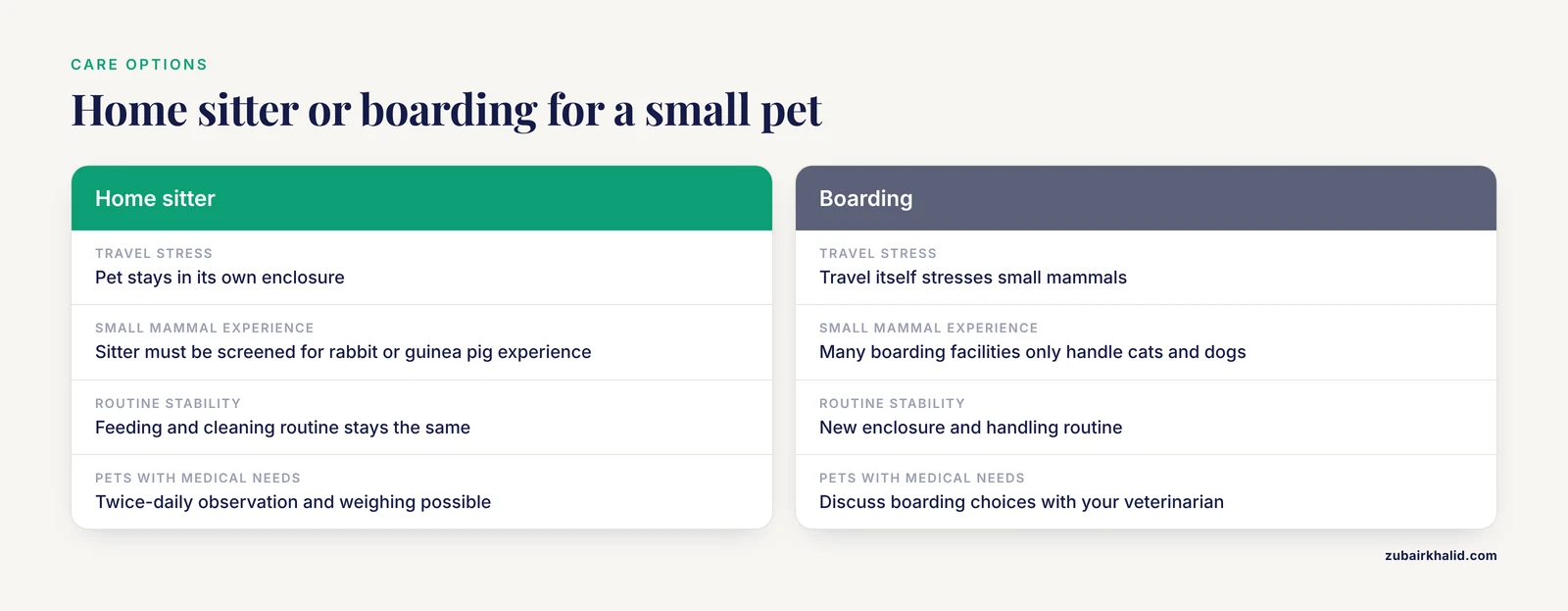
It depends on the available facilities and your pet's temperament. Some exotics veterinary clinics and small animal boarders offer appropriate care, but many boarding facilities only handle cats and dogs, and travel itself stresses small mammals. For most rabbits and guinea pigs, staying home with a well-prepared sitter is the calmer option, but discuss boarding choices with your veterinarian if your pet has medical needs.
How often does a pet sitter need to visit a rabbit or guinea pig?
Plan on a minimum of two visits per day, ideally morning and evening at consistent times. Both species need fresh vegetables, a water check, a hay top-up, a quick health observation, and a droppings check at least twice daily, and a single daily visit leaves too long a gap to catch a gut slowdown early.
What should the sitter do if my rabbit stops eating?
The sitter should check the hay and food bowls, note the droppings, and call the emergency contact immediately rather than waiting for the next visit. Reduced or absent appetite in a rabbit progresses quickly, so put your veterinarian's agreed action threshold in writing and treat it as a same-day matter.
Do guinea pigs need anything special while I am away?
Yes, daily vitamin C from established dietary sources, unlimited grass hay, twice-daily fresh vegetables and water checks, and a sitter who knows that pellets alone do not meet the vitamin C requirement. A one-page guinea pig care guide in the leave-behind folder keeps all of this in front of the sitter every day.
Can one sitter care for my rabbit and my dog?
Possibly, if the sitter is experienced with both and keeps them fully separated at all times. Dogs and cats are predator species, and even without direct contact their presence, noise, and smell can stress a rabbit or guinea pig enough to suppress appetite. If your dog sitter has no small mammal experience, hire a second sitter for the small pets.
How do I know if a sitter is qualified for exotic pets?
Ask for specific rabbit or guinea pig experience, test their knowledge with the interview questions in Step 1, and require a paid trial visit while you are home. A qualified sitter answers with unlimited hay, twice-daily routines, and immediate concern about appetite changes, and follows your written plan without improvising.