How to Introduce Rabbits to Each Other and Other Pets
By Dr. Zubair Khalid, DVM, MS, PhD ·

Rabbits are among the most social animals kept as pets, and most live calmer, more active lives with a compatible partner. They are also territorial animals with strong opinions about who belongs in their space, which is why learning how to introduce rabbits correctly matters. Done well, the rabbit bonding process turns two strangers into a bonded pair that eats, grooms, and sleeps together. Done badly, it produces injuries, chronic stress, or a permanent grudge. This guide explains how to introduce rabbits to each other, how to manage rabbits and other pets such as dogs and cats, and when to call in professional help.
The short version: spay or neuter both animals, start with side-by-side housing, hold short daily meetings on neutral territory, and allow unsupervised time together only after weeks of mutual grooming and clean body checks. Around dogs and cats, supervision is permanent, because rabbits are prey animals and even a trusted family pet can injure one in seconds.
This article is educational and is not a substitute for veterinary diagnosis or treatment.
At a Glance: The Rabbit Bonding Process
| Stage | What you do | What success looks like | Red flags |
|---|---|---|---|
| 1. Prepare | Spay or neuter both rabbits, veterinary exam for each, quarantine the newcomer | Both healthy, healed, hormones settling | Any illness, wounds, or untreated parasites |
| 2. Parallel housing | Place pens side by side with a barrier, swap bedding and litter daily | Rabbits eat and relax near each other without lunging | Persistent lunging or biting through the barrier |
| 3. Neutral territory | Short daily meetings, 10 to 15 minutes, in a space neither rabbit claims | Mutual ignoring, then sniffing, then grooming | Fights, biting, rolling, fur pulling |
| 4. Extend | Longer sessions, slightly more space, hides and hay available | Mounting accepted or reversed, brief chasing without contact | Circling, sustained chasing, attacks |
| 5. Cohabit with supervision | Move into a cleaned or new enclosure, supervise all day, check bodies twice daily | Eating together, lying in contact, calm nights | Wounds found on body checks |
| 6. Full bond | Allow overnight time together, keep weekly body checks | Mutual grooming, resting in contact, stable weight | Repeated injuries or chronic avoidance |
Can Rabbits Live Together? What the Evidence Says
Domestic rabbits descend from European wild rabbits, and that heritage cuts both ways. It gives rabbits a deep need for company, and it gives them the territorial instincts that make introductions risky. Age, sex, and housing density all influence territoriality, dominance hierarchies, and social ranking in this species [1].
The benefits of companionship are well documented. Pair-housed female rabbits show significantly steadier body weight patterns than genetically similar siblings housed alone, a finding reflected in European laboratory regulations that now favor housing compatible rabbits in pairs [2]. Paired rabbits rest in body contact, use postures and behaviors that are impossible in small solitary cages, and show none of the stereotypies reported in individually housed rabbits [3]. Pairing also increased normal activity in adult females without changing body temperature or cardiovascular responses during routine handling, meaning company added natural behavior without destabilizing their physiology [4]. Veterinary references such as the Merck Veterinary Manual describe rabbits as social animals that thrive with companionship.
The risks are just as real. In a survey of 1,254 rabbit owners, only 41.9 percent kept a rabbit with another rabbit. Among the pairs that did share space, 25.3 percent fought at least occasionally, 22.7 percent guarded resources, and 27.1 percent avoided one another, leading the authors to call incompatible cohabitation a significant welfare issue [5].
So, can rabbits live together? Yes, most can, provided they are desexed, matched carefully, and introduced through a gradual process. Opposite-sex desexed pairs are the most reliable combination in rescue practice, a principle the House Rabbit Society emphasizes in its bonding guidance. Same-sex pairs can work, especially sisters raised together, but puberty turns intact males seriously aggressive, which is why hormones are the first problem to solve.
Before Introducing a New Rabbit: Health, Hormones, and Supplies
Spay or neuter both rabbits
Desexing is the single most influential step in the rabbit bonding process. In a study of male littermates, castrated pairs lived together compatibly at significantly higher rates than intact pairs, and intact males displayed serious aggression as they passed through puberty [3]. Spaying and neutering are also standard preventive care recommendations for pet rabbits [6], and they prevent the unwanted litters that come with any opposite-sex pairing.
Ask your veterinarian when each rabbit is ready for meetings after surgery. Healing comes first, and hormone-driven behavior typically fades over the following weeks.
Book health checks and quarantine the newcomer
Have a veterinarian examine every new rabbit before it meets your resident. House Rabbit Society guidance recommends a quarantine period for incoming rabbits, both to protect the resident and to let the newcomer settle. During the exam, ask specifically about ears and skin. Psoroptes cuniculi is the most prevalent mite affecting rabbits worldwide and the primary cause of ear disease in this species, and it significantly compromises welfare [7]. A rabbit in chronic discomfort is a rabbit that will not bond well.
Gather your supplies
- Two exercise pens, or one large pen with a divider, tall enough that neither rabbit can jump out.
- A neutral room, such as a bathroom or hallway, that neither rabbit has lived in.
- Non-slip matting. Rabbits slip on smooth floors, and a slip during a tense moment can trigger a chase.
- Separation tools: a piece of cardboard, a stiff board, or a dustpan to slide between fighting rabbits, plus a thick towel and gloves.
- Duplicate resources: two food bowls, two water sources, two hides, two litter boxes, and multiple hay piles.
- Edible enrichment. Environmental enrichment is considered an essential component of animal care, as important as nutrition and veterinary care [8], and rabbits interact far more with food-based enrichment than with toys or chew objects [9]. Scatter feeding also gives two nervous rabbits something to do together instead of staring at each other.
How to Introduce Rabbits: The Bonding Process, Step by Step
Step 1: Side-by-side housing
Set the two pens a few inches apart with a secure barrier, close enough for noses to touch, far enough that teeth cannot reach. Swap litter boxes, hides, and cloth items between the pens daily so each rabbit absorbs the other's scent, a technique House Rabbit Society bonding guides recommend. Feed both rabbits near the barrier so they associate each other with good things. Stay at this stage until both rabbits eat, relax, and ignore each other calmly, which usually takes days to a week or more.
Step 2: First meetings on neutral territory
Choose a space neither rabbit has claimed. A bathroom, an empty hallway, or a pen set up in a room neither has lived in all work. Keep sessions short, 10 to 15 minutes, once or twice daily. Scatter a small amount of food at the start. End every session while things are calm, even if that means ending early.
Step 3: Read the body language
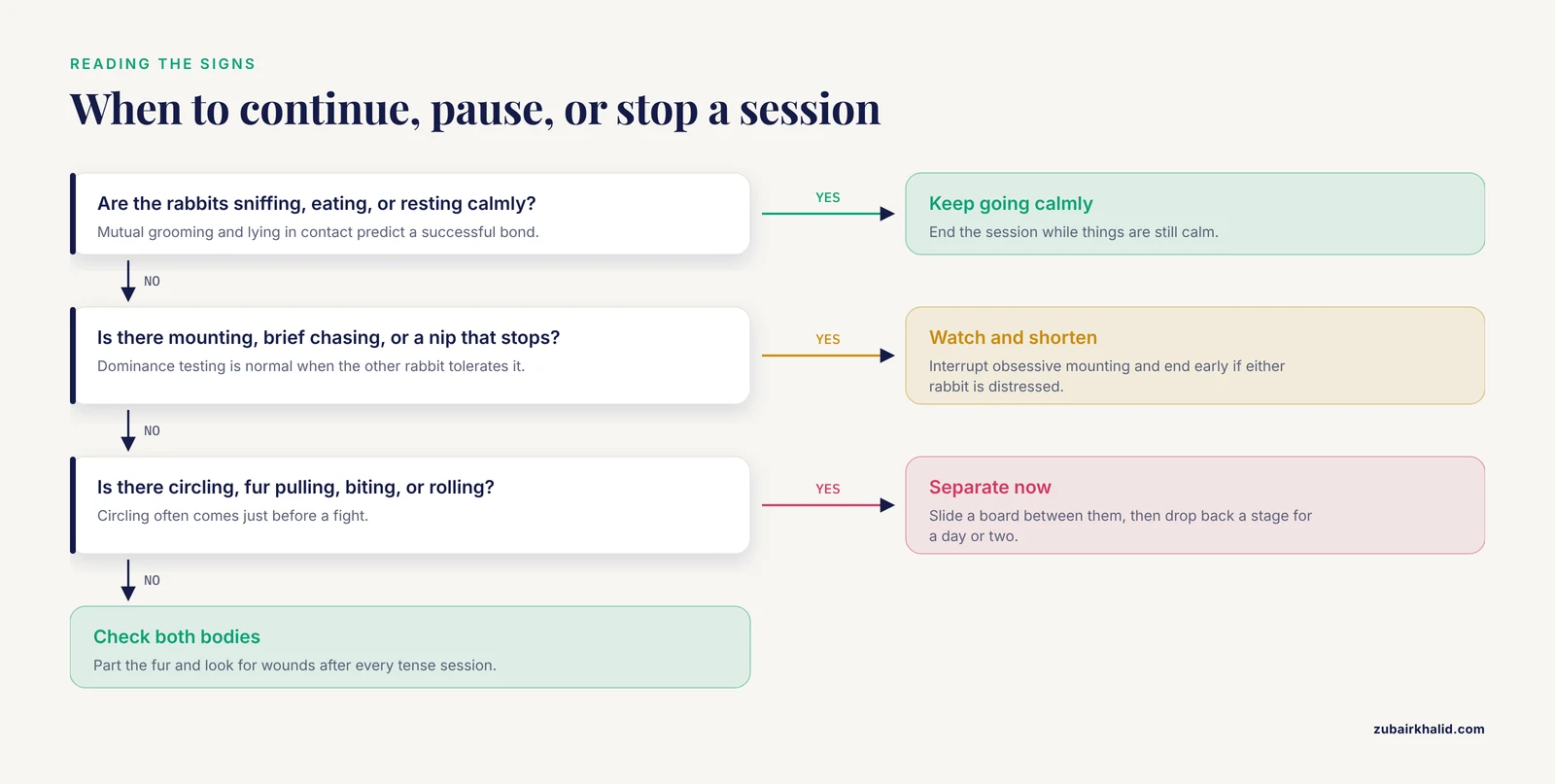
Positive signs: mutual sniffing, ignoring each other, eating side by side, flopping nearby, mutual grooming, and lying in contact. These behaviors predict a successful bond.
Normal but managed: mounting, which is dominance testing and is acceptable when the other rabbit tolerates it calmly, brief chasing without contact, and an occasional nip that stops immediately. Interrupt mounting that becomes obsessive or that clearly distresses the rabbit underneath.
Intervene immediately: circling, which often precedes a fight, sustained chasing, fur pulling, biting, and any fight where rabbits lock together and roll.
Fear signs: thumping, freezing, cowering in a corner, and refusing food. Shorten the next session if you see these.
Step 4: Intervene safely when you must
Never reach bare hands into a rabbit fight. Slide cardboard or a board between the rabbits, or drop a towel over one and lift it away. After a fight, separate the pair completely, give them a day or two to settle, and drop back to the previous stage. A setback handled calmly costs days. A setback pushed through can cost the bond.
Step 5: Extend time and space
Lengthen sessions gradually, from 15 minutes to an hour to several hours, and add hides so either rabbit can opt out. Progress to the next stage only when the pair grooms each other and rests in contact across multiple sessions. If a bond stalls, some experienced rescues use a shared mild stressor, such as a short car ride with both rabbits in one carrier, to reset tension. Discuss this technique with a rabbit-savvy veterinarian first, especially if either rabbit is anxious or elderly.
Step 6: Supervised cohabitation
When the pair reliably grooms and lies together, move them into the permanent enclosure, ideally freshly cleaned or rearranged so it does not smell like either rabbit's territory. Supervise all day and check both bodies morning and night, parting the fur to look at skin. Hands-on checks matter more than most owners realize. In one research colony, female rabbits that appeared compatible through six weeks of daily observations were later found to have skin wounds from occult, largely nocturnal aggression, and the injuries surfaced only when staff clipped fur for a procedure [1]. Watching is not enough.
Step 7: Full-time bonding
Allow overnight time together only after several days of clean body checks. Keep routines, feeding times, and the enclosure layout stable while the bond matures. Continue weekly body checks and regular weight checks for life.
An honest timeline: some pairs bond within days, most need several weeks, and some need months. Do not compress stages to fit a weekend. A serious fight can set a pair back weeks, while patient progression rarely fails without a reason.
Living Together: Preventing Conflict After the Bond
A bonded pair still needs a setup designed for two.
Give duplicates of everything. Competition over food, water, and resting spots is one of the main friction points between cohabiting rabbits, so provide multiple hay piles, bowls, hides, and litter boxes across the enclosure.
Provide room to separate. Even devoted pairs sometimes want distance, and a rabbit that cannot move away will guard space instead.
Monitor health daily. Rabbits hide illness and pain, so track appetite, droppings, posture, and activity, and run a hands-on body check weekly [6]. Weight loss or a drop in droppings is a reason to call your veterinarian.
Keep the pair together at the veterinary clinic when possible. House Rabbit Society guidance recommends bringing a bonded partner along for trips, because separation stresses bonded rabbits and a partner's presence is calming. Ask your veterinarian about this before any hospital stay.
Know when to stop. Injuries, repeated serious fights after months of gradual work, or chronic avoidance with ongoing stress signs mean this pairing is not working. Living side by side in adjacent pens is a humane, permanent alternative that preserves visual and scent contact without risk.
Introducing Rabbits and Other Pets: Dogs, Cats, and More
The prey-animal reality
Rabbits are prey animals, and their bodies treat predator presence as a threat even without contact. In a study using non-invasive stress measures, rabbits that were never handled, but that lived in the same room as rabbits being restrained and sampled, showed a rise in periocular temperature and elevations in fecal cortisol metabolites, mirroring the handled animals, whose stress markers stayed elevated for up to three days [10]. Environmental cues alone, the sounds and smells of a stressful event, were enough. A rabbit living within sight and smell of an excited dog is processing that presence physiologically all day. Design for distance and control, not for photo opportunities.
Rabbits and dogs
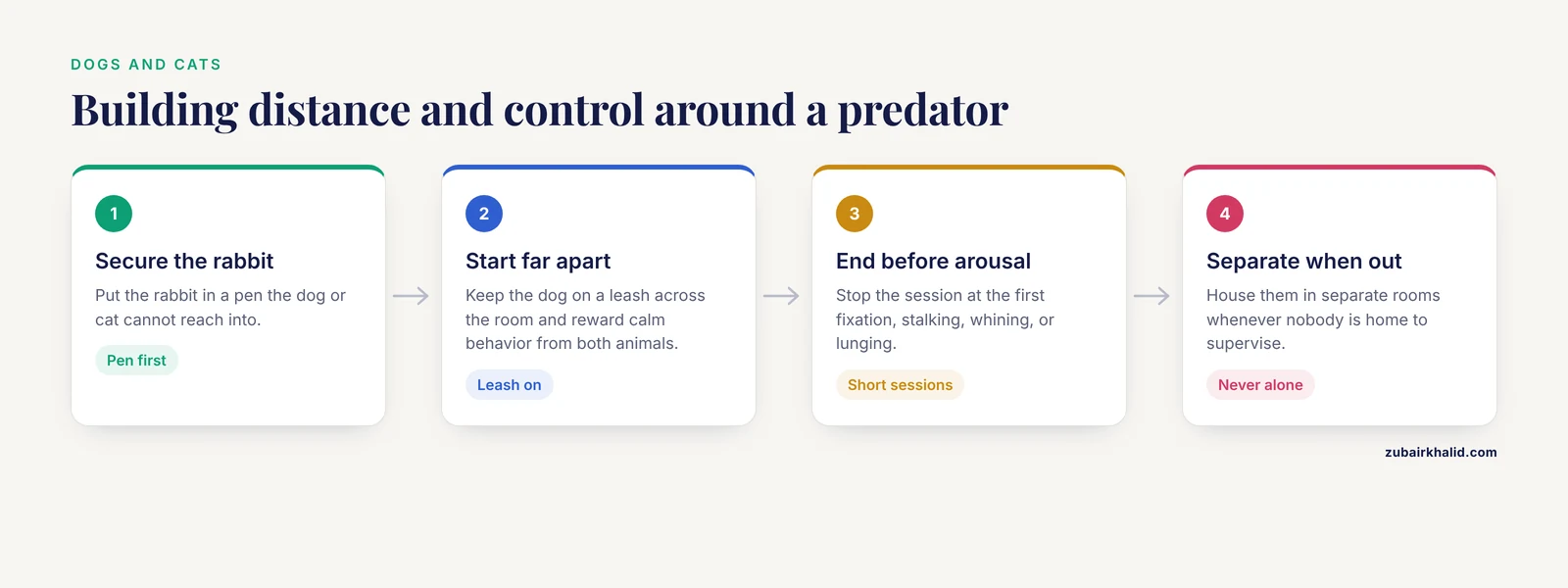
Start with the rabbit in a secure pen and the dog on a leash across the room. Reward calm behavior from the dog and relaxed behavior from the rabbit. Keep sessions short and end before either animal becomes aroused. Watch for fixation, stalking, whining, or lunging, any of which means the distance is too small. Never leave a dog and rabbit together unsupervised, and house them in separate rooms when you are out. AVMA pet owner guidance on multi-pet households reinforces this approach through its emphasis on gradual, supervised introductions. Dogs with strong prey drive should never have direct access to a rabbit, and if you are unsure how your dog will respond, involve a qualified trainer before starting.
Rabbits and cats
Domestic cats retain hunting behavior even when well fed, a point the Cornell Feline Health Center makes in its guidance on indoor cat behavior. Many households reach a peaceful arrangement with a rabbit in a secure pen and a cat that loses interest, but a playful swat from feline claws can cause serious wounds. The rules are simple. Use a pen the cat cannot reach into, supervise every direct interaction, never leave them alone together, and give the cat vertical space away from the rabbit. VCA Animal Hospitals small mammal guidance stresses the same constant-supervision rule for rabbits around predator species.
Ferrets and other predators
Ferrets are predators of rabbits and should never share space with one. Keep them in separate rooms with no direct contact, ever.
Rabbits and guinea pigs
The old tradition of pairing rabbits with guinea pigs is no longer recommended. The Rabbit Welfare Association & Fund advises against it because the two species have different dietary, social, and behavioral needs, and rabbits can bully or injure guinea pigs. If you want a companion for your rabbit, choose another desexed rabbit and follow the bonding process above.
Common Mistakes That Sabotage Rabbit Introductions
- Skipping desexing. Hormones drive territorial aggression, and intact males become seriously aggressive around puberty [3].
- Introducing on home territory. A rabbit defends its own space. Neutral ground removes the map.
- Sessions that run too long, too soon. Fatigue and frustration convert curiosity into conflict.
- Leaving a new pair unsupervised overnight. Most serious injuries happen when no one is watching.
- Trusting observation alone. Hands-on body checks catch wounds that watching misses.
- Providing one of everything. Resource competition turns a workable pair into a fighting one.
- Pushing through red flags. Circling and sustained chasing are instructions to stop, not tests of nerve.
- Giving up after one setback, or never giving up on a truly incompatible pair. Both errors damage welfare. Assess honestly at every stage.
Welfare and Safety: Monitoring Your Pair
Professional rabbit facilities track welfare with structured tools that score physical, behavioral, and environmental categories together [11]. You can borrow the same logic with a simple daily log: appetite, droppings, wounds found on body checks, and a one-line behavior note. Trends catch problems before emergencies do.
Pace the process around recovery. Stress responses in rabbits can outlast the event that triggered them, so build rest days into bonding weeks and end every session on a calm note. Keep hay available constantly, maintain hiding places on both sides of any barrier, and use edible enrichment to keep sessions positive.
Safety rules never relax. No rabbit shares space with a dog, cat, or ferret without supervision. No new pair spends a night alone together until body checks have been clean for days. Keep a carrier ready so either rabbit can be moved quickly in an emergency.
Limitations and When to Contact a Veterinarian
Every pair of rabbits is different, and individual cases need a veterinarian who treats rabbits, ideally one with behavior experience. The process above reflects how successful bonds are built, but your animals' histories and health status can change the plan.
Contact your veterinarian promptly if any of the following occur:
- Any bite, wound, or bleeding, even a small one. Rabbit mouths carry bacteria, and puncture wounds can abscess.
- A rabbit that is not eating, or that has produced no droppings, for 12 hours.
- Lethargy, hunched posture, teeth grinding, or pressing the belly low, all recognized pain signs in rabbits [6].
- Limping, head tilt, or a sudden behavior change.
- Fights that injure either rabbit, or aggression that escalates despite dropping back a stage.
- A rabbit that hides constantly, stops grooming itself, or thumps persistently for days.
For bonds that stall for months, ask your veterinarian for a referral to a behavior-savvy exotics veterinarian or a rabbit rescue with bonding experience. Permanent side-by-side housing is a legitimate outcome, not a failure.
Frequently Asked Questions
Can rabbits live together?
Yes, most rabbits can live together if they are spayed or neutered, matched carefully, and introduced gradually, but not every pairing succeeds. Opposite-sex desexed pairs are the most reliable combination. When a pair never settles, adjacent pens with a shared barrier provide companionship without risk.
How long does the rabbit bonding process take?
Anywhere from days to months, with most pairs needing several weeks. Progress depends on age, hormonal status, previous social experience, and personality. Move at the pace of the more nervous rabbit and expect occasional setbacks.
Do both rabbits need to be spayed or neutered before introductions?
Yes. Hormones drive territorial and sexual aggression, and intact males in particular become seriously aggressive around puberty. Desexing also prevents unwanted litters and carries long-term health benefits your veterinarian can explain.
Where should I introduce two rabbits?
On neutral territory, a room or pen that neither rabbit has lived in or claimed. Introductions on either rabbit's home ground invite defensive aggression. Side-by-side housing before meetings helps both rabbits adjust to each other's scent first.
Is mounting and chasing normal during bonding?
Some is. Mounting is dominance testing, and brief chasing without contact is common early on. Interrupt circling, sustained chasing, fur pulling, or any fight, then drop back to shorter sessions. Check both rabbits for wounds after every tense session.
Can rabbits live with guinea pigs?
No, this pairing is no longer recommended. The Rabbit Welfare Association & Fund advises against it because the species have different dietary and social needs, and rabbits can bully or injure guinea pigs. House your rabbit with another desexed rabbit instead.
How do I introduce my rabbit to my dog or cat?
Start with the rabbit in a secure pen and the dog or cat on a leash at a distance, reward calm behavior, and keep sessions short. Supervision must be constant, and the animals should be separated whenever you are not home. Many dogs and cats should never have direct access to the rabbit at all.
When should I give up on bonding two rabbits?
If serious fights or injuries continue after months of gradual work, or if one rabbit shows chronic stress, separate them permanently. Adjacent pens let rabbits live as neighbors without risk. Ask a rabbit-savvy veterinarian or rescue for help before making the final call.
Sources
- Sequelae of Occult Aggression Disqualifying Young, Socially Housed, Female New Zealand White Rabbits (Oryctolagus cuniculus) from Participation in Dermal Toxicology Studies.
- Pair housing of rabbits reduces variances in growth rates and serum alkaline phosphatase levels.
- Effect of castration on rabbits housed in littermate pairs.
- Method of measuring effects of study procedures in single and pair housed New Zealand White rabbits (Oryctolagus cuniculus).
- The current state of welfare, housing and husbandry of the English pet rabbit population.
- Rabbit care and husbandry.
- In Vivo Acaricidal Effect of Linoleic Acid and Olive Oil Against Psoroptes cuniculi Mites in Experimentally Infested Rabbits.
- Environmental enrichment for laboratory rodents and rabbits: requirements of rodents, rabbits, and research.
- Evaluation of objects and food for environmental enrichment of NZW rabbits.
- Infrared Thermal Imaging and Blood and Faecal Cortisol Measurements for Stress Assessment in Rabbits During Blood Sampling.
- A Welfare Assessment Tool to Harmonize Care and Management for Research Rabbits.