How to Introduce Pet Mice to Each Other and Other Pets
By Dr. Zubair Khalid, DVM, MS, PhD ·

Introduce pet mice to each other slowly, on neutral ground, and with scent swapping before any direct contact. Mice are social animals that generally do better in pairs or small groups, but every introduction carries a real risk of fighting, so the process needs a divider cage, patient scent familiarization, and close supervision at every stage [1]. If you follow a structured plan, most compatible mice accept each other within days to weeks. If you rush it, bites and chronic bullying are common outcomes.
This guide walks you through the full mouse bonding process, from choosing a compatible companion to managing pet mice and other pets such as cats and dogs in the same home.
At a Glance: The Introduction Plan
| Step | What you do | What success looks like |
|---|---|---|
| 1. Health check | Have any new mouse examined by a veterinarian before it meets your current mice | A clean bill of health and confirmed sex |
| 2. Side-by-side housing | Place two cages or a split cage near each other for several days | Mice notice each other without contact and eat and behave normally |
| 3. Scent swapping | Transfer used nesting material and bedding between cages daily | Curious sniffing, no frantic escape behavior |
| 4. Neutral meeting | Let the mice meet in a clean, unfamiliar play area with hiding spots | Brief sniffing and mild chasing that settles quickly |
| 5. Supervised cohabitation | Move both mice into a fully cleaned cage with doubled resources | Shared sleeping or relaxed coexistence within the cage |
| 6. Extended monitoring | Check the pair several times daily for the first weeks | No wounds, no mouse being excluded from food, water, or shelter |
| 7. Permanent bonding | Keep a successful pair together and minimize unnecessary separations | Stable pair or group with normal grooming, nesting, and activity |
Can Pet Mice Live Together?
Yes, pet mice can and generally should live together. Mice are a social species, and pair or group housing is recognized as beneficial for their welfare when the animals are compatible [1]. Research in laboratory settings consistently treats social housing as the default goal because isolated mice show more signs of discomfort, particularly females [2].
That said, compatibility is not automatic. Three realities shape whether your mice can live together:
- Individual temperament matters. Even under highly controlled conditions, researchers find that the personality of each mouse strongly influences how housing goes, and that what works in one setting does not automatically transfer to another [2]. Your mice are individuals, and your plan should flex around them.
- Mixing mice from different backgrounds can increase friction. In studies where unfamiliar mice of different origins were co-housed, researchers observed increased agonistic (aggressive or competitive) behavior and reduced sociability compared with mice housed with familiar partners [3]. Pet shop or rescue mice from different litters fall into this category, which is why introductions must be gradual.
- Males are the harder case. Male mice are territorial, and aggression between adult males is the main obstacle to social housing. Successful strategies identified in research include pairing males before they reach sexual maturity, transferring familiar nesting material between enclosures, removing high-value resources that trigger territorial defense, and using calm, low-stress handling [1]. In one 28-day compatibility study, young male mice paired before maturity showed no fighting severe enough to require separation, even under stressful handling and housing routines [1].
The practical takeaway is that can pet mice live together has a yes-with-conditions answer. Females from compatible backgrounds usually integrate well. Males have the best odds when paired young, introduced gradually, and given enough space and resources.
Preparing to Introduce a New Mouse
Choose the right companion
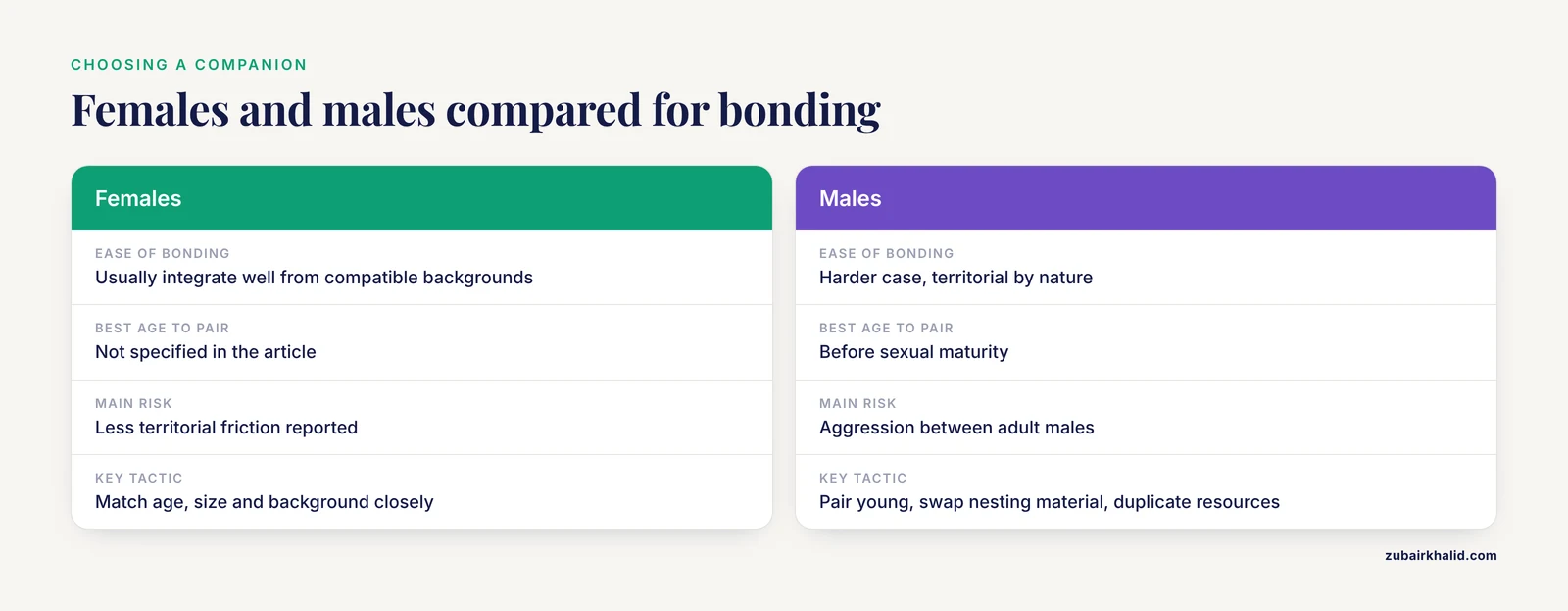
Match age, size, and background as closely as you can. A juvenile mouse paired with an adult has a better outcome than two unfamiliar adult males meeting for the first time, because pairing before sexual maturity measurably reduces territorial aggression [1]. Confirm the sex yourself and have your veterinarian confirm it as well. Accidentally adding an unneutered male to a female group produces litters, and a mis-sexed female in a male cage risks serious fighting.
Gather the right equipment
- A divider or split cage. A tank or cage divided by sturdy hardware mesh or a double-layered barrier lets mice see and smell each other with zero risk of bites. This is the safest starting point for introducing a new mouse.
- A second water bottle and extra food stations. High-value, defensible resources encourage guarding and territorial behavior, so duplicating food and water sources before cohabitation is one of the tactics shown to reduce aggression [1].
- At least one hiding house per mouse, plus one spare. Multiple refuges prevent a mouse from being cornered. Enrichment through hiding structures, nesting material, and varied cage furniture is considered fundamental to welfare even in the most controlled research environments [4], and a good life for mice means being able to express a full behavioral repertoire, which requires room and structures to do so [5].
- Paper-based bedding and nesting material. Soft nesting material serves both comfort and scent exchange. Paper pulp bedding is also associated with favorable microenvironment conditions in mouse housing studies [6].
- A large neutral play area. A bin or playpen that neither mouse has claimed, cleaned and rearranged before each session, so neither animal perceives it as home territory.
- Unscented cleaning supplies and spare gloves. Scent control matters more than most owners realize, which the next section explains.
Understand how much scent drives mouse behavior
Mice communicate largely through smell. Scent carries information about genetic identity, physiological status, and alarm, and odors from other animals can trigger measurable physiological and behavioral responses in mice [7]. This cuts both ways during introductions. Familiar scents from a future cage mate, transferred as used nesting material, are one of the documented tools for reducing aggression between males [1]. Foreign and predator-associated scents, on the other hand, can provoke stress responses [7]. Handle your mice with clean hands, keep their cages away from strong foreign animal odors, and treat scent exchange itself as a deliberate part of the bonding process.
The Mouse Bonding Process, Step by Step
Step 1: Quarantine period and veterinary check
Before introducing a new mouse to your existing mice, keep the newcomer in a separate cage in a separate room and schedule a veterinary examination. A new mouse can carry respiratory infections, parasites, or skin disease that shows no outward signs at purchase, and respiratory and skin conditions are among the most common spontaneous disease problems reported in mice [8]. Your veterinarian can advise on an appropriate observation period and any screening for your situation.
Step 2: Side-by-side familiarization
Place the two cages close enough that the mice can see and smell each other but cannot touch. Watch how each reacts. Relaxed eating, normal grooming, and calm investigation are good signs. Constant bar-barring, frantic pacing, or lunging at the barrier means slow down and give them more days apart.
Step 3: Scent swapping
Once both mice seem calm at the barrier, begin transferring small amounts of used nesting material between the cages each day, and also swap a small amount of bedding. This mirrors the technique used successfully in research settings, where moving used nesting material between enclosures during cage changes helped male mice remain compatible [1]. Expect increased sniffing at first. That is normal. What you want to see over several days is indifference, meaning each mouse treats the other's smell as part of the landscape.
Step 4: First neutral-territory meetings
Set up a roomy play bin with a shallow layer of fresh bedding, a hide at each end, and a scatter of food so there is no single contested resource. Place both mice in at the same time, from opposite sides, and stay present the entire session. Keep the first sessions short.
Normal behavior includes mutual sniffing, brief chasing, one mouse pinning the other briefly, and mounting, which is a dominance display rather than mating behavior in this context. Interrupt only true fights, described in the troubleshooting section below. End every session on a calm note rather than after a scuffle, so the last impression is neutral.
Step 5: Supervised cohabitation
When neutral meetings stay calm, clean the main cage thoroughly, rearrange the interior completely so no scent map says "this is mine," provide duplicate bottles, wheels, and hides, and place both mice in together. Watch continuously for at least the first hour and check frequently after that. Rearranging the cage removes each mouse's territorial scent marks and gives both animals an equally unfamiliar space, which reduces the home-cage advantage one mouse would otherwise hold [1].
Step 6: Extended monitoring
Check the pair several times daily for the first two weeks and at least daily afterward. Look for wounds around the tail base and rump, a mouse that huddles alone in a corner, guarding of the food bowl, or one mouse losing weight because the other controls resources. Weighing each mouse weekly with a small scale is an objective way to catch resource guarding before it becomes a health problem.
Step 7: Settling into a stable bond
Once the mice sleep together, groom each other, and nest as a unit, the bond is established. From that point, protect it. Research shows that even routine husbandry can disturb a stable group, which is why keeping some familiar nesting material in the cage during cleaning is a recognized aggression-reduction tactic [1]. When you clean the cage, return a portion of the old, unsoiled nesting material so the group scent persists. Avoid separating bonded mice for long periods, because reintroductions restart the whole process and can go worse the second time.
Recognizing Acceptance Versus Aggression
| Behavior | What it means | What to do |
|---|---|---|
| Mutual sniffing, following | Normal investigation | Let it continue |
| Brief chasing, pinning, mounting | Dominance sorting | Monitor, only intervene if it escalates |
| Loud squealing with a pinned mouse | Escalating conflict | Separate with a divider or cup, not your hands |
| Bites drawing blood, torn ears, tail wounds | Real fighting | Separate immediately and return to earlier steps |
| One mouse always hiding, not eating, weight loss | Chronic bullying | Separate permanently, this pairing may not work |
| Sleeping together, allogrooming, shared nesting | Bonded | Maintain the pair, protect their scent environment |
A useful benchmark from research is that compatibility is judged over time, not in one session. In the 28-day male pairing study, success was defined as no pair ever needing separation, assessed across weeks of shared housing and routine disturbances [1]. Give your mice the same standard. Two mice that tolerate each other for a week can still be genuinely bonded, or still merely avoiding conflict, so keep checking body condition and wounds through the first month.
Common Mistakes and Troubleshooting
Mistake 1: Skipping scent swapping. Going straight from barrier to physical contact removes the gradual familiarization that makes introductions work. The nesting-material transfer technique exists in the research literature precisely because it lowers aggression [1].
Mistake 2: Introducing on home territory. Placing a new mouse into the established cage means the resident defends its territory immediately. Neutral ground first, cleaned home cage second.
Mistake 3: Too few resources. One wheel, one bottle, or one hide creates a defensible prize. Territorial guarding of high-value items is a documented driver of male mouse aggression, and removing such items is a listed mitigation [1]. Duplicate everything.
Mistake 4: Trusting store sexing. Re-verify sex before any mixed-sex exposure.
Mistake 5: Repeating failed introductions identically. If a pairing fails after proper gradual steps, some mice simply never accept each other. The influence of individual temperament on social outcomes is well documented, even among mice of the same strain and origin [2]. Have a second cage ready and be willing to house the mouse separately with extra enrichment rather than forcing a dangerous pairing.
Mistake 6: Fighting after an injury or illness. If one mouse has been at the veterinarian, smells of clinic odors, or has returned from a stay elsewhere, expect the pair to be unsettled. Scent disruption is a genuine trigger in mice [7]. Reintroduce gradually using the same scent-swap steps, and use your judgment about whether the pair can return to the shared cage safely.
What if a fight happens? Never reach in with your hand. Use a cup, a piece of cardboard, or a dust-free spray of air to separate them. Assess both mice for wounds, then house them apart and step back to the scent-swapping stage. Fighting that draws blood means the pair needs a longer reset or permanent separation.
Pet Mice and Other Pets in the Same Home
Cats and dogs
Cats and dogs are predators, and mice respond to predator-associated odors with strong fear reactions and elevated stress. A well-known experimental trigger for mouse fear responses is a synthetic analog of fox feces, which reliably produces avoidance and stress behavior [9]. Even if your cat never touches the mouse cage, the smell of a predator nearby is itself a stressor for small prey species.
Practical rules for pet mice and other pets:
- House mice in a room your cat and dog cannot enter, or at minimum place cages on sturdy, elevated furniture well away from cat reach and dog noses.
- Wash your hands and change sleeves after handling cats or dogs before handling your mice. Cross-species scent transfer between animal areas is common even in professional facilities, where staff practices around glove changing and species separation vary widely, and professionals recognize that scents from other species, notably rats, affect mice [7].
- Never allow free interaction. A mouse escaped from its cage in a room with a dog or cat is a life-threatening emergency, and even a playful swat can be fatal.
- Secure the cage against tipping and bar-chewing predators. Cages designed for small rodents are not built to withstand a determined cat or dog leaning on them.
One reassuring note from the research is that not every human-associated odor frightens mice. In controlled testing, mice showed clear fear responses to a fox-feces analog but no significant fear response to human urine odor, suggesting that routine, calm human presence is not inherently frightening to them [9]. The species to manage carefully around your mice are the predatory ones.
Other rodents and small pets
Mice and rats should never share a cage. Rats are larger and can injure or kill mice, and the scent of rats alone can affect mouse behavior and physiology [7]. Rabbits, guinea pigs, hamsters, and gerbils have different dietary, environmental, and social needs and should not be co-housed with mice. If you keep multiple species, give each species its own room or well-separated zone, use species-specific cleaning equipment, and wash hands between species.
Handling visitors and other animals' scents
If a friend's pet visits, or your dog comes back from the park smelling of other animals, delay mouse handling until you have washed thoroughly. Between 18 and 33 percent of animal facility staff surveyed in the United Kingdom believed human and non-human animal odors strongly affect mouse behavior, and the survey documented wide variation in scent-control practices between facilities [7]. Applying that standard at home costs nothing and reduces background stress in your mice.
Welfare and Safety Points
- Social contact is enrichment. Social housing counts as enrichment in its own right, alongside environmental enrichment, dietary variety, and improved husbandry [4]. A bonded companion is one of the best welfare investments you can make for a mouse.
- Aim beyond minimum care. Animal welfare specialists argue that mice should be given conditions that let them express a rich behavioral repertoire, use their abilities, and actively engage with their environment, not merely survive [5]. For pet owners this means deep bedding for digging, nesting material, climbing structures, foraging opportunities, and a companion.
- Monitor systematically. Welfare professionals identify structured, frequent monitoring as a key area for improving mouse care [10]. Build a daily habit: watch activity, posture, coat condition, breathing, eating, and droppings, and weigh weekly.
- Keep the cage environment stable. Frequent full cleanouts unsettle group scent. Longer intervals between bedding changes have been evaluated in research settings with acceptable microenvironment results when appropriate bedding is used, but your cage size and mouse number determine what is safe, so spot-clean soiled areas and discuss a cleaning schedule suited to your setup with your veterinarian [6].
- Never house mice with predator species or leave cages within a predator's reach, for the scent and safety reasons covered above [7][9].
Limitations and When to Contact a Veterinarian
Every introduction is different, and individual temperament, age, sex, and past social experience all shape the outcome, so what works for one pair may fail for another [2]. This article is educational and is not a substitute for veterinary diagnosis or treatment. Find an exotic pet or small mammal veterinarian before you start, not after a problem appears.
Contact a veterinarian promptly if any of the following occur:
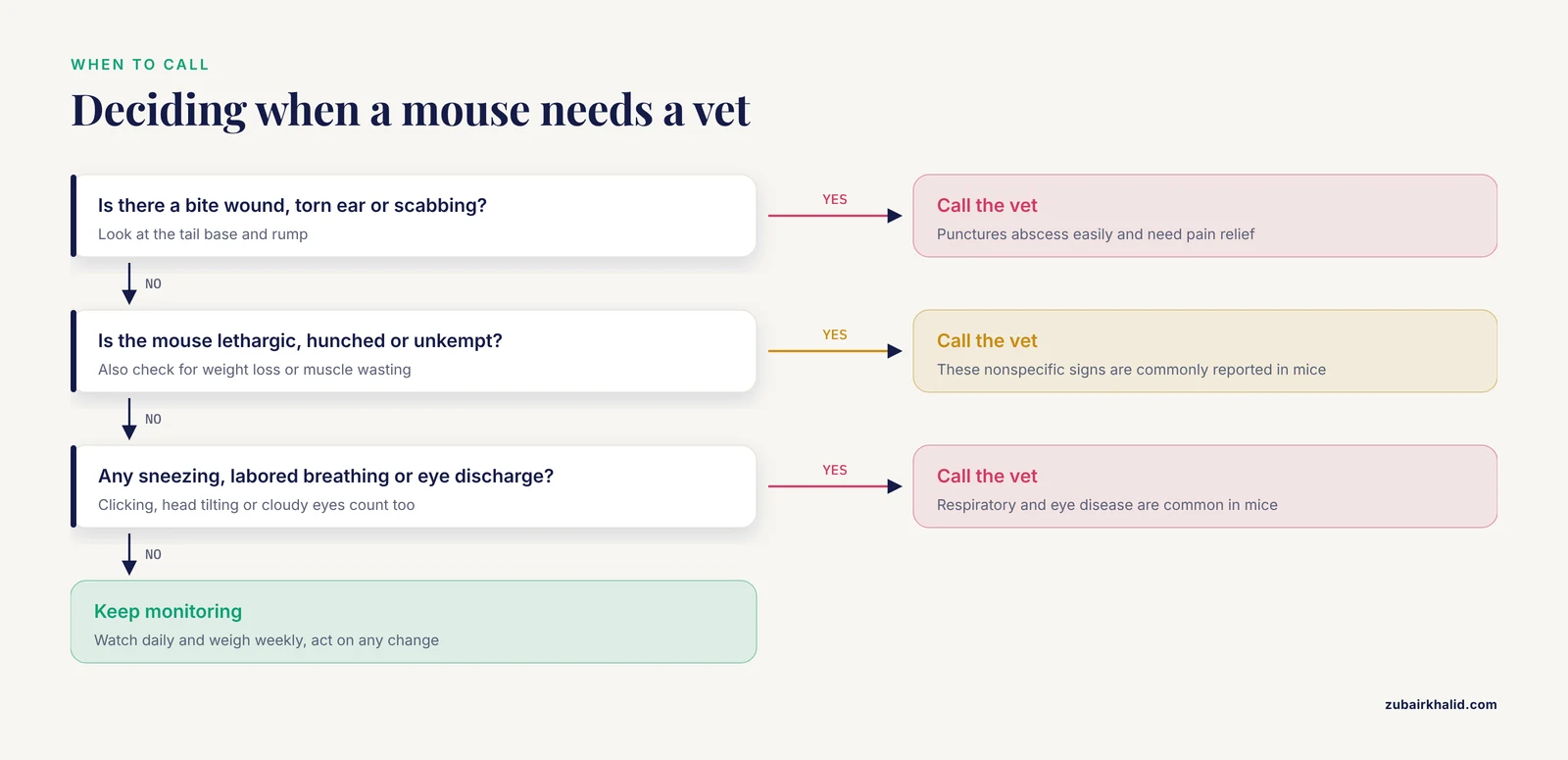
- Any bite wound, bleeding, torn ear, or scabbing on the tail or rump. Even small punctures abscess easily in mice. Pain management in mice, including non-steroidal anti-inflammatory drugs such as meloxicam, is best directed by a veterinarian, because effective dosing varies considerably with the individual and the situation [11].
- Lethargy, hunched posture, a rough or unkempt coat, or muscle wasting. These nonspecific signs are among the most commonly reported clinical problems in mice and are easy to miss in a group setting [8].
- Sneezing, clicking or labored breathing, discharge from the eyes or nose, or head tilting.
- Visible weight loss in one mouse, which signals resource guarding or illness.
- Eye abnormalities such as cloudiness, squinting, or discharge, since ocular disease is a documented common problem in mice and regular eye checks are recommended as part of good veterinary care [12].
- Persistent fighting despite restarting the introduction process, which means the pair should be separated permanently for welfare reasons.
- Aged mice showing new lumps, reduced mobility, or declining condition, which warrant enhanced monitoring and veterinary review because older mice develop progressive conditions that need individualized care decisions [13][14].
Frequently Asked Questions
Can pet mice live together?
Yes, mice are social animals and generally thrive in same-sex pairs or small groups, with pair or group housing recognized as a welfare benefit for compatible animals [1]. Females usually adjust most easily. Males do best when paired young, introduced gradually, and given duplicate resources, and some individual males may never accept a companion.
How long does introducing a new mouse take?
Plan on days to weeks, not a single session. Most successful introductions move through scent swapping, neutral-territory meetings, and supervised cohabitation over one to three weeks, and stability is only confirmed after several weeks without fighting. Rushing any stage is the most common cause of failure.
Can adult male mice live together?
Sometimes, but they are the most difficult pairing. Adult male mice are territorial, and the documented strategies for success include pairing before sexual maturity, transferring used nesting material between cages, removing high-value items, and calm handling [1]. Two unfamiliar adult males often cannot be safely bonded, and forcing it risks serious injury.
What signs show my mice are bonded?
Bonded mice sleep curled together, groom each other, share nests, and move calmly around each other without chronic chasing. A stable pair eats side by side and shows no wounds or weight disparities. Once bonded, protect the relationship by keeping familiar nesting material in the cage during cleanings and avoiding unnecessary separations [1].
Why are my previously peaceful mice fighting now?
Sudden fighting usually follows a scent or health disruption, such as a veterinary visit, a full cage cleanout, the return of a mouse from elsewhere, or one mouse becoming ill and smelling different to its companion. Foreign and unfamiliar odors measurably alter mouse social behavior [7]. Restart with scent swapping and supervised time before returning them to the shared cage, and rule out illness with your veterinarian.
Can pet mice and other pets like cats and dogs share a home?
Yes, with strict separation. Predator odors alone trigger fear and stress responses in mice, and direct contact from a cat or dog is usually fatal [9]. Keep mice in a predator-proof cage in a room other pets cannot access, and wash your hands after handling cats, dogs, or other animals before touching your mice [7].
What should I do if a mouse is injured during an introduction?
Separate the mice immediately using a cup or barrier, never your bare hands, and examine the injured mouse for punctures. Any bite wound needs veterinary attention, because small punctures commonly abscess, and appropriate pain relief such as meloxicam should be prescribed and dosed by a veterinarian rather than guessed at home [11].
Do mice get lonely living alone?
Mice are a social species, and single housing is considered a source of discomfort and reduced welfare, particularly for females [2]. If your mouse truly cannot live with others, compensate with substantial enrichment, daily interaction, and foraging opportunities, and discuss your specific situation with a small mammal veterinarian.
Sources
- Social Housing of Male CD-1 Mice (Mus musculus) in the Toxicological Setting: A 28-Day Social Compatibility Study of Male Mice following Oral Gavage of Theophylline.
- Laboratory conditions matter: social housing in male and female laboratory mice in a multicenter study approach.
- Not all mice are alike: Mixed-strain housing alters social behaviour.
- Environmental enrichment of laboratory animals used in regulatory toxicology studies.
- A Good Life for Laboratory Rodents?
- Analysis of Individually Ventilated Cage (IVC) Microenvironments During 21-d Cage Change Frequency for Mice Using Two Different Bedding Types.
- Olfaction variation in mouse husbandry and its implications for refinement and standardization: UK survey of animal scents.
- Incidence rates of spontaneous disease in laboratory mice used at a large biomedical research institution.
- Lack of fear response in mice (Mus musculus) exposed to human urine odor.
- A Survey of Laboratory Animal Veterinarians Regarding Mouse Welfare in Biomedical Research.
- Administration of meloxicam to improve the welfare of mice in research: a systematic review (2000 - 2020).
- Prevalence and management practices of ophthalmic lesions in laboratory mice.
- Progressing the care, husbandry and management of ageing mice used in scientific studies.
- Practical pathology of aging mice.