How to Introduce Hedgehogs to Each Other and Other Pets
By Dr. Zubair Khalid, DVM, MS, PhD ·

Hedgehogs are solitary animals, and the safest answer to most introduction questions is a slow, supervised process with realistic expectations. When introducing a new hedgehog to your home, give it a quiet, warm, separate enclosure for the first several days, then build trust through short, calm handling sessions. When hedgehogs meet each other or meet dogs and cats, every interaction should be brief, neutral, and closely watched, because a hedgehog's main defenses are its spines and its ability to ball up, while a dog or cat's instinct to investigate can injure a hedgehog in seconds. Co-housing two hedgehogs in one cage is rarely appropriate, and the Merck Veterinary Manual notes that African hedgehogs are solitary and are best housed alone in captivity.
This guide walks you through the whole process: whether hedgehogs can live together, how to introduce hedgehogs to each other step by step, the hedgehog bonding process with people, and how to manage hedgehogs and other pets in the same household.
At a Glance: Hedgehog Introduction Rules
| Step | What to Do | Key Point |
|---|---|---|
| 1 | House the new hedgehog alone in a quiet room | Hedgehogs are solitary and stressed by constant company |
| 2 | Quarantine the newcomer | Keep a new hedgehog separated from any existing pets and wash hands after handling |
| 3 | Schedule a wellness exam | Ask an exotics veterinarian to check for mites, ringworm, and other problems before any contact |
| 4 | Swap scents first | Exchange bedding or a used hide between enclosures before any visual or physical meeting |
| 5 | Use neutral territory | First hedgehog-to-hedgehog meetings happen on neutral ground, never inside either cage |
| 6 | Keep sessions short | A few minutes is enough for a first meeting, end on a calm note |
| 7 | Watch body language | Hissing, clicking, spines raised, or a tightly balled hedgehog means stop |
| 8 | Never force contact | Do not push a hedgehog toward a dog, cat, or another hedgehog |
| 9 | Supervise every pet interaction | One unsupervised moment can cause serious injury |
| 10 | Have separate housing as the default | Shared cages are the exception, not the goal |
Can Hedgehogs Live Together?
The short answer is that most hedgehogs should not. The Merck Veterinary Manual describes African hedgehogs as solitary and states that captive hedgehogs are best housed alone, with males kept separately to avoid fighting, and even females that are grouped together can show aggression. This is not a species that forms social bonds with cage mates the way guinea pigs do. Company is more often a source of chronic stress than comfort.
There are a few situations owners ask about:
- Two adult males. These should not share a cage. Fighting between males can cause serious bite wounds, and injuries are common when males are housed together.
- Two adult females. Some experienced keepers manage female pairs or small groups, but aggression can still occur even among females, so any shared housing requires constant monitoring and a backup cage ready at all times.
- A male and a female. Housing them together means breeding. If you do not intend to breed, do not house them together. Unplanned litters are common and females can be bred again very soon after giving birth.
- A mother and her litter. This works only on the mother's terms. The Merck Veterinary Manual warns that adults, including the mother, may injure or cannibalize young hedgehogs, especially if there is disturbance, crowding, or a shortage of food and water. Separate litters from the mother at the age your veterinarian or breeder advises, and never leave other adult hedgehogs near babies.
Two practical points drive the decision more than anything else. First, each hedgehog needs its own wheel, hide, food bowl, and water, and cages need real separation so the animals cannot injure each other through cage bars. Second, shared space makes it hard to monitor who is eating, whose droppings are normal, and whether one animal is bullying the other. If you cannot observe and separate instantly, do not co-house.
If you are determined to try a female pair, discuss it with an exotics veterinarian first, start with a large cage with duplicate resources and multiple hides, and accept that separation may become permanent at any time. Many owners find that the effort of managing co-housed females exceeds the benefit, since the animals do not seek each other's company.
How to Introduce Hedgehogs to Each Other
If you want your hedgehogs to tolerate shared playpen time or a controlled introduction, treat it as a supervised activity rather than a housing plan. Here is a step-by-step approach.
Step 1: Confirm the Introduction Is Needed
Ask what you actually want. If the goal is two hedgehogs living happily in one cage, the evidence says that is unlikely and risky. If the goal is for two hedgehogs to tolerate each other during short, supervised play sessions, that is achievable for some pairs, especially calm females. Knowing your goal keeps you from pushing past what the animals can handle.
Step 2: Quarantine and Health Screening
Keep a new hedgehog in a separate room, with separate supplies and hand washing before and after handling, until a veterinarian has evaluated it. Hedgehogs can carry ringworm and the salmonella bacterium without looking sick, and both can spread to people and to other animals. Skin mites are also common in hedgehogs and can spread between animals. A wellness exam with an exotics veterinarian before any contact protects everyone in the house, including your other pets.
Step 3: Swap Scents
Scent is how hedgehogs recognize their world. Before any face-to-face meeting, place a small piece of used bedding or a fabric square from one hedgehog's cage into the other's enclosure, and repeat the exchange over several days. If either animal reacts with prolonged hissing, persistent spine raising, or refusal to settle, give them more days of scent-only exposure before moving on.
Step 4: Hold Side-by-Side Viewing
Place the two enclosures or carry crates near each other so the hedgehogs can see and smell each other without touching. Keep these sessions short and calm, and watch for the body language described in the next section. Relaxed exploring is a green light for the next step. Balled-up posture that never relaxes is a signal to slow down.
Step 5: Hold Neutral-Territory Meetings
The first physical meeting should happen on neutral ground, such as a clean playpen or a bathtub neither animal associates with its own territory. Have thick gloves or a rolled towel nearby for safe separation. Place the animals at opposite ends, let them approach at will, and plan to end after just a few minutes. End every session while things are going well rather than waiting for a fight.
Step 6: Read Body Language and Stop Early
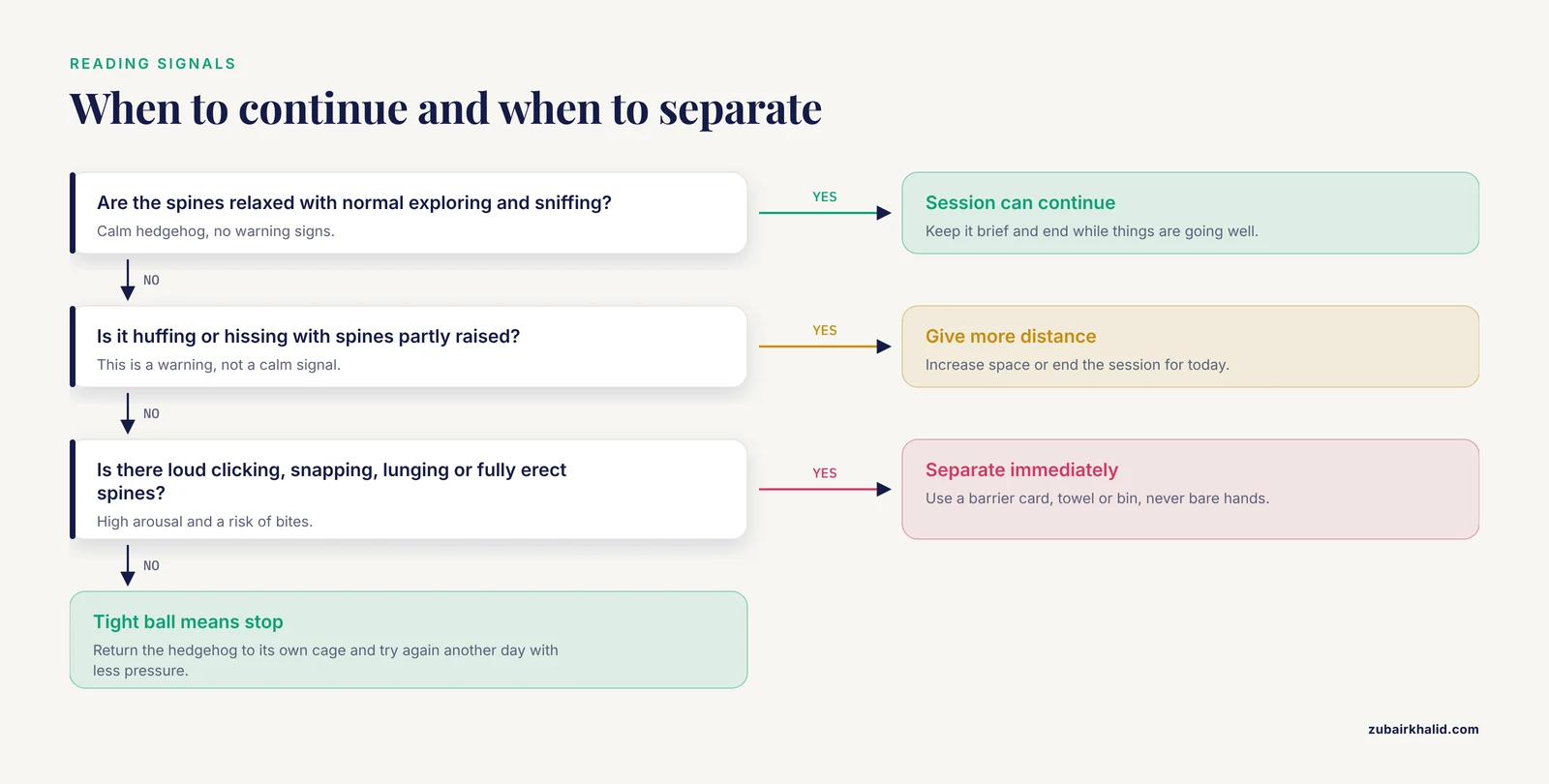
Hedgehogs broadcast their mood clearly if you know what to look for. The Merck Veterinary Manual describes defensive behaviors including hissing, clicking sounds, erect spines, and rolling into a tight ball when a hedgehog is threatened or agitated. Interpret them this way:
- Relaxed spines, normal exploring, sniffing. Calm. The session can continue briefly.
- Huffing or hissing, spines partially raised. Warning. Give more distance or end the session.
- Loud clicking or snapping, lunging, spines fully erect. High arousal. Separate immediately and calmly.
- Tight ball that does not relax. Overwhelmed. Return the animal to its own cage and try again another day with less pressure.
Bites between hedgehogs can be serious, so never use bare hands to separate two aggressive animals. Use a barrier such as a cardboard box, a towel, or a plastic bin slid between them.
Introducing a New Hedgehog to Your Home and Building a Bond
The hedgehog bonding process is less about your hedgehog accepting other animals and more about it learning that you are safe. Hedgehogs are nocturnal, so plan interactions for the evening when the animal is naturally awake and alert. VCA Animal Hospitals notes that hedgehogs are shy by nature and need patient, gentle, regular handling to become comfortable with people.
A workable bonding plan looks like this:
- Give the newcomer several quiet days. Let your hedgehog eat, drink, run on its wheel, and sleep without handling. This lets it map its cage and feel secure.
- Let it learn your scent. Rest a worn, unwashed t-shirt or a piece of your bedding near (not inside) the hide so your smell becomes familiar.
- Offer your hand in the cage. Place a flat, open hand in the enclosure and let the hedgehog sniff and step onto it. Do not grab from above, which mimics a predator.
- Start short lap sessions. Sit with the hedgehog on your lap inside a small enclosed area for five to ten minutes. Expect a balled-up hedgehog at first. Speak softly, stay still, and let it unball on its own.
- Build duration gradually. Over weeks, extend sessions and add gentle exploration on the floor in a hedgehog-proofed room.
- Expect quilling. Young hedgehogs go through quilling phases as adult spines come in, and they can be grumpier during this period. Shorten sessions rather than stopping handling altogether, and ask your veterinarian to check that the spine loss is quilling and not mites or skin disease.
Puffing, huffing, and an occasional balled-up session are normal during the hedgehog bonding process and do not mean you have failed. Consistency, calm hands, and predictable handling matter far more than any single session.
Hedgehogs and Other Pets: Dogs, Cats, and Small Animals
Many owners keep hedgehogs alongside dogs and cats successfully, but hedgehogs and other pets should never interact unsupervised. A hedgehog's spines protect it against many casual sniffs, but they do not protect it from a determined bite to the face, a shake, or a paw injury, and cats in particular may treat a moving hedgehog as prey.
Dogs and Hedgehogs
Keep your dog on a leash or under firm control during any first exposure. Many dogs show intense interest in hedgehogs because of their smell and movement. Let the dog observe from a distance while your hedgehog is in its closed cage or a secure carrier. Reward calm behavior. Only progress to closer viewing when the dog can remain relaxed. Never allow a dog to paw at, mouth, or bark at a hedgehog, and never leave them in the same room unsupervised. Dogs that have caught or injured small pets before should not meet the hedgehog at close range at all.
Cats and Hedgehogs
Cats usually respond with cautious curiosity, but a swat from a cat's claws can injure a hedgehog's face and eyes, and a cat's persistent stalking is stressful even without contact. Keep first exposures through a closed cage or playpen bars the cat cannot reach through. Watch for the cat's crouch-and-stalk posture, which is a signal to end the session. As with dogs, supervise every interaction permanently.
Ferrets and Other Predatory Pets
Ferrets are predators with a strong prey drive and are not appropriate companions for hedgehogs under any circumstances. Keep them fully separated. Rabbits, guinea pigs, and other small herbivores are less directly dangerous, but they have different temperature, diet, and disease considerations, and a startled hedgehog's spines can injure them too. Separate housing and separate play times are the clean solution.
Hygiene Between Species
Handle your hedgehog and then clean your hands before touching other pets or food, because hedgehogs can carry salmonella and ringworm that infect humans and other animals. If a dog or cat licks or contacts hedgehog droppings or bedding, clean up promptly and mention it to your veterinarian at your pet's next visit. The Merck Veterinary Manual identifies salmonellosis and dermatophytosis (ringworm) as diseases of concern in hedgehogs, and both are zoonotic.
Equipment and Supplies for Safe Introductions
You do not need specialized gear, but a few items make introductions dramatically safer:
- A second complete cage. Every hedgehog needs its own enclosure, wheel, hide, food, and water, both as a default and as an escape plan if a co-housing attempt fails.
- A playpen or neutral meeting space. A clean, shallow-walled playpen or a bathtub works for neutral-territory meetings. Check for escape routes, since hedgehogs are surprisingly persistent climbers and squeezers.
- Thick gloves or a rolled towel. For emergencies only. Routine handling should be bare-handed so your hedgehog learns your scent.
- A barrier card or box. Something flat you can slide between two hedgehogs instantly if a meeting turns hostile.
- Secure hides in each cage. A stressed hedgehog needs the option to retreat, and a hide lowers background stress before you ever start introductions.
- Thermometer and heat source. Hedgehogs are sensitive to temperature. Environments that are too cool can trigger an attempted hibernation, which is dangerous for African hedgehogs, and excessive heat causes heat stress. Verify temperatures in every room where a hedgehog spends time, including the introduction space.
- Separate cleaning supplies. Dedicated sponges, scoops, and buckets for each cage reduce disease transfer during quarantine and afterward.
Common Mistakes Owners Make
- Assuming two hedgehogs need a friend. Solitary species do not get lonely the way social species do. A hedgehog with adequate space, a wheel, and daily human interaction is not suffering from the lack of a cage mate.
- Skipping quarantine. New hedgehogs can carry mites, ringworm, or salmonella without visible signs. Quarantine plus a veterinary exam is the standard safeguard.
- Introducing animals on one animal's territory. A hedgehog in its own cage will defend it. Use neutral ground for meetings.
- Letting sessions run too long. Fatigue and overstimulation turn curiosity into aggression. Short and successful beats long and chaotic.
- Reading a balled hedgehog as cute. Balled up means scared. Repeated forced handling that ends in balled-up fear teaches the hedgehog that humans are threatening, which slows the bonding process.
- Trusting a dog or cat "for just a minute." Most hedgehog injuries from other pets happen in brief unsupervised moments.
- Ignoring the nocturnal schedule. Waking a hedgehog during its sleep window for introductions adds stress and makes defensive behavior more likely.
- Handling with gloves all the time. Gloves are for emergencies and for handling unfamiliar animals. Your hedgehog bonds to your scent, and constant gloves interfere with that.
Troubleshooting Introduction Problems
My hedgehog huffs at everything new. Huffing is a normal warning vocalization. Slow down, increase distance, shorten sessions, and give more scent-only days. Some hedgehogs are simply more cautious than others, and caution is temperament, not failure.
One hedgehog keeps attacking the other. Stop co-housing attempts permanently. Some individual pairs never tolerate each other, and repeated fighting risks real injury. House them separately and enjoy them individually.
The new hedgehog stays balled up for days. Give it more time in a quiet room. If refusal to unball lasts beyond the first week, if the animal will not eat, or if you notice flaky skin, quill loss beyond normal quilling, or droppings that are persistent diarrhea rather than normal formed droppings, book a veterinary exam.
My dog cannot settle around the cage. Manage the dog with exercise before sessions, use barriers, and reward calm behavior. If the dog remains fixated or aggressive, keep them permanently separated and consult a professional dog trainer. The hedgehog's welfare comes first.
My hedgehog was injured by another animal. See the section below. Wounds, even small ones, need veterinary assessment because bite wounds commonly become infected.
Welfare and Safety Points
- Hedgehogs are nocturnal. Schedule all introductions and handling for their active hours in the evening.
- Temperature control matters before, during, and after introductions. A cold room can trigger a dangerous hibernation attempt and excessive heat causes heat stress, so verify the temperature of any space you use.
- Every hedgehog needs its own enclosure, wheel, and resources. The default answer to "can hedgehogs live together" is no, and shared housing is a carefully managed exception at best.
- Wash hands before and after handling, and keep hedgehog supplies away from human food areas, because of the risk of salmonella and other zoonotic organisms.
- Supervision is permanent. A hedgehog and a dog or cat may coexist peacefully for months and still have a bad moment. Your presence is the safety mechanism.
- Handle with quiet, low movements. Hedgehogs rely on senses of smell and hearing, and a calm voice and slow hands shorten the hedgehog bonding process more than anything else.
Limitations and When to Contact a Veterinarian
This article is educational and is not a substitute for veterinary diagnosis or treatment. Individual hedgehogs vary widely in temperament and health, and a veterinarian experienced with exotic companion mammals should guide decisions about co-housing, health screening, and any medical problem.
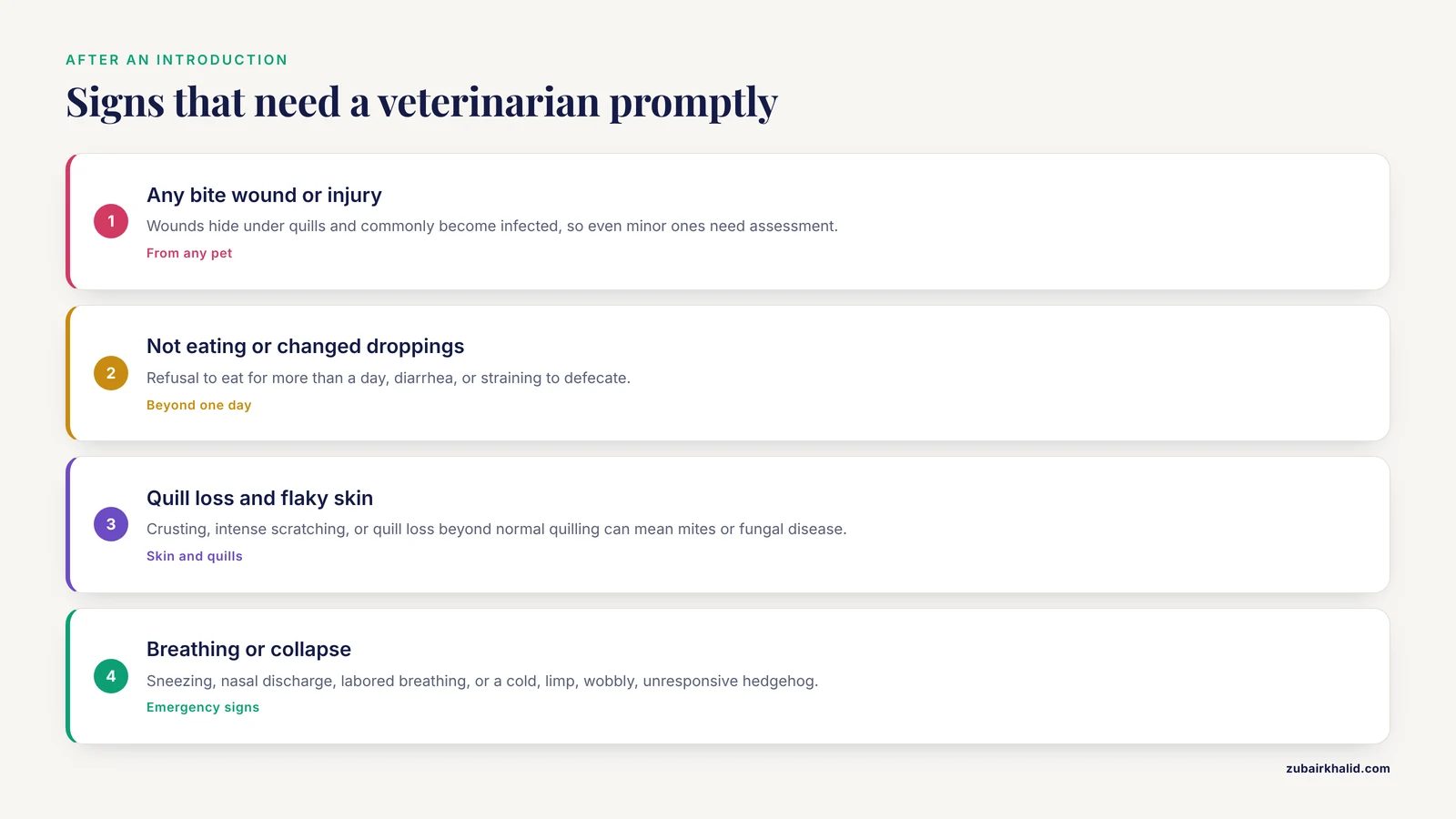
Contact an exotics veterinarian promptly if any of the following occur:
- Any bite wound or injury from another hedgehog, dog, cat, or other pet, even if it looks minor. Wounds in spined animals are easy to miss under the quills and commonly become infected.
- Refusal to eat for more than a day, or a sudden drop in wheel use and activity beyond normal variation.
- Diarrhea, very loose or discolored droppings, or straining to defecate.
- Quill loss, flaking skin, crusting, or intense scratching, which can indicate mites or fungal skin disease.
- Sneezing, nasal discharge, or labored breathing.
- A hedgehog that is cold, limp, wobbly, or unresponsive, which can indicate attempted hibernation from a too-cold environment or another emergency.
- Progressive weakness, stumbling, or dragging of the limbs, which warrants evaluation for neurologic disease such as wobbly hedgehog syndrome.
- Persistent, unrelieved defensive behavior in a previously calm hedgehog, which can signal pain or illness rather than temperament.
An annual or new-pet wellness exam with a veterinarian comfortable treating hedgehogs is the best time to ask about your specific household, your other pets, and whether any introduction plan makes sense for your animals.
Frequently Asked Questions
Can hedgehogs live together in the same cage?
Most should not. Hedgehogs are solitary, and veterinary references advise housing African hedgehogs alone, with males always separated because of fighting and even females sometimes showing aggression. If two females share a cage, it requires duplicate resources, constant monitoring, and a spare cage for immediate separation.
How do I introduce a new hedgehog to my current hedgehog?
Quarantine and a veterinary check first, then scent swapping with exchanged bedding, side-by-side cage viewing, and finally short meetings on neutral ground such as a playpen. Watch body language closely and end any session at the first hissing, clicking, or balled-up posture.
How long does the hedgehog bonding process take?
Most hedgehogs need several weeks of short, calm, consistent handling sessions to settle, and some take longer, especially during quilling. Patience matters more than speed. Expect early sessions to involve huffing and balled-up posture while your hedgehog learns your scent.
Are hedgehogs good with dogs?
Some dogs and hedgehogs learn to coexist calmly, but every interaction must be supervised. A dog's bite can seriously injure or kill a hedgehog despite its spines. Start with the dog on leash observing the hedgehog in a secure cage, and never leave them alone together.
Are hedgehogs good with cats?
Cats and hedgehogs can often share a home with strict supervision, but a cat's claws and stalking behavior can injure or chronically stress a hedgehog. Keep first meetings through bars the cat cannot reach past, and end any session where the cat crouches and stalks.
Do hedgehogs get lonely if kept alone?
No. Hedgehogs are solitary by nature, and veterinary references describe them as best housed alone in captivity. A single hedgehog with adequate space, enrichment, and regular gentle handling from you is meeting its social needs.
Can hedgehogs catch anything from my other pets, or give them anything?
Hedgehogs can carry salmonella and ringworm, both of which can infect people and potentially other animals, and mites can spread between small animals. Quarantine new hedgehogs, wash hands after handling, keep supplies separate, and ask your veterinarian about risks specific to your household.
When should I call a veterinarian after an introduction?
Call for any bite wound, quill loss, refusal to eat beyond a day, diarrhea, breathing changes, extreme lethargy, a cold or wobbly hedgehog, or defensive behavior that does not ease with time. Injuries under spines are easy to miss and often need treatment even when they look small.