How to Introduce Hamsters to Each Other and Other Pets
By Dr. Zubair Khalid, DVM, MS, PhD ·

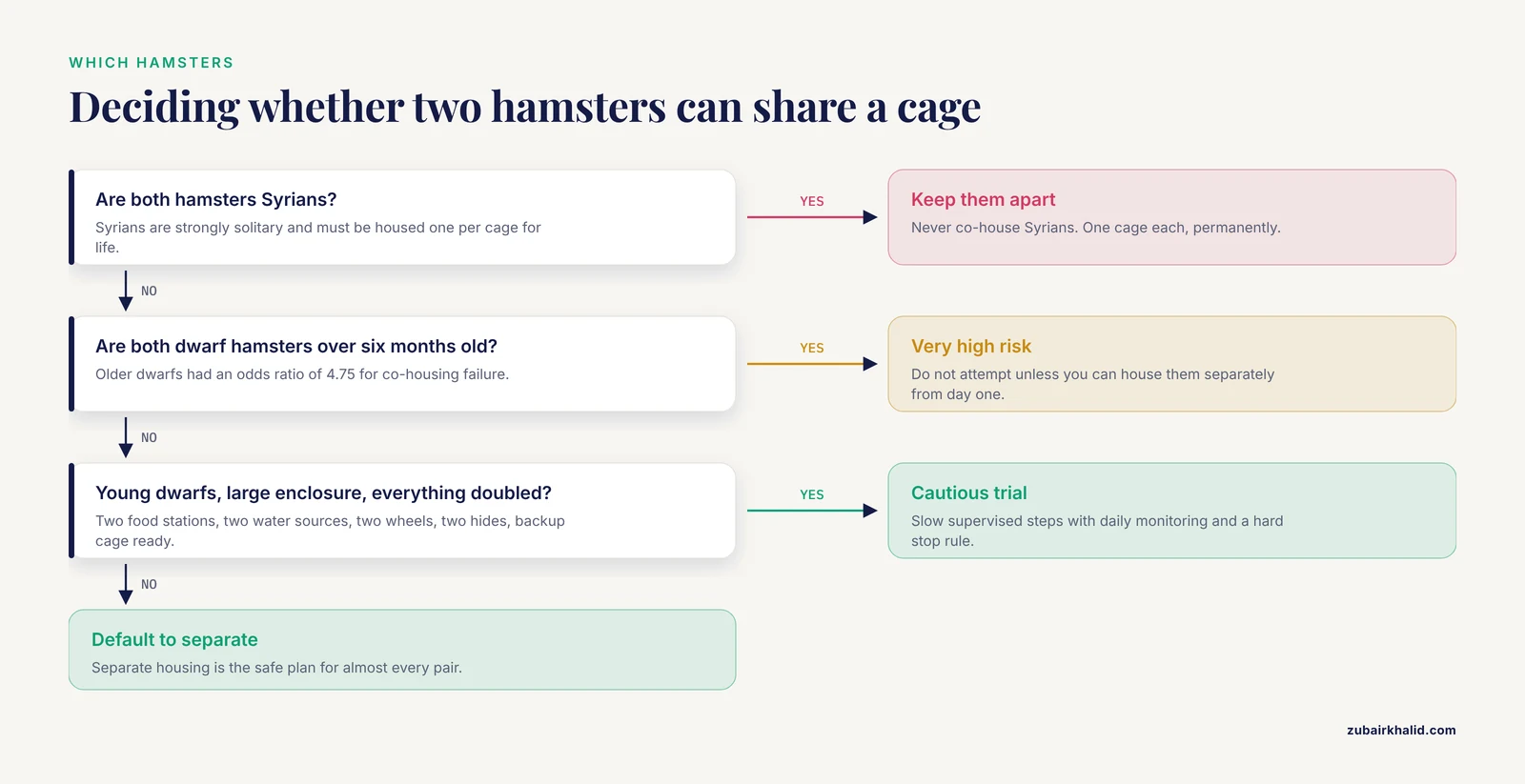
Most hamsters should not live with another hamster at all. Syrian hamsters are strongly solitary and must be housed one per cage for life. Some dwarf hamsters can be kept in pairs or small groups if they are introduced young, given a very large enclosure, and provided with duplicate resources, but even then fights are common and can be fatal. Recent survey data on dwarf hamster co-housing found that aggression-driven co-housing failure was the norm rather than the exception, and the risk roughly quadrupled once hamsters passed six months of age [1]. When it comes to hamsters and other pets such as cats, dogs, or ferrets, the answer is simpler and stricter. Other pets stay separated from hamsters at all times, because a survey of Syrian hamster owners found that nearly half of hamsters were already housed in close proximity to predator species, a recognized welfare concern [2].
This guide walks you through deciding whether an introduction is worth attempting, the step-by-step hamster bonding process for a new hamster, how to manage hamsters and other pets safely, and the warning signs that mean you should stop and separate the animals immediately.
At a Glance: Hamster Introduction Decisions
| Situation | Verdict | Your first action |
|---|---|---|
| Two Syrian hamsters | Never co-house | Keep separate cages, permanently |
| Two adult dwarf hamsters (over 6 months) | Very high failure risk | Do not attempt unless you can house them separately from day one |
| Young dwarf hamsters from the same litter | Possible with strict setup | Large enclosure, duplicate food and water, daily monitoring, backup cage ready |
| New hamster and existing hamster | Default to separate housing | Quarantine the new hamster and plan a slow, supervised process |
| Hamster and cat or dog | Never direct contact | Secure enclosure, separate rooms, closed doors during free time |
| Hamster and bird, ferret, or reptile | Never direct contact | Ferrets and many reptiles are predators, treat them as you would a cat |
| New hamster and human family | Bonding is achievable | Quiet first days, then short positive handling sessions at the hamster's pace |
This article is educational and is not a substitute for veterinary diagnosis or treatment.
Can Hamsters Live Together?
The honest answer is that most cannot, and the ones that can require conditions most homes cannot reliably provide. Hamsters are territorial animals with strong defensive instincts. In captivity, that territorial drive translates into chasing, pinning, biting, and in the worst cases killing a cage mate.
A cross-sectional survey of dwarf hamster owners published in the Veterinary Record examined which factors predicted co-housing failure. The findings matter for anyone considering a pair or group. Co-housing failure, defined by aggression, was significantly more likely in dwarf hamsters older than six months, with an odds ratio of 4.75. Sex and species did not predict failure, which means no dwarf hamster variety can be assumed safe, and splitting a pair into a male and female does not guarantee peace. The same survey identified three widespread welfare problems among co-housed hamsters: enclosures that were too small, with 12 percent under 75 cm in length, fewer food and water sources than the number of animals, and a majority of hamsters that had never received veterinary care [1].
Two practical conclusions follow from that evidence:
- Age is the strongest known risk factor. Introductions between hamsters over six months old fail far more often. If you are introducing a new hamster to an adult, plan for permanent separate housing as the realistic outcome.
- Resources must exceed animal numbers. Every co-housed hamster needs its own food source, water source, hide, and wheel. Resource competition is a recognized driver of aggression, and the survey showed many owners under-provision these basics [1].
Syrian hamsters deserve a separate mention because they are the most commonly kept pet hamster. Owner survey data from over 500 Syrian hamster keepers in the United Kingdom found that more than 90 percent already housed their hamster alone, which reflects the widely accepted standard for this species [2]. If you own a Syrian, the question of introducing a second hamster into the same cage is settled. Do not do it. Syrians can sustain a brief neutral-territory meeting for enrichment purposes only under expert supervision, but they should never share an enclosure.
Why Hamster Aggression Escalates So Fast
Hamster fights are not like dog or cat squabbles. There is rarely a clear winner who then backs off. Hamsters fight with the intent to injure, they cannot retreat from a small cage, and severe wounds or death can occur within minutes or even overnight. This is why every introduction protocol below includes constant supervision and a hard stop rule. Any escalation means permanent separation, not another try tomorrow.
Introducing a New Hamster to Another Hamster: Step by Step
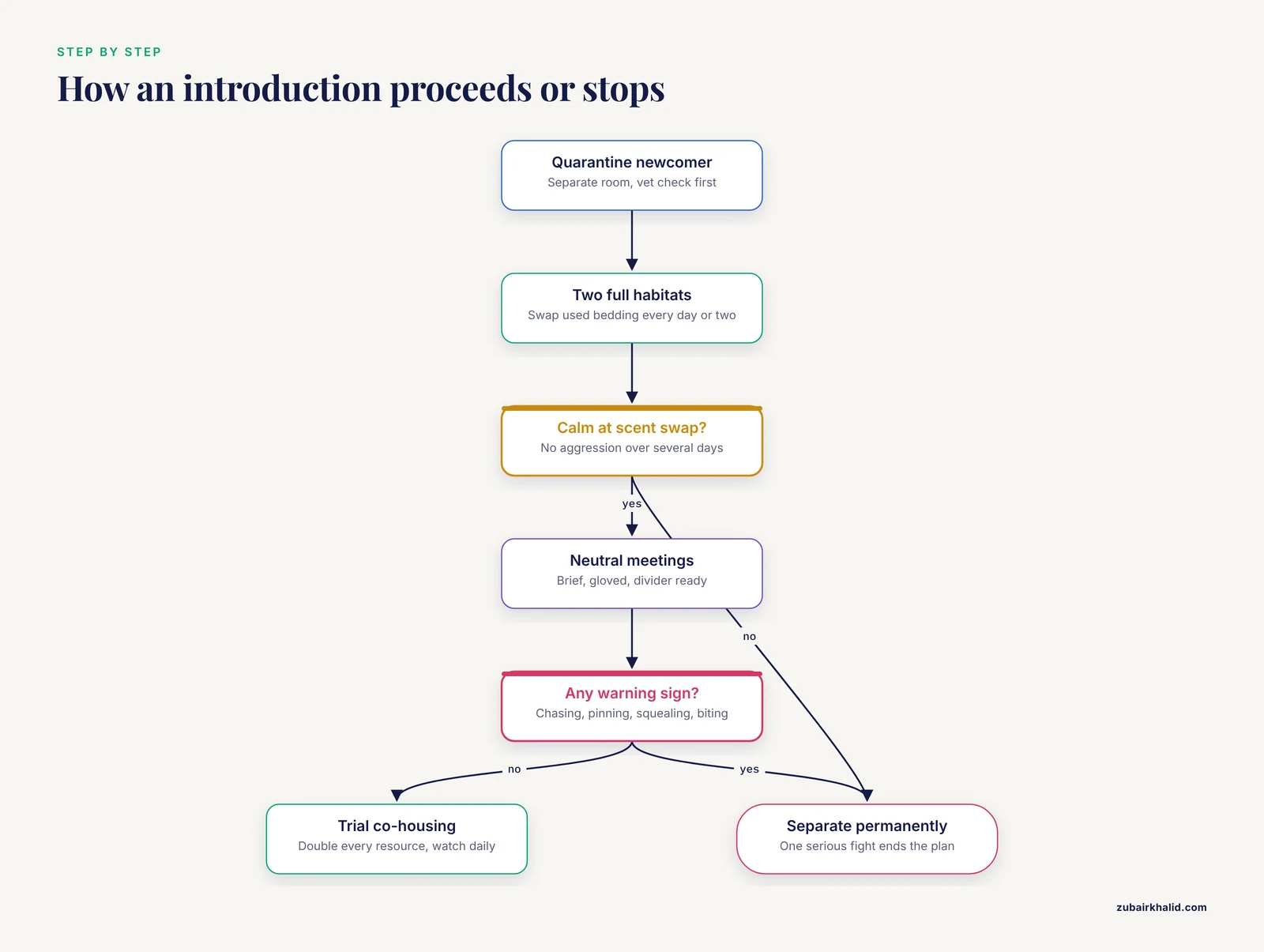
If you are introducing a new hamster and you have read the section above and still want to attempt co-housing, generally only realistic for young dwarf hamsters, follow this sequence. Move to the next step only when the previous step shows no aggression over several days, and be prepared to abandon the process at any point.
Step 1: Quarantine the New Hamster
House the new hamster in a completely separate room or at minimum a separate cage on a different surface for the quarantine period. Quarantine serves two purposes. It prevents disease transmission, since new hamsters can carry infections that are not yet obvious, and it lets you confirm the new hamster is eating, drinking, and behaving normally before any contact.
This is also the right time for a veterinary check. Hamsters presented to veterinary clinics benefit from a full physical examination, history, and husbandry review, and assessment of hematologic parameters can supplement that examination when illness is suspected [3]. A new hamster that has never seen a veterinarian is not a good candidate for an introduction, because underlying illness increases stress and aggression on both sides. Most pet hamsters never see a veterinarian, with surveys showing a majority have never had veterinary care [1] [2], so finding an exotics-savvy clinic before you bring a hamster home is part of responsible planning.
Step 2: Set Up Two Complete, Separate Habitats
Each hamster needs its own full setup during the introduction phase, not a divided cage. Separate housing means each hamster has its own wheel, hide, food bowl, and water bottle. Position the cages so the hamsters can smell and hear each other but cannot make physical contact. A few inches of space between cages prevents biting through bars.
During this phase, swap small items such as a handful of used bedding between the two cages every day or two. Scent swapping lets each hamster become familiar with the other's smell without any risk of injury.
Step 3: Neutral Territory Meetings, Fully Supervised
When both hamsters remain calm during scent swapping, you can try short meetings on neutral ground, meaning a surface and container that neither hamster has claimed. Keep sessions brief. Keep your hands gloved and ready to separate the animals with a cup or cardboard divider, never your bare hands, because hamster bites during a fight can be deep.
Watch specifically for these signs, and end the session immediately if you see any of them:
- Sideways approach or stiff-legged walking toward the other hamster
- Chasing that does not stop
- Pinning one hamster on its back
- Loud, repeated squealing
- Any bite, even one that seems minor
- One hamster freezing in fear while the other investigates relentlessly
Calm mutual sniffing, parallel exploring, and ignoring each other are the only acceptable outcomes.
Step 4: Trial Co-Housing With Full Resource Duplication
Only if neutral meetings stay peaceful across multiple sessions should you consider shared housing, and only in an enclosure large enough for each hamster to establish its own area. The dwarf hamster survey identified inadequate enclosure size and inadequate resource provision as central welfare problems in co-housed animals [1], so the practical standard is this: double everything. Two food stations placed far apart, two water sources, two wheels, two hides, and enough burrowing substrate for each hamster to dig its own space.
Continue daily, close observation for the first weeks. Co-housing failure can happen suddenly, including in pairs that seemed settled.
Step 5: Keep a Permanent Separation Plan
Have a fully equipped spare cage ready before you ever put two hamsters together. If a fight occurs, or if one hamster begins losing weight, hiding constantly, or showing stress behaviors, separate them permanently. In the survey data, co-housing failure was common overall, and repeated failed reintroductions simply add up to repeated injuries [1]. One serious fight is the end of the experiment.
The Hamster Bonding Process With Humans
Introducing a hamster to you and your household follows a different and much safer path than hamster-to-hamster introductions. Hamsters are prey animals, and a new hamster needs days of quiet to settle before handling begins.
A practical bonding sequence looks like this:
- Days 1 to 3, hands off. Set up the cage fully before the hamster arrives. Provide deep bedding for burrowing, a hide, a wheel, and food and water. Let the hamster explore and settle without disturbance beyond routine care.
- Days 3 to 7, presence without contact. Sit near the cage quietly, speak softly, and place treats near the open door so the hamster associates your presence with good things.
- Week 2 onward, contact on the hamster's terms. Offer your hand low in the cage and let the hamster step onto it. Keep early sessions short and end before the hamster shows stress.
- Build predictability. Hamsters are nocturnal, so handle them in the evening when they are naturally awake. A hamster woken from daytime sleep is more likely to startle and nip.
One finding from the Syrian hamster owner survey deserves attention here. Hamsters whose owners reported more frequent handling were significantly more likely to be observed bar biting, a repetitive behavior associated with poor welfare [2]. The likely interpretation is not that handling itself causes bar biting, but that forced or excessive interaction with a hamster who is not comfortable escalates stress. Quality of interaction matters more than quantity. If your hamster hides, bites, or paces at the bars after handling, shorten sessions and let the hamster initiate.
Owners in a large survey of small mammal keepers relied heavily on behavioral observations to judge their pets' welfare at home, and most owners were both willing and able to provide good welfare. The study also found that opportunity, particularly access to suitable enclosures, was the primary barrier to better husbandry [4]. Applied to bonding, this means your hamster's behavior is your best guide. A hamster that approaches you voluntarily, eats in your presence, and explores confidently is telling you the bonding process is working.
Hamsters and Other Pets: Cats, Dogs, and Beyond
Hamsters and other pets in the same home require a different mindset than hamster-to-hamster introductions. There is no supervised bonding process that makes direct contact between a hamster and a cat, dog, ferret, or bird of prey safe. The size difference alone is decisive, and the predator-prey relationship is hardwired.
The welfare concern is documented. In the Syrian hamster owner survey, over 45 percent of respondents reported that their hamsters were housed in close proximity to predator species [2]. Proximity alone creates chronic stress for a prey animal, even when the predator never gets close enough to touch the cage.
Practical rules for households with hamsters and other pets:
- Housing placement. Keep the hamster enclosure in a room the other pets cannot enter, or at minimum on a stable surface well above pet access, with the room door closed whenever the hamster is awake and active.
- Never free-roam a hamster around other pets. Open-floor playtime happens in a secured area with other pets out of the room and the door closed.
- Skip the exercise ball if predators are present. Nearly one in five Syrian hamster owners in the survey used hamster balls, and ball use was significantly associated with more frequent observations of bar biting [2]. A hamster rolling in a ball on the floor is also a hamster rolling toward a cat or dog, with no ability to escape.
- Secure the enclosure. Latch-opening cats and nose-pushing dogs defeat unsecured lids. Verify that the cage top cannot be displaced by a determined pet.
- Wash hands after handling other pets. A hamster that smells cat or dog on your hands may react with fear or defensive biting.
Ferrets deserve an explicit warning. Ferrets are dedicated carnivores with a strong prey drive toward small rodents, and no amount of supervision makes ferret-hamster contact acceptable. Birds such as hawks and owls kept in homes, and many snakes and other reptiles fed rodents, fall into the same category.
The general small mammal welfare survey found that owners' main barrier to better housing was opportunity, especially the availability of suitable enclosures, not unwillingness [4]. If your home layout makes true separation from a predator pet difficult, solving the housing placement problem, for example by relocating the hamster's cage to a pet-free room, is one of the highest-impact welfare improvements you can make.
Equipment and Supplies for Safe Introductions
Nothing in this list requires specialty brands. Selection criteria matter more than product names.
- A second complete enclosure. Non-negotiable for any hamster-to-hamster introduction. The backup cage is your emergency exit.
- Large main enclosure for trial co-housing. Bigger is better for reducing competition. The dwarf hamster survey flagged enclosures under 75 cm as inadequate, and that floor size applies to single hamsters, so co-housing setups should be substantially larger [1].
- Duplicate resources. Two food bowls, two water bottles or dishes, two wheels, two hides, sized appropriately for the species.
- Deep, diggable substrate. Burrowing is a core hamster behavior, and shallower substrate was associated with more bar biting in Syrian hamsters [2]. Provide the deepest layer your enclosure safely allows.
- A separation tool. A plastic cup, piece of cardboard, or similar barrier you can slide between fighting hamsters without putting hands in the path of teeth.
- An enrichment rotation. Chew items, hides, and foraging opportunities reduce stress and redirected aggression. Over 95 percent of surveyed Syrian hamster owners provided a wheel, hideaway, or chew toy, and these basics are the minimum, not the ceiling [2].
Common Mistakes When Introducing Hamsters
- Assuming a bonded pair stays bonded. Pairs that got along as juveniles fight more often after six months of age. The odds of co-housing failure rise sharply with age [1], so a peaceful young pair can still become a fighting adult pair.
- Trusting species stereotypes. The survey found no association between species or sex and co-housing failure [1]. "Roborovskis are fine in groups" is not a safety guarantee for your specific pair.
- Skipping quarantine. New hamsters can carry disease into your home. Quarantine protects both animals.
- Introducing in a cage either hamster knows. Territory defense makes cage-side meetings far more dangerous than neutral ground.
- Under-provisioning resources. Fewer food and water sources than animals was common among surveyed owners of co-housed dwarf hamsters [1]. This is one of the easiest problems to fix and one of the most commonly missed.
- Intervening with bare hands. Hamsters fighting will bite anything between them, including fingers.
- Treating a first fight as a fluke. A fight is data. The safest response is permanent separation.
- Assuming the hamster and the cat "are friends." Calm behavior by a predator in your presence is not a reliable indicator of safety when you leave the room.
Troubleshooting: When an Introduction Goes Wrong
The hamsters fought during a neutral meeting. End the session, return each hamster to its own cage, and check both for wounds. Do not attempt another meeting for several days, and treat any subsequent fight as the end of the co-housing plan.
One hamster is bullying without obvious injury. Constant chasing, food guarding, or one hamster losing weight while the other gains weight is co-housing failure in progress. Separate them. Subclinical stress causes real harm even when no blood is drawn.
You notice wounds after the fact. Any bite wound needs veterinary attention. Bite wounds in small mammals can abscess and infection can spread quickly. Small hamsters can be sampled for bloodwork when needed, and veterinary laboratories routinely assess hamster hemograms as part of clinical workups [3] [5], so ask your exotics veterinarian about baseline bloodwork if your hamster has been injured or is failing to thrive.
The new hamster is hiding constantly after arrival. Hiding for the first days is normal settling behavior. Hiding that persists past the first week, with reduced food intake, warrants both an extension of quiet time and a veterinary call if it continues.
Your other pet is fixated on the hamster cage. A cat that paws at the cage or a dog that barks at it is chronically stressing the hamster. Move the enclosure to a room the pet cannot access. Proximity to predator species is a documented welfare concern for pet hamsters [2].
Welfare and Safety Points Every Owner Should Know
- Solitary housing is the default standard for Syrian hamsters, and the overwhelming majority of surveyed owners already follow it [2].
- Dwarf hamster co-housing carries a real, quantified risk of aggression-driven failure, especially past six months of age [1].
- Resource duplication and generous enclosure size are the two most evidence-supported levers for reducing co-housing conflict [1].
- Hamster balls carry welfare concerns and remove the hamster's control over its environment and exposure to other pets [2].
- Behavioral observation at home is the primary way owners assess welfare, and changes in behavior deserve attention [4].
- A majority of pet hamsters never receive veterinary care [1] [2]. Establishing a relationship with an exotics veterinarian before a crisis is part of the hamster bonding process, not separate from it.
Limitations and When to Contact a Veterinarian
Every hamster is an individual, and no article can predict how a specific animal will respond to an introduction. Decisions about co-housing, injury treatment, and chronic stress belong in partnership with a veterinarian experienced in small mammals.
Contact a veterinarian promptly for any of the following:
- Any bite wound, puncture, or torn skin from a fight, at any age
- Bleeding, limping, or a hunched, painful posture after an altercation
- Loss of appetite, weight loss, or reduced droppings lasting more than a day
- Persistent hiding past the initial settling period, combined with reduced eating
- Bar biting, pacing, or other repetitive behaviors that persist or worsen
- Sudden aggression in a previously peaceful hamster, which can signal pain or illness
- A hamster that is wet around the tail area, lethargic, or cold to the touch
For wounds, follow-up timing matters. Ask your veterinarian when a recheck is needed for any injury, because small mammal infections progress quickly and a wound that looks superficial can deepen within days. Because hematologic assessment is a standard supplement to physical examination in hamsters presented to clinics [3], your veterinarian may recommend bloodwork as part of the workup after an injury or during a prolonged illness.
Frequently Asked Questions
Can hamsters live together?
Most cannot. Syrian hamsters must live alone, and dwarf hamster co-housing fails often enough that separate housing should be your default plan. Survey data show aggression-driven co-housing failure rises sharply after six months of age [1].
How do I introduce a new hamster to my current hamster?
Quarantine the newcomer first, keep two complete separate cages, swap bedding for scent familiarity, then try brief supervised neutral-territory meetings only if both are young dwarf hamsters. Stop permanently at the first sign of chasing, pinning, or biting.
At what age is hamster co-housing riskiest?
After six months of age. In a survey of dwarf hamster owners, hamsters older than six months had nearly five times the odds of co-housing failure compared with younger animals [1].
Can hamsters bond with humans?
Yes. A patient bonding process of quiet presence, treat association, and short handling sessions on the hamster's schedule, usually in the evening, builds trust over weeks. Let the hamster initiate contact rather than forcing interaction.
Are hamster balls safe?
Hamster balls carry welfare concerns. Owner survey data linked ball use with more frequent bar biting, and balls also expose hamsters to predators and hazards on the floor with no means of escape [2]. A secure, enriched enclosure is a better option.
Can my hamster be in the same room as my cat or dog?
A closed, latch-secured enclosure in a room the predator cannot enter is the safest standard. Nearly half of surveyed hamster owners housed their hamsters near predator species, which is a recognized welfare risk [2]. Never allow direct contact or free-roaming time together.
What signs mean a hamster introduction is failing?
Chasing, pinning, loud squealing, biting, food guarding, one hamster hiding constantly, or weight loss in one animal all indicate failure. Separate the hamsters permanently at the first serious sign rather than attempting repeated reintroductions.
When should a fighting hamster see a veterinarian?
Immediately after any fight that breaks skin. Bite wounds abscess quickly in small mammals, and prompt care plus any recommended recheck prevents complications. Underlying illness can also drive sudden aggression, so unexplained fighting in a previously peaceful pair warrants an examination.
Further Reading
Sources
- Preliminary investigation into the housing of dwarf hamsters.
- Burrowing for answers: Investigating Syrian hamster welfare through owner surveys.
- Hematologic Assessment in Pet Rats, Mice, Hamsters, and Gerbils: Blood Sample Collection and Blood Cell Identification.
- Small mammal owners' experiences of housing challenges and animal welfare: A COM-B and word frequency analysis.
- The mentolabial approach is a novel, safe, and effective method of blood collection in rats (Rattus norvegicus) and Chinese hamsters (Cricetulus griseus).