How to Introduce Ferrets to Each Other and Other Pets
By Dr. Zubair Khalid, DVM, MS, PhD ·
Introduce ferrets slowly, on neutral ground, through a series of short supervised meetings that you extend over days to weeks. Ferrets are social animals and most can live together happily, but they are also territorial carnivores with strong individual personalities, so a rushed introduction is the most common cause of fighting, injuries, and failed pairings. The same careful, staged approach applies to ferrets and other pets, with one hard rule: ferrets are predators, so rabbits, rodents, birds, and other small animals must never have direct contact with them.
This guide walks you through the entire ferret bonding process, from the first scent exchange to full shared housing, and covers how to manage ferrets around cats and dogs safely.
At a Glance: Introduction Checklist
| Step | What to Do | Typical Timeframe |
|---|---|---|
| 1 | Veterinary health check and quarantine for the new ferret | First days after arrival, per your veterinarian |
| 2 | Separate housing in the same room, out of reach | Several days |
| 3 | Scent swapping with bedding and towels | 2 to 5 days |
| 4 | Side-by-side cage time so they can see and smell each other | 2 to 5 days |
| 5 | First supervised meetings on neutral territory, fully awake | Minutes at a time |
| 6 | Gradually longer play sessions, ending on a good note | 1 to 3 weeks |
| 7 | Shared play area, then shared cage if all sessions stay peaceful | After consistent success |
| 8 | Same protocol, slower, for cats and dogs, with physical barriers | Weeks, never rushed |
Why Ferret Introductions Take Time
Ferrets (Mustela putorius furo) were domesticated thousands of years ago and were historically used for their hunting skills, a working background that still shows in their bold, exploratory, and sometimes rough play style [1]. They are obligate carnivores with sharp teeth, quick reflexes, and a high prey drive, and they communicate largely through body posture, scent, and vocalizations that owners need time to learn.
Individual temperament varies enormously. A large owner survey of more than 1,000 ferrets identified four underlying personality dimensions: extraversion, sociability, attentiveness, and neuroticism. Sex and age influenced these traits, with males rated as more sociable, females rated higher on attentiveness and neuroticism, and extraversion decreasing with age [2]. In practical terms, this means two ferrets that look similar on the outside may have completely different tolerances for a housemate. Owner-reported behavior also differs by region and background. In one international welfare survey, biting was the behavior most often reported by owners in central Europe, while owners in North America more often described their ferrets as exploratory and friendly, and acquisition source, housing, and care differed significantly between regions [3].
The good news is that most ferrets, especially neutered ones, can live together successfully. In a survey of 495 ferret owners across France, Italy, the United States, the United Kingdom, and Belgium, most ferrets were neutered young adults housed indoors, and daily free-roaming time and environmental enrichment were common husbandry practices [4]. Many of those households clearly managed multi-ferret living. The key is giving each animal time to accept the newcomer on its own terms.
Before the First Ferret Meets Anyone
Step 1: Veterinary Check and Quarantine
Have any new ferret examined by a veterinarian before it meets your existing pets. This visit should include a general health assessment, discussion of vaccination status, and parasite prevention appropriate for your area. Ferrets are routinely vaccinated against canine distemper virus, a disease to which they are highly susceptible [5]. Ferrets are also unusually susceptible to human respiratory viruses, including influenza viruses and SARS-CoV-2, because their respiratory tract closely resembles that of humans [6]. A ferret with a respiratory infection should never be introduced to your other animals or exposed to sick household members until it has recovered.
Ask your veterinarian how long to keep the newcomer separated from your resident pets. A short quarantine period in a separate cage, in a separate room with separate handling routines, protects everyone while you watch for signs of illness.
Step 2: Know the Signs of a Healthy Ferret
Baseline knowledge helps you judge whether a new ferret is ready to socialize at all. Healthy ferrets show bright eyes, a smooth coat, and distinct energy and sleep cycles. Signs that something is wrong include excessive sleep, poor body condition, and subdued behavior. A ferret that is in pain or unwell will not behave normally during introductions, and stress can mask or mimic both. If you are unsure whether a ferret is comfortable or unwell, ask your veterinarian. Researchers have developed a ferret grimace scale, and while its evidence base is still rated as moderate rather than high, facial expression tools are increasingly used to help identify pain in this species [7].
Step 3: Neutering Status
Neutering matters for introductions. Most pet ferrets are neutered, with one large survey reporting 70.7 percent neutered [4], and intact males in particular can be more territorial and driven by hormones during introductions. Discuss timing with your veterinarian. In some regions, particularly North America, early neutering is common, and adrenal disease is diagnosed more frequently there, which has led many ferret-savvy veterinarians to discuss neutering timing individually rather than treating it as a one-size-fits-all decision [3]. Ask your veterinarian what timing makes sense for your ferret and your household.
Step 4: Set Up Separate but Close Housing
Prepare a second cage or playpen so each ferret has its own secure space with its own food bowl, water bottle, litter area, and hammock or bedding. Place the enclosures in the same room but out of physical contact range. Ferrets are housed indoors in the vast majority of households [4], so this setup fits a typical home. The goal of this stage is passive familiarity: each ferret hears, smells, and eventually sees the other while remaining safe and unable to escalate.
Step-by-Step: Introducing a New Ferret to Your Ferrets
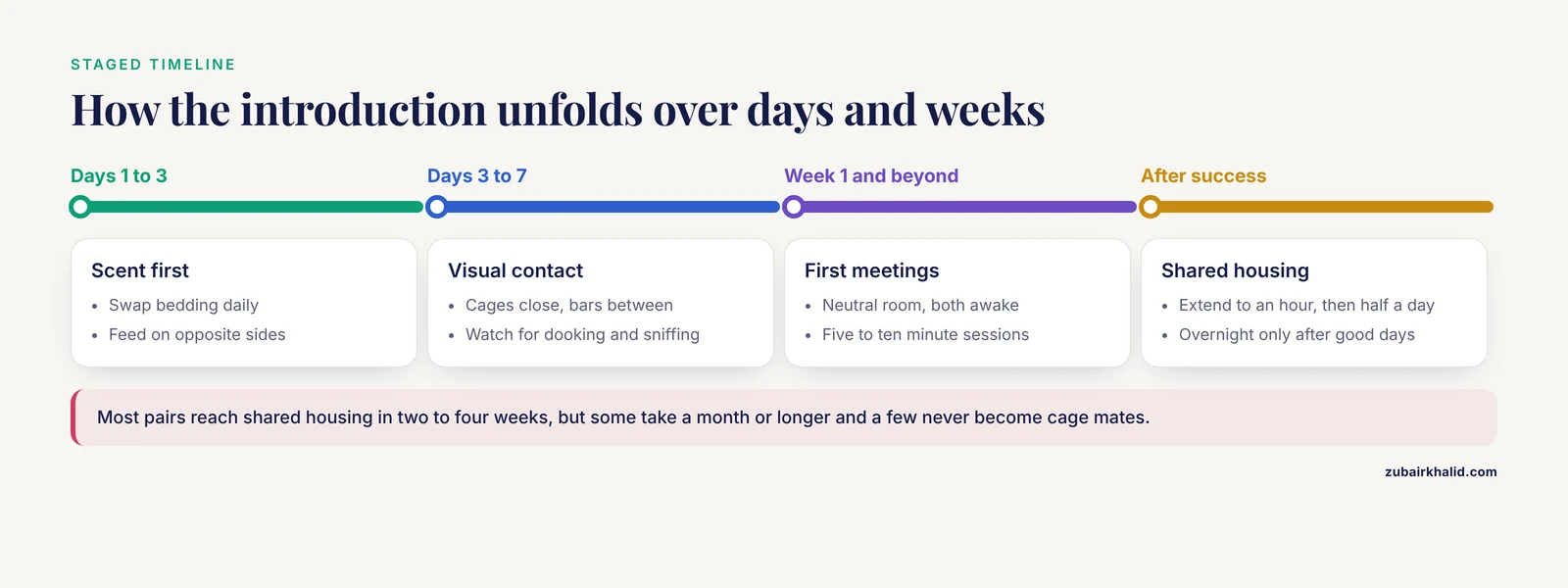
Days 1 to 3: Scent First, Sights Second
Animals learn a great deal about each other through smell before any face-to-face contact. Exchange bedding between the cages daily. Rub a towel on one ferret and place it in the other's enclosure, then swap. Feed them on opposite sides of the room, or eventually near the cage bars, so the presence of the other ferret becomes associated with something pleasant. Food hiding is a very common natural behavior in ferrets, reported by 75.4 percent of owners in one international survey [4], so do not be surprised if your ferret stashes treats near the newcomer's cage. That is normal foraging behavior, not necessarily a problem.
Days 3 to 7: Visual Contact
Once both ferrets seem relaxed, allow cage-side contact. Keep the cages close enough that they can see and sniff through the bars but cannot bite each other. Watch for relaxed curiosity, sniffing, dooking (the chuckling sound content ferrets make), and normal eating and sleeping. Ignore brief attention-seeking behavior. If either ferret shows persistent stress, such as frantic cage pacing, hissing, or refusing food, slow down and give them a few more days at this stage.
Week 1 and Beyond: First Face-to-Face Meetings
Choose a neutral play area, ideally a room neither ferret has claimed, such as a bathroom or a hallway. Ferrets spend significant time free-roaming in typical homes [4], so a room both can explore for the first time works well. Remove hideouts, tubes, and anything either ferret may guard. Have a thick towel within reach to separate them if needed, never your bare hands, because an aroused ferret can bite hard without meaning to hurt you.
Both ferrets should be fully awake and playful, not just woken from deep sleep. Place them on the floor a few feet apart. Short sessions of five to ten minutes work best. Expect some drama. Typical ferret introductions involve puffy tails, sideway arching, chasing, neck biting, and wrestling that sounds alarming. Rough play and genuine aggression can look similar at first.
End every session before it deteriorates. Two or three calm-to-rough-but-recoverable sessions per day, each ending well, builds a better association than one long session that ends in a fight.
When to Move to Shared Housing
Once the ferrets play together, ignore each other, or sleep near each other without repeated lunge-and-bite attacks, extend the sessions. Let them share the play room for an hour, then half a day, then a full day under supervision. Only when several consecutive days of supervised togetherness have gone smoothly should you allow overnight or unsupervised coexistence, and even then each ferret should keep access to its own food, water, litter, and sleeping space. Some pairs merge into one cage within a couple of weeks. Others take a month or more, and some never become cage mates but do fine sharing a ferret-proofed room on a rotation.
Reading Ferret Body Language: Acceptance Versus Conflict
Normal introduction behavior includes:
- Puffy tails and arched backs during initial excitement, which usually settle within minutes
- Chasing that both ferrets can escape from
- Neck grabbing and dragging during play, with the grabbed ferret returning voluntarily
- Dooking, play bows, and alternating who is on top during wrestling
- Brief hissing followed by disengagement
Warning signs that mean separate them immediately and slow the process down include:
- One ferret consistently fleeing and unable to get away
- Screaming rather than dooking
- Bites that break skin or leave scabs, especially on the rump or neck
- One ferret pinning another and shaking it while the pinned ferret screams
- Persistent avoidance, hiding, refusing food, or eliminating outside the litter box after sessions
Inappropriate elimination is the most frequently reported undesirable behavior in pet ferrets, noted by 79.0 percent of owners in one large survey [4]. While it has many causes, a sudden breakdown in litter habits after introductions begin is often a signal that a ferret feels stressed or threatened in its territory.
Introducing Ferrets to Cats
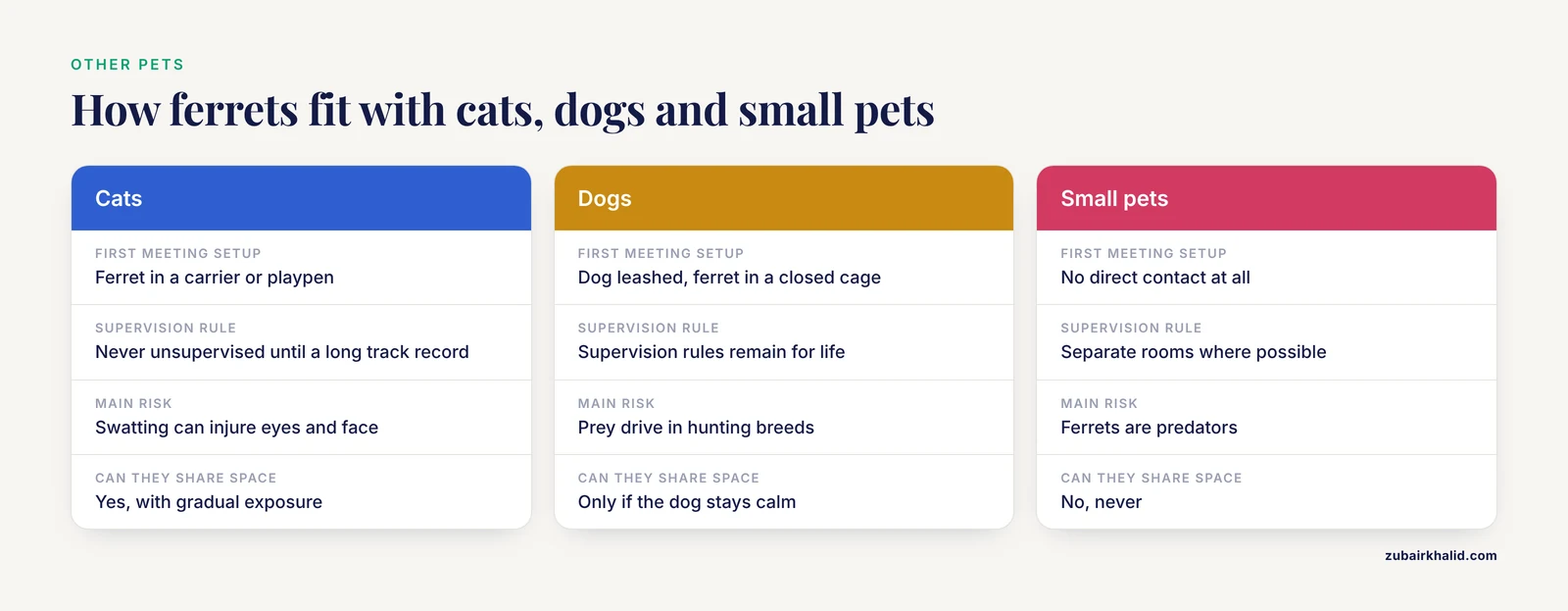
Many households successfully keep ferrets and cats together, but the introduction must respect both animals. Cats are predators with their own territorial instincts, and shelter research on multi-cat housing shows that psychological needs, not just physical ones, determine how well animals cope with sharing space, which is why gradual exposure and choice-based access matter [8].
Follow the same staged protocol:
- Keep the ferret in its cage in a room the cat cannot enter for the first days.
- Swap scents with bedding.
- Allow the cat to investigate the ferret's cage while the ferret is awake and able to retreat into a hide box.
- Hold the first face-to-face meeting with the ferret in a carrier or playpen the cat cannot tip over.
- Progress to floor meetings with the cat's claws trimmed, the ferret awake, and you positioned between them.
Watch the cat's body language closely. Dilated pupils, tail lashing, crouching, and stalking behavior mean the cat views the ferret as prey or a threat and the meeting should end. A confident ferret that runs at the cat head-on often startles cats into retreat, but a hissing, swatting cat can injure a ferret's eyes and face. Never leave a ferret and cat unsupervised together until they have a long track record of indifference, and even then, many owners separate them when out of the house.
Introducing Ferrets to Dogs
Dog introductions carry the highest stakes in the house. Some dogs have strong prey drive toward small furry animals, and ferrets were historically used alongside dogs for hunting, a partnership that depends on careful control [1]. Breeds and individual dogs selected for hunting small quarry may never be safe around a ferret, no matter how gradual the introduction.
The rules are stricter here:
- The dog must have solid obedience skills and respond reliably to its name and to a leave or settle cue before any face-to-face meeting.
- First meetings happen with the dog on a leash and the ferret in a closed bar-style cage or secure playpen, never loose on the floor.
- Reward the dog for calm behavior. If the dog lunges, paws at, or barks intensely at the cage, end the session and do not progress.
- If controlled meetings go well, allow the ferret to move freely while the dog remains leashed and lying down. Keep sessions short.
- A dog that shows fixation, stalking, or shaking behavior toward the ferret needs professional help from a qualified behaviorist before you consider any closer contact, and many such dogs should simply never have ferret access.
Ferrets can also injure dogs, particularly by clinging to the face and ears, so neither animal gets a free pass. When you cannot supervise, keep them in physically separate spaces with a closed door between them.
Ferrets and Small Pets: Rabbits, Rodents, Birds, and Guinea Pigs
This is the one category with no middle ground. Ferrets are predators, and rabbits, guinea pigs, hamsters, gerbils, rats, mice, chinchillas, and birds are prey species. Direct interaction between them is unsafe for the small animal regardless of how calm or well fed your ferret is.
Housing them in the same room requires care too. Prey species are chronically stressed by the sight, smell, and sound of a predator. Guinea pigs, for example, are prey animals that hide signs of illness, and chronic stress can contribute to them becoming unwell before an owner notices anything wrong [9]. Keep predator and prey species in separate rooms where possible, with secure, escape-proof and gnaw-proof enclosures, and never allow a ferret access to a small pet's play area. Wash your hands between handling the two, since a ferret's scent on your hands alone can alarm a prey animal.
The Ferret Bonding Process After Introduction
A successful introduction is not the end of the bonding process. Ferrets build relationships over weeks and months. Support it with these habits:
- Feed separately at first, then side by side once meals are calm, because food guarding is a common trigger for conflict.
- Provide at least one hideout, hammock, and litter box per ferret, plus one extra, so no one has to compete for resources.
- Maintain daily out-of-cage play time. Regular free-roaming and enrichment are already standard practice in most ferret households [4], and shared play is how ferret pairs cement their bond.
- Watch sleep patterns. Ferrets sleep deeply and often, and disturbances of their normal energy and sleep cycles are recognized early indicators that something is wrong. A ferret that starts sleeping abnormally after a new housemate arrives may be stressed or ill rather than simply tired.
- Keep up routine veterinary health checks for every ferret in the group, since subclinical illness in one animal can change group dynamics [10].
Common Mistakes to Avoid
- Skipping the quarantine. New ferrets can carry respiratory infections that spread quickly, and ferrets' susceptibility to influenza and other respiratory viruses is well documented [6].
- Introducing on someone's territory. A resident ferret will defend its cage and favorite rooms. Always start on neutral ground.
- Misreading rough play. Loud wrestling is normal. The difference between play and aggression is whether the loser can escape and whether it keeps coming back. If one ferret is trapped and screaming, intervene.
- Using your hands to separate fighting ferrets. Use a towel or spray bottle with water. Ferret bites can be severe, and any bite that breaks skin needs medical attention for both you and the animal.
- Rushing the timeline. Owners often move to shared housing after two good days. Give it at least a week of consistently good supervised sessions.
- Assuming sex pairings predict success. Temperament matters more than sex. Personality research shows individual traits like sociability and neuroticism vary widely between ferrets [2], so judge the individuals in front of you.
- Forgetting the dog or cat is still a predator. A year of peaceful coexistence does not erase prey drive in a dog or a cat. Supervision rules remain for life.
Troubleshooting Common Problems
The ferrets fight every session. Return to cage-side-only contact for several more days, then restart with much shorter meetings on truly neutral ground. Try introducing them after a shared activity, such as separate but simultaneous play in adjacent rooms, so they meet slightly tired. If fights involve screaming, drawing blood, or sustained pinning after several weeks of patient work, consult a ferret-knowledgeable veterinarian or behaviorist. Not every pairing will succeed, and forced cohabitation is a welfare risk.
One ferret bullies the other. Check for resource competition. Add a second litter box, second food station, and more hideouts. Inappropriate elimination and food hiding are both very common in pet ferrets [4], and both can intensify when a ferret feels it must guard resources. Give the bullied ferret protected time out of the cage.
The new ferret hides and will not engage. Give it more time in its own space. Ferrets from some backgrounds show more fear-related behavior than others, and acquisition source influences reported behavior [3]. Let it set the pace. A ferret that eats well and sleeps normally but avoids play for a week is usually just adjusting.
Your resident ferret stops eating or becomes lethargic during the process. Stop introductions and call your veterinarian. Subdued behavior and excessive sleep are recognized signs of illness in ferrets, and stress-related illness in this species can progress quickly.
Limitations and When to Contact a Veterinarian
Every ferret is an individual, and this article describes general patterns rather than guarantees about your specific animals. Age, sex, neutering status, prior socialization, and health all influence how introductions go, and an in-person veterinary examination cannot be replaced by any guide.
Contact your veterinarian promptly if any of the following occurs:
- Any bite that breaks skin on a ferret, or on you, which also requires attention to your own wound
- A ferret that refuses food for more than a day, since ferrets deteriorate quickly
- Screaming, limping, swelling, or bleeding after an introduction session
- Persistent diarrhea, vomiting, coughing, sneezing, or nasal discharge in the newcomer during quarantine
- Sudden litter box training breakdown, hide-and-not-eat behavior, or aggression that appears abruptly in a previously peaceful pair
- Any ferret showing signs of pain, which in this species can be subtle and is best assessed with veterinary help
- A dog or cat that cannot remain calm around the ferret despite weeks of controlled exposure
Frequently Asked Questions
Can ferrets live together?
Yes. Ferrets are social animals and most neutered ferrets can live together happily once properly introduced. Success depends on individual temperament, gradual introductions, and providing enough food stations, litter boxes, and hideouts for each ferret.
How long does the ferret bonding process take?
Most ferret pairs move from first meeting to shared housing in two to four weeks, but some take a month or longer and a few never become full cage mates. Progress at the pace of the more hesitant ferret and only move forward after several consistently good sessions.
Can ferrets live with cats?
Many ferrets and cats learn to coexist peacefully, but introductions must be gradual, with the ferret secured in a cage or carrier for early meetings and the cat supervised and calm before any free contact. Never leave them unsupervised together until they have a long, proven track record.
Are ferrets safe around dogs?
Some are, and some are not. It depends almost entirely on the individual dog's prey drive and training. A dog that stalks, lunges, or fixates on the ferret's cage should not have direct access, and even friendly dogs should only meet the ferret leashed and under supervision.
Can ferrets live with rabbits or guinea pigs?
No. Ferrets are predators and rabbits, guinea pigs, rodents, and birds are prey species. Direct contact is dangerous for the small animal, and even housing them in the same room can chronically stress a prey species. Keep them in separate rooms with secure enclosures.
Why are my ferrets fighting after living together peacefully?
Sudden conflict usually traces back to illness in one ferret, resource competition, a change in the environment, or hormonal status in an intact animal. Check for adequate resources, stop and restart introductions at an earlier stage, and have both ferrets examined if fighting persists or appears abruptly.
Should ferrets be neutered before introductions?
Neutering reduces hormone-driven territorial behavior and most pet ferrets are neutered. The right timing varies, however, and should be discussed with a ferret-savvy veterinarian, since neutering practices and associated health considerations differ between regions and individual animals.
What signs show the introduction is not working?
Screaming rather than play vocalizations, bites that break skin, one ferret consistently trapped and unable to escape, refusal to eat, hiding, and a sudden breakdown in litter habits all indicate the pairing is failing. Separate the ferrets, return to earlier introduction stages, and seek veterinary or behavioral help if problems continue.
This article is educational and is not a substitute for veterinary diagnosis or treatment.
Sources
- Husbandry and management of the domestic ferret.
- Identifying Behavioural Traits and Underlying Personality Dimensions in Domestic Ferrets (Mustela putorius furo).
- The Ferret as a Companion Animal: A Welfare Analysis of Husbandry, Health and Behavior Across Regions.
- Feeding and Husbandry Practices in Pet Ferrets (Mustela putorius furo): A Cross-Sectional International Study
- Type I Hypersensitivity in Ferrets Following Exposure to SARS-CoV-2 Inoculum: Lessons Learned.
- Ferrets as Models for Viral Respiratory Disease.
- Measurement properties of grimace scales for pain assessment in nonhuman mammals: a systematic review.
- Part 1: A Sector-Wide Survey of UK/British Isles Shelter Organisations Caring for Cats: Caregiver-Reported Approaches to Housing, Husbandry and General Care Provision
- Veterinary care of guinea pigs. Part 1: husbandry, stabilisation and diagnostics
- Pain in ferrets: a review for veterinary nurses Part 3 Chronic pain management