How to Introduce Chinchillas to Each Other and Other Pets
By Dr. Zubair Khalid, DVM, MS, PhD ·

Introduce chinchillas slowly, in stages, with separate cages at first and always under supervision. Most successful pairings take weeks, not days, and some chinchillas never accept a companion. When it comes to cats and dogs, the safest rule is permanent physical separation, because a chinchilla can be seriously injured or killed in seconds even by a playful or well-meaning pet.
This guide walks through the full process of introducing a new chinchilla, how to read the signs that a pairing is working or failing, and how to manage chinchillas and other pets in the same household. The plan below follows the same welfare logic that veterinary researchers apply to small mammals generally. A 2025 survey of 723 UK small mammal owners found that suitable housing was the single biggest barrier to good welfare, while most owners were willing and able to provide high standards of care when they had the right setup [1]. Preparation, not enthusiasm, is what makes introductions succeed.
This article is educational and is not a substitute for veterinary diagnosis or treatment.
At a Glance: The Introduction Plan
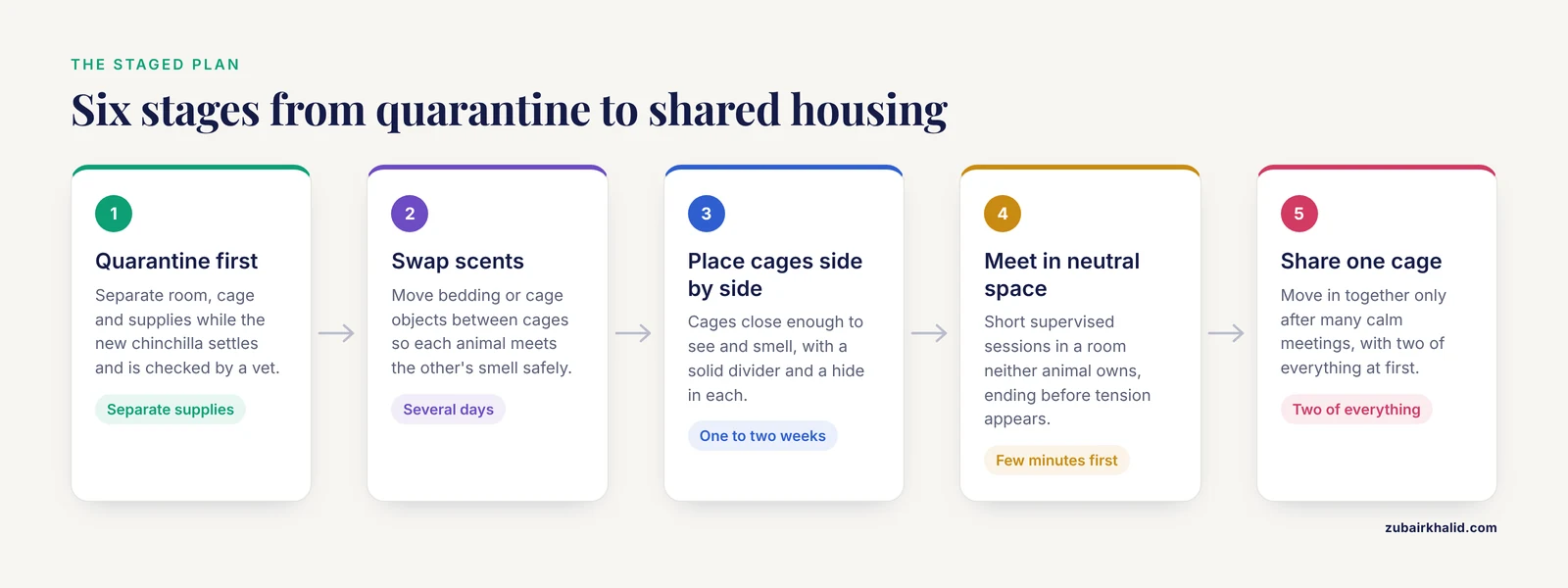
Use this checklist as your working plan. Each step gets a detailed explanation below.
| Step | What you do | Typical duration | Go-ahead signal | Stop signal |
|---|---|---|---|---|
| 1. Quarantine | House the new chinchilla in a separate room, separate cage, separate supplies | Talk to your veterinarian about an appropriate quarantine period for your situation | New chinchilla eats, drinks, and behaves normally | Any sign of illness, diarrhea, or lethargy |
| 2. Scent swap | Swap bedding, dust bath containers, or cage objects between the two cages | Several days to a week | Curiosity, no alarm at the other's scent | Persistent hiding or stress behaviors |
| 3. Side-by-side cages | Place cages close enough for the chinchillas to see and smell each other, with a solid barrier and personal space for each | One to two weeks or longer | Relaxed eating, resting, and normal activity near each other | Fur slipping, barking, urine spraying, pacing at the barrier |
| 4. Neutral territory meetings | Brief, closely supervised meetings in a neutral, escape-proof space | Short sessions, gradually longer | Tolerance, mutual sniffing, grooming | Biting, prolonged chasing, fighting |
| 5. Shared housing | Move in together only after many peaceful meetings | Permanent, with monitoring | Settled, relaxed behavior over weeks | Any serious fight means immediate separation, possibly permanent |
Two rules hold at every step. Never leave chinchillas together unsupervised until they have a long, established track record, and never house two unneutered males together if you also have females in the home, a point worth discussing with your veterinarian given the distinctive reproductive physiology of hystricomorph rodents described in the veterinary literature [2].
Can Chinchillas Live Together?
Chinchillas can live together, and many thrive in same-species pairs or small groups, but compatibility is individual and never guaranteed. Some chinchillas bond closely. Others remain intolerant of company for life, which matches their natural behavior as territorial animals. The honest answer to "can chinchillas live together" is that successful cohabitation depends on the individual animals, the sexes involved, the size and complexity of the enclosure, and your willingness to separate them if things go wrong.
Research on chinchilla housing gives useful context. In a study of farmed female chinchillas, animals kept in enlarged, deep-litter cages showed significantly fewer timid reactions toward humans than animals in standard cages, and round-the-clock video showed the animals spent about 68 percent of the day resting and 23 percent in locomotion [3]. Two lessons follow for owners. First, space matters. A cramped cage raises stress and reduces the options an animal has to retreat, which is exactly what a bonding pair needs. Second, chinchillas spend most of the day resting, so bursts of intense activity, including squabbling, can happen in short windows that you will miss if you only glance at the cage occasionally [3].
Same-sex pairs are the most common successful configuration for pet chinchillas. Opposite-sex pairs will breed, and chinchilla reproduction involves risks and diseases described in the veterinary literature, so breeding is a decision to make deliberately, not a side effect of housing two animals together [2]. Littermates or animals raised together tend to adapt fastest. Adults introduced to each other as strangers need the full staged process below.
Age and sex matter more than breed here. Pet chinchillas in the United States are almost all Chinchilla lanigera or hybrids of lanigera and breeder lines, and behavioral compatibility is not a breed trait. It is an individual trait. A chinchilla that has lived alone for years may reject a companion. A young chinchilla paired with another young chinchilla usually has the easiest path.
How to Introduce Chinchillas: Step by Step
This section covers how to introduce chinchillas to each other using a staged, low-risk method. The same logic applies whether you are introducing a new chinchilla to a resident one or setting up a new pair.
Step 1: Veterinary Check and Quarantine
Before any introduction, have the new chinchilla examined by a veterinarian comfortable with exotic pets. Discuss quarantine with that veterinarian. Keep the new arrival in a separate room with its own cage, food bowls, water bottle, hay, and dust bath. Handle the resident chinchilla first, the new one second, or wash your hands between animals. Quarantine protects both animals from infectious disease and gives the newcomer time to settle without the added stress of a stranger.
Watch the newcomer's eating, drinking, and droppings daily. Water intake in chinchillas is species-specific and varies with diet and environment, and research in small mammals has shown that water consumption cannot be predicted by a one-size-fits-all rule, so learn your own animal's normal pattern rather than comparing across species [4]. Persistent changes in drinking or a drop in droppings are reasons to call your veterinarian.
Step 2: Prepare the Environment
Set up two complete cages, not one divided cage, for the start of the process. Each cage needs hiding places, a solid shelf or platform, hay, pellets, a water bottle, and access to dust bathing on a schedule your veterinarian recommends. Enrichment and cage complexity are not luxuries. The cage study cited above found that animals in larger, more complex environments were measurably less fearful [3], and a fearful animal is harder to bond.
Plan for a neutral territory. This is a room or enclosed area where neither chinchilla has lived, so neither animal considers it home turf. Remove hazards, block gaps behind furniture, and make sure neither animal can get under anything you cannot reach. A bathtub, a cleaned empty bathtub with a towel on the bottom, or a small pet pen works for many owners.
Step 3: Scent Swapping
Scent is how rodents communicate. Swap bedding between the two cages, or swap a chewed piece of wood, a hide, or the dust bath container. The goal is for each animal to encounter the other's smell inside its own safe space without any visual contact. Continue for several days. Mild curiosity or brief sniffing is a good sign. Frantic digging at the swap item, continuous hiding, or aggression directed at the object tells you to slow down and repeat the stage.
Step 4: Side-by-Side Housing
Move the two cages next to each other, close enough that the animals can see and smell each other but with a small gap or solid divider so they cannot bite through the bars. Give each cage a hide so each animal can opt out of contact. Chinchillas that can choose to retreat are calmer animals, and the freedom to retreat is a core welfare principle reflected in the Five Domains model used to assess small mammal welfare at home [1].
Watch for these signals during this stage.
Good signs include both animals eating normally in view of the other, resting near the shared side, mirroring activity cycles, and ignoring each other. Mutual calm indifference is a real achievement.
Warning signs include persistent alarm barking, urine spraying, fur slipping (patches of loose fur released when an animal is grabbed or terrified), pacing at the barrier, refusing to eat, and Barbering or over-grooming. Chinchillas vocalize, and the veterinary literature documents the vocal repertoire of hystricomorph rodents [2]. Learn your animals' alarm calls during this stage. A sharp bark during a side-by-side phase is your animal telling you the pace is too fast.
Stay in this stage for at least a week after the last warning sign. Some pairs need a month or more here, and that is normal.
Step 5: Neutral Territory Meetings
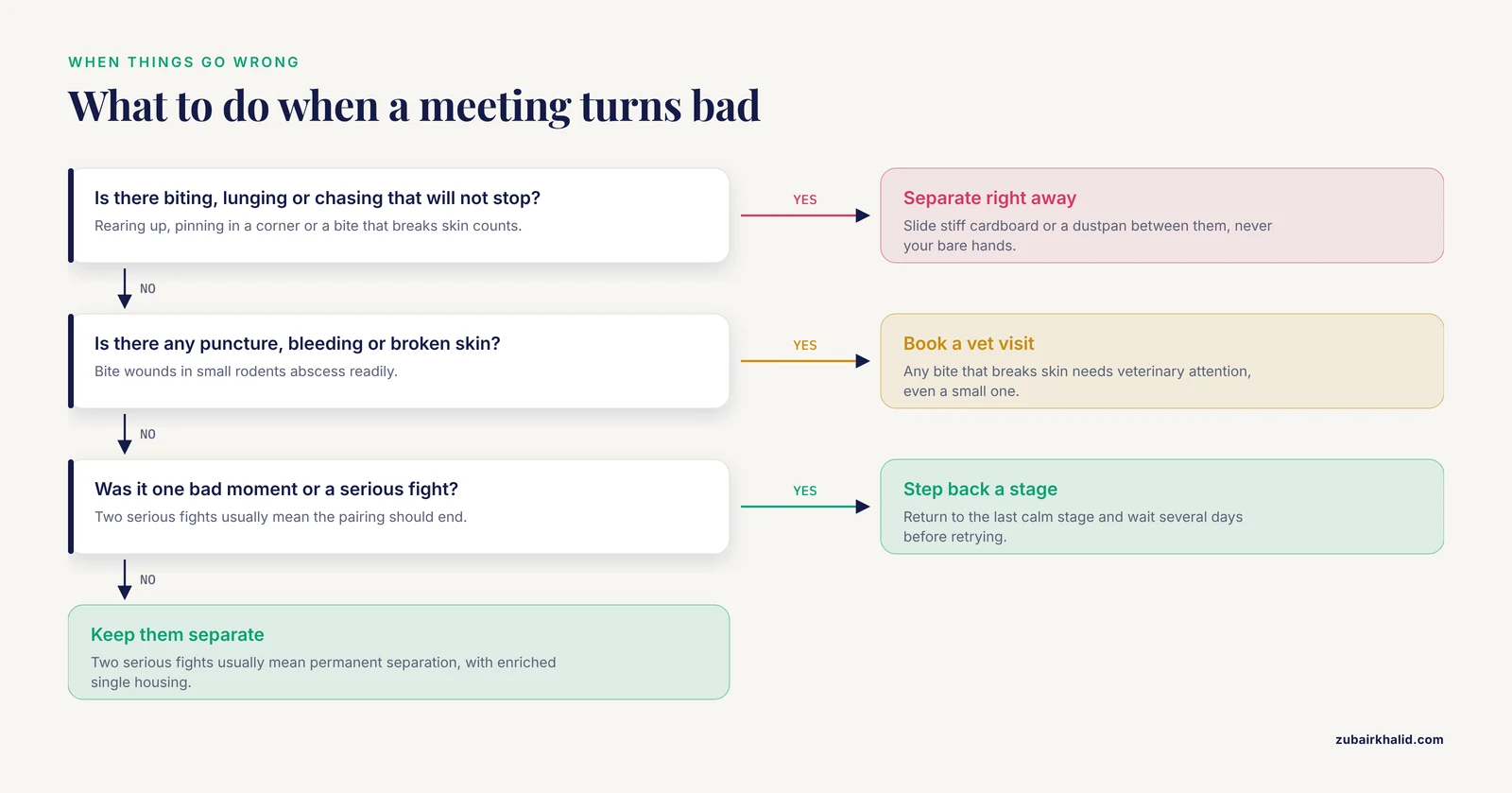
Once side-by-side living is calm, start short meetings in the neutral territory. Keep the first sessions brief, a few minutes at most, and end them before any tension appears. Have a plan for separating animals safely, such as a large piece of cardboard or a dustpan to slide between them, never your bare hands, because a panicked chinchilla can bite hard and because grabbing a chinchilla by the fur causes fur slip.
During meetings, watch for mutual sniffing, brief chasing that stops, and settling. Some owners offer a small pile of hay at opposite ends of the space so both animals eat in shared company. Feeding near each other builds positive associations.
Increase session length gradually over days and weeks. If a meeting goes badly, separate calmly, return to the previous successful stage, and wait several days before trying again. A single bad meeting does not end the pairing, but repeated serious fights usually do.
Step 6: Shared Housing
When the animals tolerate long, relaxed sessions together, move them into one cage. Use the largest enclosure you can provide, ideally one that neither animal has claimed exclusively, cleaned and rearranged so it feels neutral to both. Provide two of everything, two hides, two food dishes or well-separated feeding stations, two water bottles, two shelves at different heights, for the first weeks. Duplicate resources remove the most common trigger for conflict.
Continue daily supervised observation for several weeks. Check both animals daily for wounds, fur loss, weight changes, and droppings. Even a bonded pair can have bad days, and a hidden injury found early is a minor problem while the same injury found late can be life-threatening.
The Chinchilla Bonding Process: Reading Body Language
The chinchilla bonding process is slower than many owners expect, and misreading signals is the most common cause of failed introductions. Learn this vocabulary before your first meeting.
Affiliative and calm signals include soft mutual sniffing, gentle nibbling or grooming of the ears and face, sitting or resting within a body length of each other, and synchronized eating. These are the signs you want to see more of each week.
Tolerant but unbothered signals include simply ignoring each other. This is acceptable. A pair that ignores each other peacefully can still be a successful living arrangement even if they never become cuddly.
Stress and fear signals include alarm barking, urine spraying, crouching flat against the floor, teeth chattering, fur slipping, and frantic attempts to escape. Fur slip is a signature chinchilla stress response, the release of tufts of fur when the animal is frightened or grabbed, and it leaves visible bald patches. If you see fur slip during a meeting, the session has exceeded the animal's tolerance.
Aggressive signals include rearing up toward the other animal, lunging, biting, prolonged chasing, and pinning one animal in a corner. Any bite that breaks skin ends the session immediately, and wounds need veterinary attention because abscesses are a real risk in small mammals.
Hystricomorph rodents, the group that includes chinchillas and guinea pigs, have a documented range of vocalizations that carry meaning [2]. Spend your first weeks simply listening. Owners who learn their animals' normal sounds catch problems days earlier than owners who do not.
Housing, Space, and Why Setup Determines Success
Housing is not the backdrop to bonding. It is the foundation. The 2025 survey of small mammal owners identified the availability of suitable enclosures as the primary barrier to good welfare, while capability and motivation were facilitators, meaning most owners wanted to do the right thing but were held back by practical access to proper housing [1]. Apply that finding to your own plan. Before you introduce a second chinchilla, confirm you actually have the space for two complete setups and, eventually, one appropriately large shared cage.
Cage complexity matters independently of floor space. In the chinchilla housing study, the animals with the most complex, enlarged environments were the least fearful toward humans, and their daily time budget, dominated by resting, reflects a crepuscular activity pattern [3]. Practical implications for a bonding setup follow from this.
Give each animal a hide it can fully enter so retreat is always possible. Provide multiple shelves so two animals can occupy the cage without occupying the same platform. Use deep litter or solid flooring rather than bare wire, since the study's deep-litter groups showed calmer behavior [3]. Keep the cage away from loud household traffic during the bonding weeks. And remember that chinchillas rest most of the day and are most active in short windows, so schedule your observation sessions around dawn and dusk activity rather than midday [3].
Provide fresh water at all times in both cages during the bonding process. Research on small mammal water intake has shown that water consumption is species-dependent and influenced by factors such as diet and environment, and that adequate water supply is indispensable for health, including prevention of urinary sludge and stones [4]. A chinchilla that stops drinking during a stressful introduction is showing you a welfare red flag, not a quirk.
Chinchillas and Other Pets
Chinchillas and other pets in the same home is the question with the least room for optimism. The short answer is that chinchillas should not have physical contact with cats, dogs, ferrets, or predatory pets, ever, and interactions with other rodents and rabbits should also be avoided.
Cats and dogs are predators, and a chinchilla is prey. Even a cat that has lived peacefully beside a caged rodent for years retains the reflexes and the motivation to swat, and a dog that has never shown interest can still seize a small animal in a moment of play or prey drive. There is no introduction protocol that makes direct contact safe. The correct arrangement is permanent separation, meaning the chinchilla lives in a room the dog or cat cannot enter, or in a cage with a locked door the other pets cannot open. Many owners underestimate how determined a bored dog can be. Secure the door latch with a clip, and never rely on height alone, because cats climb.
Ferrets are a particular danger because they were domesticated to hunt rabbits and rodents, and no household supervision makes them safe around a chinchilla.
Rabbits and guinea pigs are common questions, since they are similar-sized herbivores. They should not be housed together. They have different dietary needs, different disease risks, and different communication styles, and rabbits can seriously injure guinea pigs and small rodents with a single kick. The veterinary literature treats guinea pigs and chinchillas as related but distinct species with their own husbandry and disease profiles [2], which is exactly why cross-species cohabitation creates problems for both.
If you own both a chinchilla and a dog or cat, manage the environment rather than the animals. Close the door. Supervise any accidental encounters, and treat every encounter as potentially the last free one if the other pet shows focused interest. Interactions across a closed, mesh-fronted cage with the dog or cat on a leash are the limit of reasonable exposure, and even then, sustained predatory staring or pawing at the cage means the arrangement needs to change.
Supplies for the Introduction Period
Gather these before you bring the new chinchilla home. The selection criteria matter more than the brands, so evaluate any product against these points.
Two full cages, sized generously, with solid or deep-litter flooring rather than bare wire, since flooring type affected behavior in the chinchilla housing study [3]. Multiple hide houses, one per animal minimum, so retreat is always available. Heavy ceramic food dishes that cannot be tipped. Water bottles with metal spouts, one per animal in shared housing, because water adequacy is a daily welfare check in small mammals [4]. Chinchilla dust bath containers, one per cage, never shared between quarantined animals. Untreated wood chews and shelves. A backup cage or carrier for each animal so you always have somewhere to separate a fight instantly. A barrier tool, such as a stiff piece of cardboard, for breaking up encounters without using your hands. A digital kitchen scale for weekly weight checks. A thermometer for the room where the cages live, and a plan for keeping that room cool, which you should discuss with your veterinarian as part of standard chinchilla husbandry [2].
Common Mistakes That Sink Introductions
Skipping quarantine. Owners who skip quarantine to save time risk exposing both animals to infectious disease, and the cost of treating an outbreak in a small mammal dwarfs the inconvenience of a few extra weeks of patience.
Rushing the timeline. The most common failure in the chinchilla bonding process is moving from side-by-side cages to full contact in days. A pairing that might have succeeded over six weeks is lost in one fight on day four.
Insufficient cage size and complexity. An animal that cannot retreat cannot de-escalate. The research showing calmer behavior in larger, more complex cages [3] applies directly to whether two chinchillas can share space at all.
Reading tolerance as acceptance. Two chinchillas that merely tolerate each other in a meeting are not bonded. Acceptance is weeks of calm, shared resting, mutual grooming, and no incidents. Tolerance is five minutes of stiff coexistence. Confusing the two leads to premature unsupervised housing, which is when serious injuries happen.
Ignoring vocal warnings. Chinchillas bark before they bite. Owners who dismiss barking as noise miss the clearest warning signal their animal gives.
Leaving them alone too soon. Every fight that maims a chinchilla happened when the owner was asleep, at work, or in another room. Supervision is not optional until you have months of incident-free shared housing.
Housing intact opposite-sex pairs. This produces litters, and chinchilla reproduction carries documented risks and diseases [2]. Discuss neutering with an exotics veterinarian before any opposite-sex housing.
Forcing cross-species friendships. A dog and a chinchilla in a photo together is not evidence of safety. It is evidence that the owner accepted a risk the animal could not decline.
Troubleshooting Common Problems
Persistent barking at the barrier. Slow down. Return to pure scent swapping for a week, then restart side-by-side placement with more distance between cages, closing the distance gradually. Barking is an alarm, and alarms need more space, not more exposure.
One animal monopolizes resources. This appears in shared housing as one chinchilla guarding the hay rack, the hide, or the shelf. The fix is duplication, a second of everything placed far apart in the cage. If guarding continues after duplication, separate again and consult a veterinarian or an experienced exotics behavior resource.
Fur slip during meetings. Fur slip means the animal experienced genuine fear. End the session, give the animal a day or two of normal routine, and restart at the previous stage. Repeated fur slip tells you the pairing may not be viable.
A fight breaks out despite precautions. Separate with a barrier tool, never your hands. Check both animals for wounds. Any puncture, even a small one, needs a veterinary visit, because bite wounds in small rodents abscess readily. Return to the last successful stage. Two serious fights usually mean the pairing should end permanently, and both animals can live healthy lives singly provided their environment is enriched.
One chinchilla stops eating after a change. Anorexia in a chinchilla is an emergency, not a mood. Call an exotics veterinarian the same day. Watch droppings, and note that changes in water intake also matter, since research on small mammal water consumption links hydration status to health outcomes such as urinary disease [4].
Welfare and Safety Points
Welfare in this context means the animal can express normal behavior and avoid fear, pain, and distress, which is the framework of the Five Domains model that small mammal welfare assessments at home have been mapped against [1]. Apply it concretely. A chinchilla in a bonding process needs room to retreat, predictable routines, appropriate food and water, and freedom from being chased or cornered, whether by another chinchilla or by a household dog.
The behavioral evidence from chinchilla housing research supports generous space and environmental complexity as direct welfare interventions, not extras [3]. If your home cannot accommodate that, the better welfare decision is to keep a single chinchilla in a properly enriched environment rather than crowd two animals into inadequate space. Owners who cannot access suitable large enclosures should not feel shame for this, since the 2025 survey showed enclosure availability, not owner motivation, was the main barrier [1]. But they should choose the single-animal plan.
Safety for other pets is one-directional. The chinchilla is always the vulnerable animal. Every household rule, closed doors, secured latches, no free-roaming time shared with cats or dogs, exists to protect the small animal from the larger one.
Limitations and When to Contact a Veterinarian
Individual cases vary, and any specific decision about your chinchilla, especially anything involving illness, injury, aggression with blood drawn, or breeding, needs an in-person assessment by a veterinarian experienced with exotic companion mammals. The published research on pet chinchilla behavior is limited compared with research on dogs, cats, rabbits, and guinea pigs, and much of what is known comes from farmed animals and related species, so treat the timelines in this article as ranges, not rules.
Contact a veterinarian promptly in these situations.
Any bite wound, puncture, or bleeding, at any point in the process. A chinchilla that has not eaten or has produced few or no droppings for a day. Diarrhea or soft, misshapen droppings lasting more than a day. Sudden behavior change, including hiding that persists past the normal settling period. Fur loss beyond a small slip, or visible bald patches. Rapid weight loss on weekly checks. Signs of pain, including hunching, tooth grinding unrelated to eating, or reluctance to move. Heat stress signs, including drooling, lying stretched out and limp, or open-mouth breathing, which is an emergency. Any concern about reproductive behavior, pregnancy, or aggression between intact animals. Any situation where you feel unsafe handling an animal, which is a common reason owners delay care and one worth naming to your veterinarian directly.
Frequently Asked Questions
How long does it take to introduce two chinchillas?
Most successful introductions take four to eight weeks from quarantine to shared housing, and some take months. The timeline depends on the individual animals, their ages, and how quickly each stage stays calm. Moving faster than the animals' signals allow is the main cause of failed pairings.
Can chinchillas live together permanently?
Yes, many chinchillas live together permanently in same-sex pairs or small groups, but some individuals remain intolerant of companions for life. A permanent pairing only works when both animals show sustained calm behavior over months, resources are duplicated, and the owner stays alert for late-appearing conflicts.
Can I keep two male chinchillas together?
Two males can live together successfully, especially if they were raised together or introduced young. Two unneutered males that can smell a female in the home are much more likely to fight, so discuss the situation and any neutering options with an exotics veterinarian before housing males together.
Can a chinchilla live with a guinea pig or rabbit?
No. Chinchillas, guinea pigs, and rabbits are distinct species with different diets, diseases, and communication, and cross-species housing risks injury and illness for all of them. The veterinary literature treats each species' husbandry separately for good reason.
Can my chinchilla play with my cat or dog?
No. Cats and dogs are predators and a chinchilla is prey, and no amount of prior peaceful behavior makes direct contact safe. Keep them permanently separated by a closed door or a cage the other pet cannot open, and treat every accidental encounter as a near miss.
Do chinchillas get lonely if kept alone?
A single chinchilla with daily human interaction, enrichment, and a complex environment can live a good life alone, and research on chinchilla housing shows that cage complexity reduces fearfulness. A companion is not mandatory, but if you provide one, follow the full staged introduction rather than assuming any two chinchillas will pair.
What should I do if my chinchillas fight?
Separate them immediately using a barrier such as stiff cardboard, never your hands, check both for wounds, and return to the last stage where they were calm. Any bite that breaks skin needs veterinary attention. Two serious fights usually mean the pairing should end permanently.
How do I know if the introduction is working?
Progress looks like both animals eating normally, resting near each other, mutual sniffing and grooming, and no incidents over increasing periods. Warning signs include barking, urine spraying, fur slip, hiding, refusal to eat, and chasing that does not stop. Judge the pairing by weeks of consistent calm behavior, not by one good meeting.
Sources
- Small mammal owners' experiences of housing challenges and animal welfare: A COM-B and word frequency analysis.
- Guinea pig and chinchilla care and husbandry.
- The effects of age, size, and cage complexity on the behaviour of farmed female chinchillas (Chinchilla lanigera).
- Water consumption in small mammals (dwarf rabbits, Guinea pigs and chinchillas): New data about possible influencing factors.