How Often to Clean a Gerbil Habitat: Cleaning Schedule
By Dr. Zubair Khalid, DVM, MS, PhD ·

The answer to how often to clean a gerbil habitat comes in three overlapping rhythms. Spot clean daily, removing wet bedding, spoiled fresh food, and soiled toilet corners in about five minutes. Do a partial clean once a week, refreshing roughly a third of the substrate, scrubbing the water bottle, and wiping the wheel. Deep clean the entire enclosure every three to four weeks, or sooner if odor, dampness, crowding, or illness says otherwise.
There is a principle underneath those numbers. Gerbils are burrow animals, and their relationship with their substrate is functional, not decorative. Research on Mongolian gerbils (Meriones unguiculatus) has shown that access to a working burrow shapes normal behavior and that daily husbandry routines have measurable effects on gerbil stress [1]. A gerbil cage cleaning schedule that preserves the burrow and some familiar scent will outperform a rigid, aggressive one, even when both involve the same products and the same effort.
This article gives you the full schedule, the reasoning behind it, a safe product list, a step-by-step deep cleaning method, and the warning signs that turn a cleaning session into a veterinary question.
This article is educational and is not a substitute for veterinary diagnosis or treatment.
At a Glance: Gerbil Cage Cleaning Schedule
| Task | Frequency | Time | Key points |
|---|---|---|---|
| Spot clean (wet patches, toilet corner, dropped fresh food) | Daily | 2 to 5 minutes | Remove only the soiled patch, leave tunnels and nest untouched |
| Water bottle check and refill | Daily | Under 1 minute | Tap the nozzle to confirm water flows, refill with fresh water |
| Partial clean and substrate top-up | Weekly | 15 to 25 minutes | Refresh about one third of the substrate, scrub the bottle, wipe the wheel |
| Sand bath refresh | 2 to 3 times weekly, or when soiled | 5 minutes | Dump used sand, wash the dish, refill with clean dust-free sand |
| Deep clean (full substrate change, tank wash, disinfection) | Every 3 to 4 weeks | 45 to 60 minutes | Keep a handful of dry old bedding, dry everything completely before returning gerbils |
| Welfare check | Every session | Included | Droppings, urine, coat, teeth, nails, breathing, activity |
Why Cleaning Frequency Matters for Gerbil Habitat Hygiene
Two separate concerns sit behind every cleaning decision, and they pull in opposite directions.
The first is hygiene. Urine breaks down into ammonia, which irritates the airways of small animals in enclosed spaces. Damp bedding supports mold and bacterial growth within days, especially in warm rooms. Fresh food left in the tank spoils and attracts pests. A glass tank holds humidity and odor more than an open wire cage, which makes the cleaning rhythm, not the tank itself, the deciding factor in how the enclosure smells and what grows in it.
The second is psychological. Gerbils are not casual diggers. In laboratory studies, Mongolian gerbils housed without any burrow developed stereotypic digging, a repetitive and functionless behavior, and providing an integrated artificial burrow prevented it. The same research used fecal cortisol, a noninvasive stress hormone measure, to compare housing conditions and demonstrated that husbandry routines themselves influence gerbil stress levels [1]. For a pet gerbil, the substrate in the tank is the burrow. Every cleaning decision either preserves that structure or resets it to zero.
Cleaning is also a psychological event for the animal. Shelter welfare research on cats found that caregivers met physical needs, such as access to veterinary care, more consistently than psychological needs, and that cleaning and handling routines were a common weak point [2]. Small prey animals experience a full teardown of their territory as a major event. The goal is a routine that is hygienic for you and predictable for them.
Modern welfare science frames this dual view clearly. The Five Domains model, a widely accepted framework for building welfare assessment tools across species and settings, treats the animal's physical environment and its mental state as connected rather than separate concerns [3]. Reviews of welfare indicators in small mammals such as rats, mice, guinea pigs, and rabbits pair resource-based measures, such as enclosure hygiene, with animal-based measures, such as posture and activity, because neither alone tells the full story [4]. Your cleaning schedule is the resource-based half. Your gerbils' behavior after cleaning is the animal-based half that confirms whether the schedule is right.
How Often to Clean a Gerbil Habitat: The Core Schedule
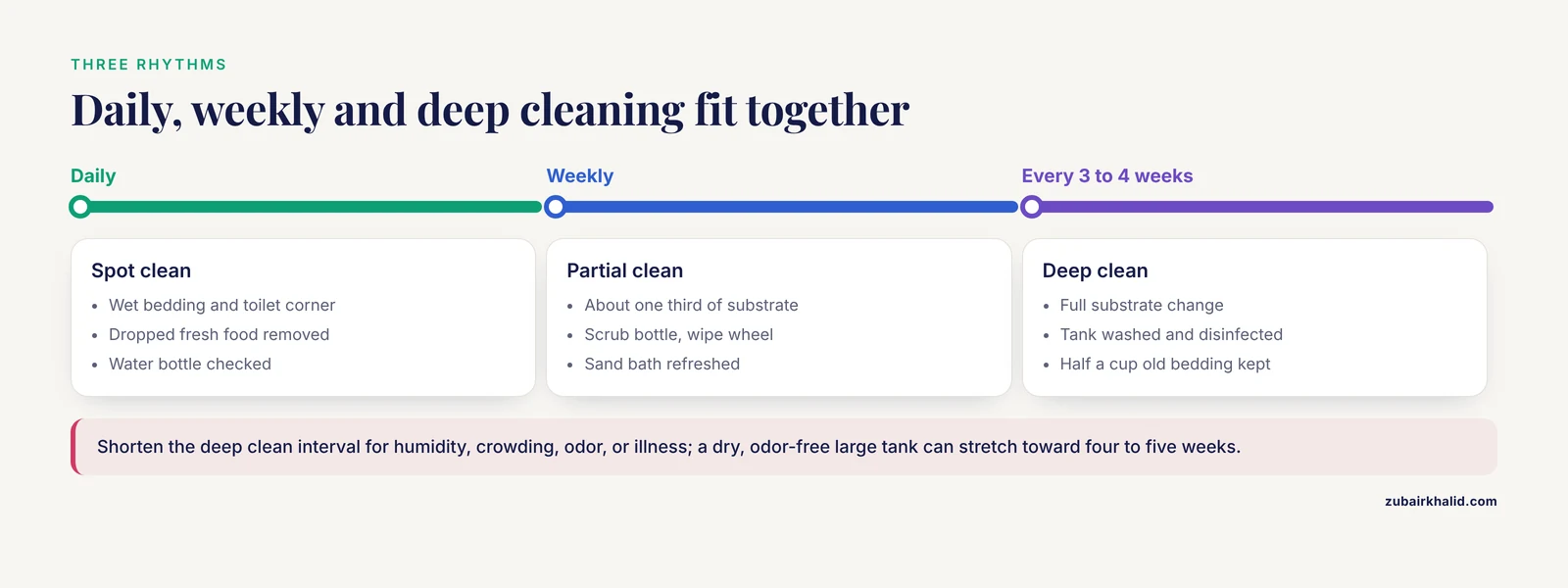
No single interval fits every tank. The schedule below is a workable default for a typical pair of gerbils in a glass tank with deep substrate. Treat it as a starting point, then adjust using the signals described later in this article.
Daily Tasks (About 5 Minutes)
- Remove wet or visibly soiled bedding, especially in the toilet corner and under the water bottle spout.
- Lift out dropped fresh food. Remove vegetables or fruit within a few hours of feeding, before they spoil.
- Check the water bottle. Tap the nozzle to confirm water flows, and top up with fresh water.
- Watch each gerbil for thirty seconds. You are looking for normal breathing, normal movement, and normal curiosity.
- Glance at the droppings. Small, firm, dark pellets are what you want to see.
Weekly Tasks (15 to 25 Minutes)
- Remove the top, soiled layer of substrate from toilet corners and around the wheel, and replace it with fresh substrate of the same type.
- Top up the substrate so the overall depth stays consistent. Gerbils excavate constantly, and depth is what lets them rebuild.
- Wipe the wheel and hard accessories with a damp cloth. Swap soiled cardboard items for fresh ones.
- Scrub the water bottle and nozzle with a bottle brush and unscented soap, then rinse until the water runs clear of any suds.
- Refresh the sand bath. Dump used sand, wash the dish if it is dirty, and refill with clean, dust-free sand sold for small mammals. Gerbils use sand rather than water for coat care, and soiled sand defeats the purpose.
- Do a nose test. A healthy gerbil tank smells faintly of substrate and animal. A sharp ammonia smell means you need to clean more often or improve ventilation.
- While the gerbils are active, run a quick hands-off health check. Coat condition, eyes, nose, rear end, nails, and visible teeth.
One rule outranks the rest of the weekly list. Leave the burrow alone. Do not collapse tunnels, do not remove nest material unless it is wet or heavily soiled, and work around the structure your gerbils have built, because gerbil welfare research ties burrow access directly to normal behavior and lower stress [1].
Deep Cleaning: Every 3 to 4 Weeks
Deep cleaning a gerbil enclosure means emptying the tank, washing and disinfecting every surface, and rebuilding the substrate from scratch. For most healthy pairs in a well sized tank, every three to four weeks is a sensible default. Shorten the interval when any of the following apply.
- Warm, humid weather or a humid home.
- More than two gerbils, or a tank on the small side.
- Any spill, bottle leak, or episode of diarrhea.
- A noticeable odor between scheduled cleans.
- A gerbil recovering from illness, where your veterinarian may advise a specific routine.
Stretch the interval, within reason, when the opposite holds. A single pair in a large tank with deep, dry substrate and no odor can often go closer to four or five weeks between deep cleans, with daily spot cleaning and weekly partial refreshes doing the heavy work in between. Dry, undisturbed substrate is part of the hygiene system in a gerbil tank, not separate from it.
How Often to Change Gerbil Bedding
Owners often ask how often to change gerbil bedding. The useful answer is by zone, not by date. Change soiled zones weekly, top up weekly, and do a full change only at the scheduled deep clean. At every full change, save a handful, about half a cup, of clean, dry old bedding and scatter it back over the fresh substrate. Familiar scent shortens the restless re-marking period after a clean and keeps the enclosure feeling like territory rather than a blank box.
Safe Cleaning Products for Gerbils
The safest kit is also the cheapest. Hot water, unscented dish soap, and diluted white vinegar handle nearly every cleaning job in a gerbil tank. For disinfection, use a small-mammal-safe disinfectant from a pet retailer, following the label exactly, or heavily diluted plain unscented household bleach followed by multiple thorough rinses and complete air drying. Whatever you use, the standard is the same. Rinse until you cannot smell the product, then dry until no moisture remains.
Avoid the following.
- Scented soaps, fabric-scented sprays, and anything that leaves a lingering perfume.
- Pine and citrus scented cleaners and phenolic disinfectants, which are traditionally avoided around small animals.
- Ammonia-based glass cleaners used in the same room as the tank, which add fumes on top of the ammonia already present in urine.
- Essential oil products and antibacterial sprays applied inside the enclosure.
- Any product used at a stronger concentration or with less rinsing than the label directs.
Practical handling rules. Clean in a ventilated room, keep the gerbils in a separate space while products are out, and never spray anything while an animal is inside the enclosure. Return the gerbils only when the tank is completely dry and odorless. Wash your hands before and after handling gerbils or their equipment. If a product contacts a gerbil directly, or if a gerbil seems unwell after a cleaning session, contact a veterinarian.
Deep Cleaning a Gerbil Enclosure, Step by Step
- Set up a holding area. A spare tank, a secure travel carrier with a solid floor, or a deep bin with a ventilated lid works. Add a scoop of substrate, a hide, and water. Keep it away from drafts, direct sun, and other pets.
- Move the gerbils safely. Guide them into a cup with both hands, or lure them into a hide or tube and lift the hide. Never lift a gerbil by its tail. Tail skin injuries are a well known gerbil hazard, and the rule against tail lifting is absolute.
- Remove everything. Take out accessories, the wheel, the bottle, the sand bath, and all substrate. Note where the main tunnels and nest sit before you dismantle them.
- Wash the tank. Use hot water and unscented dish soap with a scrub brush dedicated to pet use. White vinegar cuts the mineral and urine scale that builds up at the waterline and in corners.
- Disinfect. Apply your chosen disinfectant according to the label, keep surfaces wet for the full contact time, then rinse thoroughly.
- Dry completely. Air dry or towel dry, then wait. Damp surfaces and damp substrate invite mold within days.
- Clean the accessories. Scrub plastic and ceramic items and the wheel. Check wooden items and chew toys. Wood that is saturated with urine or heavily gnawed is better replaced than disinfected, because porous wood holds residue.
- Rebuild deep. Fill the tank with fresh substrate as deep as the design safely allows. Depth is what lets gerbils dig tunnels and chambers, and shallow coverage is one of the most common gerbil housing mistakes.
- Restore continuity. Scatter the reserved handful of old dry bedding across the surface. If you noted the tunnel layout, dig starter tunnels in roughly the same places. Your gerbils will finish the job within hours.
- Return and feed. Put the gerbils back, scatter a portion of their regular food across the substrate, and let them redecorate. Scattering food turns the post-clean period into natural foraging instead of restless pacing.
- Log the date. Write the deep clean date on the tank or in your phone calendar and set the next reminder for three to four weeks out.
Equipment and Supplies for Gerbil Habitat Hygiene
- Substrate. Paper-based bedding or aspen shavings, always unscented. Pine and cedar shavings are traditionally avoided for small pets because of their aromatic oils. Buy in bulk, because a deep-filled gerbil tank consumes far more substrate than a shallow hamster cage.
- A glass tank or deep-based enclosure. Glass walls hold deep substrate without collapse, which supports the burrow-centered cleaning approach this article recommends.
- Unscented dish soap and white vinegar. The workhorses of the routine.
- A pet-safe disinfectant, or plain unscented bleach for dilution. Choose products with clear label directions for contact time and rinsing.
- A dedicated scrub brush and sponge. Kept separate from kitchen items, and replaced when worn.
- Labeled spray bottles. One for water, one for vinegar solution, one for disinfectant.
- A bottle brush. For the water bottle and its nozzle.
- Gloves, paper towels, and a substrate scoop or dustpan. For the removal step.
- A secure holding carrier or spare tank. Essential for deep cleans.
- Sand bath sand. Dust-free sand sold for small mammals, replaced rather than washed.
- Replacement cardboard, hay, and chew wood. Some items are cheaper to replace than to clean.
For gerbil care questions beyond cleaning, owner-facing references such as the Merck Veterinary Manual's exotic and laboratory animal resources and VCA Animal Hospitals' small mammal guides are reasonable background reading.
Common Mistakes in the Gerbil Cage Cleaning Schedule
Full teardown every week. This fights gerbil biology. Repeatedly flattening tunnels and stripping all familiar scent removes the burrow continuity that gerbil welfare research identifies as central to normal behavior [1]. Fix: spot clean daily, refresh a third of the substrate weekly, deep clean on a three to four week cycle.
Never deep cleaning. Ammonia builds, bedding stays damp, scale coats the tank corners, and odor eventually fills the room. Fix: set a calendar reminder and treat the deep clean as a fixed appointment.
Scented products. Perfume residues on surfaces and hands are unpleasant for animals that read their world through scent. Fix: an unscented kit.
Leaving damp patches in place. A wet spot under the bottle becomes mold within days. Fix: remove wet substrate the same day you find it.
Removing every trace of old bedding. A sterile-smelling tank invites hours of frantic re-marking. Fix: keep a handful of clean, dry old bedding for every deep clean.
Digging out the burrow during weekly cleans. The weekly tidy should work around the structure, not through it. Fix: clean the toilet corner and wheel zone, leave tunnels and nest intact unless they are wet or soiled.
Returning gerbils to a damp or fragrant tank. Moisture and perfume residue defeat the purpose of the clean. Fix: dry fully and pass the sniff test before the gerbils go back.
Cleaning with the animals inside. Sprays, fumes, and vibration stress the animals and risk direct exposure. Fix: relocate to a holding carrier for anything beyond spot cleaning.
Reading Your Gerbils: Welfare Checks Built Into Cleaning Time
Every cleaning session doubles as a health check, which is one more reason a consistent schedule pays off. While your hands are in the tank, look at the following.
- Droppings and urine. Quantity, form, and any wetness where there should be none.
- Coat and skin. Bare patches, scabs, redness, or visible itching.
- Teeth and chewing. Normal gnawing on chew items versus drooling or dropping food.
- Nails and feet. Overgrowth, sores, or redness, especially on the feet of heavy wheel users.
- Breathing. Clicking, wheezing, or discharge from the nose or eyes.
- Posture and energy. A hunched, fluffed, or lethargic gerbil at a time of day when it is normally active.
Expect a burst of digging, rearranging, and scent marking after any clean. That is normal territory maintenance. What is not normal is repetitive, compulsive digging at the same spot hour after hour, or constant bar chewing. Stereotypic digging and bar chewing are documented welfare problems in gerbils and signal that housing or routine needs review [1].
This mirrors the structure veterinarians use in formal welfare assessment. Small-mammal welfare reviews combine resource-based indicators, like enclosure hygiene and substrate depth, with animal-based indicators, like coat condition and activity, and stress that no single indicator is sufficient on its own [4]. Welfare assessment frameworks also emphasize that husbandry decisions should be consistent and repeatable rather than improvised, because consistent management is what makes problems visible early [5]. Protocols developed across farmed species reach the same conclusion, favoring standardized, repeatable checks over one-off impressions [6].
Special Situations That Change the Schedule
New gerbils and introductions. Scent is the bonding language of gerbils. During split-cage introductions or the first weeks with a new gerbil, postpone deep cleaning. Swap small amounts of bedding between sides to share scent instead, and deep clean once the animals are settled and bonded.
Nursing mothers and litters. Leave the nest untouched in the first days. Spot clean only the far corners, keep noise low, and postpone the deep clean until the pups are mobile and the mother is settled. Your veterinarian can advise timing for your specific litter.
Senior or ill gerbils. Increase spot cleaning frequency, handle gently, and agree on a substrate and cleaning plan with your veterinarian. Ill gerbils often soil more, so daily changes of the soiled zone keep them clean without repeated full disruption.
Hot and humid weather. Shorten the intervals. Dampness and ammonia both build faster in heat, and mold can appear within days.
Larger groups. More animals mean more waste. Scale the schedule up in frequency, not in the force of each individual clean.
Limitations and When to Contact a Veterinarian
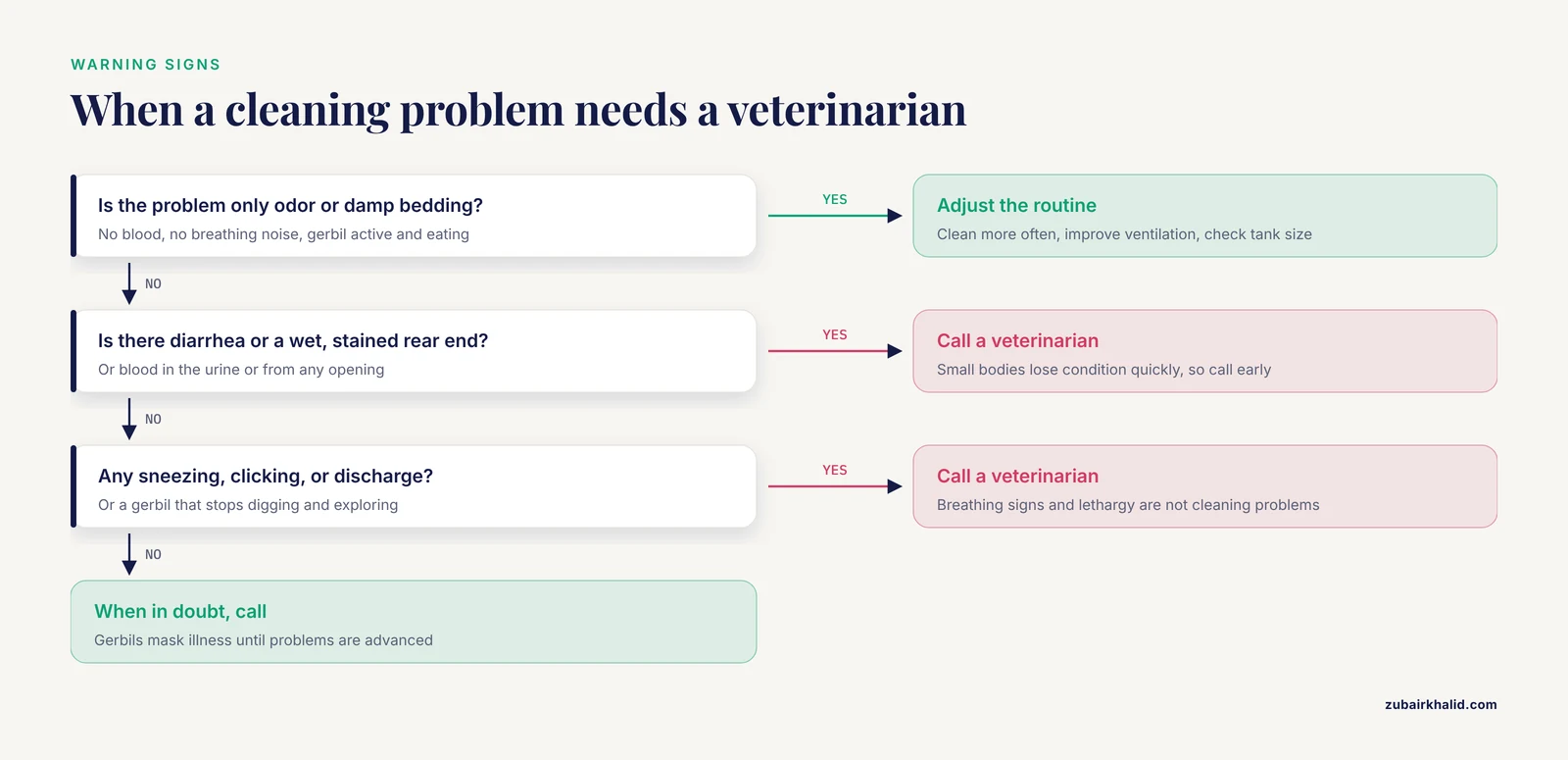
Every gerbil, tank, and home is different, and the schedule in this article is a starting framework rather than a prescription. A veterinarian experienced with small mammals can tailor cleaning and husbandry advice to your animals, especially when illness, pregnancy, or behavior problems are in the picture.
Contact a veterinarian promptly if you see any of the following.
- Not eating, or eating far less than usual, for more than a day.
- Diarrhea, or a wet, stained, or foul-smelling rear end.
- Blood in the urine, or blood from any opening.
- Sneezing, clicking, wheezing, or discharge from the nose or eyes.
- Lethargy, hunched posture, or a gerbil that stops digging and exploring.
- Hair loss, scabs, visible itching, or any lump.
- Drooling, overgrown incisors, or a drop in body condition you can feel along the spine.
- Overgrown nails, foot sores, or any injury, including tail injuries.
- Sudden aggression or any abrupt behavior change.
- Any suspected exposure to a cleaning product. Ventilate the area and call your veterinarian or an animal poison control center.
Gerbils are prey animals and tend to mask illness until problems are advanced. Small bodies lose condition quickly, so an early call is inexpensive insurance. When in doubt, call.
This article is educational and is not a substitute for veterinary diagnosis or treatment.
Frequently Asked Questions
How often should you fully clean a gerbil cage?
Every 3 to 4 weeks as a default, with daily spot cleaning and a weekly partial refresh in between. Shorten the interval for humidity, crowding, odor, or illness, and stretch it slightly for a single pair in a large, dry, odor-free tank.
Can I clean the cage while my gerbils are inside?
Spot cleaning around them is fine once they are used to your hands. A deep clean should always happen with the gerbils in a secure holding carrier or spare tank, away from fumes and noise.
What cleaning products are safe for gerbils?
Hot water, unscented dish soap, and diluted white vinegar cover most jobs. For disinfection, use a pet-safe product according to its label, or heavily diluted plain unscented bleach with thorough rinsing and complete drying. Avoid scented, pine, phenolic, and ammonia-heavy products.
How often should I change gerbil bedding?
Change soiled zones weekly, top up weekly, and do a full change only at the deep clean. Always mix a handful of clean, dry old bedding into the fresh substrate to preserve familiar scent.
Why does my gerbil tank smell even after cleaning?
Look for hidden damp substrate, urine scale on the tank floor and bottle, a soiled sand bath, or a deep clean that is overdue. Persistent odor despite a proper routine usually means the enclosure is too small for the number of gerbils in it.
Should I leave the burrow alone when cleaning?
Yes. Keep tunnels and the nest intact during daily and weekly tasks, and during deep cleans dig starter tunnels in similar spots and return some old bedding. Burrow continuity keeps cleaning low stress.
How do I clean a gerbil water bottle?
Check it daily and confirm water flows. Scrub the bottle and nozzle weekly with a bottle brush and unscented soap, rinse until no residue remains, and sanitize it as part of every deep clean.
Is frantic digging after cleaning normal?
A short burst of digging and rearranging is normal scent redistribution. Digging that stays repetitive and compulsive at the same spot, or constant bar chewing, signals a housing or routine problem worth fixing and discussing with a veterinarian.
Sources
- Refinement of gerbil housing and husbandry in the laboratory.
- Part 1: A Sector-Wide Survey of UK/British Isles Shelter Organisations Caring for Cats: Caregiver-Reported Approaches to Housing, Husbandry and General Care Provision
- Validation of indicators for the welfare assessment of captive Yangtze finless porpoises (Neophocaena asiaeorientalis asiaeorientalis)
- Review of Rat (Rattus norvegicus), Mouse (Mus musculus), Guinea pig (Cavia porcellus), and Rabbit (Oryctolagus cuniculus) Indicators for Welfare Assessment
- Animal welfare definitions, frameworks, and assessment tools: Advancing the measurement and laying the foundation for improved animal welfare through a three-step approach
- A review of existing scientific literature on welfare assessment of farmed species applied in commercial practice: identification of strengths, weaknesses, and areas for further development