Hedgehog Grooming Guide: Coat, Nails, and Skin Checks
By Dr. Zubair Khalid, DVM, MS, PhD ·

Hedgehog grooming comes down to three routines: a weekly quill and skin inspection, nail trims every two to four weeks, and a monthly head-to-tail check of the face, feet, and genital area. Most of this can be done at home in ten to fifteen minutes per session. The goal is not cosmetic. Grooming sessions are how owners catch mites, fungal infections, wounds, and growths early, and skin disease is one of the most common reasons pet African pygmy hedgehogs need veterinary care. In a retrospective review of 100 pet hedgehogs, skin samples accounted for 19.05 percent of all tissue submissions, second only to female reproductive organs [1].
This article is educational and is not a substitute for veterinary diagnosis or treatment.
At a Glance: Hedgehog Grooming Checklist
| Task | Frequency | What You Do | Red Flags That Need a Vet |
|---|---|---|---|
| Quill and skin check | Weekly | Part the quills, look for flaking, crusting, redness, quill loss | Scratching, large bald patches, white scabs, crusted quill bases |
| Nail trim | Every 2 to 4 weeks | Trim the tip of each nail past the quick | Bleeding, torn nails, overgrown nails curling into footpads |
| Foot bath | Weekly or as needed | Shallow lukewarm water, soak feet, pat dry | Swollen toes, missing nails, limping |
| Full body check | Monthly | Inspect face, ears, eyes, genitals, underside, between toes | Lumps, wounds, discharge, sores on the forelimbs or preputial area |
| Weight check | Monthly | Weigh on a kitchen scale | Sudden weight loss, inappetence alongside skin changes |
Why Grooming Matters for Hedgehogs
Hedgehogs hide illness well. By the time a hedgehog stops eating or acts lethargic, disease is often advanced. Regular grooming reverses that problem. It turns you into the first line of detection, and the published case record shows why that matters.
Skin conditions in this species span parasites, fungi, bacteria, and cancer. A 16-month-old hedgehog with intense itching, crusting, and appetite loss was diagnosed with mange caused by the mite Caparinia tripilis through skin scrapings [2]. A pet hedgehog in Romania developed generalized dermatitis with restlessness, large alopecic areas, and thin whitish scabs, and testing revealed both Caparinia tripilis mites and a Microsporum dermatophyte in the same animal [3]. Bacterial skin disease occurs too. A 1-year-old female hedgehog presented with bilateral cutaneous wounds on both forelimbs, and culture identified Lancefield Group A Streptococcus, an organism that can also infect humans [4]. Even rarer infections, such as granulomatous dermatitis caused by non-tuberculous mycobacteria, have been documented as nodular skin lesions on a forelimb [5].
Skin cancer is also on the list. Cutaneous squamous cell carcinoma has been documented in a 4-year-old hedgehog, with local recurrence strongly suspected after excision [6]. In the same retrospective review, fibrosarcomas and mammary tumors each accounted for 7.62 percent of submitted skin samples [1]. A 4-year-old female hedgehog with a chronic subcutaneous mass over the mammary region was diagnosed with cutaneous epithelioid haemangiosarcoma, and she survived approximately 21 months after surgery despite aggressive histological features.
Grooming is also a hygiene issue for you. The CDC documented an outbreak of African pygmy hedgehog-associated salmonellosis in Washington in 1994, which is why handwashing after every handling session, including grooming, is standard practice [7].
How Often to Groom a Hedgehog
If you are wondering how often to groom a hedgehog, the practical answer is a little every week rather than one long session monthly. Hedgehogs tolerate short handling better than long restraint, and frequent short checks build a baseline so you notice changes quickly.
A workable schedule for an adult hedgehog:
- Weekly (5 to 10 minutes): Quill and skin inspection. Part the quills in several spots and look at the skin underneath. Check the feet and trim nails if needed.
- Every 2 to 4 weeks (5 to 10 minutes): Full nail trim. Frequency depends on how much your hedgehog walks on rough surfaces, which files nails naturally.
- Monthly (10 to 15 minutes): Full body check. Examine the face, ears, eyes, mouth area, underside, genitals, and between the toes. Weigh your hedgehog.
- As needed: Foot soaks or a brief bath when feet are dirty or bedding is stuck to the quills.
Young hedgehogs and seniors need slightly more attention. Juveniles can develop parasitic skin disease early, as the 16-month-old mange case shows [2]. Middle-aged and older hedgehogs, typically 3 to 4 years and beyond, are the age group where tumors appear in published reports, including cutaneous squamous cell carcinoma at age 4 [6] and a mammary-region haemangiosarcoma at age 4. Reproductive tract disease in females is also common in this age range, with one retrospective study of 50 intact females finding reproductive tract disease in 32 percent, at a median age of 3.5 years [8]. Monthly full-body checks are how you catch these problems while they are still treatable.
Supplies You Need
You do not need specialized equipment. Gather the following before each session:
- Two small towels. One for restraint, one for drying.
- A shallow basin or sink. For foot baths and optional brief baths.
- Small animal or kitten nail clippers, or human baby nail clippers. Small, sharp blades give a clean cut. Blunt or large clippers crush the nail.
- Styptic powder or cornstarch. To stop bleeding if you nick the quick.
- A soft toothbrush. Useful for gently parting quills and for scrubbing dirty feet during a soak.
- A kitchen scale. Monthly weight tracking catches illness before skin changes do.
- Good lighting. A headlamp or bright lamp lets you see the quick inside light-colored nails and inspect skin folds.
- Treats, such as a favorite mealworm. To reward cooperation.
Avoid medicated shampoos, mite sprays, antifungal rinses, or parasite products unless your veterinarian prescribes them. In the published mange case, treatment required prescription ivermectin injections at a specific dose, repeated three times at two-week intervals, with skin scrapings rechecked at days 14 and 28 [2]. In the mixed mite and fungal case, the veterinarian used selamectin spot-on and enilconazole washes to achieve full skin healing and quill regrowth [3]. These are prescription-level decisions, not home remedies.
How to Groom a Hedgehog, Step by Step
Step 1: Set Up and Handle Calmly
Work in a small, enclosed space such a bathroom or a playpen so a startled hedgehog cannot run far. Wash your hands before and after, both to protect your hedgehog and to protect yourself, since hedgehogs have been associated with human salmonellosis [7].
Some hedgehogs huff and raise their spines when picked up. Slide both hands under the hedgehog from the sides, scoop, and support the full body. Once the hedgehog relaxes and lowers its spines, you can begin. Keep sessions short. If your hedgehog stays balled after several minutes, end the session and try again later rather than forcing it open.
Step 2: Inspect the Quills and Skin
Hold the hedgehog on your lap on a towel and let it unroll. Using your fingers or a soft toothbrush, part the quills in a grid pattern across the back, the sides, and the rump. At each spot, look for:
- Flaking or dandruff-like white debris at the quill bases
- Crusty, brownish scabs on the skin or quill shafts
- Redness, irritation, or broken skin
- Quill loss in patches, or quills that pull out easily
- Live movement at the quill bases, which can indicate mites
The combination of intense scratching, crusting, and quill loss is the classic presentation of Caparinia tripilis mange, and it requires veterinary skin scrapings for diagnosis, since the mites are confirmed microscopically rather than by eye [2]. Do not assume quill loss is normal shedding. Some quill loss during seasonal changes can be expected, but patchy loss, thin whitish scabs, and restlessness match the published dermatitis case that involved both mites and a Microsporum fungus [3].
Step 3: Bathing and Foot Care
Hedgehogs do not need frequent baths. A bath is useful when the feet are caked with droppings or bedding, or when the quills are soiled. For routine care, a foot bath is enough:
- Place one to two centimeters of lukewarm water in a shallow basin. The water should feel warm, not hot, to your inner wrist.
- Hold the hedgehog so only its feet touch the water. Let it walk in place for a minute or two.
- Use a soft toothbrush to gently scrub the soles and between the toes.
- Lift the hedgehog out, pat the feet dry with a towel, and return it to a warm enclosure until fully dry.
While the feet are wet, inspect each toe and nail. Look for swelling, redness, a torn or missing nail, or a nail that has grown long enough to curl toward the pad. If you notice swelling of a toe or limping after the bath, book a veterinary appointment rather than waiting for the next grooming session.
Step 4: How to Trim Hedgehog Nails
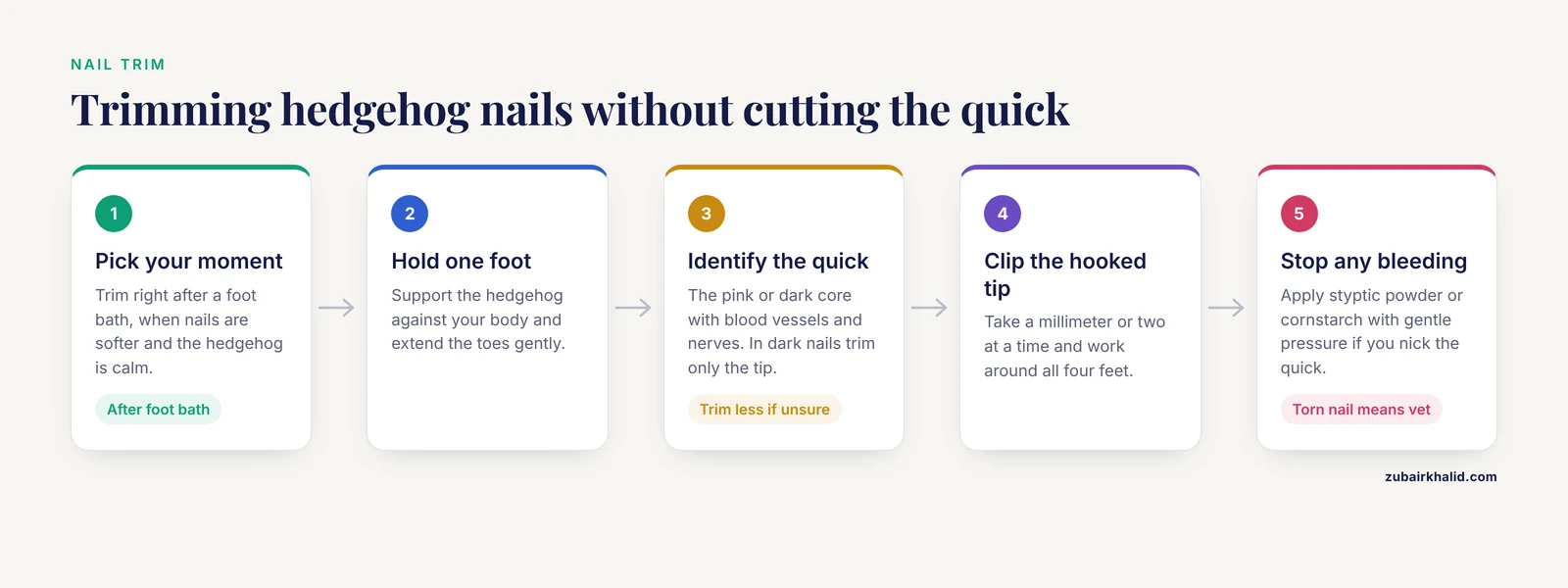
Nail trimming is the part of hedgehog grooming owners fear most, and it is the task most often done wrong. Overgrown nails curl into the footpads and cause pain and infection, so learning how to trim hedgehog nails is worth the practice.
Follow this sequence:
- Pick your moment. Trim nails right after a foot bath, when the nails are slightly softer and the hedgehog is calm. Some owners trim while the hedgehog eats a treat, which occupies the mouth and reduces stress.
- Hold one foot at a time. Support the hedgehog against your body, gently grasp one foot between your thumb and forefinger, and extend the toes.
- Identify the quick. The quick is the pink or dark core inside the nail that contains blood vessels and nerves. In light nails it is visible. In dark nails, trim only the sharp, thin tip and take less material per cut.
- Cut past the quick. Clip only the hooked tip, a millimeter or two at a time. If in doubt, trim less. You can always trim again in a week.
- Work around all four feet. A full trim may take several short sessions with a young or wiggly hedgehog. That is acceptable.
- Stop any bleeding. If you nick the quick, apply styptic powder or cornstarch with gentle pressure. A small bleed stops quickly. A nail that keeps bleeding, or a torn nail, needs a veterinary visit.
If your hedgehog will not tolerate a full trim, trim one or two nails per session and rotate. Consistency beats force. If nail trimming is a battle every time, ask your veterinarian or an exotic animal technician to demonstrate their restraint technique on your hedgehog, or to trim the nails during a routine visit.
Step 5: Check the Face, Ears, Genitals, and Underside
Once a month, extend the inspection beyond the back:
- Face and nose: Look for crusting on the nose, discharge, or sores.
- Eyes: They should be clear and open. Cloudiness, swelling, or closure warrants a vet visit.
- Ears: Check for crusting or debris.
- Mouth area: Oral disease is common in this species. In the retrospective review, oral mucosa samples made up 18.1 percent of submissions, with gingival hyperplasia and chronic suppurative inflammation among the most frequent diagnoses [1]. If your hedgehog drools, paws at the mouth, or eats less, arrange an examination.
- Underside and genitals: In males, check the preputial area for swelling, redness, or a protruding mass. A 3-year-old male hedgehog was presented with a sudden mass protruding from the preputium, which turned out to include a penile myxofibrosarcoma requiring surgical removal [9]. Male hedgehogs can also develop urogenital obstruction, as in one case of urethral obstruction from accessory gland enlargement that required preputial cystostomy surgery [10]. In females, check the mammary region and ventral abdomen for lumps. Reproductive tract disease is frequent in intact females, and uterine masses were detected in 56 percent of affected females in one retrospective study, with neoplasia confirmed in 55 percent of those uterine masses [8].
- Limbs: Look at the forelimbs closely, since both streptococcal dermatitis [4] and mycobacterial granulomatous dermatitis [5] presented as lesions on the forelimbs, and a distal radius osteosarcoma has been treated with forelimb amputation in this species [11].
Hedgehog Skin Problems to Watch For
Grooming sessions are only useful if you know what you are looking for. Here are the major hedgehog skin problems, what they look like, and how they are handled.
Mites (Caparinia tripilis)
Caparinia tripilis is the main mite affecting African pygmy hedgehogs, and acariasis is a prevalent disease in this species [2]. Signs include intense pruritus, crusts, quill loss, restlessness, and sometimes inappetence and diarrhea. Diagnosis requires microscopic examination of skin scrapings. In the reported case, treatment consisted of subcutaneous ivermectin at 0.4 mg/kg given three times, two weeks apart, with skin scrapings repeated at 14 and 28 days confirming the mites were gone and clinical signs fully resolved [2]. A second case combined selamectin spot-on treatment with enilconazole washes because a Microsporum dermatophyte was present alongside the mites [3]. The key point for owners is that mite infestations need prescription treatment and recheck examinations, not over-the-counter sprays.
Fungal Skin Infections (Dermatophytes)
Hedgehogs carry dermatophyte fungi, and these infections are zoonotic. Trichophyton erinacei was transmitted from a pet African pygmy hedgehog to a 29-year-old woman, causing severe erosive inflammation of an entire finger that required prolonged topical and systemic antifungal treatment [12]. A separate report described a 44-year-old woman who developed an intensely itchy, blistering plaque on her finger after contact with her pet hedgehogs, diagnosed as a dermatophyte infection transmitted by the animals [13]. In hedgehogs, dermatophytosis can occur alone or together with mite infestation [3]. If you develop an unexplained itchy, red, ring-like or blistering skin lesion after handling your hedgehog, mention the hedgehog to your physician, and have your hedgehog examined by a veterinarian at the same time.
Bacterial and Mycobacterial Dermatitis
Bacterial skin infections can appear as wounds, sores, or crusted lesions, particularly on the limbs. Lancefield Group A Streptococcus dermatitis was diagnosed in a 1-year-old female hedgehog with bilateral cutaneous wounds on both forelimbs, confirmed by aerobic bacterial culture, and the animal responded well to antibiotic therapy with no recurrence over the following six months [4]. Non-tuberculous mycobacterial granulomatous dermatitis has also been documented as a nodular lesion on the dorsal surface of a forelimb, confirmed by culture and gene sequencing [5]. Any wound that does not heal within a few days, or any firm nodule on a limb, needs veterinary evaluation with culture or cytology rather than home treatment.
Skin Tumors and Growths
Hedgehogs develop skin cancer at rates that make monthly checks worthwhile. In the retrospective review of 100 hedgehogs, skin was the second most common tissue submitted for histopathology, and fibrosarcomas and mammary tumors each represented 7.62 percent of diagnoses [1]. Documented cases include cutaneous squamous cell carcinoma in a 4-year-old hedgehog with suspected local recurrence after excision [6], cutaneous epithelioid haemangiosarcoma in a 4-year-old female with a chronic mass over the mammary region, and penile myxofibrosarcoma in a 3-year-old male [9]. The consistent lesson from these reports is that a lump is diagnosed by surgical excision and histopathology, not by appearance. Any new or growing lump, especially in a hedgehog aged 3 years or older, should be examined promptly.
Zoonotic Risks: Protecting Yourself During Grooming
Grooming puts your hands directly on your hedgehog's skin, quills, and feet, so hygiene is part of the routine. Three documented risks shape the recommendations:
- Salmonellosis. The CDC investigated an outbreak of African pygmy hedgehog-associated salmonellosis in Washington in 1994 [7]. Wash your hands with soap and water after every handling session, keep grooming equipment out of the kitchen, and clean the sink or basin you use for foot baths.
- Dermatophyte fungi. Trichophyton erinacei and other dermatophytes have been transmitted from pet hedgehogs to owners, causing significant skin infections requiring prolonged antifungal treatment [12] [13]. Wear gloves if you or your hedgehog have an active skin problem, and wash your hands afterward.
- Streptococcal bacteria. Lancefield Group A Streptococcus, a recognized human pathogen, was isolated from a hedgehog with dermatitis, and researchers noted that the normal microflora of hedgehogs is not fully documented [4]. Handwashing covers this risk as well.
Common Grooming Mistakes
- Trimming nails too short out of fear of overgrowth. Cutting into the quick causes pain, bleeding, and a hedgehog that resists future trims. Trim small amounts more often.
- Skipping nail trims entirely. Overgrown nails curl into footpads and cause lameness. If you cannot trim at home, schedule nail trims at your veterinary clinic.
- Bathing too often. Frequent full baths dry the skin and stress the hedgehog. Use targeted foot baths for routine cleaning and reserve full baths for genuine soiling.
- Using parasite products without a diagnosis. Mite treatments such as ivermectin and selamectin require a veterinary diagnosis and dosing. In the published cases, treatment was confirmed by follow-up skin scrapings [2] or combined with antifungal washes when a second pathogen was present [3]. Guessing the diagnosis can leave a fungal infection untreated while you medicate for mites.
- Ignoring small wounds. The streptococcal dermatitis case began as cutaneous wounds on the forelimbs [4]. Small wounds on a hedgehog deserve the same attention as large ones.
- Watching a lump instead of acting. Published skin tumors in this species were diagnosed by excision and histopathology, and local recurrence was suspected in at least one case [6]. Early surgical removal offers the best chance of a clean result.
- Forgetting hand hygiene. The salmonellosis outbreak linked to hedgehogs [7] and the documented fungal transmissions to owners [12] [13] both trace back to close contact. Wash your hands every time.
Limitations and When to Contact a Veterinarian
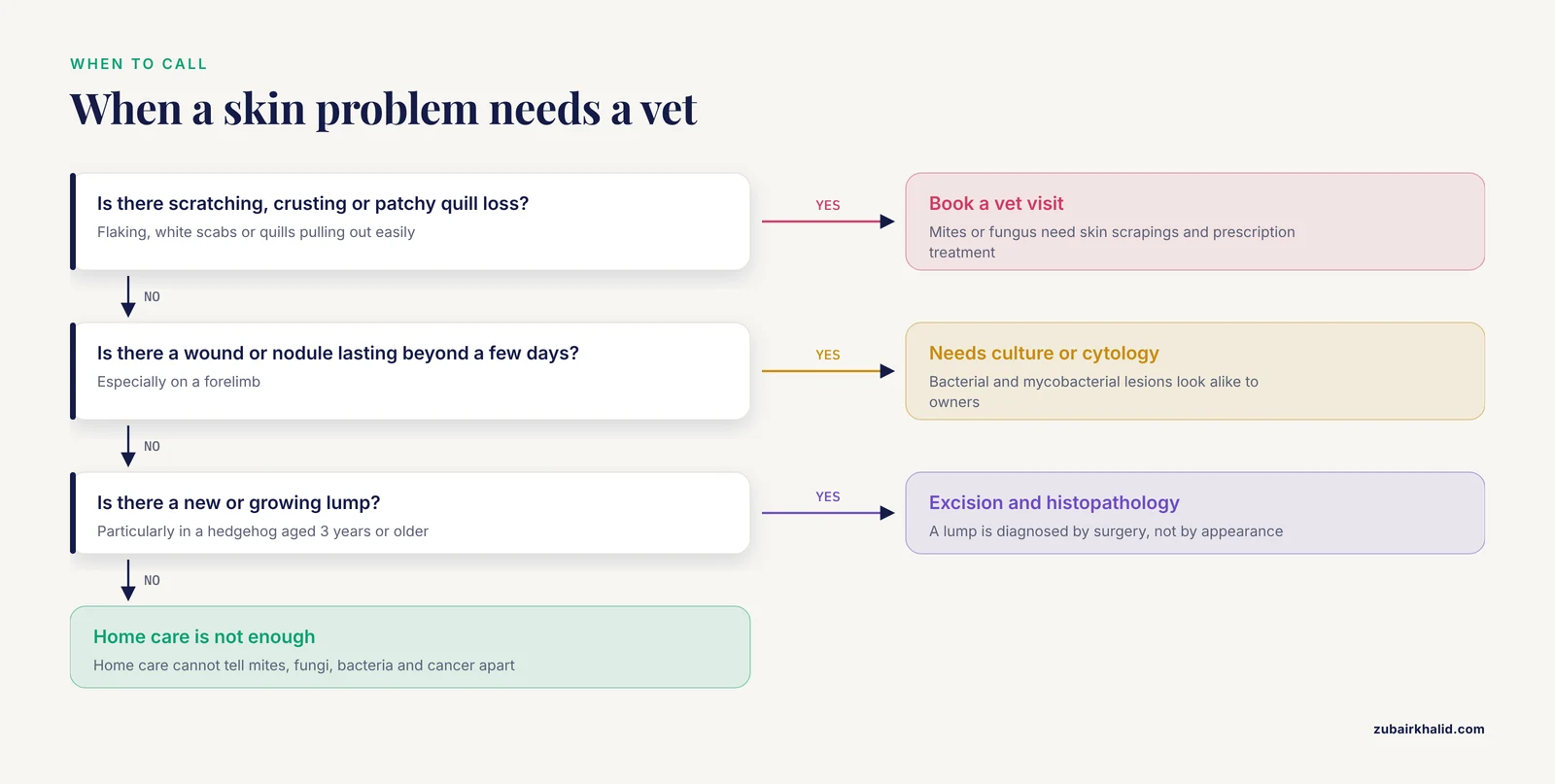
This guide covers routine grooming and the skin conditions documented in the published literature for African pygmy hedgehogs. Individual hedgehogs vary in temperament, nail growth rate, and skin health, and any specific diagnosis, medication, dose, or treatment plan for your hedgehog needs an in-person examination by a veterinarian with exotic pet experience.
Contact a veterinarian promptly, within a day or two, if you see any of the following:
- Intense scratching, flaking, crusting, or patchy quill loss, which may indicate mites or fungal infection requiring skin scrapings and prescription treatment [2] [3]
- A wound, sore, or nodule on a limb or anywhere on the body that persists beyond a few days
- Any new lump or growing mass, particularly in a hedgehog aged 3 years or older [6]
- A torn nail, persistent bleeding after a trim, a swollen toe, or limping
- Swelling, redness, or a protruding mass around the preputial area in males [9]
- A lump in the mammary region or ventral abdomen in females
- Drooling, pawing at the mouth, or reduced appetite, since oral disease is common in this species [1]
- Weight loss, inappetence, or lethargy, with or without skin changes
Seek emergency care if your hedgehog stops eating, has difficulty breathing, or shows sudden severe weakness.
Frequently Asked Questions
How often should I trim my hedgehog's nails?
Most hedgehogs need a nail trim every two to four weeks. Hedgehogs that walk on rough surfaces wear their nails down naturally and may need trims less often, while hedgehogs on soft bedding need them more often. Check the nails during your weekly grooming session and trim whenever the tips start to hook.
Why is my hedgehog losing quills?
Some quill loss can occur during normal seasonal changes, but patchy quill loss combined with scratching, flaking, or crusted scabs suggests mites or a fungal infection. Both conditions require veterinary diagnosis, typically by skin scraping, and prescription treatment [2] [3]. Do not wait for quill loss to resolve on its own if your hedgehog is also scratching.
Can I use dog or cat nail clippers on my hedgehog?
Small clippers designed for kittens or small animals, or even human baby nail clippers, work better than large dog clippers. Hedgehog nails are thin and small, so a small, sharp blade gives a clean cut without crushing the nail. Trim only the sharp tip, past the quick, and keep styptic powder nearby.
What does hedgehog mite infestation look like?
The classic signs are intense scratching, crusts on the skin or quill bases, flaky white debris, patchy quill loss, and restlessness. Some hedgehogs also lose appetite. In the documented case, a 16-month-old hedgehog showed inappetence, intense pruritus, diarrhea, and crusts, and the diagnosis was confirmed by microscopic skin scrapings [2]. Treatment required prescription ivermectin given three times at two-week intervals, with recheck scrapings at days 14 and 28 [2].
Can hedgehogs transmit skin diseases to humans?
Yes. Dermatophyte fungi have been transmitted from pet African pygmy hedgehogs to owners, including Trichophyton erinacei causing severe finger inflammation that required prolonged antifungal treatment [12], and a separate dermatophyte infection in a woman who kept two pet hedgehogs [13]. Hedgehogs have also been associated with human salmonellosis [7]. Wash your hands after every handling session and tell your physician about your hedgehog if you develop an unexplained skin rash.
Should I bathe my hedgehog?
Hedgehogs do not need regular baths. A shallow foot bath once a week or when the feet are dirty handles routine cleaning, and a full bath is only needed when the quills are soiled. Keep baths brief, use lukewarm water, and dry the hedgehog thoroughly before returning it to a warm enclosure.
Do hedgehogs need brushing?
Hedgehogs do not require coat brushing the way furry pets do, but a soft toothbrush is a useful grooming tool for parting the quills during skin checks and for scrubbing dirty feet during foot baths. Gentle, brief sessions work best. If you notice quills that seem brittle or quill loss beyond normal shedding, ask your veterinarian to examine the skin.
When should a skin problem go to the vet instead of home care?
See a veterinarian for any skin problem that involves scratching, crusting, quill loss, a wound that does not heal, or a lump. Skin disease in hedgehogs ranges from mites and dermatophytes to bacterial and mycobacterial infections and cancer, and these conditions look similar to an owner but require completely different treatments, confirmed by skin scrapings, culture, or histopathology [2] [4] [5] [6]. Home care cannot distinguish between them, and delaying diagnosis risks the condition spreading or becoming harder to treat.
Sources
- A retrospective study of disease incidence in African pygmy hedgehogs (Atelerix albiventris)
- Successful treatment of Caparinia tripilis infestation with ivermectin in an African pygmy hedgehog
- The dermatitis by Caparinia tripilis and Microsporum , in african pygmy hedgehog (Atelerix albiventris) in Romania - first report.
- Lancefield Group A Streptococcus-Associated Dermatitis in an African Pygmy Hedgehog (Atelerix albiventris)
- Non-tuberculous Mycobacterial Granulomatous Dermatitis in an African Pygmy Hedgehog (Atelerix albiventris).
- Cutaneous squamous cell carcinoma in an African pygmy hedgehog (Atelerix albiventris).
- From the Centers for Disease Control and Prevention. African pygmy hedgehog-associated salmonellosis--Washington, 1994.
- Retrospective analysis of reproductive tract disease incidence in intact female African pygmy hedgehogs (Atelerix albiventris).
- Myxofibrosarcoma of the penis in an African pygmy hedgehog (Atelerix albiventris) - A clinical case
- A case of preputial cystostomy performed on an African pygmy hedgehog (Atelerix albiventris) with urethral obstruction
- Forelimb amputation for the treatment of distal radius osteosarcoma in an African pygmy hedgehog (Atelerix albiventris)
- A different kind of hedgehog pathway: tinea manus due to Trichophyton erinacei transmitted by an African pygmy hedgehog (Atelerix albiventris).
- Dermatophyte infection transmitted by an African pygmy hedgehog