Hamster Grooming Guide: Coat, Nails, and Skin Checks
By Dr. Zubair Khalid, DVM, MS, PhD ·

Hamsters are fastidious self-groomers, so hands-on grooming for most of them means three things: a weekly coat and skin check, spot cleaning only when fur is genuinely soiled, and a nail trim when claws start to hook or catch. Water baths are off the table. A hamster that suddenly stops grooming, develops patches of hair loss, or has nails curling into the pads needs a veterinarian, not a bath or a bigger brush.
This guide walks through exactly how to groom a hamster, how to trim hamster nails without causing pain, and how to run a skin check that catches hamster skin problems early. It also explains how often to groom a hamster at different ages and life stages, and when home care should stop and a veterinary visit should begin.
This article is educational and is not a substitute for veterinary diagnosis or treatment.
At a Glance: Your Hamster Grooming Checklist
| Task | How often | What you do | Escalate to a vet if |
|---|---|---|---|
| Coat and skin check | Weekly, 2 to 3 minutes | Part the fur gently, check flanks, belly, ears, tail base, and paws | Hair loss, scabs, redness, lumps, dampness at the tail |
| Spot cleaning | Only when fur is soiled | Wipe the soiled patch with a damp cloth, dry fully | Fur stays matted, skin underneath is broken |
| Nail check | Monthly | Look for hooked tips, splitting, or nails catching on bedding | Nails curl into pads or bleed |
| Nail trim | As needed, often every few weeks to months in older hamsters | Trim only the hooked tip beyond the quick | You cannot see the quick, the nail bleeds heavily, or your hamster resists strongly |
| Full handling session | Once or twice weekly for most hamsters | Check teeth-adjacent fur, rear end, and weight trend at the same time | Any change in grooming, appetite, or behavior lasting more than a day |
What Hamster Grooming Actually Involves
A hamster spends a large part of its waking routine washing its face, cleaning its flanks, and rearranging its coat. Healthy hamsters rarely need a human to keep their fur in order. Your role as an owner is closer to a health inspector than a stylist.
That distinction matters because research on pet hamster care repeatedly shows two things. First, the published literature on hamster husbandry and health is limited, and care guidelines vary widely between sources, so owners often have to rely on close observation of their own animal [1]. Second, most owners never get professional help calibrating that observation. In a large UK survey of Syrian hamster owners, 65.9 percent of hamsters had never been taken to a veterinarian [2]. Routine home grooming and skin checks are, for many hamsters, the only health monitoring they receive.
Home monitoring works best when it is structured. Studies of small mammal owners show that most people assess their pets' health at home primarily through behavior and physical appearance rather than measurements, and that owners are generally willing and motivated to provide good welfare when they know what to look for [3]. A repeatable grooming routine gives you exactly that structure. You check the same things, in the same order, every week, so a change stands out immediately.
How Often to Groom a Hamster
The question of how often to groom a hamster has a short answer and a longer answer. Short answer: plan on a brief grooming and skin check once a week for a healthy adult hamster. Longer answer: frequency depends on age, coat length, housing, and mobility.
- Young, healthy, short-coated hamsters. A weekly check during regular handling is enough. These animals maintain their own coats well.
- Long-coated Syrian hamsters. Check twice weekly. Long fur around the rear, belly, and legs traps soiled bedding and can mat.
- Older hamsters. Increase to two or three short checks per week. Aging hamsters groom less thoroughly because of reduced flexibility and energy, and their nails often grow faster than their wear rate.
- Hamsters recovering from illness. Follow your veterinarian's guidance. A hamster that feels unwell may stop grooming, which is itself a warning sign.
One caution from the dwarf hamster literature applies here. Dwarf hamster welfare problems cluster around inadequate enclosures, insufficient resources, and aggression between co-housed animals, especially in animals older than six months [1]. A stressed or injured hamster grooms abnormally, either over-grooming from stress or neglecting its coat because it feels unwell. If you house dwarf hamsters together and one coat deteriorates, suspect conflict and separate housing as part of the answer, not just grooming.
How to Groom a Hamster, Step by Step
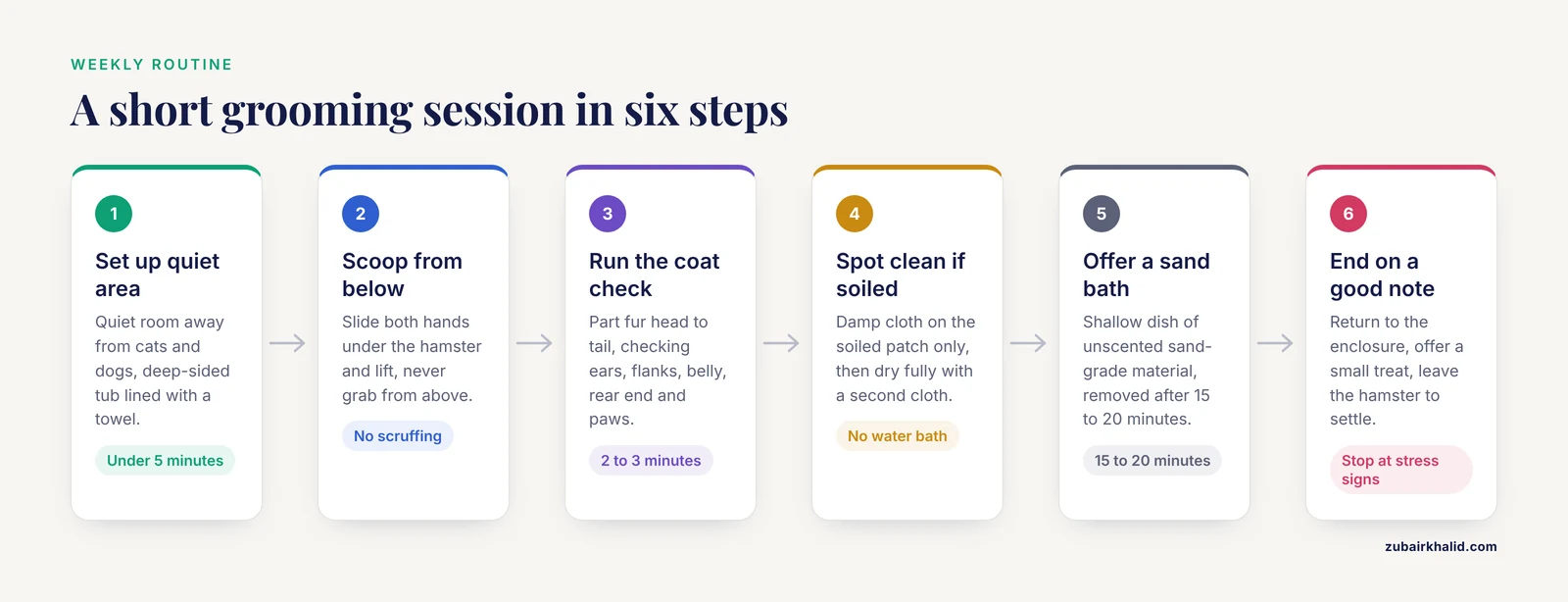
The goal of every session is the same. Complete the task in under five minutes, keep stress low, and put the hamster back in a familiar environment before it becomes agitated.
Step 1: Set up a safe handling area
Choose a quiet room away from cats, dogs, and other predators. Surveys of Syrian hamster owners found that a large share of hamsters lived in close proximity to predator species, a housing factor associated with welfare concerns [2]. A hamster that can smell a predator three feet away will not sit still for a coat check, and chronic fear is a welfare problem in its own right.
Prepare a landing zone. A deep-sided storage tub lined with a towel works well. If your hamster jumps or wriggles, it lands safely instead of falling to the floor.
Step 2: Scoope from below, never from above
Slide both hands under the hamster and lift it from beneath, forming a cup. Grabbing from above mimics a predator strike and triggers defensive behavior, including biting. Support the whole body. For hamsters that resist, let them walk into a cup or toilet-roll tube and carry them that way.
Never pick up a hamster by the scruff. Hamsters have loose skin, and scruffing can injure them or cause eye protrusion in severe cases.
Step 3: Run the coat and skin check
With the hamster resting in one cupped hand, use the fingers of your other hand to part the fur in a sequence you repeat every time.
- Head and face, including around the eyes and nose
- Ears and ear pinnae
- Neck and shoulders
- Flanks, where scent glands sit in Syrian hamsters
- Belly and chest
- Rear end, tail base, and genital area
- All four paws, including nail length and the spaces between toes
- Along the spine from shoulders to tail
You are feeling and looking for matted fur, bald patches, flaking, redness, scabs, lumps, dampness, and parasites. Two to three minutes is enough.
Step 4: Spot clean only what needs cleaning
If bedding or feces is stuck to the fur, dampen a soft cloth with warm water, wipe the patch, and dry the area completely with a second cloth or a paper towel. Hamsters lose body heat quickly, and a wet coat in a cool room is a real risk.
Do not bathe a hamster in water as part of routine grooming. Small mammal veterinary resources, including the Merck Veterinary Manual and VCA Animal Hospitals hamster care guides, describe hamsters as animals that groom themselves and note that water bathing is stressful and generally unnecessary. Full immersion can also strip natural oils and, in a small rodent, lead to dangerous chilling.
Step 5: Offer a sand bath as an alternative
Many owners provide a shallow dish of unscented, sand-grade bathing material so the hamster can roll and groom its coat naturally. If you do this, remove the dish after 15 to 20 minutes so it does not become a toilet, and keep it out of enclosures with poor ventilation. Powdery dust products designed for chinchillas are finer than sand and are more likely to irritate small airways, so choose coarser sand-grade material. If your hamster sneezes or develops discharge around the nose after sand sessions, stop and discuss this with your veterinarian.
Step 6: End on a good note
Return the hamster to its enclosure, offer a small treat, and leave it alone to settle. Grooming should end before the hamster shows stress signs such as frantic escape attempts, screaming, or trying to bite.
Coat Care Details Worth Knowing
Recognize normal scent glands
New owners frequently mistake normal scent glands for skin disease. Syrian hamsters have dark, slightly greasy patches on each flank. Dwarf hamsters have a ventral scent gland in the middle of the belly. These are normal anatomy. They can look alarming, but they are symmetric, non-irritating, and consistent over time. If a flank or belly patch changes in size, becomes crusted, bleeds, or seems itchy, that is a reason for a veterinary exam rather than a home diagnosis.
Long-coated hamsters need extra help
Long-haired Syrian hamsters can develop matted fur around the rear end, especially males, where urine and feces stick to the long coat. Check this area every few days in long-coated animals. Use a soft-bristled small animal brush or a clean toothbrush, brushing in the direction of hair growth with almost no pressure. If a mat cannot be separated with your fingers, do not cut it with scissors on a squirming hamster. Ask an exotic animal veterinarian to trim it, ideally with the hamster calm and, if needed, appropriately sedated.
A poor coat is a health signal
A greasy, unkempt, or roughened coat in a hamster that previously kept itself immaculate usually means the animal is not feeling well or cannot physically groom anymore. Treat it the same way you would treat a car that stops indicating. The symptom is on the outside, but the problem is usually inside. Coat deterioration, especially combined with weight loss or reduced activity, justifies a veterinary visit rather than a waiting period.
How to Trim Hamster Nails
Learning how to trim hamster nails is one of the more requested small mammal skills, and it is genuinely useful, because overgrown claws catch on bedding and wheel surfaces, split, and can curl into the foot pads. It is also the grooming task with the highest potential for a quick mistake, so approach it methodically.
Know the anatomy first
Hamster nails have a curved, translucent front section and a pinkish core called the quick, which contains a blood vessel and nerve. In pale-coated hamsters with light nails, the quick is usually visible as a pink line. In dark-nailed animals it may be invisible. You trim only the clear, hooked tip beyond the quick. If you cannot see the quick at all, trim a very small amount or defer the trim to a professional.
Tools you need
- Small animal or kitten nail clippers, or human baby nail scissors with a fine tip
- A clean towel for restraint
- Cornstarch or a styptic product recommended by your veterinarian, kept within reach
- Good lighting, ideally a flashlight held behind the nail to silhouette the quick
Trimming steps
- Pick a calm moment. Evening, when your hamster is naturally awake, works better than waking a sleeping animal. A hamster handled during its active phase is far more tolerant.
- Restrain gently. Cradle the hamster on its back or side against your body, wrapped loosely in a towel with one paw exposed. Many hamsters calm down when lightly wrapped, similar to swaddling.
- Hold the paw firmly but kindly. Extend one toe at a time by pressing gently on the top of the toe pad.
- Identify the quick. Use backlighting if the nail is pale. In dark nails, trim only the sharp hooked tip, one millimeter at a time.
- Cut at the right angle. Trim across the nail so the cut surface sits flat, removing only the portion that curves beyond a natural shape.
- Work in tiny sessions. One or two nails per session is a legitimate outcome. Spread a full trim over several days if your hamster becomes stressed.
- Reward and release. End with a treat and return the hamster to its enclosure.
If a nail bleeds
Minor nick of the quick, small bead of blood. Press cornstarch into the tip with gentle pressure for one to two minutes and keep the hamster calm and quiet until bleeding stops. Bleeding that does not stop within a few minutes of pressure, or a torn nail still partially attached, needs veterinary attention the same day.
When to hand the clippers to a professional
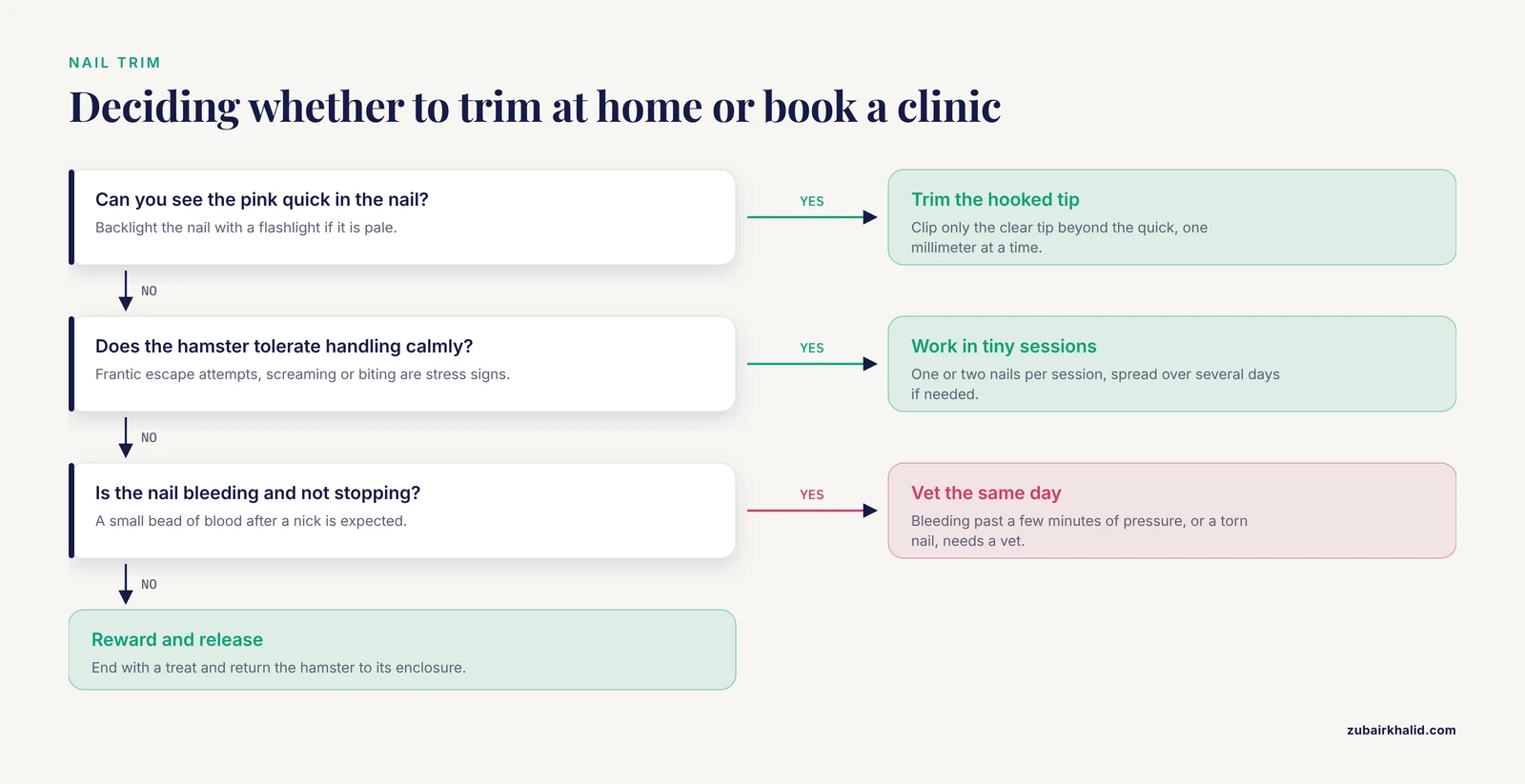
Some hamsters will never tolerate nail trims, and forcing the issue risks bites, falls, and broken nails. Exotic animal veterinarians and experienced technicians trim hamster nails routinely, often with light sedation or anesthesia so the trim is painless and precise. There is no prize for doing it at home under poor conditions. For an anxious animal or an owner who cannot see the quick, professional trims at health checks are the safer route.
Skin Checks and Common Hamster Skin Problems
The weekly skin check is where hamster grooming becomes preventive medicine. Hamster skin problems share a short list of visible signs, and the causes behind them range from harmless to serious.
What normal looks like
Normal hamster skin is clean, even in color, and covered by a smooth coat with no bald patches except the natural scent gland areas. Normal ears are pink to lightly furred with no crusting at the edges. Normal feet have short straight nails and intact pads.
Warning signs to record
- Patches of hair loss, especially if the skin underneath is red, scaly, or crusted
- Increase in scratching, licking, or chewing at one body area
- Flaking or dandruff-like scale
- Redness, swelling, or warmth, which suggests inflammation or infection
- Scabs, wounds, or bite marks, particularly in co-housed animals
- Lumps under the skin or attached to it
- Dampness or staining around the tail or genitals
- Lesions on the ears, a location where certain parasitic skin infections appear in hamsters [4]
Photograph anything you find. A dated photo gives your veterinarian an objective record of whether a lesion is growing, spreading, or healing.
Conditions behind the visible signs
Skin changes in hamsters are a symptom category, not a diagnosis. Several distinct disease processes show up through the coat and skin, which is why your veterinarian examines the whole animal rather than the lesion alone.
Adrenal gland disease. Hyperadrenocorticism, the overproduction of corticosteroid hormones, occurs in pet hamsters and produces dermatologic signs similar to those seen in dogs, including coat and skin changes. Diagnosis relies on clinical signs, imaging such as abdominal ultrasound, and hormone measurement, and treatment options include oral trilostane or ketoconazole, with surgery possible in selected cases [5]. The practical takeaway for owners is that certain patterns of hair loss and skin thinning are hormonal, not parasitic or behavioral, and they require bloodwork and imaging to sort out rather than topical treatment.
Parasitic skin disease. Hamsters are susceptible to parasite infections that manifest in the skin. Experimental work in Chinese hamsters and related rodents showed that Leishmania parasites infect the skin of the ear pinnae and produce lesions there over weeks to months [4]. Skin infections in hamsters can also persist quietly in skin and subcutaneous tissue without producing dramatic early signs, as demonstrated in Syrian hamsters with chronic Trypanosoma cruzi infection, where chronic infection localized almost entirely to skin and underlying fat and still caused measurable inflammation and fibrosis in tissues [6]. The lesson for owners is consistent. A skin lesion that does not resolve, or that keeps recurring, deserves diagnostics rather than repeated home treatment.
Wounds and abscesses. Bite wounds from co-housed animals, injuries from enclosure fixtures, and infected small cuts can all present as swellings or scabs. Because pus pockets under rodent skin need drainage and appropriate antimicrobial treatment, home care is limited to keeping the animal comfortable until a veterinarian can examine it.
Barbering and stress-related over-grooming. Hair loss with intact skin beneath, in patterns matching where a hamster or cagemate can reach, points toward self- or partner-induced hair removal. In co-housed dwarf hamsters, aggression is a recognized and common welfare problem, especially in animals over six months of age [1]. Hair loss in a co-housed dwarf hamster should prompt an assessment of housing compatibility as well as skin.
Supplies Worth Having
You do not need a large kit for hamster grooming.
- A soft-bristled small animal brush or a clean, soft toothbrush
- Two soft cloths, one damp for spot cleaning and one dry for drying
- Small animal or kitten nail clippers with a fine tip
- Cornstarch for minor nail bleeding, plus styptic powder if your veterinarian recommends one
- A deep-sided handling tub with towel lining
- Unscented sand-grade bathing material, if you choose to offer sand baths
- Your phone camera for recording lesions
Avoid heavily scented wipes, shampoos, and grooming sprays marketed for other pets. Small rodents have sensitive airways and skin, and residues from fragranced products are an avoidable risk. If a product is not labeled for hamsters, ask your veterinarian before using it.
Common Grooming Mistakes
- Water bathing a hamster. Stress, chilling, and stripped coat oils outweigh any benefit for a self-grooming species.
- Trimming to the level of the quick because the nail looked long. Cut the hook tip only.
- Using human scissors on a matted coat. Skin folds into scissors easily on a small, wriggling animal. Let a professional cut mats.
- Bathing or brushing a sick-looking hamster in place of a vet visit. A poor coat is a symptom. Grooming it prettier does nothing for the underlying problem.
- Grooming during the day after waking the hamster. Handle hamsters during their natural active period, in the evening, to reduce stress.
- Ignoring the rear end. Soiled fur around the tail base is one of the most overlooked findings on home checks and one of the easiest to catch with a routine.
- Assuming a lone hamster has no social stress. Even single-housed hamsters develop stress-related behaviors in unsuitable environments, and housing quality is a recognized driver of hamster welfare problems [2].
Welfare and Stress During Grooming
Every grooming interaction is also a handling experience, and handling frequency has measurable effects on hamster behavior. In the Syrian hamster owner survey, more frequent handling was significantly associated with greater owner observations of bar biting, a behavior linked with poorer welfare, while shallower substrate depth showed the same association [2]. The interpretation is nuanced. Hamsters need handling for health checks, but the way handling is done, and the environment the animal returns to, shape whether it is neutral, positive, or stressful overall.
Two practical rules follow. Keep sessions short and predictable, and make sure the home environment, including deep bedding for burrowing, gives the hamster genuine control over its own exposure. Owner surveys using behavioral models found that opportunity, particularly access to suitable enclosures, was the main barrier to good small mammal welfare, even among motivated and capable owners [3]. A hamster with adequate depth of bedding, hiding places, and appropriate space tolerates brief handling far better than one kept in a shallow, barren enclosure.
The Veterinarian's Role in Grooming-Related Problems
A grooming or skin finding that needs professional follow-up is common, and knowing what happens at the clinic helps owners act faster rather than wait.
At a small mammal appointment, the veterinarian starts with history and physical examination, and those basic steps can be meaningfully extended with laboratory assessment. Hematologic evaluation, including blood cell identification and interpretation, is a standard supplement to physical examination in hamsters presented for care [7]. Blood collection in small rodents requires skill and appropriate restraint, and modern techniques performed under sedation or anesthesia are designed to be safe and repeatable, with procedures such as mentolabial blood collection in Chinese hamsters producing successful samples with no clinical complications in published evaluations [8].
For owners, the practical points are simple. Veterinary clinics can safely collect small blood samples from hamsters when diagnostics are needed, and waiting to see whether a skin or coat problem resolves on its own often costs more treatment time than an early exam would have.
Limitations and When to Contact a Veterinarian
Published research on pet hamster health is limited and care guidelines vary, which means individual cases genuinely need individual veterinary assessment [1]. The schedules and techniques in this article are starting points, not substitutes for examination of your specific animal.
Contact a veterinarian promptly, the same day when possible, for any of the following.
- Bleeding that does not stop with a few minutes of gentle pressure
- A torn or split nail, or a nail curling into a foot pad
- Rapidly spreading hair loss, open sores, or crusted skin
- Any lump, especially one that is growing, firm, or fixed in place
- Dampness or staining around the tail base, especially with diarrhea or a wet appearance
- A hamster that has stopped grooming, is eating less, is lethargic, or is hiding more than usual
- Labored breathing, sneezing with discharge, or discharge from eyes or nose
- Bites or wounds in a co-housed animal, plus immediate separation of the animals
- Sudden weight loss or a hunched, unthrifty posture
Because hamsters are small, fast metabolizing prey animals, delays that would be tolerable in a dog or cat can be dangerous here. When in doubt, call an exotic animal or small mammal veterinarian and describe what you saw during your grooming check.
Frequently Asked Questions
How often should I groom my hamster?
Once a week is enough for most healthy, short-coated hamsters, with a brief coat and skin check during normal handling. Increase to two or three shorter checks per week for long-haired Syrians, older hamsters, or any hamster whose coat is deteriorating.
Do hamsters need baths?
No. Hamsters groom themselves effectively, and water baths are stressful, strip natural coat oils, and create a real risk of chilling in a small animal. Spot clean soiled fur with a damp cloth and offer sand bathing if your hamster enjoys it.
How do I trim my hamster's nails safely?
Wrap the hamster loosely in a towel, expose one paw, identify the pink quick, and clip only the clear hooked tip with fine small animal clippers under good light. Work a nail or two at a time, keep cornstarch nearby for minor bleeding, and hand the job to a veterinary clinic if you cannot see the quick or your hamster will not tolerate it.
Why is my hamster losing hair?
Common causes include mites and other parasites, barbering from stress or a cage mate, hormonal disease such as hyperadrenocorticism, wounds, and infections. Pattern, location, and skin appearance all narrow the possibilities, so bring photos and your grooming notes to a veterinarian rather than treating blind.
Can I use baby shampoo or pet wipes on my hamster?
It is best not to. Products not formulated for hamsters can irritate skin and airways, and residues linger on fur a hamster will then lick. Warm water on a soft cloth handles most spot cleaning without any product at all.
What does a healthy hamster coat look like?
A healthy coat is smooth, even, and clean, with no bald patches except the normal scent gland areas on the flanks or belly. The skin underneath should be pale to pink, unbroken, and free of scale, scabs, and redness.
Why is my hamster scratching so much?
Frequent scratching usually indicates skin irritation from mites, bedding sensitivity, a wound healing, or an underlying dermatologic condition. Occasional scratching during grooming is normal, but persistent scratching with hair loss or broken skin warrants a veterinary exam.
What should I do if my hamster's nail is bleeding?
Apply cornstarch or a styptic powder to the nail tip with gentle pressure for one to two minutes and keep the hamster calm. If bleeding continues past a few minutes, or the nail is torn or hanging off, contact a veterinarian the same day.
Sources
- Preliminary investigation into the housing of dwarf hamsters.
- Burrowing for answers: Investigating Syrian hamster welfare through owner surveys.
- Small mammal owners' experiences of housing challenges and animal welfare: A COM-B and word frequency analysis.
- Steppe lemmings and Chinese hamsters as new potential animal models for the study of the Leishmania subgenus Mundinia (Kinetoplastida: Trypanosomatidae).
- Adrenal Disease in Small Mammals.
- Dynamics of Trypanosoma cruzi infection in hamsters and novel association with progressive motor dysfunction.
- Hematologic Assessment in Pet Rats, Mice, Hamsters, and Gerbils: Blood Sample Collection and Blood Cell Identification.
- The mentolabial approach is a novel, safe, and effective method of blood collection in rats (Rattus norvegicus) and Chinese hamsters (Cricetulus griseus).