How Much Exercise Does a Hamster Need?
By Dr. Zubair Khalid, DVM, MS, PhD ·

A healthy hamster needs the opportunity to be active every single night. Hamsters are nocturnal, and in a natural setting they spend their waking hours traveling, digging, climbing, and foraging over a large territory. In captivity, that activity must be rebuilt inside the cage. The practical answer to how much exercise does a hamster need is this: your hamster should have unlimited access to a correctly sized running wheel every night, a spacious enclosure with deep bedding for digging and moving around, and regular supervised playtime outside the cage once the animal is comfortable being handled.
Exercise is not optional enrichment for hamsters. A long-term study of golden hamsters found that males with access to a running wheel were in measurably better physical condition than hamsters without one, and the authors concluded that a wheel is useful enrichment that enhances welfare [1]. At the same time, research on pet dwarf hamsters has identified undersized enclosures as a major welfare concern, with some owners keeping animals in cages under 75 cm in length [2]. Movement space and exercise equipment together determine whether a hamster can express its natural behavior.
This guide explains how much activity a hamster actually needs, how to set up the cage for movement, how to run safe playtime outside the enclosure, and which signs suggest your hamster needs more exercise.
Hamster Exercise at a Glance
| Element | What to Do |
|---|---|
| , - | , - |
| Running wheel | Provide a solid-surface wheel sized so your hamster runs with a flat back, available every night |
| Cage size | Choose the largest enclosure you can accommodate, well above the minimums that research has flagged as inadequate [2] |
| Bedding | Offer deep bedding for burrowing and tunneling, which is a major form of natural exercise |
| Out-of-cage time | Offer supervised playtime outside the cage in a secure, escape-proof area, once your hamster accepts handling |
| Timing | Schedule all activity and handling for the evening and night, when hamsters are naturally awake |
| Rotation | Rotate tunnels, chews, and climbing structures to keep the environment interesting |
| Monitoring | Watch body condition, activity level, and behavior, and report changes to an exotic animal veterinarian |
| Red flags | Lethargy during normal waking hours, reluctance to move, limping, or sudden weight change warrant a veterinary visit |
Why Exercise Matters for Hamsters
Hamsters are built for distance. Their wild counterparts travel long distances each night searching for seeds, hoarding food, and patrolling burrow systems. A captive hamster that cannot run, dig, and climb is an animal whose most powerful behavioral needs are unmet.
The scientific case for exercise is strongest for wheel running. In a 52-week study, male golden hamsters with continuous access to a running wheel consumed nearly twice as much food as hamsters without a wheel, gained more fat-free mass and total body water, and ended the year in better absolute physical condition. Their relative body composition stayed normal, meaning the extra weight was functional lean tissue rather than fat. The researchers concluded that the wheel improved physical condition and acted as useful enrichment that enhanced animal welfare [1].
Modern welfare science supports the same conclusion from a different angle. Welfare assessment frameworks for captive animals evaluate both resource-based measures, such as enclosure size and enrichment, and animal-based measures, such as behavior and body condition, because the two together reveal whether an animal's needs are being met [3]. Small mammal welfare reviews emphasize that multiple validated indicators, including behavioral measures, should be monitored together rather than relying on any single observation [4]. For a hamster owner, that translates into a simple habit: watch how your hamster moves and behaves every night, and adjust the environment when activity drops.
How Much Exercise Does a Hamster Need?
There is no fixed number of minutes that defines hamster exercise needs, and any source promising one should be read with caution. What the evidence and veterinary guidance support is a pattern of daily opportunity rather than scheduled workouts.
Activity Is Nightly and Self-Directed
The Merck Veterinary Manual describes hamsters as nocturnal animals that are most active during the night. This single fact should shape your entire approach. A hamster that sleeps through the day is not lazy or unwell, and a hamster that ignores your afternoon offers of play is behaving normally. Structured exercise should be available when the animal chooses to use it.
That is exactly why the running wheel matters so much. The wheel lets a hamster self-dose its own exercise across the night, which mirrors how wild hamsters alternate travel with rest and feeding. In the golden hamster study, animals used their wheels over a full year of observation, and the resulting activity level was high enough to nearly double their food intake [1]. A hamster that voluntarily runs for long stretches of the night is not displaying a stereotypy or a problem behavior in most cases. It is expressing a deeply rooted locomotor drive.
Three Pillars of the Daily Exercise Budget
Rather than counting minutes, build the daily routine around three pillars:
- Wheel access all night. The wheel stays in the cage and available whenever the hamster wakes.
- A cage built for movement. Floor space, deep bedding, tunnels, and climbing opportunities let the hamster exercise between wheel sessions.
- Supervised exploration outside the cage. Regular playtime outside the cage adds novelty and terrain variety that no enclosure can fully replicate.
If all three pillars are in place, most healthy hamsters regulate their own activity well. If one pillar is missing, the other two have to work harder, and gaps usually show up in behavior first.
The Exercise Wheel: Selection Criteria
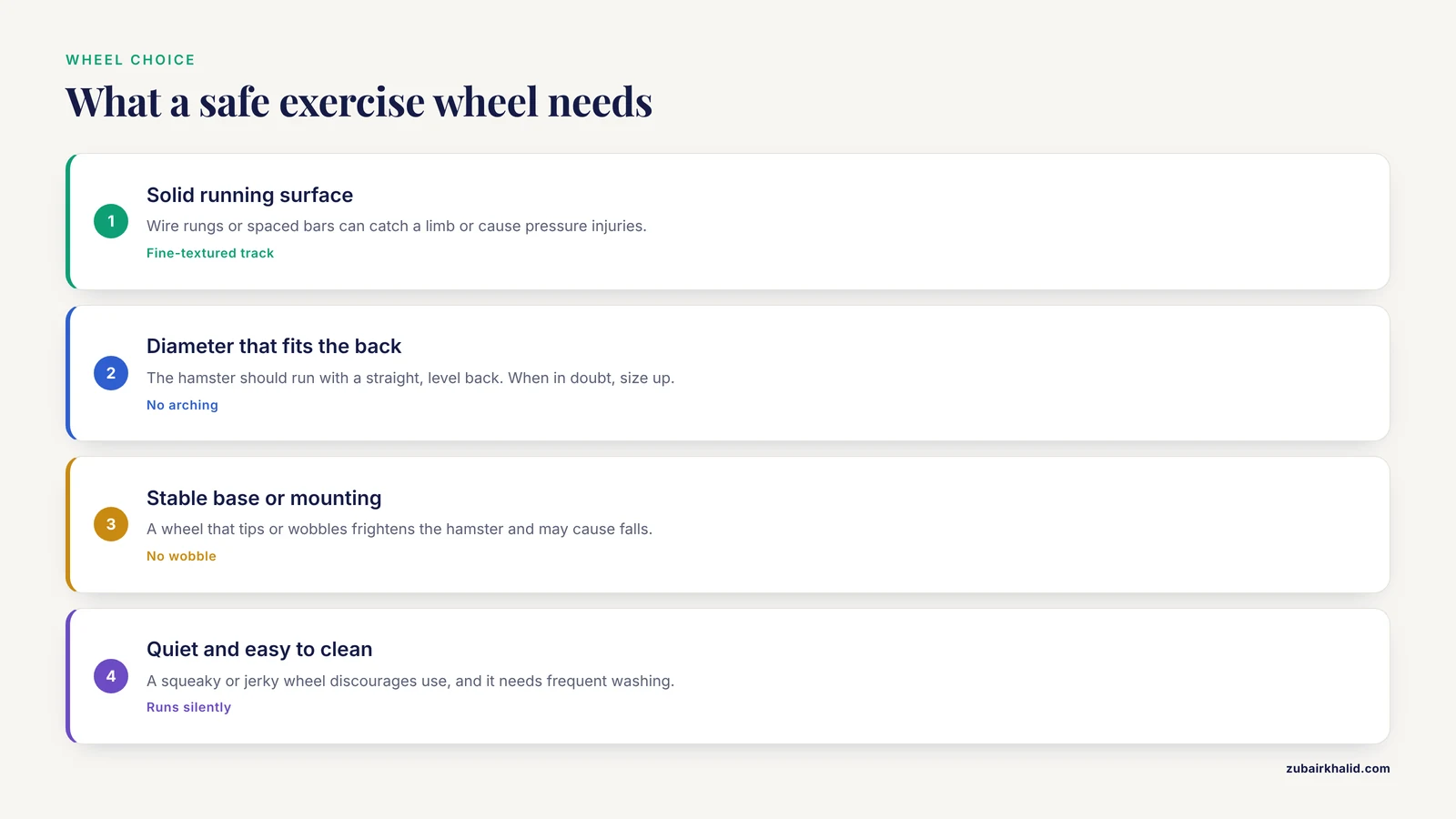
The wheel is the centerpiece of hamster exercise, so choosing the right one matters more than any other single purchase. The Merck Veterinary Manual and the small mammal guides published by VCA Animal Hospitals both identify wheel running as core hamster husbandry, and both emphasize equipment that protects the animal from injury.
Use these selection criteria:
- Solid running surface. Wire rungs or spaced bars can catch a limb or cause bumblefoot-style pressure injuries. A solid or fine-textured running track is the safer choice.
- Adequate diameter. Size the wheel so your hamster runs with a straight, level back. A Syrian hamster arching upward on the wheel, or a dwarf hamster rattling around in a wheel sized for a larger animal, both signal poor fit. When in doubt, size up.
- Stable base or secure mounting. A wheel that tips or wobbles will frighten the hamster and may cause falls.
- Smooth, quiet mechanism. A hamster runs for much of the night. A squeaky or jerky wheel discourages use and disrupts the household.
- Easy cleaning. The wheel will need frequent washing, so choose a design that comes apart or wipes down easily.
Wheels also carry an important lesson about exercise and appetite. Because wheel running raised energy expenditure sharply in the golden hamster study, food consumption nearly doubled in the animals that had wheels [1]. If your hamster has consistent wheel access, expect a healthy appetite and check body condition during routine handling rather than restricting food to compensate.
Enclosure Space and Bedding: Exercise Built Into the Cage
An undersized cage limits exercise no matter how good the wheel is. The dwarf hamster housing survey found that 12% of pet dwarf hamsters were kept in enclosures under 75 cm in length and identified inadequate enclosure size as a key welfare concern [2]. That study focused on co-housing and resource provision, but its core finding applies broadly: many pet hamsters live in spaces that do not allow normal movement.
Practical steps for a movement-friendly cage:
- Maximize floor space. Buy the largest footprint your home and budget allow. Floor space supports burrowing, running circuits, and foraging, none of which happen well in a tall but narrow cage.
- Provide deep bedding. Bedding deep enough to tunnel through turns the cage floor into an exercise surface. Digging works the shoulders, forelimbs, and jaw, and it occupies a hamster for hours.
- Create a layout with distance. Place the food store, water, wheel, and nest area in different zones so the hamster travels between them each night.
- Add tunnels and platforms. Cardboard tubes, wooden hides, and low platforms create climbing and route choices. Keep structures low and stable to prevent falls.
- Match resources to animal numbers. The dwarf hamster survey found that many co-housed animals received fewer food and water sources than the number of animals, and that co-housing failure became more likely after six months of age [2]. For dwarf hamsters kept together, providing multiple wheels, food stations, and water points reduces competition and allows every animal to exercise freely.
One housing decision matters more than any equipment upgrade. Syrian hamsters are solitary and should be housed alone. For dwarf species, the evidence on co-housing failure, particularly the sharply increased odds of aggression in animals older than six months, means that shared housing demands careful monitoring and, in most cases, eventual separation [2]. A hamster that is being bullied cannot exercise safely, because it cannot move freely around its own cage.
Hamster Playtime Outside the Cage
Hamster playtime outside the cage is the part of the exercise plan that owners most often get wrong, usually by starting too fast or by underestimating a hamster's escape ability. Done well, out-of-cage time adds mental stimulation and muscle use that complement the wheel.
Preparing for Playtime
Before the first session, set up a controlled space:
- Choose a secure area. A blocked-off section of a quiet room, a playpen, or a dry bathtub works well. Hamsters can squeeze through surprisingly small gaps, so seal every opening, block gaps under furniture, and close doors.
- Remove hazards. Remove other pets from the room, cover electrical cords, move plants that may be toxic, and check for openings behind appliances.
- Control temperature and drafts. Hamsters are sensitive to chilling and to heat. Keep the play area away from windows, radiators, and air conditioning vents.
- Plan for retrieval. A hamster loose in a room can disappear fast. Keep the cage door open nearby, use a familiar hide or tube the hamster can enter, and never chase the animal.
Step-by-Step: Introducing Playtime
- Wait until the hamster is awake and active. Wake a sleeping hamster only gently, or wait until evening when it stirs on its own.
- Start inside familiar territory. Early handling should happen in or beside the cage, in a carrier, or in a small playpen, so the hamster learns your scent and hands in a low-stakes setting.
- Move to the play area gradually. Once the hamster steps onto your hand willingly, carry it to the prepared space or let it walk into a transport cup.
- Keep early sessions short. A few minutes is enough for the first sessions. Watch for stress signs such as freezing, frantic dashes, or attempts to hide, and end the session calmly before stress builds.
- Extend time as confidence grows. Over days and weeks, lengthen sessions. A confident hamster will forage, dig in a shallow tray, and investigate freely.
- Return the hamster before it becomes tired or agitated. End on a calm note, ideally by guiding the animal back into its own hide and carrying it home.
Safety Rules for Out-of-Cage Play
- Never leave a hamster unattended outside the cage, even for a moment.
- Keep dogs, cats, and other household pets in another room. Even a curious sniff from a predator species can injure a hamster or cause lasting fear.
- Avoid heights. A fall from a table or bed can cause serious injury. Play happens at floor level.
- Do not allow access to rooms where the hamster could reach rodenticides, sticky traps, or other household poisons. If you ever suspect toxin exposure, contact a veterinarian immediately.
- Supervise children at all times, and handle the hamster yourself with young children watching.
Exercise Ideas for Hamsters
If you want varied exercise ideas for hamsters, build them around natural behaviors: running, digging, foraging, climbing, and hoarding.
- Foraging scatter. Scatter a portion of the daily seed or pellet ration through the bedding instead of placing it all in a bowl. Searching for food produces travel, sniffing, and digging.
- Burrow boxes. Fill a deep box or corner with bedding, shredded paper, or hay safe for small mammals, and let the hamster excavate.
- Tunnel networks. Connect cardboard tubes and wooden hides into changing routes. Rearrange the layout periodically so the hamster must explore a new map.
- Low climbing structures. Stable platforms, cork bark, and terraced bedding banks encourage vertical movement within safe heights.
- Seed and sprout foraging toys. Chew-safe foraging toys make the hamster work for treats. Rotate them so novelty stays high.
- Sand bath digging. A shallow dish of chinchilla-style sand for small mammals lets a hamster roll and dig, which supports grooming as well as activity. Confirm product safety with your veterinarian.
- Wheel variety over time. If your hamster loses interest in the wheel, check fit and surface first, then clean the mechanism. Do not offer multiple small wheels to compensate for a poorly sized one.
Avoid overfilling the cage. A hamster needs open running lanes between structures. A cluttered enclosure restricts movement rather than enriching it.
Signs a Hamster Needs More Exercise
Because hamsters are nocturnal and stoic, owners must read indirect signals. Animal welfare researchers distinguish resource-based indicators, such as cage size and enrichment availability, from animal-based indicators, such as behavior and body condition, and recommend monitoring both together [4]. Use that framework at home.
Physical and behavioral signs a hamster needs more exercise include:
- Weight gain or a heavy body condition. Without adequate activity, excess energy intake becomes fat. The golden hamster study showed how dramatically activity changes energy balance, with wheeled animals eating nearly twice as much yet maintaining normal relative body composition [1]. A hamster with no wheel and little space faces the opposite problem, taking in energy it cannot spend.
- Bar biting or persistent escape attempts. Repetitive chewing on cage bars often reflects an environment too small or too barren.
- Pacing along cage walls. Fixed route pacing with no other behavioral variety suggests insufficient space or enrichment.
- Lethargy during normal waking hours. A hamster that barely moves even at night may be under-stimulated, ill, or both. Rule out illness first.
- Destructive or stereotypic digging at corners. Digging with no outlet, such as scratching endlessly at a corner without bedding depth to burrow, points to unmet burrowing needs.
- Poor muscle tone or reluctance to climb. Deconditioning shows up as hesitation on structures the animal previously used.
- Aggression or irritability during handling. Frustrated hamsters often become nippy. Enrichment and exercise frequently improve temperament.
If you observe these signs, audit the three pillars. Is the wheel correctly sized and used? Is the cage floor large and the bedding deep? Is out-of-cage playtime happening regularly? Address the gaps one at a time and watch behavior over the following week.
Common Mistakes Owners Make
- Relying on the wheel alone. A wheel in a tiny, bare cage does not meet digging and foraging needs.
- Choosing a wheel that is too small. An arched running posture is a visible red flag. Upgrade the diameter.
- Scheduling playtime during the day. Forcing a sleeping hamster awake for your convenience disrupts its rhythm and provokes defensive bites.
- Letting playtime happen in an unsecured room. Most lost hamsters escape during out-of-cage play. Prepare the space every time.
- Housing incompatible hamsters together. The dwarf hamster evidence shows co-housing failure climbing sharply in animals over six months of age, independent of sex or species [2]. Fighting prevents exercise and causes injury.
- Mistaking normal nocturnal sleeping for illness or boredom. A hamster that sleeps all day and runs all night is healthy. Judge activity during its natural waking window.
- Adding more food when activity increases. If you install a wheel, expect higher appetite, which is normal and healthy [1]. Offer a balanced ration rather than restricting intake.
Troubleshooting Common Exercise Problems
My hamster ignores the wheel. Check wheel diameter, surface, and stability first. Confirm the wheel runs silently and freely. Position it in an active zone of the cage rather than tucked behind the nest. Some hamsters take days or weeks to adopt a new wheel.
My hamster seems stressed outside the cage. Shrink the play area, add hiding spots, shorten sessions, and slow the pace of handling. Some hamsters accept a playpen long before they accept an open room.
My hamster chews the cage bars at night. Deepen the bedding, add chew-safe items, enlarge the enclosure, and scatter feed. Bar chewing is usually an environment problem before it is a behavior problem.
My hamster runs the wheel obsessively. Continuous wheel use, especially with reduced eating or weight loss, deserves a veterinary check to rule out pain or neurologic causes. In most healthy hamsters, heavy wheel use with normal appetite and body condition is within normal behavior [1].
Two dwarf hamsters are fighting over the wheel. Provide duplicate resources immediately and plan separation. Aggression risk rises sharply after six months of age [2], and injuries from fighting are an emergency.
Welfare and Safety Points
Small mammal welfare frameworks stress that good welfare means more than the absence of disease. It includes the ability to express natural behavior and to experience positive states. For a hamster, positive welfare looks like this: nightly running, active digging, foraging interest, relaxed hoarding, and a calm response to your hands. Negative welfare looks like the opposite list in the signs section above.
Keep these safety principles in force:
- Handle low, over a soft surface, so a startle response never becomes a fall.
- Wash hands before and after handling to protect both you and the hamster.
- Keep the exercise environment free of other pets, extreme temperatures, and drafts.
- Clean the wheel and cage regularly. Poor hygiene undermines every fitness benefit exercise provides.
- If you are ever unsure whether a piece of equipment, bedding, or food is safe for hamsters, ask an exotic animal veterinarian before offering it.
Limitations and When to Contact a Veterinarian
This article is educational and is not a substitute for veterinary diagnosis or treatment. Individual hamsters vary widely in age, species, temperament, and health status, and an exotic animal veterinarian should tailor exercise recommendations to your specific animal.
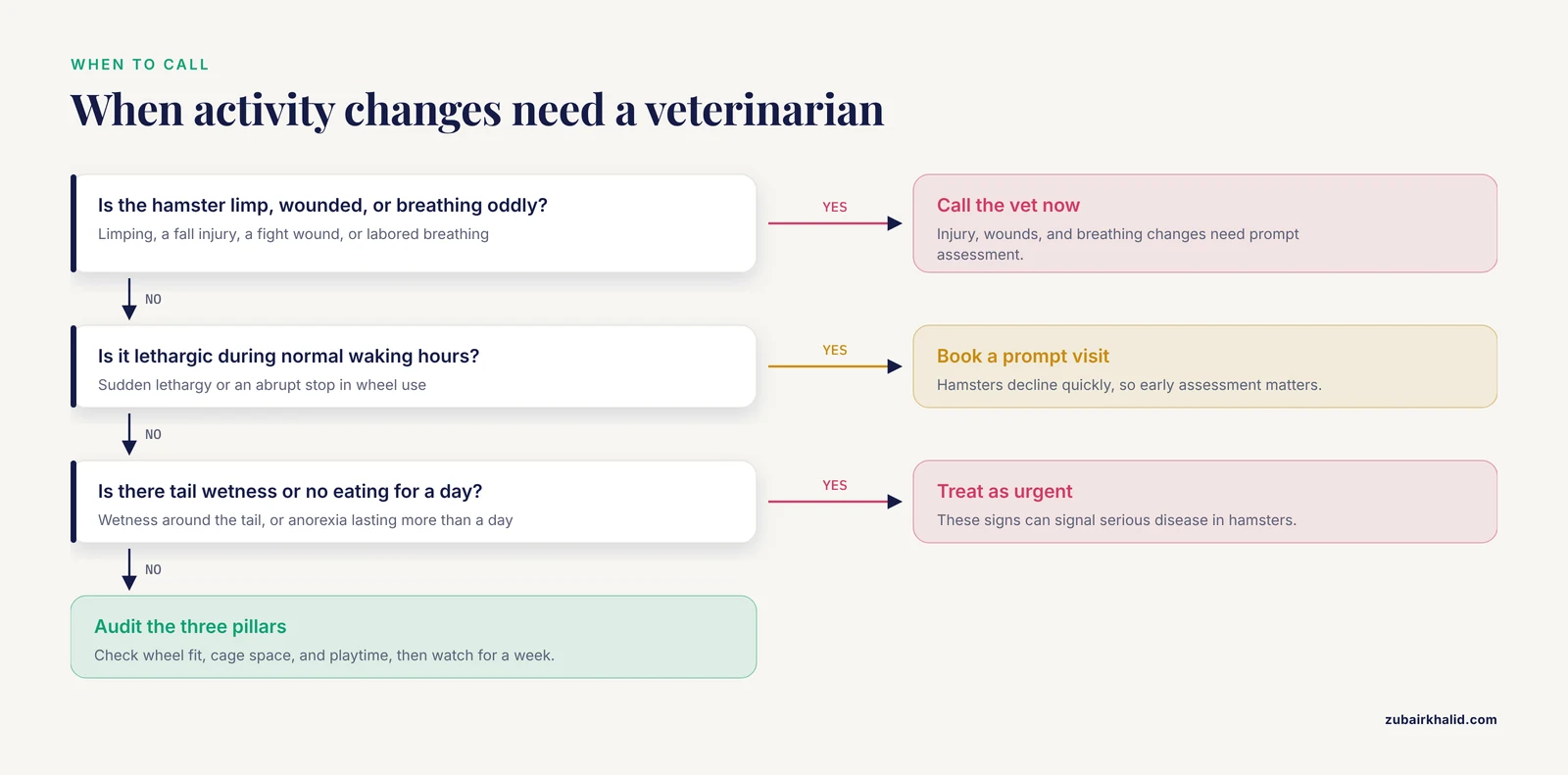
Contact a veterinarian promptly if you observe any of the following:
- Sudden lethargy or failure to leave the nest during normal waking hours
- Limping, reluctance to bear weight, or a visible injury after a fall or wheel accident
- Rapid weight loss or gain, or a noticeable change in body condition
- Wetness around the tail or hindquarters, which can signal serious disease in hamsters
- Bleeding, a wound from co-housed fighting, or bite injuries
- Respiratory signs such as labored breathing, clicking, or discharge from the nose or eyes
- Anorexia lasting more than a day, or an abrupt stop in wheel use and activity combined with any other sign
Hamsters are presented to veterinary clinics for both routine care and illness, and a physical exam paired with a thorough husbandry history forms the foundation of that care. Veterinarians can extend the assessment with hematologic testing when indicated, because bloodwork helps interpret clinical signs in hamsters much as it does in other small mammals [5]. Because most pet hamsters in surveys had never received veterinary care [2], establishing a relationship with an exotic animal practice before an emergency is one of the highest-value steps you can take.
Frequently Asked Questions
How much exercise does a hamster need every day?
Your hamster needs the opportunity to exercise every night, through constant wheel access, a spacious cage with deep bedding, and regular supervised playtime outside the cage. There is no scientifically fixed minute count. Watch your hamster's behavior and body condition, and expand opportunities if activity or fitness seems low.
What time of day should hamster playtime happen?
Schedule all playtime and handling in the evening or at night, when your hamster is naturally awake. The Merck Veterinary Manual identifies hamsters as nocturnal, so daytime sessions interrupt essential sleep and increase stress and defensive biting.
Is an exercise ball necessary for hamsters?
No. An exercise ball is not necessary if your hamster has a correctly sized wheel, a movement-friendly cage, and supervised floor time. Many exotic animal veterinarians prefer a secure playpen over a ball, because a ball on an open floor gives the hamster no control over direction, speed, or stopping. If you use one, keep sessions short and watch for stress signs, and discuss the choice with your veterinarian.
Why does my hamster run on the wheel all night?
Wheel running is a normal, strongly motivated behavior for hamsters. In a year-long study of golden hamsters, animals with wheel access used it consistently and developed better physical condition, and the authors considered the wheel welfare-enhancing enrichment [1]. Constant running with a normal appetite is typically healthy. Sudden obsessive running paired with weight loss or poor appetite warrants a veterinary visit.
What should I do if my hamster never uses the wheel?
Check the wheel's size, running surface, stability, and noise first, because an ill-fitting or jerky wheel discourages use. Move it to an active zone of the cage and give the hamster time to adapt. If the wheel goes unused despite good design and placement, review the rest of the cage for space and enrichment gaps, and ask your veterinarian for guidance.
Can two dwarf hamsters share exercise equipment?
Sharing equipment invites conflict. Research on pet dwarf hamsters found that co-housing failure, meaning aggression between cage mates, became nearly five times more likely in animals older than six months, and that many group-housed animals had fewer resources than animals [2]. If dwarf hamsters live together, provide separate wheels, food, and water, monitor nightly for aggression, and be prepared to house them apart.
Can I take my hamster outside for exercise?
Outdoor playtime is risky and generally unnecessary. Temperature swings, predators, parasites, and escape risk all threaten a hamster outdoors. A secure indoor play area provides the same exercise benefits with far less danger. If you want outdoor experiences, discuss safe options with your veterinarian first.
When should I call a veterinarian about my hamster's activity level?
Call an exotic animal veterinarian if your hamster becomes lethargic during its normal waking hours, stops using the wheel abruptly, limps or favors a limb, loses or gains weight quickly, or shows tail wetness, breathing changes, or wounds. Hamsters decline quickly when ill, so early assessment matters, and bloodwork can help your veterinarian interpret the picture [5].
Sources
- Running-wheel activity and body composition in golden hamsters (Mesocricetus auratus).
- Preliminary investigation into the housing of dwarf hamsters.
- Animal welfare definitions, frameworks, and assessment tools: Advancing the measurement and laying the foundation for improved animal welfare through a three-step approach
- Review of Rat (Rattus norvegicus), Mouse (Mus musculus), Guinea pig (Cavia porcellus), and Rabbit (Oryctolagus cuniculus) Indicators for Welfare Assessment
- Hematologic Assessment in Pet Rats, Mice, Hamsters, and Gerbils: Blood Sample Collection and Blood Cell Identification.