Hamsters Enrichment Ideas That Match Natural Behavior
By Dr. Zubair Khalid, DVM, MS, PhD ·
The best hamster enrichment ideas are the ones that let a hamster do what hamsters evolved to do: dig deep tunnels, run long distances at night, hoard food, chew continuously, and hide in enclosed spaces. A solid wheel, deep bedding for burrowing, a network of tunnels, chew items, and daily food-scattering puzzles cover the core needs. Research on Syrian hamsters shows that enriched housing actually shifts their emotional state in a measurable way. Hamsters living with enrichment approached ambiguous cues more optimistically than hamsters in barren cages, which is one of the clearest demonstrations that cage setup changes mood, not just activity [1].
This guide explains which behaviors you are targeting, how to build enrichment around each one, what to buy, what to make yourself, and which common setups actually work against your hamster.
Enrichment at a Glance
| Natural behavior | Enrichment that matches it | How to start today |
|---|---|---|
| Burrowing and tunneling | Deep substrate, at least several inches, plus hideouts | Pile bedding deeper in one corner and bury a treat there |
| Running | A solid-surface wheel sized to the hamster's body | Confirm the wheel spins silently and has no rung gaps |
| Exploring | Connected tunnels and multiple hideouts | Rearrange one tunnel or hideout tonight |
| Foraging and hoarding | Scattered food, buried treats, foraging toys | Hide the next portion of seed mix under substrate |
| Chewing | Safe wood chews, cardboard, hay-based items | Offer an unsprayed cardboard tube |
| Nesting | Nesting material such as unscented paper or hay | Add a fresh handful of nesting material |
Why Enrichment Is a Welfare Requirement, Not a Luxury
Hamsters are one of the most commonly kept small mammals, and they are also one of the most commonly under-housed. A survey of 723 UK small mammal owners found that opportunity, particularly access to suitable enclosures, was the single biggest barrier to good housing, even though most owners were willing and motivated to provide better welfare [2]. That gap between intention and setup is exactly what this article addresses.
The scientific case for enrichment is unusually strong in this species. In a controlled study, Syrian hamsters housed with enrichment responded to ambiguous situations more like an animal in a positive emotional state, while unenriched hamsters showed the more pessimistic pattern associated with poor welfare [1]. Separately, work in Siberian hamsters notes that animals in enriched environments show fewer stereotypic behaviors, the repetitive, functionless movements such as bar biting and pacing that signal chronic frustration [3].
There is also a physical dimension. Male golden hamsters given running-wheel access for a full year were significantly heavier than wheel-less counterparts, with greater food consumption and higher fat-free mass, while overall body composition stayed normal. The study authors concluded that a running wheel is a useful enrichment that enhances welfare by improving physical condition [4].
Signs of a Bored Hamster
Owners overwhelmingly rely on behavior to judge their pet's welfare, and behavioral indicators are the most common tool small mammal owners use to assess health at home [2]. Watch for these patterns, especially any that appear at the same time each day.
- Bar biting and cage biting. In a survey of 548 Syrian hamster owners, bar biting was significantly associated with hamster ball use, shallower substrate, and more frequent handling [5]. Repetitive biting at bars is a classic stereotypy, not a request to come out.
- Pacing or repeating the same route. Fixed, repetitive paths along cage walls fall into the same stereotypic category [3].
- Digging at corners without burrowing. Scratching obsessively at the same spot, especially near the base of walls, suggests the substrate is too shallow to support real tunneling.
- Excessive sleeping with no activity cycle. Hamsters are naturally active at night. A hamster that never runs, forages, or explores may have given up.
- Apathy toward food changes or new objects. A healthy curious hamster investigates. Total indifference can signal chronic understimulation or illness.
- Over-grooming or fur thinning in patches, which can accompany stress and frustration.
Any sudden change in behavior, appetite, or droppings is a medical question first, not an enrichment question. Illness in hamsters can look like laziness.
Match Enrichment to Natural Behavior
Burrowing and Tunneling
Burrowing is arguably the hamster's defining behavior. In the Syrian hamster owner survey, substrate depth was a welfare variable that mattered: shallower substrate was associated with more bar biting [5]. Practical guidance from hamster-focused veterinary literature and owner-survey work converges on one principle. Provide a thick layer of paper-based or aspen bedding, deep enough in at least one zone for the hamster to dig a collapsed tunnel that holds its shape. Aim for the deepest layer your enclosure height allows, and compress it lightly so tunnels stay open.
Support burrowing with:
- Multiple chambers and hideouts at different levels
- Pre-formed starter tunnels you dig by hand so the hamster expands them
- Hay and paper nesting material packed around tunnel walls for structure
Nesting material itself is a low-effort, high-value addition. In Siberian hamsters, nesting material was evaluated alongside wheels and pair housing, and while it did not change metabolic measures, it is a standard component of enriched housing in that work [3]. For a pet hamster, a generous handful of unscented paper bedding or hay supports natural nest-building behavior without cost.
Running
Wheel running is the most studied enrichment in hamsters, and the evidence supports it. Long-term data from male golden hamsters showed that wheel access improved physical condition over 52 weeks [4]. In a separate chronobiology study, daily wheel use was only slightly affected when hamsters gained extra tunnels and toys, which tells you the wheel holds its own appeal even in a rich environment [6].
Selection criteria for a wheel:
- Solid running surface. Rungs and wire mesh risk foot injury.
- Large enough diameter that the hamster runs with a straight back rather than arching upward.
- Stable, quiet bearings. A wheel that wobbles or squeals gets used less and can discourage nocturnal running.
- No center bar if you can avoid it, since some hamsters run awkwardly around spokes.
In the Syrian hamster owner survey, more than 95% of owners provided a wheel, a hideaway, or a chew toy, which shows these basics are widely understood. The welfare gaps appeared in the subtler items, such as substrate depth and hamster ball use [5].
Exploration Through Tunnels and Multi-Zone Housing
Hamsters are burrow-dwellers with strong drives to move between chambers. One approach tested in research is connecting multiple cages with tunnels. Syrian hamsters in multi-cage tunnel systems kept their normal circadian rhythms and wheel-running patterns, with only small reductions in daily revolutions [6]. For pet owners, this translates into a practical idea. If floor space allows, link two enclosures or add a large tank-to-tank tunnel so the hamster patrols a territory. At minimum, build complexity inside one enclosure with:
- Cork tubes and ceramic or wooden hides
- Platforms supported safely, low enough that falls are not possible
- Rearranged layouts every few weeks to renew novelty
Foraging and Food Puzzles
Wild hamsters travel, hoard, and dig for food. Feeding from a bowl removes all three behaviors. Scatter feeding is the simplest fix. Hide the daily seed portion across the substrate, press some pieces just under the surface, and bury a few deeper for the hamster to excavate. Rotate between scatter feeding, treat-stuffed cardboard tubes, and food buried inside nesting material.
Che Diy Hamster Enrichment: Safe Builds From Household Items
DIY hamster enrichment does not need to be elaborate. Use only unscented, unprinted-ink or minimal-ink cardboard, untreated wood, and food-safe containers.
- Cardboard tube puzzle feeder. Fold one end of a toilet paper tube, drop in a few seeds, fold the other end, and bury it. The hamster has to chew through or dig it up.
- Buried treasure boxes. Fill a small cardboard box with shredded paper and hide food inside. Cut entry holes so the hamster can climb in.
- Digging tray. Place a shallow tray of coconut fiber or plain topsoil with no fertilizers or pesticides inside the enclosure for a different digging texture.
- Hay and paper nesting bundles. Twist unscented paper and timothy hay into loose bundles. Nest-building is itself enrichment.
- Maze from connectable tubes. Arrange cardboard tubes into changing layouts. Rebuild the layout weekly.
- Seed sprays and millet clusters. Hang or tuck whole seed heads so the hamster works to strip them.
Safety rules for every build. No staples, tape, glue, or string that can tangle limbs or be swallowed. Avoid softwoods like cedar and pine shavings with strong aromatic oils, and check that anything wooden has not been treated or painted. Remove and replace items once they are heavily soiled with urine or chewed into swallowable fragments.
Best Toys for Hamsters: What to Buy and What to Skip
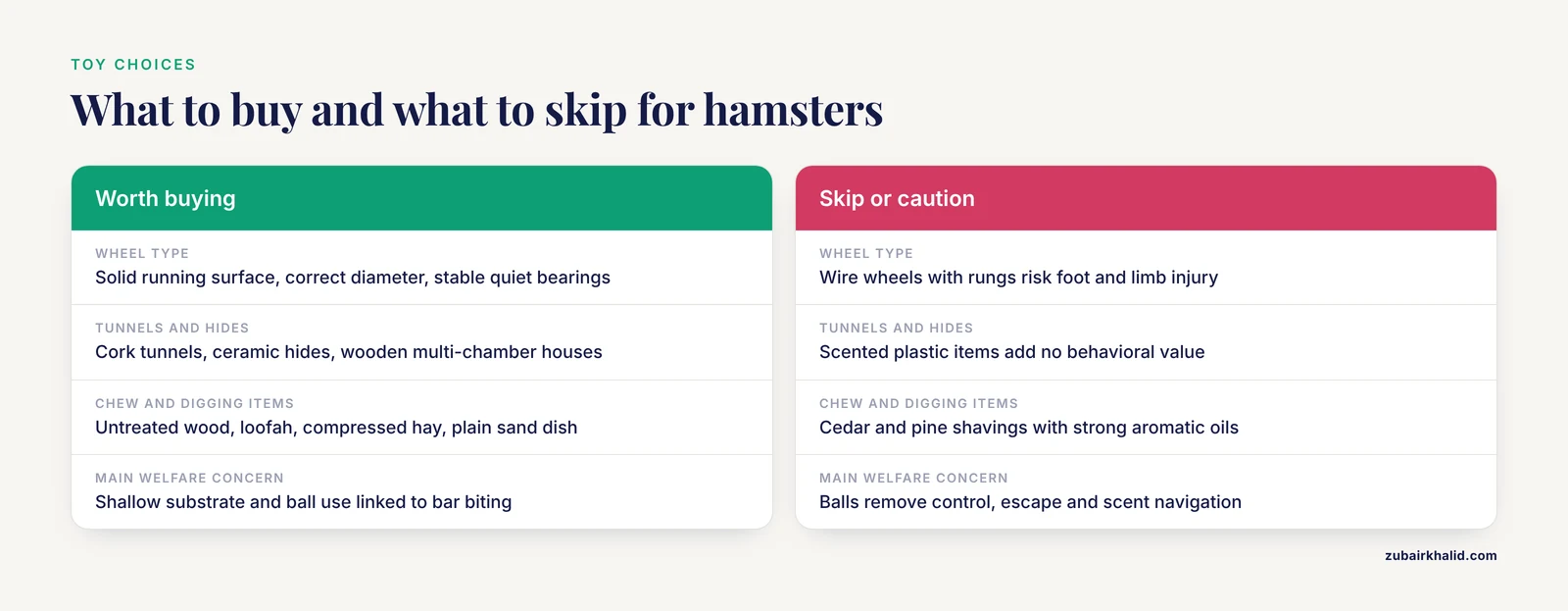
The best toys for hamsters fall into five functional categories rather than five brands. Buy to the behavior, not the marketing.
Worth buying:
- A properly sized solid-surface wheel, since the physical-condition benefits are documented [4]
- Cork tunnels, ceramic hides, and wooden multi-chamber houses
- Chew toys of untreated wood, loofah, or compressed hay
- A deep base enclosure with room for substrate, which addresses the housing deficits reported in dwarf hamsters, where a minority of pets were kept in enclosures under 75 cm in length [7]
- A sand bath dish with plain, dust-free reptile sand for grooming behavior
Worth skipping or using with caution:
- Hamster balls. In the Syrian hamster owner survey, 18.4% of owners used hamster balls, and ball use was significantly associated with more observed bar biting [5]. Balls remove control from the animal, block escape, and roll on surfaces that offer no traction or scent information. For a species that navigates by smell and whiskers, a closed plastic sphere is a poor match for natural behavior.
- Wire wheels with rungs. Foot and limb injuries are a foreseeable risk.
- Colored, scented plastic everything. Scented items interfere with scent-based exploration and add no behavioral value.
- Exercise without burrowing. A wheel alone does not satisfy the tunneling drive. Shallow substrate plus a wheel leaves the strongest natural behavior unmet [5].
Common Mistakes That Undermine Enrichment
Mistake 1. Keeping two hamsters together for company. Enrichment does not replace solitary housing for most pet hamsters. In the dwarf hamster housing survey, co-housing failure from aggression was a leading welfare concern, and hamsters older than 6 months were more than four times as likely to experience co-housing failure, with an odds ratio of 4.75 [7]. Even where owners supplied multiple food and water sources, many pair- or group-housed animals still had inadequate resource provision [7]. Housing a hamster alone and investing in a richer single environment is the safer default.
Mistake 2. A large cage full of empty space. Floor area matters, but so does structural complexity. A big tank with three inches of bedding and a wheel is still a barren cage by welfare standards [3]. Fill vertical and horizontal space with substrate depth, tunnels, hides, and foraging zones.
Mistake 3. Placing the enclosure near predators. More than 45% of surveyed Syrian hamster owners housed their pets in close proximity to predator species such as cats or dogs [5]. A hamster that can smell and see predators all day is not relaxing, no matter how good the toys are. Relocate the enclosure to a calm room.
Mistake 4. Skipping veterinary care. In the Syrian hamster survey, most hamsters, 65.9%, had never been taken to a veterinarian [5]. Enrichment supports welfare, but it does not replace health monitoring. The Merck Veterinary Manual's exotic animal resources emphasize routine wellness assessment for small mammals, which is worth building into your yearly routine even for a pet that seems fine.
Mistake 5. Treating handling as enrichment. Hamsters are prey animals. In the survey, more frequent handling was associated with more bar biting, not less [5]. Handling on the hamster's terms, in short sessions, is reasonable. Constant handling as a substitute for a stimulating habitat is a common and counterproductive trade.
Step-by-Step: Rebuilding an Enrichment Setup in One Weekend
- Start with footprint. Move to the largest enclosure you can accommodate, prioritizing horizontal floor space and unbroken length for tunnels and substrate mounds.
- Add substrate depth. Fill at least one third of the enclosure with bedding deep enough to hold burrows. Pack it firmly at the base.
- Install the wheel. Solid surface, correct diameter, stable mount, positioned away from hides so dust does not accumulate.
- Build a tunnel network. Cork tubes, cardboard tubes, and hides arranged so the hamster can travel without crossing open ground the entire way.
- Create feeding zones. Move from one bowl to scatter feeding plus one or two puzzle feeders.
- Offer nesting material generously. Provide more than the hamster will use. Building oversized nests is normal and satisfying.
- Add a sand bath. A separate dish of plain sand supports natural grooming.
- Observe for a week. Note when the hamster uses each element. Keep what gets used, replace what gets ignored, and rotate one item at a time.
Troubleshooting
My hamster ignores the wheel. Check size and stability first. A wheel that is too small or wobbles discourages use. Wheel use also varies between individuals and week to week, so a quiet week is not automatically a problem.
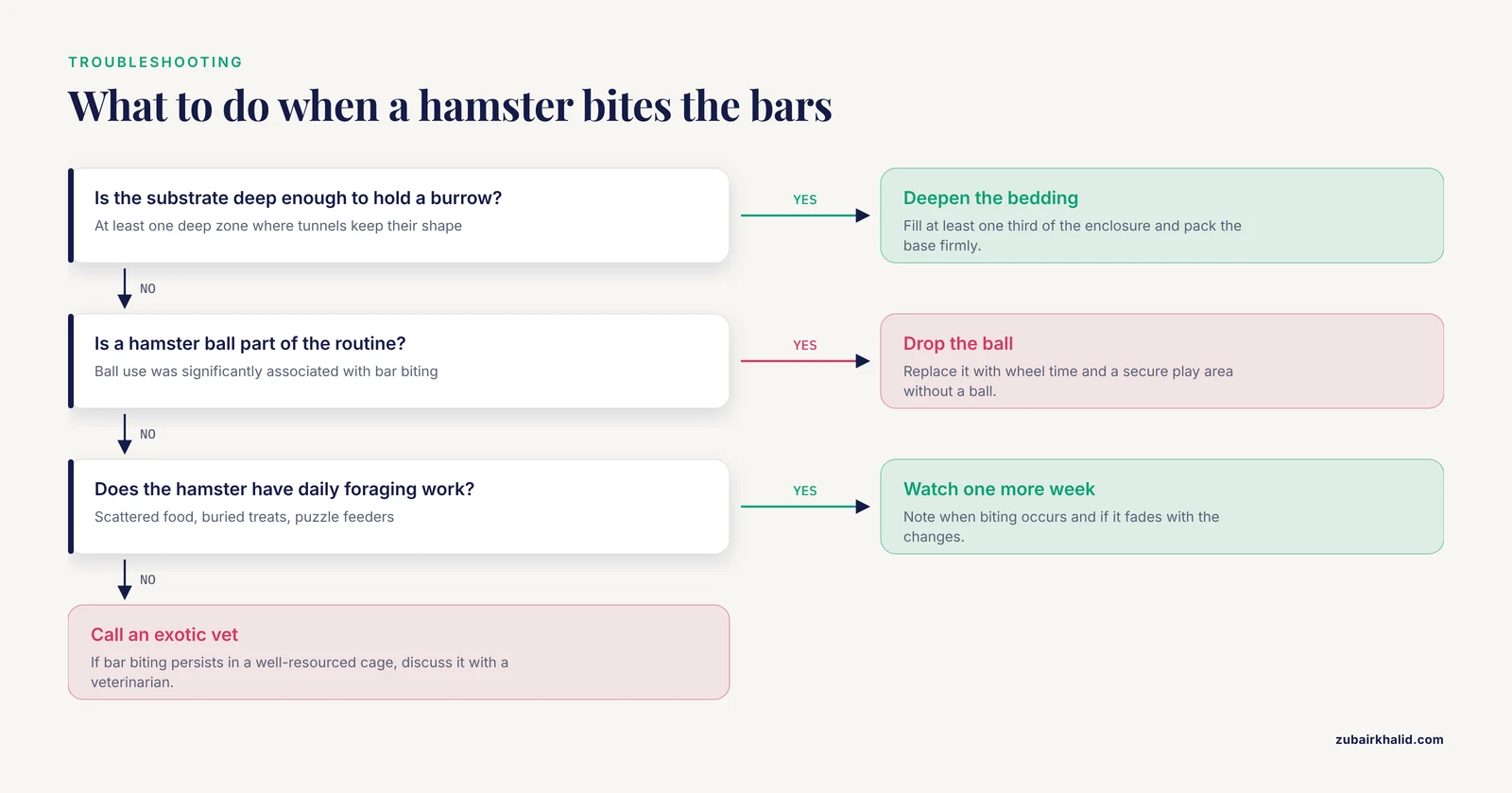
My hamster bites the bars every night. Increase substrate depth, add foraging work, and remove any hamster ball from the routine, since all three were linked to bar biting in owner-reported data [5]. If bar biting persists in a well-resourced cage, discuss it with an exotic animal veterinarian.
My hamster hoards everything and never eats in the open. Hoarding is natural and healthy. Scatter food so the hoarding trip itself becomes the enrichment.
My dwarf hamsters fight over resources. Separate them. Co-housing failure rises sharply after 6 months of age, and aggression is the primary failure mode [7]. Provide separate enclosures, each fully enriched.
I cannot afford a huge setup. Prioritize in this order: enclosure footprint and substrate depth, wheel, hides, then chew and foraging items. The owner-survey research shows the enclosure itself is the biggest opportunity barrier, and incremental improvements there pay off most [2].
Limitations and When to Contact a Veterinarian
This article is educational and is not a substitute for veterinary diagnosis or treatment. Individual hamsters vary in temperament, age, and health status, so any specific plan for an animal with medical issues needs an exotic-animal veterinarian's input. The research cited here comes from owner surveys and controlled studies with known limitations, including possible selection bias toward more knowledgeable owners, so population-level findings may not describe your individual pet [7][5].
Contact a veterinarian promptly if you see any of the following:
- Sudden lethargy, loss of appetite, or refusal to drink
- Wet tail, diarrhea, or a wet, stained rear end
- Blood in urine, or straining to urinate
- Labored breathing, nasal discharge, or clicking sounds
- A fall, drop, or suspected fracture, including a limp
- Overgrown or broken incisors, drooling, or dropping food
- Skin wounds, abscesses, or rapid fur loss
- Any stereotypic behavior that appeared abruptly, since abrupt behavioral change can indicate illness rather than boredom
- A hamster over 6 months old showing unexplained aggression or withdrawal, especially if co-housed, given the documented rise in co-housing failure at that age [7]
Because most pet hamsters never see a veterinarian at all, establishing a relationship with an exotic animal practice before an emergency is one of the highest-value welfare decisions an owner can make [5].
Frequently Asked Questions
How do I keep a hamster entertained every day?
Rotate scatter feeding, tunnel layouts, and buried treats, and keep a properly sized wheel available at all times. Hamsters entertain themselves at night if the habitat gives them burrowing, running, foraging, and chewing options. Your daily job is mostly food placement and novelty rotation, not direct play.
What are the best toys for hamsters?
The best toys are a solid-surface wheel, cork or wooden tunnels, ceramic and wooden hides, untreated chew items, and a sand bath dish. Choose toys that match a behavior the species performs in the wild. Avoid hamster balls and wire rung wheels, which carry documented welfare concerns and injury risk.
What are the signs of a bored hamster?
Bar biting, pacing fixed routes, compulsive digging at one corner, and total apathy toward food or new objects are the clearest signs. Repetitive behaviors like bar biting are stereotypies associated with inadequate housing, especially shallow bedding and hamster ball use.
How deep should hamster bedding be for burrowing?
Make it as deep as your enclosure allows, with at least one deep zone where tunnels hold their shape when the hamster digs them. Owner survey data linked shallower substrate with more bar biting, so depth directly supports welfare.
Are hamster balls safe for exercise?
No, they are not recommended. Ball use was associated with increased bar biting in a large owner survey, and balls remove the hamster's control over movement, escape, and scent-based navigation. A wheel inside the enclosure plus a secure play area without a ball is a better substitute.
Can I use a large fish tank as a hamster enclosure?
A large glass tank with a secure mesh lid can work well because it allows deep substrate and holds tunnels. What matters is floor space, substrate depth, ventilation, and secure containment rather than the material itself. Confirm the lid locks, since hamsters are escape artists.
What DIY enrichment is safe for hamsters?
Cardboard tube puzzle feeders, buried treasure boxes filled with shredded paper, coconut fiber digging trays, hay nesting bundles, and rebuildable tube mazes are all safe builds. Use unscented, untreated materials, remove tape, glue, and staples, and replace items once soiled or chewed into small fragments.
How often should I change my hamster's enrichment?
Change one element at a time every one to two weeks rather than gutting the whole habitat. Hamsters map their environment by scent, so a full reset can be stressful. Keep the wheel, main hides, and deep substrate zones stable, and rotate foraging items, tube layouts, and nesting materials for novelty.
Sources
- Happy hamsters? Enrichment induces positive judgement bias for mildly (but not truly) ambiguous cues to reward and punishment in Mesocricetus auratus.
- Small mammal owners' experiences of housing challenges and animal welfare: A COM-B and word frequency analysis.
- Housing conditions modify seasonal changes in basal metabolism and body mass of the Siberian hamster, Phodopus sungorus.
- Running-wheel activity and body composition in golden hamsters (Mesocricetus auratus).
- Burrowing for answers: Investigating Syrian hamster welfare through owner surveys.
- Effect of cage enrichment on the daily use of running wheels by Syrian hamsters.
- Preliminary investigation into the housing of dwarf hamsters.