Guinea Pig Show Supplies Checklist
By Dr. Zubair Khalid, DVM, MS, PhD ·
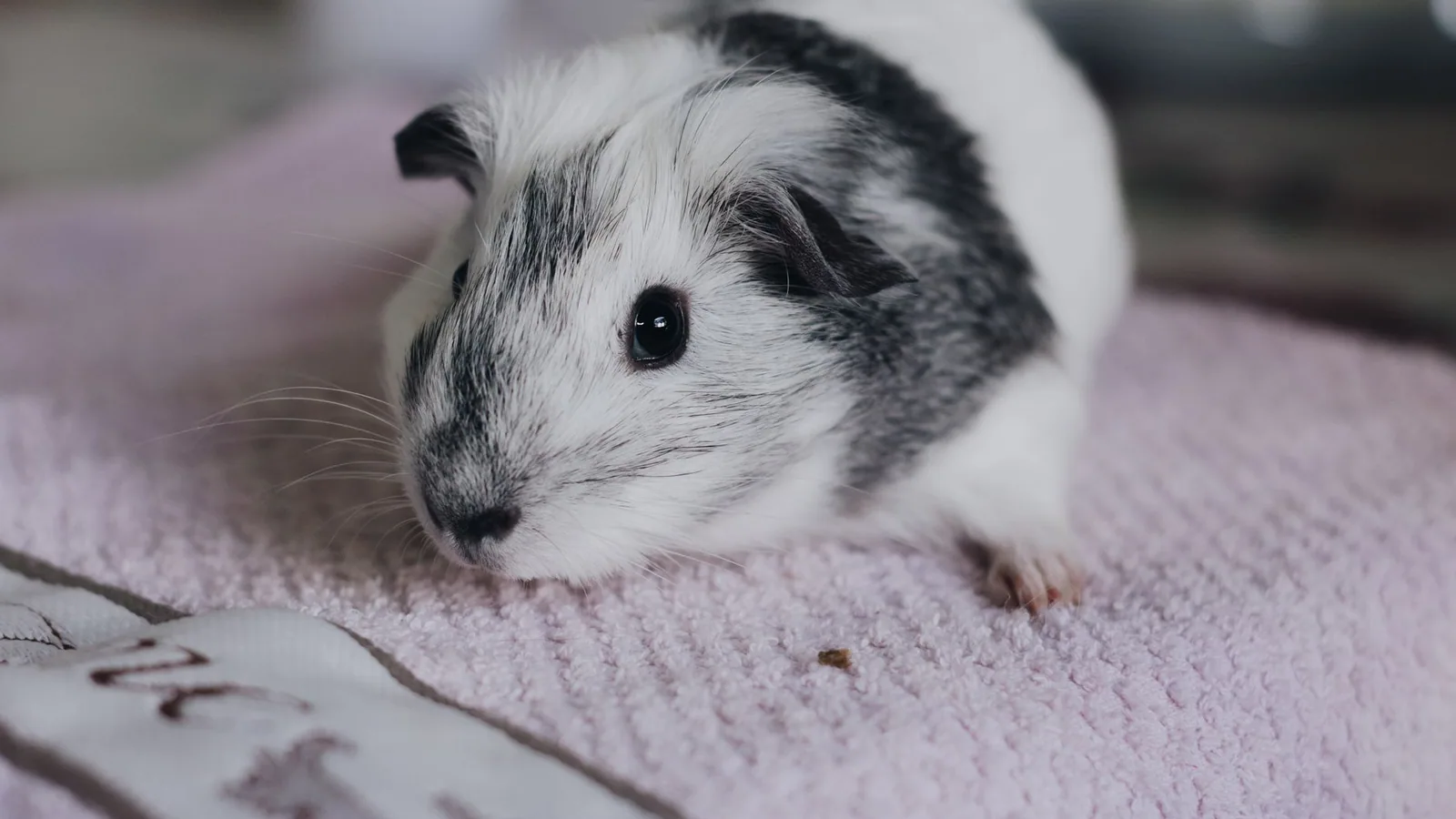
A complete set of guinea pig show supplies comes down to nine categories: paperwork, transport, feed, water, grooming, housing, cleaning and biosecurity, a small health kit, and comfort items. Pack the night before, verify against a written checklist the morning of the show, and the classic failures (forgotten hay, a leaking bottle, a missing entry confirmation) never happen.
This guide gives you the checklist in three usable forms: an at-a-glance table, a copy-and-adapt master template with a filled-in example, and a timed show-day format. Treat it as the event-day companion to your regular guinea pig care guide, and read it once all the way through before your first entry.
This article is educational and is not a substitute for veterinary diagnosis or treatment.
At a Glance: The Complete Guinea Pig Show Supplies Checklist
| Category | Pack this | Why it matters |
|---|---|---|
| Paperwork | Entry confirmation, pedigree or registration papers, coop labels, pen and notebook | Entry and identification errors are the most preventable way to lose a class |
| Transport | Hard-sided ventilated carrier, leak-proof base, familiar bedding, cover cloth, towels | Escapes, spills, and chills are the most common travel failures |
| Feed | Usual hay in a sealed bag, usual pellets pre-portioned, any familiar fresh foods | Ration changes measurably affect condition and digestion |
| Water | Two bottles or a bottle plus a heavy crock, water from home | Bottles leak and get removed at the table, so always carry a backup |
| Grooming | Coat-matched brushes and combs, nail clippers, soft cloth | Show-day grooming is touch-up only, so the kit stays simple |
| Housing | Show coop that meets club rules, familiar bedding, hide, hay rack | A familiar-smelling setup lowers stress in a loud venue |
| Cleaning and biosecurity | Disinfectant, paper towels, gloves, hand sanitizer, trash bags, dedicated scoop | Shows concentrate animals and disease risk in one room |
| Health kit | Gauze pads, self-adhesive wrap, digital scale, veterinarian-approved items | Early action keeps small problems small |
| Comfort | Hide house, fleece pad, spare clips and labels, your own water and snacks | A calm exhibitor keeps a calm cavy |
Why a Written Checklist Earns Its Place
Cavy shows (cavy is the show term for a guinea pig) start early, run loud, and move fast. Under those conditions memory fails in predictable ways: the hay bag stays in the garage, the pedigree stays in the printer, the water bottle stays on the drying rack. A written guinea pig show supplies checklist converts packing from recall into verification. You tick each line as the item physically goes into the vehicle, so a forgotten item becomes impossible rather than likely.
A checklist also works as a welfare gate. If you cannot tick the feed, water, bedding, and climate lines for the full time the animal will be away from home, the entry should be scratched. That decision protects the cavy and costs nothing.
Keep the same template for every show and add a notes column. After each event, write down what ran short, what went unused, and what the venue demanded that you did not expect. Two or three shows in, the list becomes specific to your animal, your vehicle, and your region. Dated packing lists and weight logs also document a pattern of care should any welfare question about your animals ever arise.
The Master Template: A Copy-and-Adapt Guinea Pig Show Supplies Example
Copy this template into your phone or print it and tape it inside your carrier storage bin. Tick items as they physically go into the vehicle, not as you remember them. Quantities below assume a one-day show, so double the consumables for a weekend.
Animal and paperwork
- Entry confirmation and the show secretary's contact details
- Pedigree or registration papers the sponsoring club requires
- Coop or cage labels with your name and the animal's name or ear number
- Pen and small notebook for judge comments and weights
- The cavy's current weight, recorded at home within the past week
Transport
- Hard-sided carrier with secure latches, ventilation, and a leak-proof base, large enough for the animal to turn around and rest
- Bedding that smells like home, enough to line the carrier and refresh the show coop
- A light cover cloth for visual calm between classes
- Towels for spills and for warming a chilled animal on the ride home
Feed
- The cavy's usual hay, sealed against moisture, at least a two-day supply for a one-day show
- Usual pellets, pre-portioned into labeled bags
- Any fresh foods the cavy already eats at home, washed and packed ready to serve
- A familiar small food reward, in a quantity the cavy normally gets
Water
- Two water bottles, or one bottle plus a heavy crock that cannot be flipped
- Water from home in sealed jugs
- A sponge or towel for bottle leaks
Grooming
- Brush and comb matched to the coat, a soft bristle brush for short coats, wide-tooth and fine combs for long coats
- Nail clippers you have already practiced with
- A soft cloth for a final wipe-down
- Coat wraps only if you already use them at home and the cavy accepts them calmly
Housing at the venue
- A show coop or evaluation cage that meets the sponsoring club's rules, confirmed with the show secretary before you buy or build
- Familiar bedding
- A hide house or tunnel
- A hay rack or loose hay in the coop
- Absorbent padding if the table rules require it
Cleaning and biosecurity
- Disinfectant suitable for use around small animals, in a labeled spray bottle
- Paper towels and trash bags
- Disposable gloves
- Hand sanitizer
- A dedicated scoop and brush that never touch anyone else's equipment
- Sealable bags for soiled bedding so everything you brought goes home with you
Health kit
- Gauze pads and self-adhesive wrap
- A digital scale for weight checks
- A short written record of the cavy's normal appetite and dropping pattern
- The specific first aid items your exotics veterinarian recommends for your herd
Comfort and extras
- A hide house that smells like home
- Spare clips, labels, and fasteners
- Chair, water, snacks, and a phone charger for yourself
A filled-in example. For a one-day summer show with a long-haired cavy, the template expands to include a fine-tooth comb, extra bedding (long coats shed debris into it all day), a second hay bag, a shade cloth for the carrier, and coat wraps with spare fasteners. The same show with a short-haired cavy needs less grooming gear and more water capacity instead. A two-day weekend doubles the hay, bedding, and fresh food lines and adds a second hide house so one can be washed and dried overnight.
Before You Pack: Health, Conditioning, and Eligibility
Show only a healthy animal. The ethical standard that governs responsible breeding and exhibition is straightforward: healthy animals, true to their species in behavior and physical appearance, with the health and welfare of the individual treated as a central goal rather than an afterthought [1]. In practice that means you scratch the entry when you see weight loss, soft stool, sneezing, discharge from the eyes or nose, skin problems, or a cavy that seems quieter than usual. A class placement is never worth hauling a sick animal into a building full of other animals.
Condition is built in the weeks before the show, not the days before it. Feeding trials in guinea pigs show why consistency matters: when researchers replaced 30% of the forage in a fattening ration with an alternative feed (fresh orange pulp), growth and carcass traits dropped measurably, while a 15% replacement produced no measurable difference [2]. The exhibitor's takeaway is not about any single ingredient. Ration composition moves condition, so the pre-show period is for holding the diet steady and letting good daily husbandry do its work.
Leave bred females home. Pregnancy is physiologically demanding on its own, and research in guinea pigs shows that when placental blood supply is compromised, the placenta's exchange zone develops fibrosis and reduced blood vessel formation, and fetal growth restriction follows [3]. A pregnant sow does not need the added handling, noise, and temperature swings of a show hall, so experienced keepers simply do not take the risk. If you are unsure whether a female is pregnant or how far along she is, ask your exotics veterinarian before committing to an entry.
Carrier, Travel, and Climate
Choose a carrier the way you would choose a cage: hard sides, latches a pushing cavy cannot pop, ventilation without drafts, a leak-proof floor, and surfaces you can sanitize. Never transport a guinea pig loose in a vehicle or in cardboard. Line the carrier with bedding from the home cage so the animal travels on a familiar scent, and keep a light cover handy to dim a chaotic venue between classes.
Small-mammal references, including the Merck Veterinary Manual's exotic animal resources and VCA Animal Hospitals' guinea pig guides, consistently stress secure, ventilated transport and protection from temperature extremes. Put that into show-day terms: pre-cool or pre-warm the vehicle, keep carriers out of direct sun, never leave an animal in a parked car, and plan the route so a delayed arrival does not become an animal sitting in heat or cold.
Offer hay in the carrier for trips longer than an hour so the cavy can nibble through the journey, and check on the animal at every stop.
Feeding and Watering Away from Home
Bring the exact diet the cavy gets at home, in the amounts it gets at home. Forage sits at the center of guinea pig feeding across pet and production settings alike, and it formed the dietary base in the feeding trials cited above [2]. A show is not the place to discover that a new hay or pellet does not agree with your animal. Pack double what you expect to use, because delays and rescheduled classes happen more often than exhibitors expect.
Water deserves the same discipline. Bottles leak, get knocked, or get removed by handlers at the table, so carry a backup bottle and a heavy crock. If your cavy is picky about water, bring water from home in sealed jugs so taste is one less variable in a strange place.
Fresh foods travel washed and portioned, ready to serve, and nothing new gets introduced at the venue, including vendor treats. If you want to change anything about the diet, do it weeks after you are home, one item at a time, with your veterinarian's input.
Grooming and Presentation Kit
Do the heavy coat work at home in the weeks before the show. Show-day grooming is touch-up only, and the tools are simple: a brush and comb matched to the coat length, nail clippers, and a soft cloth. Trim nails several days before the show rather than the morning of, so the edges settle and you are not wrestling a nervous animal in a parking lot.
For long-haired breeds, comb thoroughly before travel, protect the coat in transit with wraps only if the animal already wears them calmly at home, and never wrap a damp coat. Pack a fine-tooth comb for last-minute debris removal and spare fasteners, because a lost wrap at a show is a common small crisis.
Judges evaluate the whole animal, and condition shows. A cavy kept on clean bedding, steady feed, and routine gentle handling presents better than anything a show-morning rescue can produce. Practice calm handling by a stranger at home so a judge's hands are not a surprise.
Biosecurity and the Show-Day Health Kit
Shows concentrate animals from many homes into one room, which is exactly the condition under which disease spreads efficiently. Veterinary epidemiologists studying how livestock move through market chains found that mapping those movements reveals the risk pathways where disease is most likely to be introduced and spread, and that targeting the highest-risk points makes biosecurity practical even with limited resources [4]. A cavy show is a market node in miniature: animals from many homes converge, mix, and return. The same research found that combining movement-chain analysis with risk pathways is a practical way to communicate risk and improve biosecurity [4], and for an exhibitor that decision is simple: hands, equipment, and carry-out.
Run the day accordingly. Sanitize hands between handling your animals and anyone else's. Borrow nothing and lend nothing. Bag every piece of soiled bedding and leftover feed and take it home. Disinfect the carrier and coop at home before they go into storage, and ask your exotics veterinarian how long show returns should be isolated from the rest of your animals before rejoining the herd.
Keep the health kit small and honest: gauze pads, self-adhesive wrap, a scale, and whatever your veterinarian has specifically recommended. Wounds deserve respect. Wound research in guinea pigs shows how much treatment changes outcome, with treated wounds reaching more than 65% contraction by two weeks compared with 33 to 34% in untreated controls [5]. That is a laboratory result, not a home protocol, but it supports one clear rule: any wound deeper than a superficial scrape gets veterinary attention, and no creams or ointments go on a guinea pig unless your veterinarian has directed them for that animal.
A Show-Day Format from Pack-Up to Return Home
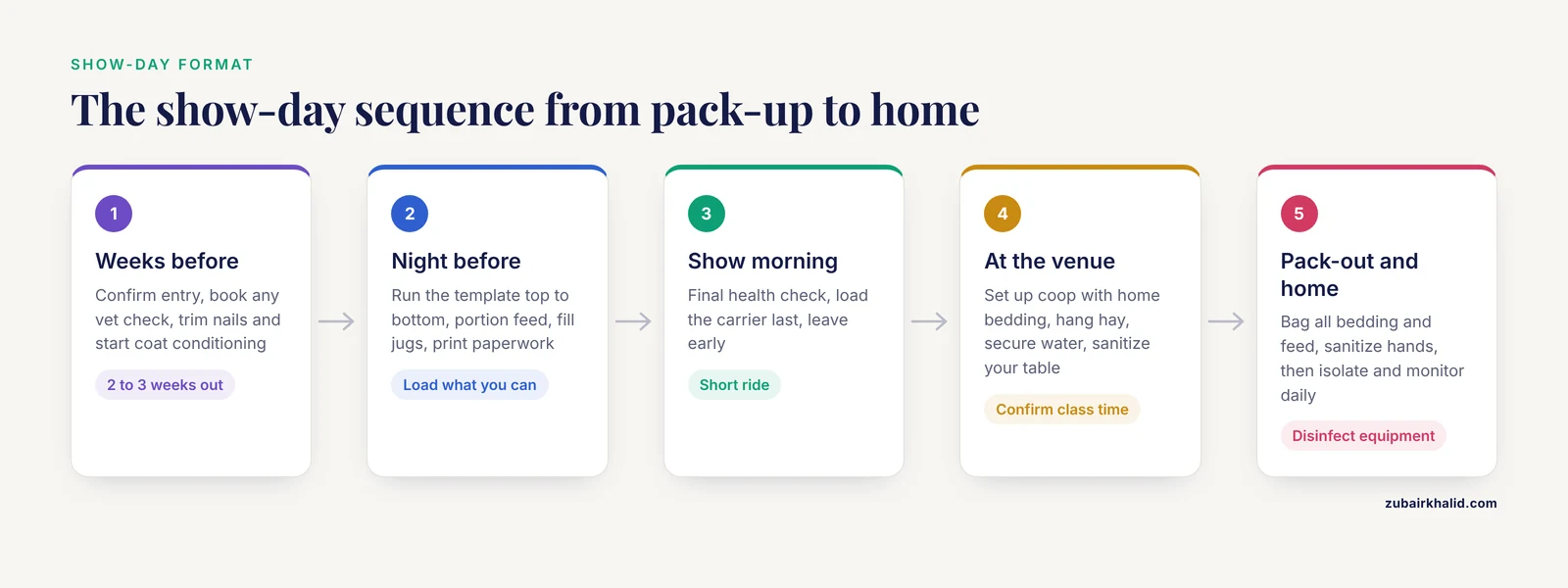
The template gives you the format for what goes in the vehicle. This sequence gives you the timing, and it is the part most exhibitors skip.
- Two to three weeks out. Confirm the entry, schedule a veterinary check if one is due, trim nails, and begin final coat conditioning. Practice calm handling by a stranger so the judging table feels routine.
- Night before. Run the template top to bottom, portion feed, fill water jugs, print paperwork, check the weather, and load what you can.
- Show morning. Do a final health check: overnight appetite, droppings, eyes, nose, bottom, weight, and attitude. Load the carrier last so the ride is short, and leave early.
- At the venue. Set up the coop with home bedding, hang hay, secure water, sanitize your table area, and confirm your class time with the steward.
- Between classes. Keep the carrier covered in a quiet corner, offer a small familiar food, and handle only as much as needed.
- At the table. Follow the steward's instructions, keep the animal away from drafts, sun, and other animals, and speak up calmly if handling seems unsafe.
- Pack-out. Bag all bedding and leftover feed, sanitize hands, and load the carrier for a calm ride home.
- At home. Start the isolation period your veterinarian recommends, monitor appetite, droppings, and weight daily, and disinfect all equipment before it goes back into storage.
Common Mistakes and Quick Fixes
Mistakes that cost classes or health:
- Changing feed or hay in the days before a show. Condition is a weeks-long project.
- Bathing the morning of the show. Finish coat work days ahead, because a damp, stressed animal travels badly.
- Overhandling before and between classes.
- One water bottle with no backup.
- Skipping the post-show isolation period.
- Bringing an animal that is almost right. If health or temperament is in question, the entry waits for the next show.
- An unsecured carrier in the vehicle.
Quick fixes:
- The cavy will not eat at the venue. Offer home hay in the covered carrier and cut the noise. Ask your veterinarian before show season how they want you to handle appetite refusal, because many exotics practices treat appetite loss in guinea pigs as time-sensitive.
- The bottle leaks. Switch to the crock and keep the bottle for the ride home.
- A nail bleeds. Use the styptic product your veterinarian recommends, keep the animal calm, and call the clinic if bleeding does not stop quickly.
- Heat in the hall. Move the carrier to shade, improve airflow, and offer cool (not cold) surroundings. Guinea pigs tolerate heat poorly, a point emphasized across small-mammal references such as the Merck Veterinary Manual and VCA Animal Hospitals' guides.
- An escape. Block the area, go quiet, and lure with hay rather than chasing, because a chased cavy finds hiding places a venue full of equipment should not contain.
Welfare and Ethics in the Show Ring
Showing exists, at its best, to improve animals. The ethical standard for breeding and exhibition asks for healthy animals, true to their species in behavior and appearance, with preservation of the breed's genetic resources and the welfare of each individual built into the goals [1]. Welfare has not always been prioritized in the development of show and companion breeds, and breeding practices now face increasing welfare scrutiny as a result [1]. A cavy exhibitor answers that scrutiny in concrete ways: limited litters with homes planned before breeding, retirement from breeding while animals are young and healthy, and a standing rule that a stressed or unwell animal leaves the venue even if that means scratching a final.
Overbreeding relative to demand creates welfare problems in other companion species, a pattern documented across dogs, cats, and horses [1]. The lesson travels. Every breeding decision a cavy keeper makes should have more homes and more health behind it than ahead of it.
Limitations and When to Contact a Veterinarian
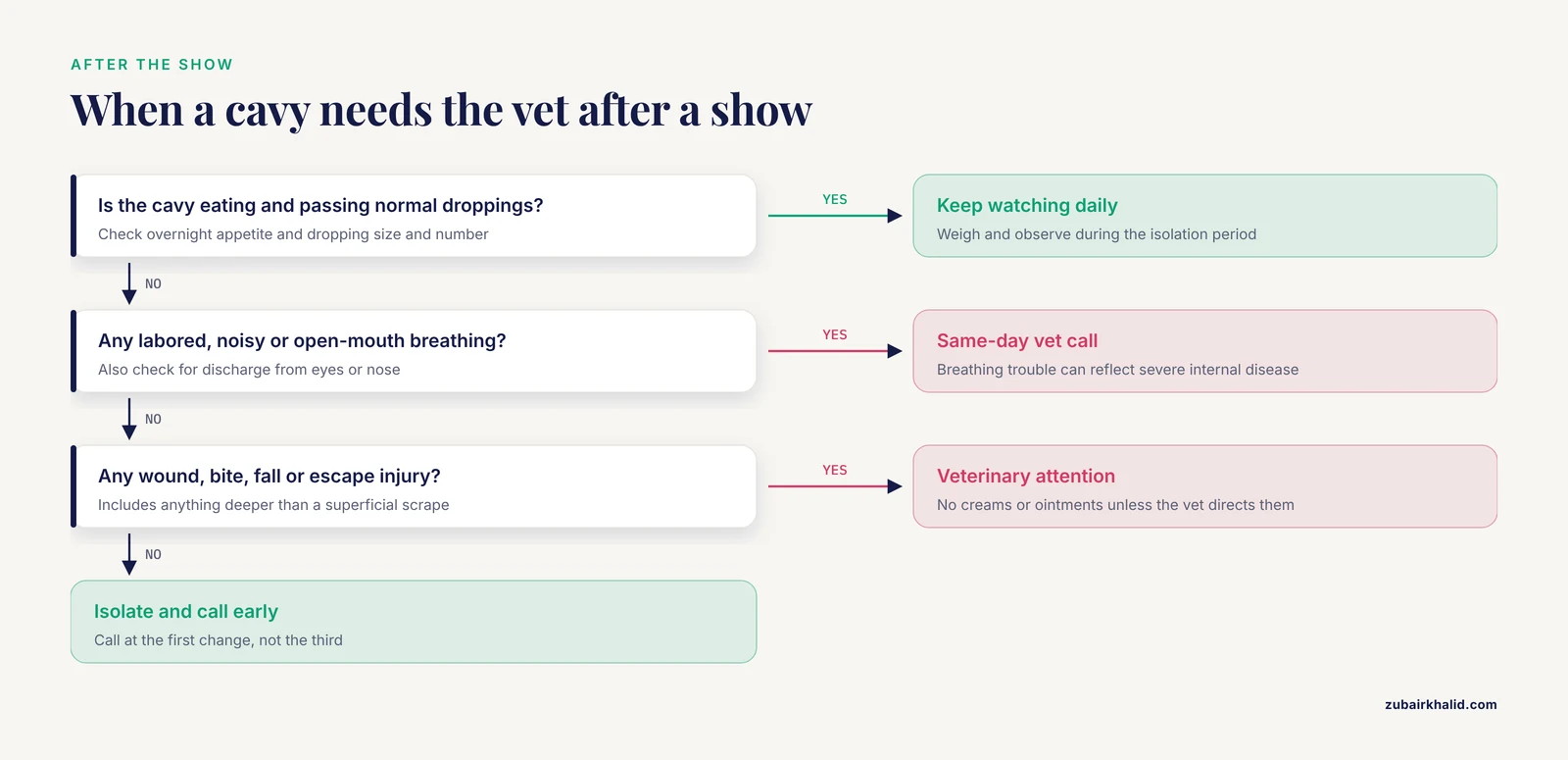
Every animal is an individual, and this checklist is a template, not a medical plan. Discuss your herd, your travel distances, and your show calendar with an exotics veterinarian before the season starts.
Contact a veterinarian the same day for any of the following:
- No eating, clearly reduced appetite, or fewer or smaller droppings
- Diarrhea, or a wet or soiled bottom
- Labored, noisy, or open-mouth breathing, or discharge from the eyes or nose
- Lethargy, hunching, or a cavy that will not move normally
- Any wound, bite, or suspected injury from a fall or escape
- Exposure to heat or cold
- Any concern in a pregnant female
The urgency is not dramatic. Labored breathing in a guinea pig can reflect severe internal disease, and published case series in this species document animals found dead without premonitory signs [6]. After a show, weigh and observe isolated returns daily and call at the first change rather than the third.
Show logistics also vary. Coop dimensions, health requirements, and paperwork differ between clubs and events, so confirm details with each show secretary before you pack.
Frequently Asked Questions
What supplies do I need for a guinea pig show?
At minimum you need a secure ventilated carrier, familiar bedding, your cavy's usual hay and pellets, water from home with a backup bottle or crock, coat-appropriate grooming tools, a show coop that meets club rules, cleaning and biosecurity supplies, basic first aid items, and all entry paperwork. Everything else is refinement.
What does a guinea pig show supplies template include?
A good template has nine categories: paperwork, transport, feed, water, grooming, housing, cleaning and biosecurity, health kit, and comfort items. Copy the master template in this article, tick items as they physically go into the vehicle, and add a notes column so the list improves with every show.
Should I bring my own hay and feed to a show?
Yes. Bring the exact hay, pellets, and fresh foods your cavy gets at home, in familiar amounts, plus water from home if your cavy is picky. A show is the worst possible time to test a new feed, and packing double what you expect to use covers delays.
What kind of carrier works best for showing a guinea pig?
A hard-sided carrier with secure latches, good ventilation, a leak-proof floor, and easy-to-sanitize surfaces, sized so the cavy can turn and rest. Never travel with a guinea pig loose in a vehicle or in cardboard, and line the carrier with bedding from home for a familiar scent.
How do I keep my guinea pig calm at a show?
Familiar smells do most of the work: home bedding in the carrier and coop, home hay, home water. Between classes keep the carrier covered in a quiet corner, handle only as needed, and watch for stress signs such as freezing, teeth chattering, or refusal to eat.
Can I show a pregnant guinea pig?
No. Leave bred females home. Pregnancy is physiologically demanding, and a show adds handling, noise, and temperature swings a pregnant sow does not need. If you are unsure whether a female is pregnant, ask your exotics veterinarian before entering her.
What should I do if my guinea pig seems sick after a show?
Isolate the animal from your other cavies immediately and call an exotics veterinarian rather than waiting. Track appetite, droppings, and weight daily during the isolation period, and tell the clinic where you traveled and how many animals were at the event.
Is a rabbit care checklist different from a cavy show kit?
The two overlap heavily: secure carrier, hay, water with backups, grooming tools, and biosecurity supplies appear on both. Rabbit welfare organizations such as the House Rabbit Society and the Rabbit Welfare Association & Fund publish detailed rabbit care checklists, and multi-species exhibitors usually run one packing system with strictly separate feed and equipment.
Sources
- Ethics in animal breeding.
- Effect of supplementation with fresh orange pulp (Citrus sinensis) on mortality, growth performance, slaughter traits and sensory characteristics in meat guinea pigs.
- Progressive uterine artery occlusion in the Guinea pig leads to defects in placental structure that relate to fetal growth.
- Field application of a combined pig and poultry market chain and risk pathway analysis within the Pacific Islands region as a tool for targeted disease surveillance and biosecurity.
- Effect of cryopreservation on therapeutic potential of canine bone marrow derived mesenchymal stem cells augmented mesh scaffold for wound healing in guinea pig.
- Cranial Vena Cava Syndrome in Guinea Pigs with Chronic Jugular Vein Catheters.