How to Set Up a Guinea Pig Cage for 3 Pigs
By Dr. Zubair Khalid, DVM, MS, PhD ·
A proper guinea pig cage for 3 pigs setup comes down to five things: a single-level enclosure that is as large as your room allows, a solid floor with absorbent bedding, at least three hideouts so no pig can be cornered, a dedicated hay feeding area, and a location with stable temperature, good airflow, and daily human contact. Three guinea pigs need substantially more floor space than one or two, and the extra room is not a luxury. Housing conditions have measurable effects on guinea pig health and productivity. In a retrospective study of more than 7,000 guinea pig records from a production system where females were kept in groups in 3 square meter cages, mortality and litter outcomes varied with housing and management conditions, which underlines how sensitive this species is to its environment [1].
This guide walks through the full guinea pig cage for 3 pigs setup step by step, then covers practical setup tips, the mistakes owners make most often, and the points at which you should stop troubleshooting and call an exotic animal veterinarian. If you keep rabbits as well, note that a rabbit care checklist and a guinea pig care guide overlap on themes like hay, enrichment, and predator-proofing, but the two species have different requirements, and they should not share the same enclosure.
Veterinary disclaimer: This article is educational and is not a substitute for veterinary diagnosis or treatment. Any specific concern about one of your guinea pigs should be discussed with a licensed veterinarian, ideally one with exotic animal experience.
At a Glance: Cage Setup Checklist for 3 Guinea Pigs
| Element | What to Do | Why It Matters |
|---|---|---|
| Enclosure | One large, single-level cage, biggest footprint your space allows | Three pigs need room to run, eat, and retreat without conflict |
| Location | Quiet room, stable temperature, away from drafts, direct sun, and loud electronics | Guinea pigs are sensitive to heat stress and startle easily |
| Flooring | Solid floor, never wire | Wire floors cause foot injuries and bumblefoot risk |
| Bedding | Paper-based or fleece bedding, several centimeters deep | Absorbency and odor control, gentle on feet |
| Hideouts | At least one hide per pig, plus an extra | Prevents resource guarding and cornering in a trio |
| Hay | Large rack or feeder area, refilled daily | Hay should be available around the clock |
| Water | Bottle or heavy bowl, checked twice daily | Fresh water at all times, bottles can jam |
| Food bowls | One heavy bowl per pig or extra | Reduces competition at meal times |
| Enrichment | Tunnels, chew items, foraging opportunities | Prevents boredom and stereotypic behavior |
| Cleaning | Spot clean daily, full clean on a schedule | Ammonia buildup irritates respiratory tracts |
| Bonding | Observe the trio for chasing, biting, or persistent bullying | Group dynamics need monitoring, especially early on |
Why Space and Setup Matter So Much for a Trio
Guinea pigs are a highly social, herd-living species, so keeping three together is generally better for their welfare than keeping a single animal. But social living only works when the environment gives each pig room to disengage. A trio in a cramped cage means one pig is always in another pig's path, which is the root of most chasing, mounting, and fighting that owners report after an upgrade from two pigs to three.
The research record supports the link between housing conditions and guinea pig outcomes. The Andean production study cited above analyzed offspring sex ratio, litter size, number of weaned pups, mortality, and weaning weights across years of records, and found that environmental and management variables, including the conditions around mating and parturition, influenced litter size, the number of animals weaned, mortality, and litter weaning weight [1]. While that study comes from a farming context rather than a living room, the practical lesson transfers. Guinea pigs kept in groups are responsive to their housing environment, and owners who invest in a generous, well-structured enclosure see fewer stress-related problems.
A trio also has a specific social geometry. Two pigs can always split into one and one. Three pigs can form a stable group, but they can also produce a dynamic where two bond and the third is pressured. Extra floor space, extra hides, and duplicate resources are your main tools for keeping a trio stable. If you are assembling this enclosure as part of building out a broader guinea pig care guide for your household, treat the cage itself as the foundation and everything else as supporting structure.
Choosing the Right Enclosure for 3 Guinea Pigs
What to Look For
When you evaluate any cage for a guinea pig cage for 3 pigs setup, judge it against these criteria:
- Footprint over height. Guinea pigs are ground-dwelling animals that sprint and popcorn horizontally. They do not climb or use ramps well, and they do not benefit from tall multi-level cages the way ferrets or rats do. A long, low cage beats a tall tower.
- Solid, smooth floor. Wire or slatted floors injure feet. Guinea pigs are prone to pododermatitis, commonly called bumblefoot, and continuous standing on wire is a classic contributing factor.
- Open sides with good airflow. Aquariums and solid-sided bins trap ammonia from urine and limit ventilation. A wire or grid-sided cage with a plastic base, or a DIY grid panel enclosure, ventilates better.
- No access gaps at floor level. Bar spacing should keep pigs inside and keep other household pets out. Cats and dogs must never be able to reach through the bars.
- Door openings large enough for your arm. You will be reaching in daily for spot cleaning, hay refills, and health checks. A cage you can only access through a small top hatch gets neglected.
- Room to grow and rearrange. You will want to reconfigure hides, hay stations, and enrichment periodically. A modular enclosure makes that easy.
Enclosure Types Compared
| Type | Strengths | Weaknesses |
|---|---|---|
| Store-bought small pet cage | Easy to buy, packaged for beginners | Almost always too small for 3 pigs, and marketing photos of tiny cages mislead new owners |
| DIY grid panel enclosure (cube storage grids plus corrugated plastic base) | Large footprint for the money, modular, deep sides contain bedding | Requires assembly time and a water-resistant base |
| Large single-level plastic-based wire cage | Durable, easy to clean, widely available | Large models for three pigs can be expensive and heavy |
| Converted indoor pen or playpen setup | Maximum floor space, flexible | Needs a fence the pigs cannot push over or chew through |
If you already keep rabbits and built their enclosure from a rabbit care checklist, resist the temptation to reuse that design logic directly. Rabbits jump and use vertical space, so rabbit setups often include levels and high sides. Guinea pigs need horizontal area, shallow bedding depth you can reach into, and no ramps that a heavier adult pig could slip from.
Guinea Pig Cage for 3 Pigs Setup Step by Step
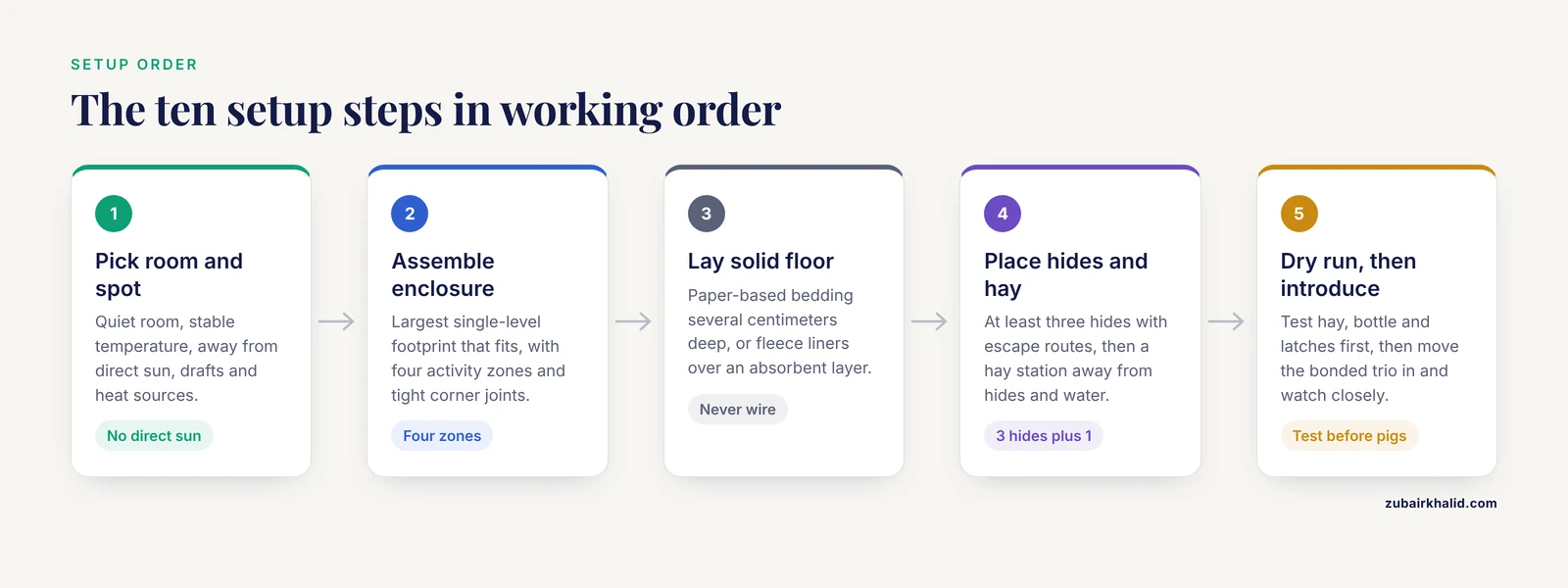
This is the full setup sequence, ordered so that each step builds on the last. Plan on most of a day to complete it properly, including a trial run of the hay and water stations before the pigs move in.
Step 1: Choose the Room and the Exact Spot
Pick a location before you pick a cage, because the location constrains everything else. The spot should be:
- Away from direct sunlight and away from radiators, vents, and fireplaces. Guinea pigs handle cold far better than heat, and overheating is an emergency risk.
- Out of drafts but in a room people use. Guinea pigs that live in isolation become harder to handle and less responsive.
- Off the floor if the room is drafty or if you have dogs or cats, but never so high that daily access becomes awkward.
- Near an electrical outlet only if you use nothing that could heat the cage. Avoid placing lamps, heat cables, or heaters inside or against the cage unless an exotic veterinarian has advised it for a specific medical reason.
- On a floor covering you do not mind sweeping. Loose hay travels.
Step 2: Select and Assemble the Enclosure
Choose the largest footprint that fits the room and your budget. For a trio, think in terms of activity zones rather than square footage alone. A well-arranged cage for three pigs needs four zones: a sleeping and hiding zone, a hay and feeding zone, a water point, and an open running area. If your enclosure cannot hold four distinct zones without crowding, go bigger.
Assemble the base, check that every corner joint is tight, and run your hand along every interior surface looking for sharp wire ends, plastic burrs, or gaps a foot could slip through. Corrugated plastic (coroplast) bases from DIY grid builds should have sealed seams so urine cannot wick out.
Step 3: Lay the Floor and Bedding
Line the floor with an absorbent substrate. Two common approaches:
- Disposable bedding. Paper-based or kiln-dried bedding laid several centimeters deep over the floor. Scented softwood shavings and products with heavy aromatic oils are frequently raised as respiratory concerns, so if you are unsure, ask your exotic veterinarian which substrate they recommend for your specific pigs.
- Washable fleece liners. Fleece wicks urine through to an absorbent layer underneath. Owners of trios usually keep at least two full liner sets so a clean one goes down while the dirty one is washed.
Never use a bare wire floor, and do not rely on a thin sprinkle of bedding over wire. The floor under every pig, at every spot in the cage, must be solid.
Step 4: Place the Hideouts
For three pigs, place at least three separate hides, plus one more if space allows. Distribute them so that no single hide sits in a dead-end corner where a pig could be trapped. Open-fronted hides, tunnels with two exits, and hides with multiple entrance holes are all better for groups than single-door boxes, because a pig inside a one-door box can be ambushed at the entrance.
Check every hide for stability. A hide that collapses when a pig burrows under it is an injury risk.
Step 5: Set Up the Hay Station
Hay is the backbone of the guinea pig diet and should be available continuously. For a trio, set up a hay zone rather than a single small rack. Options include a large rack, a hay bag hung at head height, or a designated corner of a hay tray. Position the hay station away from the water bottle or bowl so hay does not get soaked, and away from the sleeping hides so soiled hay does not accumulate under the pigs overnight.
Whatever feeder you use, confirm the pigs can pull hay through easily and that no gap can trap a limb or a head.
Step 6: Place Water and Food Stations
Hang one water bottle, or provide a heavy ceramic bowl, and check it works by running your finger along the spout. For a trio, many owners hang two bottles or use two bowls, because a jammed bottle or a guarding pig should never leave the group without water. Place heavy food bowls far enough apart that one pig cannot guard all of them at once. One bowl per pig, spread across the cage, is a reasonable starting point.
Pellet food, vegetables, and supplements are diet decisions that belong in a full guinea pig care guide rather than a cage setup article. If you are unsure what and how much to feed, write down your current plan and review it with your veterinarian at the first health check.
Step 7: Add Enrichment and Functional Items
Add tunnels, chew-safe items, and foraging opportunities such as hay stuffed in cardboard tubes. Rotate items every week or two rather than overcrowding the cage. Leave the open running zone genuinely open. A cage where enrichment occupies every square centimeter defeats the purpose of a large footprint.
Step 8: Do a Dry Run Before the Pigs Move In
Before introducing the pigs, test the finished setup:
- Fill the hay station and check reachability from three angles.
- Test the water bottle by tapping the spout and confirming it dispenses and reseals.
- Sit at cage level and look for gaps, sharp points, or unstable items.
- Check that the cage door latches securely and that no household pet can open it or reach inside.
Step 9: Introduce the Trio to the Cage
If the three pigs are already bonded, move them in together with all hides pre-placed, and scatter a little hay across the cage to occupy them while they explore. If you are combining pigs for the first time, that is a separate behavioral project with its own protocol, usually done on neutral territory with supervision, and it is worth discussing your specific animals with a veterinarian or experienced rescue before you start. Monitor the trio closely for the first several days. Some squabbling and mounting is normal as they settle. Sustained chasing, cornering, biting, or a pig that is not eating or not coming out to drink needs intervention.
Step 10: Establish the Cleaning Routine
A trio produces three times the waste of a single pig. Spot clean soiled areas daily, refresh the hay station daily, and schedule full substrate or liner changes based on how fast odor develops in your specific cage, which depends on bedding depth, ventilation, and cage size. A clean cage is part of the setup, not an afterthought.
Guinea Pig Cage for 3 Pigs Setup Tips
These refinements separate an adequate cage from an excellent one.
- Oversize the hay zone. In trios, the hay station is the social hub. A generous hay area reduces crowding and lets the lowest-ranked pig eat calmly.
- Duplicate critical resources. Water points, food bowls, and hides are the three resources that trigger guarding. Duplicates cost little and prevent most conflicts.
- Keep hides open-fronted or double-doored. Closed single-door boxes give a dominant pig a weapon, literally a door it can sit against.
- Use bedding depth to your advantage. Deeper bedding in the sleeping zone absorbs odor and gives pigs a soft surface. Shallow, frequently changed bedding beats deep, stale bedding.
- Observe from cage level. Crouch down and look across the cage the way a guinea pig experiences it. Sight lines, dead ends, and hiding shadows look very different from a foot above.
- Plan the location for your own routine. A cage you can reach comfortably, in a room you visit often, gets better daily care than a beautiful setup in an inconvenient corner.
- Photograph the finished layout. When something goes wrong later, such as a bottle leaking or a hide being guarded, a photo of the working layout makes troubleshooting and rearranging faster.
Common Mistakes in a Guinea Pig Cage for 3 Pigs Setup
Almost every failed trio setup traces back to one of these errors.
Mistake 1: Buying the cage marketed for the number of pigs you own. Retail cage labels routinely understate the space a group actually needs. Judge the cage by whether it fits four activity zones, not by the picture on the box.
Mistake 2: Choosing a cage with a wire floor. Wire floors, or wire floors with a thin bedding layer, contribute to foot injuries. Every resting surface should be solid.
Mistake 3: One hide for three pigs. A single hide turns the cage into a competition. Three pigs need at least three hides arranged with escape routes.
Mistake 4: Placing the cage in direct sun or next to a heat source. Guinea pigs overheat easily. A cage that feels pleasant to you in a sunbeam can be dangerous for them within hours.
Mistake 5: Enclosing the cage in glass or acrylic. Aquarium-style enclosures limit airflow and let ammonia accumulate at nose level, which is exactly where a guinea pig breathes.
Mistake 6: Putting the hay rack over the sleeping area. Soiled hay accumulates where pigs sit under it. Keep the hay station separate from the hides.
Mistake 7: Assuming three pigs will get along without monitoring. A trio can flip from stable to tense after an illness, a molt, or a cage rearrangement. Watch for one pig being excluded from food or water and adjust resources early.
Mistake 8: Skipping the dry run. Discovering that the water bottle does not seal, or that a hide tips over, is far better discovered before three pigs are living in the cage.
Mistake 9: Treating a rabbit checklist as a guinea pig checklist. Owners coming from rabbit keeping often reuse a rabbit care checklist for guinea pigs. The overlap is real, both species need constant hay, chew enrichment, and predator-proof housing, but the differences matter more. Guinea pigs need lower, wider enclosures, different handling, and species-specific dietary planning.
Troubleshooting Common Problems After Setup
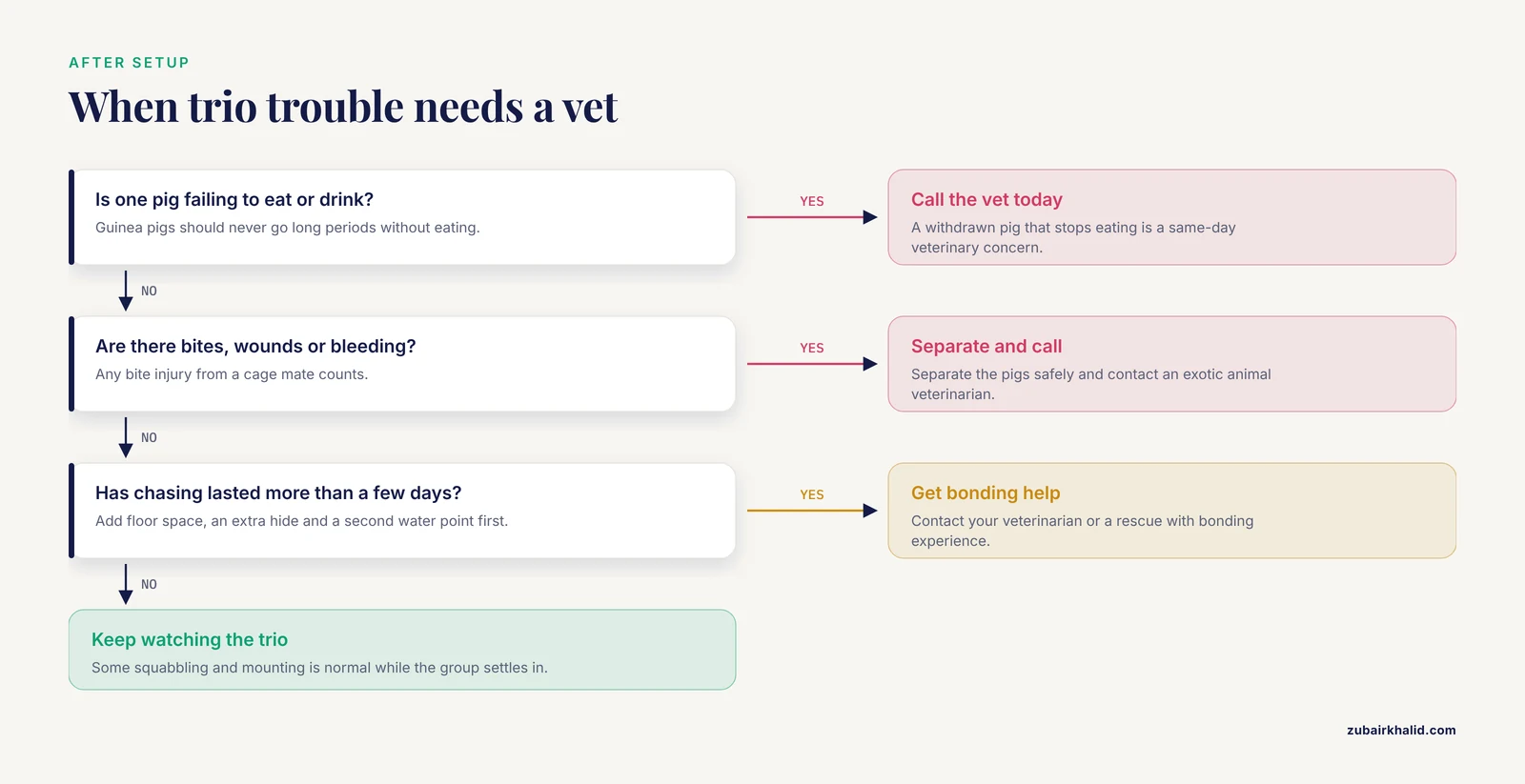
The trio chases constantly. Add floor space and add a hide. Rearrange the layout so no hide sits in a dead end. If chasing continues for more than a few days, or if any pig loses weight or has visible wounds, separate the pigs safely and contact your veterinarian or a rescue with bonding experience.
One pig stays hidden and will not come out to eat. This is a resource access or bullying problem until proven otherwise. Add a second food station and a second water point at the opposite end of the cage. If the withdrawn pig still will not eat, that is a veterinary concern the same day, because guinea pigs should never go long periods without eating.
Urine odor builds up quickly. Increase bedding depth in the soiled zone, increase spot cleaning frequency, and check airflow. Persistent strong odor despite diligent cleaning usually means the cage is too small for three pigs or the substrate is wrong for your routine.
The water bottle jams or leaks. Test bottles weekly by tapping the ball bearing. Provide a bowl as backup during any period when you suspect a bottle is malfunctioning.
Bedding is kicked everywhere. Use higher-sided bases or deeper trays. Some scatter is normal and reflects natural foraging behavior rather than a problem to fix.
The pigs chew the cage bars. Bar chewing usually signals boredom, insufficient hay access, or a cage that is too small. Add foraging enrichment and recheck the hay station first.
Welfare and Safety Points for a Trio
- Never house guinea pigs with rabbits or other species. Owners researching small mammal housing sometimes consider mixed-species setups. Housing decisions that combine species carry disease and injury risks and should only ever be made with input from a veterinarian who knows your specific animals.
- Supervise all interactions with household predators. Dogs and cats do not need to touch a cage to injure the animals inside. A paw through the bars or a night of pacing next to the cage is a stress event for prey animals.
- Keep the routine predictable. Guinea pigs learn feeding and handling times quickly. Predictability reduces chronic stress.
- Check every pig daily. A daily head-to-tail look at each pig, including eyes, nose, feet, and rear end, catches most problems early. A weekly weigh-in on a kitchen scale is one of the highest-value monitoring habits an owner can build.
- Protect the cage from children's access and from other pets at night. Locking latches beat magnetic or sliding latches when cats are in the house.
Limitations and When to Contact a Veterinarian
Every guinea pig trio is different in age, temperament, size, and history, and any specific recommendation about your animals, including exact enclosure dimensions, substrate selection, and diet quantities, is a conversation for a veterinarian who has examined them. Use the guidance here as a framework and adjust with professional input.
Contact an exotic animal veterinarian promptly, and do not wait more than a day, in any of these situations:
- Any pig is not eating, or is eating dramatically less than usual
- Any pig has not produced droppings, or the droppings are small, misshapen, or markedly fewer
- Drooling, wet chin, or difficulty chewing, which can indicate dental disease
- Labored breathing, clicking sounds, discharge from the nose or eyes
- Diarrhea or persistently soft stools
- Lameness, reluctance to move, or sores on the bottom of the feet
- A wound, bleeding, or a bite injury from a cage mate
- Sudden behavior change, including a social pig hiding for more than a day
- Hair loss, intense scratching, or visible skin changes
- Any pig exposed to heat, including open-mouth breathing or lethargy in a warm room, which is an immediate emergency
Guinea pigs are prey animals that mask illness well, so the gap between "seems a bit quiet" and "seriously ill" is often short. When in doubt, call.
Frequently Asked Questions
How big should a guinea pig cage be for 3 pigs?
Bigger is always better, and the practical test is whether the cage holds four distinct zones (sleeping, hay and feeding, water, and open running space) without crowding. For a trio, prioritize the largest single-level footprint your room allows rather than any minimum on a product label, and discuss specific dimensions with your veterinarian if you are choosing between options.
Can 3 guinea pigs live together peacefully?
Yes, many trios live together peacefully, especially properly bonded groups with enough space and duplicate resources. Because three is an odd number, monitor for one pig being excluded, and add extra hides, food stations, and water points to keep competition low.
Should guinea pigs and rabbits share a cage?
No, guinea pigs and rabbits should not share the same enclosure. Species mixing carries health and injury risks and is a decision only for a veterinarian who knows your specific animals. If you keep both species, set up separate enclosures and follow a rabbit care checklist for the rabbit and a guinea pig care guide for the pigs.
What bedding is best for a guinea pig cage?
Solid flooring covered with an absorbent substrate, either paper-based bedding or washable fleece liners over an absorbent layer, works well for trios. Avoid wire floors, and if you are weighing substrate options, including wood-based products, ask your exotic veterinarian what they recommend for your pigs and your cleaning routine.
How often should I clean a cage for 3 guinea pigs?
Spot clean soiled areas and refresh the hay station daily, and do a full substrate or liner change as often as odor and moisture require, which for a trio is typically more frequent than for a single pig. The right interval depends on cage size, bedding depth, and ventilation, so adjust based on what you smell and see rather than a fixed calendar.
How many hideouts do 3 guinea pigs need?
At least three, ideally four. Use open-fronted or double-exit hides arranged so no pig can be cornered, and make sure each hide is stable and cannot collapse or trap a pig underneath.
Do guinea pigs need ramps or levels in their cage?
No. Guinea pigs are ground dwellers that do not climb reliably, and ramps and levels in a guinea pig cage mostly create fall and slip risks. Choose a long, low, single-level enclosure with maximal floor area.
What do I do if my 3 guinea pigs fight after the cage setup?
First, add space and resources, especially an extra hide, extra food bowl, and a second water point, and rearrange any hide that sits in a dead end. If chasing continues for several days, if anyone is bitten, or if a pig stops eating or drinking normally, separate the pigs safely and contact your veterinarian or an experienced rescue for bonding help.