Gerbils Enrichment Ideas That Match Natural Behavior
By Dr. Zubair Khalid, DVM, MS, PhD ·
The gerbil enrichment ideas that work best are the ones that let a gerbil do what a gerbil is built to do: dig deep tunnels, gnaw continuously, forage for food, sand bathe, and live as part of a compatible pair or clan. Research on Mongolian gerbils (Meriones unguiculatus) shows that when these natural behaviors are blocked, welfare problems follow quickly. Gerbils housed without the ability to burrow developed stereotypic digging, and gerbils separated from their families too early developed stereotypic bar chewing. Simple changes to housing solved both problems in the laboratory setting [1]. The same principle applies in your home. Enrichment is not decoration. It is the daily opportunity to perform natural behavior, and it is the single most effective tool for preventing the repetitive, harmful habits that bored gerbils develop.
This guide covers the behaviors gerbils need to express, the signs that tell you enrichment is falling short, safe toy selection criteria, do-it-yourself projects, and a structured daily routine. Every recommendation is grounded in gerbil-specific research and small mammal welfare literature.
Enrichment at a Glance
Use this checklist to audit your setup today. Each row links a natural behavior to a practical enrichment solution.
| Natural Behavior | What It Looks Like in Captivity | Quick Action You Can Take Today |
|---|---|---|
| Burrowing and tunnel building | Deep substrate at least several inches deep, a dark enclosed burrow zone | Add a deep layer of safe bedding on one side of the enclosure |
| Digging | Dig box or substrate-filled container | Fill a box with shredded paper or aspen shavings and hide seed in it |
| Gnawing and tooth wear | Untreated wood, cardboard, hay-based chew items | Place two or three chew items in different corners |
| Foraging | Seed and food scattered in substrate rather than in a bowl | Scatter the day's food ration across the bedding |
| Sand bathing | Shallow dish of chinchilla-grade sand, offered regularly | Offer a sand bath container for a supervised period, then remove it |
| Running | Solid-surface exercise wheel sized for the animal | Check that the wheel has no rung gaps that can trap a limb |
| Social contact | Same-sex compatible pair or small clan | Never house a solitary gerbil without a plan for companionship |
| Cognitive challenge | Hand target training, novel objects, rearranged layouts | Spend five minutes offering a food reward by hand |
Why Enrichment Is a Welfare Requirement, Not a Luxury
Gerbils are fossorial rodents. In their natural range they spend much of their lives underground, excavating and maintaining burrow systems. Captivity that removes this behavior entirely creates a vacuum, and the animal fills the vacuum with abnormal behavior.
The clearest evidence comes from laboratory welfare research. Scientists studying Mongolian gerbils under standard caging found two distinctive abnormalities: stereotypic digging and stereotypic bar chewing. Their work traced stereotypic digging directly to the absence of a burrow in the cage. When the researchers introduced an integrated artificial burrow system, the development of stereotypic digging was prevented. Stereotypic bar chewing traced to husbandry rather than housing, specifically to the premature separation of juveniles from their family group before the birth of younger siblings. Adjustments to those routines significantly reduced bar chewing [1].
This research matters to pet owners for a simple reason. The behaviors that look like quirks in a pet gerbil, such as frantic digging at cage corners or gnawing on cage bars for hours, are documented welfare problems with identified causes. They respond to environmental change. A gerbil that digs obsessively at a glass corner is often a gerbil whose burrowing need has no outlet. A gerbil that chews bars relentlessly may be socially frustrated, under-enriched, or both.
Broader small mammal welfare research reinforces the stakes. A 2025 survey of 723 UK small mammal owners, including owners of gerbils, found that opportunity, particularly the availability of suitable enclosures, was the primary barrier to good housing provision. Most owners were willing and able to provide good welfare, but their animals depended entirely on what the owners provided [2]. Gerbils cannot dig a better home for themselves. The enclosure and everything in it are the whole world your gerbil experiences.
Signs of a Bored Gerbil
Watch for these patterns. Each one is a signal to increase enrichment, not a reason to punish the animal.
Stereotypic digging. Digging that is repetitive, focused on one spot, such as a corner or a wheel location, and does not result in actual tunnel construction. In research settings this behavior was specifically linked to the lack of a burrow and was preventable with a burrow system [1].
Bar chewing. Persistent gnawing on cage or tank bars or edges. Laboratory work connected bar chewing to early separation from the family group, and reduced it through husbandry changes [1]. In pet homes, bar chewing can also reflect insufficient chew outlets or an enclosure that is too small. It can damage teeth and gums, so it warrants action, not just observation.
Wire wheel fixation or lid climbing. Repetitive running or climbing that serves no apparent purpose and continues at unusual hours.
Lethargy and lack of exploration. A gerbil that no longer investigates changes in its environment may be under-stimulated or unwell. Because illness can look like boredom, new lethargy warrants a health check before you assume the problem is purely environmental.
Aggression or irritability toward cagemates. Social friction can stem from crowding, lack of retreat space, or boredom. Multiple hides, deep substrate, and divided territories reduce conflict.
Over-grooming or fur barbering. Self-directed repetitive grooming can indicate stress or under-stimulation.
Owner behavior research offers a useful validation here. In the survey of small mammal owners, behavioral indicators were the most common way owners assessed positive health and welfare at home [2]. You are already doing the right thing by watching behavior. The next step is responding to what you see with environmental change.
Understanding Natural Gerbil Behavior Before You Buy Anything
The best toys for gerbils are the ones that map onto species-specific behavior. Before shopping or building, know what the animal actually does.
Burrow engineering. Wild gerbils dig complex multi-chamber tunnel systems. This is not occasional exercise. It is a core daily activity with a documented welfare function, as the burrow-prevention research demonstrates [1].
Excavation and hoarding. Gerbils move substrate, bury and unbury objects, and cache food. Scatter feeding works precisely because hoarding and searching are natural.
Continuous gnawing. Rodent incisors grow throughout life. Gnawing on wood, seeds, and hard material is normal maintenance behavior and needs a legal outlet in captivity.
Social living. Gerbils are social animals that live in family groups. Research linking bar chewing to premature separation from the family group [1] underlines how central social context is to this species.
Sand bathing. Gerbils maintain coat condition by rolling in fine sand. Water bathing is inappropriate for this species.
Burst activity. Gerbils are active, fast-moving animals that use running space and wheels, particularly at night and in early morning.
Gerbil Enrichment Ideas, Organized by Behavior
Deep Substrate and Burrow Zones
This is the highest-priority change most pet gerbils need. Provide a deep layer of safe bedding, such as aspen shavings or paper-based substrate, deep enough on at least one side of the enclosure for the gerbil to tunnel and for tunnels to hold their shape. The landmark laboratory finding is direct: an integrated artificial burrow system prevented the development of stereotypic digging [1]. In a home tank, the equivalent is a deep substrate zone with a stable ceiling, created by layering substrate deeply and adding structures such as terracotta, cardboard boxes, or wooden platforms that tunnels can run beneath and anchor against.
Practical setup approach:
- Choose one half of the enclosure for deep substrate, six inches or more where the enclosure allows.
- Place heavy, stable objects partially buried in that zone so tunnels have structure.
- Add cardboard tubes and boxes that the gerbil can connect into its own tunnel layout.
- Leave one side shallower so you retain visibility for daily health checks.
Expect the layout to change weekly. Gerbils redesign their burrows constantly, and that redesign is itself enrichment.
Dig Boxes and Rotation
A dig box is a container filled with substrate that satisfies excavation drive even when the main enclosure has limits. Hide seeds, millet, or small portions of food in it. Rotate contents weekly. Fresh substrate, a handful of plain oats, or clean hay all renew the challenge.
Chew Items
Offer untreated wood, plain cardboard, hay-based chews, and hard seed items. Selection criteria:
- Untreated, unpainted, unvarnished wood from known-safe sources.
- No plastic items that shed fragments, since ingested plastic is a hazard.
- No soft porous materials that trap moisture and mold.
- Variety, because gerbils habituate to a single chew item.
Replace chew items when they are worn, soiled, or waterlogged.
Foraging and Scatter Feeding
Scatter the daily food ration across the substrate instead of presenting it in a bowl. Bury small amounts in the dig box. Hide food inside cardboard tubes crimped at both ends. This converts eating, which takes minutes, into a natural foraging session that occupies real time. It also produces natural hoarding behavior, which is normal and healthy for this species.
Running and Exercise
Gerbils run. Provide a solid-surface wheel with no rung gaps that could trap a limb or tail. Avoid wire wheels. Size the wheel so the gerbil's back stays level while running, which generally means a wheel larger than the common hamster-sized options sold in pet stores. If the gerbil uses the wheel obsessively to the exclusion of everything else, treat that as a signal to add variety, since repetitive wheel use can shade toward stereotypy.
Sand Bath Enrichment
Offer a shallow, heavy dish of fine sand on a regular schedule. Gerbils roll, dig briefly, and groom in sand, which maintains coat condition. Remove the bath after the session or scoop and refresh it frequently, because gerbils will also use it as a toilet, which turns coat care into a hygiene problem.
Climbing, Platforms, and Layout Complexity
Add cork bark, wooden ledges, terracotta pots, and branches to create a three-dimensional landscape. Rearrange periodically. Novelty alone stimulates exploration. Keep all structures stable and low enough that a fall from the top cannot injure the animal, since gerbils are sprinters rather than climbers by build.
Social Enrichment
Gerbils should live in compatible same-sex pairs or family groups. Solitary housing removes a fundamental dimension of this species' life. The laboratory evidence that early separation from the family contributed to stereotypic bar chewing [1] illustrates how deeply social experience shapes gerbil behavior. If you keep a single gerbil, plan carefully for how you will address companionship, and introduce new cagemates only with a proper gradual method, ideally in neutral territory with a split-cage approach, because adult gerbils can fight seriously. Ask a veterinarian or an experienced gerbil rescuer for guidance on introductions before attempting them.
Cognitive Enrichment and Training
Training is enrichment, and gerbils can be trained. A 2025 study adapted clicker training, a form of positive reinforcement using a click sound as a conditioned reinforcer, specifically for Mongolian gerbils. Forty-three gerbils completed a standardized 10-day protocol and learned to voluntarily approach and interact with a human hand in exchange for food rewards. Training was described as fast, efficient, and well tolerated, and trained animals, particularly females, showed increased voluntary exploration and engagement [3].
You can replicate this at home:
- Pair a consistent click or short verbal marker with an immediate small food reward.
- Repeat until the marker alone prompts anticipation, usually within days.
- Shape simple behaviors such as approaching your hand, standing at a target, or stepping onto your palm.
- Keep sessions to a few minutes and end on success.
This doubles as husbandry enrichment. A gerbil that voluntarily approaches your hand is easier to examine, easier to move safely, and less stressed during routine care.
DIY Gerbil Enrichment
Most gerbil enrichment can be made from materials already in your home. These projects cost little and perform as well as commercial products.
Cardboard tunnel networks. Connect toilet paper tubes, paper towel tubes, and small boxes into a changing tunnel system. Bury sections in the deep substrate so the gerbil can extend its own burrow. Replace monthly or sooner.
Crumpled paper foraging bundles. Wrap a day's seed ration in plain unprinted paper, twist the ends, and bury the bundle. Unwrapping engages foraging and manipulation.
Dig box variants. Rotate fill materials across weeks: aspen shavings, shredded plain paper, clean hay, and coconut fiber where available. Hide food in each. Never use cedar or pine shavings with strong aromatic oils, and never use clumping or dusty materials.
Seed and millet caches. Bury small food caches in different locations. Hoarding and relocation are natural gerbil behaviors, and buried caches turn the whole tank into a puzzle.
Cardboard chew shapes. Plain boxes, egg cartons without staples, and tube mazes all double as chew items and hiding places. Remove any tape, staples, glue, or ink-heavy printing.
Terracotta hide and dig stations. Partially bury a terracotta pot on its side to create a cool chamber and a digging anchor point.
Millet sprays suspended in substrate. Stand a spray upright in the deep zone so the gerbil must excavate to harvest it.
Safety rules for all DIY projects:
- No adhesives, staples, dyes, or scented materials.
- No treated wood.
- No fabric or stuffing that can cause intestinal blockage if eaten.
- Inspect daily, because gerbils destroy items quickly and wet or soiled cardboard must be removed before it molds.
- Supervise new items the first day you offer them.
Best Toys for Gerbils: Selection Criteria
When evaluating commercial toys, judge every item against the behavior it serves.
- Burrow and digging toys. Anything that lets the gerbil excavate and hide. Substrate depth and structure matter more than any single product.
- Chew toys. Untreated wood, loofah, hay-based products, and hardened seed chews. Reject dyed, scented, plastic, or rubber items.
- Wheels. Solid running surface, appropriately sized, quiet bearing, securely mounted.
- Foraging toys. Puzzle feeders designed for small rodents, or simple DIY versions. Confirm openings cannot trap a paw or tail.
- Sand bath accessories. Heavy ceramic dishes that cannot tip, filled with fine sand, not dust.
Two cautions apply to the entire category. First, gerbils chew everything, so durability is not the goal. Safe destructibility is the goal. Second, volume does not equal enrichment. A tank packed with plastic novelty items provides less welfare value than deep substrate, a burrow zone, and a cagemate.
How to Keep a Gerbil Entertained: A Daily and Weekly Routine
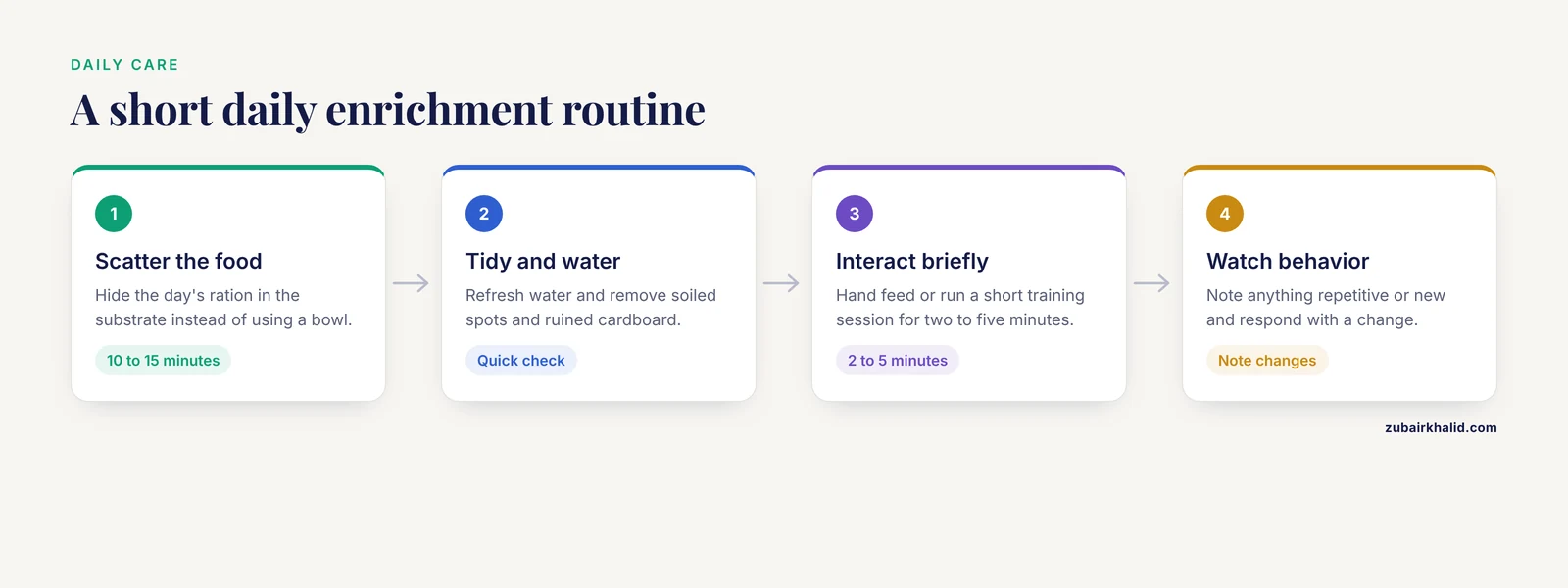
Consistency matters more than intensity. A workable routine:
Daily (10 to 15 minutes of effort):
- Scatter or hide the food ration rather than bowl-feeding.
- Check and refresh water.
- Quick tidy of soiled spots, removal of ruined cardboard.
- Two to five minutes of interaction, hand feeding, or training.
- Observe behavior and note anything repetitive or new.
Two to three times weekly:
- Offer the sand bath for a supervised session.
- Introduce one new item, a fresh tube, a new dig box fill, a buried cache.
- Rotate one item out and one in to maintain novelty.
Weekly:
- Rearrange the layout, preserving any established burrow structures the gerbil is actively using.
- Full inspection of chew items, wheel, and hides for damage or hazards.
- Deeper substrate maintenance, topping up the burrow zone as it compresses.
Monthly:
- Rebuild the deep substrate zone and refresh tunnel anchors.
- Review the whole setup against the at-a-glance table.
Common Mistakes That Undermine Enrichment
- Shallow bedding. An inch of shavings is floor covering, not substrate. Burrowing requires depth, and shallow bedding is a direct route to corner-digging stereotypies [1].
- Bowl feeding exclusively. Food in a bowl removes foraging entirely.
- Plastic-heavy setups. Plastic toys, tubes, and hideouts shed fragments when chewed and are hard to keep hygienic.
- Overcrowding with gadgets. Gerbils need floor area and substrate depth more than hanging toys.
- Solitary housing with no plan. Isolation is a welfare risk in this social species [1].
- Wheel that is too small. A wheel that forces an arched back creates strain instead of exercise.
- Cleaning away all scent marks. Full deep cleans that erase every scent marker can stress a gerbil that has invested in a scent-structured territory. Spot clean, keep some used bedding, and rebuild tunnels into a similar layout.
- Treating behavior change as a quirk. Repetitive behaviors are documented, preventable welfare problems in this species [1]. Respond to them.
Troubleshooting Specific Problems
My gerbil digs frantically at the glass corners. The burrowing need has no outlet. Increase substrate depth first, then add a dig box on top of that. If substrate depth is limited by the enclosure, the real fix may be a larger tank with a topper or a deeper base.
My gerbil chews the bars or tank edges. Add more chew variety first. If bar chewing persists, review social housing, because premature family separation was linked to bar chewing in research gerbils [1]. Also review enclosure size, since cramped space drives escape-directed behavior.
My gerbil ignores new toys. Gerbils are neophobic at first but investigate quickly. Place new items near active burrow entrances, scent them lightly with used bedding, and give them a few days. Novelty works best alongside familiar structures.
My cagemates have started fighting. Increase space and retreat options immediately. Add a second of everything, two wheels, multiple hides, food in separate locations. If conflict escalates to injury, separate them safely and consult a veterinarian or an experienced small mammal rescue before any reintroduction.
My gerbil seems withdrawn. Rule out illness before assuming boredom. Loss of interest in enrichment alongside weight loss, changes in droppings, rough coat, or reduced eating needs prompt veterinary attention. Physical examination and husbandry history together form the basis of small mammal health assessment, which is why veterinarians rely on owner reports of the home environment [4].
Safety and Welfare Points
- Tail safety. Never pick a gerbil up by the tail. Handle by cupping in both hands or scooping in a container.
- Escape security. Every enrichment session outside the enclosure needs a secured room and a watchful eye, because gerbils squeeze through tiny gaps and can injure themselves in falls.
- Temperature. Keep the enclosure away from direct sun, drafts, and heat sources, consistent with standard small mammal care guidance from resources such as the Merck Veterinary Manual's exotic animal section.
- Chew hazard check. Inspect the wheel, hideouts, and toys weekly for sharp edges, cracks, or trapped limbs.
- Food safety. Foraging enrichments must use appropriate gerbil foods. Do not introduce new foods as enrichment treats without checking they are safe for the species, and ask your veterinarian about anything you are unsure of.
- Cleanliness. Damp substrate and soiled cardboard mold quickly. Mold exposure is a respiratory hazard.
Limitations and When to Contact a Veterinarian
Most enrichment decisions are environmental, not medical, and the evidence base for gerbil enrichment comes largely from laboratory welfare research applied carefully to the home. Individual animals vary. An individual gerbil's health, age, and history require in-person veterinary judgment, and this article is educational rather than diagnostic.
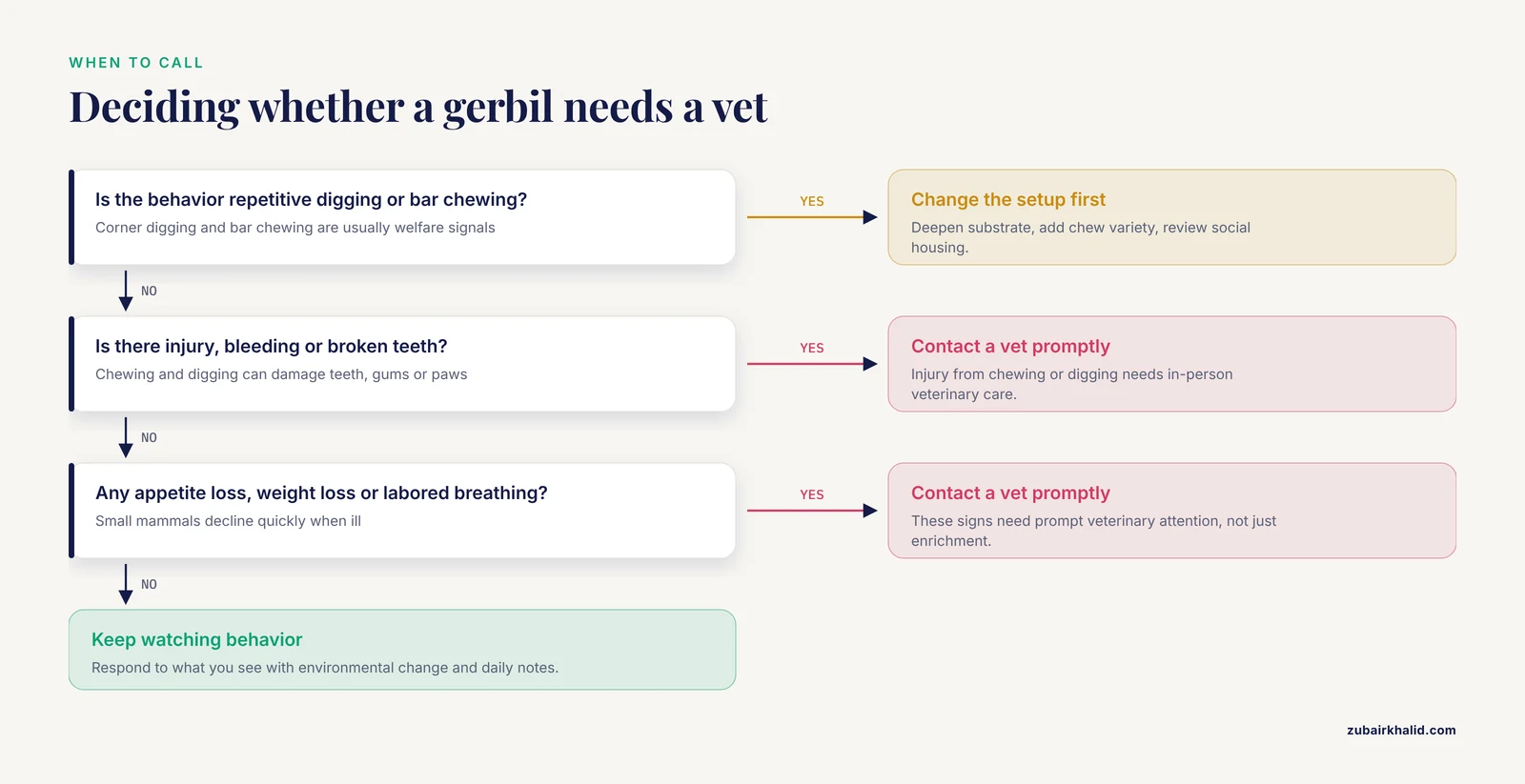
Contact a veterinarian promptly if you observe any of the following:
- Bar chewing or digging that has caused injury, such as broken teeth, bleeding, or paw damage.
- Sudden loss of interest in food, water, or previously enjoyed enrichment lasting more than a day.
- Weight loss, a rough or unkempt coat, diarrhea, or changes in dropping size and frequency.
- Facial swelling, drooling, or difficulty eating, which can indicate dental disease aggravated by chewing habits.
- Any wound, lump, or swelling.
- Overgrown or misaligned incisors.
- Persistent sneezing, nasal discharge, or labored breathing.
- Sudden aggression between cagemates that has produced blood or sustained avoidance of food.
Small mammals decline quickly when ill. Veterinarians who see gerbils routinely can also combine an examination with hematologic assessment when indicated, since blood work supplements the physical exam and husbandry history in these species [4]. Ask for an exotic pet or small mammal veterinarian, and bring photos or notes of your enclosure when you go, because husbandry review is part of the visit.
This article is educational and is not a substitute for veterinary diagnosis or treatment.
Frequently Asked Questions
What are the best gerbil enrichment ideas overall?
Deep substrate for burrowing, a dig box, scattered food for foraging, safe chew items, a solid-surface wheel, sand baths, and a compatible cagemate. Burrowing deserves top priority because research shows a burrow system prevents stereotypic digging in gerbils.
What are the signs of a bored gerbil?
Repetitive digging at one spot without building anything, persistent bar chewing, obsessive wheel use, lethargy toward novel objects, over-grooming, and new irritability toward cagemates. Sudden lethargy can also signal illness, so rule out health problems first.
How do I keep a gerbil entertained every day?
Scatter the food ration instead of using a bowl, hide food caches in the substrate, offer one new or rotated item, and spend a few minutes on hand feeding or simple training. Ten to fifteen minutes of daily effort covers it.
What are the best toys for gerbils?
Untreated wood chews, cardboard tubes and boxes, hay-based chews, a large solid-surface exercise wheel, heavy ceramic sand bath dishes, and puzzle feeders or foraging tubes. Avoid plastic, dyed, scented, or stapled items because gerbils chew and swallow fragments.
What is good DIY gerbil enrichment?
Cardboard tunnel networks buried in deep substrate, paper-wrapped seed bundles, rotating dig boxes filled with aspen shavings or shredded paper, buried millet sprays, and half-buried terracotta pots. Use only plain, untreated, unstapled materials and replace items when soiled.
Can you train a gerbil, and does it count as enrichment?
Yes. Positive reinforcement training with a clicker or consistent marker signal was adapted successfully for Mongolian gerbils in a 10-day protocol, and trained gerbils showed increased voluntary exploration and interaction. Keep sessions short and reward with small food portions.
Do gerbils need to live in pairs?
Yes, gerbils are social animals and should live in compatible same-sex pairs or family groups. Research links early separation from family groups to stereotypic bar chewing. Introduce new cagemates gradually with a split-cage method, ideally with guidance from a veterinarian or experienced rescuer.
How deep should gerbil bedding be for burrowing?
Aim for a deep zone of at least six inches on one side of the enclosure, deeper where the enclosure allows, with stable structures such as terracotta or cardboard anchoring the tunnels. The exact depth depends on your enclosure, so build the deepest substrate zone your setup safely permits and watch whether your gerbil can construct and maintain tunnels.
Sources
- Refinement of gerbil housing and husbandry in the laboratory.
- Small mammal owners' experiences of housing challenges and animal welfare: A COM-B and word frequency analysis.
- Enhancing Gerbil Welfare Through Positive Reinforcement Training in Research Environments.
- Hematologic Assessment in Pet Rats, Mice, Hamsters, and Gerbils: Blood Sample Collection and Blood Cell Identification.