Gerbil Care Guide: Daily, Weekly, and Monthly Routine
By Dr. Zubair Khalid, DVM, MS, PhD ·

A solid gerbil care routine comes down to three repeating layers: a few minutes of daily feeding, water, and observation, a weekly block of hands-on health checks and enrichment work, and a monthly session for deep cleaning, equipment inspection, and a full welfare review. Gerbils are small, quiet animals, and their problems develop quietly too. A predictable routine is how an owner catches weight loss, dental trouble, or abnormal digging and chewing before those issues become emergencies.
This guide walks through each layer of that routine in order, explains the reasoning behind each task, and tells you when a problem needs a veterinarian rather than an adjustment at home.
This article is educational and is not a substitute for veterinary diagnosis or treatment.
Gerbil Care Routine at a Glance
Use this checklist as your starting template. Each task is explained in the sections below.
| Frequency | Task | Time |
|---|---|---|
| Daily (morning or evening) | Refresh water, offer food, remove visibly soiled bedding or spoiled food | 5 minutes |
| Daily | Observation check: activity, posture, breathing, eating, droppings | 2 to 3 minutes |
| Daily | Brief interaction or environmental change for enrichment | 5 minutes |
| Weekly | Full enclosure inspection, substrate and nest check, toy and wheel check | 15 to 20 minutes |
| Weekly | Hands-on health check: weight, coat, eyes, nose, teeth visibility, nails, tail | 10 minutes |
| Weekly | Handling or training session, such as clicker or target work | 10 to 15 minutes |
| Weekly | Rotate or add enrichment items | 5 minutes |
| Monthly | Deep clean of the enclosure and all equipment, full replacement plan for substrate | 45 to 60 minutes |
| Monthly | Structural inspection of the cage, wheel, bottles, and hides, replace worn items | 15 minutes |
| Monthly | Record weight trends and review welfare indicators, schedule vet care as needed | 10 minutes |
Why a Routine Matters More for Gerbils Than Most Owners Expect
Small mammals live inside whatever environment their owner provides. Their food, water, substrate depth, temperature, and social contact are all owner-controlled, which makes them unusually dependent on the consistency of daily husbandry. A recent survey of more than 700 UK small mammal owners found that housing was the single biggest barrier to good welfare, with the availability of suitable enclosures identified as the primary limiting factor, even though most owners were willing and able to provide high welfare standards [1]. In practice, that means the difference between a thriving gerbil and a stressed one is usually the routine the owner runs, not the owner's intentions.
Two behavioral findings drive much of the advice in this guide. In laboratory studies of Mongolian gerbils (Meriones unguiculatus), the same species kept as pets, researchers identified two distinctive stereotypies, repetitive digging and bar chewing. Stereotypic digging appeared when gerbils lacked any burrow structure in their cage, and bar chewing appeared when juveniles were separated from their family group too early, before younger siblings were born [2]. Both problems were preventable with simple changes to housing and husbandry, and the researchers concluded that straightforward refinement of housing effectively improves gerbil welfare [2].
For a pet owner, the translation is direct. A gerbil that cannot dig into deep substrate, or a young gerbil removed from its family too soon, is a gerbil at risk of developing repetitive, hard-to-reverse behaviors. Your daily and weekly routine is the tool that prevents those outcomes.
Getting Set Up Before the Routine Starts
If you are learning how to take care of a gerbil for the first time, build the enclosure correctly before you build the schedule. Retrofitting a setup around an established routine leads to the compromise housing that the welfare survey identified as the main barrier for small mammal owners [1].
Enclosure Requirements
The core principle from the housing research is that gerbils need to dig and burrow, not just stand on bedding. An integrated burrow system, meaning deep substrate that allows real tunneling or an artificial burrow structure, prevented the development of stereotypic digging in study animals [2]. For a pet gerbil, plan for:
- A tank or enclosure with secure ventilation and escape-proof walls
- Deep substrate, deep enough for tunnel construction, rather than a thin scatter of shavings
- A nesting area or hide that functions as a burrow substitute if substrate depth is limited
- A solid-surface exercise wheel, checked weekly for wear and stability
- Multiple hides, chew items, and climbing structures arranged so the gerbil can choose where to spend time
Selection criteria are simple. Prioritize floor space over height, avoid wire flooring that traps feet, avoid plastic surfaces the gerbil can chew and ingest, and confirm any secondhand equipment has no cracked or sharp edges.
Supplies Checklist
- Substrate suitable for burrowing
- Water bottle or heavy ceramic bowl
- Ceramic food dish
- Solid exercise wheel
- Nesting material sold for small mammals (avoid fibrous materials that can tangle limbs or be ingested)
- Chew items and cardboard for enrichment rotation
- A small digital kitchen scale for weekly weights
- A record sheet or notebook for weights and observations
The Daily Gerbil Care Checklist
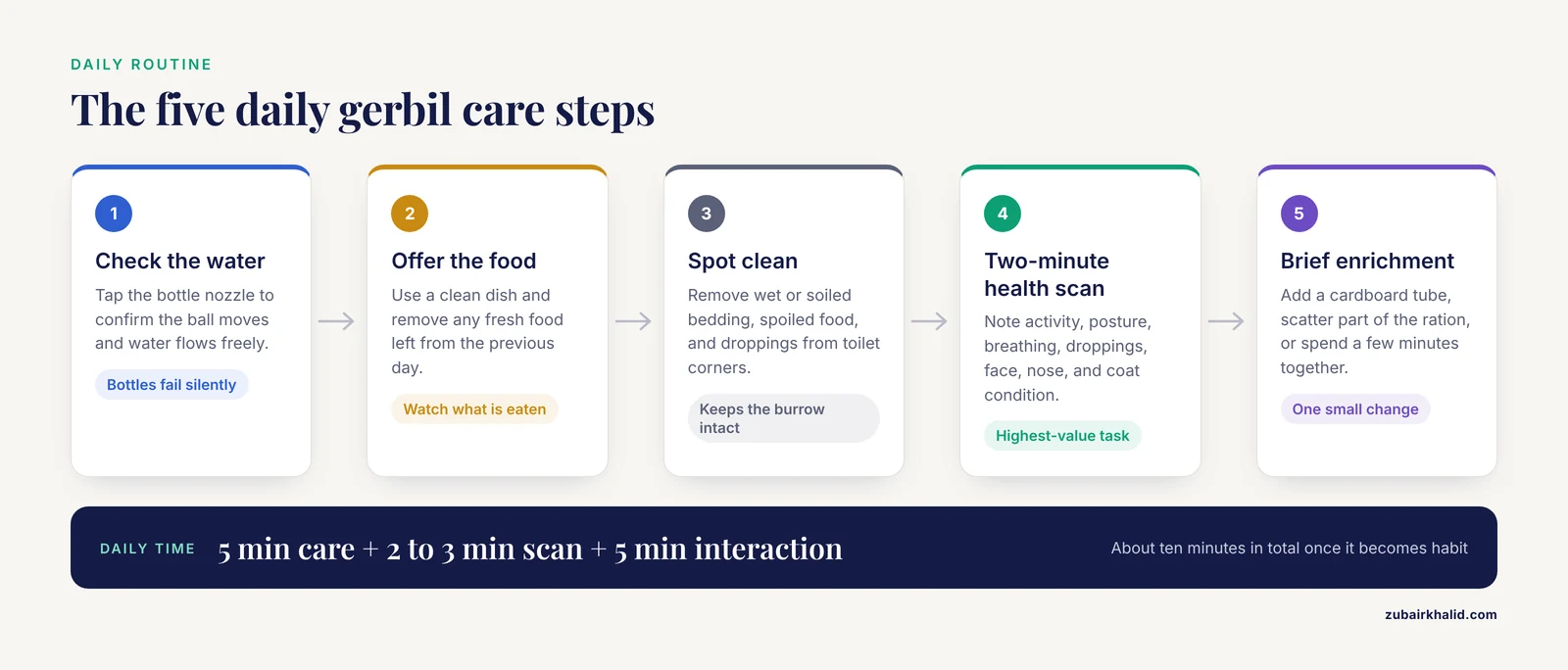
Daily care takes under ten minutes once it becomes habit. Consistency matters more than timing, but most gerbils are active at dawn and dusk, so morning or early evening checks give you the best view of normal behavior.
Step 1: Water
Check the water supply every day. If you use a bottle, tap the nozzle to confirm water flows and the ball moves freely. Bottles fail silently, and a gerbil can dehydrate within a day of a blocked nozzle. If you use a bowl, dump and refresh the water and wipe any bedding out of it.
Step 2: Food
Offer the daily ration of food in a clean dish. Remove any fresh food from the previous day before it spoils. Gerbils hoard, so scattered food caches are normal and do not mean the dish was ignored. Watch that your gerbil actually approaches and eats during the day, because reduced appetite is often the first visible sign of illness in small mammals.
Step 3: Spot Cleaning
Remove visibly wet or soiled bedding, any uneaten fresh food, and droppings from preferred toilet corners. Spot cleaning keeps the environment dry and reduces the frequency of full cleans, which matters because frequent full disruption of the burrow structure is itself a welfare cost for a tunneling species.
Step 4: The Two-Minute Health Scan
This is the highest-value task in the whole routine. The welfare survey of small mammal owners found that owners most commonly rely on behavioral indicators to judge whether their animals are healthy and doing well, mapping those observations to the Five Domains welfare model, which covers nutrition, physical environment, health, behavior, and mental state [1]. Build the same habit deliberately. Each day, note:
- Activity level: Is the gerbil moving normally, exploring, digging, and interacting as usual?
- Posture and gait: Any hunching, limping, reluctance to move, or head tilt?
- Breathing: Breathing should be quiet and effortless. Clicking, wheezing, or open-mouth breathing needs veterinary attention.
- Droppings: Normal formed pellets. Watery, absent, or stuck-on droppings are red flags.
- Face and nose: Any staining, wetness, or swelling around the nose, eyes, or mouth.
- Coat: A rough, greasy, or patchy coat suggests the gerbil is not grooming.
Owners who consistently use these behavioral markers detect problems earlier, and the welfare survey identified this observation-based approach as the dominant method owners use at home [1].
Step 5: Brief Enrichment or Interaction
Change one small thing. Add a cardboard tube, scatter a portion of the food ration to encourage foraging, or spend a few minutes with a hand-tame gerbil. Daily novelty is part of the routine, not a bonus.
Weekly Gerbil Care Tasks
The weekly session is where the gerbil daily care checklist expands into hands-on health care and welfare maintenance. Set aside 30 to 45 minutes, ideally on the same day each week so patterns are easier to track.
Task 1: Weekly Weight
Weigh your gerbil on the same scale, at roughly the same time of day, and record the number. Steady weight is one of the most reliable indicators of health in a small mammal, and a trend over three or four weeks tells you far more than a single reading. Unexplained weight loss or a sudden gain (which can reflect fluid, a mass, or pregnancy) both warrant a veterinary conversation.
Task 2: Hands-On Physical Check
If your gerbil is hand-tame, do this during handling. If not, observe closely at the water bottle and wheel, and work toward handleability using the training approach described below. Check:
- Eyes: Clear, open, symmetrical, no discharge or cloudiness
- Nose and face: No staining, swelling, or crusting
- Teeth: Incisors should be aligned, yellow-orange (normal for gerbils), and not overgrown or broken. You are looking for obvious overgrowth or asymmetry, not performing dentistry
- Ears and skin: No flaking, wounds, scabs, or visible parasites
- Coat and tail: Even coat, intact tail with no kinks or injuries. Never restrain a gerbil by the tail, because degloving injuries of the tail skin occur when gerbils are grabbed there
- Nails: Not curling or catching on fabric
- Vent and belly: Clean and dry, no staining or swelling
- Pouch and mouth area: No drooling or wet fur at the chin, which can accompany dental disease
Any abnormality that persists for more than a day or two, or any acute injury, moves to the veterinary column described later in this article.
Task 3: Full Enclosure Inspection
Walk the entire setup with fresh eyes:
- Confirm the wheel spins freely and has no cracked surfaces or gaps that can catch a limb
- Check that the substrate is holding tunnels without collapsing excessively, and top up areas that have thinned
- Inspect the nest. Heavy soiling of the nest itself may justify a partial nest refresh, but keep some familiar scent material, because rebuilding the whole nest weekly is disruptive
- Look for chew damage on plastic components, cable proximity, or weak points in the cage walls. Bar chewing in particular is a behavior to record and respond to, not ignore
- Verify the lid or mesh is secure. Gerbils are persistent and powerful for their size
Task 4: Handling and Training Session
Positive reinforcement training is a practical, evidence-based part of a weekly gerbil routine. Researchers adapted clicker training for Mongolian gerbils using a standardized 10-day protocol in which gerbils learned to voluntarily approach and interact with a human hand in exchange for a food reward. The method proved fast, efficient, and well tolerated, and trained animals, particularly females, showed increased voluntary interaction and altered exploratory behavior in standardized tests [3].
You do not need laboratory equipment to use the same principle. A short weekly (or daily) session in which a calm hand delivers a small food reward for approaching, stepping onto the hand, or targeting a finger builds cooperation and reduces handling stress over time. Keep sessions short, end on success, and never force contact. Clicker training also functions as cognitive enrichment, giving the gerbil a problem to solve rather than only an object to chew [3].
Task 5: Enrichment Rotation
Swap or add at least one item each week. Rotate chew materials, rearrange hides, bury food in the substrate for foraging, or introduce new cardboard structures. The goal of enrichment for a gerbil is specific: give the animal outlets for digging, gnawing, and foraging so those motivations do not turn into stereotypic digging at cage corners or bar chewing [2].
Monthly Routine: Deep Clean and Full Review
Monthly Deep Clean
Once a month, do a full clean of the enclosure. Move the gerbil to a secure temporary container, then:
- Remove all substrate and nesting material
- Wash the tank, dishes, wheel, and hides with hot water and a pet-safe cleaning product, then rinse thoroughly and dry completely
- Inspect every surface for cracks, chew damage, or rust
- Refill with fresh substrate deep enough to allow tunneling, since burrow availability is what prevents stereotypic digging from developing [2]
- Retain a small amount of unsoiled familiar nesting material to preserve scent continuity, which reduces the stress of a full clean
Between monthly deep cleans, weekly spot cleaning and soiled-substrate removal should keep the environment dry and odor-controlled. If the enclosure develops odor problems within days of cleaning, that is a signal to review ventilation, substrate depth, and toilet-corner management rather than simply cleaning more often.
Monthly Equipment and Welfare Review
Once a month, step back and review the whole picture:
- Weight trend: Compare the last four weekly weights. A flat line is good. A consistent decline is not.
- Behavior inventory: Are you seeing natural behaviors (digging, tunneling, foraging, gnawing on appropriate items) or stereotypies (repetitive corner digging, persistent bar chewing)? Stereotypic behaviors in gerbils are documented consequences of unmet housing and husbandry needs, and they respond to environmental change when caught early [2].
- Structural integrity: Replace worn wheels, bottles, and hides before they fail.
- Record review: Check your notes for anything you noticed but did not act on.
Feeding Within the Routine
Food is a daily task, and the specifics of a gerbil diet, including the balance of seed mixes, pellets, and fresh foods, are worth discussing with an exotics veterinarian, because individual recommendations vary with age, health status, and the specific product you use. Within the routine itself, your jobs are consistent: offer food daily, remove spoiled fresh food, monitor what is actually eaten rather than what is merely hoarded, and record appetite changes. A gerbil that stops eating is an urgent case, not a wait-and-see case, because small animals deteriorate quickly when they are anorexic.
If you change foods, do so gradually across a week or more and watch droppings and appetite daily during the transition.
Common Mistakes in a Gerbil Care Routine
These are the errors seen most often in new owners, and each has a direct fix.
- Shallow bedding. A thin layer of substrate removes the ability to dig and burrow, which is precisely the deficit that produces stereotypic digging in gerbils [2]. Fill the tank properly.
- Separating young gerbils from their family too early. In the laboratory study, bar chewing developed in juveniles separated from their family before younger siblings were born [2]. If you acquire or rehome young gerbils, discuss timing with your breeder or veterinarian rather than separating at the earliest possible date.
- Reading bar chewing as a personality quirk. Repetitive bar chewing is a documented stress-linked behavior, not entertainment. Respond by reviewing enrichment, substrate, and social context.
- Treating observation as optional. Owners who actively watch behavior catch disease earlier than owners who only refill food. The behavioral observation habit is what the welfare survey identified as owners' main tool for assessing health at home [1].
- Forcing handling. Grabbing a gerbil from above, or restraining by the tail, damages trust and risks injury. Use the reward-based approach instead, which gerbils learn quickly [3].
- Neglecting the water bottle check. A failed nozzle produces a dehydrated gerbil within a day. Thirty seconds daily prevents this.
- Full cleans that erase the burrow every week. Over-cleaning destroys scent and tunnel structures. Spot clean weekly, deep clean monthly.
Health Monitoring and the Veterinary Relationship
Gerbils are presented to veterinary clinics for preventive care as well as for illness, and a veterinarian builds a picture from three inputs: physical examination, history, and husbandry information [4]. Your routine records are exactly the husbandry history that makes those visits productive. Bring your weight log, your observations about behavior and appetite, and a description of your enclosure when you go.
Diagnostic workups in gerbils can include hematologic assessment, and veterinary references describe blood collection and blood cell identification specifically for gerbils among other small mammals, which means your veterinarian has species-appropriate tools if bloodwork is needed [4]. What you should not expect is for a general practitioner to see gerbils routinely, so it is worth identifying an exotics-savvy clinic before you need one urgently.
A reasonable baseline for a healthy adult gerbil is an annual wellness examination, with your monthly welfare review determining whether anything needs attention sooner. Ask your own veterinarian to set the interval for your animal, because age and history change the answer.
Limitations and When to Contact a Veterinarian
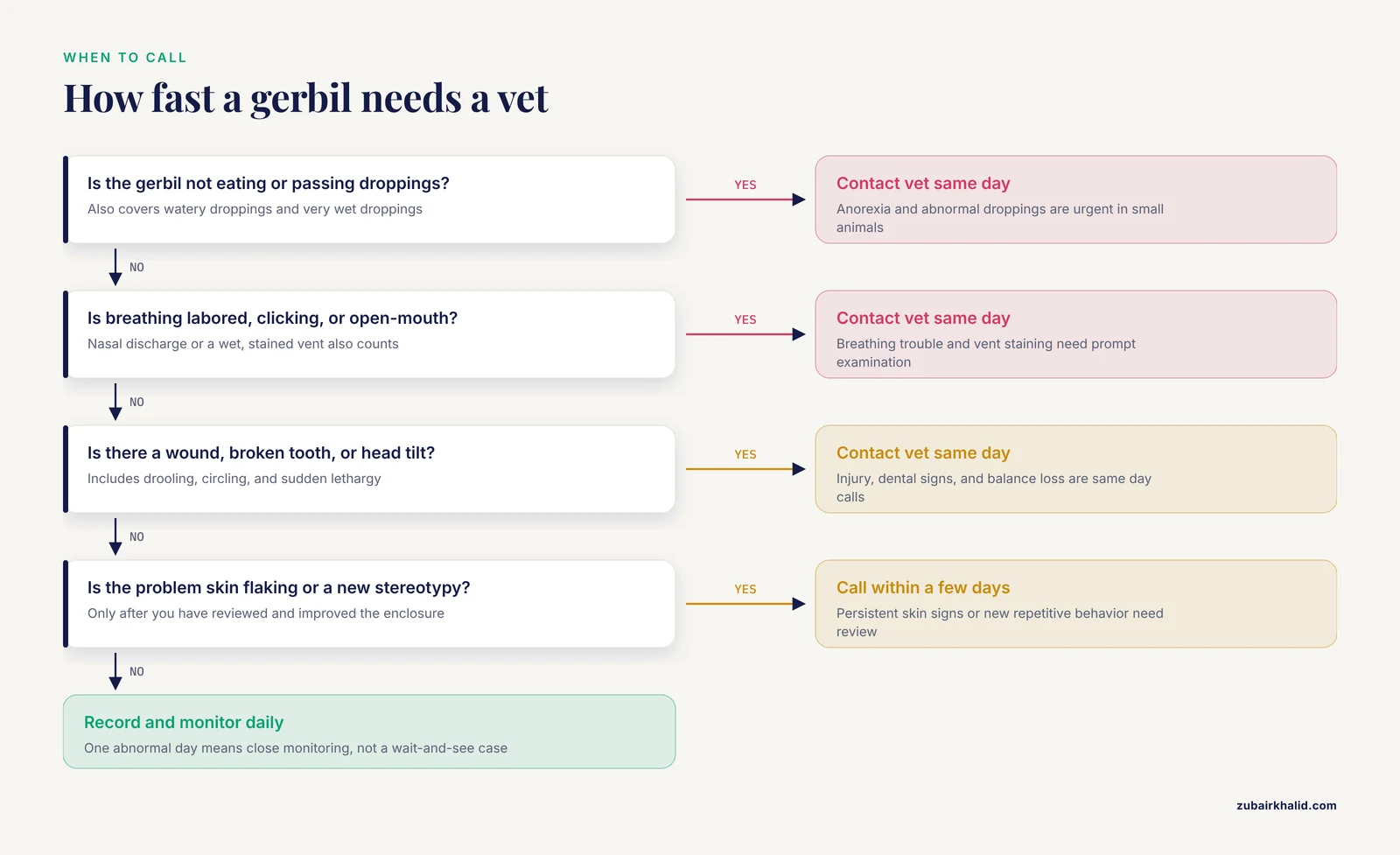
Individual gerbils vary, and the routine in this article is a framework rather than a prescription. Any specific concern about your animal, including diet composition, cleaning product choices, and housing dimensions, should be confirmed with a veterinarian who examines your gerbil in person.
Contact a veterinarian promptly, same day if possible, for any of the following:
- Not eating or dramatically reduced appetite, even for one day
- No droppings, diarrhea, or very wet droppings
- Labored breathing, clicking sounds, nasal discharge, or open-mouth breathing
- Blood in the urine, or a wet or stained vent
- A broken, overgrown, or misaligned incisor tooth, or drooling and a wet chin
- Sudden lethargy, hunching, or unwillingness to move
- Any wound, bleeding, tail injury, or suspected fracture
- Head tilt, circling, or loss of balance
- Unexplained weight loss across weekly measurements
- Eye injury, closed eye, or significant discharge
Contact a veterinarian within a few days (sooner if signs progress) for:
- Persistent skin flaking, scabs, or hair loss
- A new repetitive behavior such as constant corner digging or bar chewing, after you have reviewed and improved the enclosure
- Chronic overgrown nails or recurring minor issues
- Any question about social housing, introducing gerbils, or separating a group
Emergency clinics that do not treat exotics should still be identified in advance, along with the nearest clinic that does, so you are not searching for one at two in the morning.
Frequently Asked Questions
How much time does a daily gerbil care routine actually take?
Plan for about ten minutes daily. Five minutes covers fresh water, food, and spot cleaning, and two to three minutes covers the observation check. Interaction adds a few more. Weekly sessions run 30 to 45 minutes and the monthly deep clean takes about an hour.
How often should I clean a gerbil cage?
Spot clean daily by removing soiled bedding and spoiled food, do a fuller substrate and nest review weekly, and perform a complete deep clean with substrate replacement about once a month. Keep some familiar nesting material at the deep clean to preserve the gerbil's scent environment.
What does a gerbil need in its enclosure?
The essentials are deep substrate that supports real tunneling, a nest or burrow structure, a solid exercise wheel, hides, chew items, and a secure, well-ventilated enclosure. Research shows that the absence of a burrow is directly linked to stereotypic digging in gerbils, so burrowing opportunity is not optional furniture, it is a core need.
Why does my gerbil dig frantically at the corners or chew the bars?
Repetitive corner digging and bar chewing are the two classic gerbil stereotypies. Studies traced stereotypic digging to a lack of any burrow in the cage and bar chewing to premature separation of juveniles from their family group. Review substrate depth and burrow access first, then social history and enrichment, and ask an exotics veterinarian if the behavior persists.
How do I tame a gerbil that does not want to be handled?
Use positive reinforcement. A 10-day clicker-style protocol successfully taught gerbils to voluntarily approach and interact with a human hand for food rewards, and the training was fast, efficient, and well tolerated. Start with rewards for approaching your hand, keep sessions short, and never grab the gerbil or restrain it by the tail.
Can gerbils live alone?
Gerbils are social animals, and their welfare is tied to appropriate company and to how they were raised, since juveniles separated from their family too early show higher rates of bar chewing. Compatibility between individuals is a real management question with real risk of fighting, so discuss your specific animals, their ages, and their history with an exotics veterinarian before making changes.
What signs of illness should I check for every day?
Watch activity level, posture, breathing, appetite, droppings, and grooming daily. Red flags include not eating, absent or watery droppings, labored or noisy breathing, nasal or eye discharge, a wet chin suggesting dental problems, blood in the urine, sudden lethargy, and any injury. One abnormal day merits close monitoring, and two days or any acute sign merits a call to your veterinarian.
How often should a gerbil see a veterinarian?
Schedule a wellness examination at least annually with a clinic experienced in gerbils, and go sooner whenever your daily or weekly checks turn up an abnormality. Bring your weight log and husbandry notes, because examination, history, and husbandry information together are what allow a veterinarian to assess a small mammal properly.
Sources
- Small mammal owners' experiences of housing challenges and animal welfare: A COM-B and word frequency analysis.
- Refinement of gerbil housing and husbandry in the laboratory.
- Enhancing Gerbil Welfare Through Positive Reinforcement Training in Research Environments.
- Hematologic Assessment in Pet Rats, Mice, Hamsters, and Gerbils: Blood Sample Collection and Blood Cell Identification.