DIY Small Pet Supplies You Canat Make at Home
By Dr. Zubair Khalid, DVM, MS, PhD ·
You can make most of the enrichment items a pet rabbit or guinea pig needs at home using plain cardboard, untreated wood, pet-safe fleece, hay, and paper. Hideouts, tunnels, hay feeders, foraging toys, digging boxes, and chew items are all simple builds that take minutes to an hour and cost little more than the contents of your recycling bin. The only rules that matter are the safety rules. Use materials without glue, tape, staples, ink-heavy printing, or treated wood, supervise your pet with anything new, and replace items once they get soggy, shredded, or soiled.
This guide walks through every step, from choosing safe materials through building seven proven projects. It also covers the tips and common mistakes that separate a toy your pet loves from a toy that ends up in the trash, and it shows where homemade supplies fit into a complete rabbit care checklist and guinea pig care guide.
At a Glance: Seven DIY Projects You Can Build Today
| Project | Main Materials | Build Time | Best For | Key Safety Note |
|---|---|---|---|---|
| Cardboard hideout castle | Boxes, utility knife | 20-30 minutes | Rabbits, guinea pigs | No tape, staples, or glossy ink |
| Hay-stuffed forage tubes | Toilet paper tubes, hay | 2 minutes | Rabbits, guinea pigs | Stuff loosely, remove when destroyed |
| Box hay feeder | Cardboard box, utility knife | 15 minutes | Rabbits, guinea pigs | Smooth all cut edges |
| Digging and foraging box | Shallow box, paper, hay, herbs | 10 minutes | Rabbits | Shredded paper only, no plastic |
| Fleece snuffle mat | Fleece strips, fence base or fleece base | 45-60 minutes | Rabbits, guinea pigs | No loose threads longer than a few inches |
| Braided fleece tug toy | Fleece strips | 10 minutes | Rabbits, guinea pigs | Check for unraveling weekly |
| Box tunnel run | Large boxes, utility knife | 20 minutes | Rabbits, guinea pigs | Wide enough for your pet to turn around |
Why DIY Supplies Matter for Small Mammals
Rabbits and guinea pigs are prey species with bodies and behaviors built around constant movement, constant chewing, and constant vigilance. Small-mammal veterinary resources, including the Merck Veterinary Manual's exotic and laboratory animal section and the care guides published by VCA Animal Hospitals, consistently emphasize that these animals need unlimited hay, places to hide, items to chew, and space to move. A bare cage with a food bowl and a water bottle meets survival needs. It does not meet behavioral needs.
Chewing is the clearest example. A rabbit's and a guinea pig's teeth grow continuously throughout life. Chewing on hay and safe fibrous materials helps wear the teeth down and keeps the jaw working. The Rabbit Welfare Association and Fund, one of the largest rabbit welfare organizations in Europe, builds nearly all of its husbandry advice around unlimited grass hay for exactly this reason. Cardboard tubes stuffed with hay, willow-based chew items, and untreated wood blocks all serve that same biological need.
Foraging is the second pillar. In the wild, these animals spend a large part of their day searching for food. Scatter-feeding hay through homemade foraging toys recreates that pattern and reduces boredom-related behaviors such as bar biting, cage circling, and destructive chewing on baseboards.
The third pillar is hiding. Prey animals need at least one enclosed retreat where they can see out but nothing can see in. A cardboard box with two exits does this job as well as most commercial hides, and it costs nothing.
Safety First: Materials You Can and Cannot Use
Before you build anything, master the material rules. Almost every DIY injury in small mammals traces back to the wrong adhesive, the wrong wood, or a toy left unattended after it broke apart.
Safe materials
- Plain brown cardboard. Unprinted corrugated cardboard from shipping boxes is the workhorse of DIY small pet supplies. Remove all tape and labels first.
- Untreated, unpainted wood. Wood with no stains, paints, varnishes, or pressure treatment. When you are unsure whether a specific wood species is safe for your species of pet, ask an exotic animal veterinarian before offering it.
- Pet-safe fleece. Polar fleece does not fray into long loose threads the way woven fabrics do, which is why rescue organizations use it for cage liners.
- Paper. Plain shredded office paper, unprinted newsprint, and paper bags. Avoid glossy inserts and heavily inked pages.
- Hay and dried grasses. Timothy, orchard, meadow, or oat hay, always the same hay you already feed.
- Natural fibers. Seagrass mats, dried willow, and plain undyed sisal twine are commonly sold for small mammals. Confirm any natural fiber product is labeled for small pets before use.
Materials to avoid
- Adhesives of any kind. Hot glue, wood glue, super glue, school glue, and spray adhesive all belong in a workshop, not a chew toy.
- Staples, pins, brads, and nails. A single swallowed staple can cause serious internal injury. Fasten everything with interlocking cuts instead.
- Tape. Masking tape, packing tape, and duct tape all pose a wrap-around-toe and swallowing risk.
- Pressure-treated lumber and painted or stained wood. Treatment chemicals are not meant to be ingested.
- Plastic bags, plastic mesh, and thin plastic sheeting. These can be swallowed or trap a limb.
- String, yarn, and long threads. These cause intestinal blockages if swallowed. This is why fleece, which resists unraveling, is the preferred fabric.
- Glossy paper, magazine pages, and heavily dyed paper. Inks and coatings are not meant to be eaten.
- Anything with small detachable parts. If a piece can fit through the opening of a toilet paper tube, assume a curious pet can swallow it.
The four universal safety rules
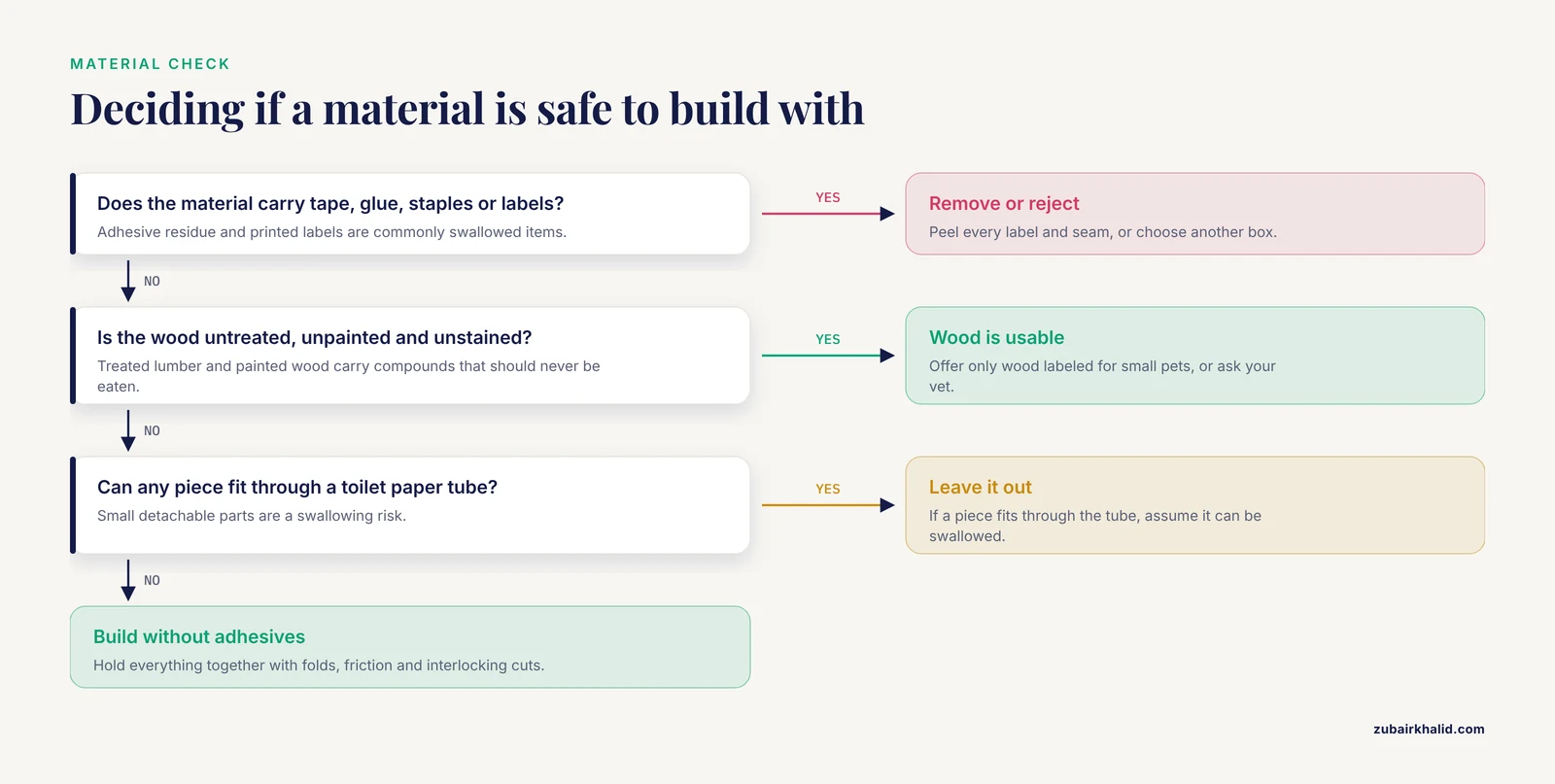
- No glue, no tape, no staples. Everything must hold together by friction, folds, or cuts alone.
- Two exits minimum on any enclosed hide or tunnel. A prey animal will not relax in a structure with one exit, and a single-exit structure increases the chance of an animal being cornered or trapped by a collapsed wall.
- Inspect daily and retire on schedule. Cardboard softens with moisture and chewing. A toy that has become wet, dirty, or torn into swallowable strips goes in the compost bin.
- Supervise first contact. The first hour with any new item tells you whether your pet shreds it safely or attacks it in a way you did not predict.
DIY Small Pet Supplies Step by Step: Seven Projects
Project 1: The Cardboard Hideout Castle
A multi-room castle is the single highest-value project you can build. It provides shelter, perching, climbing, and chewing in one structure.
Materials. Two to four cardboard boxes of different sizes, a utility knife, a cutting mat, and a ruler. Remove every staple, label, and strip of tape before starting.
Step by step.
- Choose your largest box as the ground floor. Cut two round or arched doorways on opposite walls, each slightly wider than your pet's shoulders. Two exits are non-negotiable.
- Cut windows in the upper walls so your pet can watch the room. Prey animals relax faster when they can see their surroundings from inside a hide.
- Place a smaller box on top, rotated ninety degrees, with doorways aligned so the interior connects. Cut doorways in the top box as well.
- Add cardboard ramps between levels by cutting a strip of cardboard, folding it into a gentle slope, and scoring it every few inches so it grips.
- Anchor the structure by wedging it into a corner or placing heavy hay blocks beside it. Do not weight the structure with anything your pet could chew or knock over.
- Stuff a few forage tubes into the interior rooms so the castle doubles as a foraging station.
Maintenance. Vacuum the interior weekly. Replace the entire castle when walls soften or the structure wobbles, typically every few weeks depending on how enthusiastic the chewing is.
Project 2: Hay-Stuffed Forage Tubes
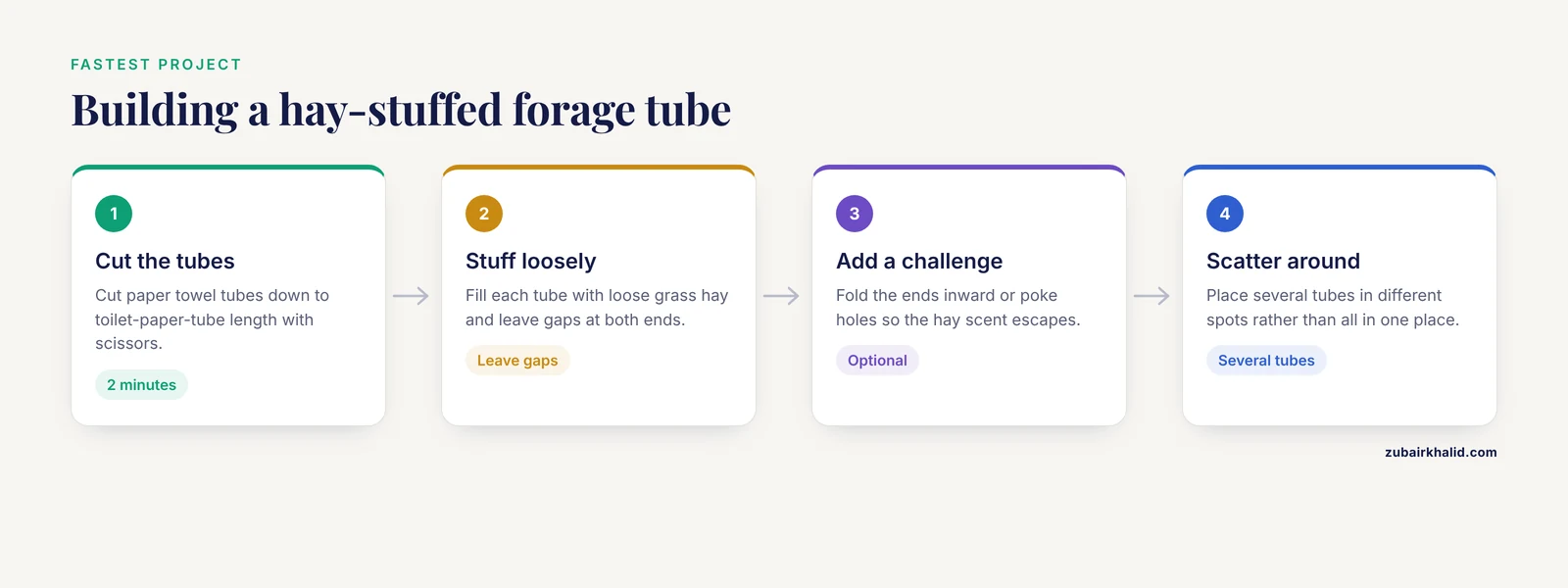
This is the fastest project in the guide and the one that gets used the most.
Materials. Empty toilet paper or paper towel tubes and loose grass hay.
Step by step.
- Cut paper towel tubes into toilet-paper-tube lengths with scissors.
- Loosely fill each tube with hay. Leave gaps so your pet can pull hay out from both ends. A packed tube frustrates animals and gets ignored.
- For an added challenge, fold the ends inward to partially close them, or poke a few holes in the sides so the hay scent escapes.
- Scatter several tubes around the enclosure rather than placing them all in one spot.
Tips. Mix a pinch of dried herbs or a few fresh herb leaves into the hay to raise interest. Remove and replace tubes once they are shredded or soiled, which for a committed chewer may be the same day you made them.
Project 3: A Cardboard Hay Feeder
Feeding hay off the floor keeps it cleaner and slows fast eaters. Commercial hay feeders work, but a cardboard version costs nothing and is fully chewable, which is actually a feature.
Materials. A small cardboard box with sides roughly as tall as your pet can reach, a utility knife, and a cutting mat.
Step by step.
- Remove all tape and labels from the box.
- Cut multiple large openings in the sides and ends, spaced a few inches apart. Openings should be wide enough for your pet to pull hay through with ease but small enough that it cannot climb inside and sit in the hay, where it would soil the feed.
- Cut a low opening on one end so your pet can reach deeper into the box as hay runs out.
- Smooth every cut edge by running your finger along it and trimming any loose flaps. Corrugated edges can shed small cardboard curls, which is fine, but long hanging strips are not.
- Pack hay firmly into the box and place it against a wall so it cannot tip.
- Refill twice a day or whenever the box runs low. Unlimited grass hay is the foundation of both rabbit and guinea pig nutrition, as the care guidance from House Rabbit Society and the Merck Veterinary Manual's exotic animal resources make clear.
Retirement. Replace the feeder when the walls get soggy, which happens faster near a water bottle or in humid weather.
Project 4: The Digging and Foraging Box
Rabbits dig. A dedicated dig box redirects that instinct away from your carpets.
Materials. A shallow cardboard box or plastic storage tray used only for this purpose, plain shredded paper, loose hay, and optional dried herbs.
Step by step.
- Fill the box one third to one half full with shredded plain paper.
- Mix in handfuls of hay so your pet forages while it digs.
- Bury a few forage tubes or a small pile of herbs in the middle to create hidden finds.
- Place the box in an area with easy cleanup, because shredded paper will travel.
- Refresh the contents weekly and discard anything damp.
Guinea pig adaptation. Guinea pigs dig less than rabbits but love burrowing through hay piles. Skip the deep paper fill and instead build a shallow hay tray with tunnels made from toilet paper tubes laid sideways through the hay.
Project 5: The Fleece Snuffle Mat
A snuffle mat hides food and herbs inside a dense field of fabric strips, turning a five-second snack into a ten-minute foraging session.
Materials. Fleece in one or two colors, scissors, and a base. The base can be a second piece of fleece, a rubber sink mat, or a plastic canvas grid. If you use any base other than fleece, inspect it constantly, because some small mammals will chew plastic.
Step by step.
- Cut the fleece into strips roughly one inch wide and four to five inches long. Fleece does not need hemming because it does not fray.
- Tie each strip onto the base with a single tight knot, working in rows until the surface is dense and no base material is visible. If you are using a fleece-on-fleece base, poke a small starter hole with scissors and push two strips through, then knot them on the underside.
- Trim any strip that hangs more than a few inches.
- Hide pieces of your pet's normal daily ration of hay-based food or fresh herb leaves between the strips.
- Roll the mat loosely at first for beginners and flatten it out as your pet learns the game.
Washing and care. Hand wash in cool water with unscented detergent and air dry. Retire the mat if strips come loose or the knots fail. Supervise early sessions to confirm your pet nibbles the fleece rather than swallowing it.
Project 6: The Braided Fleece Tug Toy
Materials. Three long strips of fleece, each about two inches wide.
Step by step.
- Lay the three strips side by side and knot them together at one end.
- Braid tightly down the full length.
- Knot the other end.
- Trim the fringe short so no loop can catch a tooth or toe.
- Tuck hay or herbs into the braid's gaps to convert it into a foraging toy.
Care. Check the braid weekly for unraveling. Fleece resists fraying but the knots can loosen with determined chewing. Wash as needed and retire the toy at the first sign of loose threads.
Project 7: The Box Tunnel Run
Tunnels satisfy the bolt-hole instinct that prey animals never outgrow.
Materials. Large cardboard boxes, a utility knife, and a cutting mat.
Step by step.
- Open both ends of each box so the interior becomes a tunnel.
- Connect boxes by cutting matching doorway openings where they meet and butting the openings together. For a more stable connection, cut short tabs along one opening and fold the tabs outward so they grip the second box from inside.
- Make the tunnel wide enough for your pet to turn around inside comfortably. A rabbit needs substantially more width than a guinea pig, so plan on the largest boxes you can get.
- Cut a few peephole windows along the top so you can check on your pet and so light and air move through.
- Anchor the run against walls or weigh the exterior sides with rolled towels.
- Add a hay layer on the tunnel floor or hide forage tubes along the route to make the run earn its keep.
Rotation. Swap which boxes face which direction each week. The novelty of a changed layout is nearly as valuable as the tunnel itself.
DIY Small Pet Supplies Tips That Make the Difference
Rotate rather than accumulate. Keep two or three items available at a time and swap them every few days. Novelty drives engagement more than quantity. A toy removed for a week returns with the appeal of something new.
Feed through the toys. Whenever possible, your pet's normal daily ration should be earned through foraging rather than delivered from a bowl. This is the single most effective behavioral intervention in small-mammal care, and every project in this guide can be converted into a feeder with a handful of hay.
Match the project to the chewer. Every species and every individual has a different destruction rate. A gentle nibbler may keep a cardboard castle for a month. A determined chewer may flatten it in an afternoon. Watch the first session and calibrate how often you rebuild.
Build to the enclosure, not the other way around. Measure your pet's enclosure and main exercise area before cutting. A castle that blocks the only open floor space reduces usable space even though it adds enrichment.
Involve scent. Small mammals communicate and explore largely by nose. Rubbing a new hide with a little hay before introduction makes it familiar immediately.
Keep a spare. Build duplicates of your pet's favorite items during a quiet weekend. When the current one gets destroyed or soiled, the replacement appears instantly, which prevents the frustration of a favorite hide vanishing overnight.
photograph your layouts. A quick phone photo of a configuration your pet loved saves you from reconstructing it from memory.
Common Mistakes to Avoid
Using tape or glue because it is faster. This is the most frequent and most dangerous mistake. A build that cannot hold together without adhesive should be redesigned with interlocking cuts and folds instead.
Single-exit hideouts. A hide with one door is a trap in your pet's mind. Prey animals need two exits and will avoid or stress inside single-exit structures.
Skipping the tape-and-label removal step. Adhesive residue and printed labels are among the most commonly swallowed items on homemade toys. Peel every label and run a finger around every seam before offering any box.
Leaving destroyed toys in place. A toy shredded into long strips becomes a thread-and-string hazard. Retire items the moment they reach that state rather than letting them linger a few extra days.
Offering unknown wood. Treated lumber, painted wood, and wood from unknown trees can all carry compounds that should never be eaten. Stick to wood products explicitly labeled for small pets, or ask your veterinarian to confirm that a specific species of wood from your yard is safe.
Replacing hay with toys. Enrichment supplements unlimited grass hay, fresh water, appropriate vegetables, and adequate space. It never substitutes for them. The Rabbit Welfare Association and Fund and House Rabbit Society both structure their husbandry guidance around hay and space first, with enrichment layered on top.
Introducing too many items at once. A dozen new objects dumped into an enclosure can overwhelm a prey animal and make it hide rather than explore. Add one item, watch the reaction, and add the next a day or two later.
Ignoring cleanliness. Cardboard absorbs urine and moisture, and damp cardboard grows mold. Any item that smells, stains, or softens from moisture goes out.
Assuming one design fits all species. Rabbits and guinea pigs differ in size, digging drive, and climbing ability. Guinea pigs have a delicate spine and poor climbing and jumping ability, so avoid any build that requires a jump or a steep ramp for them. Rabbits handle low ramps and vertical elements well.
Troubleshooting: When Your Pet Ignores Your Builds
The item sits untouched. Add food. Stuff the hide with hay, tuck herbs into the tunnel, or scatter a small portion of the daily ration inside the toy. A toy with no reward is furniture. A toy with food inside is a game.
Your pet flees from the new item. Prey animals distrust novel objects. Place the item outside the enclosure for a day so it carries the room's scent, then place it in a corner rather than the center. Never chase or place your pet onto a new item.
Your pet chews everything except the intended chew toy. Redirect by making the intended toy more interesting than the baseboard, not by punishing the behavior. Rub an herb leaf on the chew item and physically block access to the off-limits surface.
Your pet soaks or soils the cardboard. Relocate the item away from the water source and the litter corner. If the behavior continues, retire cardboard versions of that item and switch to a washable fleece or ceramic alternative for that function.
The snuffle mat is shredded in minutes. Your pet is a power chewer. Increase the braid tightness, double the fabric thickness, or switch that pet to hay-based foraging tubes, which are disposable by design.
Where DIY Fits a Complete Rabbit Care Checklist
Homemade supplies fill specific lines on a broader care plan. Use this checklist to see where each project belongs.
| Checklist Item | What It Means | DIY Solution |
|---|---|---|
| Unlimited grass hay | Available at all times, fed off the floor where possible | Box hay feeder, forage tubes |
| Fresh water | Changed daily, checked twice daily in warm weather | Not a DIY project, but position it away from cardboard |
| Hides and shelters | At least one enclosed retreat with two exits | Cardboard castle, box tunnel |
| Chewing outlets | Safe fibrous items available daily | Forage tubes, approved wood chews |
| Exercise space | Daily time in a secure area larger than the enclosure | Box tunnel run placed in the exercise pen |
| Digging outlet | A place to perform natural digging behavior | Digging box |
| Litter area | A defined corner with litter, refreshed regularly | Place the dig box far from this area |
| Daily health check | Eating, drinking, droppings, posture, and behavior observed every day | No DIY substitute, this is observation work |
A Guinea Pig Care Guide Perspective on DIY Supplies
Guinea pigs share most of the rabbit checklist with a few species-specific differences that shape your builds.
Dietary vitamin C. Unlike rabbits, guinea pigs cannot manufacture their own vitamin C and must obtain it from their diet every day. This is a standard point in exotic animal medicine, and it appears in resources such as the Merck Veterinary Manual's exotic animal section. Fresh vegetables and any supplemental source should be discussed with an exotic animal veterinarian, who can help you match the source to your pet's age and health status. DIY toys never replace this dietary requirement.
Spine and joint protection. Guinea pigs are not climbers or jumpers. Any DIY ramp should be nearly flat, and any multi-level build should have a gentle, wide ramp with sides. When in doubt, build single-level structures.
Herd behavior. Guinea pigs are highly social and are generally kept in compatible pairs or groups. Enrichment builds should include room for two animals side by side, and hideouts should have at least two entrances so a subordinate animal is never cornered by a companion.
Floor time. A larger secured area for daily movement outside the enclosure benefits guinea pigs as much as rabbits. The box tunnel run and hay tray work well as floor-time furniture.
Startle response. Guinea pigs freeze when frightened. Introduce new builds at the edge of the enclosure and let approach happen on the animal's terms.
Welfare and Supervision Points
Every DIY item lives under three conditions. First, inspection. Look at each toy daily for damage, moisture, and loose parts. Second, rotation. Swap items regularly to maintain novelty and give yourself a chance to clean them. Third, observation. Watch how your pet uses each build. A hideout used constantly is a success. A tunnel never entered may need repositioning, scent conditioning, or a redesign.
Enrichment is not decoration. It is preventive health care for the mind, and for rabbits and guinea pigs it also protects the body, because chewing and foraging keep teeth, jaws, and digestive systems active. Owners who pair good enrichment with good diet and adequate space address the most common husbandry problems these species face.
Limitations and When to Contact a Veterinarian
This article is educational and is not a substitute for veterinary diagnosis or treatment. Every animal is an individual. Age, breed, dental history, body condition, and existing illness all change what is safe for a particular pet, and a build that suits one rabbit may be wrong for another. Find a veterinarian with exotic and small-mammal experience and discuss your enclosure setup and enrichment plan during a routine visit.
Contact a veterinarian promptly, and treat the following as urgent rather than optional, if you see:
- Reduced or absent appetite, or reduced droppings. Rabbits and guinea pigs that stop eating can deteriorate quickly, and both House Rabbit Society resources and exotic animal veterinarians consistently treat loss of appetite in these species as a same-day concern.
- Changes in droppings, including very small, malformed, wet, or absent droppings.
- Drooling, dropping food, or chewing on one side, which can indicate dental disease.
- Signs of pain, such as hunching, grinding teeth, reluctance to move, or hiding more than usual.
- Any injury from a DIY item, including a caught toe, a bleeding mouth, or a suspected swallowed piece.
- Diarrhea or a soiled, wet rear end.
- Sudden behavioral change, especially a normally social animal that becomes withdrawn or aggressive.
When in doubt about a material, a build, or a behavior change, call the clinic and describe what you observed. A short phone call is far cheaper than an emergency visit.
Frequently Asked Questions
What materials are safest for DIY small pet supplies?
Plain unprinted cardboard, untreated and unpainted wood, pet-safe polar fleece, plain paper, and grass hay are the safest core materials. Avoid all adhesives, tape, staples, treated or painted wood, plastic sheeting, string, yarn, and glossy printed paper.
Is cardboard safe for rabbits and guinea pigs to chew?
Yes, plain cardboard from shipping boxes is generally safe to chew and is widely used in small-mammal enrichment. Remove all tape, staples, and labels first, inspect it daily, and remove any piece that becomes wet, soiled, or shredded into long swallowable strips.
What kind of wood can I use for homemade chew toys?
Use only untreated, unpainted, unstained wood, and preferably wood products sold specifically for small pets. Before offering any wood from your yard or a craft store, ask an exotic animal veterinarian to confirm that the specific species is safe for your pet, because safe and toxic wood lists vary and misidentification is easy.
How often should I replace homemade cardboard toys and hideouts?
Replace items as soon as they become wet, soiled, wobbly, or shredded into long strips, which for a committed chewer can be the same day. A clean, intact cardboard castle may last several weeks for a gentler animal. Let the item's condition, not the calendar, decide.
Can I use hot glue or tape on DIY small pet supplies?
No. Glue, hot glue, tape, and staples should never be used on anything a rabbit or guinea pig can chew, and these animals chew everything. Design builds that hold together through interlocking cuts, folds, and friction instead.
How do I get my pet to use a homemade foraging toy?
Put food in it. Stuff forage tubes loosely with hay, tuck fresh herbs into a snuffle mat, and bury treats in the dig box. Introduce one new item at a time in a corner of the enclosure, and let your pet investigate on its own rather than placing it onto the toy.
Are fleece liners and fleece toys safe for small pets?
Fleece is the preferred fabric for small mammals because polar fleece does not fray into long dangerous threads the way woven fabrics do. Trim loose edges short, check toys weekly for unraveling knots, wash in cool water with unscented detergent, and supervise early sessions to confirm your pet is not swallowing fabric.
Do guinea pigs need vitamin C supplements if they eat fresh vegetables?
Guinea pigs must get vitamin C from their diet every day because they cannot produce it themselves. Whether your pet's vegetable plan covers this fully, and whether a supplement is appropriate, is a decision to make with an exotic animal veterinarian based on your pet's diet, age, and health.