DIY Enrichment Ideas for Guinea Pigs and Rabbits
By Dr. Zubair Khalid, DVM, MS, PhD ·
The best DIY enrichment for guinea pigs and rabbits costs almost nothing. Stuff cardboard tubes with hay, build a maze from delivery boxes, hide fresh greens inside a paper bag, and give each animal a digging box filled with shredded paper. These projects work because they recreate three natural behaviors that small herbivores spend most of their waking hours performing in the wild: foraging for food, chewing fibrous plant material, and hiding from perceived threats.
Both species are prey animals with continuously growing teeth. An environment that offers only food in a bowl and an empty floor leaves their foraging and chewing instincts unmet, which contributes to boredom, bar biting, overgrown teeth, and obesity. The House Rabbit Society emphasizes that rabbits are highly social and intelligent animals that need daily mental stimulation and toys to chew, dig, and toss. The same logic applies to guinea pigs, which the Merck Veterinary Manual describes as social, active rodents whose wellbeing depends on appropriate diet, housing, and environmental stimulation.
This guide walks through step-by-step projects you can build today, the materials that are safe, the mistakes that send small mammals to the vet, and the daily care habits that make enrichment effective.
Enrichment at a Glance
| Project | Species | Build Time | Main Skill Encouraged |
|---|---|---|---|
| , - | , - | , - | , - |
| Hay-stuffed toilet paper tubes | Both | 2 minutes | Foraging and chewing |
| Forage box with buried greens | Both | 10 minutes | Natural food searching |
| Cardboard box maze or castle | Both | 30 to 60 minutes | Hiding, exploring, exercise |
| Digging box | Rabbits primarily | 15 minutes | Digging and burrowing |
| Crumpled paper treat bags | Both | 2 minutes | Foraging and tossing |
| Hanging vegetable line | Both | 10 minutes | Reaching and stretching to feed |
| Hay tunnel from a cereal box | Both | 20 minutes | Hiding and tunnel running |
| Untreated wood chew sticks | Both | 5 minutes | Tooth wear through chewing |
Why Enrichment Matters for Small Herbivores
Guinea pigs and rabbits share a digestive design built around near-constant grazing. Their teeth grow continuously throughout life, and their gastrointestinal tract depends on a steady flow of long-stem fiber to contract normally. The Merck Veterinary Manual notes that guinea pigs require unlimited grass hay and daily vitamin C because they cannot synthesize this vitamin themselves. Rabbits similarly need a diet built around grass hay, which the Rabbit Welfare Association and Fund identifies as the single most important component of rabbit feeding and health.
Enrichment turns those biological requirements into activity. Instead of eating a pile of hay from a rack in ten minutes, a guinea pig that must pull hay out of a stuffed tube, dig through a forage box, or stretch up to reach a hanging leaf of romaine spends far longer engaged in natural feeding behavior. This supports dental wear through prolonged chewing, encourages gut motility, burns calories, and reduces stereotypic behaviors such as cage biting and repetitive pacing.
The behavioral side matters just as much. Both species are prey animals that feel safest when they have places to hide and retreat. VCA Animal Hospitals' small mammal guidance stresses that hiding places are a core component of appropriate housing for small herbivores, not an optional accessory. A rabbit or guinea pig without a hideout lives in a state of low-grade vigilance, which suppresses normal behavior. Every DIY project in this article either adds a hiding opportunity, a foraging challenge, or a safe chewing outlet.
Safety Rules Before You Build
Follow these material rules for every project, for both species:
- Use only plain, untreated cardboard and paper. Remove tape, staples, plastic windows, and glossy printing. Ink-heavy or heavily dyed paper should be avoided. Plain brown cardboard and unprinted newsprint-style paper are the standard recommendations in small mammal care guidance.
- Never use glue, staples, or pins. Fold and interlock cardboard instead. Rabbits and guinea pigs will chew every joint, and swallowed adhesive or metal causes gastrointestinal obstruction or injury.
- Avoid cedar and untreated pine bedding or scented wood products. Aromatic oils in softwoods are associated with respiratory and liver irritation in small mammals, a caution repeated across small mammal housing guidance, including VCA Animal Hospitals' resources.
- Skip anything with small detachable parts. Eyes on stuffed toys, plastic wiggle eyes, beads, and staples can be swallowed.
- Inspect projects daily. Replace any item that is soggy, heavily chewed, or breaking apart.
- Introduce food-based enrichment in moderation. Treats and fresh vegetables used in puzzles count toward the daily diet. The Merck Veterinary Manual warns that overfeeding vegetables and treats contributes to digestive upset and obesity in guinea pigs, and the same principle applies to rabbits.
DIY Guinea Pig Enrichment Ideas, Step by Step
These projects are sized for guinea pigs but work for most rabbits with slight scaling. Each includes the materials, the build, and the reason it works.
Project 1: The Hay-Stuffed Toilet Paper Tube
Materials: Empty toilet paper or paper towel tubes, timothy or orchard grass hay.
Steps:
- Cut paper towel tubes into toilet-tube-sized sections with scissors.
- Stuff each tube loosely with handfuls of hay. Pack it tight enough that hay does not fall out, but loose enough that the animal can dig and pull.
- For guinea pigs new to foraging, leave a visible tuft of hay sticking out of both ends at first.
- As your pet improves, fold the tube ends inward to seal the hay inside, creating a puzzle the animal must chew open.
- Scatter three to five tubes around the enclosure instead of one, so foraging becomes a hunt.
Why it works: This is the cheapest possible way to convert a passive hay rack into an active foraging task. Pulling hay through a narrow opening mimics how these animals extract food from dense vegetation.
Project 2: The Forage Box
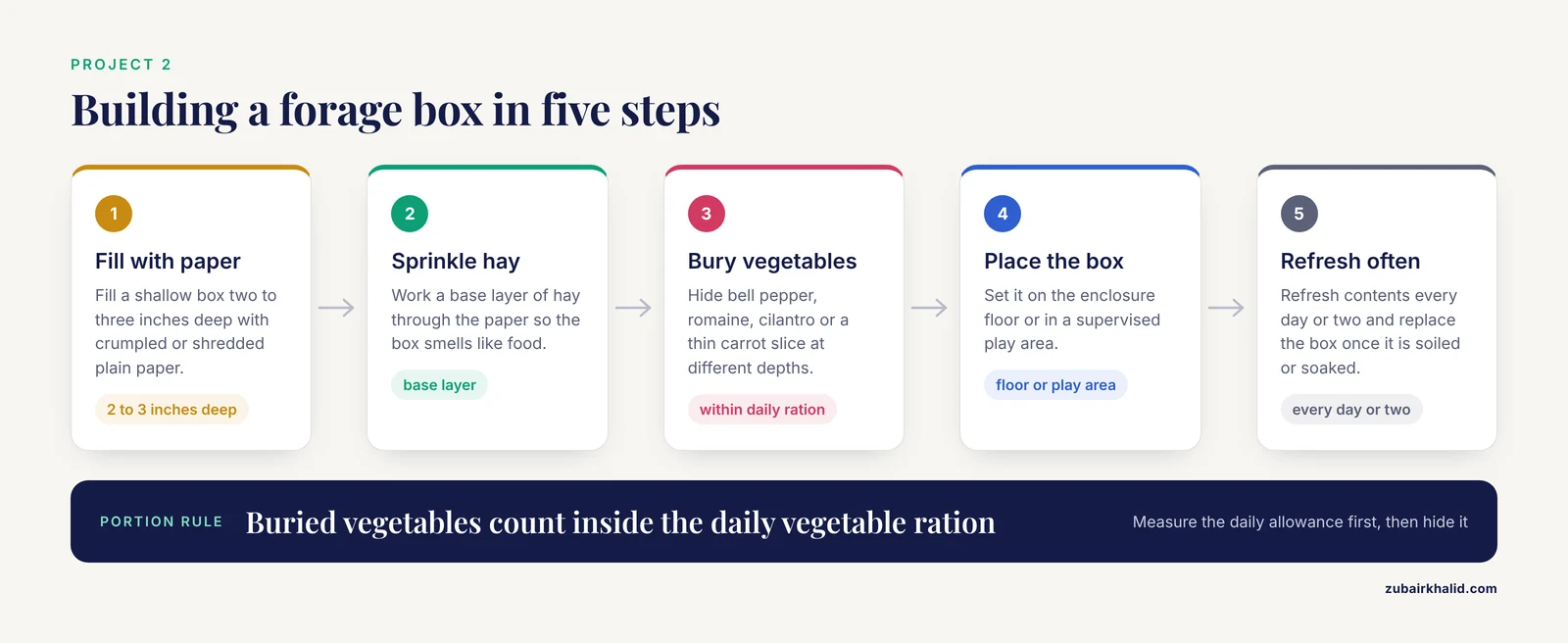
Materials: A shallow cardboard box or plastic storage tray, plain paper, unprinted shredded paper or crumpled brown paper, hay, small pieces of preferred vegetables or herbs.
Steps:
- Fill the box two to three inches deep with crumpled paper or shredded plain paper.
- Sprinkle a base layer of hay through the paper so the box smells like food.
- Bury small pieces of bell pepper, romaine, cilantro, or a thin slice of carrot at different depths. Keep the total vegetable amount within your pet's normal daily ration.
- Place the box on the floor of the enclosure or in a play area.
- Refresh the contents every day or two and replace the box when it becomes soiled or soaked.
Why it works: Searching for buried food engages scent-driven foraging, digging, and problem solving all at once. It also slows eating, which extends feeding time and supports normal gut function.
Project 3: The Cardboard Castle and Maze
Materials: Several delivery boxes of different sizes, additional flat cardboard for walls and ramps, scissors or a utility knife.
Steps:
- Close flaps on two or three boxes and cut a guinea-pig-sized doorway in each, placed low to the ground. Rabbits need larger doorways sized to their shoulders.
- Cut a second doorway in at least one box. Two exits reduce fear, because prey animals avoid structures with only one escape route.
- Connect the boxes with short cardboard tunnels cut from longer boxes, and interlock joints by cutting matching slots so no tape is needed inside chewing range.
- Add a cardboard ramp between a low platform and the floor if your animals enjoy climbing. Keep ramps shallow and textured with strips of plain paper for grip.
- Rearrange the layout every one to two weeks. Novelty is itself enriching.
Why it works: Hideouts are essential, not optional. VCA Animal Hospitals identifies hiding structures as a standard requirement in small mammal enclosures because prey species need secure retreats. A multi-chamber castle also adds floor space value in the same footprint.
Project 4: The Hanging Vegetable Line
Materials: Food-grade metal skewer or a length of untreated natural twine, leafy greens such as romaine, kale leaves, or herbs, a clip or safe anchor point.
Steps:
- Thread leaves of washed, drained greens onto the skewer or twine, spaced so the animal must work at each leaf.
- Hang or clip the line so the food sits at head height or slightly above. Rabbits will stretch up onto their hind legs, which is healthy exercise.
- Keep the hanging height modest so the animal never strains or has to jump dangerously.
- Remove any wilted leftovers within a few hours.
Why it works: Feeding at height and in motion encourages natural reaching and pulling behavior and slows consumption of high-water vegetables.
Project 5: The Hay Tunnel From a Cereal Box
Materials: A tall cereal or cracker box, plain cardboard, hay.
Steps:
- Cut off the top and bottom of the box to create an open-ended tunnel.
- Cut two or three small peek holes in the sides.
- Pack the inner walls loosely with hay by wedging it into the box's folds, or line the floor with a thick hay layer.
- Place the tunnel in the enclosure and refresh the hay daily.
Why it works: A tunnel that is also food satisfies hiding and foraging in one object, and it is fully disposable when chewed through.
DIY Enrichment Toys for Rabbits and Guinea Pigs Shared by Both Species
Some projects scale cleanly across both animals, and these are the workhorses of a rotation system.
The Crumpled Paper and Bag Treat Cache
Place a small handful of hay and one piece of vegetable inside a plain paper lunch bag. Crumple the top loosely and set the bag on its side in the enclosure. Rabbits in particular will toss, shred, and flatten the bag, which House Rabbit Society enrichment guidance identifies as normal playful chewing and digging behavior. Guinea pigs will tunnel in from the open end. Use one bag per animal per day at most, and treat it as part of the daily food allowance rather than an addition to it.
The Stuffed Ball Feeder
Take a plain paper tube, fold one end closed, add a teaspoon-sized portion of pellets or a few hay-based treats, then fold the other end. Guinea pigs will push and gnaw the tube to extract the contents. Because pellets are calorie-dense, keep the portion small. The Merck Veterinary Manual cautions that pellet overfeeding is a common driver of obesity and selective eating in small herbivores, with hay and fresh vegetables forming the bulk of the diet.
The Cardboard Dig and Chew Tray
Fill a low cardboard tray with shredded plain paper, hay, and a few dried Timothy-based chew pieces. For rabbits, deepen the tray to six inches or more, since digging is a core rabbit behavior. House Rabbit Society resources note that rabbits dig naturally and need a legal outlet for the behavior, or they will dig carpets and furniture instead. For guinea pigs, keep the tray shallower and add tunnels to push through.
The Untreated Wood Chew Station
Rabbits and guinea pigs both need chewing outlets beyond hay. House Rabbit Society guidance on rabbit chewing lists untreated apple and willow branches as safe chew material when sourced from trees not treated with pesticides, washed, and fully dried before use. Bundle two or three short branches with plain paper twine or lean them against the cage wall so the animal can gnaw at an angle. Replace them when bark is stripped and wood is splintered heavily.
Rabbit-Specific DIY Projects
Rabbits bring extra drives to the table. They dig, they throw, they chew larger volumes, and they use vertical space more boldly than guinea pigs. The Rabbit Welfare Association and Fund emphasizes that rabbits need constant access to hay, secure hiding places, and enough space to perform normal movements such as standing fully upright and hopping in a straight line.
The Rabbit Digging Pit
- Select a large cardboard box or an under-bed storage tray.
- Fill it with shredded plain paper, hay, or a mix of both. Some owners use plain topsoil or child-safe sand in a covered outdoor area, but paper and hay are the simplest indoor options.
- Bury a few treats or dried forage pieces at the bottom.
- Place the pit in the rabbit's exercise area and refresh the filling weekly.
- Expect mess. Position the pit away from food and water bowls and sweep daily.
The Bunny Obstacle Course
Rabbits benefit from low jumps and tunnels that encourage full-body movement. The Rabbit Welfare Association and Fund recommends environments that allow rabbits to stretch, stand, and move freely, and regular exercise outside the primary enclosure.
- Lay two short cardboard tunnels end to end with a gap between them.
- Prop a broom handle or sturdy cardboard tube across two low, stable boxes to create a jump no more than a few inches high.
- Lure the rabbit through the course with a forage box at the finish line.
- Never force a rabbit through the course. Let curiosity drive participation.
The Toss-and-Shell Toy
Rabbits throw objects with their teeth. A small willow ball, a rolled paper log, or a baby-size stainless steel bell toy without small parts gives this behavior an outlet. House Rabbit Society notes that toys satisfying the urge to throw and chew reduce destructive behavior directed at baseboards and furniture.
Daily and Weekly Routine: Care Checklist Context
Enrichment works only inside a foundation of good husbandry. The lists below reflect standard small mammal care guidance from the Merck Veterinary Manual, VCA Animal Hospitals, and the Rabbit Welfare Association and Fund.
Every day:
- Unlimited fresh grass hay, topped up and checked for freshness
- Fresh water, rinsed and refilled
- Measured pellets appropriate to body size
- Fresh vegetables in appropriate amounts, with daily vitamin C sources for guinea pigs, which cannot produce their own vitamin C
- One or two enrichment items rotated in and old ones removed
- Spot-clean soiled bedding and remove droppings under hay feeders
- Time outside the enclosure or in a larger exercise area, supervised
- A quick visual health check, including appetite, droppings, eyes, nose, and coat
Every week:
- Full bedding or litter change
- Wash food bowls, water bottles, and hideouts
- Inspect and discard chewed or damaged enrichment items
- Rearrange the enclosure layout for novelty
- Weigh your pet if possible, since gradual weight change is an early sign of dental or digestive disease
Every month:
- Deep clean the full enclosure
- Check teeth, nails, and coat condition, or have these assessed at a wellness visit
- Reassess whether your enrichment rotation still holds your pet's interest
DIY Enrichment Tips That Make Projects Work
- Rotate, do not accumulate. Keep two or three items in use and swap them every few days. Animals habituate quickly to objects that never change.
- Make food work before every meal. Place the daily vegetable portion inside a forage box or paper bag instead of a dish at least once a day.
- Start easy. A guinea pig that has never foraged will ignore a fully sealed tube. Leave food visible the first week and increase difficulty gradually.
- Watch preferences. Some guinea pigs ignore digging but love hay tunnels. Some rabbits ignore balls but shred paper obsessively. Build around the behaviors your individual animal already shows.
- Add scent variety through food, not products. Different safe herbs and leafy greens vary the sensory experience. Avoid essential oils and scented products near small mammals, whose respiratory tracts are sensitive.
- Pair enrichment with social time. Both species are social, and House Rabbit Society stresses that companionship and interaction are themselves enrichment for rabbits. Guinea pigs are similarly social and are best kept in compatible pairs or groups per standard small mammal guidance.
- Keep the floor interesting. Most enclosure floors are flat and featureless. Tunnels, low platforms, and texture changes such as a grass mat convert floor space into an environment.
- Supervise new projects. Watch the first session with any new item to confirm your pet interacts with it safely.
Common Mistakes to Avoid
Using taped or glued construction. Owners often assemble elaborate cardboard structures with packing tape and hot glue. Once chewing reaches the joints, the animal ingests adhesive or plastic. Fold-and-slot construction solves this.
Treating enrichment as extra calories. Stuffing tubes with high-sugar fruits or adding treat balls on top of the normal ration causes weight gain. The Merck Veterinary Manual identifies obesity and inappropriate diets as significant problems in pet guinea pigs, and rabbits face the same risk. Every food-based project must subtract from something else.
Overfeeding vegetables to make puzzles fun. Loose leaf lettuce volumes can exceed appropriate vegetable portions, leading to soft stools or digestive upset. Measure the daily vegetable allowance first, then hide it.
Using cedar or strongly scented pine products. Scented wood shavings and cedar-filled toys expose small mammals to aromatic hydrocarbons linked with respiratory irritation, a warning repeated in VCA Animal Hospitals' small mammal care resources.
Skipping hay. No toy replaces hay. Unlimited grass hay must remain the dietary base for both species. Enrichment that substitutes treats for hay undermines gut and dental health.
Leaving items in until they disintegrate. A tube reduced to soggy shredded pulp, or a box soaked in urine, becomes a hygiene problem. Set a replacement schedule.
Providing a single-exit hideout. Prey animals avoid refuges they cannot escape from. Always cut two openings.
Assuming one size fits all. Rabbit-sized openings must accommodate a rabbit's shoulders and whiskers. Guinea pig projects built for rabbits can frustrate smaller animals, and guinea-pig-sized items may trap a larger rabbit.
Forcing interaction. Chasing a guinea pig to place it in a play tunnel teaches fear. Enrichment is voluntary by definition.
Ignoring the enclosure itself. A toy in an undersized cage is decoration. Both species need floor space that permits normal movement, with rabbits requiring enough room to stand and hop, per Rabbit Welfare Association and Fund housing guidance.
Troubleshooting Common Problems
My pet ignores the project. Lower the difficulty. Leave food visible for a few days, then bury it slightly deeper each session. Scent a new forage box by rubbing a used hay tuft across the paper.
My rabbit shreds everything instantly. That is success, not failure. Provide multiple duplicates of cheap items, or move to sturdier materials such as thick double-wall cardboard and untreated wood.
My guinea pig freezes when I add new items. Prey animals fear novelty. Introduce one item at a time, placed at the enclosure edge rather than the center, and let the animal approach in its own time.
Two animals fight over enrichment. Duplicate every food-based item so each animal has one. Resource guarding over treats is common in groups and duplicate items prevent most conflicts. If aggression persists between bonded animals, discuss introductions and separation strategies with a veterinarian familiar with small mammals.
My pet only wants the treat inside and destroys the rest. Reduce the treat size and increase the hay content. The goal is foraging behavior, not reward extraction.
Someone chewed and swallowed a piece of plastic or tape. Contact a veterinarian promptly. Gastrointestinal foreign bodies are emergencies in rabbits and guinea pigs, and a drop in fecal output is the key warning sign.
Limitations and When to Contact a Veterinarian
This article describes general husbandry and enrichment practices drawn from recognized small mammal care resources. Individual animals vary, and a veterinarian with exotic pet experience should evaluate any specific health concern, diet plan, or housing decision for your animal.
Contact a veterinarian promptly if you notice any of the following, because rabbits and guinea pigs deteriorate quickly once illness is visible:
- Reduced appetite, or refusal to eat hay for more than several hours
- No fecal droppings for more than 8 to 12 hours, or markedly smaller and fewer droppings
- Drooling, wet chin, or difficulty chewing, which suggests dental disease requiring professional examination
- Lethargy, hunching, hiding far more than usual, or reluctance to move
- Diarrhea, or soft stools stuck to the fur
- Sneezing, nasal discharge, labored breathing, or crackling sounds, since respiratory disease is common and serious in small mammals
- Scratches, wounds, or broken nails from enrichment items
- Any suspicion that a foreign object was swallowed
- Sudden behavior change, including aggression or withdrawal, which can signal pain
Annual wellness examinations with a veterinarian experienced in rabbits and guinea pigs are the standard of care, and any new dental, weight, or digestive findings should shape which enrichment projects you use.
This article is educational and is not a substitute for veterinary diagnosis or treatment.
Frequently Asked Questions
What are the easiest DIY guinea pig enrichment ideas to start with?
Hay-stuffed toilet paper tubes and crumpled paper treat bags take under five minutes each and need nothing but cardboard, hay, and paper. Start with those two, then add a forage box once your guinea pig shows interest.
How often should I rotate DIY enrichment toys?
Rotate items every two to four days. Keep two or three projects in use at a time, remove worn or soiled items daily, and rearrange the enclosure layout weekly for added novelty.
Are cardboard and paper safe for rabbits and guinea pigs to chew?
Plain, untreated cardboard and unprinted paper are safe in small amounts and are widely recommended chew and foraging materials. Remove tape, staples, glossy coatings, and heavily dyed print, and discard items that become soggy or heavily shredded.
What wood is safe for DIY chew toys?
Untreated apple and willow branches are commonly recommended chew woods for rabbits when they come from pesticide-free trees and are washed and dried before use. Avoid cedar and strongly scented softwoods, which carry respiratory risks for small mammals.
Can enrichment replace daily exercise time outside the cage?
No. Enrichment enriches the enclosure, but both species still need supervised time in a larger exercise area where they can run, stretch, and hop. Housing guidance from rabbit welfare organizations emphasizes regular free movement in addition to a well-furnished enclosure.
How do I use food in enrichment without causing weight gain?
Treat the food inside puzzles as part of the daily ration, not an addition. Measure the daily pellet and vegetable allowance first, then place portions inside forage boxes and tubes. Keep unlimited grass hay as the dietary base for both species.
Why does my guinea pig need vitamin C in enrichment foods?
Guinea pigs cannot synthesize vitamin C and must consume it daily to prevent deficiency disease, a point the Merck Veterinary Manual highlights as central to guinea pig nutrition. Using bell pepper, kale, and other vitamin C-rich vegetables inside foraging projects feeds this requirement while adding mental stimulation.
What signs tell me an enrichment item is unsafe?
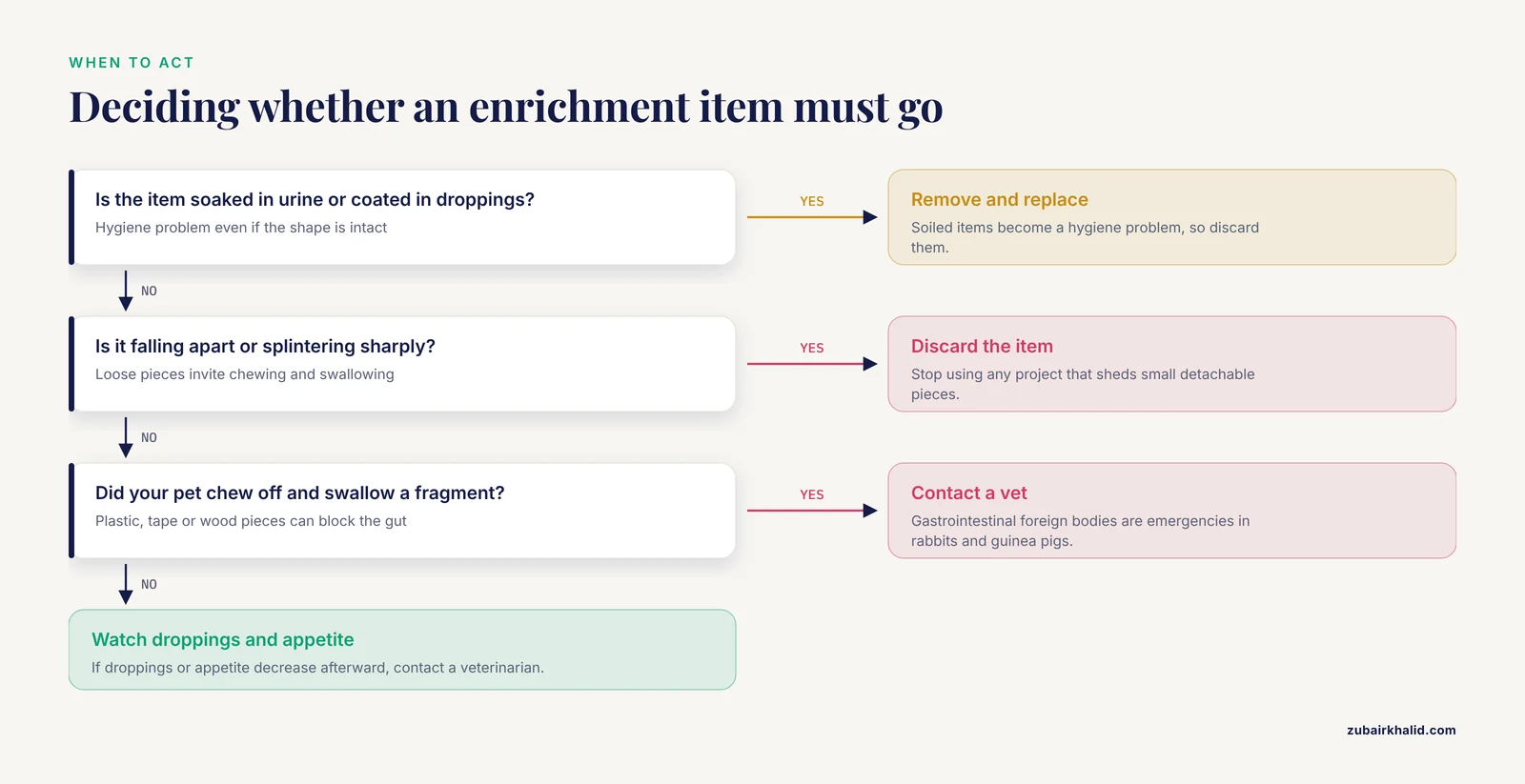
Discard any item that is soaked in urine, falling apart, splintering sharply, coated in droppings, or shedding small detachable pieces. Stop using any project immediately if your pet chews off and swallows fragments, and contact a veterinarian if droppings or appetite decrease afterward.