Chinchilla Care Guide: Daily, Weekly, and Monthly Routine
By Dr. Zubair Khalid, DVM, MS, PhD ·

A solid chinchilla care routine comes down to three layers. Daily, you provide fresh water, constant hay, a measured pellet ration, a visual health check, and time to observe your pet's behavior. Weekly, you clean soiled areas of the enclosure, inspect equipment, weigh your chinchilla if your veterinarian has advised it, and check enrichment items for wear. Monthly, you deep clean the entire enclosure, reassess cage size and complexity, and review your supplies and veterinary plan.
Chinchillas are long-lived rodents with specific needs that differ sharply from rabbits and guinea pigs. Research on pet chinchilla husbandry shows that most caretakers meet basic needs such as companionship, constant water and hay access, and dust baths, but undersized enclosures and single housing remain common welfare problems [1]. This guide turns that evidence into a practical schedule you can follow, whether you are learning how to take care of a chinchilla for the first time or tightening an existing routine.
This article is educational and is not a substitute for veterinary diagnosis or treatment.
Chinchilla Care at a Glance
Use this checklist as the skeleton of your chinchilla care routine. Each task is expanded in the sections below.
| Frequency | Task | Key point |
|---|---|---|
| Daily | Refresh water | Constant access, watch intake for changes [2] |
| Daily | Check and top up hay | Hay should be available constantly [1] |
| Daily | Feed measured pellets | Nutrition drives long-term disease risk [3] |
| Daily | Visual health and behavior check | Behavior is the earliest warning system [4] |
| Daily | Offer dust bath per your veterinarian's schedule | Dust bathing is a core chinchilla need [1] |
| Daily | Social time and observation | Companionship and interaction track with welfare [1] |
| Weekly | Remove soiled bedding and droppings | Spot cleaning keeps ammonia and moisture down |
| Weekly | Inspect cage, shelves, and wheels for damage | Escape gaps and broken hardware cause injury |
| Weekly | Rotate and check chew items and enrichment | Enrichment counters barren housing problems [5] |
| Monthly | Full enclosure deep clean | Complete bedding change and disinfection |
| Monthly | Reassess cage size and complexity | Larger, more complex housing lowers fearfulness [6] |
| Monthly | Review supplies, food stock, and vet plan | Schedule wellness visits before problems appear |
Understanding Your Chinchilla's Natural Rhythm
Before building a schedule, you need to know when your chinchilla is actually awake. Time-budget studies on chinchillas found that they spent roughly 68 percent of the day resting, about 23 percent in locomotion, and the remainder eating and performing other behaviors [6]. In practical terms, your chinchilla will sleep through much of the day and concentrate feeding, exploration, and play into discrete active periods.
This has direct scheduling consequences. Place the routine's noisy tasks, such as full cage cleaning and vacuuming, at times your chinchilla is naturally settling rather than mid-activity. Offer the dust bath and fresh food during or just before active periods so the animal can use them. Handle and interact during the active window, because waking a sleeping chinchilla repeatedly for handling builds avoidance and fear responses.
Cage environment also shapes behavior. In a study comparing standard cages with enlarged, deep-litter housing, chinchillas in the larger, more complex cages showed significantly less timid behavior toward humans [6]. Your routine should therefore include a monthly review of the enclosure itself, not just its cleanliness.
The Daily Chinchilla Care Checklist
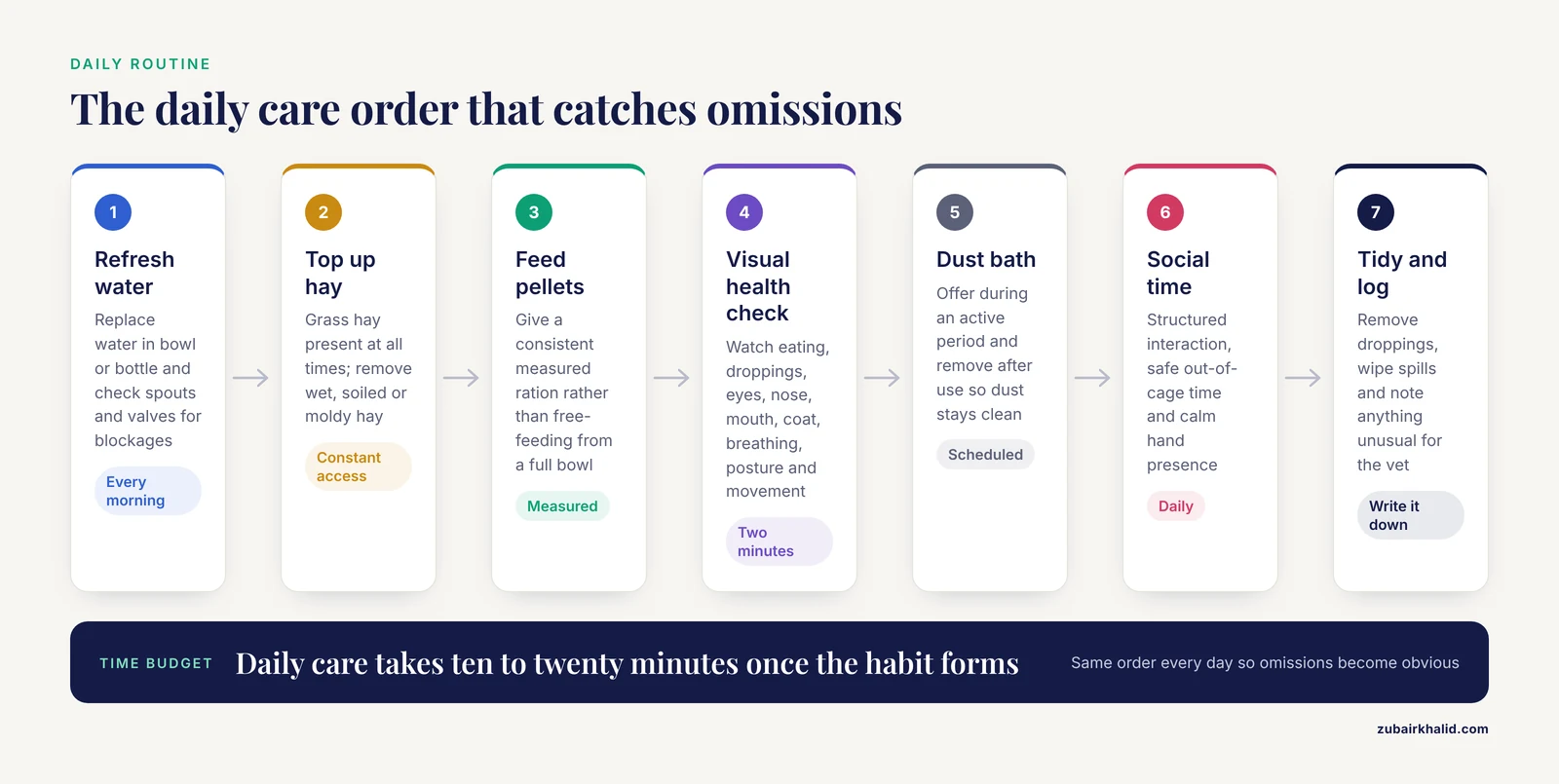
Daily care takes ten to twenty minutes once the habit forms. Work through the same order every day so omissions become obvious.
1. Refresh Water Every Morning
Chinchillas need constant access to water, and in the pet chinchilla survey, continuous water availability was among the basic needs most caretakers fulfilled [1]. Provide water in a heavy bowl or a bottle, check both spouts and valves for blockages, and replace the water rather than just topping up.
Water intake is also a health signal. Research on small mammal water consumption, including chinchillas, found wide species-related variation in uptake, and showed that water intake is interlinked with feed intake and influenced by factors such as ambient temperature and the minerals the kidneys must excrete, including calcium. Adequate water supply is described as indispensable for health, including prophylaxis of urolithiasis [2]. Because there is no single universal number, learn your own chinchilla's baseline. A marked increase or decrease in drinking is a reason to call your veterinarian, not a problem to wait out.
2. Keep Hay Constantly Available
Grass hay should be present at all times. Constant hay access was one of the basic needs fulfilled by most caretakers in the pet chinchilla survey [1], and chinchillas in behavioral studies spent a meaningful share of each day eating [6]. Remove hay that has become wet, soiled, or moldy, and store your bulk hay in a dry, pest-proof container so the daily top-up is genuinely fresh.
3. Feed a Measured Pellet Ration
Offer a consistent, measured amount of chinchilla-specific pellets each day rather than free-feeding from an overflowing bowl. The veterinary literature on guinea pig and chinchilla husbandry emphasizes nutrition and the potential for disease on poor diets [3]. Treat pellets as the concentrated component of the diet and hay as the bulk. Discuss the exact daily pellet quantity for your chinchilla's weight and life stage with an exotics veterinarian, because appropriate amounts vary with age, body condition, and reproductive status.
Foods outside this pattern, including sugary treats and large amounts of fruit, do not fit the feeding pattern described in the husbandry literature and are a common way well-meaning owners create digestive problems [3]. If you want to offer something extra, raise it at your next veterinary visit rather than experimenting.
4. Run the Visual Health Check
Spend two minutes watching your chinchilla from a short distance and then, if the animal tolerates it, looking at it in the cage. Check for:
- Eating behavior and normal chewing
- Droppings that look normal in size and number
- Eyes, nose, and mouth free of discharge or drooling
- Coat condition, including any patches of damaged or chewed fur
- Breathing that is quiet and unlabored
- Posture and movement that look fluid rather than stiff or hunched
This check matters because chinchillas are small prey animals that mask illness. Behavioral indicators are the tool small mammal owners themselves most commonly rely on to detect changes in health and welfare at home, according to a survey of small mammal owners mapped against the Five Domains welfare model [4]. Daily observation is what makes that indicator system work.
5. Provide the Dust Bath
Dust bathing is a species-typical behavior and a recognized basic need. In the survey of pet chinchilla caretakers, offering dust baths was among the needs most often met [1]. Give the dust bath during an active period, in a container large enough for the animal to roll in, and follow the frequency and duration your exotics veterinarian recommends for your climate and humidity. Remove the bath after use so the dust stays clean and is not fouled with droppings or used as a litter area.
6. Social Time and Observation
Chinchillas are social animals. In the pet caretaker survey, behaviors considered indicators of good welfare, such as playing with conspecifics and cuddling with them, were observed multiple times per day in many households [1]. Caretakers who felt closer to their animals also spent more time engaging with them [1]. If your chinchilla lives alone, daily structured interaction, out-of-cage time in a chinchilla-safe room, and calm talking and hand presence are part of the care routine, not optional extras.
7. Tidy, Then Log
Before you walk away, remove visible droppings from shelves and fleece, wipe any spilled water, and jot down anything unusual in the health check. A simple note on your phone creates the baseline a veterinarian will ask for if illness develops.
Weekly Chinchilla Care Tasks
The weekly layer catches what daily tidying misses and inspects the physical environment before problems escalate.
Partial Clean and Hygiene
Remove and replace heavily soiled bedding, wipe shelf surfaces, and clean or swap litter areas. Keeping moisture and waste accumulation down protects both respiratory health and coat condition. The exact substrate and cleaning products should match what your veterinarian recommends, since chinchillas are sensitive to strong fumes. Rinse thoroughly after any cleaning product and let surfaces dry completely before returning your pet.
Equipment Inspection
Go over the enclosure hardware weekly:
- Check bars, welds, and latches for gaps or breakage
- Test shelves and ledges for wobble
- Examine exercise wheels for loose parts and rough seams
- Inspect water bottles for leaks and nipples for flow
- Confirm chew items are intact and not frayed into threads that can snag teeth or toes
Enrichment Rotation
Barren environments are a documented welfare problem for chinchillas. In the EFSA scientific opinion on chinchilla welfare in farming systems, restriction of movement, inability to perform exploratory or foraging behavior, and sensory under- and overstimulation were selected as the most relevant welfare consequences, with hazards tied to cage size and barrenness [5]. A weekly rotation of safe wooden chew items, tunnels, and platforms keeps the environment from going stale and supports natural chewing and exploratory behavior.
Weight and Condition Check
If your veterinarian has taught you how to handle your chinchilla safely and has recommended a weigh-in schedule, weigh the animal weekly at the same time of day and record the number. Unexplained weight change in a small herbivore is always worth a phone call. Handling technique itself is a learned skill covered in the veterinary husbandry literature, which describes safe handling approaches for chinchillas [3]. Ask your veterinarian to demonstrate at a wellness visit before you begin regular at-home weighing.
Deeper Behavior Review
Once a week, look back over your daily notes for patterns rather than one-off events. Fur biting, for example, was reported as never occurring in the majority of pet chinchillas in one large survey, which means that new fur chewing in your animal stands out as a genuine change worth investigating [1]. Repetitive and unwanted behaviors are considered welfare indicators, so a pattern that appears over a week of observations justifies a veterinary conversation [1].
Monthly Chinchilla Care Tasks
Full Deep Clean
Once a month, move your chinchilla to a safe temporary enclosure, remove all bedding and accessories, and clean the entire cage. Wash plastic and metal accessories with hot water and a pet-appropriate disinfectant, rinse thoroughly, and dry fully. Replace all substrate. Clean the area around and under the cage as well, because spilled hay and dust accumulate there.
Reassess Cage Size and Complexity
Monthly is the right cadence to ask whether the enclosure still meets your chinchilla's needs. The evidence here is consistent. In the pet caretaker survey, undersized cages or enclosures were reported by more than a quarter of respondents, and keeping chinchillas individually was another identified welfare issue [1]. In the farmed-chinchilla study, animals in enlarged cages with deep litter showed significantly less timid reactions to humans than animals in standard cages [6]. And the EFSA opinion identified cage size and barrenness as central hazards behind the most relevant welfare consequences in chinchillas [5].
Practically, this means that as your chinchilla matures or as your budget allows, upgrading to a larger multi-level enclosure with solid flooring areas, deep litter, shelves at different heights, and space for genuine locomotion is one of the highest-impact changes you can make. A study of small mammal owners found that the availability of suitable enclosures was the primary barrier to good housing provision, while most owners were willing and able to provide high welfare [4]. Planning the upgrade as a monthly budget line turns that barrier into a timeline.
Restock and Review
Check your stores of hay, pellets, dust bath product, and substrate. Rotate out any chew items that are nearly destroyed. Review your veterinary records and confirm when the next wellness examination is due.
Home Welfare Audit
Once a month, walk through the same questions a welfare assessor would ask:
- Is my chinchilla housed with or near appropriate companions, and is that arrangement working peacefully?
- Does the enclosure allow real movement, climbing, and choice of resting spots, [5]?
- Are feeding, water, and dust bathing consistently provided [1],?
- Do I see positive welfare behaviors, such as play and relaxed social contact, on a typical day [1]?
- Have any repetitive or fearful behaviors appeared or increased [1]?
Housing Fundamentals Behind the Routine
Understanding why each task exists makes the routine easier to sustain. Several points from the research deserve emphasis for anyone learning how to take care of a chinchilla.
Companionship is a basic need, not a bonus. Keeping chinchillas with conspecifics was listed among the basic needs in the pet caretaker survey, and positive social behaviors like cuddling were observed several times per day in many homes [1]. Individual housing occurred in a meaningful minority of households and was flagged as a welfare concern [1]. Pair or group housing must be done carefully and with veterinary or experienced-breeder guidance on introduction and sexing, because inappropriate pairings lead to fighting and unplanned breeding. The veterinary literature specifically covers sexing and reproductive physiology in these species [3], which makes a pre-adoption veterinary consult genuinely useful.
Floor space and complexity reduce fear. Enlarged, deep-litter housing measurably reduced timid reactions toward humans in controlled study conditions [6]. A routine that includes monthly evaluation of enclosure size is therefore not cosmetic, it is behavioral medicine.
Foraging and exploration need outlets. The EFSA welfare analysis identified inability to perform exploratory or foraging behavior as one of the most relevant welfare consequences for chinchillas in restrictive systems [5]. Scattering appropriate foraging opportunities and rotating chew and climb items in your weekly routine directly addresses this.
Water and diet are linked. Because water and feed intake are interlaced in small mammals, and because calcium excretion and ambient conditions influence drinking, monitoring both together gives you a better picture than monitoring either alone [2].
Common Mistakes in a Chinchilla Care Routine
Most problems that reach exotic veterinarians trace back to a handful of routine failures.
- Free-feeding pellets and sugary extras. Poor diets carry disease risk in guinea pigs and chinchillas alike [3]. Measure the ration and keep treats out of the daily routine.
- Housing a chinchilla alone by default. Individual keeping was one of the identified welfare issues in the pet survey [1]. If you keep a single animal, compensate with substantial daily interaction and discuss whether a companion is appropriate for your animal with your veterinarian.
- An undersized or barren cage. Undersized enclosures were common in the survey [1], and barren restrictive housing drives the welfare consequences identified by EFSA [5].
- Skipping the daily behavior check. Owners rely heavily on behavioral indicators to assess welfare [4]. Without a daily baseline, the first obvious sign of illness is often the last chance for early treatment.
- Leaving the dust bath in permanently. Dust bathing is essential [1], but a permanently available bath becomes a toilet and the dust loses quality. Treat it as a scheduled activity.
- Ignoring water intake changes. Water uptake varies by species and individual, and abnormalities can signal disease or serve as a substitute behavior, so a change in drinking pattern is a genuine clinical signal [2].
- Cleaning with harsh products or strong fumes. Clean thoroughly but rinse and dry completely, and keep the animal out of the room while fumes dissipate.
Troubleshooting Routine Problems
My chinchilla hides when I approach. Some timidity is normal, and cage type influences it, with animals in larger, more complex housing showing less fearful reactions to humans [6]. Slow down your approach, offer interaction during active periods, and audit whether the enclosure gives your chinchilla hiding options and vertical complexity.
Fur is looking chewed or patchy. Fur biting was uncommon in the surveyed pet population but is recognized as a repetitive unwanted behavior linked to welfare [1]. Review housing size, enrichment, social situation, and stressors, and book a veterinary exam to rule out medical causes.
My chinchilla is drinking much more or much less. Water intake in small mammals is influenced by diet, temperature, and kidney solute load, and abnormal intake can reflect behavioral or medical problems [2]. Call your veterinarian with your notes on baseline intake.
The pair I keep together has started squabbling. Social housing supports welfare when it works [1], but conflict requires separation and a plan. Ask your veterinarian for help with sexing, re-pairing, and housing strategy, since reproductive physiology in this species is distinctive and described in the veterinary literature [3].
My routine keeps slipping. The research on small mammal owners found that owners generally had the capability and motivation to provide good welfare, and that opportunity, especially access to suitable enclosures, was the main barrier [4]. Build the routine into anchored daily moments, such as feeding times, and put the monthly tasks on a calendar reminder rather than relying on memory.
Limitations and When to Contact a Veterinarian
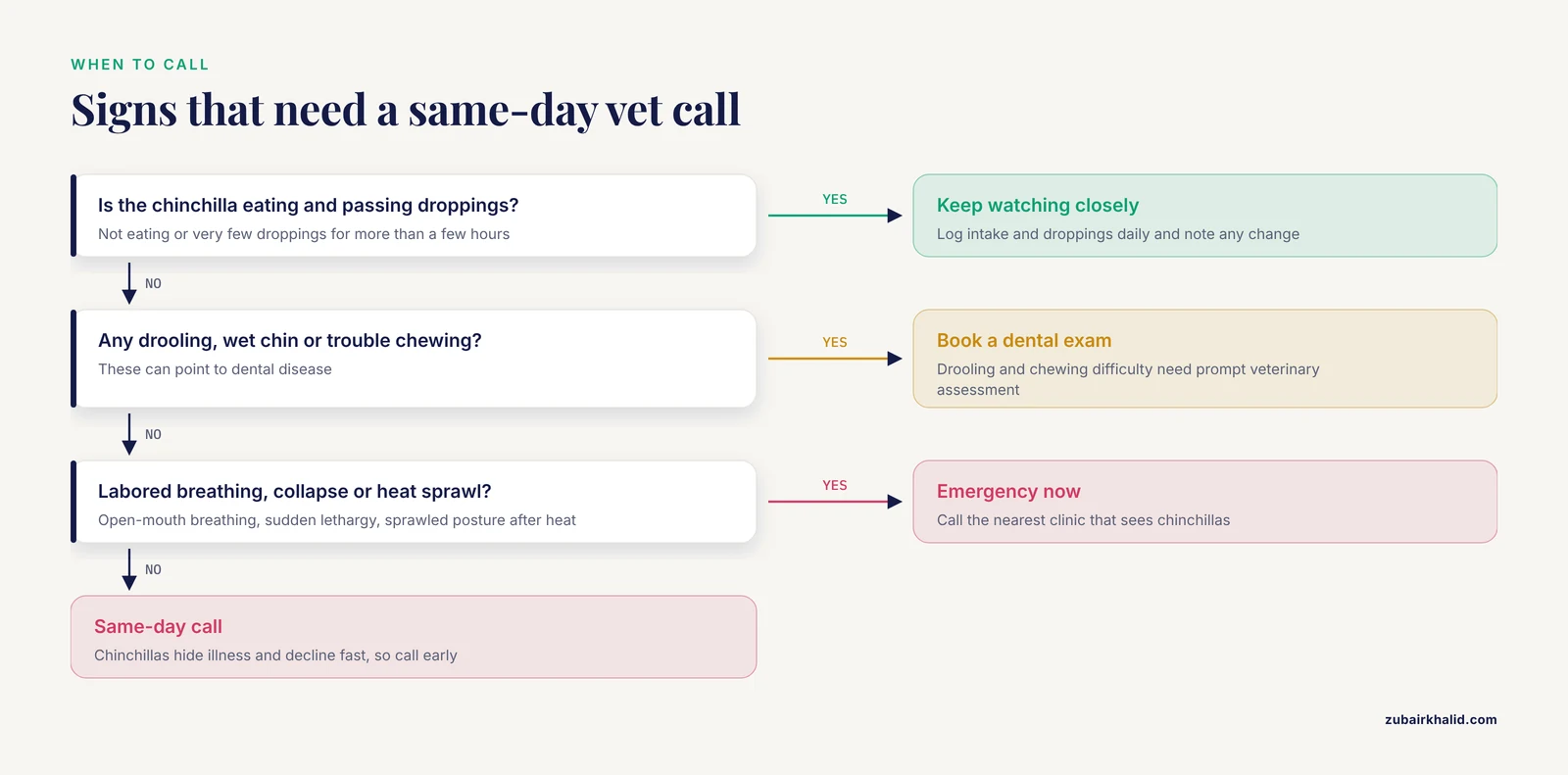
This article describes a general care structure for healthy adult pet chinchillas. Individual animals vary in age, health status, reproductive state, and temperament, and every specific question about diet quantities, dust bath frequency, cleaning products, housing dimensions, and companionship decisions should be answered by a veterinarian with exotic pet experience. General resources such as the Merck Veterinary Manual and VCA Animal Hospitals offer useful background on exotic pets, but they do not replace an examination of your animal.
Contact your veterinarian promptly, and treat the following as urgent rather than watch-and-wait situations:
- Not eating or reduced pellet and hay intake over any period longer than a few hours
- No or very few droppings, or droppings that are dramatically smaller or misshapen
- Drooling, wet chin, or difficulty chewing, which can indicate dental disease
- Labored breathing, open-mouth breathing, or audible respiratory noise
- Sudden lethargy, collapse, or unresponsiveness
- Diarrhea or markedly wet or soiled bedding around the perineum
- Bleeding, an injured limb, or refusal to move
- Signs of overheating, such as sprawled posture with rapid breathing after heat exposure
- A sudden increase or decrease in water intake [2]
- New or worsening fur chewing, self-injury, or repetitive behavior [1]
- Any eye or nasal discharge, swelling, or wound
Chinchillas are prey species that deteriorate quickly once they show obvious illness, so a same-day call is the right response to any of the items above. Ask your regular veterinarian whether they treat exotics, and identify the nearest emergency clinic that sees chinchillas before you need it. General small animal clinics may not, and resources such as the Merck Veterinary Manual and VCA Animal Hospitals can help you prepare questions to ask a prospective exotics veterinarian.
Frequently Asked Questions
How often should I give my chinchilla a dust bath?
Offer a dust bath on a regular schedule during your chinchilla's active period, and remove it after the session so it stays clean. Dust bathing is a recognized basic need for the species [1], and your exotics veterinarian can help you set the right frequency for your home's humidity and your animal's coat condition.
What should a chinchilla eat every day?
Feed constant grass hay, a measured daily ration of chinchilla pellets, and fresh water. Constant hay access and clean water are among the core needs identified in pet chinchilla surveys [1], and the veterinary husbandry literature links poor diets to disease in this species [3].
How much space does a chinchilla really need?
More than most starter enclosures provide. Undersized cages were one of the most commonly reported welfare problems among pet caretakers [1], and enlarged, complex housing reduced fearful behavior in controlled study conditions [6]. Aim for the largest multi-level enclosure you can accommodate and review it monthly.
Do chinchillas need a companion?
Yes, companionship is considered a basic need, and positive social behaviors like playing and cuddling with conspecifics are daily indicators of good welfare in well-managed homes [1]. Introductions must be planned carefully, ideally with veterinary input on sexing and compatibility [3].
How long can a chinchilla be left alone?
Plan around daily needs rather than testing limits. Water, hay, and observation happen every day in a sound routine [1], so a chinchilla should be checked at least once daily by you or a competent sitter, with any longer absence covered by a person trained in your routine.
How do I know if my chinchilla is sick?
Watch for reduced eating, fewer or abnormal droppings, lethargy, drooling, discharge, labored breathing, and changes in water intake or behavior. Behavior is the indicator small mammal owners rely on most for at-home welfare assessment [4], and prey animals hide illness, so escalate quickly to a veterinarian.
How often should I clean the cage?
Spot clean daily, remove soiled bedding and wipe surfaces weekly, and deep clean the entire enclosure monthly. This rhythm keeps waste and moisture controlled without exposing your chinchilla to excessive disruption or chemical fumes.
Can I hold my chinchilla every day?
Yes, handling during the animal's active periods builds a positive relationship, and caretakers who spent more time engaging with their chinchillas reported feeling closer to them [1]. Use gentle, low-to-the-ground handling technique, and have your veterinarian demonstrate proper restraint before you begin regular handling [3].
Sources
- Husbandry Conditions and Welfare State of Pet Chinchillas (Chinchilla lanigera) and Caretakers' Perceptions of Stress and Emotional Closeness to Their Animals.
- Water consumption in small mammals (dwarf rabbits, Guinea pigs and chinchillas): New data about possible influencing factors.
- Guinea pig and chinchilla care and husbandry.
- Small mammal owners' experiences of housing challenges and animal welfare: A COM-B and word frequency analysis.
- Welfare of American mink, red and Arctic foxes, raccoon dog and chinchilla kept for fur production.
- The effects of age, size, and cage complexity on the behaviour of farmed female chinchillas (Chinchilla lanigera).