Chewy vs. Petco vs. Amazon for Small Pet Supplies
By Dr. Zubair Khalid, DVM, MS, PhD ·

Chewy is the strongest choice for scheduled repeat deliveries of hay, pellets, and litter, Petco is the strongest choice when you need something today plus in-person advice and small animal services, and Amazon is the strongest choice for hard-to-find accessories and fast one-off purchases. The rule of thumb is simple. If your rabbit or guinea pig depends on a steady monthly supply of the same foods and bedding, set up autoship with Chewy. If you have run out of something or you want to see a habitat item in person before buying, go to Petco. If you are hunting for a specific hideout, tunnel, playpen, or enrichment toy that a big-box store does not stock, search Amazon.
This guide walks through each retailer on its own terms, compares them on the criteria that actually decide purchases for rabbit, guinea pig, hamster, gerbil, rat, mouse, chinchilla, and ferret owners, then works through real scenarios, common mistakes, and the veterinary questions that shopping decisions can raise along the way.
This article is educational and is not a substitute for veterinary diagnosis or treatment.
Side-by-Side Comparison: Chewy vs. Petco vs. Amazon
| Criteria | Chewy | Petco | Amazon |
|---|---|---|---|
| Best for | Recurring food, hay, litter, and pharmacy refills | Same-day needs, habitat shopping in person, small animal services | Niche accessories, enrichment items, price comparisons |
| Product depth in small pets | Deep in food, hay, bedding, litter, and prescription items | Solid core range plus live small animals and starter habitats | Widest catalog overall, but quality varies by third-party seller |
| Freshness-sensitive items (hay, pellets) | Good, with dated stock rotation on subscription orders | Good, and you can inspect the bag before buying | Variable, depends entirely on the individual seller and warehouse |
| Ordering for a new pet | Convenient bundled first orders | Strong, because you can shop habitat and supplies together and ask staff questions | Possible but requires more research to avoid low-quality items |
| Prescription and veterinary items | Straightforward online prescription verification | Fills prescriptions in store or online | Limited selection, generally not the first stop for prescriptions |
| Returns and problem resolution | Strong phone and chat support, generous policies | In-store returns are fast and simple | Easy for fulfillment-by-Amazon items, slower for third-party sellers |
| Speed | One to two days in most serviced areas | Immediate if the store has it in stock | One to two days for Prime, longer for marketplace sellers |
| Advice available | 24/7 chat with customer service, some pet health resources | In-store staff, in-store veterinary partners | Almost none, reviews are the main guidance |
| Weakest point | No in-person experience, you cannot inspect hay or habitat items before delivery | Smaller catalog than the online giants, store inventory varies by location | Inconsistent seller quality, counterfeit risk on branded items |
What Chewy Does Best for Small Pet Owners
Chewy built its business on subscription replenishment, and that model fits small mammals unusually well. Rabbits, guinea pigs, and chinchillas consume hay continuously, which means owners buy it in bulk and never want to run out. Guinea pigs also need a consistent daily source of vitamin C, since they cannot synthesize the vitamin themselves, a point emphasized in small mammal resources from VCA Animal Hospitals and the Merck Veterinary Manual's exotic animal section. A predictable supply chain matters more for these species than for a dog or cat owner who can switch kibble brands on a whim.
When to use Chewy:
- You buy the same grass hay, pellets, or paper bedding every month and want it to arrive without reordering.
- Your veterinarian has prescribed a medication, a supplemented diet, or a specific product for your rabbit, ferret, or rodent, and you want the prescription verified online without a second trip.
- You want to read a large volume of owner reviews before committing to a new pellet brand or bedding material.
- You prefer resolving problems by phone or chat rather than driving to a store.
Chewy's subscription tool lets you set delivery intervals and adjust them as your animal's needs change. That flexibility is useful because hay consumption is not constant. A rabbit recovering from illness, a growing guinea pig, or a bonded pair that suddenly starts eating more can all change your burn rate, and a subscription you can push or pull forward by a week prevents both shortages and garage shelves full of stale hay.
One practical habit worth building regardless of where you shop. Check the packaging or best-by date when food arrives, especially hay and pellets. Pelleted diets for rabbits and guinea pigs are formulated with vitamins that degrade over time, a general storage principle discussed in small mammal feeding guidance from VCA Animal Hospitals, so very old stock is a real quality issue. If a bag arrives dated far back, contact customer service rather than feeding it.
Chewy's main weakness is the mirror image of its strength. You cannot open the hay box, smell it, or watch your rabbit's reaction before the money is spent. Owners of picky eaters sometimes need one in-person purchase to test a new hay cut or brand before committing to a subscription.
What Petco Does Best for Small Pet Owners
Petco's advantage starts with the physical store. For small mammal owners, that matters in three specific situations.
First, urgent replacement. If you discover on a Saturday morning that the water bottle cracked overnight, that the last of the timothy hay went stale, or that the guinea pig tipped the pellet container, a store run solves the problem in an hour. No online retailer can compete with that timeline, and for animals with continuous grazing needs, running out of hay is not a trivial inconvenience. Rabbits and guinea pigs are designed to eat nearly constantly, and prolonged gaps in forage intake are associated with serious gastrointestinal problems, a core husbandry message repeated across House Rabbit Society educational materials and the RWAF's rabbit care guidance.
Second, habitat evaluation. Cages, exercise pens, hideouts, and bedding are items where size, material texture, and build quality are hard to judge from product photos. The welfare guidance published by the Rabbit Welfare Association and Fund emphasizes that rabbits need space to stretch fully, stand up, and move around continuously, which is exactly the kind of requirement that is easier to verify with a tape measure in the store aisle than on a product listing. Picking up a plastic hideout, checking a wheel's surface, or feeling a paper bedding's dust level are all judgments that a photograph cannot make for you.
Third, the bundle purchase for a new pet. When a family adopts a first guinea pig, they typically need a habitat, bedding, hay, pellets, a water bottle, a hideout, a nail trimmer, and a carrier in one trip. Petco sells small animals and the supplies around them, so one visit covers the list, and staff can answer basic setup questions on the spot.
Petco also operates in-store veterinary services in many locations, which is genuinely useful for small mammals. Exotic-experienced veterinarians are far less common than dog and cat clinics, and pairing a supply stop with a wellness visit or a nail trim appointment simplifies care logistics. When you do find a small mammal veterinarian, keep their contact information handy. The AVMA's pet owner resources consistently encourage owners to establish a relationship with a veterinarian who knows their species, and for rabbits, guinea pigs, ferrets, and other exotics, that relationship is worth searching for deliberately because not every clinic sees them.
Petco's weaknesses are catalog depth and price competition. A specific brand of orchard grass hay blend, a particular ceramic chew toy, or a specialized ferret harness may simply not be in stock, and store inventory varies widely by location. For anything beyond the core list, you will likely end up online anyway.
What Amazon Does Best for Small Pet Owners
Amazon's role in small pet supplies is the long tail. The core foods and bedding are available, but Amazon's real value is the enormous secondary catalog of accessories that neither Chewy nor Petco can stock comprehensively. Examples include:
- Unusual hideout designs, ceramic crocks, and woven grass mats
- Large exercise pens in specific heights and panel counts
- Rodent-specific enrichment, tunnels, and digging boxes
- Chinchilla dust bath containers and specialized grooming tools
- Replacement parts, spare water bottle nozzles, and cage accessories for unusual enclosure brands
- Bulk orders of paper litter or fleece liner fabric in cuts that stores do not carry
For a shopper comparing chewy vs. petco vs. amazon on accessory breadth, Amazon wins on selection and loses on curation. Two structural risks deserve attention. The first is seller quality. Many listings come from third-party sellers with limited track records, and product photos can misrepresent size, which matters enormously when you are buying a hideout or a cage door. Reading recent reviews with photos, and checking the listed dimensions against your animal's actual needs, is essential rather than optional.
The second risk is counterfeit and mislabeled products. Branded foods and supplements sold through marketplace listings can occasionally arrive with questionable provenance. For anything your animal eats daily, or anything your veterinarian prescribed, buying from the manufacturer's own storefront or an authorized retailer is the safer path. This is one reason the practical answer to "chewy or petco small pet supplies" is often "either, for food and medicine, and Amazon for everything else."
Speed is the other Amazon advantage. For Prime members, next-day delivery on accessories is routine, and that speed is genuinely useful when a habitat upgrade idea strikes midweek. It does not, however, match Petco's immediacy for consumables you need right now.
The Real Difference Between Chewy and Petco Small Pet Supplies
Because the chewy vs petco small pet supplies question drives the most owner deliberation, it deserves a focused comparison. The difference between Chewy and Petco for small pet supplies comes down to five criteria.
Catalog depth versus curation
Chewy's small mammal category is deeper in consumables. More hay brands and cut types, more pellet formulations for each species, more bedding options, more litter varieties. Petco curates a smaller range that covers the mainstream choices well but may not carry the specific brand your veterinarian recommended or the hay blend your picky rabbit accepts. If you already know exactly what product you need, Chewy is more likely to have it. If you are deciding what product you need, Petco's smaller shelf makes comparison easier in person.
The prescription channel
Both retailers can dispense veterinary prescription products after verifying authorization, but the workflows differ. Chewy's process is fully online. Your veterinary clinic receives a verification request and approves it digitally, which usually takes hours to a day. Petco can fill prescriptions in stores that have pharmacy capability or through its online channel. For a rabbit on a long-term medication or a ferret on a prescribed diet, Chewy's automated refill rhythm is usually the smoother system. Ask your veterinarian which channel they prefer to work with, since approval speed varies by clinic.
Timing
Petco wins every same-day scenario, full stop. Chewy typically delivers in one to two days in serviced areas, which is fast but not immediate. If your purchase is driven by a shortage, go to the store. If it is driven by planning, order online.
Advice and inspection
Petco gives you human contact and physical inspection. Chewy gives you scale, reviews, and responsive remote service. Neither replaces a veterinarian for health questions, but for questions like "will this wheel fit my cage" or "is this bedding too dusty," the store has the edge.
Price and promotions
Prices across all three retailers fluctuate constantly, and no single one is reliably cheapest for small pet supplies. Sale cycles, subscription discounts, bulk sizes, and shipping thresholds shift the calculus from month to month. The practical approach is to standardize your recurring consumables with one retailer that offers a subscription discount, then comparison shop one-off purchases across all three at checkout. This is general shopping strategy rather than a claim about any specific price, and it applies because all three retailers run promotions frequently enough that patience is usually rewarded.
Building the Supply List: A Rabbit Care Checklist and a Guinea Pig Care Guide
Retail choice only matters if you are buying the right things. The two lists below reflect core husbandry recommendations drawn from the organizations small mammal owners most often rely on, including the Merck Veterinary Manual's exotic animal resources, VCA Animal Hospitals' small mammal guides, the Rabbit Welfare Association and Fund, and House Rabbit Society. Use them to structure either an in-store trip or an online order.
Rabbit care checklist
- Unlimited grass hay. This is the foundation of the diet, supporting normal digestion and dental wear, a point stressed by House Rabbit Society and the RWAF alike. Buy the largest format you can store properly, kept dry and away from pests.
- Appropriate pelleted food in modest quantities. Hay is the bulk of the diet, with pellets as a supplement rather than the main course. Confirm the appropriate amount for your rabbit's size and life stage with your veterinarian.
- Fresh vegetables appropriate for rabbits. Introduce new foods gradually and discuss the list with your veterinarian, since individual tolerance varies.
- Litter box and rabbit-safe litter. Paper-based or wood-stove-pellet style litters without aromatic oils are the usual recommendations. Avoid clumping cat litters and litters with strong added scents, and confirm choices with your veterinarian if you are unsure.
- Water source. A heavy ceramic bowl or a bottle, changed daily.
- Exercise pen or rabbit-proofed room access. The RWAF's guidance centers on giving rabbits enough continuous space to run, stretch, and stand. Cages alone are generally considered insufficient as a permanent living arrangement.
- Hideouts and enrichment. Cardcastles, tunnels, untreated wood chews, and foraging opportunities.
- Grooming tools. A brush suited to your rabbit's coat, and nail clippers. Long-haired breeds need more frequent help.
- Carrier. A hard-sided carrier sized for secure transport to a rabbit-savvy veterinarian.
- Hay feeder. Keeps hay clean and off the litter, reducing waste.
Guinea pig care guide essentials
- Unlimited grass hay, again. The same digestive logic applies, and constant forage availability is standard guidance from VCA Animal Hospitals and the Merck Veterinary Manual's small mammal coverage.
- Daily vitamin C source. Guinea pigs cannot make their own vitamin C, so they need it supplied in the diet. Veterinarians commonly recommend fresh vegetables as a primary source, with fortified pellets as support, and vitamin C supplementation when diet alone falls short. Confirm the approach and any dose with your veterinarian, because needs vary with age and health status.
- Fortified guinea pig pellets. Formulated for the species, not rabbit or rodent generic mixes.
- Adequately sized enclosure with a solid bottom. Wire floors are hard on small feet.
- Hideouts, one per pig at minimum. Guinea pigs are prey animals and need retreats to feel secure.
- Paper-based bedding. Deep enough for foraging and burrowing behavior.
- Water bottle or heavy bowl, refreshed daily. Bottle nozzles clog, so check flow daily.
- Grooming supplies and nail clippers. Short-haired and long-haired breeds both need nail care, long-haired breeds need coat help.
- A bonded companion where appropriate. Guinea pigs are social, and single-housing decisions should be discussed with an exotic veterinarian.
- Carrier for veterinary visits.
Notice that both lists are hay-heavy and accessory-light at the core. That asymmetry is exactly why the chewy vs. petco vs. amazon decision splits the way it does. The consumables that dominate your annual spending are subscription-friendly, while the habitat items you buy once or twice benefit from in-person evaluation or a wide online catalog.
Worked Scenarios
Scenario 1. A new guinea pig pair comes home next week
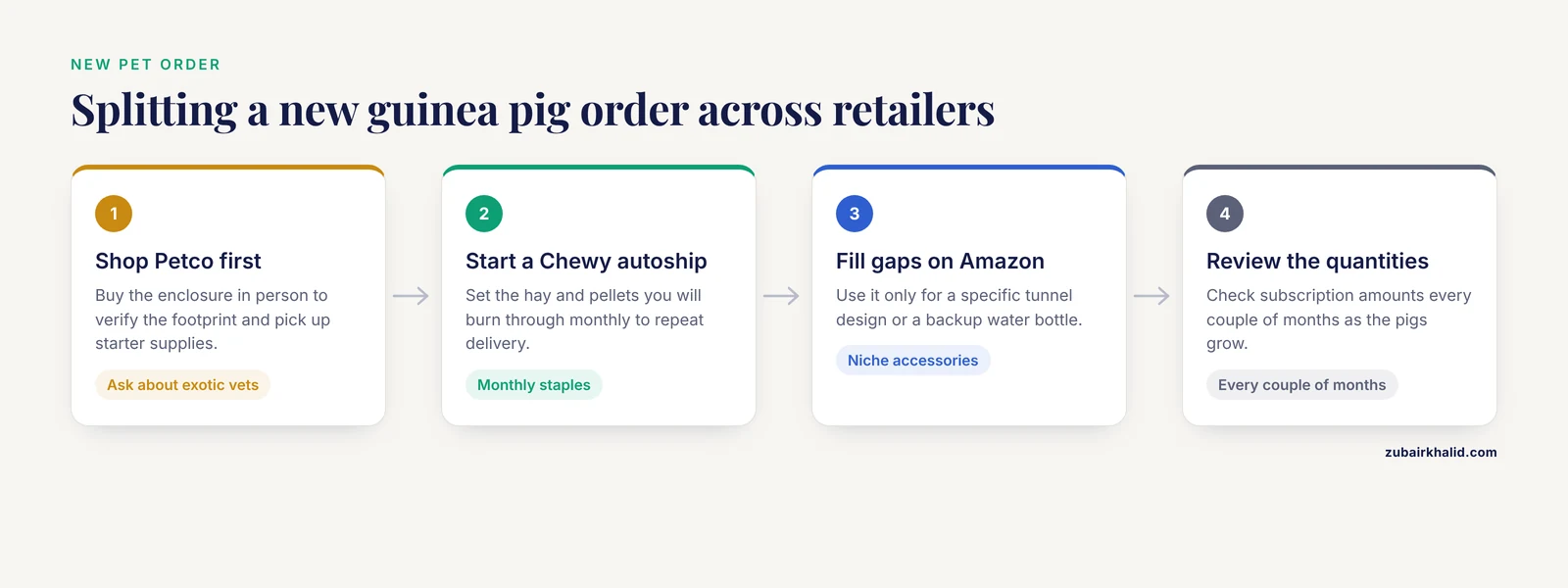
Shop Petco first. Buy the enclosure in person so you can verify the footprint, pick up starter supplies, and ask staff about local exotic veterinarians. Then set up a Chewy autoship for the hay and pellets you will burn through monthly, and use Amazon only to fill gaps, such as a specific tunnel design or a second water bottle as a backup. This splits the order across all three retailers according to each one's actual strength.
Scenario 2. Your rabbit refuses a new hay shipment
This is the classic case where the chewy vs petco small pet supplies comparison flips depending on circumstances. Order a small bag of an alternative cut or blend from Chewy or Amazon as a trial. If the rabbit accepts it, add it to the subscription. If the refusal persists across multiple brands, treat it as a veterinary question rather than a shopping problem, since appetite changes in rabbits can signal dental disease or gastrointestinal issues and warrant an examination by a rabbit-savvy veterinarian.
Scenario 3. Your ferret needs a prescribed medication refilled monthly
Use Chewy's prescription flow, set the refill interval to match your veterinarian's dosing schedule, and let the automation handle it. Confirm with your veterinarian that they are comfortable approving online requests and ask how quickly their office typically turns them around. Keep a small buffer supply where the prescription allows, so a shipping delay never becomes a treatment gap.
Scenario 4. You are upgrading a hamster enclosure
Measure first, then go to Amazon. Enclosure dimensions, wheel diameter, and platform compatibility are the specs that matter, and Amazon's catalog will have options a store does not. Read recent reviews with photos, check the listed dimensions twice, and buy the bedding from whichever retailer has the size and price you want that week.
Scenario 5. You discover midweek that hay is nearly gone
Do not gamble on a two-day delivery window. Petco, or a local feed store or farm supply retailer, solves the same-day problem. Then increase the size of your next Chewy delivery so the buffer grows.
Common Mix-Ups Small Pet Owners Make When Shopping
- Buying a cage that meets the minimum photo, not the minimum behavior. Small mammal welfare guidance from groups like the RWAF consistently emphasizes space for natural movement. A product photo with no reference object hides the true size. Check dimensions in inches and centimeters, not the manufacturer's marketing labels.
- Substituting rabbit food for guinea pig food or vice versa. The vitamin C requirement of guinea pigs is the clearest reason these diets are not interchangeable. Check species labeling every time.
- Treating hay as an accessory rather than a staple. Owners sometimes economize on hay and overspend on toys. Invert that. Hay is the single most important purchase in the cart for rabbits, guinea pigs, and chinchillas.
- Ignoring packaging dates on food. Pellets lose vitamin potency over long storage. Buy sizes you will finish within a reasonable window rather than the cheapest per-ounce bulk deal that will sit for a year.
- Buying aromatic wood bedding by default. Beddings with strong added scents are a recurring concern in small mammal respiratory discussions, and the right choice depends on species and individual sensitivity. When in doubt, ask your veterinarian before filling the enclosure.
- Assuming every pet store employee knows exotics. Store staff can be helpful on logistics, but species-specific health questions belong with an exotic veterinarian. The AVMA's owner resources and the Merck Veterinary Manual both exist precisely because general pet knowledge does not transfer automatically to rabbits, rodents, and ferrets.
- Letting a subscription run untouched for a year. Animals change. A guinea pig that ages into adulthood, a rabbit recovering from surgery, or a newly bonded pair can all change consumption patterns. Review your subscription quantities every couple of months.
Limitations and When to Contact a Veterinarian
Retail comparisons can tell you where to buy a product. They cannot tell you whether a product is right for your individual animal, and every health, diet, and husbandry decision for a rabbit, guinea pig, ferret, hamster, gerbil, rat, mouse, or chinchilla ultimately needs the judgment of a veterinarian experienced with that species. Individual cases vary, and the guidance in this article is general.
Contact a veterinarian promptly, rather than waiting for a scheduled visit, when you see any of the following:
- A rabbit or guinea pig that has not eaten, or has produced fewer or smaller droppings, for more than a few hours. Gastrointestinal stasis in these species is an emergency, and delay is dangerous.
- Any period of complete anorexia in a small mammal, regardless of species.
- Diarrhea, or markedly soft or misshapen droppings.
- Labored breathing, nasal discharge, sneezing, or head tilt.
- A sudden drop in activity, hiding that is new, or aggression that is new.
- Drooling, a wet chin, or difficulty chewing, which can indicate dental disease.
- Hair loss, persistent scratching, or visible parasites.
- In guinea pigs, signs that could reflect inadequate vitamin C status, such as reluctance to move, a rough coat, or apparent pain.
- Any injury, any fall, any suspected fracture, or bleeding.
- A female guinea pig that may be pregnant, since reproductive complications in this species are a veterinary emergency.
For routine questions, such as how much pellet to feed, which bedding to choose, or whether an enclosure upgrade is adequate, bring the topic to your next wellness visit or ask your clinic between appointments. If you do not yet have an exotic-savvy veterinarian, ask the store where you buy supplies for referrals, and verify that the clinic treats your species before you need urgent care.
Frequently Asked Questions
Is Chewy or Petco better for rabbit and guinea pig food?
Chewy is generally better for recurring food purchases because its subscription system keeps hay, pellets, and bedding arriving on schedule, and its catalog of food brands is deeper. Petco is better when you need food today or want to inspect a bag before buying. Many owners use both, with a Chewy subscription for the staples and Petco for emergencies.
What is the main difference between Chewy and Petco small pet supplies?
The main difference is the channel. Chewy is an online retailer built around scheduled home delivery, prescription verification, and phone or chat service. Petco is a physical store built around immediate availability, in-person habitat inspection, staff interaction, and in-store veterinary services. The product categories overlap heavily, so the choice usually comes down to whether you need the item now or on a schedule.
When to use Chewy instead of Petco or Amazon?
Use Chewy when the purchase is a recurring consumable such as hay, pellets, bedding, or litter, when you need a veterinary prescription filled and delivered, or when you want to standardize a monthly order and stop thinking about it. Use Petco when you need the item immediately or want to see it first. Use Amazon when you are hunting for a specific accessory that the other two do not carry.
Can I buy my rabbit's or guinea pig's medication on Amazon?
Amazon is generally not the first stop for veterinary prescription items for small mammals. Chewy and Petco both have established prescription verification processes, and your veterinarian can authorize directly. For any medication, buy through a channel your veterinarian knows and trusts, and confirm the product and directions with the clinic before the first dose.
What should be at the top of a rabbit care checklist?
Unlimited grass hay, appropriate fresh water, a suitably sized living space with room to run and stretch, appropriate pelleted food, a litter box with rabbit-safe litter, hideouts and chew items, grooming tools, and a carrier for veterinary visits. Organizations such as House Rabbit Society and the Rabbit Welfare Association and Fund consistently place continuous access to hay and adequate exercise space at the top of rabbit welfare priorities. Confirm the specific diet plan with a rabbit-savvy veterinarian.
What does a guinea pig care guide say about vitamin C?
A guinea pig care guide will tell you that guinea pigs cannot produce their own vitamin C and must receive it through their diet every day. Fresh vegetables are commonly used as the main source, supported by fortified pellets, with supplementation when a veterinarian recommends it. The exact amount for your animal depends on age, diet, and health status, so discuss the plan with your veterinarian rather than guessing at a dose.