Why Is My Reptile Hissing? 7 Common Causes and How to Respond
By Dr. Zubair Khalid, DVM, MS, PhD ·
Hissing is a distance-increasing signal. Your reptile is telling you, another animal, or something in the environment that it feels threatened, cornered, stressed, or unwell, and it wants the perceived threat to back off. Hissing itself is rarely a disease, but it is almost always a symptom of something you can identify and fix: a handling pattern that frightens the animal, an enclosure that misses the mark, an environmental problem that has pushed the animal past its tolerance, or occasionally pain or illness that needs a veterinarian.
The good news is that most hissing has a husbandry or handling root cause. Research on reptile wellness consistently shows that improper nutrition, supplementation, caging, lighting, substrate, temperature, and humidity all lead to stress and the development of disease, while larger, more naturalistic habitats with choices and enrichment reduce stress and increase natural behavior [1]. Fix the environment and the relationship, and hissing usually fades.
This article walks through the 7 most common reasons a reptile hisses, what to do in the moment, the long-term solutions that address the cause, and the specific signs that mean you should call a reptile veterinarian instead of adjusting the thermostat.
This article is educational and is not a substitute for veterinary diagnosis or treatment.
At a Glance: What Your Reptile's Hissing Is Telling You
| Hissing context | Most likely cause | Your first response today |
|---|---|---|
| Hisses when you reach in or lift the animal | Defensive response to handling | Slow down, support the body fully, shorten sessions |
| Hisses when anyone walks past the enclosure | Stress from exposure or lack of secure hiding places | Add hides, reduce traffic, evaluate enclosure placement |
| New hissing in an animal that never hissed | Change in environment, pain, or illness | Check temperatures, humidity, recent changes, and call an exotics vet if signs persist |
| Hissing with open-mouth breathing, wheezing, or lethargy | Possible respiratory disease | Veterinarian visit, not a husbandry tweak |
| Hissing during a shed | Discomfort and reduced vision while shedding | Raise humidity, do not force handling, never pull skin |
| Hissing at feeding time | Food-related arousal, not fear | Adjust feeding technique, use a separate feeding area or tong-feeding |
| Hissing from a new animal | Relocation stress and unfamiliar surroundings | Give quiet adjustment time, hands-off for the first days |
Why Is My Reptile Hissing? Reading the Signal Correctly
Before listing causes, it helps to understand what hissing is. Reptiles hiss by forcefully expelling air, and in snakes this sound is amplified by the shape of the mouth and airway. The behavior is defensive communication. It is a warning that appears before more escalated defensive behavior such as striking, thrashing, tail whipping, biting, or withdrawing.
That matters for two reasons. First, hissing is information, not defiance. A reptile that hisses is an animal that has decided to warn you instead of escalate, which means you still have room to de-escalate. Second, hissing is almost never random. If you note when it happens, who is present, what happened in the minutes before, and what the enclosure conditions were, you will usually find a pattern within a week or two.
Modern reptile husbandry has moved away from sterile, spartan enclosures toward larger, more naturalistic habitats, precisely because those environments give reptiles more space, more choices, higher activity levels, reduced stress, and more opportunities to express natural behavior [1]. An animal that can retreat, thermoregulate, hide, and behave normally is an animal that rarely feels the need to hiss.
The 7 Common Causes of Hissing in Reptiles
1. Defensive Response to Handling or Perceived Threat
This is the most common answer to the question "why is my reptile hissing." The animal perceives your hand, a tool, or an approach from above as a predator threat. Snakes and lizards in particular are preyed upon in nature by birds and mammals that descend from above, so a hand coming down from the top of the enclosure reads as an attack.
Common handling mistakes that trigger defensive hissing include:
- Reaching down from directly above the animal
- Grabbing rather than scooping and supporting the full body
- Pulling the animal off a perch or out of a hide it is gripping
- Handling during the acclimation period after a new arrival
- Handling right after feeding, when prey-scent on your hands can trigger a feeding or defensive response
- Handling during the dark phase for nocturnal species, when the animal is asleep and startles easily
The fix is predictable handling built on choice and control. A peer-reviewed study on juvenile false water cobras showed that snakes readily learn through operant conditioning and that positive reinforcement training lets animals choose to participate in husbandry and veterinary procedures while preventing unnecessary stress for both animal and keeper [2]. You do not need formal target training to apply the principle. Let the animal notice you, approach low and slow, scoop from beneath, support the body, and end the session on your terms before the animal shows stress.
2. Stress From Improper Husbandry
Hissing can be the visible tip of a larger stress load. The veterinary literature is explicit that improper nutrition, supplementation, caging, lighting, substrate, temperature, and humidity all lead to stress and disease development in captive reptiles [1]. An animal living at the wrong temperature gradient, in air that is too dry or too damp, under inadequate or missing UVB lighting, or on an inappropriate substrate is running a background level of chronic stress. That stress lowers the threshold at which defensive behaviors like hissing appear.
If hissing is new or has increased, audit the basics before blaming temperament:
- Is the thermal gradient correct for the species, measured at the animal's level with a thermometer, not guessed by feel?
- Is humidity within the species' range, measured with a hygrometer?
- Is lighting on a consistent photoperiod, with appropriate UVB provision and replacement on schedule?
- Is the substrate appropriate, clean, and deep enough for natural behavior?
- Is fresh water always available?
If you cannot answer yes to every question, the hissing may be environmental, and the solutions section below gives you a step-by-step correction plan.
3. Enclosure Setup Problems: Too Small, Too Bare, or Too Exposed
A surprising number of hissing cases trace directly to the physical enclosure. Three setup failures stand out.
No secure retreat. A reptile without a hide it can fully retreat into feels perpetually exposed. Reptiles benefit from environments that give them choices, and wellness recommendations emphasize larger, more naturalistic habitats over spartan ones precisely because choice reduces stress [1]. If your animal hisses every time you walk past, it may be hissing because it has nowhere to go.
Enclosure too small. An animal that cannot distance itself from your hand, a cage mate, or household activity lives at a constant low-grade threat level. Defensive distance-increasing signals like hissing become the default response to any approach.
Enclosure in a high-traffic or high-stimulation location. Placement next to a television, a dog's sleeping area, a doorway, or a child's play zone means constant perceived threat. Relocating the enclosure to a quieter room, or screening part of the glass, often reduces hissing within days.
4. Pain or Illness
New hissing in a previously calm animal deserves a health check, because pain makes animals defensive. Mouth, jaw, or tooth problems, respiratory disease, gastrointestinal discomfort, injuries, and burns or abrasions from improper enclosure furniture can all make an animal that tolerates handling suddenly object to any touch.
Treat any hissing that comes with these signs as a veterinary problem:
- Open-mouth breathing, gaping, or audible wheezing or clicking
- Nasal discharge or bubbles around the nostrils or mouth
- Lethargy, spending all day in the hide, refusing food for an unusual period
- Swelling around the mouth, jaw, or limbs
- Abnormal posture, weakness, or inability to perch or climb normally
- Visible wounds, retained shed constricting toes or tail tip, or discoloration of the mouth lining
Reptiles are adapted to hide illness, so by the time an animal acts defensively out of pain, the problem is usually established. The Association of Reptilian and Amphibian Veterinarians maintains a directory of reptile-savvy veterinarians at arav.org, and the Merck Veterinary Manual's exotic animal resources and VCA Animal Hospitals' reptile care guides are reliable references for recognizing disease signs between visits.
5. Shedding Discomfort
Hissing during a shed cycle is common and usually benign. As the old skin separates, vision can dim behind opaque eye scales, the new skin can be tight and itchy, and the animal generally wants to be left alone. An animal that normally handles well may hiss at any approach during this window.
Respond by supporting the shed rather than fighting it. Provide appropriate humidity for the species, offer a humid hide or rough surfaces the animal can rub against, keep handling to a minimum until the shed is complete, and never pull at partially attached skin, especially around the eye caps, toes, and tail tip. A complete shed followed by a return to normal temperament confirms this cause.
6. Food-Related Arousal
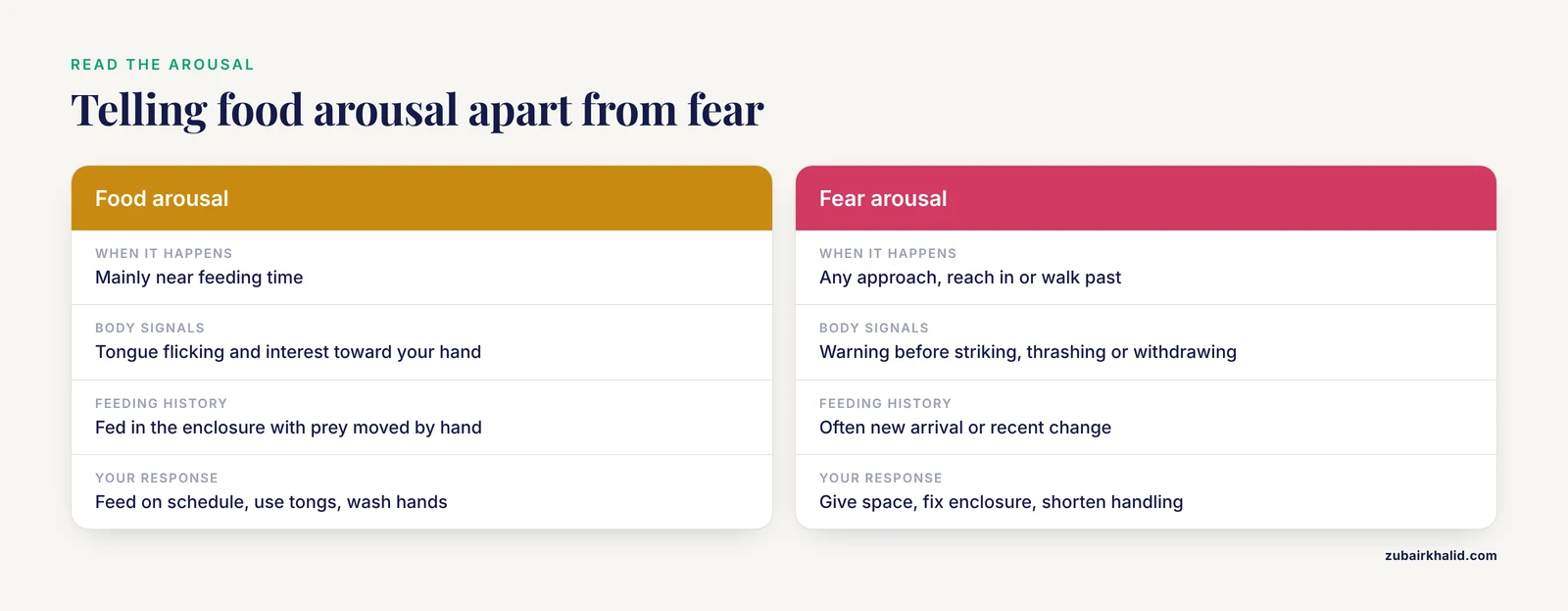
Not every hiss is fear. Some snakes and some lizards hiss in association with feeding, either in anticipation of prey or as part of an exaggerated feeding display. The problem for keepers is that food arousal and fear arousal look similar from outside the glass, and confusing the two leads to bites.
Clues that point to food arousal include hissing that occurs mainly near feeding time, tongue flicking combined with directed interest toward your hand, striking posture toward movement, and a history of the animal being fed in the enclosure with prey items moved by hand. Solutions include feeding on a consistent schedule, tong-feeding or placing prey so the animal does not associate your hand with food, washing hands after handling prey or other animals, and using a hook or paper towel roll to gently tap-signal before opening the enclosure so the animal learns the difference between feeding events and non-feeding events.
7. Territorial and Breeding-Season Behavior
Some hissing is directed at rivals rather than you. Housing incompatible animals together, keeping multiple males of territorial species within sight of each other, or keeping a male near a female during breeding season can produce defensive displays, including hissing, directed at the perceived competitor. The response is straightforward. Separate animals that hiss at each other. Cohabitation is a husbandry choice that carries risk for most species, and an animal that cannot get away from a cage mate has no way to de-escalate. Give each animal its own enclosure with its own thermal gradient and hides, and most rivalry hissing stops immediately.
How to Respond in the Moment: A Step-by-Step Plan
When your reptile hisses, do this:
- Stop moving. Freeze your hand or body where it is. Sudden continued movement escalates the interaction.
- Give space. Slowly withdraw. If the animal is being handled, lower it toward a surface or back into the enclosure at its level so it does not feel suspended over a drop.
- Remove the trigger. If another pet, a child, loud noise, or your shadow triggered the response, remove that element.
- Do not punish. Tapping, shaking, spraying, or squeezing an animal to "teach it not to hiss" suppresses the warning without fixing the cause, and it teaches the animal to skip the warning next time and go straight to biting or thrashing.
- Log the event. Write down the date, time, what happened before the hiss, enclosure temperatures and humidity, and whether the animal was in shed, recently fed, or newly arrived.
- Do not handle again that day. End on a calm note and let the animal settle.
- Plan the fix, not the retry. Use the log to identify which of the 7 causes applies, then apply the matching solution below.
Why Is My Reptile Hissing? Solutions That Fix the Root Cause
Answering "how to fix why is my reptile hissing" means matching the solution to the cause. The three work streams below cover most cases.
Fix 1: Correct the Reptile Enclosure Setup
A sound enclosure setup removes most of the background stress that lowers an animal's hissing threshold. Work through this in order.
Space first. Size the enclosure generously for the adult size of the species. Larger enclosures with more choices are associated with higher activity, reduced stress, and more natural behavior in captive reptiles [1]. When in doubt, go bigger, and fill the bigger volume with structure so the animal does not feel exposed.
A full thermal gradient. Establish a warm zone and a cooler zone so the animal can choose its body temperature continuously. Measure with calibrated digital thermometers at the surface where the animal actually sits, not at the glass. A reptile that is chronically too cold or cannot escape excess heat is a stressed reptile.
Humidity matched to the species. Use a hygrometer, provide a humidity gradient with a drier zone and a more humid zone or humid hide, and adjust with misting, a larger water source, or ventilation rather than guessing.
Lighting and photoperiod. Provide appropriate lighting for the species on a consistent day-night cycle, and replace ultraviolet bulbs on the manufacturer's schedule even if they still light up, because output declines before the lamp fails visibly. Proper lighting is one of the husbandry factors the veterinary literature specifically links to reptile health and stress [1].
Substrate and structure. Choose a substrate that supports the species' natural behavior, holds burrows or humidity where needed, and is safe if ingested. Add multiple hides, one on the warm side and one on the cool side at minimum, climbing and perching structure for arboreal species, and visual barriers along lower glass panels for ground-dwelling animals that hiss at passersby.
Placement and traffic. Put the enclosure in a room with predictable, moderate activity. Screen the front glass partially if reflections or movement trigger defensive responses.
Fix 2: Rebuild Handling From the Animal's Perspective
If the hissing is handling-driven, change the pattern rather than forcing the animal to tolerate it.
- Take a handling holiday. Give a hissing animal several days to two weeks of minimal interaction so it can settle, especially if it is newly arrived.
- Change your approach geometry. Approach from the side or below, never from above. Move at half the speed you think is necessary.
- Support the whole body. Scoop from underneath. A reptile with all its feet supported and its body resting on your arms or hands feels secure. An animal dangling in the air feels captured.
- Shorten sessions. Two calm minutes that end well beat twenty minutes that end in a hiss. Build duration gradually.
- Use a consistent cue. A gentle, consistent signal before your hand enters, such as a light tap on the enclosure frame, lets the animal predict handling. Predictability is the core of stress reduction in trained animals.
- Adopt choice-based training. The false water cobra study demonstrated that even snakes widely assumed to be behaviorally simple learn through operant conditioning and benefit from training that lets them choose to participate in husbandry routines, providing mental stimulation while reducing stress and keeper risk [2]. Target training, in which the animal touches a target for a food reward, is a practical entry point. It converts handling from something done to the animal into something the animal chooses, and it makes routine care and future veterinary examinations dramatically easier.
Fix 3: Separate Health and Feeding Variables
- If hissing is new, persistent, or paired with any clinical sign in section 4, schedule a reptile veterinarian visit rather than another round of husbandry tweaks.
- If hissing clusters around feeding, restructure feeding so the animal does not rehearse defensive or arousal behavior at your hand. Feed on a schedule, use long tongs where appropriate, and keep hands clean of prey scent.
- If hissing happens at shedding, adjust humidity proactively when the eyes go opaque and take a handling holiday until the shed finishes.
Reptile Care Checklist: The Weekly Routine That Prevents Hissing
Use this checklist as your standing reptile care checklist. Consistency in these items keeps stress low, and low stress means less defensive behavior.
Daily
- Check temperatures at both ends of the gradient with a thermometer.
- Check humidity with a hygrometer.
- Confirm fresh, clean water is available.
- Spot-clean waste and urates.
- Observe the animal for posture, breathing, activity, and appetite.
Weekly
- Clean and disinfect water bowls.
- Inspect hides, branches, and furniture for damage or waste.
- Verify all lighting is functioning on the correct photoperiod.
- Track weight and feeding records.
Monthly and Seasonal
- Replace UVB-emitting lamps on the manufacturer's replacement schedule.
- Deep-clean the enclosure and replace or refresh substrate as appropriate for the species.
- Reassess enclosure size against the animal's current size.
- Review your handling log. If hissing frequency is falling, your plan is working. If it is rising or unchanged after environment and handling fixes, book a veterinary exam.
Common Mistakes That Keep a Reptile Hissing
- Treating the hiss instead of the cause. Punishing or repeatedly "testing" the animal to see if it will hiss adds stress and makes the behavior more entrenched.
- Guessing temperatures. Stick-on dial thermometers and hand-feel readings are unreliable. Measured gradients are the standard of care.
- Skipping the acclimation period. Handling a new arrival in its first days at home is one of the most reliable ways to create a defensive animal.
- Handling during shed, after feeding, or during the animal's normal rest period.
- Cohabiting animals that display at each other and then wondering why both hiss.
- Assuming hissing means the animal is aggressive. Hissing is defensive communication, and defensive animals become tolerant animals when their environment and handling improve.
- Waiting too long on health signs. Reptiles mask illness well. New hissing plus lethargy, anorexia, or breathing changes warrants a veterinary exam promptly.
Troubleshooting: When the Usual Fixes Do Not Work
If you have corrected enclosure setup and handling and the hissing persists, walk this diagnostic ladder.
- Re-measure everything. Equipment fails. Verify thermometer and hygrometer readings and confirm lamps are within their replacement window.
- Check for changes in the household. New pets, new babies, renovation noise, moved furniture, or a different room placement all register as environmental change.
- Check the shed calendar and feeding calendar. Hissing during these windows is expected.
- Review sex and season. Breeding-season territoriality is time-limited but real. Separation resolves it.
- Consider pain. An animal that hisses only in one posture, only when a specific body region is touched, or only during certain movements is telling you where it hurts. That level of specificity is a strong veterinary referral signal.
- Get a veterinary exam. A reptile-experienced veterinarian can examine the oral cavity, auscultate the respiratory system, palpate the coelom or abdomen, and assess for pain. Requesting a wellness examination is reasonable for any reptile showing new defensive behavior, and routine wellness care is a recognized pillar of keeping captive reptiles healthy [1].
Welfare and Safety Points
- Hissing is a warning. Respecting the warning protects both you and the animal. An animal pushed past hissing may strike or bite.
- Never cohabit species or individuals whose interactions include defensive displays.
- Children should interact with reptiles only with adult supervision, from outside the glass or with calm, supported handling appropriate to the species.
- Wash hands before and after any reptile contact, both for the animal's safety and yours, and follow standard hygiene guidance from organizations such as the AVMA and CDC regarding reptile-associated salmonella.
- Enrichment is not optional. Reptiles benefit from enrichment and can be trained, which reduces stress and makes handling and veterinary care easier [1] [2]. An enriched, choice-rich animal is a calmer animal.
Limitations and When to Contact a Veterinarian
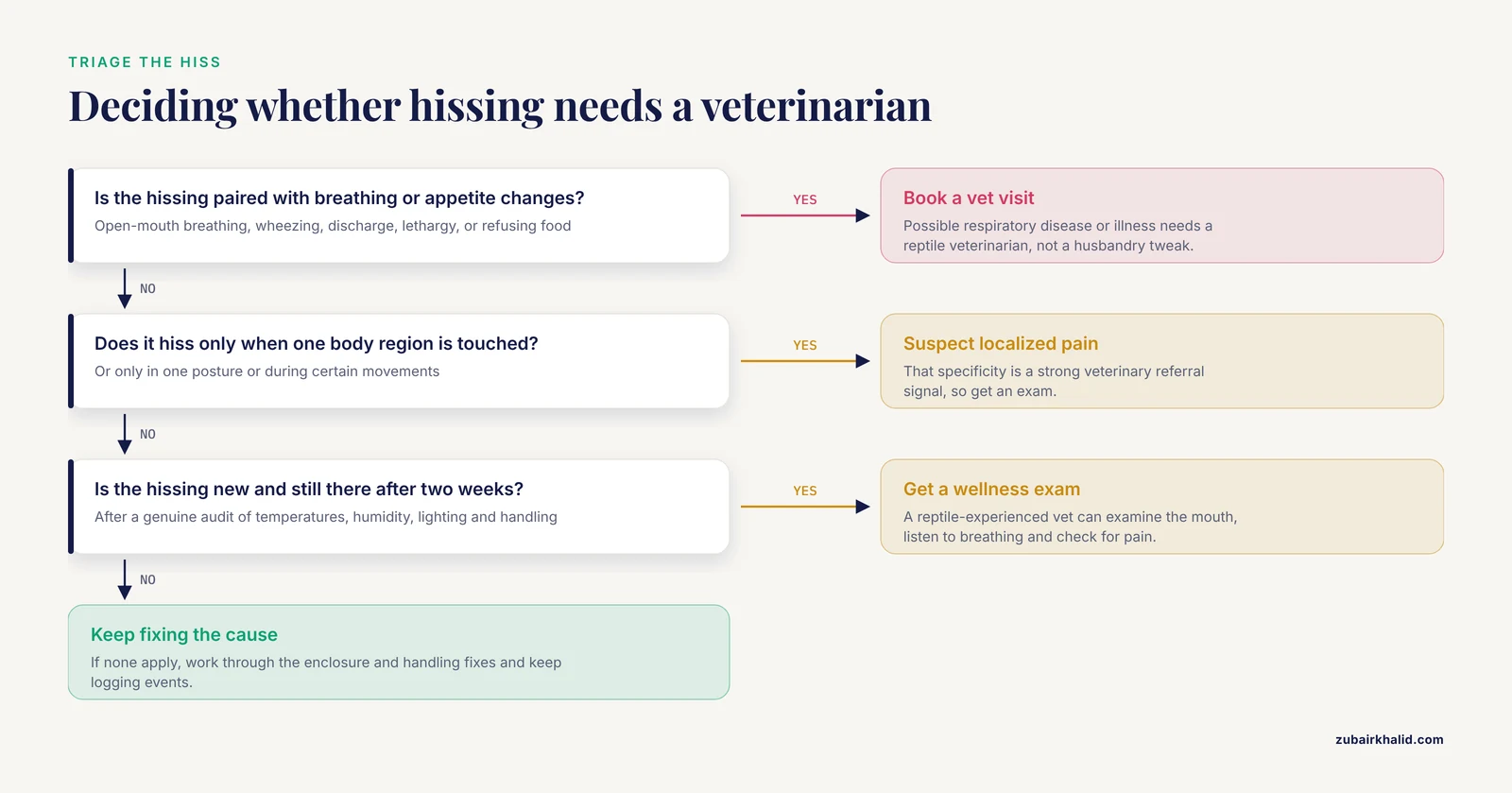
Individual animals vary, and no article can diagnose your specific reptile. A hissing animal needs a veterinarian if any of the following apply:
- Hissing is new in an animal that was previously calm, and it persists beyond a few days despite environmental review
- Hissing occurs with open-mouth breathing, wheezing, nasal or oral discharge, lethargy, or loss of appetite
- The animal hisses when a specific body region is touched or during specific movements, suggesting localized pain
- There is swelling, a wound, retained shed, mouth discoloration, or abnormal posture
- The animal stops eating, stops defecating, or shows marked weight loss
- You cannot identify an environmental or handling trigger after a genuine two-week audit
Contact a veterinarian with reptile and exotics experience. The Association of Reptilian and Amphibian Veterinarians provides a client directory at arav.org, and general exotic-animal references such as the Merck Veterinary Manual and VCA Animal Hospitals reptile guides can help you prepare questions before the visit. This article is educational and is not a substitute for veterinary diagnosis or treatment.
Frequently Asked Questions
Why is my reptile hissing at me when I open the enclosure?
The animal most likely perceives your approach from above or your reaching hand as a threat. Approach from the side, move slowly, scoop from beneath with full body support, and give new animals an acclimation period before regular handling.
Is hissing always a sign of aggression?
No. Hissing is defensive communication, a warning issued before escalation. A hissing reptile is usually frightened, stressed, in shed, food-aroused, or in pain, not aggressive, and the underlying trigger is usually fixable.
Can hissing mean my reptile is sick?
Yes, it can. New hissing in a previously calm animal, especially with lethargy, appetite loss, open-mouth breathing, wheezing, discharge, or swelling, warrants a prompt examination by a reptile veterinarian.
How do I stop my snake from hissing during handling?
Shorten sessions, approach low and slow, support the entire body, handle only outside shed and post-feeding windows, and introduce a consistent pre-handling cue. Choice-based training with a food reward has been shown to reduce stress and improve cooperation in snakes.
My bearded dragon started hissing. What changed?
Audit the basics first: temperatures, humidity, UVB lamp age, enclosure size and hides, and any household changes. If the environment checks out and hissing persists or is paired with appetite loss or breathing changes, book a veterinary exam.
Should I punish my reptile for hissing?
Never. Punishment suppresses the warning signal without fixing the cause, which teaches the animal to escalate directly to striking or biting, and it damages trust you will need for routine care.
Why does my reptile hiss only at feeding time?
That hissing usually reflects food arousal rather than fear. Feed on a consistent schedule, keep prey scent off your hands, use tongs or careful prey placement, and use a distinct pre-feeding signal so the animal learns the difference between feeding events and other interactions.
How long does it take a new reptile to stop hissing?
Most animals settle and reduce defensive hissing over the first weeks at home if they are left mostly undisturbed in a correct enclosure with proper hides, temperatures, and humidity. If hissing continues after a genuine adjustment period with good husbandry, seek a reptile veterinary exam.