When to Euthanize a Ball Python: Quality of Life Signs
By Dr. Zubair Khalid, DVM, MS, PhD ·
This article is educational and is not a substitute for veterinary diagnosis or treatment.
Choosing when to euthanize a ball python comes down to one question, can this snake's suffering be relieved? Euthanasia is the humane choice when a progressive disease will not respond to treatment, when pain or distress cannot be controlled, or when the snake has permanently lost the functions that make a snake's life tolerable, such as feeding, moving freely, breathing easily, and shedding cleanly. The decision should rest on a tracked trend, confirmed with a reptile veterinarian, rather than on a single bad day.
Ball pythons hide illness until it is often advanced, so the gap between a treatable problem and true suffering can close faster than most owners expect. A structured quality of life assessment, written down and repeated weekly, turns an agonizing guess into a measurable trend you and your veterinarian can act on together.
This guide covers the decision framework, a practical ball python quality of life scale, the signs a ball python is dying rather than merely off its food, the conditions that most often lead to this decision, hospice steps for how to comfort a dying ball python at home, what happens at the euthanasia appointment, and how to carry the grief that follows.
At a Glance: The Quality of Life Checklist
| Domain | What good looks like | Warning zone | Crisis zone |
|---|---|---|---|
| Feeding | Strikes and eats on schedule | Skipped meals, weak strike | No feeding response for weeks despite treatment |
| Body condition | Stable weight, firm muscle along the spine | Slow weight loss | Prominent spine and skull, visible muscle wasting |
| Breathing | Quiet and effortless | Occasional wheeze or click | Open-mouth breathing, gurgling, extended neck |
| Movement | Explores, climbs, rights itself instantly | Sluggish, stays hidden | Cannot right itself, drags its body, tremors |
| Skin and shed | Complete, clean sheds | Patchy or delayed shed | Stuck shed with retained eyecaps, open wounds |
| Hydration | Smooth skin, clear eyes | Slight wrinkles | Deep skin folds, sunken eyes |
| Behavior | Tongue flicks, investigates changes | Reduced interest | No response to touch, food, or movement |
| Pain | No visible signs | Suspected discomfort | Flinching, abnormal posture, obvious distress |
Do these five things today:
- Weigh your snake on a gram scale and write the number down.
- Take clear photos from above and from the side for comparison.
- Score each domain above from 0 (crisis) to 2 (good) and total the points.
- Book an appointment with a reptile veterinarian. If you do not have one, the Association of Reptilian and Amphibian Veterinarians (ARAV) maintains a member directory.
- Start a daily log of eating, defecation, shedding, and behavior.
When to Euthanize a Ball Python: The Decision Framework
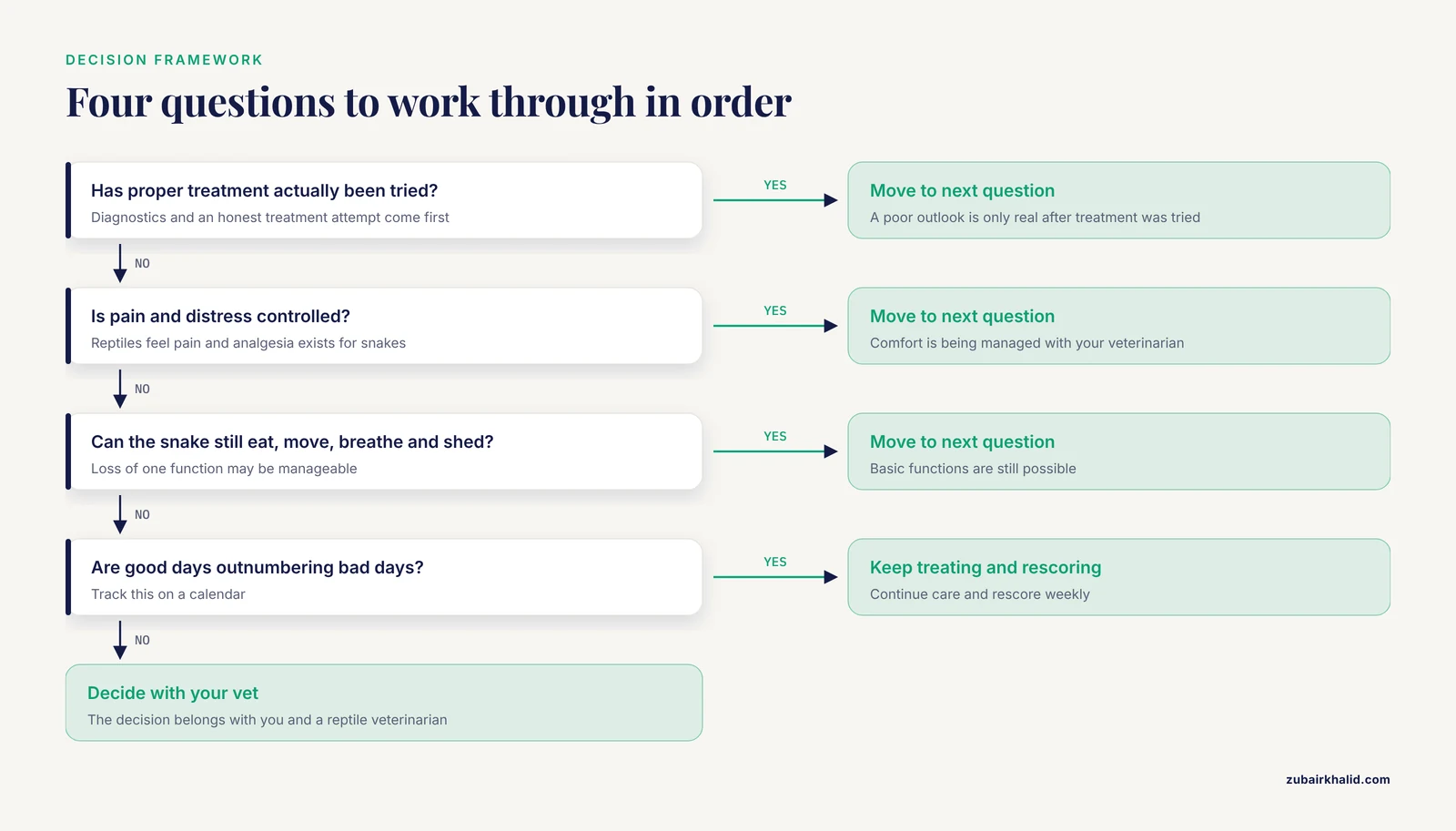
Work through four questions, in order, every time the thought of euthanasia crosses your mind.
- Is the condition treatable, and has treatment actually been tried? Many problems that look terminal, such as a respiratory infection caught early or a mild burn, respond well to veterinary care. A poor outlook is only real after proper diagnostics and an honest treatment attempt.
- Is pain and distress controlled? Reptiles feel pain, and analgesia exists for snakes. If your veterinarian cannot get discomfort under control, quality of life is already gone.
- Can the snake still perform basic functions? Eating, moving, breathing easily, shedding, drinking or soaking, and eliminating. Loss of one function may be manageable. Loss of several, permanently, is not.
- Are the good days still outnumbering the bad? Track this on a calendar. A snake that has one good day for every five bad ones is telling you something.
Modern welfare science frames this clearly. Meeting a captive animal's basic needs is the floor, not the ceiling, welfare also requires the opportunity to express species-typical behaviors such as exploring, climbing, soaking, and hiding [1]. When disease permanently strips away that capacity, and treatment cannot restore it, the snake's life has narrowed to survival without comfort.
The AVMA describes euthanasia as the act of inducing death in a way that minimizes pain and distress, and its guidance covers reptiles explicitly. In practice, that means the decision belongs with you and your veterinarian, and the method belongs in veterinary hands.
Two timelines exist. Some decisions are urgent. A snake with severe respiratory distress, a spinal injury, or advanced septicemia may be suffering now, and delaying euthanasia prolongs that suffering. Others unfold over weeks. Chronic anorexia with muscle wasting, advanced neurological disease, and end-stage decline give you time to score, treat, and reassess before choosing.
Euthanasia is not giving up. It is the final treatment option, chosen when every other option has failed or offers only more suffering.
Ball Python Quality of Life Scale
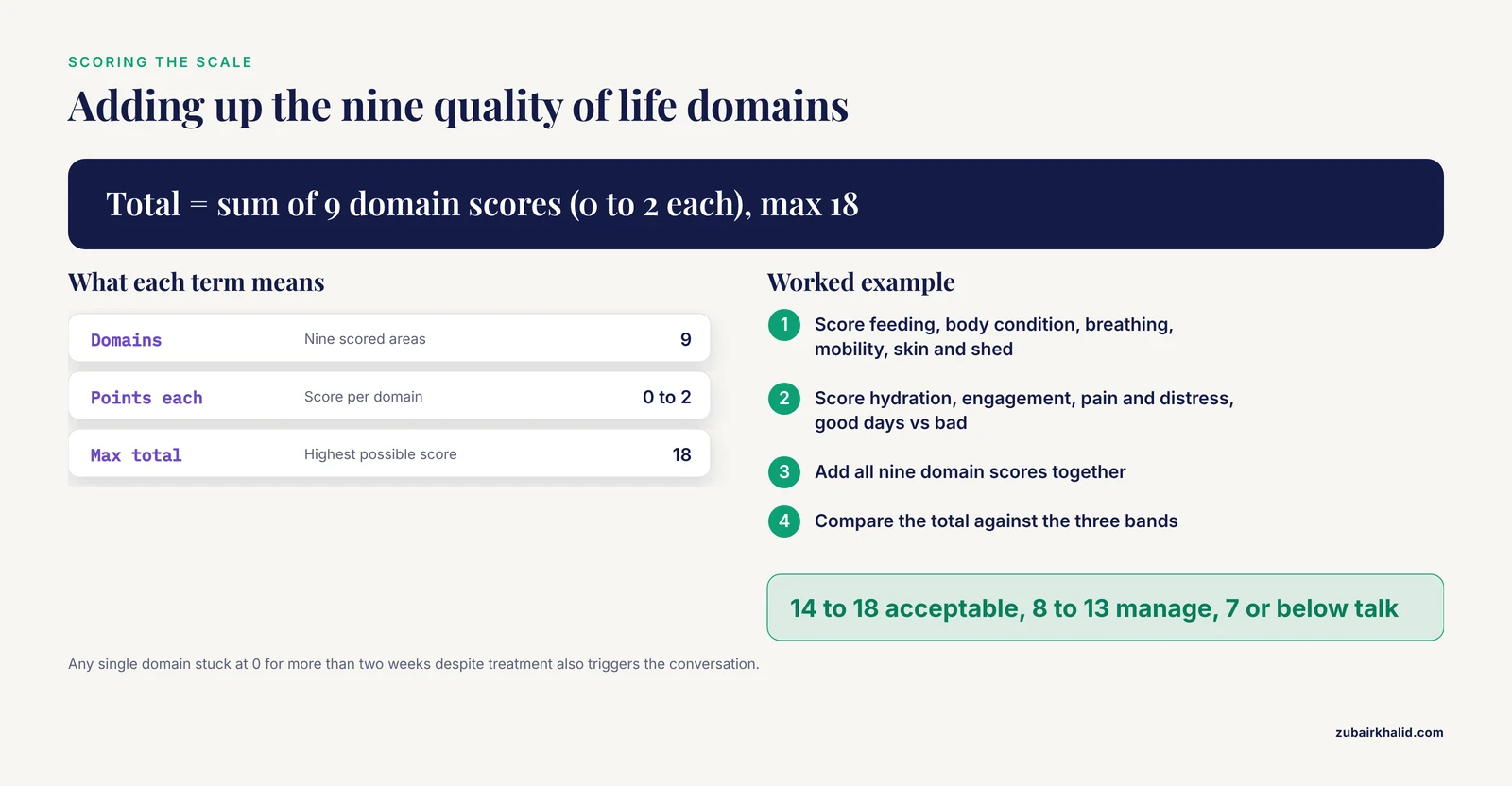
No validated quality of life instrument exists for pet snakes, so the scale below adapts the hospice scoring approach used in small animal practice to ball python biology. Use it as a structured way to observe, record, and discuss, not as a machine that outputs a decision.
Score each domain from 0 to 2.
| Domain | 0 points | 1 point | 2 points |
|---|---|---|---|
| Feeding response | No strike or tongue flick at food for weeks | Eats inconsistently or needs assistance | Takes prey readily on its normal schedule |
| Body condition | Spine and skull prominent, muscle loss | Mild weight loss | Stable weight, rounded, firm body |
| Breathing | Open-mouth, wheezing, visible effort | Occasional click or wheeze | Quiet and effortless |
| Mobility | Cannot right itself, drags, falls | Sluggish, moves little | Moves and explores normally |
| Skin and shed | Multiple stuck sheds, wounds, retained eyecaps | Patchy sheds | Complete clean sheds |
| Hydration | Sunken eyes, skin stays tented after a gentle fold test | Mildly dry skin | Good skin tone |
| Engagement | No tongue flicking, no awareness of surroundings | Reduced interest | Alert, investigates, tongue flicks |
| Pain and distress | Obvious distress or abnormal posture | Suspected discomfort | No signs of pain |
| Good days vs bad | Mostly bad days | Mixed | Mostly good days |
The maximum score is 18. Use these bands as practical guideposts, not validated cutoffs:
- 14 to 18. Quality of life is acceptable. Treat underlying problems and rescore weekly.
- 8 to 13. Active disease management with veterinary guidance. Rescore twice weekly.
- 7 or below, any single domain stuck at 0 for more than two weeks despite treatment, or a steady downward trend across three weeks. The euthanasia conversation is due.
Two rules make the scale work. First, weigh your snake weekly on a gram scale, because a table cannot replace a number in a log. Second, rescore on a schedule and bring the record to every appointment. Scores guide the conversation, they do not replace it.
Signs a Ball Python Is Dying
The signs a ball python is dying fall into two groups, early warning signs that need a veterinarian within days, and end-stage signs that mean the disease has reached the point where comfort-focused care or euthanasia is the realistic path. Many end-stage signs are individually treatable when caught early, so any one of them still warrants a same-week veterinary visit.
Early warning signs
- Refusal of food beyond a normal fast, especially alongside weight loss
- A weak or inaccurate strike at prey
- An occasional wheeze, click, or bubble at the nostrils
- A patchy, delayed, or incomplete shed
- Subtle lethargy, fewer tongue flicks, less exploring
- Small scale lesions, minor discoloration, or a slow-healing spot
End-stage signs
- No feeding response at all, with weeks of food refusal and visible muscle wasting along the spine and skull
- Open-mouth breathing, gurgling, wheezing, or the head and neck held extended to breathe
- Inability to right itself, stargazing, twisting, tremors, or disorientation
- Regurgitation after meals
- Deep skin folds, sunken eyes, skin that stays tented after a gentle pinch
- Multiple stuck sheds with retained eyecaps
- Non-healing wounds, abscesses, or spreading discoloration
- Small red or purple spots on the belly scales, which can indicate septicemia
- A bloated body with no defecation, or a visible mass
- Total unresponsiveness to touch, food, and movement
Snakes compensate until they cannot, so visible decline usually reflects substantial underlying disease. Reptile medicine references, including the Merck Veterinary Manual, emphasize that clinical signs in reptiles are often vague and nonspecific, which is why diagnostics, examination, imaging, and laboratory work, rather than guesswork, should drive the plan. A snake showing several end-stage signs together is usually past the point where treatment restores function, and that is when the quality of life scale becomes the deciding tool.
Conditions That Most Often Lead to This Decision
Advanced respiratory disease
Bacterial pneumonia in snakes can progress from a mild wheeze to open-mouth breathing and severe distress. When imaging shows extensive lung involvement, or infection fails to respond to appropriate antimicrobial therapy, the humane endpoint is close. Your veterinarian bases this call on examination, imaging, and the snake's response to treatment.
Incurable neurologic disease
Viral conditions such as inclusion body disease are progressive and have no cure. Ask your veterinarian about testing if your snake shows stargazing, twisting, regurgitation, or progressive incoordination, because an early diagnosis gives you time to plan rather than decide in a crisis.
Severe wobble syndrome in spider morphs
The spider morph carries a well-documented neurological problem. An imaging study comparing spider and wild type ball pythons with computed tomography and magnetic resonance imaging identified distinctive structural differences in the inner ear of spider morphs that were highly likely related to wobble syndrome [2]. Mild wobble can often be managed with adjusted husbandry, such as simpler enclosures and assisted feeding techniques. A spider that cannot strike accurately, feed reliably, or right itself has a quality of life problem that warrants a serious conversation.
Reproductive disease in females
Female ball pythons develop large pre-ovulatory follicles each breeding season, and research using ultrasound found ovulation mainly between April and August, with ultrasound tracking follicle growth far more reliably than manual palpation, which carried a 25% false-negative rate [3]. When follicles stall before ovulation (follicular stasis) or eggs become stuck (dystocia), the snake can deteriorate quickly through exhaustion, infection, and inflammation of the body cavity. Surgery can save some of these snakes, but a snake found late, severely debilitated, or unable to tolerate anesthesia may have reached the humane endpoint.
Severe trauma and burns
Unregulated heat sources cause deep burns, live rodents can bite a snake that is not feeding, and falls or crushing injuries can damage the spine. Large-area burns and spinal injuries that leave a snake unable to move or defecate carry a grave outlook even with intensive care.
Cancer and internal masses
Tumors occur in snakes, and some are operable when caught early. A rapidly growing mass, an ulcerated lesion, or an internal tumor driving weight loss often has a poor outlook. Imaging and biopsy tell you which situation you are in.
End-stage welfare failure
Years in inadequate housing can set a snake up for chronic stress and repeated illness. A large welfare assessment of more than 5,000 ball pythons at pet expositions and in online sales videos found that most were kept in enclosures failing minimum welfare recommendations, many too small for the snake to stretch out fully [4]. Correcting husbandry is part of treating any sick ball python, but when damage from years of poor conditions has compounded, recovery may not be possible.
Septicemia and overwhelming infection
Small red or purple spots on the belly scales, spreading discoloration, profound lethargy, and food refusal can signal bacteria in the bloodstream. Advanced septicemia responds poorly to treatment, and affected snakes are often suffering by the time the signs become obvious.
How to Comfort a Dying Ball Python
Hospice care for a snake has one goal, keeping the animal comfortable and free from distress while you monitor the trend and stay in contact with your veterinarian. Comfort is not the same as cure, and it does not replace diagnostics. It is what you do while treatment runs its course, or after you and your vet agree that treatment has run out.
Set up a single-level hospice enclosure
Welfare research on ball pythons shows why the environment matters even at the end of life. A behavior-based study of 35 ball pythons found that snakes moved into furnished terrariums, with substrate, a hide, climbing opportunities, a bathing basin, an elevated basking spot, and living plants, showed a broader behavior spectrum than snakes kept in bare rack systems, and the authors concluded that racks are no welfare substitute for a furnished terrarium [1]. A dying snake still benefits from the same principles, scaled down for reachability:
- Keep the thermal gradient your veterinarian recommends, with a warm basking area and a cooler retreat, controlled by a thermostat.
- Choose hides with low entrances on both the warm and cool sides so the snake can thermoregulate without effort.
- Use soft, dry, easily replaced substrate such as paper or fine aspen, changed frequently for hygiene.
- Provide a shallow water basin the snake can enter and leave without struggling.
- Remove tall climbs and unstable decor that a weak snake could fall from.
- Keep lighting gentle and give the snake a choice of light and shade.
Hospice supplies worth having ready
- A gram scale with fine resolution for weekly weights
- A thermostat on every heat source, to prevent burns on skin that cannot escape
- A digital thermometer and hygrometer, so you can verify conditions rather than guess
- Low-entry hides, one on the warm side and one on the cool side
- A shallow, wide water dish for easy soaking
- Replaceable substrate and disinfectable surfaces for daily spot cleaning
- A notebook or notes app for the daily log
Reduce stress and handling
Snakes read handling as a predator interaction, not as affection. In hospice, handle only for treatment, weighing, and gentle soaks. Keep the enclosure in a quiet room with low traffic, cover one or two sides for visual security, and avoid sudden lights and noise. Chronic stress in reptiles can now be measured non-invasively, and a recent study using corticosterone from shed skins found that housing effects are species-specific, with ball pythons in enriched terraria showing higher concentrations than those in racks, corn snakes showing the reverse, and larger enclosure volume tracking with higher corticosterone in ball pythons [5]. The practical takeaway is to individualize, make one change at a time in a fragile snake's enclosure and watch its behavior over the following days.
Support hydration and shedding
Dehydration makes every disease worse. Offer a shallow soak in warm water if your veterinarian approves, keep humidity in the range your vet recommends for the condition, and never pull at stuck shed, especially around the eyecaps, where torn skin can cost an eye. A piece of clean cork or bark gives the snake a rough surface to rub against during a shed.
Feeding in hospice
Offer food only if the snake shows a strike response, and choose smaller, easier meals if your vet agrees. Never force feed without hands-on instruction from a veterinarian, because tubing a snake incorrectly can push material into the airway. If your snake has refused several meals and is losing weight, that is a diagnostic question, not a feeding-trick question.
Pain control
Reptiles feel pain, and veterinarians have analgesic options for snakes, with drugs and doses tailored to the individual. If your snake flinches when touched, holds an abnormal posture, or guards part of its body, ask explicitly about pain management at your next appointment. Pain control is often the single biggest quality of life intervention in the final weeks.
Hygiene
Spot clean daily, because a weak snake lying in its own waste develops skin infections quickly. Smooth, non-porous surfaces and replaceable substrate make this easy. Wash your hands after handling your snake or cleaning the enclosure, standard reptile hygiene.
Keep a daily record
Weigh the snake at the same time each week, note every meal, defecation, shed, and odd behavior, and rescore the quality of life scale weekly. Bring the log to appointments. Trends, not single data points, drive good decisions.
Troubleshooting common hospice problems
- Your snake refuses all food. Confirm with your vet that this is expected decline rather than a fixable problem such as wrong prey temperature or an oral lesion. Then decide together whether assist feeding is appropriate or whether feeding is no longer in the snake's interest.
- Stuck shed will not come off. Increase humidity in a hide box rather than the whole enclosure if the snake resists soaks, and have the vet remove retained eyecaps.
- Your snake hides constantly and you cannot monitor it. Use a hide with a visible side or do a quick visual scan rather than lifting hides, which disturbs the snake.
- Restless pacing at night. Check temperatures first, because pacing is often a thermoregulation problem rather than anxiety.
What Happens at the Euthanasia Appointment
Once you and your veterinarian agree that euthanasia is the right choice, the appointment itself is usually calm and quick.
Before the appointment
Ask whether you can be present, what the process looks like, and what aftercare involves. Decide in advance whether you want an individual cremation with ashes returned, a communal cremation, or home burial where local rules allow it. Check municipal regulations before planning a burial. Some owners choose a final gentle moment with their snake beforehand, ask your vet what is realistic for the snake's condition.
During the appointment
Your veterinarian will confirm the snake's condition, discuss the plan, and then perform euthanasia with an injectable anesthetic agent, given into a vein, the heart, or the body cavity, sometimes preceded by sedation to keep the snake still and calm. The AVMA publishes euthanasia guidance covering reptiles, and its central principle is that the method must minimize pain and distress, which is why improvised approaches have no place in this process. The snake slips into deep anesthesia first, and breathing and heartbeat then stop.
After
Never attempt to end a snake's life yourself. Cooling or freezing a reptile does not produce rapid, painless unconsciousness and causes prolonged suffering. If cost or access to a reptile veterinarian is a barrier, call exotic animal clinics and ask about options rather than improvising at home. Many owners keep a piece of shed skin or a photograph as a keepsake, and some clinics return ashes with a small certificate.
Common Mistakes Owners Make at the End of Life
- Calling it fasting when it is anorexia. Ball pythons can voluntarily refuse food for long stretches, especially in cooler months, but weight loss, visible muscle wasting, and lethargy separate a normal fast from disease. Weekly weigh-ins settle the question.
- Waiting for a bounce back without diagnostics. Snakes compensate until they cannot, so visible decline usually reflects advanced disease. Diagnostics tell you whether the decline is reversible.
- Treating with heat and humidity alone. Supportive care helps, but pneumonia, abscesses, and reproductive disease need targeted treatment.
- Leaving a sick snake in the enclosure that made it sick. Husbandry correction is part of treatment, and owners routinely underestimate how much their setup contributes to chronic problems.
- Trusting hands over imaging for reproductive problems. As noted above, palpation misses a meaningful share of developing follicles, so ask for ultrasound when a breeding female looks off.
- Skipping the reptile-experienced veterinarian. A practitioner who rarely sees snakes may miss early signs. The ARAV directory is the fastest route to experienced help, and many exotics clinics take urgent cases.
- Prolonging with repeated interventions that add stress. Every hospital visit, injection course, and force feed is a welfare cost to a snake. Ask your vet directly whether further treatment has a realistic chance of restoring function, and weigh that against the burden.
- Handling a dying snake for comfort. Handling reads as a threat to a snake, not as comfort. Save it for treatment and short weighing sessions.
Grieving the Loss of a Ball Python
Grieving the loss of a ball python is real grief, even when the people around you do not understand the bond. You cared for an animal that depended on you for every aspect of its environment, food, warmth, and safety, sometimes for decades. That kind of caretaking creates a deep attachment, and losing it hurts.
A few things help:
- Hold a small ritual. A quiet moment, a written memory, a photo on the shelf, or keeping a piece of your snake's shed skin gives the loss a shape.
- Write down the good days. Reptile keepers often remember the final hard weeks most vividly. A short list of the best moments rebalances the story.
- Give children plain language. Say that the snake died, and avoid euphemisms such as went to sleep, which can confuse young children or make them afraid of bedtime.
- Use support resources. The AVMA provides pet owner resources on pet loss and grief, and many veterinary schools and exotics clinics can point you to support lines. Reptile keeping communities also understand this specific loss.
- Take your time with the enclosure. You do not have to dismantle it the same day. Some keepers wait weeks, others repurpose it quickly. Both are normal.
There is no fixed waiting period before bringing home another snake. Wait until grief no longer dominates your daily thoughts, and use the wait productively, correct any husbandry gaps that contributed to this loss, and quarantine any new arrival away from other reptiles in the home.
Limitations and When to Contact a Veterinarian
Every ball python is an individual, and only a veterinarian who has examined your snake can tell you whether its decline is reversible or terminal. Use this guide to structure your observations and conversations, not to replace them.
Contact a reptile veterinarian within days, or immediately for urgent signs, if your snake shows any of the following:
- Open-mouth breathing, wheezing, gurgling, or visible effort to breathe
- Regurgitation, even once
- Refusal to eat combined with measurable weight loss
- Inability to right itself, tremors, stargazing, twisting, or disorientation
- Retained eyecaps or a shed that has stalled for weeks
- Any burn, bite wound, trauma, or swelling
- A visible mass, bloating, or no defecation with a swollen body
- Suspected retained eggs, or a swollen, restless gravid female
- Red or purple spots on the belly scales, or rapidly spreading discoloration
- A sudden behavior change in a previously normal snake
If you do not have a reptile veterinarian, the ARAV member directory is the fastest way to find one, and many general exotics clinics accept urgent reptile cases. When the prognosis looks poor, ask your veterinarian two direct questions, what is the realistic best outcome of further treatment, and what will the snake experience in the meantime. Those answers, combined with your quality of life scores, make the decision clear.
Frequently Asked Questions
How do I know when it is time to euthanize my ball python?
Euthanize when treatment can no longer relieve pain or restore basic functions such as feeding, moving, breathing easily, and shedding cleanly. Track a quality of life score weekly, and when several domains sit at zero despite veterinary treatment, or the trend falls steadily for weeks, schedule a euthanasia discussion with your veterinarian.
What is a ball python quality of life scale?
It is a scorecard that rates appetite, body condition, breathing, movement, skin, hydration, engagement, pain, and the balance of good versus bad days, usually from 0 to 2 points each. Score weekly, watch the trend, and bring the numbers to your veterinarian.
What are the clearest signs a ball python is dying?
Open-mouth breathing, inability to right itself, weeks of food refusal with visible muscle wasting, deep dehydration with sunken eyes, and total unresponsiveness are the clearest end-stage signs. Any one of them warrants a same-week veterinary visit, because some are treatable when caught early.
How long can a ball python go without eating before it becomes an emergency?
There is no single number, because healthy ball pythons can fast for long periods, especially in cooler months. Weight loss is the dividing line, so weigh weekly and call your veterinarian when grams drop steadily or muscle wasting appears.
How do I comfort a dying ball python at home?
Keep it in a simple single-level hospice enclosure with a proper thermal gradient, low-entry hides, a shallow water dish, soft substrate, and minimal handling. Follow your veterinarian's plan for hydration, pain control, and any assisted feeding.
Does euthanasia hurt a snake?
No, when a veterinarian performs it with an injectable anesthetic, the snake becomes deeply unconscious first and then its breathing and heart stop. Improvised methods such as freezing cause suffering and should never be used.
What should I do with my ball python's body after euthanasia?
Choose between cremation arranged through your veterinary clinic and home burial where local regulations allow it. Many owners also keep a piece of shed skin or a photo as a keepsake.
How long does grief over a ball python last?
There is no set timeline, and grief over a reptile can be as strong as grief over any companion animal. Rituals, written memories, and pet loss support resources help, and most keepers know they are ready for a new snake when the memories bring more comfort than pain.
Sources
- Animal-appropriate housing of ball pythons (Python regius)-Behavior-based evaluation of two types of housing systems.
- Comparative Assessment of Computed Tomography and Magnetic Resonance Imaging of Spider Morph and Wild Type Ball Pythons (Python regius) for Evaluation of the Morphological Correlate of Wobble Syndrome.
- Follicular Growth Evaluation, Oviposition and Egg Hatching in the Ball Python (Python regius).
- Dropping the Ball? The Welfare of Ball Pythons Traded in the EU and North America.
- Species-specific variations in corticosterone concentrations in captive snake shed skins: implications for housing systems and welfare.