What Vegetables Can Reptiles Eat?
By Dr. Zubair Khalid, DVM, MS, PhD ·

Herbivorous reptiles such as green iguanas, most tortoises, and uromastyx can eat a daily base of dark leafy greens like collard greens, mustard greens, dandelion greens, endive, escarole, and turnip greens, plus fibrous vegetables such as squash, cactus pad (nopales), and grated carrots. Omnivorous reptiles such as bearded dragons, box turtles, and blue-tongued skinks eat a smaller vegetable portion alongside insects or other protein. Carnivorous reptiles, including nearly all pet snakes, do not need vegetables at all and gain no nutritional benefit from them.
That simple split answers the core question, but feeding vegetables safely involves more than picking the right items. Reptile nutrition resources from the Merck Veterinary Manual and VCA Animal Hospitals emphasize three practical pillars for plant-eating reptiles: species-appropriate variety, correct calcium-to-phosphorus balance, and produce that is clean and fresh. This article walks through which vegetables fit which reptile, how to prepare them step by step, the hygiene steps that matter, the mistakes veterinarians see most often, and when to call your reptile veterinarian.
This article is educational and is not a substitute for veterinary diagnosis or treatment.
At a Glance: Safe Vegetables by Reptile Type
| Reptile feeding type | Common examples | Vegetable role | Reliable staples | Use with caution or avoid |
|---|---|---|---|---|
| Herbivore | Green iguana, most tortoises, uromastyx | Majority of the diet, offered daily | Collard, mustard, and dandelion greens, endive, escarole, turnip greens, squash, cactus pad | Spinach and beet greens in large amounts, excessive brassicas (cabbage, kale, broccoli), iceberg lettuce as a staple |
| Omnivore | Bearded dragon, box turtle, blue-tongued skink | Roughly a third to half of the plant portion for adults, less for juveniles | Same leafy greens, grated squash, shredded carrot, bell pepper, green beans | Very high-oxalate greens as daily staples, onion, garlic, rhubarb |
| Carnivore | Most snakes, many monitors | None required | Not applicable, whole-prey diets | Vegetables add no nutritional value and are typically ignored |
Two cautions apply across every row. First, exact proportions for your individual animal should come from an exotics veterinarian who knows your species, age, and body condition. Second, produce quality matters as much as produce choice, which the sections below address directly.
Why Vegetable Choice Matters for Reptile Health
Reptiles are long-lived animals with slow metabolisms, so dietary errors often take months or years to show up as illness. The two most common nutrition-driven diseases in herbivorous reptiles, metabolic bone disease and secondary nutritional hyperparathyroidism, trace back to an imbalance of calcium, phosphorus, and vitamin D3 over time. Vegetable selection is the main lever owners control.
Three chemical properties of vegetables drive the recommendations you will see in any reptile care guide.
Calcium to phosphorus ratio. Plant-eating reptiles need dietary calcium to exceed phosphorus. Vegetables that deliver far more calcium than phosphorus, such as collard greens, mustard greens, turnip greens, and dandelion greens, form the base of a healthy salad. Vegetables that skew the other way, such as corn, should stay occasional.
Oxalates. Spinach, beet greens, chard, and purslane contain oxalic acid, which binds calcium in the gut and can block its absorption. Occasional small amounts are acceptable for most species, but these greens should not dominate the salad bowl in animals prone to metabolic bone disease.
Goitrogens. Cabbage, kale, broccoli, Brussels sprouts, and other brassicas contain compounds that can interfere with iodine uptake when fed in large amounts over long periods. For iguanas and tortoises, these vegetables belong in the rotation, not in daily heavy rotation.
A fourth factor is one owners routinely underestimate: what is on the surface of the vegetable. Pesticide residues on fresh produce are a recognized global concern, and many older broad-spectrum insecticides in use around the world leave meaningful residues on crops that are eaten raw and unprocessed [1]. Reptiles are far smaller than the adult humans those residue limits were calculated for, and many pet species eat the same few vegetables daily for years, which concentrates exposure to whatever is on those specific crops. Thorough washing is not optional.
Safe Vegetables by Reptile Feeding Type
Herbivorous Reptiles: Iguanas, Tortoises, and Uromastyx
For true herbivores, vegetables and greens are not a supplement, they are the diet. The Association of Reptilian and Amphibian Veterinarians and reptile nutrition chapters in the Merck Veterinary Manual both describe the same basic structure: a rotating base of calcium-rich leafy greens, a smaller layer of firm vegetables, and limited fruit.
A practical weekly rotation for a green iguana, a sulcata or Greek tortoise, or a uromastyx looks like this:
- Daily base greens. Collard greens, mustard greens, turnip greens, dandelion greens, endive, escarole, and radicchio. Rotate at least three to four types per week so no single plant's antinutrients accumulate.
- Fibrous vegetables. Grated or thinly sliced zucchini, yellow squash, acorn squash, spaghetti squash, shredded carrots, and cactus pad (spines removed). These add water, fiber, and chewing activity.
- Colorful additions. Bell peppers, snapped green beans, and small amounts of pumpkin. These increase palatability and vary the nutrient profile.
- Browse for tortoises and uromastyx. Many arid-adapted species also graze on safe weeds and flowers such as hibiscus leaves and flowers, mulberry leaves, and plantain weed, provided the source has never been sprayed with herbicide or pesticide.
- Fruit, sparingly. Melon, berries, or papaya a few times a week at most. Fruit-heavy diets cause loose stools and can displace the greens that carry the calcium.
Animal protein is the classic fatal error in this group. Herbivorous reptiles fed dog food, cat food, rodents, or insects develop kidney disease and gout that veterinary resources consistently describe as preventable and difficult or impossible to reverse once clinical.
Omnivorous Reptiles: Bearded Dragons, Box Turtles, and Blue-Tongued Skinks
Omnivores eat vegetables, but the plant share of the plate changes with age. Adult bearded dragons do well with a diet in which roughly half or more of the volume is plant matter, while juveniles need far more insects to fuel growth. VCA Animal Hospitals' bearded dragon care guide reflects this split, advising a largely insect-based juvenile diet that shifts toward vegetables and greens in adulthood.
The same leafy green staples listed for herbivores work for omnivores. Good firm vegetable additions include grated zucchini and squash, shredded carrots, finely chopped bell pepper, green beans, and occasional small amounts of sweet potato. Box turtles are notably opportunistic and also benefit from dark leafy greens, mushrooms from safe commercial sources, and a rotating vegetable mix alongside their animal protein.
Carnivorous Reptiles: Snakes and Strict Predators
Snakes eat whole prey. A corn snake, ball python, or garter snake eating appropriately sized rodents or, for garter snakes, fish and earthworms, derives complete nutrition from those items. There is no vegetable component to add, and chopping greens into snake food is a pointless exercise that risks fouling the water bowl and enclosure. If a snake owner wants to enrich the husbandry, the productive avenues are enclosure design and feeding variety within the prey range, not plant matter.
What Vegetables Can Reptiles Eat: Step-by-Step Preparation
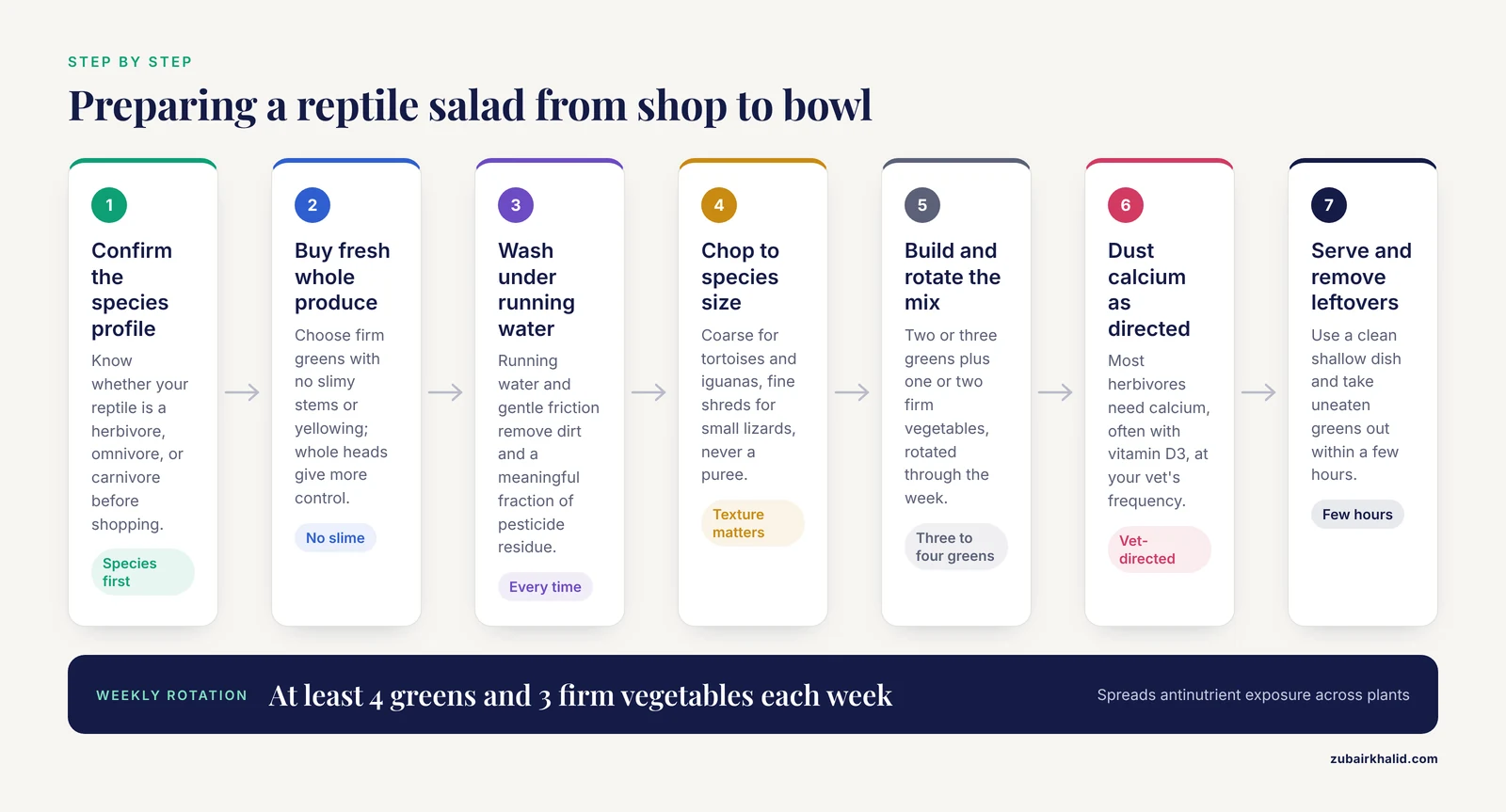
Here is the complete workflow, from grocery store to feeding bowl.
Step 1. Confirm your species' profile before you shop. Know whether your animal is a herbivore, omnivore, or carnivore, and roughly what percentage of the diet should be plants. If you are unsure, a single consultation with an exotics veterinarian settles it.
Step 2. Buy fresh, whole produce. Choose firm greens with no slimy stems or yellowing. Bagged salad mixes are acceptable in a pinch but are chopped, washed, and bagged in facilities where leafy greens are recognized as a microbiological risk category, since handling and slicing create openings that allow bacteria to colonize inner plant tissues [2]. Whole heads and bunches you chop yourself give you more control.
Step 3. Wash every vegetable thoroughly under running water. Running water and gentle friction remove surface dirt and a meaningful fraction of pesticide residue. Food safety research consistently identifies washing raw vegetables as a key consumer-level control step, precisely because many residues persist on crops eaten raw and unwashed [1]. For reptile keepers this step carries extra weight because a small animal may eat the same batch of greens for its entire life. Remove skins and outer leaves of heavily treated produce when in doubt.
Step 4. Chop to species-appropriate size. Tortoises and iguanas handle coarse chopping and tearing. Small lizards need fine shreds. The goal is a chopped mix, not a uniform puree, because varied texture encourages natural foraging behavior.
Step 5. Build a mixed salad, then rotate. Combine two or three greens with one or two firm vegetables. Mix unfamiliar items into a familiar base rather than offering a bowl of one new vegetable. Widespread research on feeding behavior shows that visual presentation and repeated exposure increase acceptance of vegetables, and although that literature comes from human and child nutrition studies, the practical lesson transfers well: keep the bowl colorful and keep offering a rejected item [3].
Step 6. Supplement as directed by your veterinarian. Most herbivorous reptiles need a calcium supplement, often with vitamin D3, dusted onto the salad. The correct product and frequency depend on your species and your UVB setup, so treat the dosing as a veterinary prescription rather than a forum recommendation.
Step 7. Serve on a clean, shallow dish in the correct spot. Place the food dish away from the basking zone if your species prefers eating at moderate temperatures, or within the warm zone if your species basks while digesting. Remove uneaten greens within a few hours.
Step 8. Clean up and wash your hands. Leftover plant matter ferments and grows bacteria quickly in a warm, humid enclosure. Discard it, wash the dish, and scrub your hands with soap and water. This protects both you and the animal, a point expanded in the hygiene section below.
Food Safety and Hygiene: The Part Most Guides Underweight
Reptile food safety runs in two directions, and both matter.
Contamination on the way in. Leafy vegetables such as lettuce, cabbage, and cress are recognized carriers of foodborne pathogens when handled or grown under poor conditions. A review of ready-to-eat salads notes that soils commonly harbor organisms including Listeria monocytogenes, Bacillus cereus, and Clostridium perfringens, that birds carry pathogens such as Salmonella and E. coli O157:H7 onto produce, and that reptiles and arthropods in cultivation fields have unrestricted access to crops and can serve as hosts or vectors for bacterial species [2]. Your reptile's greens travel the same supply chain as your own salad. Wash them as if a pathogen is present, because sometimes it is.
Contamination going the other way. Reptiles themselves are well-documented Salmonella carriers, which is why the AVMA and CDC advise handwashing after every reptile handling or enclosure cleaning session. Chopping vegetables on a board that then touches raw reptile food, or rinsing greens in a sink right after cleaning an enclosure, creates cross-contamination in both directions. Keep a dedicated cutting board and knife for reptile produce, and never wash produce in a sink used for soaking terrarium parts.
Frozen vegetables deserve special handling. A quantitative risk assessment of Listeria monocytogenes in frozen vegetables found that contamination is possible even in commercial product, and that thawing frozen vegetables at room temperature meaningfully raises the predicted risk of listeriosis compared with cooked servings [4]. For reptile owners this translates to a simple rule: never thaw frozen vegetables on the counter for hours and then serve them raw to a reptile. Either thaw them in the refrigerator and use them promptly, or skip frozen produce and rely on fresh greens. The same risk model showed that a heat step dramatically reduces risk, which is why herp keepers who use frozen vegetables for softening texture should warm them thoroughly and cool them before serving [4].
One final note on the produce supply chain: food safety researchers are actively evaluating bacteriophage treatments as a disinfection method for ready-to-eat foods including vegetables, precisely because surface decontamination of raw produce remains difficult [5]. That research has not yet reached your kitchen, which makes the running water wash in Step 3 the most important control you personally control.
Feeding Tips That Improve Acceptance and Nutrition
- Rotate relentlessly. A weekly rotation of at least four greens and three firm vegetables spreads antinutrient exposure across plants and prevents the boredom-based food refusal seen in iguanas and tortoises fed one green for months.
- Feed in the morning for diurnal herbivores. Iguanas and tortoises forage during the day and digest best with basking access afterward.
- Offer new items alongside familiar ones. Chop a new vegetable into a proven favorite. Repeated neutral exposure, not force, converts most hesitant feeders within a few weeks.
- Match moisture to species. Desert species such as uromastyx do better with drier, fibrous mixes, while forest species and box turtles tolerate and benefit from higher-moisture vegetables.
- Use food as enrichment. Scatter feeding for tortoises, hanging leafy bundles for iguanas, and whole leaves that require tearing all add activity and reduce stereotypic pacing.
- Track what goes in. Keep a simple log of what you offered and what was eaten. This log is the single most useful document you can bring to a reptile vet appointment.
Reptile Enclosure Setup That Supports a Vegetable Diet
Vegetables only convert to health inside an enclosure that lets the animal digest them properly. Three setup elements connect directly to plant-based feeding.
A thermal gradient. Digestion in herbivorous reptiles is temperature dependent. An animal kept too cool cannot process fibrous greens efficiently, which leads to slow gut transit, bacterial overgrowth, and regurgitation. Wild reptile research illustrates how precisely these animals manage temperature: a field study of overwintering reptiles in agricultural landscapes found that individuals actively selected retreat sites based on thermal and physical characteristics, favoring specific rock attributes that buffered them toward preferred body temperatures [6]. Your captive reptile is running the same internal thermostat, except it can only choose among the options you provide. Give it a warm basking zone, a mid-gradient area, and a cooler retreat so it can select, exactly as it would in the field.
Full-spectrum UVB lighting. Herbivorous reptiles synthesize vitamin D3 in skin exposed to appropriate UVB wavelengths, and that vitamin is what allows the calcium in collard greens and dandelion greens to be absorbed. Without functioning UVB or dietary D3 supplementation, the finest salad in the world still produces metabolic bone disease. The Merck Veterinary Manual's reptile husbandry sections treat UVB provision as standard care for diurnal herbivores, and every reputable reptile veterinarian will ask about your bulb type, age, and placement before discussing diet.
Appropriate humidity and hydration. Water dish, periodic soaks for tortoises, and species-correct humidity all support renal health, which is the organ system most stressed by dietary protein errors and chronic dehydration. Clean water daily is nonnegotiable.
For context on why these standards matter beyond your own animal: herpetofauna researchers have documented continuing population declines in wild reptile and amphibian species and note that habitat degradation and poor field management compound each other [7]. Well-kept captive reptiles with documented, evidence-based husbandry reduce pressure on wild-caught supply and support the conservation goals that herpetologists have spent decades advancing.
Reptile Care Checklist for a Vegetable-Feeding Household
Run this checklist weekly. It doubles as a health-monitoring tool.
- Fresh greens prepared and washed, with at least three green varieties rotated this week
- Calcium supplement dusted at the veterinarian-directed frequency
- UVB bulb checked for age and output, replaced on the manufacturer schedule
- Basking temperature and cool-side temperature verified with a digital thermometer or temperature gun
- Humidity within the species target range
- Clean water dish, refilled daily
- Uneaten food removed within hours of feeding
- Food dish and water dish washed, hands washed after every contact
- Feces and urates observed for normal color and consistency
- Body condition eyeballed weekly, spine and hip prominence noted
- Annual or semiannual exotics vet exam scheduled, with a fresh fecal parasite check
- Food log updated, including any new items and any refusals
Common Mistakes Owners Make With Reptile Vegetables
Mistake 1: Building the salad around iceberg lettuce. Iceberg lettuce is mostly water with negligible calcium. A reptile filling up on it appears to eat well while receiving almost nothing. Romaine is a modest improvement but should still be a minor component.
Mistake 2: Daily spinach or beet greens. High-oxalate greens as daily staples undermine calcium absorption and are among the most cited contributors to metabolic bone disease in herbivorous lizards. Treat them as occasional accents.
Mistake 3: Skipping the wash. Because many pesticide residues persist on produce consumed raw and unwashed, and because consumers frequently eat produce with no washing at all, food safety researchers flag washing as an urgent, simple protective step [1]. For a small, long-lived reptile eating the same handful of crops for decades, the residue exposure compounds.
Mistake 4: Leaving greens in the enclosure all day or overnight. Warm, humid enclosures turn wilted salad into a bacterial culture. Producers face exactly this problem with ready-to-eat vegetables, where mishandling of raw produce allows pathogenic microorganisms to multiply [2]. In a terrarium, the spoilage also attracts fungus gnats and fruit flies and can trigger shell or skin infections in animals that walk through it.
Mistake 5: Thawing frozen vegetables at room temperature for hours. The Listeria risk model for frozen vegetables showed that room-temperature thawing increases predicted risk compared with prompt, controlled handling, and that cooking inactivates the organism [4]. Room-temperature thaw followed by raw serving combines the two riskiest choices.
Mistake 6: Feeding vegetables to a snake. Snakes are carnivores. Vegetables in a snake enclosure are decoration, waste, and a contamination source.
Mistake 7: Assuming one diet fits all reptiles. A tortoise diet fed to a bearded dragon creates protein deficiency in a growing juvenile. A bearded dragon diet fed to an iguana creates kidney disease. Species first, always.
Mistake 8: Trusting produce safety over supply-chain realities. Field-grown vegetables share ground with wild animals, and studies of produce contamination specifically document reptiles as one of the animal groups with access to cultivation fields that can harbor and transfer bacterial pathogens [2]. That cuts both ways for reptile keepers. It is a reason to wash produce thoroughly, and a reminder that the reptile-to-human Salmonella risk in your own home deserves the same respect.
Troubleshooting: When Your Reptile Refuses Vegetables
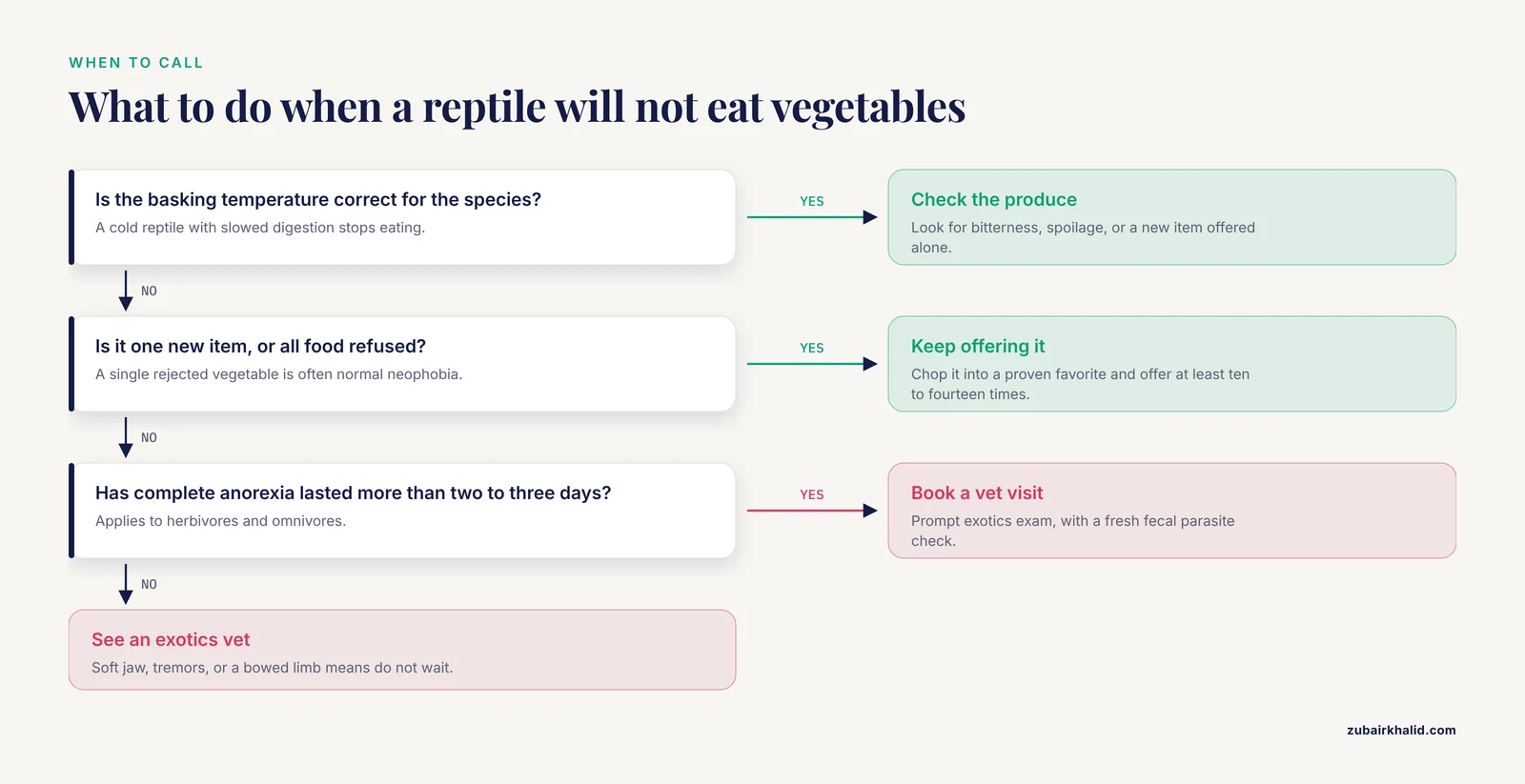
Picky iguanas and tortoises. First, check temperatures, because a cold reptile with slowed digestion stops eating. Next, increase color contrast in the bowl and finely chop new items into proven favorites. Wild reptiles select food and shelter based on sensory cues, and willingness to eat a presented item responds strongly to visual presentation, a relationship documented across feeding-behavior research including studies of visual cues and food acceptance [3]. Give a new vegetable at least ten to fourteen consistent offerings before writing it off.
Juvenile omnivores that ignore greens. This is often normal. Juvenile bearded dragons are insect-focused by design. Keep offering finely chopped greens daily alongside insects and the plant interest typically emerges with age.
Sudden rejection of a previously accepted vegetable. Check the produce itself for bitterness or spoilage, check mouth temperature by confirming basking access, and check for oral lesions or retained shed. A reptile that stops eating familiar food entirely, rather than one item, moves you toward the veterinary criteria below.
Loose stools after a diet change. Cut back fruit and high-moisture vegetables, re-anchor the diet on fibrous greens, and have a fecal examination performed to rule out parasites, which are extremely common in reptiles regardless of diet.
Limitations and When to Contact a Veterinarian
Every reptile is an individual, and species-level feeding guidance cannot replace an in-person examination by a reptile veterinarian who knows your animal's age, history, and body condition. Contact an exotics veterinarian promptly if you observe any of the following:
- Complete anorexia lasting more than two to three days in a herbivore or omnivore, or any refusal of multiple consecutive meals in an underweight animal
- Signs of metabolic bone disease, including soft or rubbery jaw, tremors, reluctance to walk or climb, or a bowed or fractured limb
- Diarrhea, persistently runny or discolored urates, or undigested food in stools
- Visible weight loss, prominent spine or hip bones, or sunken eyes
- Lethargy, prolonged hiding outside normal brumation patterns, or open-mouth breathing
- Any history of animal-protein feeding in a herbivorous species, which warrants kidney and metabolic evaluation even if the animal currently looks well
Do not wait out these signs. Reptiles mask illness until disease is advanced, and the interventions that reverse early nutritional disease are simple compared with the ones required later.
Frequently Asked Questions
Can bearded dragons eat vegetables every day?
Yes. Adult bearded dragons should have vegetables or greens offered daily, making up roughly half or more of the diet, while juveniles need proportionally more insects. Use a rotating base of collard, mustard, and dandelion greens with squash and green beans.
Can iguanas eat spinach?
Only in small, occasional amounts. Spinach is high in oxalates, which bind calcium and interfere with absorption, so it should never be a daily staple for a green iguana. Collard, mustard, and dandelion greens are far better bases.
Can snakes eat vegetables?
No. Snakes are carnivores that derive complete nutrition from whole prey such as appropriately sized rodents or fish. Vegetables provide no benefit to them and should not be placed in their enclosure.
Do I need to wash vegetables for my reptile?
Yes, every time. Pesticide residues can persist on produce eaten raw and unwashed, and leafy vegetables can also carry surface bacteria from soil and field exposure. Wash all produce under running water before chopping, and use a dedicated cutting board.
Can reptiles eat frozen vegetables?
Occasionally, with precautions. Thaw frozen vegetables in the refrigerator rather than at room temperature, use them promptly, and warm them thoroughly if you serve them softened, because frozen vegetables can carry Listeria and room-temperature thawing raises the risk.
What vegetables can baby reptiles eat?
Juvenile herbivores can eat the same safe greens as adults, chopped finely. Juvenile omnivores such as young bearded dragons should eat mostly insects with small daily green offerings, shifting toward a vegetable-heavy diet as they mature.
How do I get my reptile to eat more vegetables?
Mix new vegetables into familiar favorites, keep the mix colorful and varied, offer food in the morning for diurnal species, and keep offering a rejected item for at least two weeks. Confirm your temperatures first, because a reptile kept too cool will refuse food.
Can tortoises eat lettuce?
Romaine and leaf lettuce are safe but nutritionally modest, and iceberg lettuce is too low in nutrients to be useful. Base the diet on collard, mustard, and dandelion greens and use lettuces only as minor additions or moisture sources.
Sources
- Residue of Pesticides in Fruits, Vegetables, and Their Management in Ethiopia
- A review on microbiological safety of Ready-To-Eat Salads
- Visual Cues, Liking, and Emotional Responses: What Combination of Factors Result in the Willingness to Eat Vegetables Among Children with Food Neophobia?
- A Quantitative Risk Assessment Model for Listeria monocytogenes in Non-Ready-to-Eat Frozen Vegetables
- Phage therapy: a revolutionary shift in the management of bacterial infections, pioneering new horizons in clinical practice, and reimagining the arsenal against microbial pathogens
- Factors affecting overwintering retreat-site selection in reptiles in an agricultural landscape
- Reptiles and amphibians as targets for nature management