Turtles Enrichment Ideas That Match Natural Behavior
By Dr. Zubair Khalid, DVM, MS, PhD ·
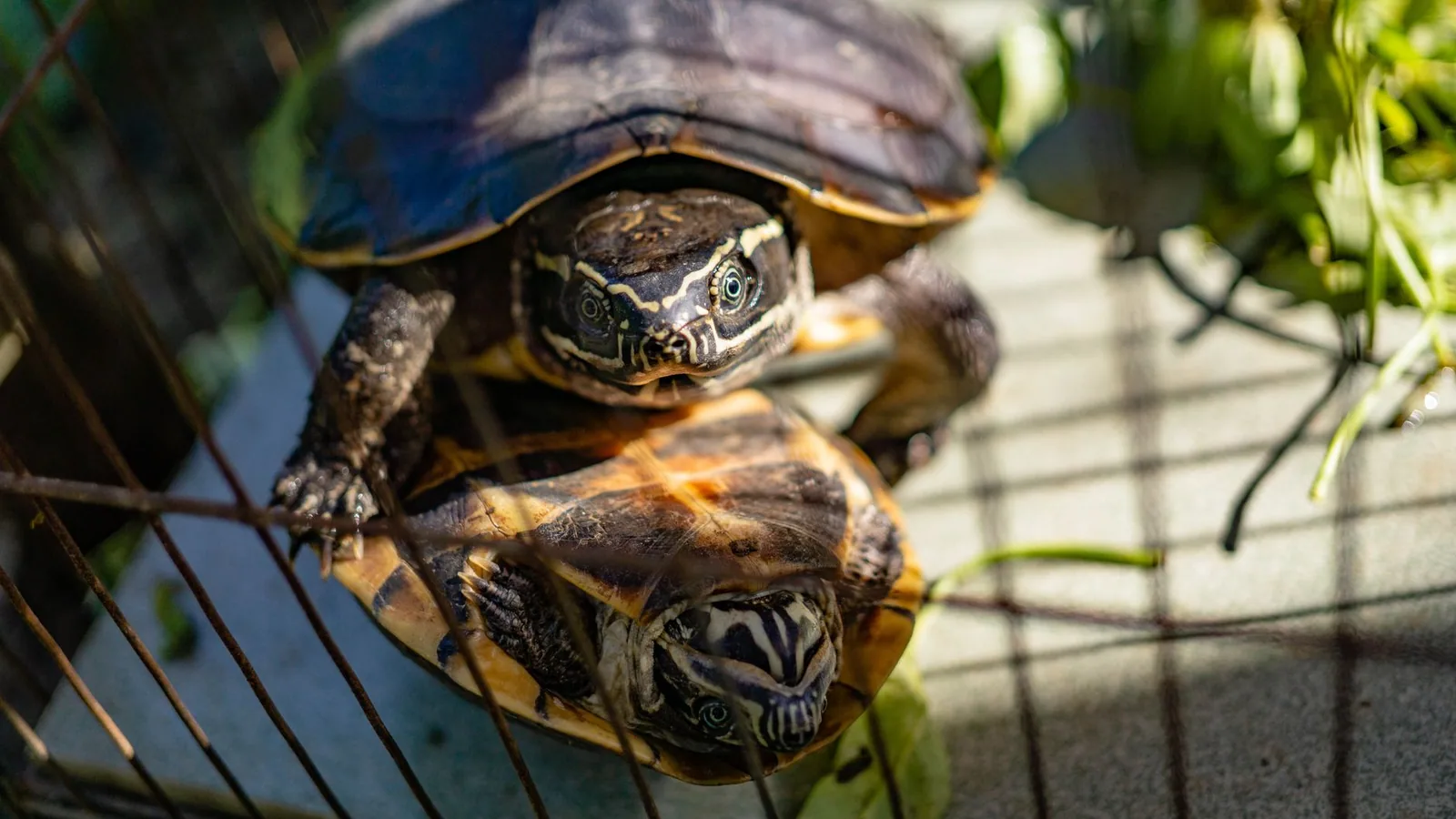
The turtle enrichment ideas that hold up to research are the ones built around behavior a turtle already owns: foraging, hunting, grazing, exploring, basking, and swimming. Environmental enrichment uses external stimuli to improve psychological and physiological wellbeing and to promote natural abilities and behaviors, and it is now a standard part of sea turtle rehabilitation programs [1]. For a pet turtle, the practical translation is simple. Make food take effort, add objects shaped for swimming through and investigating, add scent, and give the animal choices about where to rest, warm up, and hide. Controlled trials in both sea turtles and freshwater turtles show that these changes reduce escape behavior, reduce biting injuries in groups, and increase exploration [2][3].
This article is educational and is not a substitute for veterinary diagnosis or treatment.
At a Glance: Turtle Enrichment You Can Set Up Today
| Natural behavior to target | Enrichment idea | Safety check |
|---|---|---|
| , - | , - | , - |
| Foraging and grazing | Scatter greens through the water at different depths instead of one pile | Remove uneaten food the same day to protect water quality |
| Hunting live prey | Offer live food in a separate container for species that hunt | Keep the total daily ration unchanged |
| Investigation by smell | Rub a clean floating object with fish or shrimp and rotate it in | Use smooth, food-safe materials with no scent of their own |
| Swimming and exploring | Add a floating ring or a sinking cylinder to swim through and around | No gaps that can trap a head, limb, or shell |
| Basking choice | Provide more than one basking surface plus a shaded retreat | Keep temperatures and UVB at species-appropriate levels |
| Problem solving | Tuck food into a weighted pipe section or under a plant | Clean and disinfect items between rotations |
Why Enrichment Matters for Turtles
Environmental enrichment is defined in the rehabilitation literature as a series of techniques and methods that use external stimuli to enhance psychological and physiological wellbeing and to promote natural abilities and behaviors [1]. In sea turtle rehabilitation, enrichment is applied during recovery to keep natural behavior intact, with the stated goal of improving welfare during captivity and raising the odds of survival after release [1].
Reptile enrichment science is still young. Researchers running a trial on freshwater turtles at a public aquarium noted that enrichment in reptiles, and in freshwater turtles in particular, has been very little studied compared with other taxa [3]. That gap is closing. Welfare frameworks built on the Five Domains model and the Welfare Quality protocol have been proposed for reptiles in both zoo and private settings, organized around environment, nutrition, physical health, and behavior, and using both resource-based and animal-based indicators [4]. Zoo welfare reviews describe a parallel shift in goals, away from simply preventing obvious suffering and toward documenting positive states, which requires understanding the specific needs of each species [5]. Welfare scientists likewise recommend starting from agreed definitions and frameworks before building assessment tools, so that results stay consistent and comparable [6].
The need shows up even in professional facilities. In a welfare audit of a sea turtle conservation hatchery, feeding management and health scored well, but the natural behavior category received the lowest score, and the recommended improvements centered on enclosure enrichment and feed variation [7]. Investigators studying a large sea turtle farm documented distinct signs of physical injury and disease alongside abnormal arousal and discomfort-related behaviors, and concluded that the animals were showing captivity-related stress [8]. A bare tank is not a neutral environment for a turtle. Under-stimulation shows up in behavior, and behavior is where you will see enrichment work.
Signs of a Bored Turtle
Boredom in turtles is not a mood you can ask about. It is a pattern of behavior, and researchers use these same patterns as welfare indicators.
Escape behavior. Repeated paddling at the glass, digging at corners, and trying to climb the walls are the classic signs. In a group of 15 cooters and sliders at a public aquarium, this boundary-directed behavior was common enough that researchers chose it as the main target of their enrichment trial [3].
Repetitive swimming. Swimming the same fixed loop along the same walls, with little variation, is a recognized negative sign. In sea turtles, a higher proportion and longer duration of specific swimming patterns indicates negative welfare, and standardized arenas now allow these patterns to be quantified for individual animals [9].
Shifted activity budgets. When enrichment was added to the freshwater turtle tank, random swimming and focus on the enrichment increased before feeding, while basking decreased at the group level before feeding, and aggression and submission also rose before feeding [3]. A turtle that never leaves the water, or never enters it, deserves a closer look.
Aggression in groups. Chasing and biting tank mates is a documented captivity problem in juvenile turtles, and enrichment devices reduced bite wounds in a controlled trial [2].
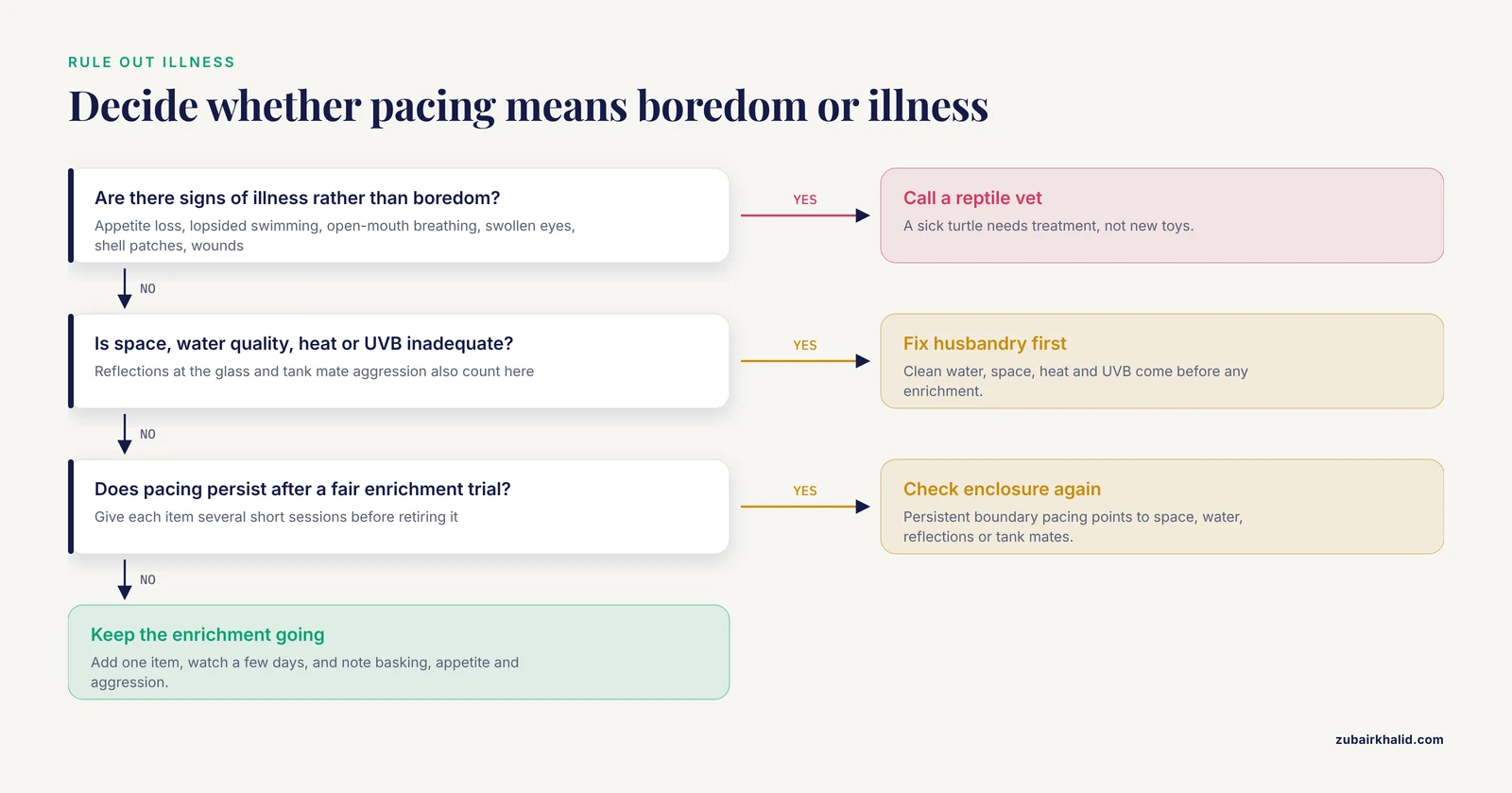
One caution applies to all of these signs. Each can also be an early sign of illness. A turtle that suddenly starts pacing, stops eating, or becomes lethargic needs a health check before you treat the problem as boredom. The escalation criteria at the end of this article list the red flags.
Turtle Enrichment Ideas, Step by Step
Keeping a turtle entertained over the long term is a rhythm, not a shopping list. You observe, change one thing, watch the response, and keep what works. The six steps below build that rhythm around natural behavior.
Step 1: Match Enrichment to Your Species' Natural Behavior
Aquatic turtles such as sliders and cooters spend their day swimming, foraging, and basking. Grazing species crop plants through much of the day. Some species are ambush hunters that wait for prey to come close. Terrestrial and semi-terrestrial species probe substrate, dig, and use cover. Spend a week watching your turtle and write down what it already does. Every enrichment idea in this article extends a behavior on that list rather than replacing it. If you are unsure what your species does in the wild, the Merck Veterinary Manual's exotic animal resources and evidence-based husbandry guides such as ReptiFiles describe species-typical behavior and habitat use.
Step 2: Turn Feeding into Foraging
Food that appears in the same spot every day wastes the strongest enrichment opportunity you have. Scatter leafy greens through the water at different depths and anchor them so they move. Clip food at the surface one day and weight it toward the bottom the next. For species that hunt live prey, offer live items occasionally in a separate container so the turtle gets a full search-and-capture sequence. Feed variation was one of the specific improvements recommended in the hatchery welfare audit [7].
Scent is a powerful lever. In the freshwater turtle trial, objects scented with fish attracted significantly more interest than identical unscented objects [3]. Rubbing a clean floating ball with fish or shrimp water turns an ignored object into a target. Keep the total daily ration the same, because enrichment calories count toward the diet.
Step 3: Add Structure to the Habitat
Open water with nothing in it gives a turtle nowhere to go. Add plants, live or silk, driftwood, cork bark, smooth rocks, a hide on the land area, and shelves at different depths. The goal is choice: shade, shelter, open water, and cover, all reachable without effort. For terrestrial turtles, add logs, slopes, leaf litter, and edible plantings. Shape matters for floating objects, and the toy section below covers which shapes turtles actually use.
Step 4: Add Scent and Visual Variety
Rotate objects with different smells, colors, and textures. Visual novelty deserves a place even when a turtle seems to ignore it, because objects that drew little direct interest still changed behavior on the days they were present, a finding covered in the toy section. Scented items, textured items, and items that move with the water each add a different sensory layer.
Step 5: Vary Basking and Microhabitats
Offer more than one basking option, one brighter and one dimmer, plus a shaded retreat in the water. Semi-terrestrial species benefit from both dry and moist retreats. Keep temperatures and UVB lighting at the levels recommended for your species in the Merck Veterinary Manual or a species-specific husbandry guide, since enrichment never justifies drifting outside proper thermal ranges.
Step 6: Observe, Rotate, and Repeat
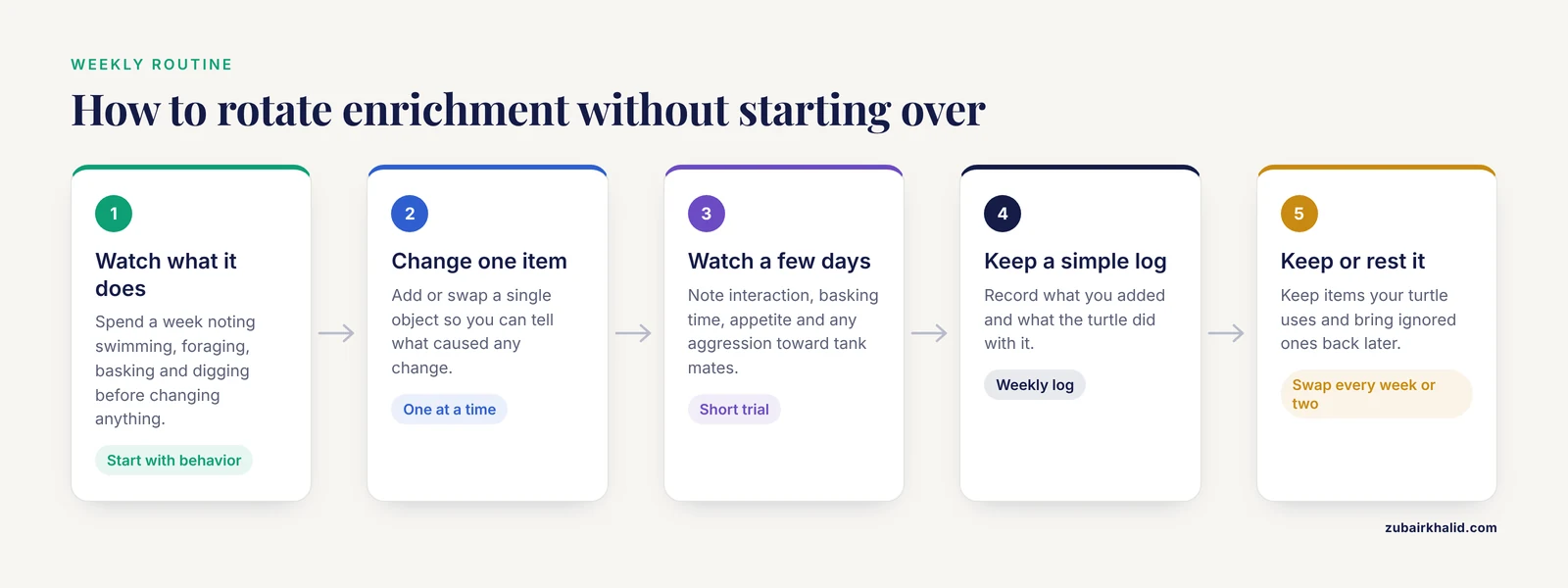
This is the core of how to keep a turtle entertained for years rather than days. Introduce one change at a time and watch for a few days. Keep a simple log of what you added, what the turtle did, basking time, appetite, and any aggression. Keep the items your turtle uses. Rest the ones it ignores and bring them back later. Novelty itself has measurable effects, which is why rotation works better than a permanent pile of toys.
DIY Turtle Enrichment Projects
Most effective turtle enrichment costs little or nothing. The devices tested in the green turtle trial were simple geometric shapes, not commercial products [2]. Build from that principle.
Safety criteria come first, for every project:
- Food-safe materials only, since turtles grab items by mouth.
- No parts small enough to be swallowed.
- No gaps that can wedge a head, limb, or shell.
- Smooth, sanded edges.
- Easy to remove, clean, and disinfect.
- Remove anything that fouls, degrades, or grows slime you cannot scrub off.
Floating swim-through ring. Form a loop from food-safe rigid plastic or PVC, sand every edge, and size it so your turtle can pass through with room to spare. Ring shapes drew the most sustained interaction of any device tested in juvenile green turtles [2]. Weight it lightly so it sits at the surface and drifts.
Sinking pipe feeder. A short section of wide pipe, weighted, with leaves tucked into and around it, turns grazing into a search task.
Scented investigation objects. Keep a rotation of smooth, clean objects such as ceramic or glass pieces too large to swallow, and rub one with fish or shrimp before adding it. Swap scents between rotations.
Scatter tray. Feed greens across a wide, shallow tray instead of one pile, and move the tray to a new location each time.
Live plant patch. Plant an edible aquatic species your veterinarian or species guide confirms is safe, and let your turtle crop it. Rinse new plants thoroughly and source them from suppliers who do not use pesticides.
Dig box for terrestrial species. A deep box of clean organic topsoil and leaf litter gives digging and probing behavior a place to happen. Spot-clean it and replace the contents regularly.
Best Toys for Turtles: What the Evidence Supports
The clearest data on turtle toys come from two trials.
In the green turtle device trial, juveniles in a head-start program were exposed to four shapes of enrichment device, ring, hollow square, sphere, and cylinder, alongside unenriched controls for a 10-week trial [2]. Rings drew the most interaction time, hollow squares the second most. Bite wounds from tank mates dropped significantly in every enriched group, with the largest reduction in the sphere group. Growth and feed utilization did not differ between groups, meaning the devices supported activity without interfering with normal development [2].
In the freshwater turtle trial, plain colored objects drew relatively little direct interest from the 15 cooters and sliders, yet escape behavior still decreased at the whole-group level on days with new enrichment before feeding [3]. The lesson is that a toy does not need to become a favorite to change a turtle's day.
Selection criteria for any turtle toy:
- Openings to swim through or poke into, such as rings, arches, and tunnels.
- Materials that tolerate water and disinfection without leaching.
- A size matched to your turtle, large enough to prevent swallowing.
- Enough weight or anchoring to stay where placed, or light enough to drift by design.
- Surfaces you can scrub.
Avoid painted items that are not food-safe, brittle plastic that sheds fragments, anything with a chemical smell of its own, and any object that traps debris.
Common Mistakes to Avoid
- Adding everything at once. Change one item and observe. In the freshwater turtle group, responses to the same enrichment varied widely between individuals, with some turtles increasing escape behavior and aggression on enrichment days while others decreased them [3].
- Judging enrichment by human standards. Direct interaction is not the only measure of benefit, as the colored-object trial demonstrated.
- Letting enrichment replace core husbandry. Clean water, adequate space, proper heat, and UVB come first. The abnormal behaviors documented in farmed sea turtles were attributed to problematic management and captivity-related stress, not to a missing toy [8].
- Food-heavy enrichment every day. Foraging projects should shift where and how food is earned, not how much is eaten.
- Dirty enrichment. Biofilm on neglected items is a water quality problem. Clean items between rotations.
- Using enrichment to patch incompatible tank mates. Enrichment is not a substitute for separating turtles that fight, and wounded turtles need veterinary care.
- Releasing an unwanted pet turtle outdoors. Released sliders have become invasive populations in Europe, where an expert welfare analysis of management options flagged behavioral welfare concerns when captive containment conditions are inadequate [10]. The same principle applies anywhere. Rehome through a herpetological society or reptile rescue instead.
Troubleshooting Turtle Enrichment
My turtle ignores everything. Add scent to objects, try shapes with openings, place items along the paths your turtle already swims, and give each item several short sessions before retiring it.
Escape behavior continues despite enrichment. Look at the enclosure itself: space, water quality, reflections at the glass, tank mate aggression, and health. Persistent boundary pacing after a fair trial of enrichment points to one of those causes.
My turtle fears a new object. Remove it and reintroduce a smaller version weeks later. Fear responses fade with gradual exposure.
Aggression continues despite enrichment. Separate the turtles. Repeated biting is a management problem, not an enrichment problem.
Enrichment fouls the water quickly. Use fewer items, move them away from the filter intake, and clean on a fixed schedule.
Welfare and Safety Points
Behavior is your welfare meter. For sea turtles, behavioral assessment is described as the most valuable welfare indicator because it is non-invasive and more cost-effective than physical, nutritional, or environmental assessments, and standardized frameworks for quantifying swimming patterns automatically are now being developed [9]. You do not need that equipment. A weekly log of basking time, swimming patterns, feeding response, object interaction, and any wounds gives you the same signal at home.
Hygiene rules:
- Disinfect enrichment items between rotations with a reptile-safe disinfectant, rinse thoroughly, and dry.
- Remove food debris the same day.
- Rinse new live plants and never collect them from areas treated with herbicides or pesticides.
- Wash hands before and after tank maintenance.
Safety rules:
- Never add items that can trap a turtle underwater.
- Watch the first session with any new object.
- Remove objects during feeding if they crowd the feeding area.
Limitations and When to Contact a Veterinarian
Enrichment research in turtles is limited. The strongest trials involve sea turtles in rehabilitation and head-start programs and a small number of freshwater species in zoo or aquarium settings, and the proposed reptile welfare frameworks for private keepers are conceptual foundations that still await validation [4]. Treat published findings as starting points and adjust to your individual animal, because responses differ between species and between individuals. Individual cases need a veterinarian.
Contact a reptile veterinarian promptly if your turtle shows any of the following:
- Refusal to eat beyond what is normal for the species and season
- Lopsided swimming or inability to submerge
- Open-mouth breathing, nasal bubbles, or prolonged gaping
- Swollen or closed eyes
- Soft, discolored, or foul-smelling shell patches
- Wounds from tank mates
- Sudden lethargy or an abrupt change in behavior
- Straining to defecate or urinate
The Association of Reptilian and Amphibian Veterinarians maintains a directory of reptile veterinarians, and the Merck Veterinary Manual's exotic animal section is a reliable reference for the species-specific husbandry parameters to discuss at that visit.
Frequently Asked Questions
What are the best toys for turtles?
Rings, tunnels, and spheres with openings have the strongest evidence behind them, especially when they carry a food scent. Choose food-safe, cleanable materials sized to your turtle, and rotate a few items rather than leaving every toy in permanently.
How can I keep a turtle entertained in a small enclosure?
Rotate foraging tasks, scented objects, and structure, and upgrade the enclosure as soon as you can. Enrichment improves welfare inside any enclosure, but it cannot compensate for inadequate space or dirty water.
What are the signs of a bored turtle?
Glass pacing, repetitive swimming loops, restless digging, aggression toward tank mates, and unexplained inactivity are the main signs. Rule out illness with a veterinarian before treating these as boredom, because the same signs can indicate disease.
What DIY turtle enrichment can I make at home?
A floating swim-through ring, a sinking pipe feeder, scented stones, a scatter-feeding tray, an edible live plant patch, and a dig box for terrestrial species all work. Follow food-safe construction rules and clean every item between rotations.
How often should I rotate turtle enrichment?
Swap one or two items every week or two, keep the items your turtle clearly uses, and rest the rest. One change at a time makes it easy to see what each item does.
Do all turtles respond to enrichment the same way?
No. Responses differ between species and between individuals, so watch your own turtle and build around what it uses. An item one turtle ignores may become another turtle's favorite.
Can enrichment replace a bigger tank or better filtration?
No. Enrichment works on top of proper space, clean water, heat, and UVB lighting. If any of those are missing, fix them first.
When should I stop adding enrichment and call a veterinarian?
Call a veterinarian when signs point to illness rather than boredom, including appetite loss, lopsided swimming, breathing problems, eye swelling, shell changes, wounds, or a sudden change in behavior. A sick turtle needs treatment, not new toys.
Sources
- Rehabilitation of Marine Turtles and Welfare Improvement by Application of Environmental Enrichment Strategies.
- Enrichment devices for green turtles (Chelonia mydas) reared in captivity programs.
- Can colored object enrichment reduce the escape behavior of captive freshwater turtles?
- Laying the groundwork for reptile welfare assessment in zoos and private keeping: A literature-based proposal
- Zoo Animal Welfare Assessment: Where Do We Stand?
- Animal welfare definitions, frameworks, and assessment tools: Advancing the measurement and laying the foundation for improved animal welfare through a three-step approach
- Assessment of Sea Turtle Welfare Using an Animal Welfare Approach at Nipah Beach Hatchery
- Welfare and Environmental Implications of Farmed Sea Turtles
- Quantification of sea turtle swimming patterns using a standardized arena to minimize effort in welfare assessment.
- Animal welfare implications of management strategies for invasive freshwater turtles