Turtle Care Guide: Daily, Weekly, and Monthly Routine
By Dr. Zubair Khalid, DVM, MS, PhD ·
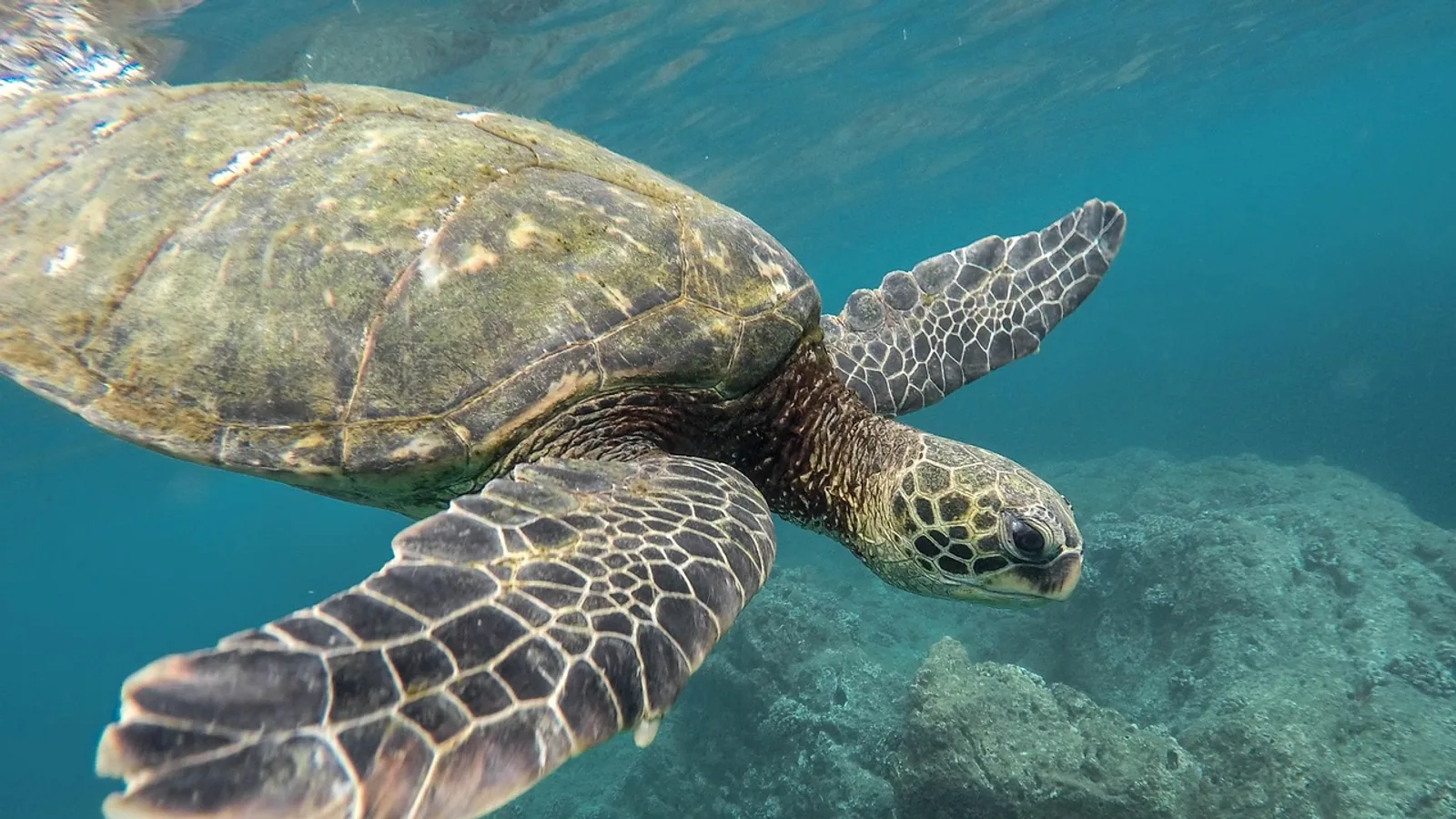
A workable turtle care routine takes about ten minutes a day, roughly an hour spread across the week, and one to two hours each month. The daily work is observation, feeding, and spot cleaning. The weekly work is water care, equipment checks, and enrichment. The monthly work is deep cleaning, weighing and measuring, and a hands-on health check. Turtles live for decades and hide illness well, so the routine is what keeps small problems from becoming emergencies.
Turtles are popular partly because people believe they are easy. In a survey of more than 200 reptile owners in Hong Kong, 35% kept turtles, a preference the authors linked to cultural factors and perceived ease of care [1]. Veterinarians who specialize in chelonians describe a different reality, noting that turtles and tortoises often require more space and time than snakes or lizards and that many owners are unaware of what proper care involves [2]. This guide turns those needs into a schedule. It explains how to take care of a turtle step by step, provides a turtle daily care checklist, and details weekly turtle care tasks and monthly ones, so turtle care for beginners becomes a habit rather than a guess.
Turtle Care Routine at a Glance
| Frequency | Core tasks | Time |
|---|---|---|
| Every morning | Visual health check, feed on schedule, remove leftovers, verify water and basking temperatures, spot clean | 5 to 10 minutes |
| Every evening | Quick behavior check, remove uneaten food, write one line in your log | 2 to 5 minutes |
| Weekly | Partial water change, rinse filter media, test water, inspect equipment and UVB bulb log, rotate enrichment, brief handling and shell check | 30 to 60 minutes |
| Monthly | Deep clean surfaces and decor, weigh and measure, hands-on health check, full equipment inspection, review records, plan veterinary visits | 1 to 2 hours |
| Ongoing | Record appetite, basking, swimming, and anything unusual | A few minutes a day |
This article is educational and is not a substitute for veterinary diagnosis or treatment.
How to Take Care of a Turtle: Build the Foundation First
A routine cannot rescue a bad setup. Before you schedule anything, confirm the basics for your species.
Know your species and its space needs
Aquatic species such as red-eared sliders and cooters need a large filtered tank with a dry basking dock. Box turtles need shallow water plus substantial land area. Mediterranean and Russian tortoises, among the most popular pet chelonians, do best in secure outdoor enclosures. In a survey of 1,075 tortoise owners, more than 75% housed their animals outdoors with a greenhouse or cold frame, an approach the authors described as the most species-appropriate form of husbandry [3]. If you are unsure how much space your species needs, ask a reptile veterinarian or consult an evidence-based guide such as ReptiFiles before you buy.
Provide a thermal gradient and choices
Turtles regulate body temperature by moving between zones. Give every enclosure a warmer basking area, a cooler area, and shade. Farmed green sea turtles given half-shaded tanks used the shade structures, and turtles kept in full sun had significantly higher water and body temperatures than turtles with shade available [4]. Zoo researchers who remotely monitored aquatic turtles around the clock found the animals spent more time in areas with ambient light than under heat or UV lamps, and that each individual split time on land, logs, and water differently [5]. The lesson for a home routine is simple. Offer options, then watch which ones your turtle actually uses.
Get water, lighting, and filtration right
Aquatic turtles produce heavy waste loads, so filtration and regular water changes carry most of the hygiene work. Use a thermometer for both the water and the basking surface, a thermostat on heaters, and full-spectrum lighting with UVB so the animal can synthesize vitamin D. UVB output declines long before the bulb stops glowing, so log the install date and replace bulbs on the schedule printed on the packaging. The Merck Veterinary Manual's reptile resources and VCA Animal Hospitals' reptile care guides are good places to find species-specific temperature and lighting ranges, and your reptile veterinarian can confirm the numbers for your animal.
Establish a behavioral baseline
Every routine depends on knowing what normal looks like for your individual turtle. Spend the first few weeks noting appetite, basking duration, swimming style, breathing, and activity times. Behavioral assessment is considered the most valuable welfare indicator in turtles because it is non-invasive and less costly than repeated physical examinations [6]. Your baseline becomes the reference point for every check on the lists below.
Your Daily Turtle Care Checklist
Daily care is mostly watching, feeding, and light cleaning. Ten focused minutes in the morning and two in the evening cover it.
Morning, 5 to 10 minutes
- Look before you feed. Count breaths, check posture and buoyancy, and watch one lap of swimming. More than 90% of surveyed reptile owners said they watched for normal behaviors such as locomotion and breathing, and this kind of observation correlated with better reported well-being in long-term pets [1]. In sea turtles, researchers have tied specific swimming patterns, when those patterns take up a larger share of the day, to poor nutritional and physical condition, which is why swimming style belongs on a daily checklist [6].
- Feed on the schedule your veterinarian set for your species and age. Feed aquatic turtles in the water or in a separate container, and remove whatever is not eaten promptly so it does not foul the water.
- Verify temperatures. Read the water thermometer and the basking surface temperature, and confirm the heater, filter, and lights are running. A glance at indicator lights catches most equipment failures before they become emergencies.
- Spot clean. Lift out feces, shed skin, or leftover food with a net, and wipe the basking dock if it is soiled.
- Refresh drinking water for terrestrial species and confirm the shallow water dish is clean.
Evening, 2 to 5 minutes
Do a second visual pass. Problems often show first as a skipped basking session or a turtle that lingers at the bottom. Write one line in a log, even if the note is "all normal." Trends across days are what make the log useful.
Handling during the daily routine
Keep out-of-water time short. In juvenile loggerhead sea turtles, dry-docking of 30 minutes or more raised circulating corticosterone, a stress hormone, from 1.51 to 5.28 nanograms per milliliter, while shorter sessions did not [7]. Pet aquatic turtles should also spend minimal time out of water outside of cleaning and health checks. When you do handle, support the whole body, keep the session brief, and wash your hands before and after. Regular, calm handling beats rare, prolonged handling, because hatchling sea turtles handled once a week showed no significant stress hormone increase while animals handled less often did, an indication that turtles acclimate to a consistent routine [8].
Weekly Turtle Care Tasks
Set a fixed day each week. Most keepers pair water care with enrichment and a short health check so nothing gets skipped.
Water care for aquatic turtles
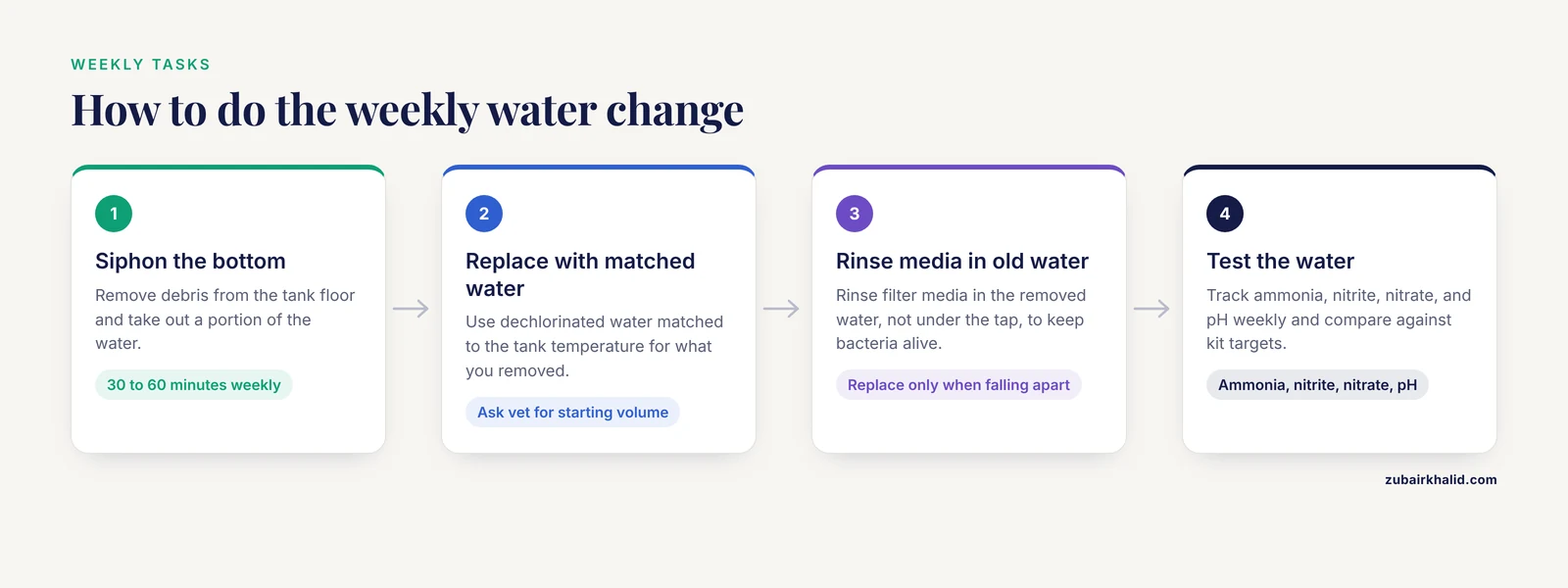
- Change a portion of the water. Siphon debris from the bottom and replace what you remove with dechlorinated water matched to the tank temperature. The right volume depends on tank size, filter capacity, and stocking, so ask your reptile veterinarian for a starting point and adjust based on your test results.
- Rinse filter media in the water you removed rather than under the tap, so the beneficial bacteria that process waste survive. Replace media only when it falls apart.
- Test the water with an aquarium test kit. Track ammonia, nitrite, nitrate, and pH weekly, compare results against the targets on the kit, and confirm species-specific targets with your veterinarian.
Equipment and lighting checks
Check heater function, thermostat accuracy, and filter flow. Confirm the UVB bulb is within its replacement window and note the date. Output falls invisibly long before a bulb burns out, which is why the log matters more than appearances.
Enrichment rotation
Enrichment belongs on the weekly list, not on the wish list. In a case study of 15 cooters and sliders at a public aquarium, adding colored object enrichment reduced escape behavior at the tank glass, and objects baited with fish scent drew significantly more interest than plain objects [9]. Rotate items weekly. Safe options include floating objects to push, scent-based foraging opportunities approved for your species, varied food presentation, and rearranged decor. Watch the response, because individual turtles in that study reacted very differently, with some increasing activity and others withdrawing, so enrichment is something you tune to the animal in front of you [9].
Brief handling and shell check
Once a week, lift the turtle briefly for a look at the shell, skin, eyes, and nostrils. Support the body, keep the session under a few minutes, and return the animal promptly, following the short-session principle above. Look for cracks, soft spots, discoloration, or flaking scutes, and compare against last week.
Review the log
Read the week's notes end to end. Appetite dips and basking changes make sense in a run of days, not in a single entry.
Monthly Turtle Care Tasks
Deep clean
Unplug equipment, move the turtle to a secure container, and clean algae from glass, decor, the basking dock, and the waterline. Scrub with water or reptile-safe products and rinse thoroughly. Reptiles can carry Salmonella bacteria, a zoonotic risk the AVMA flags for reptile owners, so wash your hands after every contact and keep tank cleaning tools out of the kitchen. Return the turtle only once temperatures are back in range.
Weigh and measure
Record weight on a digital scale and measure straight carapace length. Handling for measurements stresses animals and takes time, and a rehabilitation study of freshwater turtles found that photographing turtles and measuring from images with free software cut handling time significantly compared with calipers alone, without a meaningful loss of accuracy [10]. A monthly photo log is an easy habit. Growth itself is a welfare signal, since stress and growth track together in young turtles [8]. Sudden weight loss or a stall in a growing animal is a reason to call your veterinarian.
Hands-on health check
With the turtle in hand, run through a head-to-tail inspection. Eyes should be open and clear, nostrils dry, the mouth free of plaques or odor, the shell firm with intact scutes, the skin without wounds, and the nails a normal length. Chelonian anatomy limits what an owner can see from outside, which is why clinicians stress a working knowledge of normal anatomy and early recognition of disease [11]. Preventive care, including recognizing illness early, is a core theme of published turtle husbandry guidance [2].
Review equipment, records, and season
Inspect cords, seals, and screens. Read the month of logs and ask three questions. Is weight trending correctly, is behavior consistent with baseline, and did anything change after an adjustment you made. Indoor turtles can still shift how they use their space across the year, and zoo monitoring found individual turtles changed the time they spent on land, logs, and water between winter and summer even when their overall preferences held steady [5]. Adjust basking time, water level, or enrichment if the pattern changed.
Veterinary care on the calendar
Half of surveyed reptile owners reported performing no regular checkups even while acknowledging their importance, a gap the study authors tied to the need for better owner education [1]. Put wellness on the monthly agenda. Ask your reptile veterinarian how often your species should be seen, and book the next appointment before you leave. The AVMA's pet owner resources treat regular wellness examinations as standard preventive care for companion animals, reptiles included.
Feeding Within the Routine
Feeding is a daily task, but the plan behind it deserves monthly review.
Keep the diet consistent and species-appropriate
Abrupt diet changes and overfeeding are documented triggers of serious disease. In Central American river turtles at one zoo, most cases of intestinal gas buildup, with or without intestinal twisting, followed an abrupt diet change, especially overfeeding fresh fruit or mulberry browse, or the swallowing of indigestible material, and suboptimal environmental temperatures were suspected before several cases [12]. Feed the same core diet, introduce anything new gradually, and keep fruit and treat items rare.
Match the diet to the animal's natural one. Blood fatty acid profiles differ between wild and managed-care box turtles and snapping turtles, which means diet composition shows up in the body's tissues, not just in the food bowl [13]. Variety within the correct food groups is the practical answer, rotating appropriate commercial diets with approved plant and protein items your veterinarian recommends.
For tortoises, the target is coarse, fibrous forage. Among surveyed tortoise keepers, 67.7% fed the optimum diet of more than 80% grasses and weeds during the summer, and pyramidal shell growth, a marker of husbandry quality, was more likely in tortoises kept in terrariums or fed less grass and weed material [3].
Never feed casual human food
When people feed wild green sea turtles whatever is on hand, including processed food, bread, and leftovers, the animals' behavior and growth rates change measurably [14]. The same principle applies at home. Bread, dairy, processed snacks, and table scraps are not turtle food, and hand-fed treats distort both diet and behavior.
Portion and schedule
Feeding frequency depends on species, age, and temperature. Set the exact schedule with your reptile veterinarian, write it down, and follow it. Consistency is the point of the routine.
Enrichment and Handling as Routine, Not Extras
Enrichment is part of husbandry, not decoration. Escape behavior at glass walls is a common complaint in aquatic turtles, and in the aquarium study described above, enrichment days reduced it before feeding, with fish-scented items drawing the strongest interest [9]. That makes scent-based foraging a strong candidate for your weekly rotation.
Individuality matters. Research on Blanding's turtles documented stable personality traits, including exploration, boldness, and aggression, and those traits predicted how the animals behaved later [15]. Your turtle has a temperament too. One individual may investigate every new object while another ignores it, and both can be normal. Judge welfare by whether your turtle expresses its own pattern of natural behaviors, not by whether it matches another turtle.
Handling follows the same logic. Short, predictable, regular handling keeps stress low and makes health checks possible [7], [8]. Restrain the urge to take the turtle out for visitors. Reptiles respond differently to changes and crowds around their enclosures, and zoo reptiles, including turtles, showed measurable shifts in behavior when their environment changed [16]. A turtle that hides or stops basking after a lot of commotion is telling you something.
Common Turtle Care Mistakes
- Trusting the easy-care reputation. Turtles are common pets partly because owners perceive them as easy, yet the same survey found a gap between what owners knew and what they actually implemented [1]. The daily checklist above is the fix.
- Underestimating enclosure size. 21% of surveyed owners were uncertain about appropriate enclosure size [1]. Size drives water quality, temperature stability, and exercise. When in doubt, go larger and confirm with a veterinarian.
- Treating enrichment as optional. 51% of surveyed owners expressed concerns about enrichment [1], and the behavioral research explains why it matters [9]. Put it on the weekly list.
- Feeding by impulse. Table scraps, sudden diet changes, and overfeeding fruit are linked to real disease [12], [14]. Write the diet plan down and follow it.
- Skipping records. Memory smooths over gradual change. A one-line daily log and a monthly weight entry catch problems while they are still small.
- Having no veterinarian. Half of owners in the survey reported no regular checkups [1]. Reptile medicine is its own field, and even veterinary students report uncertainty about reptile care, so choose a veterinarian with chelonian experience deliberately [17].
Troubleshooting Routine Problems
My turtle is not eating. Check water and basking temperatures first, since suboptimal temperatures preceded serious digestive disease in river turtles [12]. If temperatures are correct and appetite is still off for more than a day or two, call your reptile veterinarian.
My turtle floats unevenly or cannot submerge. Abnormal buoyancy was the primary sign in nearly all documented cases of intestinal tympany in river turtles, and fatal cases progressed from first signs to death or euthanasia within one to two days [12]. Treat new buoyancy problems as urgent.
My turtle scratches at the glass constantly. Escape behavior responds to enrichment, especially scent-based foraging, and to more space [9]. Review tank size and start a weekly rotation.
My turtle never leaves the basking dock, or never basks. Recheck the gradient. Turtles choose their own comfort zone when you give them sun, shade, and water options, and studies show they use those options selectively [4]. A turtle parked in one zone all day usually means a temperature problem or illness.
My two turtles are aggressive toward each other. Separate them, review space and stocking, and ask a veterinarian or experienced keeper before re-housing them. Stocking density is one of the variables researchers measure when they study chelonian stress [7].
Limitations and When to Contact a Veterinarian
This article is educational and is not a substitute for veterinary diagnosis or treatment. Every turtle is an individual, and species, age, and health history change what the right routine looks like, so confirm the specifics of your plan with a reptile veterinarian.
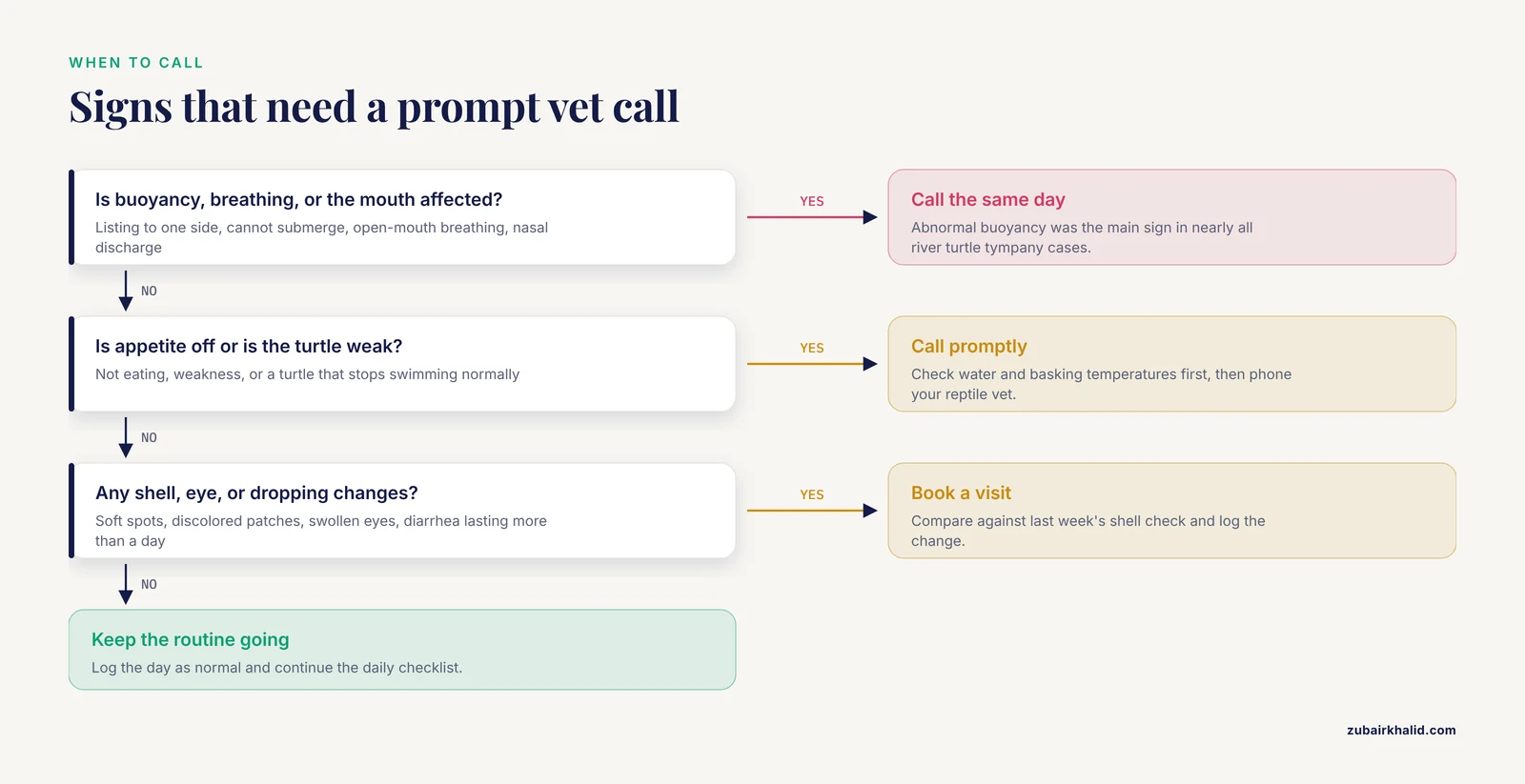
Contact a veterinarian promptly, the same day when possible, for any of the following:
- Not eating, or a marked drop in appetite
- Abnormal buoyancy, listing to one side, or inability to submerge
- Open-mouth breathing, an extended neck while breathing, or discharge from the nose or mouth
- Swollen or closed eyes, or rubbing at the eyes
- Soft spots, pits, white or discolored patches, or cracks in the shell
- Lethargy, weakness, or a turtle that stops swimming or walking normally
- Straining, diarrhea, or dropping changes lasting more than a day
- Any sign that appeared suddenly or is worsening quickly, since rapid progression is documented in chelonian disease [12]
Chelonians hide illness until it is advanced, and their anatomy limits what an owner can see from outside, which is why clinicians emphasize early professional assessment [11]. When choosing a veterinarian, look for chelonian experience. The Association of Reptilian and Amphibian Veterinarians maintains a directory of members, and it is reasonable to ask a clinic how many turtles it treats in a year. Book a wellness visit for any new turtle within the first weeks, then follow the schedule your veterinarian recommends.
Frequently Asked Questions
How much time does a turtle care routine take each day?
Plan on ten to fifteen minutes a day. Morning covers the health check, feeding, temperature verification, and spot cleaning, and an evening glance closes the loop. Weekly and monthly tasks add about an hour a week and one to two hours a month.
What should be on a turtle daily care checklist?
Five items. A visual health check before feeding, feeding on your written schedule, removing uneaten food, verifying water and basking temperatures and equipment, and a quick spot clean. Add a one-line log entry each evening.
How often should I clean my turtle's tank?
Spot clean daily, do a partial water change and rinse filter media weekly, and deep clean surfaces and decor monthly. The right water change volume depends on your tank, filter, and stocking, so set the details with your reptile veterinarian and adjust based on water test results.
How often should I handle my turtle?
Handle briefly and predictably, mainly for health checks, and keep out-of-water time to a few minutes. Turtles appear to acclimate to regular gentle handling while long sessions are stressful, so short and routine beats long and rare.
Do turtles need to eat every day?
It depends on species, age, and temperature, and there is no single schedule for all turtles. Set the frequency with your reptile veterinarian, write it down, and keep it consistent, because sudden changes in diet or routine cause problems.
How can I tell if my turtle is sick?
Watch for a drop in appetite, abnormal buoyancy, open-mouth breathing, nasal or eye discharge, swollen eyes, shell soft spots or discoloration, and lethargy. Behavior changes are often the first sign, which is why the daily visual check matters. Any of these signs warrants a call to a reptile veterinarian.
What supplies do I need for a turtle care routine?
Core supplies are an appropriately sized enclosure with secure screening, a water heater with a thermostat, thermometers for water and basking surface, full-spectrum lighting with UVB, a quality filter for aquatic setups, a water test kit, a net and separate cleaning tools, a scale, a log, and enrichment items you rotate weekly. Choose equipment rated for your tank size and species.
How often should a pet turtle see a veterinarian?
At least once a year for a wellness exam, and more often for a new animal, a sick animal, or a species your veterinarian wants to monitor closely. Ask your reptile veterinarian to set the schedule, and book the next visit before you leave the clinic.
Sources
- Assessing the Current Landscape of Reptile Pet Ownership in Hong Kong: A Foundation for Improved Animal Welfare and Future Research Directions.
- Turtle care and husbandry.
- Nutrition and husbandry conditions of Palearctic tortoises (Testudo spp.) in captivity.
- EXAMINING THE PREFERENCE FOR SHADE STRUCTURES IN FARMED GREEN SEA TURTLES (CHELONIA MYDAS) AND SHADE'S EFFECT ON GROWTH AND TEMPERATURES.
- Moving Toward Evidence-Based Care: Measuring Preferences in Zoo-Housed Aquatic Turtles Using 24-h Remote Monitoring.
- Quantification of sea turtle swimming patterns using a standardized arena to minimize effort in welfare assessment.
- Husbandry Protocols for Juvenile Loggerhead Sea Turtles (Caretta caretta) Based on Stress Response to Stocking Density and Dry-Dock Time.
- Assessment of captive rearing conditions on loggerhead hatchlings: Effect of handling frequency and stocking density.
- Can colored object enrichment reduce the escape behavior of captive freshwater turtles?
- Digital image processing: A new tool for morphological measurements of freshwater turtles under rehabilitation.
- Biology and medicine of turtles and tortoises.
- INTESTINAL TYMPANY AND VOLVULUS IN CENTRAL AMERICAN RIVER TURTLES (DERMATEMYS MAWII).
- ANALYSIS OF FATTY ACID PROFILES FOR EASTERN BOX (TERRAPENE CAROLINA CAROLINA) AND COMMON SNAPPING (CHELYDRA SERPENTINE) TURTLES IN WILD AND MANAGED CARE ENVIRONMENTS.
- EFFECTS OF "SWIM WITH THE TURTLES" TOURIST ATTRACTIONS ON GREEN SEA TURTLE (CHELONIA MYDAS) HEALTH IN BARBADOS, WEST INDIES.
- Personality in Zoo-Hatched Blanding's Turtles Affects Behavior and Survival After Reintroduction Into the Wild.
- Behavioral Assessment of Six Reptile Species during a Temporary Zoo Closure and Reopening.
- A Survey Study of Veterinary Student Opinions and Knowledge about Pet Reptiles and Their Welfare.