Tortoises Enrichment Ideas That Match Natural Behavior
By Dr. Zubair Khalid, DVM, MS, PhD ·
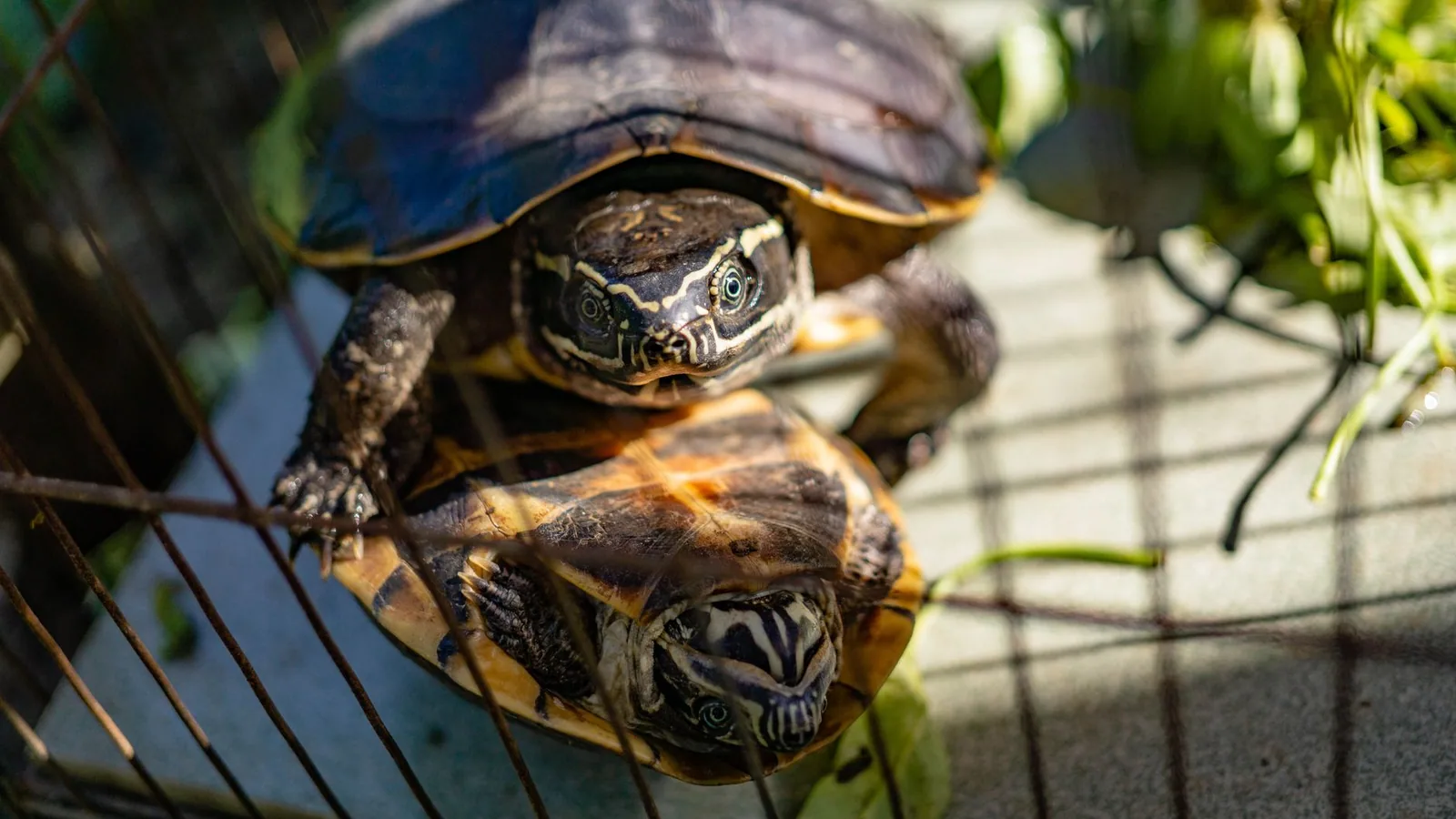
The most effective tortoise enrichment ideas are not toys in the dog or parrot sense. They are changes to the enclosure and daily routine that let a tortoise perform the behaviors its body evolved for: grazing for hours, walking long distances, digging, pushing through vegetation, climbing low obstacles, basking in a chosen warm spot, and retreating to a shelter it trusts. Veterinary researchers define environmental enrichment as a modification of an animal's living space that allows it to express highly motivated behaviors and experience positive states such as reward, choice, and control [1]. Applied to tortoises, that definition points you toward habitat design and food presentation rather than gimmicks.
This guide explains why enrichment matters, how to recognize the signs of a bored tortoise, which enrichment ideas match which natural behaviors, what makes a safe tortoise toy, and how to build DIY tortoise enrichment projects from inexpensive materials. It closes with clear criteria for when boredom-like behavior becomes a veterinary problem instead of a husbandry one.
This article is educational and is not a substitute for veterinary diagnosis or treatment.
At a Glance: Tortoise Enrichment Ideas You Can Set Up Today
Use this table to pick one or two changes that fit your tortoise's species, age, and enclosure, then add more over the following weeks.
| Natural behavior | Enrichment idea | Simple DIY version | Safety note |
|---|---|---|---|
| Grazing and foraging | Scatter feeding across a large area, planted grazing trays | Hide part of the ration in a pesticide-free leaf pile | Enrichment food must come out of the daily ration, not on top of it |
| Walking and exploring | Open floor space with varied terrain and rearranged routes | Rebuild a simple obstacle path from flat rocks and logs each month | Remove anything a limb or head could get trapped in |
| Digging and burrowing | A deep dig zone with compressible, species-safe substrate | A dig box with buried food or a cool hide at the bottom | Confirm substrate safety for your species with a reptile veterinarian |
| Basking and thermoregulation | More than one basking option plus shaded retreats | A stable stone ramp leading to the basking area | Guard all heat and lamp fixtures so the animal cannot touch them |
| Pushing and climbing | Low, stable, weighted obstacles | Terracotta pots on their sides and short untreated logs | Weight or anchor items so nothing tips onto the tortoise |
| Sensory investigation | New textures, safe scented plants, light and shade gradients | Fresh leaf litter or a clump of safe herbs added weekly | Add one change at a time and remove anything that causes hiding or appetite loss |
Why Enrichment Matters for Tortoises
Modern welfare science treats enrichment as more than entertainment. A 2025 review of enrichment for farmed ruminants organizes its benefits around rewarding experiences, choice and control, and the development of long-term competence and resilience [1]. A companion review in production animals describes how enrichment, especially during development, builds functional capacity across behavior, immunity, and metabolism, which the animal later expresses as resilience to challenges such as handling, social change, and infection [2].
Early experience shapes that capacity. Juvenile fish raised with early-life enrichment were less neophobic, showed higher serotonergic turnover, and upregulated genes related to neuronal development and stress coping after a challenge, changes the authors linked to enhanced cognitive function and positive emotional states [3]. Young tortoises growing up in a bare box miss the same developmental window that enriched young animals use to build behavioral flexibility.
Most of this evidence comes from farm and laboratory species, because those industries fund large controlled trials. The underlying principle transfers directly to reptile practice. A tortoise that can graze, walk, dig, climb, and thermoregulate on its own terms is expressing the motivated behaviors its nervous system expects. An animal denied those outlets tends to develop repetitive, restless patterns instead, and those patterns are the practical signal owners should learn to read.
Match Enrichment to Natural Tortoise Behavior
Tortoises are terrestrial reptiles built for slow, persistent travel. Reptile husbandry references, including the Merck Veterinary Manual's exotic animal resources and ReptiFiles' evidence-based care guides, frame tortoise keeping around supporting species-typical activity rather than static display. Across species, the behaviors that dominate a tortoise's active day are the same ones enrichment should target.
- Grazing and foraging. Most tortoise species spend long portions of their active day searching for and processing fibrous plant material, though a few, such as red-footed tortoises, include fruit and animal protein. Confirm your species' natural diet with a reptile veterinarian before designing food-based enrichment.
- Walking and patrolling. Wild tortoises travel while they forage, so floor space and route variety are enrichment in themselves.
- Digging and burrowing. Many species dig to escape heat, cold, or perceived danger, and some retreat underground for long seasonal rests.
- Thermoregulation. Tortoises manage body temperature by moving between sun, shade, and shelter throughout the day.
- Pushing and ramming. Some species push through dense vegetation, and males of many species ram rivals or objects with the front of the shell.
- Investigating. Tortoises explore with vision and smell, and they notice when a familiar space has been rearranged.
Enrichment works when it gives the animal a job. Bare decoration does nothing. Every idea below is built around that rule.
Signs of a Bored Tortoise
A bored tortoise rarely looks sleepy. Under-stimulation usually shows up as repetitive, restless, or food-obsessed behavior during the hours the animal should be active. Watch for these patterns.
- Pacing the same route along the enclosure walls, often for long stretches.
- Repeated climbing and pushing at the walls, especially at corners.
- Persistent digging at one spot with no goal, such as a corner or a door.
- Intense fixation on food, begging whenever a person approaches, beyond normal mealtime interest.
- Aimless wandering with no structure of grazing, basking, and resting.
- A flat, unresponsive reaction when something in the enclosure changes.
Repetitive behavior is a recognized stress signal in welfare research. In guppies kept at different enrichment levels, the only stereotypic behavior recorded appeared significantly more often in low-enrichment tanks, and water cortisol concentrations were significantly higher in those same tanks, while fish in highly enriched tanks expressed more natural behaviors [4]. Reviews of enrichment in dairy goats and sheep similarly report better activity patterns and fewer stereotypies in enriched animals, with responses varying by individual, enrichment type, and life stage [5].
In reptiles, several of these signs overlap with illness. Reduced activity, appetite change, or a tortoise that stops exploring can indicate husbandry failure or disease rather than boredom. Review temperature, lighting, diet, and hydration alongside behavior, and involve a reptile veterinarian when signs persist after the enclosure has been corrected.
Tortoise Enrichment Ideas by Behavior
The ideas below are grouped by the behavior they serve. Choose the ones that match your species' natural history and your enclosure's constraints.
Foraging and Grazing Enrichment
Food-based enrichment turns the day's largest time budget, feeding, into a task. Scatter feeding spreads the ration across a large area so the tortoise searches instead of eating from a pile. Grazing trays and planted patches let the animal crop living plants at its own pace. Whole, uncut foods with rinds or tough leaves require handling and processing before swallowing.
The principle is well supported outside herpetology. Hens given live black soldier fly larvae as foraging enrichment became faster at harvesting the larvae as a trial progressed and ate less from the standard feeder, with one of the two breeds studied showing higher live weight in the larvae-fed group [6]. Food presented as a task changes both behavior and intake patterns.
Two cautions apply. First, match the food to the species, because grazing Mediterranean species, tropical omnivores, and grassland grazers have very different dietary needs, and enrichment food must fit inside the diet plan your reptile veterinarian sets. Second, track the total amount eaten, because enrichment that delivers extra calories creates a weight problem that cancels its behavioral benefits.
Physical and Structural Enrichment
Structural enrichment gives a tortoise terrain to use. Gentle slopes, ramps, flat basking stones, cork bark half rounds, low platforms, and branches laid on the ground create routes, viewpoints, and mild physical challenges. Rearranging these items periodically renews the space without new purchases.
Trials in poultry show how much simple structure matters. Broilers provided with perches, balls, hanging bottles, and laser lights were more active and had fewer toe injuries and less footpad dermatitis than controls, with no loss of body weight [7]. In a separate trial, birds given low walls and perches had fewer foot calluses than birds in plainer housing, without any compromise in feed conversion or carcass yields [8]. A systematic review and meta-analysis of physical enrichment in indoor cattle found that calves and heifers with enrichment items had significantly improved growth rates and more locomotor play, although effects on measures such as feed intake and aggression varied between studies [9]. The consistent theme is that physical items give animals something to do with their bodies, and tortoises respond to the same opportunity with walking, climbing, and pushing.
Digging and Burrowing Enrichment
For species that dig, a deep, workable substrate zone is one of the highest-value enrichments available. A dig box filled with a safe soil and coconut fiber mix gives the behavior a real outlet. Burying food items or placing a cool hide at depth turns digging into a goal-directed task rather than an idle habit.
The function matters more than the material. Researchers added sand substrate to tanks of laboratory rare minnows and found no significant differences in growth, anxiety-like behavior, or brain monoamine levels compared with bare tanks, concluding that the substrate alone did not improve welfare for that species [10]. The lesson for tortoise keepers is direct. A shallow decorative layer of substrate is not enrichment. Digging enriches when the tortoise can actually dig somewhere, for a reason.
Sensory Enrichment
Tortoises investigate their world with vision, smell, and touch. Safe sensory additions include fresh leaf litter to sift through, clumps of edible herbs that release scent when crushed, varied textures underfoot such as stone, grass, and soil, and distinct light and shade gradients across the enclosure.
Sensory variety has measurable effects in other species. In quail, naturalistic enrichment elements such as dust bathing materials and varied lighting reduced stress and promoted natural behaviors [11]. Rain and misting sessions can add another sensory layer for species that experience them in nature, and suitability varies by species and health status, so confirm the approach with your reptile veterinarian first.
Introduce sensory changes one at a time. A calm initial response followed by investigation is the goal. Remove any item that causes retreat, prolonged hiding, or refusal to eat.
Choice and Control
Choice is enrichment in itself. Welfare frameworks list choice and control among the core outcomes good enrichment should deliver. An enclosure with several hides, more than one basking option, sun and shade available at different times of day, and both open and covered areas lets the tortoise manage its own temperature and security level.
Practical applications include a hide at each end of the temperature gradient, a shaded retreat, a shallow water dish large enough to soak in for species that soak, and visual barriers that let the tortoise break line of sight from household traffic. A tortoise that can always choose its exposure to light, heat, and people is working through decisions all day, and that decision-making is the enrichment.
Rotate Enrichment on a Schedule
Novelty keeps enrichment working. Pigs given a simple periodic enrichment, scented newsprint delivered three days a week, showed greater average daily gain in late life than pigs without it, evidence that scheduled novelty changes both behavior and physiology [12]. The type of material matters as well. Free-ranging pigs rotated through different bedding conditions, including dry leaves and straw, changed their excavation and exploration levels depending on what they were given [13].
For tortoises, a workable rotation keeps the core setup constant and varies the rest. The thermal gradient, primary hides, and water area stay put. One or two secondary items change each week, for example a new leaf litter pile, a rearranged obstacle, a fresh grazing tray, or a different safe scent. Introduce one new item at a time and watch the first response before adding more.
The Best Toys for Tortoises
The best toys for tortoises are objects that trigger a natural behavior, not objects that trigger play in the mammalian sense. A tortoise will not chase a ball, but it may push one, climb on one, or ram one, and the pushing and climbing are the point.
Good options include the following.
- Heavy, smooth balls sized well above mouth width, which some tortoises push and ram.
- Untreated hardwood logs and branches, which provide climbing, pushing, and rubbing surfaces.
- Cork bark half rounds, which serve as hides, ramps, and obstacles in one item.
- Terracotta pots laid on their sides or weighted flat, which create tunnels and barriers.
- Potted edible plants, which combine foraging, grazing, and the satisfaction of dismantling a target the tortoise is allowed to destroy.
- Foraging trays and dig boxes, which turn feeding and digging into tasks.
Apply these selection criteria to anything you place in the enclosure. The item must be too large to swallow and free of small detachable parts. It must be stable enough that it cannot tip or roll onto the animal. Materials must be untreated, unpainted, and free of glue, fragrance, and coating. It must be easy to clean or cheap enough to replace. Skip mirrors and reflective surfaces, because many reptiles respond to their own reflection as a rival and stay stressed in its presence.
DIY Tortoise Enrichment Projects
These DIY tortoise enrichment projects use inexpensive materials and take under an hour each. Build one at a time and observe your tortoise before adding the next.
1. Grazing Tray
Fill a shallow tray with drainage holes using pesticide-free soil, then plant edible weeds and grasses approved for your species, such as dandelion, as confirmed by your reptile veterinarian or a trusted herpetology resource. Place the tray in the enclosure and let the tortoise crop it. Keep two or three trays in rotation so one is always regrowing.
2. Forage Maze
Arrange flat rocks, cork bark, and weighted terracotta pots into a simple winding path with a portion of the day's food at the end. The tortoise walks, climbs, and problem-solves to reach it. Remove and rebuild the maze every week or two so the route stays novel.
3. Buried Reward Dig Box
Fill a deep box with a safe, compressible soil mix. Partially bury safe food items or a favored hide so the tortoise must excavate to reach them. For burrowing species, provide enough depth for a full-body dig. Spot-clean the box regularly and replace the mix when it becomes soiled or overly dry.
4. Push and Ram Course
Place a line of heavy, stable objects, such as smooth stones and short logs, across part of the floor. Some tortoises will push, climb, or ram their way through, which exercises natural shoving behavior. Weight or anchor every item so nothing can tip onto the animal.
5. Leaf Litter Forage Pile
Collect pesticide-free fallen leaves or purchase food-safe dried leaf litter. Pile the leaves in one zone and scatter a portion of the ration or safe dried herbs through the pile. The tortoise sifts, digs, and forages through it. Replace the pile when it becomes soiled.
DIY Safety Checklist
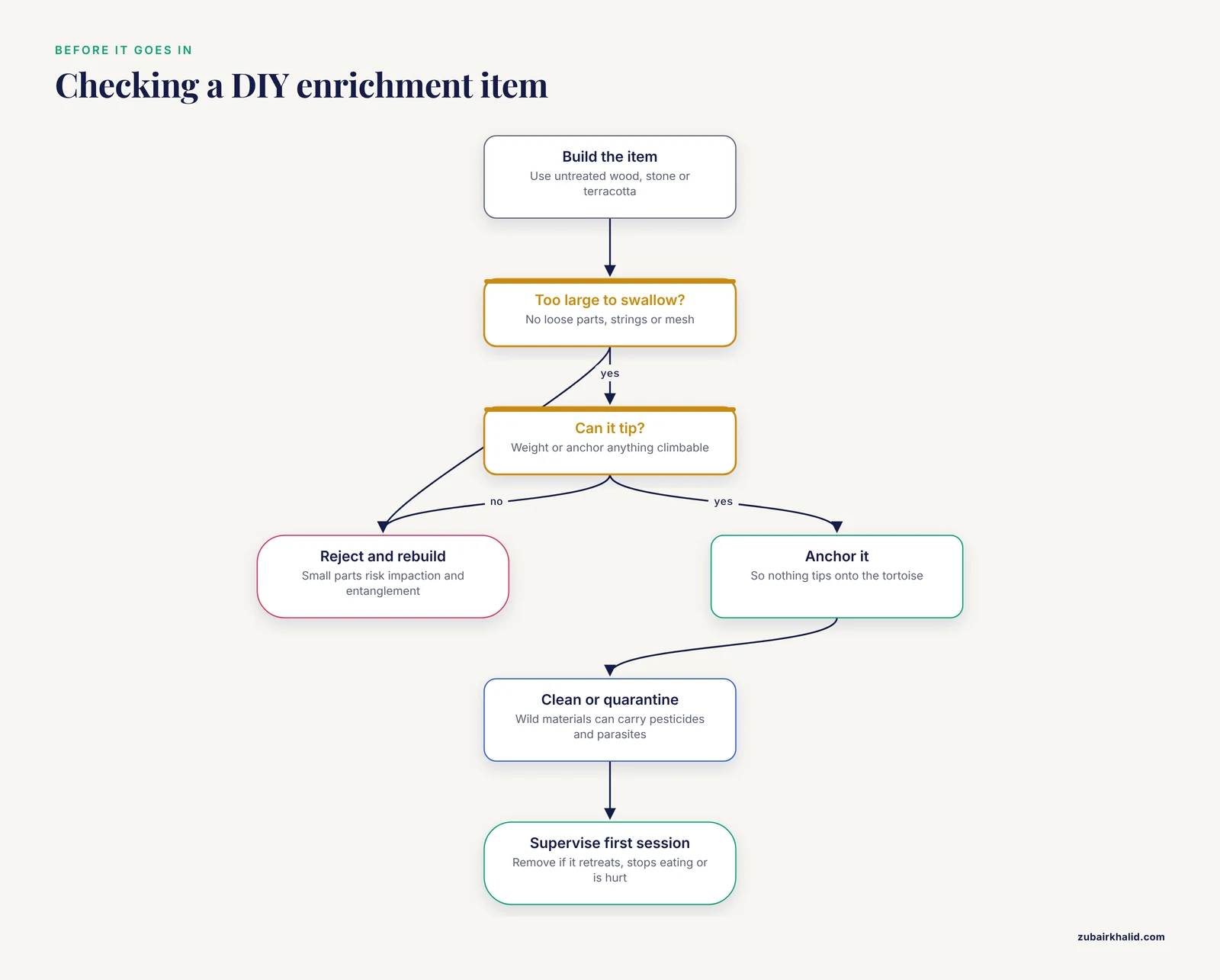
- Use untreated, unpainted wood, stone, and terracotta with no glue, varnish, or fragrance.
- Choose items too large to swallow, with no loose parts, strings, or mesh that can entangle a limb.
- Weight or anchor anything a tortoise could climb so it cannot tip.
- Clean or quarantine wild-collected materials, because soil, plants, and wood from outdoors can carry pesticides and parasites, and ask your reptile veterinarian how to handle items from your area.
- Supervise the first session with any new item and remove it if the tortoise retreats, stops eating, or injures itself.
How to Keep a Tortoise Entertained Week After Week
Consistency beats intensity. A short daily observation, a small weekly change, and a monthly rearrangement keep the environment stimulating without destabilizing it.
- Daily, spend five minutes watching your tortoise during its active period and note what it does with its time.
- Weekly, rotate one or two secondary items, such as a fresh grazing tray, a new leaf pile, or a rebuilt maze.
- Every two to four weeks, rearrange the non-essential decor to create new routes and viewpoints.
- Seasonally, add supervised outdoor time in a secure, escape-proof area when the weather suits the species, with shade, sunlight, and no pesticide exposure.
- Monthly, record weight and photograph the enclosure, so you can see whether enrichment changes correlate with activity and body condition.
Keep the core stable. The thermal gradient, primary hides, water source, and lighting stay in place, because tortoises rely on predictable landmarks for security and thermoregulation. Novelty belongs in the secondary layer of the environment, not the foundation.
Common Mistakes to Avoid
- Using food enrichment as extra food. Enrichment rations must come out of the daily total, not on top of it, or the tortoise gains weight.
- Treating substrate as decoration. A thin, shallow layer with no diggable depth gives the animal nothing to do.
- Co-housing for company. Tortoises are not social in the mammalian sense, and shared housing commonly produces competition, chasing, and bite wounds. Research in other species supports caution, because forced social enrichment raised stress levels in a trial with carp [14], and added territory structures did not ease social tension in a cichlid study, where enrichment effects on aggression were complex and sometimes contradictory [15]. Enrich the enclosure, not the census.
- Flooding the enclosure with novelty. Several new items at once can overwhelm a tortoise and trigger hiding or appetite loss.
- Buying gadgets instead of fixing husbandry. No toy compensates for a wrong thermal gradient, inadequate lighting, cramped space, or a poor diet.
- Leaving unsafe items in place. Strings, small parts, unstable stacks, and treated wood cause entrapment, impaction, and injury.
- Ignoring stress signals. Retreat, appetite loss, or repetitive pacing after a change means the change should be removed and reviewed.
Safety and Welfare Checklist
- Every enrichment item passes the swallow test, the tip test, and the clean test.
- Food-based enrichment fits inside the diet plan, and body weight is tracked.
- New items are introduced one at a time with supervision.
- The thermal gradient, hides, water, and lighting remain constant while secondary items rotate.
- Outdoor time is supervised, secure, partly shaded, and free of pesticides and predators.
- Behavior is logged, so repetitive patterns or appetite changes are caught early.
- Anything that causes fear, retreat, injury, or refusal to eat is removed the same day.
Limitations and When to Contact a Veterinarian
Individual tortoises vary widely by species, age, health status, and history, so any enrichment plan should be confirmed with a reptile veterinarian, ideally one found through the Association of Reptilian and Amphibian Veterinarians. Most enrichment research has been conducted in farm and laboratory species, so treat the findings here as principles to apply with close observation of your own animal.
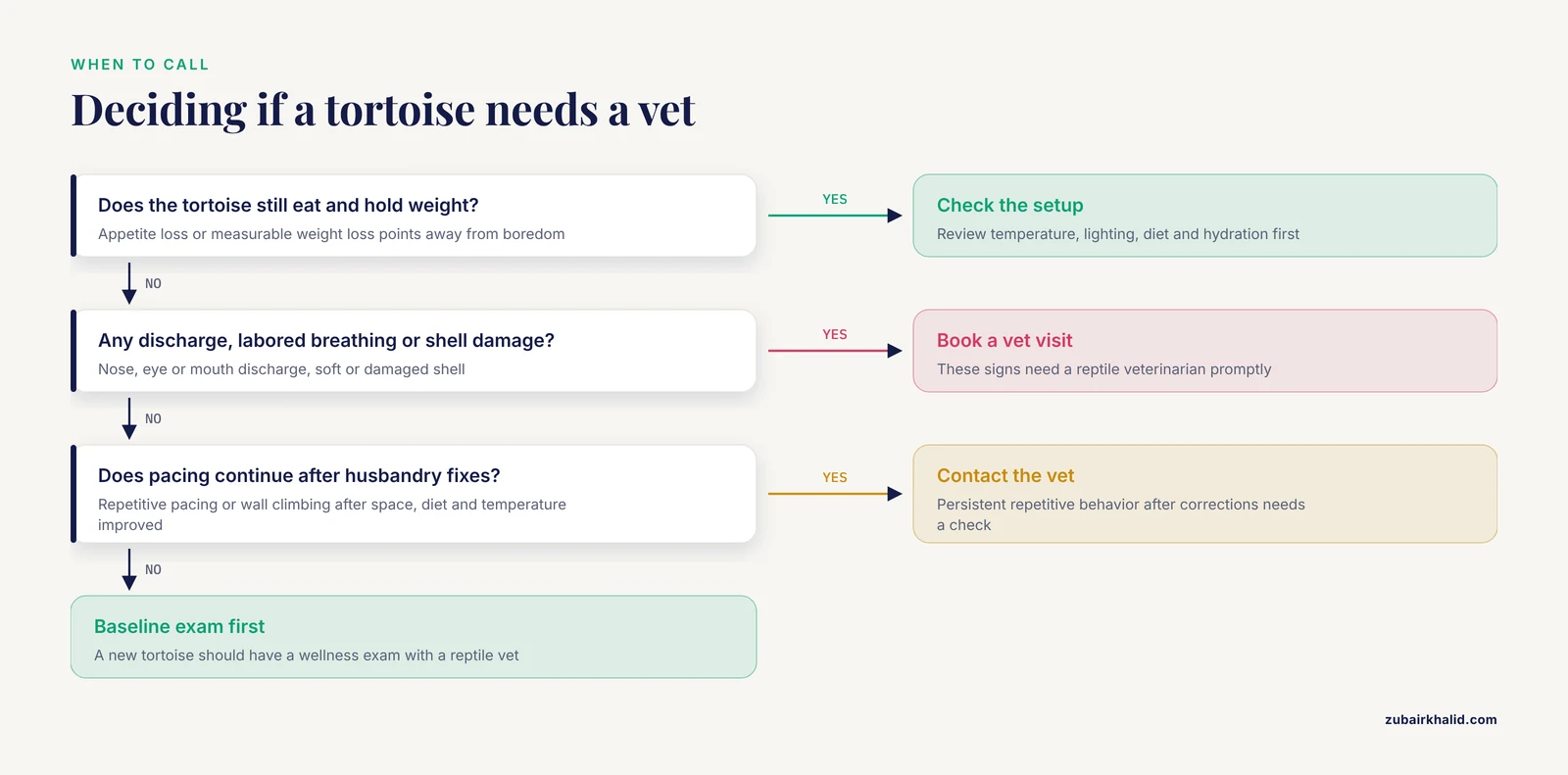
Contact a reptile veterinarian promptly if you see any of the following.
- Appetite loss beyond your tortoise's normal pattern, especially in a species that usually eats daily.
- Measurable weight loss, or a shell that becomes soft, discolored, or damaged.
- Lethargy, weakness, or a tortoise that stops using its basking area.
- Discharge from the nose, eyes, or mouth, or labored breathing.
- Straining to pass stool or urine, or no output alongside continued eating.
- Any suspicion that the tortoise swallowed substrate, wood, plastic, or another foreign object.
- An injury caused by an enrichment item.
- Repetitive pacing or wall climbing that continues after you have improved space, diet, temperature, and rotation.
A new tortoise should have a baseline wellness examination with a reptile veterinarian. That visit gives you species-specific diet, housing, and enrichment guidance and establishes normal values for your individual animal, which makes future behavior changes far easier to interpret.
Frequently Asked Questions
Do tortoises actually get bored?
Yes. Tortoises show boredom-like states when their environment gives them nothing to do. Repetitive pacing, corner digging, wall climbing, and constant restlessness during normal active hours are the usual signals that the enclosure lacks outlets for natural behavior.
What are the best toys for tortoises?
The best toys for tortoises are objects that trigger foraging, pushing, climbing, or digging. Heavy balls too large to swallow, untreated hardwood logs, cork bark, stable terracotta pots, potted edible plants, and dig boxes all work better than small colorful toys designed for mammals.
How often should I rotate tortoise enrichment?
Rotate one or two items each week while keeping the core setup stable. The thermal gradient, hides, and water area should stay in place, because constant change can stress a tortoise. Novelty works best in small, predictable doses.
Can I take my tortoise outside for enrichment?
Yes, when the weather suits the species. Supervised time in a secure, escape-proof outdoor area with sunlight, shade, and no pesticide exposure is one of the richest forms of enrichment available. Ask your reptile veterinarian about local predators and parasites before starting outdoor time.
Does a tortoise need a dig box?
Burrowing and digging species benefit greatly from a deep, purposeful dig zone, especially if the main enclosure floor is shallow. A dig box works when digging has a function, such as buried food or a cool retreat, rather than being bare decoration.
Should I get a second tortoise to keep mine company?
Most tortoises do better housed alone. They are not social animals in the mammalian sense, and shared housing often causes competition, chasing, and bite injuries. Enrich the environment instead of adding a companion.
How do I make DIY tortoise enrichment safe?
Use untreated, unpainted materials with no glue, fragrance, or small detachable parts. Every item should be too large to swallow, stable enough that it cannot tip onto the animal, and easy to clean. Supervise the first sessions with anything new and remove items that cause stress.
When is boredom actually a health problem?
Contact a reptile veterinarian when repetitive behavior continues after husbandry improvements, or when you see reduced appetite, weight loss, lethargy, discharge from the nose or eyes, shell damage, or straining to pass stool or urine. In reptiles, quietness and inactivity often signal illness rather than boredom.
Sources
- Environmental Enrichment for Farmed Ruminants Within a Positive Animal Welfare Framework.
- Review: Environmental enrichment builds functional capacity and improves resilience as an aspect of positive welfare in production animals.
- Early-life environmental enrichment promotes positive animal welfare for juvenile Atlantic salmon (Salmo salar) in aquaculture research
- Effect of different levels of environmental enrichment on the welfare of guppy (Poecilia reticulata)
- Environmental Enrichment in Dairy Small Ruminants: A PRISMA-Based Review on Welfare Implications and Future Research Directions
- Live black soldier fly larvae as environmental enrichment for native chickens: implications for bird performance, welfare, and excreta microbiota.
- Effects of different environmental enrichment tools to improve behavior, welfare, and growth performance of broiler chickens
- Environmental enrichment using low walls and perches improves broiler welfare, without compromising productivity
- A systematic review and meta-analysis of physical environmental enrichment to improve animal welfare-related outcomes in indoor cattle
- The presence of substrate as a means of environmental enrichment does not improve the welfare of the laboratory rare minnow (Gobiocypris rarus).
- Innovations in Quail Welfare: Integrating Environmental Enrichment, Nutrition and Genetic Advances for Improved Health and Productivity
- PSII-3 The effects of periodic environmental enrichment on the welfare and production of growing pigs
- Balancing welfare and habitat damage in pigs (Sus scrofa) under extensive farming: an ethological approach for determining the effects of group composition and environmental enrichment
- Effects of Environmental Enrichment on the Growth, Gonadal Development, and Welfare of the Chinese Hooksnout Carp (Opsariichthys bidens)
- The effect of environmental enrichment on social dominance and welfare in a cichlid fish